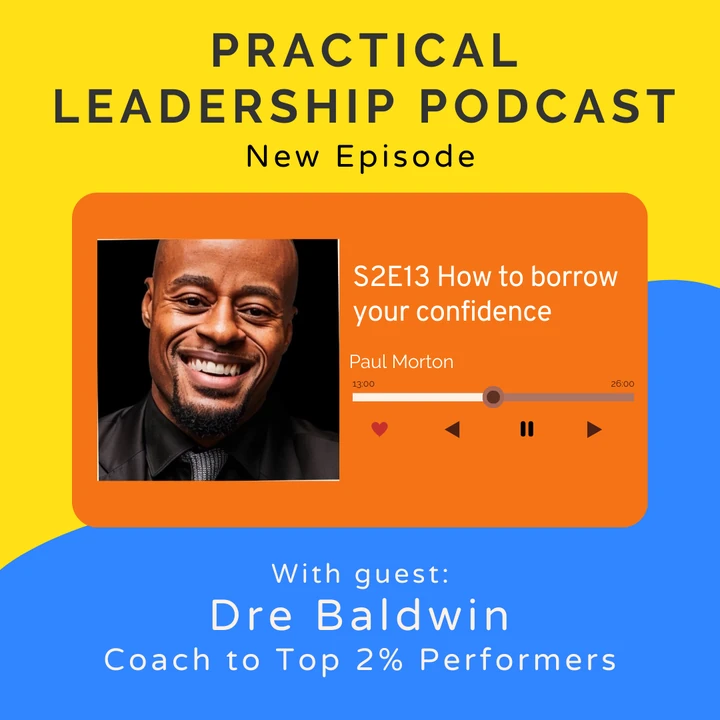
How to borrow your confidence
with Dre Baldwin
Show notes
I had the pleasure of interviewing Dre Baldwin, an athlete, author, speaker, entrepreneur, and CEO of WorkOnYourGame.
In this episode, Dre discusses his background as a walk-on basketball player and how he overcame setbacks and challenges to become a successful entrepreneur.
He shares his insights on developing mental toughness, building confidence, and the importance of discipline and personal initiative.
Dre also talks about the mindset and strategies he used to transition from the sports world to the business world.
– Mindset: Dre emphasizes the importance of having a clear vision and a strong reason for pursuing your goals. He explains that mindset is a key factor in achieving success and overcoming challenges.
– Structure and Discipline: Dre emphasizes that discipline is the foundation of success. He explains that having a structure in place and following it consistently helps build discipline and makes it easier to achieve desired outcomes.
– Borrowing Confidence: Dre discusses the power of mirror neurons and how watching someone confident can inspire and influence your own confidence. He suggests observing and learning from successful individuals in order to emulate their mindset and performance.
– Performance and Results: Dre emphasizes the significance of performance and results in any endeavor. He stresses the importance of setting clear goals, developing strategies, implementing systems, and ensuring accountability to consistently achieve desired outcomes.
Tune in to learn from Dre’s experiences and discover how to apply these principles to your own journey.
You can find Dre Baldwin on every social media platform, and for more comprehensive coaching and resources, visit his website.
You can get Dre’s free book, The Third Day 📕: http://ThirdDayBook.com
Work On Your Game University: http://www.WorkOnYourGameUniversity.com
And here’s a link to a FREE training to increase business without working harder: http://www.WorkOnYourGame.net
And Dre’s text number to get his FREE #MondayMotivation text 📲: 1.305.384.6894
Here are Dre’s social media links –
http://LinkedIn.com/in/DreAllDay
http://Facebook.com/WorkOnYourGame
http://Twitter.com/DreAllDay
http://Instagram.com/DreBaldwin
http://YouTube.com/Dreupt
http://DreAllDay.com
——————
If I can help with training or coaching your management team – get in touch: https://leadershipthatsells.com/
Transcript
Automated transcript. Speaker labels and spellings may contain errors.
Paul
Athlete, author, speaker, entrepreneur, CEO of Work on Your Game, expert in discipline, mental toughness, confidence, and personal initiative. [upbeat music] Hello and welcome to the Practical Leadership Podcast. I am your host, Paul Morton, and we are talking about leadership, management, and the various lives that surround it. It's my joy, delight, and privilege to bring into my studio some of the smartest, wisest people I've been able to find for your delectation and enjoyment, and I hope that you do get a lot out of the conversations that we have here. When you realize that your management team has grown too fast or you've inherited a new team and the fastest, best lever you have for growth and improvement is attached firmly to those managers, get in touch.
I help you run management coaching and training programs that'll make a big difference really quickly. You can find me at the Practical Leadership Academy website and on all the usual social channels. [upbeat music] Dre Baldwin, thank you very much indeed for joining me today.
Dre Baldwin
Paul, I'm excited to be here. Thank you for having me on.
Paul
Would you, for my audience over here who is probably not familiar with the whole bouncing of the ball sport, because we're more of the kicking of the ball sport.
Dre Baldwin
Right.
Paul
With... I don't know if you can see. If you're listening, you can't see me pointing at a US flag right behind me, but I'm married to an American. So for the Brits who might not be familiar with basketball, could you give us a little bit of a thumbnail sketch of it, the nine years of amazingness and all the background you've got?
Dre Baldwin
Sure. So my background's as a, as an athlete. You know, played basketball overseas nine years. I came from a Division III college, which is, uh, the third tier of college sports. Usually the pros come from the Division I level. I was at the Division III level. So for me to play pro was kinda not really in the cards, so I had to really hustle and market and sell myself in order to get an opportunity to play pro basketball, which is great 'cause it kinda set me up for my future life, what I was gonna be doing after basketball. So played pro ball for nine years. While I was doing that, started marketing, promote myself online actually. I got online on YouTube, and I was just making basketball training videos for ballplayers, not as a strategy to get into business. I was just doing it because it was available, and I had footage, and I saw the players were valuing and benefiting from the footage.
Then maybe a few years later, probably about five years into it, I did this for about 10 years, about five years into it, I realized that the players were willing to invest in things like training programs for basketball players, or they wanted to learn more about mindset. So I started doing those things, and when I started talking about the mindset pieces, Paul, what happened is people who didn't play basketball started finding me and letting me know that the stuff I was talking about, when it related to the mental game, applied off the court as well as on the court, and I was always looking for that transition piece that could take me from the sports world to the everybody else world, and that was it. That was the mindset piece. So that's what I started focusing on, and I was doing that before I even finished playing. So my transition from athlete to entrepreneur was a little bit smoother than most athletes because it wasn't do this 100%, then stop, and then start at zero.
I was already going, already had a good amount of momentum going for what is now my business before I even stopped playing basketball. So that's a, a long story short or short story of how we got here.
Paul
You've got to explain one thing as well. Getting from the Tier III into pro basketball. You did, you were a walk-on. What is that?
Dre Baldwin
Right.
Paul
And why was it, why is this unusual?
Dre Baldwin
Well, usually in, in college sports, at least here in the, in the USA, if you're gonna play at a higher level, usually you get recruited. You're sought out. People come looking for you. And because I had barely played in high school, nobody was come- no one was looking for me. So in order for me to play in college, I would have to walk on, and walking on simply means you literally just walk into the practice or the tryout or the training, and you hope, even though nobody knows you, you hope you can impress the people in charge enough with your ability that they're willing to let you be on the team. So that's what I was able to do, and I did this at, again, it was at a smaller school, at a Division III school, so it was actually good timing for me and a good, uh, situation that I went to a school that was smaller where I could get on the team, I knew, pretty easily, and I was able to build up some confidence in myself just from that experience, even though I was at a small school.
So that's how I got to play in college.
Paul
But that, that takes a degree of cojones. That takes some serious brass ones walking onto a... in front of s- as an audition, really. You're going in to audition yourself. I mean-
Dre Baldwin
Absolutely.
Paul
Yeah. Could... And then, so you managed to have this layer of the professional sporting career as you were developing this personal brand, and then later you have the, the, the sort of business that came out of that.
Dre Baldwin
Mm-hmm.
Paul
What were the biggest challenges you faced as you went through the transition from stopping sport, other than trying not to put on 300 pounds, right? But stopping sports to becoming an entrepreneur.
Dre Baldwin
Biggest challenges I faced were, the biggest one was just really figuring out how exactly does this, the, the business thing work because I had been doing some business. I'd been selling my own products and making ad revenue and, you know, started writing books. I'd been doing all that while I was still playing. But then when you have, you know, the whole day to run your business, of course you wanna add more pieces to it, and you want there to be some more, some structure, some, some, what do I wanna call it? Just make it more tangible, exactly what you're doing and how you're gonna do it. So for me, the first thing that I was gonna replace the basketball time with was I wanted to get into professional speaking. And I met someone who was already in the business, and they told me to, basically the fundamentals, the f- foundation of it, and then basically you gotta get on the phone.
You gotta start dialing and seeing if you can get someone to just give you an opportunity to get on the stage and speak. And that's really what I spent a lot of my first year out of basketball doing. I was still selling my... I had some books out at that point. I had my basketball training products, and I still had a significant basketball audience. So I was still selling those things, and I had some courses, things like that, that I was selling. Really just figuring out how to establish myself as this guy is a bona fide entrepreneur because I, I didn't wanna stay in the basketball space, which is what I, Paul, easily could have done. Could've just stayed in the basketball space and just focused on, instead of playing basketball now, just talk about training or coaching or just talking about the game as an analyst or something. But I knew I didn't wanna do that. I wanted to go into a world of business that had nothing to do with basketball, where I was just using basketball kinda as a, a feature of who I was, but I was not in the basketball industry.
Paul
It was an enabler for you. An enabler for you.
Dre Baldwin
Right. Exactly. Right.
Paul
So to, to make that step, a-and even the confidence to walk into the game, the confidence to say that I'm not gonna just be an ex-player, 'cause we have the pundits over here as well, you know. You have the, the ex-players are floating around the edges of whatever it is they're doing, what they used to be doing, whether the football matches or the tennis or whatever the sports are.
Dre Baldwin
Mm-hmm.
Paul
You stepped out, and that takes quite an element of mental toughness. Now, I know that's something you speak about and you talk about. So how did you or how would you recommend then, 'cause, uh, my, my goal from this podcast is to take the wisdom from people like you and try and shape it into something that people can go, "Oh, I can do that, that, and that." How would you recommend other people could develop that sort of mental toughness, that resilience that kept you, started you off and then kept you going?
Dre Baldwin
Well, the most important thing is you gotta be clear where you wanna go and why you wanna be there. That, that matters a ton. Uh, what is the outcome that we wanna achieve and why does it matter to you? Because when it comes to mental toughness, usually, usually you only need mental toughness when you're in a tough situation, right? 'Cause if the situation's not tough, you don't need to be mentally tough. You can be mentally weak and everything's working out. Uh, no need for any toughness. So you need to have a strong reason, and that reason is connected to emotion, and emotion overpowers logic. And when your logical reasons for doing things run out, then the emotion can take over and it can kinda power you through that challenging situation. So that's where that mental toughness comes from. Uh, tell me the rest of the question that you asked me.
Paul
Well, um, okay, you've got the mental toughness of which is the one that's puts you on the track in the first place.
Dre Baldwin
Mm-hmm.
Paul
Then to keep going. So it's that aspect of resilience, the discipline to keep going.
Dre Baldwin
Mm-hmm. Yeah, so the mental toughness is, is what's gonna push you through when a situation is challenging. When it comes to the resilience and the discipline to keep going, it's having the... There's a few things you wanna have, is clearly the decision that you actually want to achieve the outcome. That matters a lot. Then you put the structure in place because discipline is a result of structure. When you put the right structure in place, then discipline is actually a lot easier than it looks or a lot easier than it sounds.
Paul
Mm-hmm.
Dre Baldwin
And the main challenge a lot of people have with lacking discipline is that they have no structure. And when you have no structure, it's hard to remain disciplined because everything is kinda all over the place. There's no routine, there's no process, there's nothing for you to follow. And then you wanna logistically set things up so that the discipline and following the structure are actually easier for you. So for example, someone's trying to lose weight. Do you wanna get the, get the chocolate and the ice cream and the potato chips out of the house? Uh, that logistically sets you up to be more successful. And the structure is, "Okay, I'm gonna work out this day at this time with this trainer." All right, and you made the decision that I'm going to do this, and that is what allows you to push through when your trainer has you doing an extra set of push-ups that you don't wanna do.
Or you want the ice cream but you know you don't wanna eat it. So having that reason will push you through doing the stuff that the process and the logistics tell you to do.
Paul
I'm a great believer that willpower is a fantasy. I think-
Dre Baldwin
Right
Paul
... you have, you have some willpower, you have some desires and things to do. But if you make a decision, as you said there, I've decided to be, I have an intent to be a person, and people who are like that do the following things.
Dre Baldwin
Mm-hmm.
Paul
The following things require, as you said, a structure and a framework, a, a set of habits that you can shoehorn into your life that makes it as easy as possible for you to succeed.
Dre Baldwin
Right. Exactly. Exactly. And willpower, it, there is a place for willpower, but you can't base your whole business around willpower 'cause it eventually runs out.
Paul
Motivation. Yeah. I mean-
Dre Baldwin
Right
Paul
... motivation as well. You can be motivated one day and not motivated the next day, but you still have to get up. You still-
Dre Baldwin
That's right
Paul
... have to get on and do it.
Dre Baldwin
Right.
Paul
So that, that framework thing, that structure thing is good. If you had to pick it, the biggest... I know, I mean, I won't ask you as a question perhaps. You've moved from the basketball focus as a, as a, as a, as your history, as the way, the place where you learned all these, these skills and these, these mindsets.
Dre Baldwin
Mm-hmm.
Paul
You're now focusing more on business and general life really. I'm going to, I'm going to assume that the majority of now what you do is around business and life, and the minority perhaps is, is around the, the basketball side. Were there, what would you think the most important lessons from that career were that have translated to, from the court to the boardroom, for example?
Dre Baldwin
Well, the biggest thing for me personally is just understanding the concept of selling yourself, marketing yourself, and, uh, making sure that people know that you exist 'cause that's what I had to do to get my chance to play basketball. Now, going further, if I'm, let's say I'm talking to an audience of people, what are the things that I took from it, then the number one piece is the mindset, and this is kind of what we've been talking about already here, Paul. And, and the four pieces of our framework are discipline, confidence, mental toughness, and personal initiative, and we talked about a few of those already. So the most important aspect is the mindset because in any business, y- the two key factors are your performance and your results.
How do you perform and what results have been produced? Because that's the mandate for anyone in any space is you gotta produce a certain outcome. The challenge for a lot of people is they don't know what the outcome is, and they don't know what the outcome is supposed to be. Especially when I've worked with entrepreneurs, they haven't clarified these things. Now, when you work at a job or a company, they usually have it laid out for you. But when you are doing it yourself, you have to lay it out, and a lot of people neglect to do that 'cause they're not even aware. So that's the most important part, is understanding that we need to get performance and results. Mindset's the first piece. The second piece is the strategy, which is a plan of action. What are we gonna do? Who, what, when, where, why, and how? Who's responsible for what? How are we gonna do it? When we're doing it, where we're doing it, and why we're doing it. Third piece is the system. How do we make sure the strategy gets executed on consistently so it can be predictable, consistently consistent, and duplicatable?
And then the last piece is the accountability. How do you make sure that everyone and everything is and are doing their jobs as expected so that we're getting the expected outcomes on a consistent basis? So mindset, strategy, systems, and accountability.
Paul
I'm sorry, you just said that far too quickly. I think we-- there, there's at least a book there. Now, you wouldn't happen to have written a book on this, would you?
Dre Baldwin
One or two.
Paul
One or two.
Dre Baldwin
Yeah.
Paul
You wrote Forty-Four I saw somewhere. Is that right?
Dre Baldwin
Close enough, yeah.
Paul
Close e- [chuckles] close enough.
Dre Baldwin
Yeah.
Paul
Give or take five. Okay.
Dre Baldwin
[chuckles]
Paul
I'll, that's forty-five. I'll, that'll do. So discipline, mental toughness.
Dre Baldwin
Mm-hmm.
Paul
Confidence, personal and social. You're a confident guy. What would you say to somebody who isn't? Quite simply doesn't feel they have it.
Dre Baldwin
Well, everybody wants it. I mean, that's something that I've always known, even going back to the sport day. Everybody wants to be confident. And the reason why I'm, I'm qualified to talk about confidence, Paul, 'cause I wasn't always confident. I know what it feels like to not have it, and I had to build it up. So I've seen every level of the, the spectrum. So first thing is we gotta get clear on what confidence is. And for that we just go to the dictionary, and confidence is defined as your belief in your ability to do something. So where do you get the belief in your ability to do a thing is usually from actually doing it, which is why in the sports world we practice, and why in the professional world you prepare ahead of time
for the things that you're gonna do. So discipline creates confidence. So structure creates discipline, discipline creates confidence. So in that order. So that's the num- that's why discipline is the number one thing that we do here. It's the first piece of everything we do. When people ask me, "Dre, what's the most important asset, uh, for you personally or for another person who wants to achieve?" And the answer is always the same, it's discipline. Then when you are disciplined, then you afford yourself the right to be confident. So confidence is your belief in your ability to do something. Now someone may say, "Well, okay, Dre, I can practice, but I've never been on a stage. I've never been in a game. I've never been in a, on a sales call. Now how do I get the confidence to do that?
I can prepare, but I haven't actually done it." So what I tell people is you can borrow your confidence. Uh, just picture someone who is a great salesperson, who is a great speaker, or is a great athlete, and imagine the type of mindset that they would be in before they did that same thing. And, and science, science tells us that we have these things in us called mirror neurons. And a mirror neuron is, for example, I heard this guy named James Altucher. Don't know if anyone's familiar with him.
Paul
Mm-hmm. Yeah. Yeah.
Dre Baldwin
He, he, he talked about how before he goes, uh, on a date or before he goes on some social activity, he will watch a video of a comedian on stage doing standup. And the reason he did that is 'cause the comedian is very relaxed, he's affable, he's personable, making people laugh. And the mirror neurons in James watching the video will make him be more affable, personable, and relaxed when he went out and actually met with his friends at the bar or when he went on that date. So that's what mirror neurons do. So it's like if you watch another person do something, you get a little bit of ability to do it yourself just 'cause you saw them do it. So my son, for example, he's 17 months old, he hasn't been around a ton of other kids, but when I'm outside with him and he sees another kid, another kid does something, my son goes and tries to do the same thing just 'cause he saw, just saw him do it.
And that's how human beings are as well. When we see someone else do something, a little bit of that ability rubs off on us, us. Even if we're not as good as them, a little bit of that ability, or at least thinking that we can do it, rubs off on us just by watching them do it. So that's what I mean when I say borrow your confidence. So if you're a basketball player, how would LeBron James come onto the court? What kind of mindset would he be in? You can try to borrow and put yourself in the same frame of mind. You can't play like him, but you can put yourself in that frame of mind, and that will unlock your skills. Not, again, not gonna make you him, but it can unlock your skills, and you can do that in any space. And then after you go do that one time, now you can use yourself as a frame of reference. So now you're not, this is not faking it till you make it, this is actually becoming it.
Because when you're doing something like selling, now you can't fake closing a sale. Now you can't fake putting a ball in a basket on a basketball court. You either did it or you didn't do it. So this is not faking it till you make it. It's actually becoming it. 'Cause the process for achieving anything in life is being, then doing, then having. So you must step into the mindset first, then you do the thing, and then you get the outcome. And this is another thing is why, to wrap up this answer, that if someone's trying to become successful in life, however you define success, one of the worst things that can happen is you go and win the lottery, right? You win $10 million or a billion dollars in the lottery. It doesn't actually make you successful because you skipped to the having, but you never became the right type of person. And this is how someone can make a lot of money or get a lot of money from winning the lottery, but they end up going back to the same financial state they were in before five, 10 years later because they never changed as a person.
Fundamentally, they didn't change. Only thing that changed was their outcome. They didn't do anything. They didn't change who they were being. Only thing that changed was the having. And when you do things out of order, uh, you usually end up right back in the same spot.
Paul
I'm assuming that your next work will be that of social philosophy.
Dre Baldwin
[chuckles] Yeah.
Paul
Or psychiatry, Dre.
Dre Baldwin
Yes. Right.
Paul
Because I think when you're hit, you're hitting something fairly profound there. The idea of borrowing your confidence, I think is possibly rooted in the success of humanity, is it not?
Dre Baldwin
That's right.
Paul
I mean, unless we follow and copy what other people have done, how do we build on it? Yes, I might be able to watch you on the court and aspire to be, have those, those abilities. Maybe somebody else could watch that, learn from you, take that confidence, and then eventually exceed what you've done. So you've built upon, and as a species we then grow rather than, rather than just as, as an individual.
Dre Baldwin
Yeah.
Paul
This is, hmm, that's a fairly profound d-discovery there. And I do like the, the, the order of operations. You have to, you can't just have.
Dre Baldwin
Right.
Paul
You have to be. You, you have to have that aspiration. You have to have that, that, that, uh, that growth. Despite all of our best intentions and despite borrowing others' confidence, we still sometimes get kicked in the face. To quote that other great social philosopher, Mr. Tyson, "Everybody has a plan until they get punched in the face."
Dre Baldwin
Right.
Paul
Can you talk about something perhaps where you had a setback or a challenge that you've had to overcome? How you'd put your mind to that?
Dre Baldwin
Sure. So that was the kinda the really the genesis of how I started to get known online by the athletes b- was because they found out, out about my story. That I only played one year of high school ball, and, excuse me, I walked on to play college ball. So a lot of players identify with that because, you know, a lot of players, not everybody makes the basketball team. Not everyone gets, uh, gets recruited or gets a scholarship to play college ball out of school. So when they heard about that story, what really intrigued them was this guy faced the same setbacks that I'm facing, but he kept going, or he kept trying. He didn't make the team and tried out again anyway, or he wasn't invited to come play in college, but he showed up anyway and was able to play his way into that. And then in the pros it was the same thing. I was not invited.
Nobody was calling me to come play pro. I went and made the calls and reached out to them and made them understand that I was, that I existed, that there was something there that they should know about. So having done that is really what got a lot of people's, uh, attention on me from the beginning. So all three of those situations, and that's the reason why I talked so much about mindset, and this is back when I was talking to basketball players. I would talk about mindset. It would kinda just seep into the things that I was saying even when I wasn't trying to talk about mindset. It would just come up because I had to tell these people, "Here's why I did this. Here's how I did this. Here's my thinking when I was doing these things." And that's what led to people saying, "Hey, can you talk more about mindset? 'Cause the way you're describing it, no one's ever broken it down or explained it that way." So that's where it started, and then, again, as I started talking about that, people who didn't play sports said, "Well, hey, we need it, too."
So that's where it really came from for me, and because I had those things in me, uh, Paul, and this is before I even knew it was a thing, once I started talking about it, then I started to put some, put some, put something real around it. I made it into a tangible thing, and that's where Work On Your Game came from. Mindset, discipline, confidence, mental toughness, and personal initiative. So because I had, I've had those things for so long, I do face setbacks. I do face challenges. I mean, our first year when I was trying to establish myself as, all right, this guy is an entrepreneur, I made a lot more calls than I got answers, right? And I made a lot more pitches than I got acceptances. And even the ones I was getting accepted, they weren't offering to pay me 'cause I hadn't proven anything yet. I was nobody. So a bunch of free speaking gigs my first year or two, you know, getting into the game. But because I was already mentally conditioned, and that's what we call it is mental conditioning, 'cause I was mentally conditioned to deal with that, that I know not everybody you call is gonna answer, not everybody you speak to is gonna say yes, and not
everyone you leave a message is gonna call you back. I knew that was gonna happen. It didn't bother me as much as it would maybe somebody else. It's ... And conditioning is not about things happening or not happening. It's about how quickly you get over it when something does happen, and that's the hang up one call, make the next call. All right, do you need five minutes? You need five hours? You need five days? Or you need five seconds? That's what conditioning is about.
Paul
That's an athletic thing as well. You know? It's your recovery rate, how hard, how fast does your heart-
Dre Baldwin
Exactly
Paul
... get back to normal again.
Dre Baldwin
That's right.
Paul
That's a very interesting one. 17-month-old son. What about work/life balance? How do you, how do you sort that out?
Dre Baldwin
Hmm. Well, I mean, well, the first thing, we gotta be honest, that, uh, Mommy's doing a lot more work than I am.
Paul
[laughs] Yeah.
Dre Baldwin
She's ... With the breastfeeding and the nursing, I mean, the baby needs Mommy more than he needs Daddy, at least at this point.
Paul
Sure.
Dre Baldwin
So it's not as much of a shift for me, but it's, uh-
Paul
Just wait
Dre Baldwin
... yeah, not yet. Yeah.
Paul
[laughs]
Dre Baldwin
He's not, uh, yeah, he's not, he's not old enough yet that I can kinda take him for the whole day and we don't need Mommy's involvement, right? He still needs Mommy's involvement. So for me, the biggest, the biggest thing is just making sure that I'm showing him the right things, demonstrating the right things, and I know that he's, he's watching me. He's noticing things. He's starting to copy words. Uh, yesterday, uh, two days ago, no, yesterday, I was reaching for a package. He, I had him in the stroller. I was reaching for a package that was down on the, like, the ground floor, and my phone slipped out of my pocket and fell on the ground. And I said a, a swear word, and he immediately repeated it. And so-
Paul
Of course he did.
Dre Baldwin
[laughs]
Paul
Of course he did.
Dre Baldwin
Yeah. And I laughed, and then he kept saying it 'cause he, uh, he was getting a positive response from saying it, so it was just funny. And so now he says it, and then today I dropped something and I didn't say the swear word, and he immediately said that word anyway 'cause now he associated something falls on the ground, that's what you say. [laughs] So-
Paul
Yeah
Dre Baldwin
... yeah, so-
Paul
So what's your son's first word? No, anyway. It's not a nice day today. Let's move on.
Dre Baldwin
[laughs]
Paul
Change the subject. [laughs]
Dre Baldwin
No, it wasn't his first word, but it was-
Paul
It's so hard. [laughs]
Dre Baldwin
Yeah.
Paul
Oh, yes. Okay. So you're standing there, your mother in the past, though, she says, "Oh, how are you doing?" "Son of a bitch." What? [laughs]
Dre Baldwin
[laughs] Right.
Paul
Oh, love it. What are you working on right now, Dre?
Dre Baldwin
Working on right now is the Work On Your Game University. That is where we do all of our coaching, consulting, speaking, courses. Everything is housed under the umbrella of the university. So that's the biggest thing that we are focused on right now is just that. And I tried to ... For years, I created a whole bunch of different things. I had a thousand different products out there that I was marketing and promoting. We still got all the products, but the focus is on the university. That's our main focus.
Paul
And where can people find you when they need you?
Dre Baldwin
Well, you can find me on all the social medias. I'm on every single one of them, so whichever one you like the most, LinkedIn, Instagram, TikTok, Twitter, YouTube. I'm on every one. My profiles are all public, so I'm very easy to find. And as far as off social media, just go to workonyourgameuniversity.com.
Paul
Dre Baldwin, it's been an outstanding pleasure to talk to you today, so thank you so much for sharing. And, uh, I look forward to phase two when we hear how successful the university has been, and all the lives you're gonna change from that.
Dre Baldwin
Oh, absolutely. Well, I appreciate you sharing your platform. Thank you for the opportunity, Paul. [upbeat music]
Paul
And that's a wrap. I hope you enjoyed the show. Thank you for joining me. If there's ever anything I can do to help you on your journey, then do please reach out. You can find me on LinkedIn and all the usual sources. Do please subscribe, leave me your five-star review, and most importantly, get in touch with your comments and feedback. It's really how I grow, and that's what I'm doing this for. Thanks again. [upbeat music]