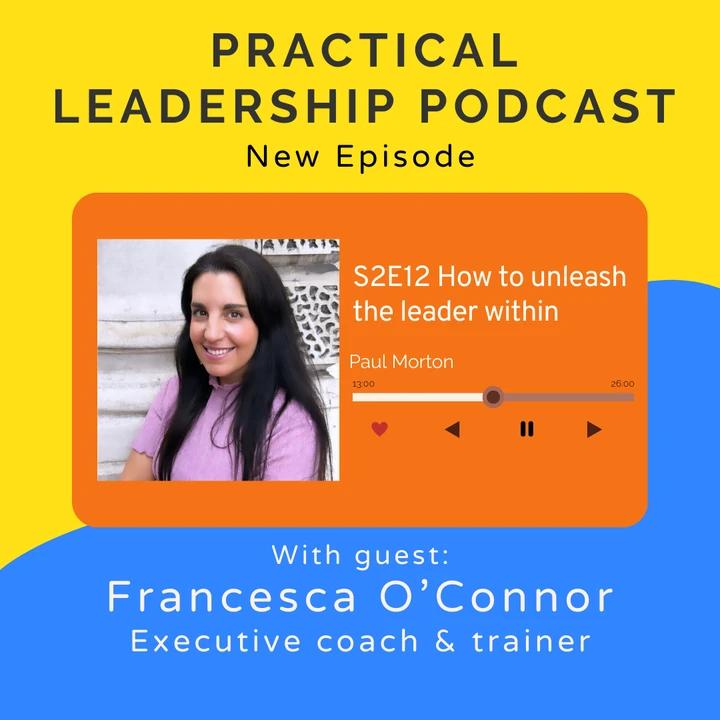
How to unleash the leader within
with Francesca O’Connor
Show notes
Unleashing the Leader Within: A Conversation with Fran O’Connor
In this episode, I interview Fran O’Connor, a leadership coach, team trainer, and much more.
Fran shares her journey from PR to coaching, the challenges and triumphs she encountered, and the lessons she learned both in her professional and personal life.
She shares her insights on leadership, providing feedback, and maintaining a high-performing team.
Fran also talks about her current business, where she uses her expertise and experiences to uplift senior men’s and women’s careers and help them raise their professional profiles.
Francesca is an executive coach and founder of Litmus, a comms company which focuses on helping people communicate in a way that’s anything but neutral. Litmus unpicks what’s holding you back, then works with you to develop the confidence and skills to communicate with precision, substance, and energy. Part coaching, part training, it takes a practical approach developed over years of helping leaders, celebrities, and global teams back themselves and get noticed.
You can find her here:
https://www.linkedin.com/in/francesca-o%E2%80%99connor-27631810/
https://litmuscomms.co.uk/
—-
If I can help with training & coaching your management team – get in touch:
https://leadershipthatsells.com/
Transcript
Automated transcript. Speaker labels and spellings may contain errors.
Paul
[upbeat music] Hello, and welcome to the Practical Leadership Podcast. I am your host, Paul Morton, and we are talking about leadership, management, and the various lives that surround it. It's my joy, delight, and privilege to bring into my studio some of the smartest, wisest people I've been able to find for your delectation and enjoyment, and I hope that you do get a lot out of the conversations that we have here. When you realize that your management team has grown too fast or you've inherited a new team, and the fastest, best lever you have for growth and improvement is attached firmly to those managers, get in touch. I help you run management coaching and training programs that'll make a big difference really quickly.
You can find me at the Practical Leadership Academy website and on all the usual social channels. [upbeat music] Fran O'Connor, thank you very much indeed for joining me. You are a leadership coach, team trainer, and so much more. Tell us all about it.
Francesca O’Connor
Yes. So, hello. Thank you for having me. Yeah, I'm a leadership coach. I'm a profile coach, which is essentially helping senior women find and get the visibility and influence that they deserve through coaching and a bit of personal PR. I, I come from a PR background, so I worked in PR for about 20 years, so I kind of have that sweet spot of helping people overcome the challenges, get out there, and then actually sort of give some tangible results, support them with some tangible results for that. So it's, it's quite a nice coming together of all my experience. And I also am a partner at a company called The Brick Coach, which is all about, um, basically creating really healthy, high-performing teams.
And we use techniques such as LEGO Serious Play. It's really the Mar Gambuni, and it is excellent fun.
Paul
That's super cool.
Francesca O’Connor
But yeah, I'm, I'm also a mother of two, to, to, uh, Barney and Lily Rose, who are three and five. Wonderful and wild in equal measure, in the thick of it, but absolutely loving it.
Paul
Do you know, I think I, I, I, I think maybe, I don't know, 70% of the practical things that I've learned about leadership and then coaching and getting people to do things has come from the kids. It's totally come from the kids. Um-
Francesca O’Connor
Yeah
Paul
... watching them learn. I mean, my background's HR, D&HR and stuff like that. And we're watching them learn in, in real time and trying to get them to do stuff or get to understand things or working with them. Wow, what a journey.
Francesca O’Connor
Yeah. Fascinating. It's such a learning ... Um, things that you think are gonna ... You know, you really have to ... I, I've really learned to do a lot of that when they're, when they slip out about something, having to, you know, it ... Your, your instinct is just to be like, "Will you shut up?" But actually, you just have to sort of go, "Yeah, I understand. I feel like that sometimes," and, "God, that makes me angry, too." And as soon as you start, it, like, diffuses it completely when you start-
Paul
Yeah
Francesca O’Connor
... acknowledging how they're feeling. What a learning curve.
Paul
I mean, so the, the pacing and leading thing, right? So you wanna get somebody to do something. I mean, so it's a psychology, and it's the psychology of children, but it's the psychology of anybody. If you, you want somebody to do something, you, you, you equate your s- stage and whatever that thing is with them. "Oh, yes. That ..." Exactly. That is a challenge. That's, whatever it is, the, my favorite thing. And then you get permission from them almost in terms of motivation.
Francesca O’Connor
Yeah. Exactly. What a great analogy. Never thought of it before like that.
Paul
Oh, yeah.
Francesca O’Connor
[laughs]
Paul
So you, you've been a- you've been around the block. Well, obviously talking to you. But, uh, been around the block. Tell me, how and when did you first take on the mantle of being a people manager?
Francesca O’Connor
So I'd worked in PR, as I mentioned before, for almost 20 years, and I'd worked at big global agencies and, um, smaller startups in leaderp- leadership positions in both. I ... About two years ago, the honest truth is I completely burnt out.
Paul
Wow.
Francesca O’Connor
I folded up like an old laptop one day and just was like, "I can't do it anymore." [laughs] I, I ... There, there'd been a lot of circumstances. I was partner at a company. I had my kids were one and three. We were moving house. COVID had just happened. It, it was an absolute, you know ... It, it, it was obvious. It ... I, I didn't feel bad about it because it was ... There was so ... It, it felt s- it made so much sense that it happened, if that makes sense.
Paul
Perfect storm. The perfect storm.
Francesca O’Connor
So I was gonna use a more sweary version of that, but it was a perfect storm. And, um, and at that point, I, I was very, very fortunate enough to be, for the first time ever in my life, in a position to make a decision about what I wanted to do next. And I, I had a great, a great career in PR. It's so versatile. It's so clever. I love doing the brand stuff. But if I was completely honest with myself, I, the thing that I loved the most was the people. It was managing the teams, getting people, um, you know, helping people get their promotions, managing a challenging client, influencing a client. I was always quite g- I was quite good at the sort of salesy pitching side of things 'cause I would listen well and understand what they wanted.
Um, and likewise with the team, I was always very good at kind of making space for people and giving the right amount of guidance to, to really grow. So I, I took a little bit of time off. I'm, I'm historically quite terrible at not charging at everything in front of me. So, but I did allow myself some time. [laughs] And yeah, took, took a few months off and then retrained to be an executive coach, which I loved.
Paul
Right.
Francesca O’Connor
And then, um, actually quickly found myself- In another kind of L&D role where... So I was doing facilitating and training and coaching women and people. So I, I, I probably lent towards women more, um, but it's kind of helping them find their voice and use their voice with more impact within the in- industry, and also, um, team chemistry. Uh, so developed a whole load more skills doing that alongside doing my day-to-day coaching, and now, um, I am starting to really have... Go full speed ahead with my own business in those areas, um, uh, without any distractions.
Paul
Good for you. Bravo. Well done.
Francesca O’Connor
Thanks.
Paul
Survivors... Well, survivors make interesting people.
Francesca O’Connor
Lovely. Love that.
Paul
Oh. Uh, I mean, honestly, I think the, the, the female approach thing is, I think 80% of the people that I work with are male. Could be because I'm a bloke. Who knows? Who knows? I mean, you wanna, you wanna, you wanna empathize with some things and, yeah, been there, done that. Um-
Francesca O’Connor
Exactly
Paul
... the, the women I work with are probably, I don't know, if you're listening to that, both of you, hi. Um, they're all a type, and I think it's just a thing. So, yeah, so I think... What do you mean? What, I mean, through this whole burnout challenge, re-orienting yourself into the new world, if you had to... If you come across, when you've come across people and, uh, that you're working with who are going through the same thing, what are you gonna advise them? What's the, what's the advice you would give to somebody in that situation?
Francesca O’Connor
I suppose it really depends on what it is that's, that's burning them out. So, you know, you could get burnt out from a toxic relationship work because it's extremely draining. Um, you could be getting burnt out because you're juggling a family. You could be getting burnt out because you don't love what you do, and so it's just making you a lot more tired and just hating, you know, you don't enjoy it, and that becomes extremely draining. So there's lots of different reasons people could burn out. Um, I think, you know, if you break it down, ultimately the first thing to think about is, what's my exit strategy? [laughs]
Paul
Yeah.
Francesca O’Connor
So if there are things... I, I'm a really big believer that knowing when to walk away from something, if you can, is a really, really great skill, but I don't take it for granted that not everyone is a position that they can walk away from something. So ultimately, if it's toxic relationship at work, or it's, um, you know, there's... They're not the right flexibility, or the culture isn't working for you as a new parent, you've gotta try and find ways to repair it first if you can't, uh, walk away from it. So it is giving feedback to senior leads to create psychologically safe spaces for you to talk about things. It's literally looking at the policy, what influence you might have in that company to change the policy and the culture.
You know, who can you speak to to get them to lead by example a little, a little bit more if it is about new moms? Or, you know, how can you get p- people to be more vocal about their struggles that everyone's experiencing, just so people simply understand it a bit more? You know, a- and then I think if you're hitting walls everywhere on how you could literally improve the structural or policy change within your company or have honest conversations with people that you have a bad relationship with, um, then that's when you need to start thinking about what your exit strategy could be, and that can just be baby steps. So it might be you're in a position that you can just walk away, and if you can, do it as soon as you can. You know, uh, get out because you need... There is nothing in this world more important than your health and your mind, and the longer you let these things go on, the more it is gonna eat away at you.
And then the longer it will kind of affect you after it as well, um, the longer it'll take to recover or get over it. So if you can, really do be brave. If you can't, it's about baby steps. So it's, you know, start zhuzhing up your LinkedIn. Start writing. Like, write a list of, "This is what I love. This is what my skills are. This is, um, how I could make money from it. These are the kind of companies." So literally just every day do little incremental gains towards working on your exit strategy, and that can immediately give you such a sense of relief because you know you're working on it. Um, so I think it's the, if you can, just understand, listen to your body, listen to your mind, and walk... You know, get out. And if you can't, take those baby steps. Let's do something every day towards how you change the situation for yourself.
And if it is a bad dynamic at work or it is a person or a culture, then think of little ways that can improve it. Is it... Do, do, do people need to be understanding how to give feedback better? Do people need to be listening better? Like, what training could people be having to, to diffuse that situation? So there's a... There's, there's, there's various different steps, but, um, that would be my advice. If you can, go, be brave, listen to your mind. If not, take those little baby steps for your own sanity to- towards it.
Paul
Well, and we spend so much time at work, and every... And then, and the, the corollary to the fact that every act of kindness leaves this beautiful ripple of energy that just circulates around the universe is that every time you come home grumpy from work, what's the story? The office boy kicked the cat, right? So it just cascades all the way down. You know, your boss has a bad day, somebody has a bad day, you have a bad day. You go home, guess who's gonna have a bad day, right?
Francesca O’Connor
Right.
Paul
Your family's gonna have a bad day. Your cat's gonna get a boot up the backside. You know, there's, uh... I'm not advocating animal cruelty. Um, there's- There's this cascade, this, um, that works both way
Francesca O’Connor
Uh, I honestly couldn't agree more, and I've, I've really noticed it at times. I've, I've always been one of those people that has had an extremely active internal urgency siren. So I've always made work. Like, I will receive an email from work, and it will be urgent. Even if it's not urgent, in my mind... I don't know where it comes from, but historically I have always, always been like... Y- yeah, it's just-
Paul
All your parents.
Francesca O’Connor
Yeah, it is. It's always about them, isn't it?
Paul
Mm-hmm.
Francesca O’Connor
But, um, and I've, I've always been bad at that, and I have had so many learnings from my own bad habits. But, um, the one thing I really noticed was just how appalling I was being around the kids. Um, just it... I would get home and, you know, when you're just, like, on edge. You've got absolutely no patience whatsoever. You know, they're going through their own stuff, [laughs] and you're... And, you know, my five-year-old having to tell me to get off my phone. I mean, that's so depressing.
Paul
Yeah.
Francesca O’Connor
It's, it's-
Paul
Yeah, totally.
Francesca O’Connor
You've got to look out for these things because the time that you have with your kids is precious.
Paul
Mm.
Francesca O’Connor
And, you know, your, your work-
Paul
Listen-
Francesca O’Connor
They, they won't give an S
Paul
... okay
Francesca O’Connor
... y- you know, when, when you go, i- i- it's... But your kids, it matters to them that you are present with them.
Paul
Mm.
Francesca O’Connor
Um, yeah, that was such a big learning for me over my sort of busiest years. Oh, my gosh, don't take it out on the kids 'cause you do bring it home.
Paul
And you come home with a, a- after a shitty day, and you have a glass of wine, which makes it all worse.
Francesca O’Connor
Well, an interesting point because I think one glass of wine takes the edge off.
Paul
Yeah. Takes the edge off.
Francesca O’Connor
And I, I, I, I parent better a little bit drunk. [laughs]
Paul
This is... But what was... I saw this wonderful thing, one of my NCT classes. It was something like, um, uh, "And this is Mommy's special juice for making her clever." [laughs]
Francesca O’Connor
[laughs] That's excellent.
Paul
[laughs]
Francesca O’Connor
Yes, it works. [laughs]
Paul
Gosh. So, um, would you have... What sort of how-to advice would you give somebody, um, like a, a new manager, first aid advice to help them out?
Francesca O’Connor
I think the, the most important things when you are a manager are to do with listening-
Paul
Mm
Francesca O’Connor
... really listening, um, and feedback. I think feedback is such an important piece of the puzzle and how you do it and when you choose to do it and the way in which you choose to give it, and I think the most important piece of that is really, really, really listening, understanding what motivates a person. Now, there, there are various frameworks that should be used to give feedback because they, you know, it's what the issue is, what the impact of the thing is, how it could've been done differently. Uh, you know, uh, uh, there are these great frameworks that remove emotion. They keep it specific. They keep it focused, and, and, and it's very easy for people to understand when there's an example, and it's kind of without emotion. But I also think, and I've experienced this firsthand so many times, there are people that are motivated by having a softer approach to feedback.
So you still say what it is, but you have to reinforce some positives around them, and I think the shit sandwich gets quite a hard time-
Paul
Mm
Francesca O’Connor
... because I, I, I understand the, why people just think, just say, just, you know, be... just say it. But I do think for certain people, they need to be reinforced and reminded of the things that they're doing great, but this needs work, and for me, that makes perfect sense. However, for other people, they, they need to hear it direct. They, they need to, like, they don't want the fluff or the puffery. They just want to know, what do I need to do? Um, and it's like with anything. If you're sending an email to those kind of people, don't like, "How are you? How was your weekend?" Like, no, no, you know, they, they, you know, no worries if not. They don't want any of that. They just want, tell me what to do and when I need it by, and I think it's so important to understand how those different people work and adapt and tailor how you manage them and how you give them feedback.
I know some people might think that it's a bit, I don't know, too soft to handle the, the, the people that are motivated by recognition. Um, I know that it can sound jarring to people, but I have genuinely seen people really, really high-performing, so much potential people get absolutely beaten down and lost their confidence and their mojo just because either the feedback was relentless, or they were being overly critiqued, or it just, there never seemed to be positive stuff coming through, and there will have been reason for them to get positive stuff. I, I think it, I just, I, I do think it's really, really important to understand how people want to, want to be managed, how they want to receive feedback.
Paul
Mm-hmm.
Francesca O’Connor
And actually, is that all in one go? Is that in little? Is it every time [laughs] they send an email? And some people, it might be like that, but others, it's like, look, how every two weeks on a Friday I'm gonna give you some feedback. I think you really, really have to tailor it so you can keep these people high-performing. It, it all comes back to that. If that's what works to keep these people high-performing, then you should do it.
Paul
Mm-hmm. I mean, I, I love the shit sandwich, you know? It's, um, um, "Yes, this was great. That was crap, but this is great."
Francesca O’Connor
[laughs] It sounds so basic when you say it like that, and I, I like-
Paul
There's, there's a [laughs]
Francesca O’Connor
Yeah, that, that's a really good point. It is certainly not without its flaws.
Paul
Mm.
Francesca O’Connor
And, and you don't wanna, you don't wanna... You know, if you're giving feedback on something, does it make sense to pull something completely irrelevant to- [laughs]
Paul
Yeah
Francesca O’Connor
... it bringing over here? But I think it's not, it's, it is about how you're making people feel to motivate them.
Paul
Yeah.
Francesca O’Connor
So I, I think it's just really understanding. You know, of course, if someone is really underperforming, and actually there isn't feedback, positive feedback to give them, then you have to work out how you are really helping them get to where they need to be.
Paul
Yeah.
Francesca O’Connor
But, um, yeah, I, I, I do just think it, it, it's just about the tailoring it and how important it is. Take the time to, to notice and understand and listen-
Paul
Mm
Francesca O’Connor
... on how they best receive feedback or best like being managed.
Paul
It's the, the... People misinterpret the, the golden rule, you know? Um, l- love thy neighbor as thyself, right? It's, I need to treat people as I want to be treated. Hmm, not quite.
Francesca O’Connor
Yes.
Paul
I need to treat people as they want to be treated, which involves actually understanding to a degree.
Francesca O’Connor
Mm.
Paul
'Cause if I treat you like a middle-aged Scots bloke, not gonna have that much success.
Francesca O’Connor
[laughs] Probably not, no.
Paul
No. Um, [laughs] so there's, there's that tailoring and based on the understanding of the individual.
Francesca O’Connor
The, the one thing that I do see companies do, I, I, I completely agree with that, and that's so perfectly put. One of the things I do see qui-, um, quite a lot of companies do is they sort of spend money up front or make a big song and dance about doing personality tests or, like, people's colors or, um, you know... What's it called? Bel- Belbin. Oh, those, like, different things that you do.
Paul
Bel- Belbin Personality Types or MBTI or, you know, voodoo. Some of them are, some of them are really shonky.
Francesca O’Connor
Yeah.
Paul
Um, Gallup Strengths is my favorite one. That seems to be actually reasonable.
Francesca O’Connor
Okay, that's interesting.
Paul
Mm.
Francesca O’Connor
But they, um, they re- they, they sort of set it all up front that we want to understand you and how we communicate and how to get the best out of you and where you go with your stress, when you're stressed, and how we can help you. Um, and there's two things that sometimes happen with that. One is that everyone just completely ignores the results anyway, and then the other is that people can feel quite pigeonholed as a certain way, and then it might be like, oh, well, she- this person's a blue. She's the, she likes process. We don't need them to do... Like, uh, you know, it, the, it, it can... You know, or this person's a red and not a, yes, let's say yellow, so she's not, like, a really kind of extroverted.
So p- people can sometimes feel a bit, I don't wanna be pigeonholed by those things.
Paul
Mm.
Francesca O’Connor
And that's when they'll be being misused by the company because they can be used really effectively, and I've seen it done, but I've also seen it be completely ignored, and it kinda get under some people's skin a bit.
Paul
Yeah, yeah. I mean, misuse, totally. Misuse and just using the wrong damn thing 'cause some of them are, are frankly, you know, not fit for toilet paper. So anyway, um, we, we... I did one once. It was, um, a wonderful woman called Theresa Wood, and she was a, she was a Gallup StrengthsFinder coach and a recruiter. She filled up some of my sales team based on that, and she had us all write down the strengths. You get four or five of them. I think you get 20, but the top, whatever, is four or five. Had us write them out on little folded cards on our desks in the olden days when we still went into the office, and that was wonderful. It was really good to see that. It really, it makes you engage people around it, and it's quite fun to do.
It makes it, it, it sort of clarifies them.
Francesca O’Connor
Yeah. It's... Yeah, yeah. I completely get that.
Paul
So you're, you're, we're talking about, um, making sure we're listening, making sure we're treating people as they want to be treated. If you had one message you could share, uh, with every... Let's say you could write 10,000 billboards, and they were plastered all around the world. What is the message you would put on it?
Francesca O’Connor
I, I thought about this in a, in, um... I thought about this before and-
Paul
Doesn't have to be professional.
Francesca O’Connor
I-
Paul
You know?
Francesca O’Connor
Sure.
Paul
Manchester United.
Francesca O’Connor
[laughs] Crystal Palace.
Paul
Yeah.
Francesca O’Connor
Um, I think m- my... And just to sort of slightly divert the question ever so slightly, I... One of the things that I have experienced most with training and coaching senior women is there's, there's, and, and this is probably what I'd want to say to the world a bit more, is that there's a, there's a few different things that, like, consistently come through. They, they aren't creating the space or the time to think about themselves. They aren't making the time to work out who they are, what they want to say, and how they want to get out there, um, or even just literally put time to themselves. And, um, that when you, when you train them, you can see this, like, sort of confusion and happiness and relief on their face that they have literally made the time to do it. So that is one consistent theme with all of them.
The second thing is, um, they all... Not all of them, and again, I, I caveat this knowing that you can't make massive sweeping gen- gen- generalizations like this, but they... There was, at one point, this was 100% of my female clients, were all holding themselves back. They were holding themselves back, whether that was in a meeting or whether it was going for the promotion. Um, they weren't saying the things that they wanted to say. They weren't challenging in the moments they wanted to say. They didn't wanna go and put themselves out there, whether that was on LinkedIn or, you know, do an industry piece or do a talk at the company, because they didn't feel like they had great opinions, or they didn't feel like they...
Sort of a bit scared of what people might say. They found it cringey. Um, and- I, so I suppose one of the, there's a, there's a few different variations of that, of what I would put on a billboard for them, would be your fear of looking stupid or your fear of failing is holding you back.
Paul
Mm.
Francesca O’Connor
Or there's, you know, this kind of... I w- uh, you know, I wanna, you know, I was like, "Just do it," but also I think that already exists. Just say it. Like, it's, it's just this whole, do it. Y- you're holding yourself back. You're punish- your fear of something that doesn't, doesn't even exist-
Paul
Mm
Francesca O’Connor
... is holding you back. No one is thinking about you as much as you are thinking about you. You just need to do it.
Paul
That's the line.
Francesca O’Connor
Yeah. That, that's, that's something that's said quite a lot. I used to say it a lot in my last job as well, but it is, you know, you, the, people think that people are gonna, are really thinking of you, too, and they're not. They're, they're rooting for you. Get out there. Do it. Say the thing. Um, and, and the, the only other thing that's quite interesting, and this kind of comes back to the feedback discussion and good management, is there's a, a lot of women that I have coached and trained that you can tell have a lot of kind of, they're carrying a lot of emotional baggage, um, from years of feedback that probably hasn't been delivered to them very well, um, and probably had, was too personal. And, you know, from some of the-
Paul
Stop being so bossy. Stop being so bossy, so prickly. You know, a lot of people-
Francesca O’Connor
Yeah
Paul
... I would have done it differently.
Francesca O’Connor
Yeah, exactly. Exactly that. Unspecific, personal-
Paul
Yeah
Francesca O’Connor
... um, and, and it, you know, it was like that for a lot of these, these women working their way through the ranks, and that they're carrying a lot of that with them. And again, you know, that's, that's what makes them scared to put themselves out there and also be themselves because they've probably had to alter themselves quite a lot, you know? This is particularly for people in some of the more creative industries, like advertising or PR or marketing, um, that have been his- you know, quite male-driven. They've, they've had to sort of take on a persona or, or, you know, hear these things quite a lot to, to get to where they are. And I think it, you know, it, it sits with them. It really sits with them, and they have to, to work through that.
Paul
Yeah. Yeah. There's a-
Francesca O’Connor
You ... Guys, think about how you're delivering it.
Paul
[laughs] Well, it's always... I mean, there was a, to be yourself, everyone else is taken. Yeah.
Francesca O’Connor
Yeah.
Paul
The, and then the halo effect. The halo effect, that thing that, I mean, the, the, the question I ask people about that is, are you really that arrogant? I didn't think you were. What-
Francesca O’Connor
Yeah
Paul
... do you genuinely think that everybody's watching you? Oh, I'm so nervous about... No, no, no. That, that's arrogance. How dare you think that about... And it's just the, the incongruence of that can help, help with this, the sprung, that-
Francesca O’Connor
Epiphany
Paul
... epiphanical moment where you realize that, no, genuinely, I don't care about anybody else. So that means nobody's caring about me, which means I'm free.
Francesca O’Connor
Exactly. The freedom of that thought, um, yeah. There's something I've got to say, but it's about, my memory's in absolute stiffs these days, sorry.
Paul
[laughs] It's called having two small children running around. [laughs]
Francesca O’Connor
Honestly. [laughs]
Paul
It totally is. Love it. Was there, tell me, is there something then, you've been a busy professional for many years, now a busy mom. Is there something in particular you've changed your mind about in the last few years?
Francesca O’Connor
Oh, that's a really good question. Um, probably within the last, if I, if I could maybe go back a little bit more than a few years, maybe within the last 10. Does that count?
Paul
Mm.
Francesca O’Connor
Um, I had such, and, and again, I think this is something that so many women will feel conditioned to feel, um, such a warped view of what good leadership was. And, you know, I had the classic feedback when I probably, you know, I don't know, 10, 15 years ago. Uh, um, lacked gravitas. I flippin' hate the word gravitas. I cannot bear it, and I am sure many, many women will be out there who also hate the word gravitas. It's just associated with a man. Um, anyway, so I got that feedback when I was at a big global agency, and I think in my head I thought, because of my personality and the way I am, I'm quite warm, I'm quite conversational. You know, I'm, I'm, I'm n- not super corporate. And, um, and I really sort of believed that I was just never gonna be a good leader. And then I tried to take some of the habits of a culture from one agency to another, and it really didn't work for me.
I, it just, it felt inauthentic. I think I probably alienated some of the team there, and I very quickly just changed and thought, "And I think this is because of the brilliant culture that agency had created." I was just completely myself, and from that moment on, I led as I would lead as a human, taking on all the learnings that you should and thinking about all the ways that you want to grow a team, grow a business, you know, make people happy. It wasn't just like, I'm just gonna airily, fairy be myself. It was considered.
Paul
Mm.
Francesca O’Connor
But I just did it as myself, and from that moment on, I just went from strength to strength to strength, to, to the point where in a, in, um, when I was on the board and partner at another agency, someone literally complimented me on my gravitas [laughs] or something. Or, you know, it was just like without even... And I didn't care. I don't wanna hear that. I wanna know that the team is happy, that we're making money, that I am doing a good job and people think I'm a good leader. And that, that seemed an absolute impossibility to me when I was, um, a bit more junior. And so, yeah, that, that's- Ignore being myself as a leader and what that meant to me-
Paul
Mm-hmm
Francesca O’Connor
... was my biggest sort of learning and growth.
Paul
Mm-hmm. That's... I mean, the, I, I have a kind of a big problem with the whole bring your whole self to work thing. I'm not bringing my whole self to work. I'm, I'm leaving, like, 75% of it at home. You know?
Francesca O’Connor
Yeah.
Paul
If I, if I brought some of my, you know, more quirky aspects of my personality out at work, it'd be more challenging. Doesn't mean-
Francesca O’Connor
[laughs]
Paul
... I'm not wanted. Doesn't mean I'm not who I am, but-
Francesca O’Connor
No
Paul
... um, I mean, at home I'm quite a sweaty person, [laughs] actually. I try not to do that at work, you know? You know. Yeah, I have some blame or whatever it is. Well, I'm not... m- with my wife, 'cause she's, she's from New Jersey. You can see the flag there somewhere. I don't know. I've got a little American flag floating around. Here you go. Just there, right? There you go. If you're watching on video, you can see this flag. If not, there's an American flag behind me. And my wife's from New Jersey, and, and New Jersey people are known for their potty mouths, as they say. So we have a bit of [laughs] a sweaty time, and, uh, it's challenging around the kids. We do try not to. A total diversion. Bringing your-
Francesca O’Connor
No, no
Paul
... whole self. Yeah.
Francesca O’Connor
Yeah
Paul
... there's, there's authenticity here. There's, there's gravitas here. I think when you think about how you actually behave, when people compliment you about that, I think there's probably one word, and it's calm. It's-
Francesca O’Connor
Yeah
Paul
... calm. You're not excitable. You're not too bubbly. You're friendly, passionate, excited, you're enjoying whatever, but you're calm because that sets the tone. Does that-
Francesca O’Connor
Today, today
Paul
... you know? You have-
Francesca O’Connor
I'll tell you what-
Paul
Calm. Joy, fear, and you can choose-
Francesca O’Connor
Yeah, yeah
Paul
... either. Yeah. Right? So present calm. Even if you don't feel it.
Francesca O’Connor
Yeah. I think, I, I think that's s- very accurate. I think the word gravitas just has a special place in hell for women, 'cause I think it's probably something that's been weaponized against them quite a lot in sense-
Paul
Bossy
Francesca O’Connor
... not allowed.
Paul
Bossy.
Francesca O’Connor
Yeah.
Paul
I've never called, I've never been called bossy. And I'm a pain in the ass, by the way.
Francesca O’Connor
[laughs] Has anyone ever said to you, "Gosh, you're so independent. You're such an independent man"? Or, like, I don't know. There's all these weird-
Paul
Piss off. I mean, what?
Francesca O’Connor
[laughs]
Paul
I'm so independent. Thank you very much. What? No.
Francesca O’Connor
[laughs]
Paul
That's the thing. They just don't, uh... B- b- believe you me, we have our own challenges. The whole, the, the male, especially the middle-aged white male population right now has its, our own particular sets of challenges. But yes, yes. We, we all, we all have-
Francesca O’Connor
[laughs]
Paul
... our crosses to bear.
Francesca O’Connor
One thing I would, um, say is what I think is a bit more interesting than, um, gravitas is charisma. And again, charisma feels like one of those slightly intangible, someone's just got charisma. They'll walk into a meeting and just be really charming, and everyone, like, you know, they just love him.
Paul
Yeah.
Francesca O’Connor
But actually, what, what it means is it's how you make people feel, how you listen to people. So that is an even more important skill as a leader than... I suppose it's kind of one and the same, but gravitas in the bin, but having good charisma-
Paul
Mm
Francesca O’Connor
... to, to get the best out of people is a brilliant leadership skill.
Paul
I think if people want to talk about inclusion, right? Um, if you talk about charisma, charisma is, I think, the act of making someone feel special to the extent-
Francesca O’Connor
Exactly
Paul
... that they want to join in.
Francesca O’Connor
Yeah. Exactly.
Paul
Being open for other people's opinions and not-
Francesca O’Connor
Yeah
Paul
... shutting them down. So that inclusion, that's inclusion. And if you don't include the people around the table, then, well, you're excluding them. And if you're excluding them, apart from the human cost, and it's not particularly nice, you're missing some tricks here, ladies and gentlemen. You're missing-
Francesca O’Connor
Yeah
Paul
... some real opportunities to learn some stuff or do or come up with new ideas. So charisma-
Francesca O’Connor
Yeah
Paul
... being able to pull people into your orbit and then let them blossom, that's a talent. And it's a learned talent.
Francesca O’Connor
Yeah. Mm.
Paul
It's a learned talent. You learn all this stuff.
Francesca O’Connor
It, it, people think it's a natural gift that people have, but it's not. It's a, it's a muscle that can be trained.
Paul
Oh, yeah. I mean, it's, it's like, like, like many things. If you think, um... I think if you asked me to, to, to deal with financial accounts day in and day out, I can do it. I'm financially literate. I've taught myself how to do it, but please don't ask me to be an FP&A guy. Uh, it'll kill me. Right?
Francesca O’Connor
[laughs]
Paul
There are some people, you c- you can, they can be charismatic. Then they're gonna go home and hide with a cup of soup. Right? So they'll-
Francesca O’Connor
100%
Paul
... you can do it. So that's, that is almost the fake it till you make it. You do that all the time. That's what we do. We, we, we are situationally observant. Good leaders are situationally observant. And they tune in to how can I treat you the way that you need to be treated, want to be treated, so that you will blossom and will unfold the potential within you.
Francesca O’Connor
Yeah. Spot on.
Paul
Mm. All right. What are you working on right now?
Francesca O’Connor
So I am focusing on my own kind of coaching, um, leadership coaching and profile coaching-
Paul
Ooh
Francesca O’Connor
... business, while also partnering with The Brit Coach. And just to tell you a bit more about that. So obviously I do leadership coaching. It's something I've been doing for the last few years with senior men and with senior women, um, which has been incredible, and I love it so much. Um, and now I'm kind of building out my offering because, because I have this PR background, and I've done a lot about helping women find their voice in their industry. Um, and it's all about kind of visibility and profile raising. So I'm kind of positioning myself as a profile coach, which basically means I can help you work out whatever struggles it is you're having with your profile, whether that is at work or whether that's in the industry or whatever, whatever it is.
And, and visibility and profile can mean many different things within a business. And, and so often that's the feedback that I would get from people about they're struggling to find their voice in their company. They need more visibility. We know visibility is linked to success. It's just a no-brainer. Women do not love self-promotion as much as men. So these are a lot of the struggles that we have. And I'm not suggesting men love it, but I think women struggle with it more.
Paul
Mm.
Francesca O’Connor
So it's kind of an offering that will coach them through challenges that they are experiencing, whether that- that's a career change, a toxic relationship at work, um, and, and a new parent coming back, which obviously I have extensive experience in. Um, and then coach them through their challenges, help them work out ideas and strategies to help them leverage their visibility, and then sort of bring that into practical outputs as well. Because I have that PR experience, I can sort of do the, do the whole piece for people, which is quite nice. Um, and then I also partner with The Brick Coach and Amal Gambuni, which is an absolutely awesome, um, coaching business, training and coaching business that does company-wide and, um, smaller group training.
It's all about... So some of the stuff we've spoken about before, like creating really healthy, really high-performing teams, creating great chem- chemistry through listening, conflict resolution, um, elaboration, uh, you know, or, or, uh, an absolute array of group training, which I really, really loved doing in my last job as well. Um, and we use Lego Serious Play as a technique for it, which is so effective. It is unbelievable watching people use it, and it's so different to any things that, things that's out there. Um, so yeah, it's used by NASA and, like, the military and, and I don't know if you've ever d- ever done it, but it's, it's really cool watching it in action. So, um, a few different things going on, and I'm really excited by all of them.
Paul
Wow. Is there something perhaps, then, looking back over the last 20 years, you would like to thank your younger self for having done?
Francesca O’Connor
Um-
Paul
What did young Fran do so well that has led you to be the magnificent human that you are today?
Francesca O’Connor
So this is really corny, but it is being a good friend. I-
Paul
Mm
Francesca O’Connor
... I, I was trying to think. You know, I don't think there's anything professionally. You know, I... It's all a huge learning, and I've, I love that. But, um, my friends, being a good friend has been probably my greatest, apart from my children and my husband, caveat, um, my friendships have been my absolute bedrock of my life. I'm still friends with my school pals. You know, we've been mates for more than 30 years. My, I've got an amazing group of friends from university. I've got some brilliant friends that I made in my early 20s. I'm so lucky with my friendships, and I am so glad that I leant into my people-pleasing tendencies with my friends. [laughs]
Paul
[laughs]
Francesca O’Connor
Yeah, they, they really... I'm, I'm, that, that, that's the thing that makes me think I, I, I've done, done some stuff right.
Paul
That's a superpower.
Francesca O’Connor
Mm.
Paul
That's a superpower. When you think about it, that's a superpower. You know? Being somebody who's there for their friend, being somebody who, um, has strong friendships. They both, it is both a skill and a foundation. It is both a, an ability, a be- behavior set, but an ability you have to make people feel wanted.
Francesca O’Connor
Yeah.
Paul
But also gives you, as a human, that sense of community and belonging that we all desperately, desperately need, and so increasingly few people have as we move around more. Or we, we, we sit on our backside in our little home offices for too long [laughs] and don't get it.
Francesca O’Connor
Yeah, exactly.
Paul
Yeah.
Francesca O’Connor
Yeah. Yeah, so it's-
Paul
I, I recent- I recently decided I'm gonna stop shaking hands.
Francesca O’Connor
Oh.
Paul
I'm a hugger now. I'm a hugger now.
Francesca O’Connor
Oh, in-
Paul
Coddly
Francesca O’Connor
... yeah.
Paul
Coddly. Uh, actually I was, I became a professional at one point and was out with somebody, and I gave this guy a hug, and he went, "Oh, we're hugging then, are we?" And I said, "Yes." And he went, "Okay." And he gave me this big hug, and it was just magnificent. It was magnificent.
Francesca O’Connor
It is.
Paul
Why not?
Francesca O’Connor
Why absolutely.
Paul
Life's too short.
Francesca O’Connor
[laughs] Love it.
Paul
How, how can people find you, Fran, when they're desperate-
Francesca O’Connor
So-
Paul
... for a senior woman who's coaching, profile-raising, team training, Lego playing. How do they find you?
Francesca O’Connor
That's a lovely sell. Thank you. Um, yeah, so o- on LinkedIn, I'm Francesca O'Connor, formerly Francesca Rich. I'm c- my, my website is being built at the moment. I'm refinessing it. So LinkedIn is the best place to find me for now.
Paul
Okay. Do you have a URL for your website yet?
Francesca O’Connor
I don't, not yet.
Paul
Not yet.
Francesca O’Connor
Not yet.
Paul
All right. Come on. Well, as soon as you have that, we'll come back, and we'll update this. So if you're listening to this in a, in a few years' time, 'cause these are artifacts. You know? This is the joy of this stuff, is the long tail of things.
Francesca O’Connor
Where it all began. [laughs]
Paul
Fran O'Connor, leadership coach, expert on profile writing, unpacking the potential of senior men and women. Thank you very much indeed for joining me.
Francesca O’Connor
Thank you so much for having me. [upbeat music]
Paul
And that's a wrap. I hope you enjoyed the show. Thank you for joining me. If there's ever anything I can do to help you on your journey, then do please reach out. You can find me on LinkedIn and all the usual sources. Do please subscribe, leave me your five-star review, and most importantly, get in touch with your comments and feedback. It's really how I grow, and that's what I'm doing this for. Thanks again. [upbeat music]