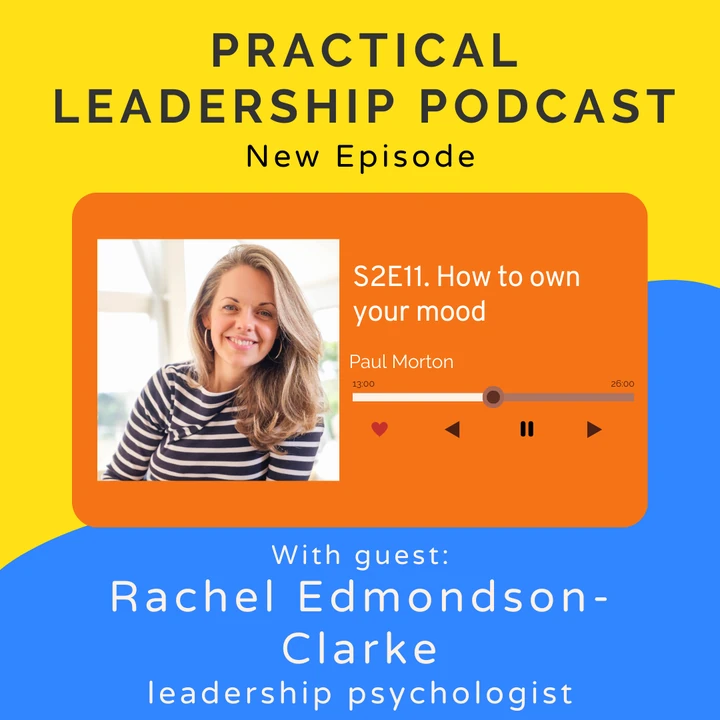
How to own your mood
with Rachel Edmondson-Clarke
Show notes
Rachel Edmondson-Clarke’s journey from her receptionist in her mother’s hair salon via collapsing on the boardroom floor to her mission driven coaching practice today is a voyage to behold.
She sold me on the idea that we have to pay attention to and manage our moods as well as our emotions. (Pay attention to the difference here!).
She has quite the turn of phrase: listening to the Whispers on her heart; making her soul’s contract and more…
In our conversation, we dug right into the importance of emotional intelligence, the challenges of transitioning into leadership roles, and the quest for personal significance over success. Rachel’s story is a testament to the power of self-discovery and the courage to follow your heart’s whispers! Unless that’s a signal to visit your cardiologist – in which case I take no responsibility…
Key Takeaways:
The Power of Emotional Intelligence: Rachel’s early years in her mother’s salon taught her to read people and adjust her approach based on their mood.
Transitioning into Leadership: Rachel shared her experience of moving into leadership roles within her teams, emphasising the importance of building credibility and gaining trust.
Seeking Significance over Success: Rachel’s life took a turn when she decided to seek significance rather than success. She encourages us all to find work that brings fulfillment and passion.
The Concept of Ikigai: We discussed the idea of ikigai – finding the intersection of what you love, what you’re good at, what society values, and what makes money. Rachel beautifully refers to it as her soul’s contract.
The Importance of Self-Care: Rachel and I explored the importance of recognising and managing moods, and the role of self-care practices in maintaining balance.
Rachel’s Mission in Six Words: “Remembering potential, realising dreams, and restoring balance.”
Rachel also shared her current projects, her leadership role in the Professional Speaking Association, and a book recommendation – “Atomic Habits” by James Clear.
Find Rachel here:
https://www.linkedin.com/in/rachaeledmondsonclarke/
https://www.facebook.com/rachael.edmondson.clarke
https://www.tiktok.com/@rachael_edmondson_clarke
Rachel’s book list: https://www.dropbox.com/s/5iwbbmy38ygo1s2/Books%20that%20changed%20my%20life.pdf?dl=0
——-
Becoming a People Manager (00:01:04)
Rachel reflects on her early experience of managing people at her mother’s salon and the skills she learned in reading and adjusting to people’s moods.
Challenges of Leadership (00:04:50)
Rachel discusses the challenges she faced when transitioning from being a team member to leading the team, including building credibility and navigating relationships.
Realizing the Desire for a Life’s Mission (00:08:21)
Rachel shares the moment she decided to shift from seeking success in her career to seeking significance and finding her life’s mission.
The stepping stones across a misty lake (00:09:22)
Rachel describes her journey of finding her life’s mission and the process of discovering her passion and purpose.
The soul’s contract (00:10:34)
Rachel and Paul discuss the concept of ikigai and finding one’s life’s mission or soul’s contract.
The decision point (00:15:19)
Rachel shares a significant moment in her life where she experienced an anxiety attack and realized that something needed to change in her life.
The importance of mood and its impact on our lives (00:17:29)
Rachel discusses the difference between emotions and moods, emphasizing the importance of recognizing and understanding our moods and how they can affect our daily lives.
The role of basic biological factors in mood (00:18:24)
Rachel highlights the significance of basic biological factors such as eating, sleeping, getting daylight, and movement in maintaining a positive mood and overall well-being.
The need for self-care and restoration to prevent burnout (00:23:36)
Rachel emphasizes the importance of self-care and restoration, including sleep, nutrition, spending time with loved ones, and engaging in activities that bring joy, to prevent burnout and maintain a healthy stress level.
Remembering Potential, Realizing Dreams, and Restoring Balance (00:26:00)
Rachel discusses the six words that define her journey and life’s mission, emphasizing the constant and never-ending process of remembering potential, realizing dreams, and restoring balance.
Book Recommendation: Atomic Habits by James Clear (00:27:09)
Rachel suggests “Atomic Habits” as a great book for people interested in personal development and improving their habits, highlighting the importance of habits in self-care and mood recognition.
Current Projects and Contact Information (00:28:11)
Rachel shares that she is currently working on multiple projects with senior leadership teams to help them gain clarity, reduce stress, and be their best selves. She also mentions her role as the vice president of the professional speaking association and her upcoming role as president. Rachel can be easily found on LinkedIn and other social media channels.
Transcript
Automated transcript. Speaker labels and spellings may contain errors.
Paul
From working age 12 in her mom's busy salon to being promoted age 14 to receptionist, all the way to collapsing on the floor with an anxiety attack at work. Let's find out what Rachel has to say about owning your mood. [upbeat music] Hello, and welcome to the Practical Leadership Podcast. I am your host, Paul Morton, and we are talking about leadership, management, and the various lives that surround it. It's my joy, delight, and privilege to bring into my studio some of the smartest, wisest people I've been able to find for your delectation and enjoyment, and I hope that you do get a lot out of the conversations that we have here. When you realize that your management team has grown too fast or you've inherited a new team and the fastest, best lever you have for growth and improvement is attached firmly to those managers, get in touch. I help you run management coaching and training programs that'll make a big difference really quickly.
You can find me at the Practical Leadership Academy website and on all the usual social channels. [upbeat music] Rachel Edmondson-Clark, thank you very much indeed for joining me. Would you mind introducing yourself? In fact, no, I'm gonna introduce you for two seconds and say the one thing that, uh, you impressed me with when we were chatting was that, like me, you've been working since you were an amoeba. So from age 12-
Rachel Edmondson-Clarke
[laughs]
Paul
... in your mom's salon, 'kay, to where you are today. If you could summarize that in 30 seconds or less, that'd be great. No.
Rachel Edmondson-Clarke
[laughs]
Paul
Take your time. Tell us about you, Rachel.
Rachel Edmondson-Clarke
Oh, Paul, thank you so much for having me on the show. I am delighted to be here, and, uh, no, it's a pleasure. It really is. Um, so yes, I started working at age 12. So my mom ran her own very busy hair and beauty salon. We'd have around 300 clients through the door every week, and, uh, by the age of 14, I was fed up of sweeping the floors and, uh, you know, doing, making the teas and coffees, and so I convinced her to train me on reception. And I think the thing we were chatting about just before we, we started recording the podcast was just how you reflect back on that journey of becoming a people manager. And, and actually, my reflection is that, my goodness, actually, I started at a really, really, really young age.
'Cause whilst the team in the salon of, of, of hairdressers, uh, weren't directly reporting to me, I was absolutely orchestrating what was happening and needing to influence and direct what was going on. And I was, of course, managing the public and the clients, um, as well. That was really, really interesting.
Paul
So what, w- would ... Does that count as, uh, non-hierarchical influencing in an environment where you don't have the delegated authority?
Rachel Edmondson-Clarke
[laughs] I think so.
Paul
I think it does.
Rachel Edmondson-Clarke
I think so. I think so. Although, although, of course, there was always that dynamic that my mum was the boss, but, um-
Paul
Yeah
Rachel Edmondson-Clarke
... no, it was-
Paul
Of course, yeah
Rachel Edmondson-Clarke
... it, it, it was, it was always fascinating. I think it's where my, um, my, my deep, deep interest with people began because I would have a number of seconds where I would look up from that reception desk and I would see clients coming through the door, and I had to very quickly judge what kind of a mood they were in so that I could respond appropriately, um, from behind the reception desk. And sometimes I might have been on the phone. I had two telephone lines that came into the salon at that time. Might have had, um, a row of people wanting to book appointments or pay or do different things. And so, kinda really being able to read people very quickly, I think, was something that I, I learnt in that salon. Um, and it was very, very good, good grounding, good foundation work, [laughs] I think.
Paul
I think being able to set your, almost your emotional volume control at the right level for someone is, is, is a, a great learned skill. You know, and this, in your case, is it, is it somebody who'll chat to you and wants a, wants a blether, or is somebody on a mission, you know?
Rachel Edmondson-Clarke
Yes.
Paul
Wh- wh- where is it on the scale of spectrum of intensity or-
Rachel Edmondson-Clarke
Ah
Paul
... humorosity or whatever it is? Oh, that's, that's, that's a fascinating thing to learn. Dealing with the general public is a great skill. I think if I can possibly wangle it, I want to kick my kids out as early as possible into the world of waiting tables-
Rachel Edmondson-Clarke
Yes
Paul
... doing something in front of people.
Rachel Edmondson-Clarke
Yes.
Paul
So you learn that the world is not their little bubble, 'cause their little bubble is, is us and their pals and people who are very much like us.
Rachel Edmondson-Clarke
Yeah, yeah.
Paul
And the world is made up of people who are very much not like us.
Rachel Edmondson-Clarke
Absolutely. Absolutely, and it's that age-old, isn't it? People like people who are like themselves. So as you say, when we can assess quickly where people are at and then we can adjust our own barometers so that we are meeting them much more where they're at, we're much more likely to be in a position to more positively influence them. And, um, yeah, it is absolutely a, a skill that can be, that can be learnt.
Paul
The positive influence, that's a lovely phrase, to, to, to positively influence someone. Um, I think the good managers that I've promoted or worked with or I currently work with as a, as a, as a coach, they're the ones who have a passion for people and who, the burn for seeing other people grow. It's the, the failures are the ones who are fabulous at the job, and then-
Rachel Edmondson-Clarke
Mm-hmm
Paul
... were promoted into the functional head of something, but they don't like people. They're really good at the thing, but they don't like the people.
Rachel Edmondson-Clarke
No, and don't you see that? You see that so much, don't you, where just because somebody's very good at their technical area of expertise, the very next step on the ladder or the natural progression then seems to be to lead a team, and yet actually being a leader has a whole nother skill set associated with it. And I really feel for people who are potentially maybe moving into a, you know, one of their first line management type of role a- a- a- particularly if they're not getting the support to do that because it can be a very different set of skills that are required in that role and, and often I think that's something that gets missed.
Paul
Mm-hmm. I think one of your first roles was one where you took over working As the boss of the folk you used to work with.
Rachel Edmondson-Clarke
Oh, I did. Yes. Yes.
Paul
Oh.
Rachel Edmondson-Clarke
It was. It was. Yeah, so, um, my first leadership role, I led a team that I was part of, so that was quite interesting. So I was the field sales manager for the whole of the UK and Northern Ireland for Uncle Ben's and Del Mio. And I was in my, you know, sort of mid-20s probably, still quite young. And I think anyone that experiences that, where you've been part of the team, and then you step up to then lead the t- ... It presents a number of challenge, um, you know, that can, that can come with that. I think, you know, you're wanting to build credibility and gain trust as a leader because you're now fulfilling a very different role for that team, and navigating the relationships at that time can also be kind of tricky.
I was really lucky with that team because they were very, very supportive of me, but I was also aware as I went into the role that there might have been some, um, competitiveness potentially. Um, there wasn't, it was great, but there, there might have been. Um, and, and also that some people might have had some reservations about my ability to lead. So, um, a- and, you know, and I think any time you're stepping up into that type of a role, there's just added pressure and expectations as well that, that, that come along with that.
Paul
Mm-hmm. Where did you go from there?
Rachel Edmondson-Clarke
Oh, so from, from sales, I went to marketing. I became brand manager of Whiskas cat food. And, um, from there I went into, uh, a head of product strategy role for Thorntons. Um, really enjoyed that. Interestingly, the same thing happened to me in the Thorntons, uh, while I was working at Thorntons. So, uh, I again became the leader of a team that I was part of, so that was, uh, that was again another interesting dynamic. It was something I'd faced before, so I felt as though I had some experience in, in doing that. And, um, yes, and then it was, oh, I don't know, seven or so years into my role at Thorntons where I realized that I had a whisper on my heart that, um, I guess, I guess I'd got to this point in my career
where I felt like I'd achieved and got to a place that I thought I'd always been striving for. At university I did a master's in marketing and management and, you know, this was always kind of like where I was headed and what I wanted. And I, I guess I got there and kinda looked around and was like, "Hang on a minute. This isn't quite as fulfilling as I perhaps thought it would be." There were elements and aspects of it that were, and I had this whisper on my heart that there was something more, and I didn't know what that was. But I remember the day that I really listened to that whisper for the very first time. It was one of those shower moments. [laughs] I don't know what it is about running water, but sometimes it helps us think more clearly. But [laughs] I, um, I, I, I was literally getting ready for work one day, and I remembered sort of almost turning to that whisper and saying, "What are you trying to say to me?"
And as I came out the shower and my feet hit the bathmat, I'd made a decision, and that decision was that I was no longer looking for a job or a career, but I was looking for my life's mission. And I had no idea at that time what it was gonna be, um, or what that meant, but that's what I wanted. Um, and I'm enormously grateful 'cause that is, gosh, 10, 13 years ago now. And, and I get to do what I love every single day.
Paul
I think it's a ... It sounds like a move from seeking success to seeking significance.
Rachel Edmondson-Clarke
Absolutely. Yeah. I think that's a beautiful way of summarizing it. We spend so much of our time at work that I think to do something that we really r- that we really enjoy and that we're passionate about, um, you know, it's so fulfilling. Um, and, and, and I, and I love my work, and I love what I do, so yeah. And I would encourage anybody that's got that whisper on their heart to take note of it. And I didn't find the answer straight away. It took maybe three years for me to work out what it was that I wanted to do, and it wasn't a straight line path. I'd often describe it almost like there's stepping stones across a misty lake, and sometimes all you can see is the very first stepping stone in front of you.
But as you have the courage to take those first steps and to explore with excitement and possibility, that mist starts to clear, and you see the next step, and then you see a bit more of the path ahead. And it, it's, it's been a beautiful unfolding, and one that I think will be ever-evolving and, um, you know, as I'm sure, you know, l- life is anyway. Um, and yeah, I would just encourage people to, to, to explore that and not to ignore that whisper on their heart.
Paul
There's, um, the idea of be yourself, everyone else is taken, which is good.
Rachel Edmondson-Clarke
Mm.
Paul
Trying to find some sort of authenticity around yourself, which is fine unless you're an ass, in which case, don't be you, be someone else. Um, and, uh, the, the following your passion piece. You know, following your passion's all very well and good, but what if you're rubbish at it? What if nobody wants what you've got?
Rachel Edmondson-Clarke
Mm-hmm.
Paul
Have you ... Oh, you, you've probably come across the idea ikigai.
Rachel Edmondson-Clarke
Mm.
Paul
This is Japanese.
Rachel Edmondson-Clarke
Yes.
Paul
And that's it right in the middle where you've got the, the thing you love-
Rachel Edmondson-Clarke
Yes
Paul
... and the thing you're good at-
Rachel Edmondson-Clarke
Absolutely
Paul
... and the thing that, valued by society-
Rachel Edmondson-Clarke
Yes
Paul
... and the thing that makes you some bloody money.
Rachel Edmondson-Clarke
Yes.
Paul
Right in the middle is the ikigai, which is your-
Rachel Edmondson-Clarke
Uh-huh
Paul
... your life's mission, as you said, your mission, yeah, the significance, the whole-
Rachel Edmondson-Clarke
My soul's contract, I call it.
Paul
Your soul's contract. You're a poet and you don't know it. That's magic. I love it. Your soul's contract. My goodness me.
Rachel Edmondson-Clarke
Ah.
Paul
Do you then have a quote or a, a mantra that you live by or you think of?
Rachel Edmondson-Clarke
I do. I do. It's to be ever-evolving, true to my spirit, to enjoy the journey of life and, you know, to be open and receptive to, um, the miracles that can come for myself and, and for others.
Paul
You ... Can be nice, like, tattooed somewhere, right? Although I don't judge that
Rachel Edmondson-Clarke
I need to get it tattooed, don't I?
Paul
Love that.
Rachel Edmondson-Clarke
I do.
Paul
Love that.
Rachel Edmondson-Clarke
I do But no, no, I think, you know, being ever-evolving, um, growth is a, growth is a, growth is a huge part of, of who I am and how I live. Um, I believe that if we're not growing, we're dying or we're dead. There's no plateaus in life. We don't stand still for very long. You've only got to look out in nature to see that. And, um, yeah, so I, I'm m- I'm, I'm often looking for what's the, you know, kind of, you know, where is the growth? What is the next thing? Um, and that does... you know, there, life inevitably throws challenges and problems our way, which causes us to grow anyway. Um, but for me, that's about how do we become more? Because as we become more, we can give more, and as we give more to others, that is, I think, the true secret to life and fulfillment, where we can, where we can give
more and contribute more. Um, that's where you've got this beautiful sweet spot of, um, fulfillment and success. And, and I think for us to be able to seek professional success and personal fulfillment is something that we can, we can absolutely, um, strive for and to do, and it's not, it's not a perfection thing. It's, you know, uh, the, the... and I, I'm still challenged every, every day. We were talking, you know, we've, we've both got young families, and I'm, you know, I'm constantly working on this. But moment to moment, showing up and being my best self here for you in this podcast, for my little four-year-old boy who's, you know, as you know, has just gone out with my m- with my mom on a bike ride, and, um, you know, it's that moment to moment, how, how do we show up and be our best selves, and, um, really enjoy that journey along the way.
Paul
Mm-hmm. Uh, I think a big part of that is actually giving ourselves a break for the most of the time when we're doing, you know-
Rachel Edmondson-Clarke
Absolutely
Paul
... most of the time.
Rachel Edmondson-Clarke
Be talking kindly to ourselves, yes. Being impeccable with our words, um, for sure. Absolutely.
Paul
There's a book in you there if you haven't written one already.
Rachel Edmondson-Clarke
No, I... no, and I have no interest in, [laughs] in writing a book. People say this to me a lot. I always think, "Oh, that's just the last thing I want to do." Maybe one day, and I would love to
Paul
Speak it to somebody. Speak... do you know, I was sitting in a, a plane once, and I ended up gabbing away to this guy. It was like a 10-hour from somewhere horrible, and ended up chatting to this, this, this woman, actually, and she said, um, she's found out I'd studied in Edinburgh and was a Scottishman. She said, "Oh, I think there's a one-man show at the festival in you." And it might be right. You might be right. Because yes, I'm a, I'm a gabby sod rather than a, the, the, the other side.
Rachel Edmondson-Clarke
[laughs]
Paul
Let's go, let's go back to, uh, carry on from you were working for 8 Out of 10 Cats, and then you moved on to The Chocolate Tears of Choice.
Rachel Edmondson-Clarke
That's right, yes.
Paul
What happened?
Rachel Edmondson-Clarke
What happened? I think, I often think that, um, life shows up for us if we're... I was ignoring that whisper on my heart, and I'd been ignoring it for a really long time, if I'm very honest. And I think what ultimately happened was, [laughs] this is not the poet in me, but I think life came along and it was like it slapped me around the face with a great big wet fish. [laughs] And it was just like, "Come on, girl. You ain't picking up the call. You ain't doing what you're doing." And so, um, it kind of... it, it threw me the curveball, and the curveball came. Um, you know, just one day I was in my glass-fronted office. I was preparing to go into the boardroom, and instead of walking out the door, I found myself on the floor, staring up at the ceiling tiles. I was unable to breathe. I couldn't think, and I'd collapsed there.
And what I didn't know at the time, but I understand now, is that I'd had an anxiety attack, and I was able to, I was able to, you know, recover from that. But I had allowed, there were habits and there were, there were things that I had disrespected, um, for a long time that had led to, that had led, that had led to that. You know, I disrespected, you know, m- my health. I'd neglected the most important relationship in my life, and, um, yeah, and, and it led to a pretty, a pretty dark moment, which was also a decision point. And I think we get these, we, we have these decision points every single day in our lives, but sometimes we have some real significant ones as well. And it led to this decision point that was, "Okay, not this no more. This needs to change."
Paul
Mm-hmm.
Rachel Edmondson-Clarke
Yeah. So it did. So it did. I actually managed to get into the boardroom. I did do it. Um, uh, to get me through that initial, that moment, um, I leaned on the support of somebody who I will be forever grateful for, someone who I could trust, um, who was able to come in and help me when I couldn't think of just even the simplest of things. Um, and they helped me prepare, and they helped me get in the room, and, and, and I got through what I needed to get through that day. Um, but then it was taking the courage to say to my then director, "Something needs to change. Something needs to be different." Um, and we looked at restructuring the team, actually, um, and instead of me leading the team, I went back into it, and we got a consultant that came in and that, um, you know, that, that did the role that I had been doing.
And so that was also a really interesting dynamic and lots of things going on there. Um, so yeah. Uh, but it's... yeah, it, it was, I realized that there were, that, that there had been a number of things that I had done that day that led me to lying on the floor. And probably one of the biggest lessons that I've learnt has just been around how, how we feel is affected by our biology, and our moods and our emotions we can have more impact and influence over than we perhaps realize. And I m- I was making, you know, I was making various choices that day around- What it was that I was focusing on around how I was moving my body. It was tight, I couldn't breathe. Obviously, you don't feel like that that's a choice at that time. And ultimately, what it all meant, that I wasn't coping, that I was struggling, that I couldn't keep up. And beneath all of that had been some habits that had led to an underlying mood over a long period of time.
And often we don't realize that mood is, like, m- mood can, mood can change gradually and over time, and it can kind of creep up. And often we don't, we- we- we're- we're aware with our emotions, I think, because often it's something from the e- external environment that normally triggers an emotion, and it's quite an acute feeling. But with our moods, it can be much more, kind of, um, just happening in the background. And often the first time that we know that we're, we're in a funk is somebody else telling us. You know, or for me with young children, it can just be actually my reaction to them. Something that one day they might say or do and I might laugh at or be, like, quite jovial about, and the next day they do, and I've flown off the handle at them. And that, that, you know, so often it can be that that means that we recognize that we're in a poor mood.
And from a mood perspective, it's driven by our biology and by simple things that we all know as leaders. But I see so many people, and myself in the past I include in this, either ignoring or disrespecting these things. And it's like, actually, have you eaten today? I see so many leaders that will not... And- and- and if you have eaten, have you eaten something that is going to, that is g- you know, that's not gonna clog you, it's gonna serve you, you know? It's this, nutrition. Nutritious. I'm also- also a certified health coach, by the way. That was also a part of this journey. We're probably won't have time to go into that, but-
Paul
Yeah
Rachel Edmondson-Clarke
... you know, so how are you eating? How are you sleeping? Did you get daylight today? Did you move today? And I don't necessarily mean, like, like hammering it out at the gym, 'cause again, I work with a lot of high achievers, and for some of them, actually, the exercise isn't the right thing. 'Cause it's about how we restore ourselves and bring us back to that equilibrium where we can operate and operate at our best. So I, you know, like, so all of these things I'd been disrespecting. Spending time with people who we care about and who care about us. You know, we are social creatures as human beings, and that's really important, and these things all feed into our moods.
Paul
And you have, just to, just to- to think about terms here. I- I've, number one, I firmly believe that we are moist, programmable robots. So a great ex-
Rachel Edmondson-Clarke
Yes
Paul
... and we can influence ourselves by what we eat, what we do, vastly more than we're aware of.
Rachel Edmondson-Clarke
Mm-hmm.
Paul
And what we eat and what we do, if we're not aware of it, influences us without us knowing.
Rachel Edmondson-Clarke
Absolutely.
Paul
So you have emotions, which are the intense, fairly short-lived responses to things. So somebody says, "That was a bit of shit," and you feel angry about it.
Rachel Edmondson-Clarke
Yes.
Paul
But you have a mood which is, as you s- you- you talk about, something that lasts, it's more general, it lasts a lot, lot, lot longer, is accreted. There's not necessarily a single trigger for it. I think there's usually sort of a s- a series of cumulative emotions that lead to a pervade of- pervasive mood. Your emotion's, typically you can say, "That's why I'm happy or sad. I got ice cream, I'm happy. I got smacked in the face with a wet fish, I'm a bit pissed off."
Rachel Edmondson-Clarke
[laughs]
Paul
Right? Whereas-
Rachel Edmondson-Clarke
It's tougher
Paul
... yeah. And I think the moods, you say that, that you've got no particular event, but you've got all the biological, all the environmental, all the, even the weather-
Rachel Edmondson-Clarke
Yes
Paul
... affect your mood.
Rachel Edmondson-Clarke
Yes.
Paul
And it's diffuse, pervasive. And it really, I think that's the challenge, is, is it's understanding all the different aspects of why, what it's doing to you. And it, to some extent, respecting it, giving it the space, and protecting yourself and others from yourself. I don't mean like a, you know, "I should be locked up or sectioned," but I mean, I- I- I try not to make decisions, big decisions, unless I've thought them through when I'm awake, when I'm sleepy, when I'm happy, and when I'm sad. And if I come to the same conclusion from those angles-
Rachel Edmondson-Clarke
Yes
Paul
... then it's a reasonable decision.
Rachel Edmondson-Clarke
Mm, yeah.
Paul
'Cause if your response in the moment is human, "Don't do that," right? Or-
Rachel Edmondson-Clarke
Yes
Paul
... "Oh, I'm just," as you said, "slung because I've eaten." You know, I w- if I wanted to go to bed, if I wanted to go to sleep, I can eat three slices of white bread and I'm done.
Rachel Edmondson-Clarke
Yeah. [laughs] Absolutely. And you know, it- it, the- the reason why I think this is so important is because a few weeks ago I started to feel something similar coming on again as to what I'd experienced all that time ago. What was different this time? So I was walking back from school, I'd dropped my little ones off there, and I was with my mother-in-law, and I noticed that I was struggling to breathe and feeling quite anxious. And I was like, "Oh my goodness." And of course your head starts playing tricks and all the thoughts start coming in, you know, "Gosh, am I gonna go through this again? What, you, uh, you know, what, what's going on?" And because I had this greater awareness of how my mood can lead to these things, I was like, "Well hang on a minute. Let's just look at what's been going on for you for the last week or so." And when I look back I was like, "I've not had enough sleep.
I've had maybe, you know, averaging between five and six hours sleep a night." And so that evening, instead of going to the gym when I normally would do, I went for an evening walk, which was really restorative, much more restorative than, you know, like sweating it out at the gym. I did a little bit of journaling, I came home, I had a bath, which helped me then get a really, really good night's sleep. The next morning I woke up and I was like a shiny, bright, new person. And it's, you know, we, we can so easily, I think, run into these walls of burnout, of stress, of anxiety. But if we can just be aware as we're s- you know, like, if, if, if we, if we start to... I think there's a, there's a really healthy level of stress where we all operate, eustress, where we all operate, um, you know, at our best because we've got that little bit of tension, um, that, that little bit of pressure that, uh, that, you know, enables us to perform
really, really well. But as soon as you feel that kind of coming off that edge and it's starting to tip into some of that burnout or that overwhelm or the stress side of things, the unhealthy stress, then you've got to look, and I would just encourage people to look, not just at the mindsets, 'cause I'm big on mindset, but not... This was my problem. I always looked at the mindset side of things. But to also remember their biology as well and to think about those real basic things that we all know about. And like we've said, sleep, daylight, movement, nutrition, people you care about, um, all of those things. And just, actually, just to assess that and go, "What do I need to restore?" Because from that restored place, you'll often find that you've, y- you know, that actually your bandwidth then for dealing with the stress
and the strains of life, you expand that bandwidth. You're able to deal with more. But we've got to, we've got to pay attention. We've got to be aware of where we're at, pay attention to it, and then make sure we're restoring on a regular basis, on a daily basis. Um, and if we're not doing that, yeah, you've gotta, you've gotta... [laughs] P- perfect example. Phone is the perf- So if you, so, uh, if you can't see us-
Paul
Oh, gone. I'm an idiot
Rachel Edmondson-Clarke
... what Paul's just done
Paul
I just, I just visually, and I'm, I mean, I'm pod... Sorry.
Rachel Edmondson-Clarke
Y- you'll be-
Paul
I'm sorry. If you're listening to this, what I just did is I held up my phone.
Rachel Edmondson-Clarke
Yes, explain. [laughs]
Paul
I, I held up my phone as Rachel was talking, so I didn't want to interrupt her. I thought it would be really, really clever, and I plugged it in. Look, here's just me plugging in my phone. And it's the idea that we should treat ourselves with the same respect as we treat our, these devilish devices that distract us all the time.
Rachel Edmondson-Clarke
We would never let that thing run out of battery, would we?
Paul
Never.
Rachel Edmondson-Clarke
But we do it to ourselves. Brilliant.
Paul
All the time.
Rachel Edmondson-Clarke
Love it.
Paul
Bananas, eh? If you had 10,000 billboards and an unlimited advertising budget, with your marketing background, what would you write on them?
Rachel Edmondson-Clarke
Oh, my goodness. What a, what a great, what a great, great, great question.
Paul
You have an oppor- I'll talk for three seconds while you actually get a chance to think about it.
Rachel Edmondson-Clarke
Mm-hmm.
Paul
So you get the opportunity to put, you know, like, a good slide of six words visible at six feet and six lines maximum or whatever. As many words as you like.
Rachel Edmondson-Clarke
Mm-hmm.
Paul
I'm gonna put these billboards all around the world, and we're gonna share your message-
Rachel Edmondson-Clarke
Mm
Paul
... with everyone, the vital thing that we all need to know.
Rachel Edmondson-Clarke
Well, I suppose you talk about the six words, and I do actually have six words. Um, they are remembering potential, realizing dreams, and restoring balance. And the reason that it's remembering on all of those things is because it's a constant and never-ending process. And I think as human beings, we underestimate what we are capable of. I think, um, and I believe that we can create the life of our dreams and we can make our dreams, uh, come true, and that I believe that there is a role for us all to be restoring our balance, whether that's internally on a, o- on a individual level within us or actually on a global scale within, in terms of what we're doing, um, uh, you know, kind of, um, of, of w- within the planet.
And so, yeah, they would be my, they would be my six words.
Paul
Remembering potential.
Rachel Edmondson-Clarke
Realizing dreams.
Paul
Realizing dreams and restoring balance.
Rachel Edmondson-Clarke
Balance.
Paul
It's lovely. Is there perhaps a, that you recommend or that you give more than any other? I saw your book list. It's fantastic. I like it. But what, was there one book that you'd give away more than any other?
Rachel Edmondson-Clarke
It's a tough one. That's a tough one. So I love to read, and I will typically read a book every week or every two weeks. Um, uh, I'm a avid nonfiction reader, so I'm passionate about this area, as you, as you know. And so I read lots and lots and lots of different books. Um, I think a great one for people getting started in this area, um, would be Atomic Habits by James Clear because, you know, the, uh, the habits that we have, and we've been talking about habits today, haven't we? We've been talking about our habits around our self-care and recognition of, um, where we're at with our moods and so on. So I think that would be a great one to start with, but there's, there's so many. Um, a- and you're right, Paul, I do have a list of books that have changed my life, so if anybody would like to check that out, then they are more than welcome to do that.
Paul
Well, I'm gonna put a whole ton of links into the description down here, places where you can find Rachel and, uh, all of her magnificence and great thinking. Um, but then just lastly before we wrap up, a couple of things. Number one is what are you working on right now? What is it you're all about?
Rachel Edmondson-Clarke
So I'm, oh, I'm working on numerous projects with, um, different senior leadership teams, helping them to get clarity, reduce stress, and be the best versions of themselves moment to moment. Um, outside of business I've got some exciting things happening. So I do a voluntary role. Currently, I'm the vice president for the Professional Speaking Association in the East Midlands, and as of January, I will be stepping up as president. So that's exciting, and I'm looking forward to that.
Paul
Magnificent. Magnificent. And then the last thing, where can people find you easily?
Rachel Edmondson-Clarke
Oh, s- LinkedIn is probably gonna be the very best place, but I am on all of the major social media channels, and you can find me at Rachel Edmondson-Clark. And it's Rachel, A-L, and it's Edmondson, E-D-M-O-N-D-S-O-N, hyphen, Clark with an E. And if you're in doubt, just add as many letters as you can to my name, and then you'll find me. Um, but I think, as Paul, you said, y- I mean, and I would love, I would l- if anything I've said has resonated, I'd love to connect. And, and if it's a book recommendation you're looking for, do just drop me a note. Let me know what you're working on and, and, and I'd be happy to, uh, point people in, um, i- in the right direction.
Paul
Absolutely magnificent. With all the letters possible to add to her name-
Rachel Edmondson-Clarke
[laughs]
Paul
... Rachel Edmondson-Clark, thank you very much for joining.
Rachel Edmondson-Clarke
Oh, it's been a delight. Thank you. [upbeat music]
Paul
And that's a wrap. I hope you enjoyed the show. Thank you for joining me. If there's ever anything I can do to help you on your journey, then do please reach out. You can find me on LinkedIn and all the usual sources. Do please subscribe, leave me your five-star review, and most importantly, get in touch with your comments and feedback. It's really how I grow, and that's what I'm doing this for. Thanks again. [upbeat music]