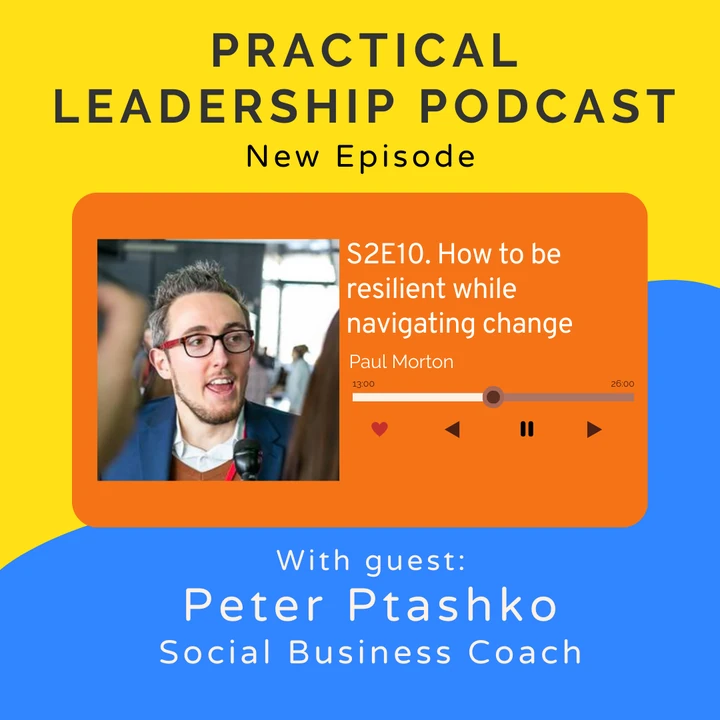
How to be resilient while navigating change
with Peter Ptashko
Show notes
In this episode, I had the pleasure of interviewing Peter Ptashko, a remarkable individual with experience in the world of social enterprises and foundations. Our conversation revolved around two crucial aspects of promoting social change: resilience and authenticity.
Peter’s wealth of knowledge and expertise in mentoring social startups became evident as he shared his insights. He emphasized the importance of resilience, explaining how it serves as a driving force for individuals and organizations to overcome obstacles and make a lasting impact. Peter’s own journey in the field has taught him that setbacks are inevitable, but it is our ability to bounce back and learn from these challenges that truly propels us forward.
Authenticity, according to Peter, is another key ingredient in effecting social change. He stressed the significance of embracing one’s true self and values when working towards a greater cause. By staying true to our beliefs and principles, we can inspire others and create a ripple effect that leads to meaningful transformation.
One aspect of our conversation that particularly resonated with me was Peter’s emphasis on the value of lived experience. He highlighted how individuals who have personally navigated significant periods of change bring a unique perspective and understanding to the table. Their firsthand knowledge allows them to connect with others on a deeper level and provide invaluable guidance and support.
We also delved into the concept of sustainability, which Peter believes is crucial for long-term social change. He challenged the current systems and called for progressive actions that prioritize the well-being of both people and the planet. By adopting sustainable practices and questioning the status quo, we can create a more equitable and inclusive society.
As our conversation drew to a close, Peter had a powerful message for global audiences. He encouraged individuals to embrace their authenticity and use it as a catalyst for change. By being true to ourselves and our values, we have the power to make a significant impact in our communities and beyond.
—
Peter mentioned this summit:
IDGs: https://idg-summit-2023.confetti.events/
Contact details:
Peter@cambioconsultancy.uk
X: @PeterPtashko
X: @CambioCulture
IG: PeterPtashko
IG: CambioConsultancy
http://linkedin.com/in/peter-ptashko-frsa
https://cambioconsultancy.uk
—
If I can help you as a coach or mentor – get in touch:
https://leadershipthatsells.com/
Transcript
Automated transcript. Speaker labels and spellings may contain errors.
Paul
Fall in love with the problem you're trying to solve. Put your arms around people and inspire them. There's no substitute for proximity in delivering change. You have to talk to the people involved. Let's find out what else Peter Potashko has to say. [upbeat music] Hello, and welcome to the Practical Leadership Podcast. I am your host, Paul Morton, and it is my joy and privilege to interview on your behalf some of the brightest and smartest people I've been able to bribe, cajole, and otherwise persuade into the studio. We're talking about leadership, management, and the life surrounding it. I hope you enjoy the show. [upbeat music] Peter Potashko, thank you very much indeed for joining me. So you have fifteen years of working in social enterprises and foundations. You want to help us understand how we should fund more social startups. You've been working in supporting, mentoring, signposting people.
You are, uh, fascinated by climate, education. Would you please introduce yourself properly?
Peter Ptashko
Thank you, Paul. I mean, it's a privilege to be on your podcast with your audience and listeners. And, um, yeah, I've been very lucky enough to have an eclectic career over the last fifteen years [chuckles] and latterly running my own, um, social change consultancy. Uh, it's a social enterprise. Uh, we do a lot of good in the world, I hope, and I'm just happy to be having a conversation with you about how we can do more of it.
Paul
My take on doing this whole thing, full stop, is the idea of doing a bit of good, right? And it came about, um, 'cause I don't think I t- told you this when we met. It came about because my daughter turned to me a couple of years ago and said, "Ah, Daddy, can I go out to work?" And she was ten at the time, and I thought, "Right. Down the pits for you, my lass."
Peter Ptashko
[laughs]
Paul
"Up with your knees." Um, and it got me thinking about the people that I've had come on straight from university or whatever, and the first jobs I had. I was a dishwasher for many years, and waiter, and barman, and all these sort of things. I think I've worked solidly since I was about twelve, thirteen, whenever you're allowed. There's a law. Like, you know. Um, and I thought about all the crappy managers and all the people I'd gone through and suffered with. So you've got and had this diverse range. That was one of the things that I thought was really interesting. This really diverse range of experiences. Is there any sort of red thread you could pull out that crosses them all?
Peter Ptashko
Yeah. It's really interesting you raise that, Paul. I think it's that lived experience that really shapes us. Um, I'm struck by your history there when clearly you will have met and spoken to a lot of people. I guess I've done the same. And so it is almost the sum of the parts being greater than the individual elements that have informed the work I'm doing now. I feel like I pulled those threads together for the work I do in Cambio, my current venture. And the, the central piece is, is the translation of the name into English. So it's called Cambio because I was based in Mexico for a number of years doing this work in Latin America. My partner's Mexican, so I have a-- There's a Latin theme here. But it-- Cambio means change in English. And what I'm struck by is the fact that we're all living through significant periods of change, um, whether it be economic change, political change, social change.
Paul
Yes.
Peter Ptashko
And how do you help people navigate that? It's one of those words that I think we all like to say we're good at, but in reality, change is hard.
Paul
Yeah.
Peter Ptashko
You know, systems don't like to change. People don't like to change. Even when it's a positive change, it's still a change. So I help people navigate change, whether they're individuals, organizations, small or large.
Paul
There's-- I think the only one, there's, there's trite and it's a cliché because it's like all these things, very, very true. The only constant is change. Things that don't change die, right?
Peter Ptashko
Yeah.
Paul
You go back to your hometown and you realize, oh, it hasn't changed. It's still a dump. You know? It's got worse. Oh, it's completely changed. It's got lots of little new boutiques, and there's more people moving in and... You know? So you have, I think, intentional change, passive change. There's lots of different sorts of cambios, you know?
Peter Ptashko
Yeah. Yeah. Absolutely. I'm, I'm looking for that more intentional change and, you know, I often use the word resilience. Yeah. How can you-
Paul
Mm-hmm
Peter Ptashko
... you know, be given a situation and make the best out of it? Opportunity. That's why a lot of the work I do is in and around social enterprise, um, you know, social innovation. It's about how can we deliver the best result possible from the situation we're in that creates the maximal social impact for you, for the people around your community, your stakeholders, beneficiaries, um, given the situation we're in.
Paul
Okay. Give us an-
Peter Ptashko
How do you make lemonade from, from lemons?
Paul
Yeah. Give us an example that's not lemonade-based.
Peter Ptashko
[laughs] Yes. Um, so I, I spend a lot of my time, and I get my-- the most energy, really, in my work from coaching entrepreneurs. So literally all the way from day one to day five hundred and one. Um, and right now I'm coaching a couple of people. One who is, uh, literally starting up, uh, a small business that is helping people, um, cope with mental health situations in the workplace, and somebody else that's about to draw down, uh, an eight-figure investment, um, helping people to get on the housing ladder who otherwise wouldn't be able to. So it's very technical. It's a tech startup scale-up now. Um, and anything in between. A-and for me, y-you know, uh, of course, there's a lot of technical elements around, okay, how do you fundraise or how do you seek investment and how do you find the right legal structure?
But it comes down to people leading interesting projects and ventures that are trying to create change. And I see I have a role with all those people in facilitating, amplifying, creating a voice and an opportunity. Um, and I think my sort of quite diverse lived experience, as, as you put it, helps us-- helps them really to deliver that change, and it helps us to do more of it collectively as an, as an organization.
Paul
Okay, you said it all comes down to people. I mean-
Peter Ptashko
Mm
Paul
... everything comes down to people. I mean, you're talking about a number of different companies, okay?
Peter Ptashko
Yes, yeah.
Paul
And the companies contain people.
Peter Ptashko
Yeah.
Paul
And the root of the word company is companion.
Peter Ptashko
Yep.
Paul
And companion comes from, as you will know with your Latin background, compan, with bread.
Peter Ptashko
Yeah.
Paul
These are people with whom I break bread.
Peter Ptashko
Yeah.
Paul
So you put organizations and, uh, institutions and, yeah, okay, fine, fine. They're companies. The people that I would actually want to have a meal and a glass of wine with.
Peter Ptashko
Yeah.
Paul
Maybe even two.
Peter Ptashko
Yeah.
Paul
That's wine, not meal. I don't wanna get fat. Um, how then do you promote or help people, individuals? So these entrepreneurs-
Peter Ptashko
Yeah
Paul
... somebody's about to get, you know, 10-plus million euro, pound, dollars. They're all the same these days. As long as you're not talking lira, you're fine.
Peter Ptashko
Yeah.
Paul
How did you get somebody who's gonna do that or start and dedicate the next 10 years of their life to something-
Peter Ptashko
Yeah. Yeah
Paul
... accept the things that they can change and accept ... And, and to, to deal with the things they can change and accept the things they can't. A study came out fairly recently here in the UK-
Peter Ptashko
Yeah
Paul
... that people have about 15% of the control over their lives that they think they do.
Peter Ptashko
Yeah.
Paul
So the other 85% is either in the hands of God-
Peter Ptashko
Yeah
Paul
... or the bank manager or the World Economic Forum-
Peter Ptashko
Yeah
Paul
... or, or it's not me.
Peter Ptashko
Yeah. Yeah. That's a really good question. Uh, let me say a bit more about what I, I might refer to as my secret sauce. A- and it may sound so, um, straightforward as to be obvious. But what I would say is that when you talk about business, and a lot of the work I do is around helping people to start and scale some kind of business, social enterprise, whatever it may be, most people think business is about money. They also think business is about structures and processes and, uh, hiring the right people for the right skills. And of course, that's part of it, but as we've both identified in different ways, it all comes down to the people. And what I do is I place the focus on the entrepreneur. So I'm-- In a world of enterprise, their business is possible. Like you say, if it is that 15%, well, how do we get the best 15% possible?
Yeah. And how do we collaborate to maybe get that number up higher with other organizations, other businesses and society and government and beyond that, you know, at scale? So for me, it comes down to what is that person-centered methodology or approach that gets the best and unleashes the potential of the individual? And so everything I talk in my coaching sessions or, or whether I'm consulting with bigger organizations is, uh, putting a focus on the individual leader, however big the team may be. Maybe a team of one, it could be a team of a thousand. That's my starting point.
Paul
I mean, everything you do then, if you're helping them to recognize and understand where they're, where they then start. So you start with them.
Peter Ptashko
Yeah.
Paul
Their starting point in starting a business, starting whatever. I think in having had the similar conversations, people start work by, "Oh, it should have a red logo, and the website should be called the..."
Peter Ptashko
Absolutely.
Paul
Fuck off. What problem are you trying to solve?
Peter Ptashko
Yeah.
Paul
And in the case of a commercial enterprise, are people willing to pay for that problem being solved?
Peter Ptashko
Absolutely.
Paul
And then the third bonus question, just for luck, is, are they already trying to fix it themselves with sticky back plastic and some chewing gum, right? If they're not trying to fix it themselves right now, it's not worth trying to fix, and they're certainly not gonna be willing to pay you to fix the problem. You know, so that's kind of working backwards. But that's, that's the person's approach to their problem. That, conversely, is a change process you have to take your customer through and reflect on the fact that they don't need to go through the pains and struggles of outrageous fortune. They can oppose them and indeed end them, to misquote Hamlet.
Peter Ptashko
Mm.
Paul
So lead on from the secret sauce. You've started with a person.
Peter Ptashko
Yeah.
Paul
All comes down to that individual trying to gain as much agency over their life as possible, which I really like, by the way.
Peter Ptashko
Yeah. Yeah.
Paul
Then?
Peter Ptashko
Then what? Yeah, I mean, a, a lot of that will depend on their own objectives for their organization because when they've, you know, realized that it's not the logo, it's not the legal structure, it's not the accountant that are the most important thing they need to get right today, otherwise it won't work, um, they start to recognize that journey. And within the journey narrative, you, you've got these key gateways, really, which is understanding my agency, understanding what the value exchange is gonna be with the customers, you know, with these other people out there that have, you know, a need, um, have pains and gains day to day, um, but also my suppliers and my competitors or my future business partners or co-founders or team members or volunteers. Ultimately, groups of people that have desires and ambitions and plans. How can I ultimately then inspire?
How can I tell a purposeful story to bring those people on that journey with me? It doesn't have to be in the organization. It's not about building massive, you know, multinational companies. I mean, that may be part of it, but in reality, it's-- I think it's far more on that human level of, "This is a course. This is something that I want you to believe in because it matters. Um, I happen to have a solution over here that I think will contribute towards it, but ultimately, you know, you're bought into this with me." So on-- When you're on that human level, I think it's easier to see that narrative, uh, kind of unfurled in front of you, and I help to guide them. One other thing I'll say on this quickly now is, of course, some people are gonna come back and say, "Well, hold on. Yeah, but I j- I just wanna start a legal structure. You know, how do I start a business? And, you know, at what point do I need to, to launch a website?" And of course, I can advise them on that, but I guess the difference is they are not the key decision-making factors of what's gonna make this a success or not.
And they come into the conversation with me thinking that they are the most important thing. So it's turning it on its head.
Paul
Okay. Let's step up, out and away a bit from the startup scale up bit.
Peter Ptashko
Yeah.
Paul
Um, 'cause your expertise is greater than that.
Peter Ptashko
Mm.
Paul
If we think you've mentioned it right at the beginning, which is resilience.
Peter Ptashko
Mm.
Paul
Change. Change is happening all around you. It happens to you whether you like it or not. You may have agency, you may not. So let's, uh, you have your thought experiment of your entrepreneur halfway through their fundraise. You have somebody doing whatever it is they're doing.
Peter Ptashko
Yeah.
Paul
And I think the technical term is shit happens-
Peter Ptashko
Mm-hmm
Paul
... to you.
Peter Ptashko
Mm.
Paul
How do we retain that resilience? How, how do you keep being elastic enough to co- to thrive in change rather than survive?
Peter Ptashko
Yeah. It is the key question that I think many people are asking themselves, Paul, and I think my answer to that question is the following. I've thought a lot about this and I've gone inside first, which I think is really key. Um, interestingly, as some of your listeners may know, th- there are, of course, the sustainable development goals. Those 17 goals, uh, that we're all meant to be hitting by 2030, but of course aren't for the most part. But there's also the inner development goals, which, um, is a relatively new concept started by a man called Otto Scharmer, who's done a lot around, um, Theory U and how we put people at the heart of sustainability. Um, there was a conference recently in Stockholm about those, so I do encourage people to take a look at those. But you, you have to start inside first, and if we're doing that, we're looking at things like authenticity. Who are you and what is your role?
So if we're being resilient, what does that mean for me? And that may be unique to anyone else. So that's the first point. The second one is, um, fall in love with the, the issue, the problem, the social challenge in the world you're trying to re-resolve, not the solution. The solution may change. You might run more than one business. You, you may have actually a portfolio career where you've got a full-time thing and then you've got a part-time thing and a whole range of other things, and that's fine. Absolutely fine. We're not defined by only one thing as people. But actually fall in love with the problem, the big picture, because it will, it will serve you. And finally, there's no substitute for proximity in resilience, uh, and, and in delivering change.
Get close to it. You know, I'm a big believer in your lived, as I said, your lived experience is unique to you. Try and make that as far as possible close to the problem you're trying to resolve. You need to have conversations with people. You need to get out of your office and live it. And that may be uncomfortable. In fact, if it works, it probably should be uncomfortable. But through that discomfort, that's where the magic starts to happen, I think. Um, this is, yeah-- Final point on this. I've said it, I've used the sort of terrible cliché of a journey narrative, but that's the reality. Change doesn't happen overnight. It happens over time. So if you've really fallen in love with something over the long term, I think that's puts you in a pretty good position.
Paul
To contextualize this even further for my audience-
Peter Ptashko
Mm
Paul
... what advice would you give them in terms of dealing with change in their teams, for their teams, for people around them?
Peter Ptashko
Uh, wrap your arms around people and inspire them. Those are the two things that I would immediately lead with. Uh, you know, whether you're a founder or a manager of a team for the first time or you're even an experienced hand, I think there's nothing quite like giving people a platform and opportunity to be the best they can be. And I think that comes at least initially through wrapping your arms around them. I use the word inspire as well because of course you can go in and you can go out. So the arms come around you, but-- and you feel like you have a place here. You feel like you have agency to deliver something, you know, to, to achieve your goals that fit within the organizational, uh, strategy or, or objectives, whatever they may be.
But also you want them to be looking out to the horizon. You know, when you're driving a car, you don't look right in front of you. You look 20 yards ahead because you wanna see what's coming. So you wanna inspire them to deliver for you into the long term, not just next week, next month, even next year. So I, I think the best results come from being able to do that. Now again, easy to sit here and say that, and it's harder to do it. But if your narrative is around proximity, authenticity, and lived experience, I think it's so much easier because you're sharing a part of you with them. They will feel, I, I feel, this is what I've, you know, my experience from working with these people is they will feel inspired if you give some of that, some of your journey to them in return.
It, it can't just be talk. You have to walk the walk. You have to demonstrate through your leadership. Um, I've no doubt you've covered this topic, uh, you know, to death, but it is very much leadership and not management. That's what it's all about.
Paul
I, I do-- Whenever anybody asks that, I always ask them to make the definitions themselves. So you define, define both for me, please.
Peter Ptashko
Leadership is something that's inspirational, it's visionary, it takes you forward. Um, it's always looking to the next challenge and seeing it as an opportunity. Certainly the work that I do, that's how I conceptualize it. I think management is more about, um, uh, you know, positioning resources and g-gathering things together on a tactical level. Um, I, I'm always careful how I, I don't like-- It's very easy when you juxtapose the two together to make it sound like management is, is, is negative and leadership is, is, is a positive or a wonderful thing. I think it's quite that simple. I think you need-- I think good leadership is harder to find than good management, but we need both.
Paul
Mm.
Peter Ptashko
And so yes, sometimes having somebody to just connect the dots, uh, get people together in a room to have a conversation, there's value in that tactical achievement. Yeah, because actually that's not easy to do either. But what we're talking about here, I think is, is authentic leadership. I think that is in even greater demand and often really in greater scarcity as well. Simple as that
Paul
If you could write something on 10,000 huge billboards all around the world, what would you write?
Peter Ptashko
In how many words?
Paul
Any as you like.
Peter Ptashko
Okay.
Paul
Well, you know, a good slide is, uh, six words, six, uh, lines visible from six feet. But, you know, you, you do what you like.
Peter Ptashko
Ooh, that's a tough question. I, for me, the essence of that has to be, um, if I've got a broadest possible audience that I can think of, it, it, it sort of ... You can deliver, you know, the change you want to see for you, your family, your community by being yourself. Uh, it's almost as simple as that. I think it's, it's such ... There's such a, a, a sort of, um, myth out there that in order to achieve what we wanna be, we have to become something we don't wanna be or we're not entirely happy with. And I don't think that's true. I think that's a compromise we make that is, is, is simply false. I think you can be and you can have the life you want if you're prepared to be who you are authentically, unashamedly. Um, I, in, in a sense, I'm, I, I naturally resist sort of [laughs] kinda one-sentence answers to life's biggest problems because, you know, there's comple-
life is complexity, but there's something powerful in you can do what you believe in, but you have to be you. You can't be somebody else. You can't be who the next person wants you to be. Um, that compromise isn't gonna work. I, I see that every day with entrepreneurs. When they start being who they are, they start delivering the change they, they have the potential to. It's all about unleashing potential that's there. It's not about building something that isn't there, which often is the way these things are sold. It's there, it's latent, but it's not being unleashed.
Paul
Be yourself, everyone else is taken.
Peter Ptashko
Yeah, exactly. It builds on that phrase, doesn't it, of ... [laughs] 'Cause it, it's so simple, but it's so true.
Paul
Yeah. Is there something you've changed your mind about in the last few years?
Peter Ptashko
Um, I think I've become a bit more focused on what I'm trying to do. Um, I think, uh, I've realized that compromise only gets you so far-
Paul
Mm-hmm
Peter Ptashko
... and that in reality, if you really believe in something, you're gonna have to stand up for it, uh, especially in a business or social enterprise context. You know, don't wait for that leader to come along. Don't wait for the entrepreneur that you think you could be to do it instead of you, because maybe it's you.
Paul
Yeah. Yeah.
Peter Ptashko
Yeah, maybe it has to be you.
Paul
You have no idea who's h- who has a plan for you. I like that.
Peter Ptashko
Absolutely, yeah. I mean, there's that other phrase that we could use, which is that if you don't spend your time, other people will spend it for you. So I'm a big believer-
Paul
Yeah
Peter Ptashko
... in if you've got it, go for it.
Paul
Yeah.
Peter Ptashko
May not always work, but don't wait for the next person to do it. They may not come.
Paul
And tell me, what, what are you working on right now?
Peter Ptashko
Yeah. So a lot of my time is, is spent in coaching sessions with entrepreneurs. Um, and I love working with early stage to, to sort of investment-ready social entrepreneurs. I love that feeling of, yeah, we've made this happen. This is landing. We're working with people, beneficiaries, we're delivering change. Uh, it keeps me grounded that e- everything that I do depends on, on those people, so I'd never stop doing that. Otherwise, a lot of the work that I do is spent, or the rest of the work that I do is spent with organizations, so particularly with universities, um, but also with corporates. Um, so very different types of organization there who are looking to deliver, uh, programs that will help to fund and support other entrepreneurs,
um, you know, whether it be coaching or mentoring or e- acceleration programs or, or, or structuring funds, et cetera. And in particular with corporates, you know, this, this idea of these organizations that, to my mind, many of them, many of whom want to change, but they don't have either the capacity or the skill set inside to do it. I don't believe, like some do, that a lot of these organizations have no desire to change whatsoever. I, I believe that they are without the, the, the roadmap, and they're without the necessarily or the resources to do it effectively, and we're running out of time. So if I can play a small role with them helping them to steer in the right direction, uh, then that's what I'll do. A- and actually the final thing I would say, the, the magic for me happens when you bring all that together. I'm able to share insight across, you know, individuals all the way up to big corporates that are valuable both ways, 'cause trust me, corporates
find that entrepreneurial insight really valuable, and entrepreneurs of course the same. So there's really interesting cross-fertilization happening there in the work that I do as well.
Paul
Mm-hmm. That's fascinating. Is there a book that you gift or recommend more than any other?
Peter Ptashko
Uh, th- I'm gonna cheat again, Paul, and say there's two. Um, one-
Paul
Oh
Peter Ptashko
... two because one is so obvious that many of your listeners will have already read it or seen the TED Talk. Um, it's the Starting With Why, um-
Paul
I want to know
Peter Ptashko
... book, which everybody loves and, you know, if you haven't seen the TED Talk, please do. I'm always amazed, and I know you're about to get it here off the shelf for me-
Paul
I'm looking for the cartoon version
Peter Ptashko
Oh, even better. Um, it, it's so good because so many people haven't seen it still, and it's 15 years old.
Paul
Yeah. So this is, this is, this is the, the, the cartoon version of it.
Peter Ptashko
Even better, yeah. However digestible you want it to be, it's a short book. The message is clear. Start with purpose, you can't go far wrong.
Paul
Mm-hmm.
Peter Ptashko
The other book that I recommend that some of your, um, viewers won't have, uh, have seen or, or read before, and I'm looking at it on my bookcase just behind the screen here, is a book called Range by David Epstein. Um, it, it's a, uh, New York Times bestseller, I think. So some will have read this or seen this. It's got a lovely green- hue on its cover sh- you will either love or not. Um, but anyway, the book is all about how as a society we focus so much on specialists, but actually in reality going forward, we need people with range. A broad set of lived experiences and skill sets that you bring together to create magic. Not to say that specialists aren't valuable, but actually maybe the age of the, uh, the generalist is here, and it's just a nice addition.
If you're trying to create change, you, you're pulling all of that lived experience together. You're not just saying, "I'm a lawyer, and therefore I see everything through a legal prism." I also have all these other parts of my life that I can bring into helping you, yeah, deliver change in whatever vehicle that may be.
Paul
Yeah. Yeah.
Peter Ptashko
Yeah.
Paul
It's nice when you talk to somebody and you say, "Who are you?" And they say, "Well, I'm Andrea's son. I'm Catherine's husband. I'm the father of John and Vivian, and, uh, I like cooking and, uh, my church's youth group, and I do this. Oh, and by the way, at the same time as that, I'm a part-time business person."
Peter Ptashko
Yeah.
Paul
You know? So that's... You know your whole self because-
Peter Ptashko
Yeah
Paul
... everything you do involves that whole self.
Peter Ptashko
Absolutely. Even though we try in- often, in reality, we are the sum of that. We are not any one part of it.
Paul
And we try very hard sometimes to actually cut off because we intentionally... You have to, if you think about it. You don't act, y- actively, you are who you are.
Peter Ptashko
Yeah.
Paul
But the way, when you go to work, you put the the- theoretical tie on and you get on the theoretical magic bus to, to the office or whatever, and you shut down all these other doors to the other parts of your life.
Peter Ptashko
Mm.
Paul
And we're impoverished because of it. You're talking about-
Peter Ptashko
Yes
Paul
... unleashing latent potential. Just open the doors back up.
Peter Ptashko
Absolutely. Yeah. It's the simplest thing in the world, but a- and yet so hard to do-
Paul
Mm
Peter Ptashko
... I think, or it can be.
Paul
As we wrap up-
Peter Ptashko
Mm
Paul
... how can people find you?
Peter Ptashko
Yeah. Well, that is easy, um, in that, uh, I, I'm very open to collaborations, partnerships, to working with entrepreneurs in the coaching capacity, so lots of different ways to collaborate. Again, change isn't done, you know, from any one person. So you can reach me, um, through social media, um, on X, on Instagram, et cetera. Our website is cambioconsultancy.uk. Um, my email address is peter@cambioconsultancy.uk. Of course, all these details we can share separately, but, um, I think the message is that I'm interested in people who want to unleash that talent. They have an idea. They're not quite sure if they're gonna make it happen, but maybe this is the jolt they need. The person that's looking for that final piece in a puzzle to really scale something, or somebody that simply wants to collaborate, wants to make something happen in, in partnership. Uh, that's, that's what we do really, all about people.
Paul
Peter Potashko, thank you very much for joining me.
Peter Ptashko
Thank you, Paul. [upbeat music]
Paul
And that's a wrap. I hope you enjoyed the show. Thank you for joining me. If there's ever anything I can do to help you on your journey, then do please reach out. You can find me on LinkedIn and all the usual sources. Do, please subscribe, leave me your five-star review, and most importantly, get in touch with your comments and feedback. It's really how I grow, and that's what I'm doing this for. Thanks again. [upbeat music]