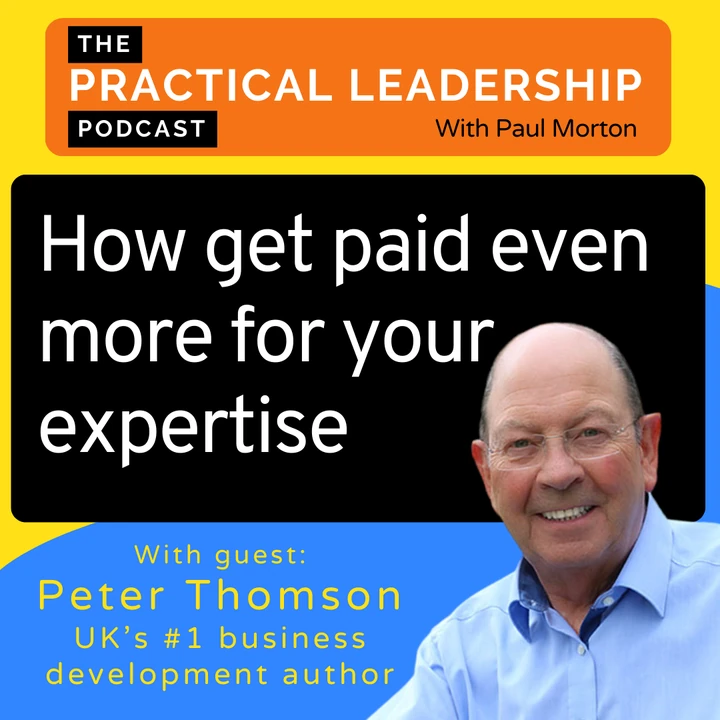
How to get paid even more for your expertise
with Peter Thomson
Show notes
Peter Thomson is the UK’s most prolific business development author with immense experience in the field.
His story is fascinating as thought he had he retired at 42, only to have to reinvent himself when the sale of his business went pear-shaped.
We have an enlightening discussion about the profound impact of personal identity on one’s level of success.
It’s a concept that people will “never consistently do who they are not.”
This understanding will frame much of our discussion and the insights shared.
We delve deep into the role of identity in personal development, particular in training. The conversation reveals how our identity shapes our values and beliefs, and ultimately determines the long-term change and success we achieve.
Peter shared his perspectives on how training should be viewed and approached.
There is an emphasis on understanding how to align the skills, knowledge, and expertise we’re teaching someone with who they are.
This revelation is based on the understanding that people are consistent with who they are, and tend to resist who they are not.
So the efficacy of training lies greatly in how much it resonates with the person’s identity.
This information would be incomplete without giving a synopsis of Peter’s insightful book ‘PAID’.
It provides guidance on how to leverage the discussed concepts, the keywords being: pricing oneself appropriately, positioning as an expert, providing valuable content, and growing a client base. How do you ensure you’re paid what you’re worth?
Then we dig into strategies for execs looking to move from formal employment to independent consulting.
Peter gives a detailed explanation of a successful approach, from the importance of providing incredible value, to setting the right price for the value delivered.
There’s a lot to learn here.
We also talk about ways you can expand your client base, with emphasis on optimising your referral process.
Rather than focusing on irregular referrals, setting up a systematic referral process tremendously boosts growth. The keyword for a successful referral system is personal introductions.
Find Peter here:
————————————-
If I can help with training or coaching your management team – get in touch: https://leadershipthatsells.com/
Transcript
Automated transcript. Speaker labels and spellings may contain errors.
Paul
Private investigator, car phone salesman, retired at 42 then it all went down the drains. The UK's most prolific business development author. [upbeat music] Hello and welcome to the Practical Leadership podcast. I am your host, Paul Morton, and we are talking about leadership, management, and the various lives that surround it. It's my joy, delight, and privilege to bring into my studio some of the smartest, wisest people I've been able to find for your delectation and enjoyment. And I hope that you do get a lot out of the conversations that we have here. When you realize that your management team has grown too fast or you've inherited a new team, and the fastest, best lever you have for growth and improvement is attached firmly to those managers, get in touch.
I help you run management, coaching, and training programs that'll make a big difference really quickly. You can find me at the Practical Leadership Academy website and on all the usual social channels. [upbeat music] The UK's most prolific business development author, Peter Thomson. Thank you very much indeed for joining me.
Peter Thomson
I'm absolutely delighted, Paul. Thank you very much indeed. I'm happy to be here.
Paul
So people will never consistently do who they're, who they aren't. What does that mean?
Peter Thomson
Isn't that a weird expression? I'll tell you where it came from. Some years ago... I've been in this sort of business for a long time, helping coaches, consultants, speakers, trainers, business owners to be more successful. But I was in business in what we call real business, if you like, years ago, and I built and sold a business for a few bob. And I was thinking about, um, 30-odd years ago, I was thinking to myself, "Why is it that some people never succeed to the level of success that their level of skill says they should?" And I was sort of pondering it, and I came up with this idea about identity and realized that firstly, that people will consistently do who they are. But the converse of that is that people will never consistently do who they aren't. So be- perhaps the question, who are they? So who somebody is, is their identity, their beliefs and values and various other things, but basically at the identity level.
And there's a wonderful expression that says long-term change happens at the identity level. So one of the reasons that training, and I was doing some training stuff and consulting and coaching. The reason some of that stuff does not work, not for me, but for everybody, is that we don't align the skills, the knowledge, the expertise we're teaching somebody with who they are. So this is the skill, and this is who they are, and it does that, it doesn't do this. Hmm. So part of the reason that we can get training to work is to make sure that we're questioning at the identity level who somebody is, and we're aligning what we're asking them to do with who they are. Why? Because people will consistently do who they are, but they won't consistently do who they're not. So that's where that expression came from because of my fascination with how do you make training actually work.
Paul
Hmm. I think, um, we're already talking the same language. I like that very much.
Peter Thomson
Good.
Paul
Because th- there's no way to get somebody to do something that they just don't believe in. As you said, it's values, it's beliefs, it's all that.
Peter Thomson
Yeah.
Paul
And you get so many companies these days who say that their values are X, Y, and Z that they've pulled out of some corporate rubbish dictionary thing.
Peter Thomson
Yeah.
Paul
That's not my values. My values come from my mother. You know? Come from faith, come from your life.
Peter Thomson
Yep.
Paul
It's all-
Peter Thomson
Absolutely. Absolutely. I couldn't agree more, and, and it's just so important. And I actually, at the time when I developed that, I created as an acronym to sort of understand for myself, and then I could share it with people how I thought it actually worked. And then I learned something 20 years later and went, "Wow, that's the same thing." Th- "Oh, this is..." Another guy, I thought, "Oh, this is wonderful. This worked. Let me share it with you." So the acronym I created was WEALTHY, and I said this, "So what is it that makes people do what they wanna do?" So I said, firstly, it's the words. It's what they say about themselves inside their mind, outside their mind to other people, and what they believe from other people. So you and I know people, Paul, who say they can't do maths. They're no good at ren- mental arithmetic.
And what's true about it? They aren't. And we know people who say they're always late. And what happens? They're always late. It becomes a self-fulfilling prophecy. So the words we use do something in our minds. And for me, what they do is they encode our belief pattern. In other words, what we believe about ourselves and the world. So that encodes belief. So what does that give us? Well, it gives us our attitude, and our attitude has two sides of it, which is in look and out look. How we look at the world. Are we positive? Are we negative? How we look at ourselves. Uh, we have a growth mindset, as it's called these days, or a fixed mindset. I know I'm very much on the growth mindset, positive and all that type of thing. So words encode belief gives you the attitude which gives you, and I prefer the American, uh, pronunciation, leverage.
So you get leverage, which is a way and towards motivation. I mean, there's only three reasons we take action as humans. It's either we don't want that bit, or we do want that bit, or it's reflex. You know, a tree starts to fall w- towards us, we jump out the way. I mean, it's just reflex. And of course, another word for reflex, which a fantastic word when it comes to doing things, is habit. A reflex is a habit that built over time. So that's... So we've got words encode belief, attitude, leverage, have a way and towards, which means we take action. And when we take action, we have a result, and who's it down to? You. So words encode belief, attitude, leverage, take action, have result, you. WEALTHY. And then years later, I saw Robert Dilts' pyramid. The Dil- what's classically known, the Dilts pyramid, which was the identity at the top.
Next level was beliefs and values. Next level, skills and capabilities. Next level, behavior. Next level, environment. Now, that's exactly the same as what I was just saying. That's the same as WEALTHY. The same as my process. I looked at that and went Wow, this Robert Dilts is clever. He knows the same things I know. But I'm, I'm playing, but you got the idea. And I went, "I love it. It absolutely works." And so one of the reasons that training and various other things don't work is that we're not addressing the identity level for somebody. We're only talking about behavior. Well, behavior's only level two. You know, there's the bottom level, your, your environment, your results, and if that's not working, what do you do? You look at what you're doing to achieve that, and that's where most training is, it's at the behavioral level.
Paul
Mm-hmm.
Peter Thomson
Great, but it, it fades. It just fades away. It's a hot bath, isn't it, you know? You've got the idea.
Paul
It's not a habit. And how do you create habit? I mean, what, what's the thing? It's ... I think it's Seneca, "We are what we repeatedly do."
Peter Thomson
Exactly. Ex- exactly right. And, and Earl Nightingale said it beautifully, didn't he? He said it, "You become what you consistently think about day after day." Badly phrased, but that was his-
Paul
Yeah
Peter Thomson
... mine is, "What you say will be the way."
Paul
What you say-
Peter Thomson
That's my-
Paul
Love it
Peter Thomson
... yeah, what, yeah, what you say will be the way. You know, what the mind of man can conceive and believe, it can achieve. And all the things that you and I know about, yeah?
Paul
Yeah.
Peter Thomson
That's in Napoleon Hill, right?
Paul
Mm-hmm.
Peter Thomson
All of those things are the same. My simple version is, what you say will be the way. If you say you're no good, then you're no good. If you say you're brilliant, you probably will be. If you say you're happy, surprise, surprise. [laughs]
Paul
My wife has a lovely one. She would tell the kids this as well, is that frankly nobody cares if you're happy or sad, so you might as well be happy.
Peter Thomson
Yeah. Love it. Love it, love it, love it, love it.
Paul
So many-
Peter Thomson
I used to ... Go
Paul
... so many people listening to this, both my listeners, you know, hello Mother, are going to be thinking about the joy of work. Now-
Peter Thomson
Yep
Paul
... you've got a job, and hopefully that's going to last a good long time, but we know lots of things. We're getting on in years. We've learned many, many, uh, interesting skills, and we are looking to share them with the world. That, I understand, Peter, is your area of expertise. How do I take what I've learned over the many years of my career and put it in front of people in such a manner that they are willing to pay for it? My definition of an expert is somebody whose knowledge and expertise is sought and repeatedly paid for.
Peter Thomson
Paid. Well, I like-
Paul
Yeah
Peter Thomson
... love it.
Paul
Yeah.
Peter Thomson
Yeah, I like that. Yeah.
Paul
Well, using the name of your book, Paid. Holding it up there, if you're watching us on the podcast, you cannae see it, but there we go. He's holding up a very nice-looking book there, which you can see at thethepaidbook.com. And-
Peter Thomson
Correct
Paul
... cracker. How do I go ... Now, I've been ... Like, use me as an example. Now, you can coach me quite happily 'cause I'll take any free knowledge I can get my hands on. I'm, I'm, I'm, I'm a sponge. So there w- there I was working for 20-nah years, ended up as a fairly senior bod in my company. Well, knowing lots of stuff, rug was rapidly pulled out from under my feet. Now, quite happily, I had put my mind in the right place and was ready for it, and also knew it was coming, and managed to get some decent little consulting gigs, and I'm starting to build. So it would've been three years now.
Peter Thomson
Yeah.
Paul
Starting to build a practice. But what would you say to folk who are in a vaguely similar situation to I was a few years ago? They know lots of things. They want to have the same pay. They want, they want resilience. They want something else just in case. Something to retire on. Something to buy the yacht. Talk to us, Peter.
Peter Thomson
I will do. Okay. So you used a key word for me there in the start of that, which was the word expert. I interviewed a guy. I've done a lot of interviews over the years, 172 of them, and, uh, I interviewed a guy years ago called Roy H. Williams, known as The Wizard of Ads. Genius of a guy, and he taught me one major thing that I added to my knowledge, so useful. And he said, "I believe," and I believe him, "That we've gotta decide whether or not we're looking for the relational client or the transactional customer." Now, I don't deal with transactional customers. It's not my marketplace. So anyone who's thinking of transitioning from being employed to being self-employed, in other words, the place where you have the most control over your life is when you work for yourself. There is no redundancy, you know?
That it's just the best place in the world 'cause you have total control over everything. You become as successful as you want. You earn at the level you want. You get to choose who you work with, when you work, where you work, how you work. You get complete and utter freedom of choice of everything in your life, and I call it building for yourself a business and a life of choice. So if you decide to do that, I believe the best way to do it is to decide at the front you're only going to deal with relational clients. Now, relational clients look to the supplier, me and you, um, and anybody else, to be the expert, and it's not a transaction, it's a relationship. And so as the expert, you have to walk like the expert. You have to talk like the expert. You have to have a book, like experts have books, right? Why? Because when you're an author, you immediately trigger three other letters, I-T-Y.
Author, I-T-Y, authority. So you become an authority in your marketplace if you have a book, and you can have a book that's small and short and whatever. Some of my books are 60 pages, right? They're, they're this, the perfect reading thing. Takes about an hour to read, and you can great information in there. So decide who you want to deal with. Secondly, never, even though you frame it this way, never charge for, for your time. Charge for the value that you deliver. Because if you focus on value rather than on time, then you're not gonna compete on time. You might quote it as time. Somebody might say what your day rate is, and you're not gonna answer that question anyway 'cause you're gonna say you're gonna find out what it is that they want.
'Cause they either want a problem solved, w- based on your expertise, your knowledge, your experience, your expertise, and by the way, your take on it, which I'll talk about in a moment, or you're gonna capitalize on an opportunity they've got and show them how to maximize that opportunity for themselves. Now, how do you position yourself in the marketplace firstly as an expert? Do you walk like an expert? You talk like an expert. You have a website, et cetera, et cetera. You have a book, and you have content that you put out there on a regular basis the way you're doing this pod. So you're sharing knowledge with people out there to position yourself As the expert, 'cause people like to deal with experts. So you're gonna share your knowledge, your experience, your expertise, and the important bit, your take on it.
Your take is what nobody else has. It's that bit, bit that differentiates you from the marketplace, and that's where the money is. So this is number one, is to decide on a fee that you think you're gonna charge in the marketplace. And it sounds glib, but it's really true, is then double it. Because you'll have it, you'll have it wrong for sure, right? The number of people I deal with who are coaches and so- speakers, trainers, et cetera, particularly say consultants, and I work with them on a one-to-one or they're part of one of my various programs, and I say, "So tell me what your day rate is." You know the average day rate these days? £1,250, right? A- and immediately that person is throwing away another £245 because no one is saying yes at 1,250 and no at 1,500. Now, you might say 1,495, but for every time- day you charge 1,250 at, it's throwing away 245 quid.
I mean... And if you're doing 100 days in the year, that's £24,500. So that's crackers, you know? So the next thing is you wanna be creating for yourself what's called a category of one. So you wanna be the only person that does what you do. So how do you do that? Well, start charging for your take 'cause nobody else has got that. So you specialize in a particular market, in a particular skill, in a particular outcome, or particular problem-solving, and you position yourself with your book, with your content, with your videos, with your YouTube channel to that one thing, and you become known for that one thing. And then when you become known for that one thing, then the fee rate is different. Let me give you an idea. I have a client of mine that teaches public speaking to C-suite.
Paul
Yep.
Peter Thomson
And he was charging about £1,500 a day. And I said to him, I won't use his name. I said to him, "This is crazy. You are undercharging for the value you deliver," right? And I gave him just one idea, and we changed his day rate, right, from 1,500 a day to 4,000 a day, like that, right? No problem whatsoever. And all I did to him, I said this. I said, "Look, instead of quoting it as a day rate, quote it as a delegate rate. And you quote 395 a day for the training that you do, a day's training. £395 a day, minimum 10. 3,950 quid. Now, if there's five people in the room, it's still minimum 10. If there's 12 people in the room, you get paid for 12 people. So suddenly you've got twel- £4,800 in time. I'm going rounding the numbers up, obviously.
And he did this and, and of course it just works because £395 a day to charge a C-suite executive is, is, is pennies for the impact, the value. Because what I believe we get paid for is the value we deliver and the cascading impact we make in our world. And when we think of it in that way, it's got nothing to do with the hours you put in.
Paul
Hang on. Say that again.
Peter Thomson
It's what you put in the hou- I will. Okay.
Paul
The value we deliver...
Peter Thomson
For the value we deliver and the cascading impact we make in our world.
Paul
The cascading impact we make in our world.
Peter Thomson
We make. If I help a business client make £100,000 extra, that affects him or her, but it affects their family, it affects their colleagues, their staff. It affects the suppliers of that business, so are now gonna supply more. It affects the community because of the tax they pay and the extra money they're gonna spend, and it's gonna affect the money that their staff spend in their communities and their families. And we don't drop a pebble in the pond. We drop this flipping great brick. Man, and the ripples everywhere. It's just amazing. Right? And that's what you get paid for. So don't charge tuppence a day to do it 'cause it's not the hours you put in, it's what you put in the hours. So that's the first thing.
The second thing, if you're gonna go onto this new path of independence, building a business, a life of choice, and this is an absolute must-have, and I've been doing this for 50 years. I've been in business now for 52 years. I know it doesn't look possible, but it's true. Right? 52. And I've been doing deluxing for 52 years. What do I mean by deluxing? When I was first in business, I'd originally worked in the bank and the usual sort of corporate-y life and, and I left, uh, left early, and I became a private investigator. And I was specializing with the company I worked for, tracing absconded debtors. And I quickly decided to go on my own, and I started a tracing business many years ago. And within two years, we were being asked to trace, this is the real figure, Paul, 4,000 people a month.
Because I was concentrating on corporate clients who were-- had bad debts because they'd lost the people who'd run away with the TVs and the radiograms in those days, and shopkeepers, and I specialized in shopkeepers. And one of my first clients was Cadbury's, what became Cadbury Schweppes. And I just went to them and said, "Send me the missing people that your other people have tried to find and can't, and I will do it for you on a contingency basis. If I can't find them, I won't charge you one penny. But if I can, I charge you my fee," which was £4 [laughs] would you believe? That's how long ago it was. Because I knew if I found a certain percentage, I could make £4 work. And of course, I could find them. That was my game, you know. And so I gave them as a client, then I gave them Schweppes, and then Career as Rothman and Imperial Tobacco, and all the people who were looking for the same people. And that's how I built that up.
But apart from charging the £4 to find them nothing if I didn't, I had a deluxe version, which was £25, win or lose. And that was for clients that trusted me, which they did, to spend more time and effort finding somebody where the debt was high enough to justify that investment. And ever since, I've done deluxing. So as a consultant, I would say to a consultant, "You must have a deluxe offering," and probably a double deluxe as well, but you must-- from the start, you must have a deluxe offering. What, what do you mean, Peter? Well, I- The normal offering you have is this. You do this for somebody, great. And the deluxe one is they get more time with you, or they get follow-up, or they get material, or they get this, or they go poaching on the back end of the training or whatever it is.
You create a deluxe offering. Why? Well, firstly, you've got to contrast your normal pricing, and secondly, you'll find that a certain percentage of your clients will go, "I want the deluxe." In fact, when I show this to people, they come back to me and say, "I can't believe how many people say yes." Right? And your deluxe wants to probably be about two to five times more than your standard. So going back to your original question, and you gather I will talk all day, is that if somebody's thinking of that transition, and then they start off by saying, "Right, I'm only dealing with clients. No customers, only clients. I'm gonna set myself as is the expert. This is what I'm gonna offer the market, my knowledge, my experience, my expertise, my take on it, and here's my deluxe offering."
Paul
That's not a bad starter for 10, I think, Peter. Okay. So I've got my idea of what it is I can do, and I'm an expert in a particular field. The thing that I deal with is I help executive teams and managers with the, the foundations. Uh, my, my definition of excellence is the basics done very, very well repeatedly.
Peter Thomson
Like it. Like it.
Paul
So I help management teams, uh, understand really what it means to be a manager of people. 'Cause these days people quit a company because the relationship they don't have with a manager that they wish they did because their managers just don't know how to do the job they've been asked to do. That's what I do.
Peter Thomson
Good.
Paul
I do it very well.
Peter Thomson
Good.
Paul
I charge them a lot of money for it. But that's my idea. So I've got my idea. I've made my interwebsite. I've got my YouTube videos. Everything's going out and humming along. How do I go and find my first clients?
Peter Thomson
I, I knew you were gonna ask that question. I'm gonna show you. I'll just get up and get something to, uh... So this is what you do, is you write a book.
Paul
Okay.
Peter Thomson
And you write a book that's this thin.
Paul
All right. It's a very thin book. Peter is holding up a book that looks like it's a, it's... It's called... Do you know what it reminds me of? It remi- reminds, reminds me of the thickness of something like The One Minute Manager.
Peter Thomson
Correct.
Paul
Million copy bestseller.
Peter Thomson
Ken Blanchard.
Paul
Million copy.
Peter Thomson
Yeah, absolutely. Ken Blanchard, One Minute Manager, a wonderful story, and built on a story. Very simple. This book has 67 pages, and it's called How to Write a Book for Your Business in Just 10 Weeks or Even Less: Attracts Clients, Increases Your Reputation, and Makes More Money. And who's it for? It says across the top, "Coaches and consultants." Right?
Paul
Yeah.
Peter Thomson
So what you do is you create a book, which is a simple process. It actually explains it in this. And I'll show you how somebody can get that for free, by the way. So you create a book, and then you advertise that book in the marketplace in which you want to be. Let's say you're gonna use LinkedIn, and you're going to advertise it with a post, with an article, with connections, with an aid advert, and you're gonna put it out there aimed at your marketplace. And so... And what's important about it all is the title. The title must speak to three things. The person you're talking to. So this says across the top, "Coaches and consultants," so it's pretty obvious who it's for. Yeah. It says it implies that it's either a problem or an opportunity. So this talks to the idea that most coaches and consultants will have thought at some stage in their life, "You know, I really ought to write a book." They'll have had that thought.
"I should write a book, position myself in the marketplace," and I agree with it. And then it tells you there's a solution. So how to write a book for your business in just 10 weeks or even less. Now, to give you an idea, this isn't me being a smart aleck. I actually wrote the original copy of the book, which was this one, How to Write a Book for Your Business in Five Days or Less, right? But people don't believe five days, so I had to use a little word you may not have come across. You might know it. Verisimilitude, which means having the appearance of truth, right? So your marketing must have verisimilitude, must have the appearance of truth. So I changed it to 10 weeks 'cause it's more believable, but I actually wrote it. I actually did the writing in 80 minutes, 'cause all I did was a webinar on this topic, and then I had it recorded, transcribed, and edited, and that was the book.
Paul
Love it.
Peter Thomson
Isn't it? So you do... You, you create a book that speaks to three things. The person, the problem, the possible solution.
Paul
Mm-hmm.
Peter Thomson
And you put that in the marketplace, and anybody who matches those three things that goes, "Oh, that's me. Oh, I've got that problem. Oh, you can solve it for me. I'll have that book, please."
Paul
Mm.
Peter Thomson
And you give, you give the book away for free, not a PDF. You can do PDFs if you like, but you get this book and you put it in the post, and it's gonna cost you about £5 to £6 to print it, package it, send it, stamp it, put a letter with it.
Paul
Physical book.
Peter Thomson
It's gonna be-
Paul
Love it.
Peter Thomson
I mean, that's a physical book. Why? 'Cause people download PDFs. They keep them-
Paul
Love them
Peter Thomson
... on the front screen of their computer. They never read... Well, they read them occasionally. They don't certainly read all of it, and they don't read it in the order you want them to read it in, and they don't get to where your message is 'cause you've buried it on page 40, right? [laughs]
Paul
Yeah.
Peter Thomson
So it just makes sense. So you get the book in the post. And you put it in... Let me just get a hold of one of these. If I could just quickly find one. It won't be a moment. Difficult problem when I can't. Well.
Paul
[laughs]
Peter Thomson
Can't quickly see. But my, my book goes out, um, it goes out in a Jiffy bag, and on the outside of the Jiffy bag it says... It's red Jiffy bag for the paid book, and it says on the front, there's a space for their name. It says, "You're about to get paid."
Paul
Oh, very clever.
Peter Thomson
Right. So that's what lands on the mat. So you make that a bit different, and you go out there aimed exactly at your market. So with the paid book, this doesn't... It appears not to say who it's for, but it actually says it as a testimonial. It says, "A must-read for anyone who charges fees."
Paul
[laughs]
Peter Thomson
That's who it's for.
Paul
Yeah.
Peter Thomson
It's really clear who it's for. Okay? So you put that book out in the marketplace, and then people will put their hand up and go, "That's me." And then you have a follow-up process because you ask them to go to the website to fill in their details to get the book. So you need the name, you need their address. All that builds your list, and you need their email. All that builds your email list, and you ask for the phone number.
Paul
Mm-hmm.
Peter Thomson
And those who feel they can trust you will put their phone number in, and those who feel they can't won't, and you don't want to talk to them anyway.
Paul
There you go.
Peter Thomson
Now, most people will say to you, "Don't, oh, don't ask for the phone number. You'll reduce the response rates." That's what you want.
Paul
Good point. Yeah, totally. Oh, yes. I'm all for it.
Peter Thomson
You want to reduce the response rate when you're doing... You're looking for clients.
Paul
Mm.
Peter Thomson
If you're looking for customers to buy your book and your products and all the rest of it, you want as many as possible. That's different.
Paul
Yeah.
Peter Thomson
If you're looking to have a conversation, meaningful conversation with somebody 'cause you're doing this transition to be able to sell your knowledge, experience, expertise, your take on it, you need a phone number, right? Now, you might be able to find the phone number on LinkedIn or a bit of trawling around, but why not ask them? Why would you do that? Because it gives them an opportunity to say three words: "I trust you."
Paul
Mm.
Peter Thomson
What a wonderful start to a relationship. They've seen you're an author. They know you're credible. They've landed on your webpage, and they've gone, "I can have this for free?" Of course. Yeah.
Paul
Right. I've got a customer. How do I get-
Peter Thomson
Client. Client
Paul
... how do I... Beg your pardon. I've got a client. How do I turn one client into a business?
Peter Thomson
Right.
Paul
I need more than one.
Peter Thomson
Of course. Once you have decided on the type of client you want and you've created your avatar so you know exactly who you're looking for, the type of person, then you can do outreach strategy on LinkedIn very easily.
Paul
Mm.
Peter Thomson
Right? You connect with people, but don't just connect like a shotgun. You wanna be connecting like a rifle to say, "This is this person. This is the exact sort of person I want to talk to." Secondly, you would have a systemized referral process, not an ad hoc referral process, a systemized referral process. So at a certain point in the relationship with a client when you've offered some benefit, and that's for you to decide when that is, you would say to them with a scripted word that you want more clients. Uh, and who could they refer you to that could give them, that you could give the same benefit to them? And you'd say to your client, you'd say, "Look, what I'd like to do with anybody that you felt I might be able to help, I'd like to send them free of charge a copy of my book as an introduction. Who would you like me to send it to?"
Paul
[laughs] There you go. Referrals.
Peter Thomson
They're referrals.
Paul
That's what we're doing, please. I mean, honestly, I think the two, the, as a revenue leader is what I do as well, outreach is hard these days. Inbound is hard these days. Referrals and partnerships, I think 'cause you lean into trust. You lean into trust. I trust Peter. Peter, who do you know who does a thing? You should talk to that guy because...
Peter Thomson
Yeah. And so let me kinda, let, let me add a little nuance to this.
Paul
Mm.
Peter Thomson
And it's all... For me, I, the way I look at this, Paul, is that we say to ourselves that everything that we do, we go next level. How can I take this to the next level? Oh, I'll have a deluxe version of my offering. That's next level, right? When it comes to referrals, we don't call it referrals. We call it personal introductions. That's the next level. You take it out of the mundane, and you make it special, whatever it is that you do, right? So for example, you don't give people a PDF. You s- you send them the actual book. Now, you can give PDFs. I mean, I give this as a PDF as a bonus with Paid.
Paul
Mm-hmm.
Peter Thomson
So when somebody gets Paid, right, and they get the Paid book, gets so many templates and bonuses and stuff that goes with it, one of which is a PDF copy of How to Write a Book for Your Business in 10 Weeks or Even Less. It co- it comes in the deal. You get it as a bonus. It's free, right? Because I know for people who want Paid and want to charge fees, one of the things they really need to be doing is creating a book. And writing a book like this seriously is done. You can do it in, it's, [laughs] you can do it in 10 weeks. You really can do it in 10 weeks. It's such a simple process. When you know how to do it, it's, it's a simple step-by-step procedure.
Paul
Mm.
Peter Thomson
Next up.
Paul
All right. I'm gonna go and write a book. I've decided. You've sold me on it. Totally sold me on it. So I've written my book. I've got my referrals.
Peter Thomson
Yep.
Paul
Next. Where do I take it from here? What's the, what's the... Just wrap this in a bow for me then, Peter. What comes next?
Peter Thomson
I will. Okay. Where, where we take it from here is there's just a couple of mindset things we get right, okay? And then the, the first, and then how we do the money bit. So the first bit with the mindset is this. Number one, we learn how to sell. We gotta understand the process of persuasive communication, but then number two, we have to stop selling, and we allow people to buy, and that is just a mindset change that's, uh, so simple to say in a couple of seconds, but once somebody gets it at a visceral level, their life will change forever. Learn how to sell. Stop selling. Allow people to buy. You don't wanna go around trying to convince people. You wanna go around being convincing. Totally different business, right? Not trying to convince somebody.
I don't mind if we do business. I would love to. I care, but I don't mind, right? You know, one new client isn't gonna make a difference to my life. I mean... And we have to think that way. We've got to be strong about this. We have to live in a little village just south of arrogant, right? Not north of arrogant, just south of arrogant, which, which is north of confident, by the way. Okay? So you gotta, we've gotta be sure of what we can do 'cause we're confident about the efficacy of what we do for our clients. We know it works. It's when, up to them whether they work. So we're not trying to convince people. The next thing is we've got to go through a stage of slowly but surely increasing our fees to the point where people say no. And I think most people struggle to find that when they know how to do this.
So we've gotta get charged for our knowledge, experience, expertise, and our take on it. We've gotta position ourselves, and then we need to simply say, "Well, what would be the right level of income?" And for most people, when they hit 20,000 a month as a consultant, and they're doing about 250 a year, they're going, "This works. This works." They're not having to work all the hours, right? Because they've got their things right. They got the pricing right. And if you think of it at the start, let's say that you had ... You were charging two and a half thousand a day. You need eight clients. I mean, you need eight clients. You're dealing with two clients a week. You know? If you got eight clients and they're paying you two and a half thousand a month because you're providing fantastic value, you're adding backup materials that they never got from anybody else, you've got this deluxe version running for them.
They love you to bits. They refer you to people. 'Cause here's the mistake as I see it, Paul, is this. If you were talking to me about a client, a, a consultant you'd use, and I said to you, "Was he any good?" And you went, "He was fantastic," or, "She was fantastic. She's fabulous." "Uh, did you get great benefits?" "Oh, brilliant. I made a fortune." "Were they expensive?" "Oh, no. They were cheap as chips." You wouldn't say that. You, you wouldn't wanna say that. You'd wanna say this. "Were they expensive?" You'd say, "Peter, hell yes, they were expensive, but boy, were they good. They were worth every penny." That's the referral you want.
Paul
Mm-hmm.
Peter Thomson
Well, you don't get that if you're cheap as chips 'cause people don't refer cheap advice.
Paul
Mm.
Peter Thomson
They re- free advice and expensive advice, but cheap doesn't cut it. Yeah. I never do cheap. I'll do free. You know, I remember a client asking me to run his, uh, award ceremony for him, and he said, "But Peter, we, we, we can't justify your fee to come for the hour." I said, "Not a problem. I'll come for nothing." And he said, "What? For nothing? Do you ... Don't you want expenses?" I said, "No, not a penny. Feed me. Feed me on the night. That'll do." 'Cause it's either free or it's the fee.
Paul
Mm-hmm.
Peter Thomson
That's the way it's gotta be, isn't it? So this is then, you decide what it is, and then you set your stall out in that way. And how many clients do you really need? 'Cause if you think about it this way, the more time off you take, the more money you tend to make because you know you gotta make it in a shorter period of time. [laughs]
Paul
[laughs] It's true. It's true. Uh, actually, it was one of the things I discovered having children-
Peter Thomson
Yeah
Paul
... was exactly how much I could get done in how little time. I think my wife and I, we say to each other, If we'd known that, how effective we could have been, we'd be running the world by now.
Peter Thomson
[laughs] It's like that. Yeah. Well, I've got four sons. I, I understand. [laughs]
Paul
Oh, my goodness. My goodness.
Peter Thomson
Mm.
Paul
Right. Let's wrap this up then, Peter. Do you have a last takeaway? If you had to write something on a billboard that the entire world would see, what would it say?
Peter Thomson
Excellent. I, I would say, and it's a reiteration of something we said 'cause it's the most important point, make sure that when you are thinking about your fees, that you are charging as a professional, just the way a surgeon or a top-level doctor would because that's who you are like that, and you're charging for the value you deliver and the cascading impact you make in our world. And if you do that, you build for yourself a business and a life of choice where you get to choose everything. And if that's not the way to live, I don't know what is.
Paul
Thepaidbook.com, go there. I'd highly-
Peter Thomson
Right
Paul
... recommend that. Where else can we find you, Peter?
Peter Thomson
Get that free. That's, that's the place to go. That's the best place to go. That's the best place. Go and have a look at Paid. It's, it's, it's 20, it's 20 pounds. I think it's £19.90 and you get... It comes in the post, and it's, it's fantastic. People come back to me and say-
Paul
Mm
Peter Thomson
... "It's the hardest book to read." Why? Because they get an idea, they start taking action with it, and then suddenly that's working. I mean, I struggle to get time with some of my clients 'cause they make so much money and are so much more success- I'm being serious, right? That they struggle to book the time to do the next level. Right? That's, that's the best place. Uh, go get a copy of Paid. Get the, all the bonuses that come with it. Learn how to write a book, and you've lit the fuse. Trust me.
Paul
Fabulous. Mine's in the post. And watch this space when I've written my book, which will be fabulous 'cause I'm gonna copy and, uh, steal all the best ideas from Peter Thomson. Thank you very much indeed for joining.
Peter Thomson
My pleasure. [upbeat music]
Paul
And that's a wrap. I hope you enjoyed the show. Thank you for joining me. If there's ever anything I can do to help you on your journey, then do please reach out. You can find me on LinkedIn and all the usual sources. Do please subscribe, leave me your five-star review, and most importantly, get in touch with your comments and feedback. It's really how I grow, and that's what I'm doing this for. Thanks again. [upbeat music]