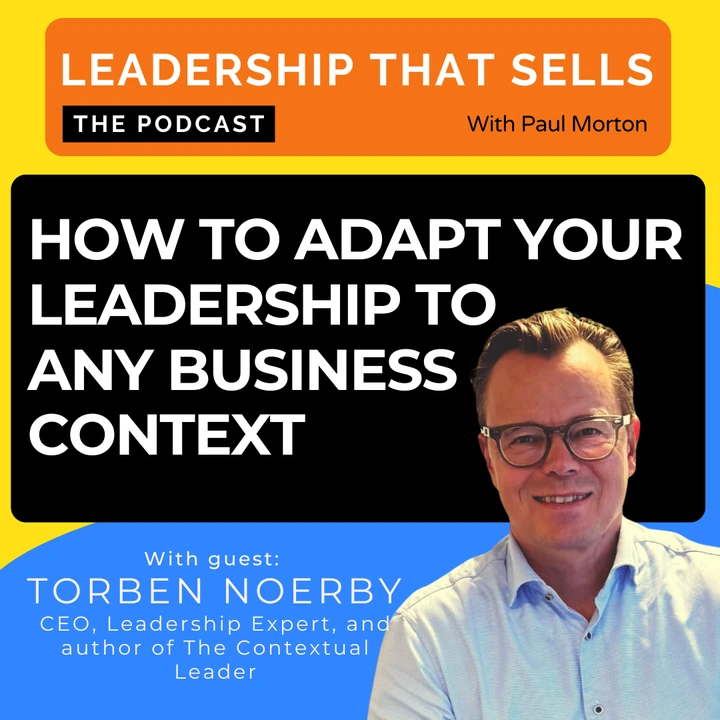
How to adapt your leadership to any business context
with Torben Noerby
Show notes
In this episode of Leadership That Sells, I sit down with Torben Nurby, former Danish military recon captain, leadership expert, and author of The Contextual Leader. We dive into the crucial difference between situational and contextual leadership—why understanding the broader business environment is the key to leading effectively. Torben shares his insights on how to diagnose before acting, shape organizational culture for success, and align leadership approaches to different business challenges. If you want to stop leading with a one-size-fits-all playbook and start making a real impact, this episode is for you.
How to lead effectively in different contexts:
- Understand that context sustains performance—it’s not just about reacting to daily situations.
- Before making changes, assess the external complexity and align internal structures accordingly.
- Set the right guardrails—structure teams, decision-making, and processes to enable the desired behaviors.
- Adapt leadership styles to match the organization’s stage—a turnaround requires different leadership than a high-growth startup.
- Identify and leverage subcultures to drive performance instead of seeing them as obstacles.
- Diagnose first—prescription without diagnosis is malpractice in leadership too.
Timeline summary:
[01:15] – Torben’s journey from military recon to leadership consultancy and authorship.
[06:45] – What is contextual leadership, and why does it matter more than situational leadership?
[12:20] – A real-world example: How one leader turned around a struggling furniture company by reshaping its context.
[19:30] – The role of subcultures in performance—how to harness them instead of fighting them.
[25:10] – Why great leaders don’t come in with pre-set solutions but instead analyze first.
[31:00] – Universal leadership traits: Authenticity, relationships, and adaptability.
Links & resources:
- The Contextual Leader by Torben Noerby
Enjoyed this episode? If you found value in this conversation, please rate, follow, and share the podcast with fellow leaders. Your support helps us continue bringing expert insights to help you lead first and sell more!
Transcript
Automated transcript. Speaker labels and spellings may contain errors.
Paul
Former captain in the Danish military, recon. Recon.
Torben Noerby
[laughs]
Paul
Founder of an international people performance consultancy, leadership expert, and now author, Torben Noirbøgh.
Torben Noerby
Mm-hmm.
Paul
Thank you very much indeed for joining me.
Torben Noerby
Thank you very much for having me, Paul. That's a, it's an honor. Thank you.
Paul
Welcome to the Leadership That Sells podcast, where we help you lead first and sell more with great insights and tactics from the best minds we can find. Every leader is in sales, whether you're selling products, ideas, a mission or a vision, and great sales team in particular need great sales leaders. When managers bring out the best in their teams, targets get hit on time every time without stress. But most sales leaders never learned how to lead. They wing it, or they repeat bad habits, and the cycle continues. Sales leaders need practical, real-world ideas that fit their busy schedules, and that's why we created the Leadership That Sells Playbook course. Nine short weeks changes your world. Check it out at the Practical Leadership Academy. And now, on with the show. Now, Noir- we've got to get this right, okay? I was, I was showing off my Danish before, before we were chatting.
Torben Noerby
That's it.
Paul
Noirbøgh, Noirbøgh?
Torben Noerby
That's absolutely, that's spot on.
Paul
No, spot on.
Torben Noerby
That's good.
Paul
Yeah. No, it's good.
Torben Noerby
Yeah, that's right.
Paul
I'm trying to get my-
Torben Noerby
That's right
Paul
... my, my wife to watch Matador-
Torben Noerby
Yeah, yeah. [laughs]
Paul
... but it's really difficult to find an, a series with subtitles in English, right?
Torben Noerby
Yeah.
Paul
Class, absolute class program. Matador, for those of you who are not into, uh, Danish subculture, is a 1970s, 1980, uh-
Torben Noerby
Yeah
Paul
... costume drama series that really gets into the, under the skin of what it means to be a traditional Dane.
Torben Noerby
Absolutely. Absolutely. It really captures the essence of the Danish culture in the, uh, in the early 1930s and, and onwards.
Paul
There you go. Anyway, back on topic. I made a very brief introduction to you there. Your life didn't start or end as a-
Torben Noerby
[laughs]
Paul
... recon sergeant in the Danish military. Tell us a little bit more.
Torben Noerby
Absolutely. Thank you very much. So, um, uh, absolutely right. I, uh, spent the first 10 years of my career in the army. Uh, then I left for corporate life. I worked with change and business transformation in first a retail organization and then globally in a, in a company that, uh, does, uh, heating, ventilation, air conditioning. That led to leaving the corporate world and founding a, uh, consultancy, People and Performance. And having worked with, uh, developing leadership teams and organizations, uh, some eight, nine years, I decided to get a bit more background, and that led to, uh, doing doctoral studies out of, uh, Henley Business School in, uh, the United Kingdom, along with still, uh, running the consultancy. And I finalized that in '21, and as you said, now author. Uh, it took me a couple of years to write down what I, what I actually learned from the global studies.
So, so that's where we're at right now. I'm still the CEO of People and Performance, and I'm enjoying it greatly working with organizations and management teams and so on.
Paul
So you wrote a book called The Contextual Leader.
Torben Noerby
Mm-hmm.
Paul
Right? So leadership-
Torben Noerby
Absolutely
Paul
... in context. Like that. Now t- turn it around-
Torben Noerby
Yeah [laughs]
Paul
... so we can all see it. I'll take a picture. There we go. That's us.
Torben Noerby
[laughs]
Paul
The Contextual Leader, magnificent.
Torben Noerby
Yeah.
Paul
Uh, available in all good bookshops.
Torben Noerby
Mm-hmm.
Paul
And I have to say that con- leadership in context is leadership or s- or bust, right?
Torben Noerby
Mm-hmm.
Paul
You can't come in as, oh, I don't know, the white knight salvation type to a regular running business.
Torben Noerby
Nope.
Paul
You can't treat a regularly running business, uh, as if it's something needed to do a turnaround in. You can't treat a turnaround the same way that you would treat a, uh, a startup, high growth.
Torben Noerby
Absolutely.
Paul
What is leadership in situation, leadership in context? What's the difference?
Torben Noerby
Mm-hmm.
Paul
What are you talking about the difference?
Torben Noerby
So, um, you can say that the, uh, the context are, has a significant influence on performance and engagement in the organization and on which leadership practices are actually effective. Um, and then the situation shifts from day to day, from person to person, from week to week, so that fluctuates at a shorter horizon, the situational leadership approach. And all of that is embedded in a context that sustains a past dependence in the organization. So it kind of sustains a way of operating, and that means that I need to, as a leader, to look at the context because that shapes the force field that sends my organization, my people, my teams in a certain direction. So if I want different performance because I'm changing strategy, I'm doing a merger, I need to start looking at the context and say, "But I want more initiative," or, "I want more diligence so we get higher quality," or, "I want faster response in my organization." And then I need to start working with the organization, their behavior, the processes, how
formalized are they, so that I start scaffolding the performance that I want. So the difference between situation and context is context sustains performance, and it encompasses all of it. Situation fluctuates. It changes from person to person, situation to situation. Yeah.
Paul
Okay. So I think what you're coming to is a framework or a set of, um, guardrails perhaps that would define a leader's, uh, how a leader approaches a set of problems. So diagnoses. You, you come in with, you come in with a set of tools to a job.
Torben Noerby
Yep.
Paul
You know, and you, you, if you've only got hammers and everything's nails, all those things. But you come in with a set of tools. So you come in with the idea of contextual leadership.
Torben Noerby
Mm-hmm.
Paul
Uh, it lets you look then at your problems before you start trying to f- fix them, which is, I think, number one problem. You know? Try and find and assess whatever it is you're about to fix before you try and fix it.
Torben Noerby
Mm-hmm.
Paul
Otherwise, you, you take your hammer and you start beating around things, and you realize it, it's all made of glass. Oops, too late.
Torben Noerby
Yeah. [laughs]
Paul
Set of tools, comes in, look at something, assess the context, and the context changes differently than the situation. I'm, I'm no- I'm sorry, I'm still not completely clear.
Torben Noerby
That's okay.
Paul
It doesn't ... Try again.
Torben Noerby
So, so let me give you an example.
Paul
It's me, I'm not ... Yeah.
Torben Noerby
No. So let me give you an example. So the, uh, the context, if I'm in a, in an environment where, let's say I'm in the wind industry, so I'm producing wind turbines, uh, doing that as prode- projects, producing the whole machine and establishing those, uh, either onshore or offshore. That means that I'm operating in a very complex external environment. There's a lot of legislation, there's a lot of different geographies, there's a lot of different ways of financing this kind of project. So that complexity, I need to convert into an internal way of organizing so that I can respond to that complexity. So I need the coordination between legal, production, supply chain, the way we develop projects. All of that I need to reflect, so I got a requisite response to the external complexity, else I can't perform.
So this is the contextual setting. Then we go into a team, and what we're doing right now is something that's totally new for the team. Then I might as a leader need to be more directing, so that means that I'm more kind of framing what are we gonna do, in which order are we gonna do it, and then as we build the competence in the team, I can start sharing that leadership. I can empower the team, and they can start taking their own decisions. So the latter is the situational part of it. The former, the, the complexity, the way I set the organization up, that's the contextual part of it. So contextual leadership ranges from, uh, defining the structure, setting up, do we have a matrix organization? Well, how do we build the interdependency in the organization? Who needs to coordinate with who? Uh, how do we formalize processes?
Do we need to describe them a lot or a little? Do we need to centralize decisions or decentralize them? And within that context, I variate my leadership depending on what's the situation at hand, what's the task at hand, what are the people competencies at hand. So they are two ends of the same task. Uh, but when I influence context, that sets guardrail, guardrails is a good, uh, way of looking at it. So if I set the guardrails like this, so I give them a mandate to make the decisions-
Paul
Yeah
Torben Noerby
... then I need to build a culture of initiative to work with that so that I get empowered action in the front line. And then that, that's not situational. That's building that up to a level where that's the way the organization performs, and then the situation can fluctuate and shift and all that stuff, but now I've created the guardrails and the carrying wave of empowered action in the front line.
Paul
Okay, okay. So this, I think it comes down to alignment then, doesn't it? You're aligning the, your leadership style to the team, to, to the organization, the organizational context.
Torben Noerby
Correct.
Paul
Now you're matching your leadership to the organizational context.
Torben Noerby
Right.
Paul
Can you give us a concrete example? Give us something you've done that would actually say, "This is what happened. This is the le- lessons you can take away."
Torben Noerby
Yeah. So I can give you, so we have in contextual leadership, we've got those two disciplines, matching the context to lead effectively-
Paul
Mm-hmm
Torben Noerby
... and then shaping the context to set the organization up for performance. So, um, I worked with a company that, uh, I would say a, a producer of, um, simple furniture. You know, the things that you buy in IKEA, somewhere like that, and then you put it together yourself, and that's not always working really well, but ready to assemble, uh, furniture. So, uh, the leader that I helped and the executive team I helped took over a furniture company that was in dire circumstances. They were not earning money, and they were actually very, very close to collapse, and that meant that they needed to do a turnaround. So they looked at the external complexity. The external complexity has grown over the years because the sales force had introduced more and more vari- variations, and they had entered more rooms, so not only the living room, but also the bathroom
and the kitchen, and started producing furniture for that. And the way that the sales force were interacting with the customer was that they introduced more and more variations. That meant that that complexity l- ended up in the production, in the supply chain, in all the administration, in all the pricing, and that made it very cumbersome, very slow. So what Tor did, that was the leader of, of the, he needed help to decipher, what are the real value drivers, and how do I simplify this complexity so we can align and formalize the processes, reduce the variation, get the quality up, because when you've got a lot of complexity, you do a lot of mistakes. So what he did was that he deselected two rooms out of the bathrooms, out of the kitchens, only living room. That removed a lot of legislation on security for kids and, and all that stuff. It removed a lot of variation.
That allowed him to streamline the supply chain, the production lines into the organization. That required that we re-educate the sales force. That required that we changed, formalized the contracts more because we were changing from an outside in to an inside out perspective, and this is shaping the context. Now, in order to lead this, the, the, uh, leaders in, throughout the organization needed to move from a very opening- Leadership style, they allowed all the variation, they, uh, took up new ideas, they, they invited customers into brainstorming sessions and towards a more closing leadership approach, trying to remove variation, focus on the value drivers, motivate people to repeat so we got systematic, repeated, continuous learning so that we ramped up the efficiency, ramped up the quality.
And you need to move that motivation up with that because they of course thought that they were losing that variation and that customer intimacy.
Paul
Mm.
Torben Noerby
That turnaround took about a year, and he went from really, really red numbers to, to a solid, uh, bottom line, and all of that was because he reshaped the context to match the strategy. And then he adapted the right leadership style to drive that behavior, motivate that behavior, involve people so they started taking over, continuous learning so they became a culture. Discipline, so that if we've written it down this way, that was also what we did. Empowerment, so they took action when they saw deviations. So these three cul- cultural components, that's the reason that it's interesting to work with subcultures.
Paul
Mm.
Torben Noerby
So try to identify the three subcultures. There's a set of 12 components in a culture. Those three, the- these were really the performance drivers. So this is what contextual leadership r- is all about. Look at the environment, look at the intentions of the organization, then you use the word align, then try to make those ducks come in a row so, you know, it pushes directly on the value creation that you want, and mobilize the people, motivate them, make them own that so you build it into the culture. And that's the way you do that. And there are multiple, uh, examples because all senior leaders have this task of organizational alignment every da- every time they do a reprioritization of their strategy, every time they wanna ramp up efficiency or do a cost out or raise quality or go into
a new market, then they need to see, look at strategy, and then align the organizational context to deliver on that strategy.
Paul
Okay, so you're talking about making, making something out of these subcultures.
Torben Noerby
Right.
Paul
Rather than dealing with them, you're looking at them as an opportunity driver.
Torben Noerby
Correct.
Paul
You're looking at those opportunities rather than things you have to squash or challenges you have to deal with.
Torben Noerby
Yep.
Paul
How, how do you then identify them? How do you pick? 'Cause you said there's 12.
Torben Noerby
Yep.
Paul
You got 12 subcultural elements, and to, to discover them all, read the latest edition of the book, available in bookstores near you.
Torben Noerby
Exactly. [laughs]
Paul
But give us, [laughs] give us a handful or give us the idea of-
Torben Noerby
Love it
Paul
... what they are, how do we say, "Aha, look at that. That's one over there."
Torben Noerby
Yeah.
Paul
"I can make money out of that."
Torben Noerby
Yep. So first of all, it's a very relevant question, and almost all senior leaders have found themself in the situation where we discuss culture, so we need to operationalize that. So the first thing we do is that we look at the operating model and we look at the strategy, then we find out what are we driving. Are we driving efficiency and stability, or are we driving innovation and change? And that's not either/or, but that's a mix. And in which parts of the organization are we driving efficiency and stability, and in which parts are we driving innovation and change? Then there is a relation. So if it is innovation, I of course need to say what, what kind of behavior drives that. So that's ideation, opening discussions, critical thinking, con- confronting the way we are doing things, reinventing, experimenting.
And that means that I need to build a strong innovation culture. And some of the components in an innovation culture that are fleshed out in the book based on the global, uh, leadership context study, these are addressable as behavior. That means you involve the team and say, "We want more of this desired behavior. We've got a principle that we want to reinvent ourselves to stay at the forefront of this service or this product." So if we are converting that principle into do more and do less, what would that be? We involve the people, we pull that out, and, and, and then we write that down, and then we start working on it. How do we get more of that? So we act our way into a stronger innovation culture.
Now, that innovation culture, that's related directly to a set of performance behaviors. So we know that we want people that are able to do critical thinking, that experiment, and then I need to look at the processes. So traditionally, when we want to do an investment, we do a business case. We try to calculate re- return on investment. Now, that's thinking coming from efficiency and stability. If I want innovation, I should do a learning case instead. So we'll do this investment in order to learn this and arrive at this stage so we can make a decision on, does this go into pilot or not? So we can't calculate the exact ROI, but what we can do is that we can say, this is the investment box that we set aside for it.
So if you use this thinking, efficiency and stability thinking, if we want to drive innovation, we'll kill innovation. If we introduce too many variations, innovation, into efficiency and stability, we'll kill, kill that. Example, um, now in a manufacturing site, you need to separate the product development and product innovation from the running line. If you do all of that into the running line, you'll do, introduce too much variation and that means you'll lose value. So you separate those. You've mature this enough, the, the new products until they are piloted. That means that if you don't separate that and understand, over here, my leadership behavior is opening behavior, innovation, ideation.
Over here, my leadership behavior is continuous improvement, diligence, quality, uh, discipline. So this is, this is the recognition And most leaders are well aware that if you lead a manufacturing line the same way you lead a hunting service, uh, or a hunting sales force, then you won't have any success either. You, you need to adapt to that, right? So, so the whole notion be- be- behind contextual leadership is to give you a map, look at that map, reflect on what are the key performance drivers that we need to work on, and then choose those two or three so you can offer the organization and the leaders simplicity. But at the senior level, if you do not first look at the complexity, there is a risk that you repeat ways of working you've seen work in one context, and you translate that or transfer, sorry, transfer that to another context where it's not apt,
where it doesn't work. And we see that with senior leaders changing jobs from one industry to another. If they do not first try to find out what are the key performance drivers in the organization I'm getting into, they might be repeating patterns that were really fit for purpose over here. They repeat them in the new context, and then they actually confront some of the value drivers. Yeah?
Paul
I think I see that when you see ... When you're interviewing senior leaders, um, for roles, and you check into their playbooks. You know, "What have you done? When I talk to your last boss, will they say that this is what you've done?"
Torben Noerby
Yeah.
Paul
"What have you done? How did you do it? How would you do it?" Right? 'Cause you won't ... You don't ... Th- this is the context I'm giving you, the problems that I have in front of me here. So I'm, I'm on the board of, um-
Torben Noerby
Mm
Paul
... a couple of companies, and you say, "Look-"
Torben Noerby
Yes
Paul
"... here, these are the problems we've identified. Would you defect-- What would you do to fix it?" I'm not asking for free consulting, I'm just saying give me your playbook.
Torben Noerby
Exactly.
Paul
And if the playbook is industry relevant or if it's situational relevant, 'cause my understanding is situational, but I'm getting the context now.
Torben Noerby
Yeah.
Paul
The situational relevant and they're trying to translate one to the other, that's valuable, right? But it's not, it's not, uh, game-changing. What I think is game-changing is if their playbook is a set of tools that allows them to first analyze.
Torben Noerby
Right.
Paul
And they, they talk about, "I know how to do a number of things, but I don't know what to do." Right? "I know how to do many things, but I don't know what to do"-
Torben Noerby
Exactly
Paul
... first. So it's going in and saying, "So what seems to be the problem?" And it's like, um, uh, you go to your doctor, and you walk in the doctor's room, and the doctor says, "Have a pill. Nice to see you, too." [laughs]
Torben Noerby
[laughs]
Paul
What? It's diagnosis without ... It's, it's, um, um, prescription without diagnosis. It's malpractice.
Torben Noerby
Exactly.
Paul
It's malpractice, right? Okay. Um, this, we could go on with this for a while, but we, we ... I wanna keep these reasonably short. If you had to pull out some sort of universal trait of a successful le- leader, regardless of context, you touched on a couple of points there. When you've got a background in military, retail, global consultancy now-
Torben Noerby
Yep
Paul
... what are the universal traits of successful leaders, and how could somebody-
Torben Noerby
So-
Paul
... go about developing them? How do you build them? Mm-hmm.
Torben Noerby
So first of all, it's a, it's a relevant and valuable question, and that's also the reason why we, in the book, we start by saying there are some fundamentals, and that's about leadership authenticity. And what are the drivers about lead- of leadership authenticity? Well, that is that you build quality relationships with the people that you lead, and you do that by having a, a high enough interaction frequency, and then you do quality exchanges. So that means that you're really interested, really present, trying to pave the way and e- enable the people that you lead. Then at the same time, what's necessary is that you have a genuine interest in the people, and we don't have the same set of genuine interest in people. We need to find that in ourselves as leaders, and then we need to understand that leadership extends beyond the person-to-person relation.
I need to look at the what are the measurement points, what are the, uh, processes that we set up, how we organize, because that's a carrying wave. That's kind of the play field for the organization. Then I need to lead the people, and that also means that when you ask for universal traits, um, I could challenge you a bit on the traits part because-
Paul
Mm
Torben Noerby
... leadership is a discipline that can be learned. Are there some that have a better starting point? Yes, there are.
Paul
Mm.
Torben Noerby
But in different contexts, it's not the same starting point that gives you the strongest starting point. So very many, uh, leaders in the early career, um, are valued because they're extroverts and, uh, good at communicating. But it's interesting to see that if you get into executives, it's more the analytical skill set that drives performance. So we need to understand also the levels is a part of the leadership context. We need to understand that in some industries, there's also this notion, you know, a good leader can lead anything. No.
Paul
No.
Torben Noerby
You can't.
Paul
Mm-hmm.
Torben Noerby
Because in, in some industries, you need a certain level of functional insight. If you don't have that functional insight, you won't understand the patterns, you won't understand how this plays out. So there's a business acumen that, well, that's not a trait, but that limits your so how far away can I move from the patterns and the pattern recognition that I know? But what we need to be aware of is that the patterns are not industry bound, they're context bound. Example, right now I'm, I'm working with an organization that has a lot of, uh, people, uh, working in trains, so they don't see those people very often. So, you know, you lead them once in a while in a touch point and, and they are all over the place all the time. That's the same for the leader who leads people on large construction sites all over a vast geography. Those are ...
There are, there are denominators. So this is about workforce dispersion. Those are two very different industries, but some of the leadership practices are the same. So that means that if I'm not exercising the leadership practice that fits the context, I will be less effective. And back to the core of it, if I'm not authentic as a leader so that I'm trustworthy in your eyes, if I'm not building that trust, then I don't build quality relationship, and the door to leadership influence is open from the inside. So that means that I need to build that rapport, that social capital with you, and over time, you will allow me that influence, which is basically at the essence of person-to-person leadership.
Yeah?
Paul
It's like, it's like give you permission to do it. Yeah.
Torben Noerby
You, you, you need to open that door. I can, I can take the handle, right, and open it up and then yell in the door, but, but if you close it again, you'll go away and you might do, you know, pay lip service, but you're not really taking it on. And then, and today, one of the, one of the key moves in leadership is that because the external complexity, because the competence levels of the workforce, we have seen a shift towards shared leadership. So in, in, go, uh, 30 years back, there was this assumption, it was the leader that leads. Now, the recognition is that leadership is a collaboration. It's a co-creation between the employees and the leader, and employees can take lead on different tasks.
Yet, we do need a, a leader, a vertical leader that holds the responsibility for orchestrating it. But the more I can empower and mobilize my people to take lead in the different areas, the more agile an organization I get. And the more, the more dynamic the external context is, the more agility I need in the organization. So that's a move, contextual move in leadership from directing to sharing leadership. And if I come from, now we talked about the military before, the military has also recognized we need, in some situations, very directive leadership because it needs to be fast and now and I direct it. But on the other hand, you need, uh, very many units with a high amount of shared leadership where they take the decisions because they're in the battlefield, they see what's going on.
So recognizing, when is it that I move towards directing and when is it I'm moving towards sharing, that's the other lever in contextual leadership. So we've got this open and closing, uh, balance that I talked about before. The other one is the directing, sharing. So that's more to the situational side you asked about before, Paul.
Paul
Excellent. We need to wrap this up, unfortunately, 'cause I'm, I'm abs- absolutely loving this. Um, the book, why did you write it? Where can we find it? What's it all about?
Torben Noerby
So I wrote it because I was challenged by going into different contexts. So I wanted answers. I couldn't get them, so I had to find them. That's why I wrote it. And secondly, I think we need more contextual awareness in the world, and I wanna contribute to that, so in the leadership, uh, area, arena. It's easy to find. Uh, the book is called The Contextual Leader, and if you then go thecontextualleader.com, you'll find the book, you'll find me, you'll find, uh, uh, some, uh, some more resources on contextual leadership. Uh, you can download the first couple of chapters. Um, when you, uh, use the book, uh, you, when you buy the book, you also get a free, uh, trial of the Leadership Context Inventory, which actually measures the leadership context.
So if you want, you know, a shortcut to say, what am I gonna do about it, you fill in that survey and it spits out a 16-page report based on all the knowledge in the book, uh, based on your specific answers saying, "Consider doing more of this. Consider doing less of that," because that's the alignment you need in your organization.
Paul
Excellent. And all the links will be in the description, uh, below in this, uh, episode as well. One last question for you.
Torben Noerby
Mm-hmm.
Paul
If you had one message you could share with the world, 10,000 billboards, you could put them anywhere you like, what would the one message be?
Torben Noerby
So the one message would be that in leadership it is not one size fits all. So forget about all the five steps to success and seven steps and that will work. You need to go contextual, and then you need to simplify that and said, then, you know, lead with simplicity. But there is no one size fits all in leadership.
Paul
We'll take that. Torben Nebbe, author, captain, and chief executive, thank you very much indeed for-
Torben Noerby
Thank you
Paul
... our conversation.
Torben Noerby
Thank you very much, Paul. Was a pleasure.