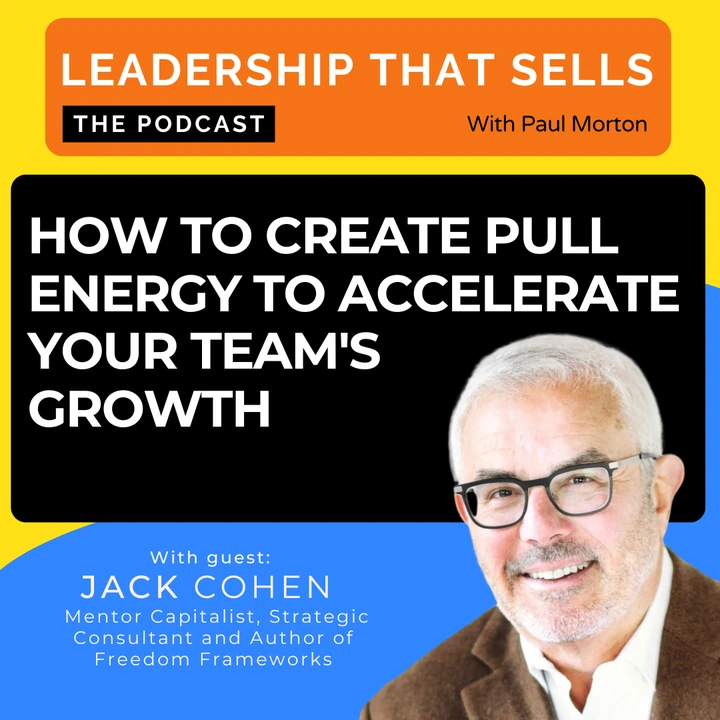
How to create pull energy to accelerate your team’s growth
with Jack Cohen
Show notes
In this episode of Leadership That Sells, I’m joined by the ever-curious and charismatic Jack Cohen — mentor capitalist, strategic consultant, pilot, black belt, and author of Freedom Frameworks. Jack’s story is one of relentless skill acquisition, diverse experience, and a deep commitment to serving others. We dig into what it really takes to grow a team, a career and a company — and it all comes down to tools, frameworks and a very particular mindset.
We talk about how the most interesting people do the most interesting business, why leadership is about creating pull energy not pushing tasks, and how to lead your life (and your people) with intention. If you’ve ever found yourself managing without a clear north star or repeating the same year of experience over and over — this one’s for you.
We get into how to use frameworks to manage yourself before managing others, the reason context is king, and how to turn success into wisdom by sharing it. Jack shares why he wrote Freedom Frameworks, what Batman taught him about business, and how you can use “pull energy” to get your people to move faster and more effectively — and most importantly, in the right direction.
How to create pull energy to accelerate your team’s growth
- Define a compelling vision of the future — not just goals, but a vivid story of success.
- Begin with the end in mind to activate intrinsic motivation.
- Create “pull energy” by connecting people emotionally to outcomes they care about.
- Build context around your content — people act faster when they understand why.
- Apply simple frameworks to manage yourself, then use those to support your team.
- Reframe challenges as opportunities — your language shapes their reality.
Timeline summary
[03:07] – Jack’s Thunderball moment: how James Bond inspired a life of skills, speed and service
[05:35] – The three ingredients of career success: skills, experiences, relationships
[07:10] – Why success without sharing is selfish: the wisdom loop from Jack’s 10-year-old son
[10:12] – Batman as the ultimate mentor capitalist: no powers, just tools and leverage
[12:37] – How Freedom Frameworks was born from mentoring young professionals
[14:58] – “Context gives meaning to content” — and why pull energy beats push every time
[16:02] – Picture your future: how storytelling unlocks momentum in life and leadership
[16:42] – Source activities vs outcomes: how clarity drives effective strategy
Links & resources
- Freedom Frameworks book by Jack Cohen
- Learn more at Dark Knight Ventures
Transcript
Automated transcript. Speaker labels and spellings may contain errors.
Paul
A visionary mentor capitalist, strategic consultant, commercial real estate finance expert with over four decades of experience. He scaled the eponymous Cohen Financial from 200 million to a staggering 6 billion in originations, with an extra 35 billion, with a B, in servicing. He's a master of corporate recapitalization, advising some of the top firms in the industry. Founder of Dark Knight Ventures. Mentor to C-suite leaders, entrepreneurs, high-performance teams, helping people accelerate growth and strategy. And beyond business, he's the author of Freedom Frameworks. He's got a second-degree black belt in Tomiki Aikido, certified scuba diver, CrossFitter, licensed airline transport pilot, and would you believe, a genuine fan of James Bond.
A true industry icon, a lifelong adventurer. Jack Cohen, thank you very much indeed for joining me. Welcome to the Leadership That Sells podcast, where we help you lead first and sell more with great insights and tactics from the best minds we can find. Every leader is in sales, whether you're selling products, ideas, a mission or a vision, and great sales team in particular need great sales leaders. When managers bring out the best in their teams, targets get hit on time every time without stress. But most sales leaders never learn how to lead. They wing it or they repeat bad habits, and the cycle continues. Sales leaders need practical, real-world ideas that fit their busy schedules, and that's why we created the Leadership That Sells playbook course.
Nine short weeks changes your world. Check it out at the Practical Leadership Academy. And now, on with the show.
Jack Cohen
Paul, thank you. And, uh, the real James Bond, you know, Sean Connery. None of those other fake guys either.
Paul
Ah. [laughs] Uh, frankly, f- money penny, your, your plan for world domination is involving some sushi and it's, uh, but [laughs] well-
Jack Cohen
Yeah
Paul
... it's the only-
Jack Cohen
Yeah
Paul
... sort of impersonation I can do.
Jack Cohen
Um, but-
Paul
The thing is, if you can impersonate Sean Connery, you can impersonate a, a, a Russian transport s- submarine captain. You can impersonate, uh, your, your average, uh, war hero. You can impersonate empty ... anybody. [laughs] It's great.
Jack Cohen
Yeah. Yeah, even, uh, The Untouchables and, uh-
Paul
That's it, he just plays him.
Jack Cohen
Right. He play-
Paul
"You bring a, you bring a gun ... knife. You bring a knife, you bring a gun, not Chicago way."
Jack Cohen
Yeah. [laughs]
Paul
We say Chicago West, Glasgow sunshine, you know.
Jack Cohen
That's great. [laughs]
Paul
Um, he was a milkman, did you know that? He was a milkman.
Jack Cohen
I did not. I did not. I remember that he was a, uh, bodybuilder, you know.
Paul
Yeah.
Jack Cohen
Uh, that, that, that's how he got picked up for the movies, I think.
Paul
That's it. That's it. He had the, he had a bit of the muscles. Mad. [laughs] So how did you get a pilot's license? And not just-
Jack Cohen
Well-
Paul
... a pilot license, but an airline, like, a proper commercial job.
Jack Cohen
So, so not to beat the James Bond thing to death, but, um, I had a seminal moment at, at 10 years old when Sean Connery was in, uh, Thunderball. And in Thunderball he-
Paul
One of my favorite-
Jack Cohen
He, he had, he, he had a black belt. He flew an airplane. He scuba dived. And, you know, he was this dashing, debonair kinda guy. And I kinda began my bucket list. And so hence the martial arts and the scuba diving. A- and I started, uh, uh, taking flying lessons way back in 1984. And one of the things, you know, I've never been adri- addicted to drugs, but I can't imagine that, uh, it's any less expensive or harder to shake than aviation. And what happens is, is you start flying more and more, and more complex airplanes, and it costs you more money, and you start getting more licenses. And so the highest license you can get in the United States, I, I assume in the world, is an airline transport pilot license.
And I, uh, fly a, um, light jet, uh, a Citation jet, uh, at 41,000 feet, 450 miles an hour, and I fly it single pilot. Uh, unless my wife or grandchildren are in the plane, they demand a second pilot. I don't know why, but, uh, they're not worried about me dying in the airplane. They're only worried about, how do they get to the ground. So, uh, flying just became one of those things I got addicted to.
Paul
Uh, yeah. [laughs] It sounds very similar to my, uh, interest in vinyl, cigars and classic vehicles.
Jack Cohen
Ah.
Paul
We are attracted-
Jack Cohen
Oh, that's cool
Paul
... to them by, you're attracted to them by the inconvenience and the expense.
Jack Cohen
Yeah. Yeah, it's true. It's funny.
Paul
[laughs]
Jack Cohen
It's true. It's really true.
Paul
Magnificent. Absolutely magnificent. Well, I gave you a, a summary introduction there. What did I miss out? I don't think I missed out much, 'cause f- what the heck?
Jack Cohen
No.
Paul
That's what life.
Jack Cohen
No, no, that, that was a great introduction. I wish w- my mom was alive to hear it. Um, the interesting, uh, thing, you know, it, Paul, I lear- I got two things out of, uh, college. Only two. Uh, an instructor once told me, uh, "Never take a job where the responsibility is not commensurate with your authority. And when you look back at any point in time in your career, do you wanna say that you had one year of experience repeated 43 times, or did you want 43 years of experience?" And, uh, I, I never forgot that. And, you know, we were joking about James Bond and, and the various skills. But the reality is, is I have been addicted to acquisition of skills. I, I tell people, if you're seeking success in any career, there's only three things you need to do, but you need to do 'em every day.
You need to be willing to acquire skills, accumulate experiences, and develop relationships. And, and I think it's as simple as that. And so for me, the whole skill acquisition thing is I really do have 43 years of varied experience. And when I add to that my experience in the real world, whether it's travel or martial arts or flying or rock climbing or whatever it may be, all of those did two things for me. It altered my perspective about interacting with other people. And I also found, especially in business, people do business with interesting people. They, you know, I, I, I don't know a lot of... Uh, I have IT people who come solve my problems, but I, I, I don't know a lot of people seeking out IT people to do business, you know, unless you really know
them for whatever background they're doing. And so, uh, you know, as a owner and operator and investor, as a hired gun, as just another guy trying to help others optimize their journey, that's who I am.
Paul
Mm-hmm. Mm-hmm. I pretty much love everything about what you just told me. One of the things I look for when I hire people, when you... And, and I try to hire people with experience, is differentiating between, uh, extension and depth.
Jack Cohen
Yeah, very good.
Paul
So you've got somebody who's got 40 years of living the same damn day again and again, or you've got somebody with 10 years, but by goodness me, it's been 10 wild and wacky years.
Jack Cohen
Yeah.
Paul
And they've done lots of interesting things. Your definition of success is a parallel to my definition of wisdom, because at the end of success you have wisdom, you have something to do, you have the output of success. There's not a goal, I think, per se. If you chase the goal, you'll never get there, right? You know, it's like saying, "I'm, I'm gonna try and, uh, lose 20 pounds." Well, immediately off the bat you're a failure 'cause you haven't lost 20 pounds.
Jack Cohen
Right.
Paul
If I'm gonna try and have a healthy lifestyle, inadvertently and intentionally, deliberately I'll lose 20 pounds, right? So the success thing, I think, you're talking about acquiring new skills, accumulating experiences, and developing relationships, and my angle in that is you take the knowledge that you are, uh, exposing yourself to, so you gather, you, you accumulate knowledge. You then apply that knowledge in some way, shape or form, uh, and then you reflect upon that knowledge. But then the third... The, the fourth thing, which actually was my, my 10-year-old son came to me and said, "No, I'm missing a trick here," because he spends all of his days in classrooms at school, right? So he said, "It doesn't matter because that's just in your, your head. That's not wise.
You, you... What's the point of being wise unless you share it?" And that piece rhymes with your, your developing relationships. So you then have to get the knowledge, try it out, reflect on what worked and what didn't, and share it. Yeah. That's what makes you wise, and I think that is a lovely corollary to... Not corollary. What's the right word? The, the success parallel. Like that really very much. So you, you talk to people. You've written this book called Freedom Frameworks, right? And of course it's available, and we'll put the link down the bottom of this thing. So Freedom Fram- Frameworks on darkknightventures.net. Subtitle is Infinite Possibilities to Achieve Career Independence On Your Own Terms.
And you're targeting ambitious professionals, which of course we all are, in their first decade of their career, which of course I am not, uh, looking to accelerate their professional ascent. Ascent, lovely word. That's a pilot, that's a climber's word, isn't it? See? Yeah.
Jack Cohen
Right. Right.
Paul
See what you're doing there. You clever man.
Jack Cohen
Right. Right.
Paul
Clever man. So why the book? What drove the book? What's, what's... What are you all about in terms of helping people? 'Cause evidently that's what you do. You're serving, you're helping. Why, for, talk to me.
Jack Cohen
Well, y- you'll, you, you'll like this. You know, your, your, your, your own martial arts background, you'll like this. Um, so, um, I've had a superhero complex, and my favorite superhero is Batman. Why? Batman has no superpowers.
Paul
Tortured soul.
Jack Cohen
What is Batman blessed with? Batman is blessed...
Paul
[laughs]
Jack Cohen
Right. That too. Sick dude. But he had the intellectual and economic resources that he used to create tools to affix to his utility belt so that he had human leverage to help others get home safely. And I thought, what a cool metaphor for a, a, a business, a mentor capitalist business, a consulting business. Dark Knight Ventures, I'm here to help you optimize your journey by giving you tools and human leverage. And so through the years, um, I have, as you can tell, Paul, a little bit of an irreverent personality and attitude. Um, I have been doing, uh, industry roundtables at conferences. I get up to 30 participants and I facilitate a discussion in front of, uh, an audience of people, and I don't know what's gonna come out of my mouth, and it, it all works.
And I had this idea, wouldn't it be interesting to do this with young professionals? And so at one of these associations, I got a closed, uh, um, a ballroom, no audience other than young professionals. They were between 25 and 35 years old, and I started facilitating this discussion. And what I concluded was, after doing this four or five times, that a third of their questions were about career, career development, work-life balance, um, good managers, bad managers. And I thought to myself, isn't that interesting? Um, m- you know, I joke in the real estate business, uh, I'm a, a little older than you, maybe a lot older. When I graduated college, the A students went to medical school, the B students went to this new thing called investment banking, and the C students who couldn't get a job anywhere else went into the real estate business.
And so our industry, um, is well paid for transactions, not for leading, you know, future leaders. And so I have for more than 50 years collecting these, I call them stupid human tricks, but they were really frameworks so that I could, uh, um, be better, faster, and more effective. I didn't think I was a world-class athlete. I was one of those grinders who just liked to compete, and I figured tools, tools, tools. So I said, "Can I curate these?" And I sat down one day and literally inventoried 60 soundbites and frameworks and started building the book out. And then I got a, a, a writing coach and he said, "Well, you have to target this to somebody." I said, "What are you talking about? These are frameworks I use to manage me, to manage others, to manage teams, to manage businesses. This stuff works." He says, "Yeah, I don't care.
You need to target it to a market." So I said, "Okay. I, my gift is to the young professionals, 25 to 35 years old. How can I create a playbook, a workbook, uh, uh, s- a resource for them to go back to and, and y- find tools that- Practice those tools and apply those tools. So it was really all about helping the young professional who had a shitty manager and administrator on top of them, uh, become, have a self career management playbook and a skill for self-efficacy, right? If, if, if I don't advocate for myself, who else will?
Paul
Hmm. If I'm not for me-
Jack Cohen
Yeah
Paul
... who is? But if I'm-
Jack Cohen
Yeah
Paul
... only for me, says I think Rabbi Hillel, "If I'm only for me, what am I?"
Jack Cohen
Yeah.
Paul
So, and now-
Jack Cohen
I like it
Paul
... the for I piece is the service piece that you have to bring yourself. So if you are-
Jack Cohen
Yeah
Paul
... I think served as you are serving, if you are served and you look at that and you reflect and you say, "That was service," then the next step, one would hope, is for you, yourself, to internalize and say, "And I, and I must also serve," 'cause it makes you feel good. It's actually good for your soul, apart from good for the world. So-
Jack Cohen
Yeah
Paul
... thought. Okay. So you've got 60 plus tools, frameworks, uh, stupid human, human tricks.
Jack Cohen
Yeah.
Paul
Rules of thumb. Um, programming language. You know, once you re- once you work out, I think, that we are, uh, somebody called us once moist programmable robots, and you work out what the programming language is, and that you can in fact hack it, you can change how you behave, you can change how other people behave just by using words, concepts, ideas, reframes. I love reframing things. It's, it's very, very powerful. Can you give ... What, what, what is a couple of your favorites?
Jack Cohen
Well, I, I think, um, I talk about, you know, it's funny, i- if you go to the gym and somebody puts on the floor for you a 100-pound dumbbell, and you go try, what's easier: pulling the dumbbell or pushing it? And I think what most people will find is pulling it, right? You've never seen a horse pushing a cart. The horse pulls a cart. Yet we, as human beings, are buried in our current reality, our day-to-day activities, and good or bad, we're doing the best job we can to survive and prosper. How can we create pull energy? How can we begin with the end in mind? And so one of the frameworks, somebody once told me context gives meaning to content. If you and I are at the end of this and you say bow because we're in front of a virtual public audience, we would bend at the waist. But if you and I were standing at the shore at a dock and there was a beautiful boat and you said bow, I would look to the front of the boat.
My point is context gives meaning to content.
Paul
Mm.
Jack Cohen
Wars are fought in content. Albert Einstein said you can't solve a problem at the level at which it was created. You have to go up a level and up a level and up a level until you can find a context that allows you to do that. And so I talk about this in the book. Can you create pull energy based on an intended future that is really a byproduct of your fantasy? And whether or not you're doing annual goals and objectives and we're gonna say, "Okay, Paul, it's January 2025, what do you wanna talk about? What are we gonna suc- uh, celebrate in success in 2026? Don't write it. Just tell me a story." And you're gonna talk about, you know, the beautiful garden or, uh, coaching your son's soccer team or whatever it may be.
And I have found if I can get people to articulate what a, a, a picture of good looks like, it creates pull energy to help them through their day-to-day. You know, entrepreneurs build businesses from, you know, clients and revenues and a current problem. But how many people actually fantasize what the business would be in the future and work backwards to find the milestones that they need to get from point to point? And then is the business about them, or is it about accomplishing this success or this outcome as a team through the efforts of others? And you talked about this earlier in our conversation. What ... Do people know the difference between source activities and outcomes?
Paul
Mm.
Jack Cohen
Right? I do a good job at a, at my job, I get paid, right? You could argue that the money is the outcome, but it's really not. The money is a source activity for what I'm going to do with that money. And, and that thinking, breaking life down functionally like that I think has been, um, eye-opening for a lot of people because we as human beings tend to complicate stuff unnecessarily.
Paul
Mm-hmm.
Jack Cohen
If we could kinda step back and look at it, I have found these are some of the elements that I've talked about in the book.
Paul
That's marvelous. I mean, you, you touch on, I think, what do people call them these days? Is the, is the, you know, if you think it, you can achieve it, that sorta stuff, the-
Jack Cohen
Yeah
Paul
... visualizations and all that stuff. I mean, visualization's a powerful tool. It's a power- powerful technique. I think it was, um, you go to people like Norman Vincent Peale, uh, you go to Jose Silva, you go to Dale Carnegie, all these things. These books from the 1930s that are still in print. Interview With the Devil, magnificent book. 1937 he wrote it. Didn't print it until after his death 'cause he was afraid. He was afraid of the power of it. And having read it, you say, "Wow, actually, yes." They don't allow his books in some US states prisons-
Jack Cohen
Yeah. Yeah
Paul
... because it's, it's such powerful stuff. Uh, and it's the idea of drifting versus intentionality. It's exactly as you say, the control that you can have, these, these stupid human tricks, knowing what you want and working backwards. That makes perfect sense. Okay. Have you done it? Well, no. Hmm. Would you try? [laughs] You know, that's, that... Getting people to, to, to do these things to any degree of mi- microscopic consistency is immensely powerful.
Jack Cohen
Yeah.
Paul
Immensely powerful. Transformative. Okay, so that's, that's saying, that's you talking about, I would say, the foundations to, to the, the Cohen method, right? What I think would be your how-to advice? What would you say? Because I, I do like to try and find a how-to for this. You see, the clue's in the ta- the na- the title of the podcast is Practical Leadership, how to do a thing, right? What would you say is that one? What's the how-to? What do you wanna do?
Jack Cohen
I, I'm, I'm gonna, I, I'm gonna give you an answer that you're gonna, uh, uh, push back on because it's too simple. I think that, you know, people think about investing, right? They think about buying a stock or buying a piece of real estate or buying a business. Why? They have valued the future and current potential of income they'll receive, right? And so people think about that, and if they bought a house, maybe they'll invest in it and they'll improve it. Or if they bought a business, maybe they'll do some coaching and try and improve it. Why don't people recognize that their most valuable asset that they'll ever own is their own earning power? Think about it. If I'm willing to pay 20 times income, right, a five cap, for a government, uh, lease on a building, what would I pay for the income stream of my ability to get paid by others to
support them? And so I really believe if people can invest in themselves, cross-train, educate themselves, play a long game. If they could hold in their mind that they're not looking for a $50,000 raise so that they can do blank, but rather that that $50,000 range, raise may represent 750,000 or a million dollars in self-worth. And how do they enhance, protect, and grow their earning power? You know, somebody once said, Paul, and I used to say this to one of my boys growing up. He was blessed with a lot of natural ability, but not a lot of grit. His brother was the opposite. You'd never seen a guy persevere and accomplish, but he didn't have his brother's skillset to begin with. And I used to say to him, "Life is super hard if you only do the easy stuff. But if you're willing to do the hard stuff, what you're gonna find is life gets easier and easier." And I, I think people have artificial fears of failure because they rationalize their station
in life. But if they... You know, it's like, "Yeah, this hotel, I'll stay at this hotel, but it's a shitty hotel and, you know, I'm, that's all I can afford," right? But would you aspire to staying at a resort instead? Can you approach your career and your capacity to earn lifetime earnings by investing in yourself to expand and bring that reality together?
Paul
So it's recognizing that over time, not even accrued, no, sorry, not, not even compounded, but over time, your earning potential has a quantifiable, objective value. And dialing that back to the present and saying, "How'd I get there?"
Jack Cohen
Right. Right.
Paul
How do I invest myself to get there?
Jack Cohen
Yeah. And, and, uh, you know, the easy example for somebody who's not usually thinking about, you know, buying income streams is, um, the little old lady in Pasadena who's, um, in retirement, right? She has to have a savings of blank at the end of her, um, working career or so that when she is no longer serving another for money, how does she live? And if you think about that, your capacity to be hired by somebody else, an employer or a customer, creates revenue for you. What are you gonna do with that revenue? Are you gonna invest further in yourself? Are you gonna expand your skillset? Are you gonna be more valuable to somebody else? And over time, part of it is putting it in savings, but why are you putting it in servi- savings? Well, be- so that you get interest income.
So can you think of your career as in- you getting paid as in- interest income? All the investment I have made in me is creating revenue for me. How do I enhance that? How do I make myself more valuable to another? How do I get paid more because I am creating more value for somebody else? You know, it's, it, it, it's an interesting... I talk about this in the book. Um, there's a guy, uh, he's running around the UK, a guy the, by the name of Darren Shirlaw, who had a consulting business called Shirlaws. And in it, he created 20 frameworks for small business enterprises, and really brilliant in its simplicity. And one of his frameworks was, um, assets predate income. In a business, whether it's a brand, whether it's, uh, intellectual property, whether it's squatters' rights because you have a barrier, a moat in your business, these assets have to be in place
before you can have income. Why can't we think of ourselves that way? If I am the most valuable asset I'll ever own, influence, and control, how do I enhance that asset to create income for me that I can capitalize on? All meanings of the double entendre there that will provide me for freedom to do what I want with my life, personally and professionally and familially
Paul
The wisest man is he who takes his purse and empties it into his head.
Jack Cohen
Really?
Paul
Yeah.
Jack Cohen
Really. For sure.
Paul
Yeah. That's, that's, I think it's Sulla or one of those, one of those Roman, Greeks. One of them, yeah. There's ... You, you touched on something before, which I think, uh, is, I think it's almost the idea of embarrassment. Fear of failure and embarrassment. I think there are, there literally, there are quite clearly two emotions. There's love and there's fear, and the closer you are to fear, the harder your life is. Fear, fear can, uh, drive and push you, but I think the love side of the c- the equation pulls. And on that side of the equation is service. On that side of the equation is leadership. On that side is all the good stuff. And i- the closer you get to, I think, the, the nirvana of, uh, agape, whatever you want to call it, um,
you recognize that embarrassment isn't a thing, and that there's no, there's no value in being embarrassed. It's purely a status thing. It's purely an internal thing. It's purely a personal opinion on your part, and quite frankly, it's none of your business what people think about you.
Jack Cohen
Right.
Paul
So if you can get over that, and it is something I genuinely have only realized in the last five or so years, uh, as I've been trying to do stuff for myself and not hiding under somebody else's wings as a corporate slave. Um, and I had wonderful jobs and wonderful managers and a lot of good opportunities, but it's not really giving a damn anymore. Just giving, trying stuff out. If it goes horribly wrong, well, people have short memories. In fact, people don't have any memories at all. You ... The, the, the, the person who pays most attention to what you say is you. So if you-
Jack Cohen
Yeah
Paul
... tell yourself that this doesn't matter, if I get it right, great. If I don't, great. It was, um, Jocko Willink, I think it was, or one of those guys, he said, "When something goes wrong, the first word out your brain, swiftly followed by out of your mouth, is good." I didn't get the promotion. Good. Means we get time to get better for the next one. We didn't win that client. Good. Means we can focus on the others, because they're more important. This didn't go well. Good. And pause and find out exactly why it's good. Why is it good? And if you can say good, that means you're learning.
Jack Cohen
Yeah. I, and you know, it, I, I lo- I, I love what, how you laid that out. Um, in the book I talk about somebody once told me, a, a coach I had, um, once told me all events are neutral. The only thing that's positive or, or negative about the event is the story you choose to tell yourself about the event.
Paul
Yeah.
Jack Cohen
So choose your stories well. And, and, uh, I, I had a colleague once say to me around this embarrassment question, uh, "You will stop worrying about what people think about you as soon as you realize how little time they actually spend doing that." Right? So it's all in our head.
Paul
Mm-hmm.
Jack Cohen
I talk about it in the books about dreams and demons, and we all should have our aspirations and, uh, you're using, you know, the good is really finding positive language around a scenario. And I think everyone has, has dreams, and I try and get people to think about their dreams and aspirations as pull energy, right? It's a fantasy that pulls them through. But their demons are tied to resistance, and sometimes it's their wife or their mother or their children or other people who have a vested interest in them staying exactly how they are. But somebody once told me fear is an acronym, acronym for false expectations appearing real, and a lot of people-
Paul
Oh, that's good
Jack Cohen
... that-
Paul
Say ... Okay, say that again
Jack Cohen
... fear, F-E-A-R, is really false expectations appearing real. And we start to worry about an outcome that, that w- we actually have influence and control of before it happens. And so all of this fear and embarrassment, or fear of embarrassment, is our system protecting us, holding us back because of safety and comfort. And, and I, I, I think we all, if we would just be self-aware about it, could chip our- ourselves. Like, to have a colleague like yourself, hanging around somebody who typically their first response is, "Oh, shit, I did it again," to be able to say to them, "Hey, that was good." Good? What are you talking about? I, I embarrassed ... No, you learned something, right? I say bad experience largely comes from bad judgment.
Paul
Mm.
Jack Cohen
But a bad experience you can learn from, which will create good judgment, which will lead to a good experience. If you can have people like yourself, like you, Paul, around them that can help feed the virtuous cycle, we can change the stories we tell ourselves to free ourselves up to live our dreams and fantasies.
Paul
With bells on, I think. With ... Absolutely. Beautiful. Beautifully put. Fear is false expectations appearing real. Oh, uh, what's the other one? Fail, first attempt is learning. Um-
Jack Cohen
Hey, that's great. I like that one.
Paul
I know. First attempt is learning. Fail and fear. Fear of failure, fail and fear. Whoa, that's a new book. Feel there's an entire book in that one. All right. Let's just, let's boil this down. One message. If I gave you 10,000 billboards, and you could write one thing on that for the whole world- There you go. Here's your Sharpie. What are you gonna say?
Jack Cohen
Well, I, I said it ear- earlier, so maybe I get another at bat. I, I really think, um, the billboard I think should be out there is, "Life is hard if you only do the easy stuff, and easy if you do the hard stuff." But, you know, um, in, in preparing for this, you kinda asked is there something that I've changed about in the last few years, so maybe this is a different, um, billboard. I think people like myself, I'm, I'm an engineer by education, I think I'm a problem solver, and I think people like me, people like you, do everything we can day to day to avoid making a mistake. Do you know, Paul, that is not the same thing as prematurely taking a problem in the future and addressing it presently.
There is a... What I've learned over the last couple of years is there is a difference between doing everything you can to avoid a problem in the future, and presently taking a future problem and addressing it now, maybe prematurely.
Paul
That's avoiding your heart attack by changing your diet, even though you-
Jack Cohen
Well-
Paul
... think of thing that's pulling some, uh, personnel thing into the, into the now. That's... Yeah. Hmm.
Jack Cohen
It's, it, it, you know, the, the... Every one of us have... Well, those of us who are old enough to have had children and the children have become the devil called teenagers-
Paul
[laughs]
Jack Cohen
You start seeing-
Paul
In process. Work in process.
Jack Cohen
You know-
Paul
Right now.
Jack Cohen
Right. And but, like, h- parents look at that child and the child does something really dumb and, and you're going, "Oh, my God, he's gonna be in jail. He's gonna be... You know, how did this come out of my system?" You know, all that kinda stuff. Are you really, really wanting to take a future problem that hasn't happened and make an issue of it today? Um, my son, Wyatt, uh, who I talk about in the book, who actually is gonna do the audio, uh, for the audiobook, was 15 years old and he did something really dumb. And I looked at, at him and I just am screaming at him, "What the frick were you thinking?" And he looked at me and he says, "Dad, I'm a teenager. By definition, I wasn't thinking at all." And honest to God, I just started laughing. How do you beat that? But, you know, when we think about, um, "Gee, I don't wanna talk to my, uh, boss about a raise." W- w- why?
"Well, my, my boss is not gonna give me a raise, and then I'm going to feel I have to leave," or, "He's gonna really tell me I'm not doing a good job," and all that kinda stuff. Should you really burn calories about that today, or should you let that play out until raises and bonuses actually happen? I'm not suggesting, um, we don't do a preflight before we get in the plane to fly it. Right? There are things you should do to prevent a problem from happening, but prematurely addressing a problem until the problem has s- fully seasoned, or you have seasoned in order to meet that problem.
Paul
Mm-hmm.
Jack Cohen
Didn't the good Lord say He gives those what they can basically handle themselves? And some of us have shittier lives than others 'cause we're tougher. We can handle it, um, you know, as opposed to those others. So maybe there's an opportunity that, Paul, you or I will involve, evolve into a human that can actually handle the next challenge when we're ready for it, not before.
Paul
So you're trying not to make your life harder than it already is.
Jack Cohen
Correct.
Paul
Hmm. Yes, yes. Um, I mean, you, as you mentioned the scripture there, something like, uh, basically, uh, God's time is perfect, right?
Jack Cohen
Yeah.
Paul
His timing is perfect.
Jack Cohen
Yeah.
Paul
Unfortunately, yours isn't.
Jack Cohen
Yeah. [laughs]
Paul
So row the damn boat and let Him steer, you know?
Jack Cohen
Yeah.
Paul
[laughs] It's just, you row, He'll steer, and it'll... You'll, you'll get to the problem in good enough time. Just don't, don't, don't be in a hurry. Okay. I like that. I like that. And talk about the self-awareness of your son. Wow. "I'm a teenager. Well, I wasn't thinking at all." Magnificent.
Jack Cohen
Yeah, yeah.
Paul
Jack, where can we find you when we need you?
Jack Cohen
Um-
Paul
DarkKnightVentures.net, LinkedIn?
Jack Cohen
Yes. Yes, you can find me on LinkedIn, Jack M. Cohen, and, uh, I am, uh... my day job is as a managing director for a real estate lending platform in the States called Arrowmark Partners, so don't be confused in when you see, uh, the label. But my website is, remember Batman, DarkKnight, two Ks, Ventures, plural, 'cause I got a lot going on, .net 'cause I couldn't get the .com, uh, URL. So Ja- JCohen, C-O-H-E-N, @DarkKnightVentures.com, .net.
Paul
[laughs] And all the links will be in the description below. Jack Cohen, adventurer, iconoclast. All right, good egg. Thank you so much indeed for joining me.
Jack Cohen
Paul, thank you.