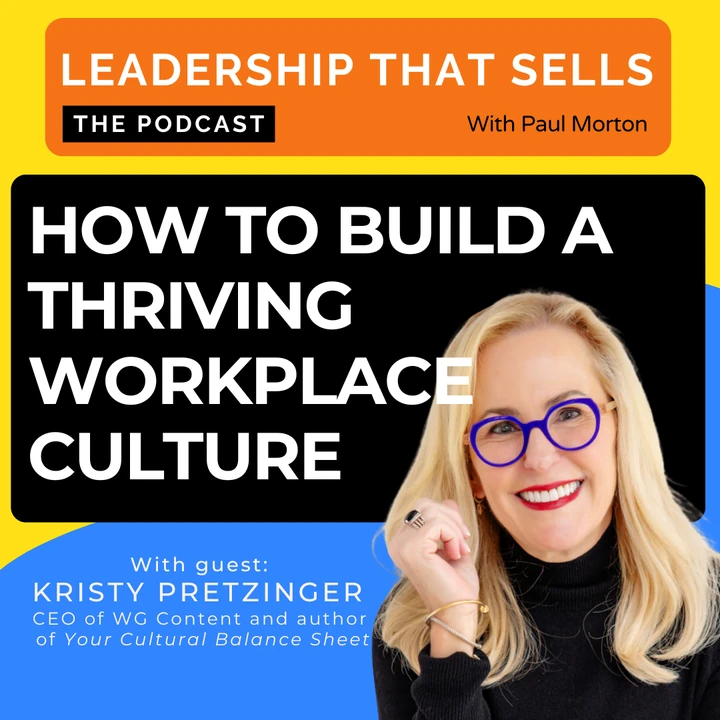
How to Build a Thriving Workplace Culture
with Kristy Pretzinger
Show notes
In this episode, we explore the intersection of leadership, kindness, and culture-building with Kristy Pretzinger, CEO of WG Content and author of Your Cultural Balance Sheet. Kristy shares her journey from freelance writer to building a successful content company anchored in kindness. She reveals how values like empowerment, curiosity, and joy can shape a thriving workplace and why businesses should prioritize culture as much as profit.
We dive into actionable strategies to foster psychological safety, reduce workplace stress, and encourage innovation. Kristy shares how meditation and mindful breaks have transformed her team’s productivity and well-being. Whether you’re leading a small team or a global organization, this conversation offers profound insights into creating environments where people—and ideas—flourish.
Episode Highlights
[1:04] – Kristy’s journey: from freelance writer to CEO with kindness as a cornerstone.
[3:31] – Empowerment, curiosity, kindness, and fun: living company values beyond the laminated card.
[7:08] – Fear, love, and leadership: the emotional foundation of a thriving workplace.
[15:34] – Vulnerability and authenticity: how to lead effectively without “over-sharing.”
[22:39] – What is a cultural balance sheet, and why every leader needs one.
[26:23] – The power of mindful practices: using meditation and device breaks to improve creativity and focus.
[29:00] – The direct link between leadership self-awareness and team performance.
Links & Resources
- Learn more about WG Content: wgcontent.com
- Connect with Kristy Pretzinger on LinkedIn: Kristy Pretinger
Closing Remarks
If you enjoyed this episode, please rate, follow, and share the podcast! Your support helps us bring more insightful conversations like this to your ears.
Transcript
Automated transcript. Speaker labels and spellings may contain errors.
Paul
Founder, CEO of WG Content, builder of kind businesses, author of Your Cultural Balance Sheet: The Keys to Creating an Environment Where People Can Thrive. Christy Pretzinger, thank you very much indeed for joining me. Welcome to the Leadership That Sells podcast, where we help you lead first and sell more with great insights and tactics from the best minds we can find. Every leader is in sales, whether you're selling products, ideas, a mission, or a vision, and great sales team in particular need great sales leaders. When managers bring out the best in their teams, targets get hit on time every time without stress. But most sales leaders never learn how to lead. They wing it, or they repeat bad habits, and the cycle continues. Sales leaders need practical, real-world ideas that fit their busy schedules, and that's why we created the Leadership That Sells playbook course.
Nine short weeks changes your world. Check it out at the Practical Leadership Academy. And now, on with the show.
Kristy Pretzinger
Thank you so much for having me, Paul. I look forward to our conversation.
Paul
Now, that was a far too brief introduction for somebody with a magnificent background in both building businesses and shaping content and shaping people's lives. Can you give me a bit more meat on the bone, please?
Kristy Pretzinger
Certainly. Um, well, I, I started out as a freelance writer a long time ago, and then, uh, started building WG Content, which was formerly known as Writer Girl back when we first started building it.
Paul
It's a good name, yeah.
Kristy Pretzinger
Probably almost, almost 20 years ago, I think. And, um, I said at, to my accountant at the time that if I couldn't build a business based on kindness, I would go back to being a freelance writer. And then, as any entrepreneur knows, you just put your head down, you're wearing all the hats, you're doing all the things, trying to make sure that you've got money coming in. And, uh, it wasn't until about five years ago when we had a, a group of consultants we were working with, and we, um, discovered them interviewing all of the employees. Sh- they were trying to find out what was the core of our business, the thing without which we would not exist, and come to find out it was our culture. And that was a, an epiphany for me because I realized then, looking back in hindsight, that
intending to build a business based on kindness indeed had happened, and it had informed the structure and the processes and the procedures that we have in this organization. And, uh, and it really is the... It, it's what gives my life and my work meaning and purpose.
Paul
So would you say kindness was your number one value when you set out? Did you, did you have a, did you paint it on the wall?
Kristy Pretzinger
You know, that's interesting because we are virtual, so we don't have any walls. Um, but what we do, that's a, a, a really, uh, good question. What we do is we, we came up together, uh, with much, a much smaller group of people, but we came up with our values I don't know how many years ago, and they're very easy to remember. We are empowered, curious, kind, and fun. They kind of roll off your tongue. And our mission is building relationships one word at a time, which makes sense since we are a content company. Um, the thing about, about our values is, pardon me, I always say that your values should remain the same. They should be constant. You don't go changing your values. The expression of them may change, but the values should remain the same. And in, in our case, our values are a thread that, that, that goes all the way through our organization, and I say that the values, that thread, is something upon which all decisions can hang.
So our employees all can, every single one of them can tell you what our values are. We have different things in place to reinforce those. For example, in our monthly team meeting, our HR person will solicit, uh, kudos based on a certain value. So, like, let's say this month it's empowered, and so she will ask people to rep- to recognize someone who has demonstrated empowerment. And so it's top of mind. People are thinking about it. They are recognizing it in their, uh, associates, and then they are awarded, it's pulled out of a hat, and someone gets what we call the Woohoo Cup. They don't get a Woohoo Cup anymore. They used to. But they're recognized for, for living out one of the values. So we do things like that to make sure that they are top of mind as opposed to just being something on a wall.
Paul
My wife used to work for a very large corporate, 100,000 people, and they had values laminated in a little card around your neck like a dog tag, you know. I love those lanyards. The lanyards. It's, it's, it's the replacement for wearing ties. We don't wear m- men don't wear ties anymore.
Kristy Pretzinger
Yes.
Paul
And the ties, of course, they were a symbol of indentured nat- the, the indentured nature of your service, right?
Kristy Pretzinger
Mm-hmm.
Paul
So now we have these dog-
Kristy Pretzinger
Mm-hmm
Paul
... collars with zipper thingies on them.
Kristy Pretzinger
Yep.
Paul
So you had this, you had this laminated card with happiness, collaboration, and, eh, whatever the heck it was. You just sat rubbing it.
Kristy Pretzinger
Right. Right.
Paul
And the question is always, are your values lived or are they laminated, I think. And yours are obviously lived.
Kristy Pretzinger
No, that's a really good way of putting it.
Paul
Right?
Kristy Pretzinger
Yeah.
Paul
And the thing that you hit precisely on, I think, when it comes to value sets are is can you use them as a decision-making tool?
Kristy Pretzinger
I mean, what's the point of them?
Paul
If you were to make a decision... Exactly. If you were to make a decision-
Kristy Pretzinger
And, and, uh, you can, you can hire and you can fire based on values.
Paul
Yes.
Kristy Pretzinger
You know, you should be able to. People should be able... If you say someone, "Look, we have talked to you about this and, and you do not demonstrate kindness, you aren't a fit, you know, for the organization." Um, and you know that pretty quickly. We don't, we don't have a lot of issues around that. But, but you, you should be able to based on those things. If, if they really are important to you, if they mean something to you in the way you're building your business, um, then you should be able to hire and fire around those.
Paul
Yeah. Yeah. I mean, fun is a hard word. Fun.
Kristy Pretzinger
Yeah.
Paul
Let's have fun. The beatings will continue until fun is had, you know?
Kristy Pretzinger
[laughs]
Paul
Or till morale improves, that sort of thing. I like fun. Fun's, fun's joy. Pref- I prefer joy, but you know, fun is good.
Kristy Pretzinger
I love the word joy. Yeah, we, um-
Paul
Fun is good
Kristy Pretzinger
... yeah, it's, uh, yeah, that kind of works 'cause it, empowered, curious, kind, and joyful would work, 'cause that, that actually is one of my favorite words, and also one of the things that from where I sit as the leader of the organization is when we are instituting new things, like we did a big, um, uh, tech stack change a couple years ago, and so from where I sat, I was always asking the question: Have we overdone it with this technology where we've removed the joy from the daily work?
Paul
[laughs]
Kristy Pretzinger
Because I wanna make sure that even though it's hard, you know, work is sometimes hard, it's not always fun, but is there some joy in what you're doing, whether that's working with the people that you're working with, or you get to actually create something you're proud of. Are we, you know, are we, are we sucking the joy out of it? We always wanna make sure that we hold onto that.
Paul
[laughs] Sucking the joy out of it. Yeah, I like that. It's like going to your doctor and your doctor tells you, "Well, you should move on to decaffeinated coffee." And you say, "Oh, great. Let me just-"
Kristy Pretzinger
Yeah
Paul
"... suck the last remnants of joy out of my morning. Thank you."
Kristy Pretzinger
Exactly.
Paul
Not gonna happen. [laughs]
Kristy Pretzinger
Right.
Paul
I love that. So we, kindness, um, when we were chatting before you mentioned rage and rudeness, and I think a lot of that comes from fear. That always comes from fear. I'm angry about things. I'm, uh, offensive towards other people because I'm fearful of something. Something's not even the person or whatever they're talking about, but I'm fearful of my lack of control or whatever it is. And the other side of fear, of course, is there o- there are only two emotions in my opinion. There's fear and there's love, and everything else is a shade in between. And I think it's when you have yourself at the center of your universe, you are fearful. When you put other people at the center of your universe, you can be joyful, you can be loving, right? And we don't talk about love in business at all 'cause it's kind of taboo and you don't want to get a call from HR saying, "Were you, were you loving people again, Martin?" Well, no, no, no, no.
Well, yes, actually, in my own special way.
Kristy Pretzinger
Well, you know, because in English, the, the word love, we have one word for it-
Paul
Yeah
Kristy Pretzinger
... unlike many other languages, and I do use the word love because it, one definition of love in English is wishing the wellbeing of others. So I genuinely wish for the wellbeing of the people that I work with. So indeed I do love them and demonstrate love, and I don't... Of course, I'm also a woman saying that, so I'm, I recognize that it is a little less fraught when a woman says something like that, uh, in a, in a, in an all female employed, all of the people who work with WG Content as, as employees are women. Our contractors include men. But, uh, so it's easier to use that language than it is for a man to walk around saying, "You know, I love you." You'd be like, "Wait, what? Why are you talking that way?" I, I do understand the, the, the nuances there.
Paul
I mean, you have, I mean, uh, CS Lewis writes about the four loves, and I, I, I talk about this a lot, but I love them. I love them, huh. Um, you have storge, which is the family, the familiar ones, the parent to the child. You have philia, which is the close friendship. You have eros, of course, the erotic, the romantic love, the one that everybody thinks it is. And then you have the one I think you just mentioned there, which is the wellbeing of the other, the other, which is the agape, the agape love. It's, um, it's, it's the, the, the building up of the other, the, the magnanimity, the desire for greatness in other people. And you p- take your own annoying, selfish self out, you put other people in, and you, you can't be full of rage.
You can't be rude, because your motive for doing this, for putting the other person into the center of your, your universe, is to build them up. How are you gonna do that if you're, if you're mean? You know? Can't be done.
Kristy Pretzinger
I also think that one of the things, um, I'm sure you're familiar with Simon Sinek.
Paul
Mm-hmm.
Kristy Pretzinger
And he talks a lot about, um, the psychological safety, and that when you talk about we, then you take care of me.
Paul
Mm.
Kristy Pretzinger
So, so by being inclusive that way-
Paul
Yeah
Kristy Pretzinger
... that you are automatically taken care of. So you, it's not as... You don't have to take yourself out of it, but you make sure you include everyone in it. And then that way, when it's a we, collectively, um, it, it changes, uh, the perspective and, and perhaps your behavior. But, you know, back to what you were talking about, fear and love, I frequently think that the, the rage, when people are angry, yes, it is often fear. I also think that anger is an emotion that's easier to access because it's out there. It's, it's, it's, like, directed outward. And sometimes, and frequently, I think that it's masking hurt, and hurt is vulnerable.
Paul
Mm-hmm.
Kristy Pretzinger
People don't want to be hurt. They don't wanna be vulnerable. They wanna make sure that they keep that shell up and, you know, nothing hurts me, and, and I'm this, whatever I am. Uh, and, and so anger is, is much easier to express than the real vulnerability of humanity. You know, the thing that, that, that is what we all are.
Paul
Yeah. I think, like you said as well, um, the f- the fear side is locked in. Um, I'm, I'm closed, I'm, I'm... I have the shellac shell covering everything. And to get to break it down, to move, to move other people into your universe, uh, requires this two-way.
Kristy Pretzinger
Mm-hmm.
Paul
Requires this presentation of self of towards the other.
Kristy Pretzinger
Mm-hmm.
Paul
And what's the line? Is people won't, um, uh, they won't know how much you care until you know how, they know how much... That... I can't remember exactly what the, the phrase-
Kristy Pretzinger
Yeah. It, yeah, what is that? The one about they don't know how much you care until they, they don't care how much you know it, but they know-
Paul
Something like that
Kristy Pretzinger
... how much you know until they know how much you care. I think it's something like that.
Paul
That's the bunny. That's it. Say that again.
Kristy Pretzinger
Yeah.
Paul
Say that one again.
Kristy Pretzinger
People don't care how much you know, they care how m- they want to know how much you care
Paul
That's it. So, so it's, it's trite, but it's, there's the, the nub of the truth-
Kristy Pretzinger
True
Paul
... is in there. Yes.
Kristy Pretzinger
True.
Paul
Yes. And so that's, I think, how you move towards this idea of vulnerability, is that you have to give of yourself. But there's a lot... And now I have a question for you as a, who talks about vulnerability a lot. How do you, how do I remain authentic in whatever the context is by sharing the one or two or three stories that I have about this, that I use all the time, because I don't really want to bring my whole s- my full self to work. I want to bring the right self to work. I want to bring my right, the right attitude, the right posture, the right behaviors to, to my work environment. Because how I am and who I am with my friends is the same person, but I have different doors that are open at different times.
We're, we're, right now it's the 11th of November, so we've got 11 little doors in our advent calendar open. Okay? You open the little a- you open the little door and maybe there's a chocolate in there or whatever it is, but you open up a door and you have a combination of these doors in your, yourself that are open for work, and a different combination that are open at home, and a different combination that are open with your friends. I want to be human and connected, but vulnerable, especially for men, it's a challenge.
Kristy Pretzinger
You know, I think that I talk about this a lot because, um, I coach other leaders and especially someone like you mentioned your wife worked in a really large organization and, um, I work with a lot of people who work in large organizations and hospital systems all over the country. And what I talk about is that as a leader, even if you, even if you're just a leader in your family or your friend group, i- if you don't have anyone reporting to you, people are still watching you. You are somehow, somewhere leading people. And when I talk about things like vulnerability, when you're in a, in a large organization, you have to be discerning about how vulnerable you can be up. But you can choose to be vulnerable out and down.
That's what you can control.
Paul
Mm.
Kristy Pretzinger
And when I say vulnerability, I'm not suggesting that you open the kimono and tell everybody, you know, your deepest, darkest secrets. That's inappropriate anyway, and it makes people uncomfortable. But if you can be just a little bit self-deprecating or acknowledge that you've made some mistakes, um, then what happens, in my own experience, is that people like you more when you're willing to say, "Oh gosh, I've done that too," or, "God, you know, I made this huge mistake, blunder," or whatever. You know, nothing tremendously serious, but something you can talk about, but then they like you more and it makes them know that it's a safe place for them to be vulnerable, and that's how you build relationship.
You know, you, you... I mean, you can build a, a surface relationship if you so choose. That just isn't... I don't wanna live my life that way. I don't have time to, you know, talk about the weather. Um, I, I've got, you know, precious amounts of days, and I want them to be meaningful. And in my own life and in my own experience, the thing that makes those days meaningful is the connections that I have and, uh, with people. And when I think about leadership in particular, I think about the privilege that I have to feed into the lives of the people that I lead, and I take that very seriously. And, um, and, and while I take it seriously, I also try to bring a bit of humor, obviously self-deprecating humor in some of it. But, um, but really understanding what we talked about earlier, the need of everyone that you come in contact with.
I don't care if it's the CEO of a huge multinational corporation or the person that sweeps up at night when nobody's there. The commonality is that every single one of us needs to know that we matter. We need to know that. That, that is hugely, vastly important to our wellbeing. And as we talked about earlier, you can't matter in isolation. You have to matter in community, in relationship with someone else.
Paul
Yeah. I, there's, um, the concept, um, definition of wisdom, which, uh, I, I l- quite like, which is your experience and your knowledge combined, which is, so you've learned things and then you've used them, and then the fact that you've reflected upon the outcomes. But then my son was talking to me the other day, and he's, he's 10, and he said, "Dad, you're wrong." "Oh, okay. Fair enough. 10-year-old philosopher king." 'Cause he spends his life at school, right, with teachers, and he said, "You've gotta share it." "Okay."
Kristy Pretzinger
You gotta what?
Paul
Share it. You've got to share it, right?
Kristy Pretzinger
Uh-huh.
Paul
In context with others. So if you're not in the context of others in community, the heck's the point?
Kristy Pretzinger
Fair enough.
Paul
So you may have all the knowledge in the world, you may have all the experience, which is great, good for you, and you've thought about it, wonderful. You're sitting at the top of your mountain in the lotus position and, you know, underneath the cherry tree. Good for you. Well done. So what? How, what are you gonna do about it? You're gonna share it. You're gonna share it, good and bad and indifferent.
Kristy Pretzinger
You know, I agree with you completely because I am so not a Buddhist, but the Buddhists frequently don't [laughs] share. You know, they ponder in isolation and, um, and that, but that's a different kind of, of, of choice, I think, than, than, you know, the great philosophers, you know, Seneca and Marcus Aurelius and all those people, that they thought and pondered and reflected, and then wrote about it and shared it with people, right? I mean, that's, that's the whole point.
Paul
Stood up on a forum.
Kristy Pretzinger
Exactly, so that we can all become better people and, and then ponder what they were pondering, and then share it with other people, you know? Um, I, I completely agree with you that you do, you do need to share it. That's actually the, the application of wisdom, isn't it?
Paul
It is. And in community, I think. It's where you're sharing to the benefit of others. It goes to one of those four loves. It goes to your idea of, um, the, the idea of building other people up. It's, it's, it's everything. So it is the other, I think, is the concept-
Kristy Pretzinger
Mm-hmm
Paul
... I'm, I'm trying to get to-
Kristy Pretzinger
Yeah
Paul
... to tackle just now, is how do you, how do you deal ... When you said the, the cynic talks about the we.
Kristy Pretzinger
Mm-hmm.
Paul
You know? You go ... It includes the we, it includes the me. Um, I, I quite like that. I think there's, there's a, a great deal of challenge in approaching the we, because so many people just need to get themselves out of the way first. I don't know.
Kristy Pretzinger
Oh, yeah.
Paul
Still, still working on it.
Kristy Pretzinger
I think that's, I think that's a sophisticated, um, concept. I think, um, I, I, I would-
Paul
Didn't say it was gonna be an easy conversation, Kirsta.
Kristy Pretzinger
[laughs] No. I feel strongly that, um, self-awareness cannot be overestimated-
Paul
Mm
Kristy Pretzinger
... in its importance in everything in life. Um, you know, i- if, uh, if you lack self-awareness, first of all, as you work on your own personal development and develop more self-awareness, you become very aware of the lack of self-awareness [laughs] of the people around you, and it can be kind of annoying. But, but in terms of, of really back to the wisdom, pondering and, and learning about yourself, especially in particular as a leader, understanding that, you know, I think about all the work that I did, as we mentioned earlier, i- I definitely went to therapy, and then I've had a lot of coaches over the year, and I've done a lot of reading and studying and self-reflection and application of all of that. Learning about the, the edges of my personality that can be off-putting, not only as a leader, but just in life, but, but importantly in, in work, in leadership.
And then moderating those because I am an adult. I am, I am a grown-up, and I can moderate that behavior because I've, I've learned about myself that there are various things that, that if I, um ... I, I, for example, I am a, a fast processor. That doesn't make me smarter. It can make me impulsive, but it can also be very irritating to people who process more slowly and are just as bright, if not brighter than me. And so I've learned that I have to slow down, and I have to stop speaking to give them the space-
Paul
Mm
Kristy Pretzinger
... to process and share, because I want to know what they know. I don't know what they know. I already know what I know. So unless I stop talking and, and engage and give space for them to share, I'm gonna miss that. I mean, I didn't, don't think I knew that 15 years ago, but I learned it, and I still have to practice it. It's not my natural ... It's, it's not my go-to. My go-to is to just talk and keep going. But it's like, okay, moderate your behavior and allow someone else to speak so that you can learn something. So that's what I think is, is really important in, in all of this, the, the we thing, is you, you can't do that we unless you learn to ... You have self-awareness and can moderate your own behavior to allow space for the we.
'Cause otherwise it's all me, me, me, me, me, me, me, me, like a three-year-old, and I'm not a three-year-old, and I don't wanna behave like [laughs] a three-year-old. So that's how-
Paul
Okay
Kristy Pretzinger
... you can allow for the we, you know?
Paul
Yeah. Yeah. And so the self-awareness thing is wonderful. It's the, it's the mirror into the soul of the other, I think, is if you know yourself ... If you want to, if you want to know about other people, first know yourself.
Kristy Pretzinger
Absolutely.
Paul
'Cause the answer to everything is, is, is within your own soul, right? Yes. Deep, deep, deeply, deeply felt. Deeply felt. Okay. What is a cultural balance sheet, and why did you write a book about one?
Kristy Pretzinger
Um, well, culture, as I mentioned, you know, you can get from a conversation, uh, building an environment where people can thrive has been the thing that really has brought meaning and purpose to my life, other than being a mother to my wonderful son. But the, the business that I've had the privilege of building is the, is the, the next thing that's brought me the most joy, and it's because of caring about these people. So, um, I'm in an organization called Entrepreneurs' Organization. I don't know if you're familiar. It's global. Um, it's in, like, 75 countries, and it's all just business owners. So it's a peer group. And I was in, um, a small group. It's called a forum. And one of my forum mates would frequently tell me that I should write a book, and I was like, "Yeah, yeah, yeah." And we were having dinner one night, and a lot of these people in, in my forum have had successful exits from their business, meaning they've either sold it or gotten investment, you know, PE money and decided to grow it or whatever.
So we were talking about things like EBITDA and multiples of selling a business. And I, I'm a person who often doesn't know what I think until I say it, and so I was sitting there kind of musing and I said, "You know, I do look at my balance sheet. Of course I do." And I said, "But it's almost like I look at my business through the lens of a cultural balance sheet." And so my friend, you know, looked at me and he goes, "Well, there's your book." I was like, "Oh, shoot, now I'm gonna have to do this." Took me long enough. Took me about two years, and I wouldn't have been able to do it without my co-author, who also happens to be an employee, and she's a brilliant writer. So anyway, what, what ... The cultural balance sheet, the, the analogy that we pull through here is obviously cultural assets, cultural liabilities, cultural equity. Um, but it's a little bit different. Uh, it's a great way of breaking down the topics within a book into chunks that make sense.
What we discovered, and what I discovered through kind of developing a signature talk around this and then working through what the book was gonna be, is that, a- and this is sometimes true on a financial balance sheet, but on a cultural balance sheet, the liabilities that you have, if you have an intention to examine them and want to give attention to them to, as I mentioned earlier, moderate your behavior, whatever it happens to be, you can actually turn those liabilities into assets in your cultural, on your cultural balance sheet. And the cultural equity in this example is the, the actual culture that you build as a result of your inquiry and curiosity about your assets and your liabilities that then results in the culture, which is the culture of we, which also takes care of me.
So we go through and break that down. There's a lot of keys. They're, they're in digestible chunks because [laughs] we mentioned everyone has the attention span of a gnat nowadays. And we wanted things to be digestible, but also actionable. Like, what can you actually do here to begin to create an environment where people can thrive?
Paul
Okay. In those three chunks, what's your favorite one? Give us an example.
Kristy Pretzinger
Well, all of it really comes down to people, you know? And, and on a financial balance sheet, the only place people show up is as a liability, which is absurd.
Paul
Yeah. Yes.
Kristy Pretzinger
Um, you know? It, it, it's crazy because you don't have anything without the people. So, um, again, it, it all comes back to that, the, the, the privilege that you have as a leader of feeding into the lives of these people, and then breaking that down. That sounds like ... That's kind of a high ideal. Well, what do you actually do? And so there's a whole bunch of things that we actually do that are all meant to really ensure the wellbeing of the people in the organization. And it's interesting 'cause we have an editor, you know, as I mentioned, my, uh, co-author works in the organization. She's been here for 10 years, so she is experienced and builds this culture. We co-create it together, so she's experienced firsthand, so we know what we're talking about.
Our outside editor doesn't work here, and so he'd be like, "We ... You need to explain that more." One of them that is so obvious to me, but he was like, "Well, people aren't gonna understand that." And what it was is we start every meeting, if there are three or more people, every meeting begins with a meditation, and the way that we do that is that usually we, they'll just rotate it. So if it's, you know, if it's just a, a quick get-together, you know, it's up to you. You get ... This isn't some rigidity thing where you have to start with a meditation. But if it's a structured meeting and you have like, say, your pod meeting every other week, and there's eight of you in the meeting, you know that someone is gonna be assigned.
You're gonna rotate, and it's gonna be, "Okay, Chris, this week you're the one who comes with the meditation." It could be a two-minute breathing exercise to a five-minute guided meditation. It's up to you. But the reasoning behind that is, first of all, meditation, we all know, is amazing, but a lot of people aren't familiar with that, and when they first join the organization, they're like, "Well, this is weird," to start a meeting with a meditation. And then they realize that it helps you become present to the, the virtual room that you are in, 'cause we are frequently in virtual meetings, as the world is now. But being, being present to that space, because a lot of times people come flying into that meeting.
They just ended another one, and they're not present at all. They're jumbling with their papers. They don't even know why they're in this meeting. And if you take anywhere from two to five minutes to just breathe collectively, then you create the space for meaning to happen in that space and to talk about whatever that meeting is for, and you can be present to one another. So really kind of digging into, into those kind of things, and that directly contributes to the wellbeing of the people in the organization and, and it, it, it enforces a meditative practice without them having to get up every morning and meditate for 15 minutes. Um, another thing that we do is we instituted something where w- you know, again, we're virtual, so people start their workday at whatever time works for them. It's, it's perfectly fine. It's very flexible. But I wanted people to start, when you start your workday, set your alarm, and after 50 minutes, take a 10-minute break from your devices.
Don't check email. Don't be on your phone. You know, go, go throw in a load of laundry, take your dog for a walk, do some stretching, do whatever you want. And the intention of that is to help people protect, intentionally protect their attention span because we need to, we need to control that. You're g- we are not ever gonna live in a device-free world, so you need to have agency over your devices as opposed to letting them control you and that algorithm control you. But even more importantly for the business and for the people, innovation and creativity happens in the gaps. If you are constantly flying from meeting to meeting and-
Paul
Mm
Kristy Pretzinger
... and, you know, not taking a breath to go to the bathroom, get a cup of coffee, put your dog out, whatever it is you have to do to live your life, there's no time for innovation and creativity, and that's ... You, you need the gaps to allow for that free-flowing thought to have an idea occur to you without constantly something being put in there to allow you to, to reflect, as we've talked about. So those are just two little things that, that really contribute to creating that environment where people can thrive, that then carries out into their lives. I can't tell you how many of my employees have said that by instituting that 10 minutes ... And they, and they do it differently. One of the employees said she needs to work, she's a strategist, and she needs to work in longer blocks of time uninterrupted, like three hours. And she said, so then she'll work three hours and take 30 minutes away from her devices, and she said she discovered that at the end of the day, she thought she was always supposed to just be completely depleted with an empty tank at the end of the workday.
And by doing this, she's like, "I realize I'm still half full at the end of the day, which gives me time to parent my daughter, to live my life." And I'm like, "Well, that's, that's the privilege of leading into someone's life."
Paul
Mm-hmm.
Kristy Pretzinger
You know? I mean, it, it, it, it bleeds into their lives, not just the time that they're working with you, and that's a tremendous privilege and an honor to be able to do that.
Paul
These are beautiful techniques, but I think what's absolutely evident is that they are techniques, strategies, tactics, call them what you want, that are underpinned with a deep sense of responsibility, of honoring the other person with a huge pragmatism as well, commercial pragmatism behind them, 'cause I bet you your performance from your team is amazing.
Kristy Pretzinger
Oh, yeah.
Paul
It's incredible.
Kristy Pretzinger
They, I mean, they really are. The, the ... One of the coaches that we work with, um, she's also a friend of mine, but she works with my leadership team, and she's met most of the people on the team, and she's been a coach for, like, 30 years in business, in larger corporations mostly. But she said that she's never run into a group of such intelligent people who are also creative, and she said, "And they would run through fire for you, Kristi." And I was like, "Well, it's because they know I would run through fire for them." Like, I don't allow a client to mistreat employees. I mean, I am more than happy to... They don't even know who I am, most of the clients, because I'm, I work on the business, not in it. But I will call somebody and say, "Hey, you know, our values are empowered, curious, kind, and fun, and none of those things are happening on either side here.
I'm not sure this is a fit." [laughs]
Paul
Mm.
Kristy Pretzinger
Because I've worked too hard to build this environment to allow some outsider to come in and tear it up.
Paul
Pollute it.
Kristy Pretzinger
And you know, another thing that I wanted to share that is incredibly valuable that this coach said to me, and it was a, it was a throwaway point for her, and for me it was an epiphany. It might be for your listeners as well. She said that the amount of dysfunction on a team is directly correlated to the amount of dysfunction the leader is comfortable with in their own life. And I was like, "Oh, wow, that's amazing." And that's where, for me, I'm like, "Oh, so this is where the tens of thousands of dollars of therapy is paying off." [laughs] Because I worked too hard to eliminate that kind of dysfunction from my life to allow it to creep in to this work environment that I have really focused on building. And I thought that was a really valuable point back to the self-awareness, right? If things are crazy around you, you might wanna look in the mirror and see how you are contributing to that.
Paul
Totally. Totally. I think it goes to, I'm not sure if it's called the law of the lid or something like that. Um-
Kristy Pretzinger
Oh, yes. Yep
Paul
... but it's, yeah. Yeah, it's the, it's the-
Kristy Pretzinger
It is
Paul
... yeah. Yeah. It's the idea that no team-
Kristy Pretzinger
John Maxwell
Paul
... yeah, no team-
Kristy Pretzinger
Go any higher than the level of its leader.
Paul
That's it. Yeah.
Kristy Pretzinger
Yep.
Paul
They'll meet your dysfunction where they, where they find it. They'll meet your integrity. They'll meet your-
Kristy Pretzinger
Well, that's why you don't ever call your business, don't call it a family.
Paul
No.
Kristy Pretzinger
Because first of all, you don't fire your brother, number one. Number two, you don't, don't bring that dysfunction in here, 'cause everybody's got some sort of dysfunction in their family, and if they don't, they're not paying attention, because they do.
Paul
[laughs]
Kristy Pretzinger
If you have two people, there will be some dysfunction. You know? [laughs] I mean, you just do. And you don't want them bringing that in there. It's like, "No, no, we can create our own dysfunction, and then we can get rid of it."
Paul
That's it.
Kristy Pretzinger
"But you're not gonna bring your family stuff in here."
Paul
I love it. All right. Kristi, where can we find you when we need you?
Kristy Pretzinger
Uh, you can go to wgcontent.com, and there's an About Us. You can find all sorts of stuff there. Um, I'm also on LinkedIn, just Kristi Pretzinger on LinkedIn. I'm happy to connect, uh, at any time with anybody.
Paul
Marvelous. And the book is out... When's the book out?
Kristy Pretzinger
The book comes out at the end of January.
Paul
End of January. Magnificent. Kristi Pretzinger, thank you very much indeed for joining us.
Kristy Pretzinger
Thank you so much for having me, Paul. I've really enjoyed our conversation.