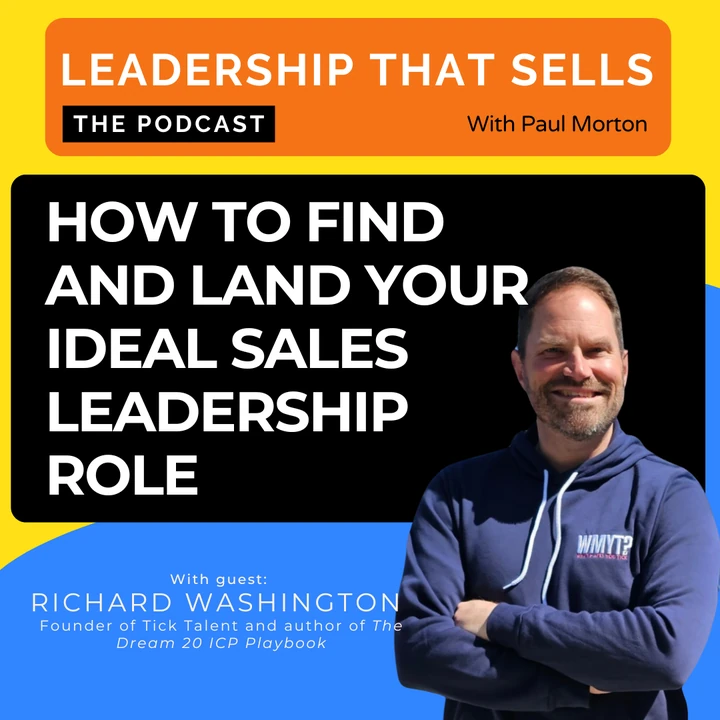
How to find and land your ideal sales leadership role
with Richard Washington
Show notes
Finding the perfect next step in your sales leadership career isn’t about applying for endless job postings—it’s about targeting the right opportunities with precision. In this episode of Leadership That Sells, I sit down with Richard Washington, founder of Tick Talent and author of The Dream 20 ICP Playbook, to discuss a strategic approach to job searching that mirrors the best sales processes.
Richard shares why most job seekers get it wrong and how to flip the script by identifying and engaging with companies before they even post a job. We talk about the importance of niching down, positioning yourself as the solution to a company’s biggest problems, and using an account-based approach to networking that puts you in a league of your own.
If you’re a sales leader looking to take control of your next career move—this episode is a must-listen.
How to land your ideal sales leadership role:
- Stop applying, start targeting. Identify 20 companies that align with your ideal challenge profile (ICP) and focus on them.
- Position yourself as the solution. Don’t pitch yourself—highlight how you solve high-impact problems for your target companies.
- Approach job hunting like a sales process. Use an account-based marketing (ABM) mindset to build relationships before a job even exists.
- Lead with value. Share insights, lessons, and advice that demonstrate your expertise rather than just asking for opportunities.
- Be strategic and patient. Building the right connections takes time—start your networking efforts long before you need a new role.
Episode highlights:
[04:10] – The biggest mistake sales leaders make when job searching
[09:25] – How to craft a compelling LinkedIn headline that attracts the right opportunities
[15:40] – Why job hunting is just like B2B sales (and how to leverage that insight)
[21:55] – The Dream 20 strategy: How to build a pipeline of ideal roles
[28:30] – The mindset shift that turns job seekers into high-value candidates
Links & Resources:
- The Dream 20 ICP Playbook by Richard Washington
- Connect with Richard Washington on LinkedIn
If this episode helped you, share it with a fellow sales leader, follow the show, and leave us a review!
Transcript
Automated transcript. Speaker labels and spellings may contain errors.
Paul
Founder of Tick Talent, sales guy gone rogue and bad, that's my words not his, and author of The Dream 20 ICP Step Playbook to Finding Your Best Job Ever. No, that's not really what we're aiming for. We're trying to find, attract, create the ideal next role in our lives. Richard Washington, thank you very much indeed for joining me.
Richard Washington
Thank you for having me, Paul.
Paul
So I already started off on the wrong foot. What is it you actually do?
Richard Washington
So, um, yes, it's, uh, been a journey of discovery to reach the point where I could answer that question succinctly. So what I do is I find entrepreneurial executives, managers, and sellers for early-stage tech startups.
Paul
There you go. That's taken a lot of work.
Richard Washington
It has taken a lot of work.
Paul
I, I, as somebody who's done this several times, getting to the point where I find entrepreneurial, intrapreneurial, which means something very specific, executives, founders for early-stage tech startups, that sort of precision and niching down.
Richard Washington
Mm.
Paul
That's like, what? 18 months, two years worth of work just to get that?
Richard Washington
Yeah, it's, it's taken 18 months. Yeah, exactly.
Paul
Wow. Nuts, isn't it?
Richard Washington
Absolutely.
Paul
It's nuts. I mean, it pisses me off mightily how much gibberish and shite I came out with. Say, starting, "Oh, I, I serve anybody and everybody," but nobody, and then every... And you really, really, really, really, really have to have the courage-
Richard Washington
Yeah
Paul
... to niche it right the way down.
Richard Washington
Sure.
Paul
And the, I don't know, the tenacity to, to just keep, keep, keep plug, plugging away at trying to find that right.
Richard Washington
Sure.
Paul
That right. Your ICP.
Richard Washington
Sure.
Paul
That hook. 'Cause if you're trying to be everything for everyone, you're nothing for no one, right?
Richard Washington
Well, this is it. You have to put it in the perspective of the customers. I think that everyone always talks about, I find this fascinating, if you look at most people's LinkedIn headlines, it always starts with, "I help," you know, "founders," or, "I help executives." That's your first five words. [laughs] Like, I help executives to something, and when you're connecting with someone on LinkedIn, you see the first five words of their headline. You've wasted it because everyone's says the same, and it's like who you help isn't really important. It's like what do you do? You know, people need to know what you do for them in their language in a way that resonates with them, and I think that a lot of people just get that wrong, myself included. My first headline was, "It's about time." Like the Saatchi & Saatchi, very clever.
You know-
Paul
Just do it
Richard Washington
... time's been innovated. It's also about protecting your time. Zero inbound leads [laughs] .
Paul
Mm.
Richard Washington
And it was only really when... And it was pretty funny, like the clue, what, what I find really fascinating about this subject, Paul, is that the clues around like the reason you started and the change you're trying to make in the world are always there.
Paul
Mm.
Richard Washington
First podcast that I ever did with my good friend Toly, on our own podcast, we talked about this message around we do, we're doing this because we love en- entrepreneurs. We were entrepreneurs ourselves. We both spent 12 years in companies progressing inside a business and building. So we knew that that's what we wanted to focus on in terms of our content and our relationships, but it took me that long to realize that is exactly what people need. So therefore aligning the message to what we actually believe and what we do every day and what we talk about and where our passions are is, of course, what we should say, but it took us a long time to get to that point.
Paul
There's a lovely line, um, from, I wish I could remember the guy's name. He was the German minister of trade years and years ago, and he said, "If you want to..." I'm not gonna do a German accent. "If you want to buy from Germany, you can speak any language you want. If you want to sell to Germany, ah, "" Okay. That was, that's profound. It's like you gotta speak the lingo. You gotta speak the language of the person that you're trying to sell something to.
Richard Washington
Mm.
Paul
Whether that's your idea, whether that's you, as we'll get onto talking about I'm sure, or you, you, whatever you're trying to do. Persuading people, you know? Even trying to... Your kid trying to get a... My daughter's 13, and last night we had the town fair, the Christmas fair, and she was asking if she can get out later. First time ever. Dark.
Richard Washington
Mm.
Paul
It's dark at like 5:00, but this was 8:00, and she didn't want to come home until like 8:45, and I'm thinking, [inhales] okay. But she sold me on it, you know?
Richard Washington
Yeah.
Paul
She sold me on it 'cause, sneaky little sausage, she's been listening to me. I'm surrounded by books on influence and selling and, you know, persuasion and all that. I got... I mean, I studied hypnosis and things, and that's all about getting into the brain and, and helping somebody else accept your message like a jigsaw piece. Just dropping into place.
Richard Washington
Yeah.
Paul
So it's, it's a beautiful thing. So you've got this beautifully succinct ICP. Now we, we went off on the actual thing. We went all meta on it.
Richard Washington
Sure.
Paul
Let's go back to it. So you're a, a discoverer, a hunter down of intrapreneurs. Okay, let's start there. What's an intrapreneur? Big clue.
Richard Washington
Yeah. So everyone knows the term entrepreneur.
Paul
Yes.
Richard Washington
So intrapreneur is simply someone who builds businesses within businesses. So, and that's most people, right?
Paul
Mm.
Richard Washington
Like, the average age of an entrepreneur is 42 when people start. So most people have had a career inside a business before they start their own thing, and very likely when they start their own thing, they're gonna fail. [laughs] And it's only gonna be the fourth, fifth, sixth iteration of what they do that they even see some success. So it is a journey to get to that point. There are some natural born entrepreneurs, you know, Gary Vaynerchuk selling stuff at 11 years old out of car boot sales. Um, but most people aren't like that.
Paul
Mm.
Richard Washington
So an intrapreneur is simply someone who builds businesses within a business, rallies people around a cause, takes that supporter profile, leadership profile, builder of teams, builder of products, builder of markets within someone else's entity.
Paul
Mm. So valuable. It's so valuable. It's the ... And it's the, the opposite, I think, of most ... Do you know what I say, most? Yeah. Most people at work.
Richard Washington
Mm.
Paul
Most people go to work and they drift. They drift. It's a, it's a word from, I think it's Norman Vincent Peale in a book he wrote, Interview With the Devil, and the devil says, "Hmm, the thing I love to do, I love to entice people just to take it easy."
Richard Washington
Mm.
Paul
"Just to drift through life. Drift. 'Cause then they're mine," he says.
Richard Washington
[laughs]
Paul
It's a wonderful book. Wonderful book. Interview With the Devil. And you drift through life, and it's just beige and it's meh, and you're paid-ish. There's a Dilbert cartoon with a T-shirt and the guy says, "I did nothing today and still get paid."
Richard Washington
Yeah.
Paul
Oh, sometimes, yeah, it's nice to have a day like that. I don't get any like that. Neither do you, 'cause you work for yourself. You do nothing, you don't get paid.
Richard Washington
Yeah.
Paul
But, "I did nothing today, I still get paid." And that's nice for a day maybe, but wow, if you're unhappy, be of service.
Richard Washington
Yeah.
Paul
That's one thing. If you're unhappy in life, go be of service. Do something for someone else that ... without expecting anything in return. That's it. Problem solved. Um, 90% of mental illnesses I reckon solve there. Just go be of service to someone. Get out in the sunshine and go be of service. Problem solved. Um, but if you drift through life, drift through work, you're paid maybe, not for long probably. [laughs] You get fired. But, you know, can't be happy. There's no joy in sitting in your hands and twiddling, or trying to twiddle your thumbs. You sit, sitting your hands and twiddling your thumbs, your th- thumbs go up your arse, right? [laughs] Just pull your thumb out of your arse and do something.
That, that's a metaphor, I didn't realize.
Richard Washington
[laughs]
Paul
How then, given that you wrote this dream ICP, how do you find your dream, dream ... How do I find my dream job, Richard? How do I find my dream role, my ideal role?
Richard Washington
Yeah. So I talk, I talk about that. So this, that playbook sounds like a very long name, right? But it's, it's ... The, the principle of this executive job search playbook is that there's all around a, a thing called a Dream 20, and it's about getting a list of 20 companies that you're gonna go and target. Where that came from is that I'm part of Pavilion, and in Pavilion there's, like, 874 members of the on-the-bench community, so executives and associates who are currently in between roles or looking for their next role strategically. Um, and everyone's lost because it's a really competitive market. There's, you know, 1,000 applications for every job. Just knowing what you want to go and do when you have this very broad range of skills, you're a generalist over a 20-year career, how on earth could you niche down and be a solution to someone's problem is hard.
And everyone talks about, you know, "Do this," and your LinkedIn profile, and, "Do this on your resume," and, "Say this in an interview," and ... But no one's having enough of the right conversations with interesting companies, and then they get into recruitment processes that are very slow, take a huge amount of time, multiple stages, um, only to get to the end and realize it's not a good fit, or worse, get hired, six months in realize it's not a fit and get fired or want to leave. So if we can be strategic around the way that we develop a list of 20 opportunities inside companies that we're attracted to, then it's a question of, well, how do we go and prospect into those from a sales approach?
So we've got our account-based marketing key account list of 20.
Paul
Mm-hmm.
Richard Washington
And then we're gonna build a marketing pack of value to send to those people and start to instigate conversations rather than the traditional approach, look for jobs and then try to get the job. So we're gonna look for companies who have the challenges that we love. So the ICP of the Dream 20 ICP playbook is ideal challenge profile.
Paul
Ah.
Richard Washington
We're looking for the challenges that we love to solve, not things we can solve, but things that we love to do. We volunteer for them naturally. As we're doing them, time runs away. We're in flow. After we've done them, we feel energized, and we're looking for those. And if we can do that, suddenly you're in a bunch of interesting conversations talking to people who are s- facing the exact challenges for whatever reason you love. It's the Mr. Muscle type job that you love, and then you're often in a competition of one 'cause they're not even looking at the market yet.
Paul
Beautiful. The number of salespeople ... I mean, like, I'm in Pavilion as well, um, which is how we connected, and I get a l- fair few folk knocking on the door saying, "Can I have a chat?"
Richard Washington
Mm-hmm.
Paul
And I'm quite happy to, to have 20 minutes, half an hour chat with lots of people. I learn more than I, than I share most of the time. But the number of varying degrees of experienced people, so from, uh, f- first, second jobs all the way to, to various levels of execs, C-levels, whatever, who don't reckon that finding your next job is actually a sales process. Now, these are s- essentially salespeople, right? Yes, uh, uh, r- revenue leadership and so... I, okay, fair enough, but even if you're a marketeer, you're still a salesperson. You understand the concept of a bloody funnel. You have lots at the beginning and less at the end. Why? Because you whittle it down, and you talk to people in a certain way.
Richard Washington
Mm-hmm.
Paul
And the account-based marketing approach is kind of fundamental to that. It's speaking to a need.
Richard Washington
Mm-hmm.
Paul
We can do it when we're selling our widgets and widgets and software, but follow me if it's kinda hard when it's trying to sell yourself. That's the hard one.
Richard Washington
Hmm.
Paul
So where do you start? Take us through some steps. Go on.
Richard Washington
Sure. So you are right. The, the fundamental thing is a mindset shift. You are now the product, and you've spent 20 years in your career taking other people's products to market.
Paul
Yeah.
Richard Washington
So you know how to do this stuff, and it's all the same stuff that you would do for those companies, and you've done successfully in your teams, and you've built playbooks for, but we just have to frame it that you are now the product. And it's like, well, you could be IBM with a million products and hope someone buys it, but you don't have the brand name for IBM. [laughs] So let's go and try and come down to a couple of very, very, very good products that solve a very, very, very big problem inside the type of businesses that you're attracted to. So it starts with that, "I'm the product." And that's a challenging mindset shift. But when you realize that you are actually the solution to someone's problem, or our products, products are things that people spend money on to solve problems.
Paul
Mm-hmm.
Richard Washington
So when you start to position yourself as a problem solver, a solution to the problem, then suddenly it becomes really clear. Now I just need to go and find people who are full of those problems. And not pain. No one buys for pain. You know, I think one of the things that's broken, my good friend Mike Mohlfelder over in Boston taught me this. He believes that one of the biggest problems with sales organization structure and pipeline structure today is that we teach people when they need 3 to 4, or now even 5X pipeline. And the problem is you're filling your pipeline full of a load of opportunities that are never a good fit.
Paul
Yeah.
Richard Washington
The customer might have a bunch of pains that your solution technically solves, so they pass BANT. They may be past medic, but they're never gonna buy.
Paul
Please don't.
Richard Washington
So you're looking for initiatives. It's like they are actually committed to go and solve this problem. It's such a burning problem for them. It's preventing them from doing business-
Paul
Yeah
Richard Washington
... or it's risking them going out of business, that they have to solve it, so they're committed to it. So if we can marry up the fact that we solve these problems, and then we're finding people who are committed to solving those problems, then it's just a case of, well, how do I find the people who are feeling those problems and then connect with them in a way that I can spark a conversation?
Paul
Mm-hmm.
Richard Washington
And often the best way to do that is to give value first. It's not to say, "I'm the best solution to your problem because I've got this track record of solving problems for businesses just like you." [laughs] It's, "Hey-
Paul
That's even like a typical sales process. Hang on.
Richard Washington
Yeah, exactly. [laughs]
Paul
You heretic.
Richard Washington
Let's get with it.
Paul
Excuse me while I burn you at the stake.
Richard Washington
Yeah, exactly. [laughs]
Paul
Go on. Mm-hmm.
Richard Washington
Exactly. Exactly. We've just got to think differently. Think about, like, how you would want, how you'd want it done, right? So let's say that you had a project, which is that you were a mid-market sales organization, and you were looking to move into enterprise. And someone reached out to you. What would you, like, love? Like, there's a type of information and value that if someone was bringing you about this move to upmarket into enterprise, you'd be like, "All day I'll pay attention to that, and I'll want to give it my time." What would that look like?
Paul
It would be three things that they've done that, uh, didn't work that I should avoid doing, and three things that they've done that did.
Richard Washington
Yeah. Love it. Beautifully broken down, bite-sized chunks. So if you use that as the play for one of the playbooks, you could reach out to the CEO of that business, depending on the size, maybe a chief revenue officer, maybe a COO, whoever is the person feeling the problem, owning the P&L for that thing. You could say, "Hey, noticed XYZ at this company. These were the three things we got wrong. Would you like me to jump on a quick call with you and talk you through our experiences?"
Paul
Mm-hmm.
Richard Washington
Or, "I just wrote an article on these top three things. Would you like me to send you a copy?"
Paul
There you go.
Richard Washington
It never starts with like, "Here's my resume." It's like, "Hey, these are the three things." Or, "Noticed you have just hired, you know, three customer success managers, and in their job description it says, 'Really pay attention to our enterprise accounts.'" And you can say, "When we were building those teams, the three things that w- took us five years to figure out [laughs] were these three. Out of those, which is most relevant?"
Paul
There you go.
Richard Washington
And then they go, "Oh, that one." And you go, "Fantastic. I just wrote an article on that," or, "I was just on a podcast about that," or, "I saw someone else's article about that."
Paul
Sure.
Richard Washington
Or, "I'm up for talking to you about the challenge." If you can create a peer-to-peer relationship around the challenge that you can solve from a, from a point of experience and lived experience, suddenly you're someone that they wanna talk to you because you're someone that's been up the mountain they're trying to scale.
Paul
Yeah.
Richard Washington
You're the Sherpa who knows the risks, rather than just another person trying to pitch the fact that they are really good at climbing mountains.
Paul
Yeah. I've not only climbed the mountain that you want to climb, is I, I broke my leg in the process and then after healing, went back up and bloody did it again.
Richard Washington
Yeah.
Paul
Yeah. That's, that's, that's the supreme, supreme method. All right. So we've, now we've nailed- How we're getting the conversation. We've ta- we've worked out that we want to have 20 target organizations-
Richard Washington
Yeah
Paul
... that fit this new idea of me as product who can solve problems for specific audiences, so our account-based marketing.
Richard Washington
Mm-hmm.
Paul
We've id- identified our ideal challenge profile, which is lovely, pitched it to the head guys, girls, and we're having conversations. Now what happens?
Richard Washington
So I would position this mentally that you are qualifying them. So I think the thing that people do wrong is they go, "Right, I've found this company, now my job is to get in." And it's like, no. Have the mentality, "I'm gonna try and help this person solve their problem," and if it's an interesting enough problem that fits what I'm really good at and I genuinely am the best solution for them, like I really believe I can help these people, then they would qualify for you to spend some more time with them and offer them the opportunity to maybe meet in person, maybe to do a proper discovery process, maybe to complete a scorecard. Maybe it's to bring in someone else from their team so you can get a different perspective on the problem. But you're only gonna really continue to invest your time if they are someone who, through qualification, is like responding to you, they're showing some interest, they've got some appetite,
and you actually believe that you can solve their pain.
Paul
Mm-hmm.
Richard Washington
It's not about trying to just for the sake of it move them through your sales process. It's, "Right. Cool. Yeah, you've met all the criteria here against this thing. You know, if you're happy to, mutual action plan, [laughs] move through to the next stage. I'd be prepared to spend the time for these reasons. Now, you might not want to for these three reasons, so tell me now."
Paul
Yeah.
Richard Washington
And if they go, "No, no, no, I do," brilliant, then you're in a proper sales process.
Paul
Now, I have one challenge with that, which is that when you're in a sales process, both parties recognize that as that. Both parties recognize it for for what it is. When you're in this sort of, um, marketing accounts deliberate intent going after somebody process, and you go to them with your idea of the mutual action plan, the other party is either looking to you for advice free, consultancy, again, free if they can get it. Maybe paid for, that sort of thing. You're looking for a job.
Richard Washington
Mm-hmm.
Paul
You're going to them and trying to qualify them, which is a wonderful approach 'cause it's a mental, uh, flip and it ma- it basically says, "I have all the value. I have all the power," which you do, and which you do. But to get them to that next stage with the mindset of, "I'm gonna talk to this person with a view to potentially bringing them onto my team."
Richard Washington
Yeah.
Paul
And you start qualifying-
Richard Washington
Yeah
Paul
... and you start that sort of posture, there's not necessarily the, the, the reciprocal approach on the other side. So you, you mentioned the, the idea there is, "These are the three reasons you might want to talk to me in the future. These are the three reasons-"
Richard Washington
Yeah
Paul
... "not."
Richard Washington
Yeah.
Paul
This is great. That's, that's a supremely targeted AB- um, ABM, uh, mutual action plan steps.
Richard Washington
Sure.
Paul
Do you have the bit at the beginning where you say, "And I'm looking for a job"? At what point do you bring that in? 'Cause that has to be the reciprocal posture from the other person-
Richard Washington
Yeah
Paul
... otherwise they're not going to actually accept the next step for what it is.
Richard Washington
Yeah, sure. Yeah, sure. I mean, I think with all those sorts of things you just gotta be up front about it. Um, but it's not the reason you're getting in contact with them. I think people should know you're available. So I'll give you a real life ex- real life example. So I've created a role for myself with an amazing entrepreneur who taught me all the skills and all the mindset shift and helped me to unlearn a load of things to be ready to go and launch my business, and it started with a Facebook message. So I knew the guy from about eight years before, incredible entrepreneur called Steve Bolton. And after leaving a company through 12 years, um, uh, through redundancy after 12 years, I knew I wanted to be an entrepreneur, but I knew I didn't know how,
so I sent him a Facebook message saying, "Steve, just want you to know I've left this company. I am available. My dream is to start a business with you one day, but I'd just love to catch up and hear how you're getting on. Are you up for it?" We ne- met the next day for lunch. So he knew straight away that I was available, but I wasn't saying, "I want a job in your business." It was like, "I would love one day to do this thing, but let's catch up." You know? And if I didn't have the relationship with him, and so it wasn't a case of just catching up, you can just be really clear, like, "I'm available, but the reason I'm talking to you isn't because I'm, like, looking to go and get a job. You probably don't even have a, a rec right now in your business. There's not even ... It's not even there. But if you're spending money on solving this problem in a different way,
and I can help you to stop wasting that money-"
Paul
Mm.
Richard Washington
"... and that might be that I just give you some advice so you can just make some better decisions. It might be that I refer you through to someone who can solve that in a better way, or maybe I am a solution to that problem in whatever that could be." It could be a fractional gig. It could be an interim gig. It could be a consulting gig. It could be just some advice, or it could be a partnership in some capacity.
Paul
Yeah.
Richard Washington
That's a nice way of positioning it, because the fact is, remember, what we're talking about is not people who have a bunch of challenges. It's they are committed to solving this problem. Like you say, they've probably broken their leg. They have spent money on this. They've invested money on this. They're pinning their future and the expectations of their team and their investors and themselves to achieving this outcome. It's just about where they spend resources to solve the problem. And will, I'm guessing this problem's gonna be quite big if they're prepared to invest the time to talk to you about it, would hiring you on however many hundred or thousand pounds be worth achieving this multi-million pound uplift and to stop spending all of this money in the wrong way? Because the fact is, is this is why you're not looking for pain, 'cause people don't spend money on pain.
They live with pain for years. You know, everyone has problems with their shoulders and backs and doesn't do anything until they can't walk. And you're looking for the people who are going, "Yeah, we're literally ... [laughs] We can't walk."
Paul
I can't get out of bed.
Richard Washington
"We need some help." [laughs]
Paul
[laughs]
Richard Washington
So, so that's, that's the shift. Be upfront for sure, but it's not like, "Here's my CV."
Paul
Mm.
Richard Washington
It's, "I'm available and I'd love to talk to you."
Paul
Excellent. Excellent. And we go into that with the posture of service, which is-
Richard Washington
100%, yeah
Paul
... my, my driver. It's the... I mean, I talk all about servant leadership, I talk about sales as service, um, the psychology of service. You know, the power of service, the power of gratitude, the power of that.
Richard Washington
Mm.
Paul
There's this, this mindset shift of moving your selfish, egotistical self out from the center of your universe and moving the other person in.
Richard Washington
Yeah.
Paul
Makes you approach everything from a posture of... well, it's a posture of love actually, rather than fear.
Richard Washington
Mm-hmm.
Paul
It's of abundance rather than of, uh, scarcity.
Richard Washington
Mm.
Paul
It's of service rather than expectation.
Richard Washington
Yeah. Exactly. Yeah. Adam Grant, right? The book Give and Get. Givers achieve much more than people who are out to get something.
Paul
Yeah.
Richard Washington
So I think if you go into life with a giving mentality, plant as many seeds as possible, help as many people as possible, good things will come back to you. And if you go in with that mentality, I'm just trying to find people that I can help. Um, and if that means my advice is, "Here's some stuff you shouldn't do," [laughs] because I made the mistake, that's value. And then maybe it'll be a week later, maybe it'll be five years later, maybe it will never happen, but they might say when someone else is facing that problem, "Hey, I know a really good person that you should talk to." Or, "I remember someone who was trying to help me with that thing a while ago. I now trust them."
Paul
Mm.
Richard Washington
"I'll come back and just pick up the conversation." And it takes a long time to build those sorts of relationships with people, but it always starts from the, "I'm here to try and help and share some advice," 'cause we're all just trying to figure this stuff out, right?
Paul
Yeah. Well, it's, it's the, the journey through life is, is life itself. It's not the destination. The destination, well, the destination is death.
Richard Washington
Yeah. [laughs]
Paul
Let's not go there quite too soon, thank you.
Richard Washington
[laughs]
Paul
You know, life before death.
Richard Washington
Sure.
Paul
So yeah. And I... The other thing that I think, and I, I, I believe you mentioned it in the, the 20 IC People book, Dream 20 IC People book, is when you need to start. So the minute you decide you need a new job, that's when you need to start building your network and your process and all this. No, no, no. No, no, no, no, no. It's 10 years before that.
Richard Washington
Yeah. Right.
Paul
Right? There's a lovely one, um, uh, it's attributed to N- Napoleon, and he's walking through France somewhere on some bu- boulevard and he says... You know, I'm not going to do a French accent this time either. Well, he's walking down the boulevard and he says to his generals, "My soldiers marching down here will need shade. Plant some trees. We need trees." And the, the generals say, "Ah, he's off again. Mr. Napoleon Emperor, sir, that'll take 20 years or a long time to grow." And he says, "Yes. So start now."
Richard Washington
Mm.
Paul
So your network, this posture of service, this, this, these seeds that you sow, you want some of them to fall on fallow ground, some of them will follow in the, fall in the path, some of them will be eaten by the birds.
Richard Washington
Mm.
Paul
Okay? Um, you want them to be cast from the minute you have the idea. So s- if you listen to this right now, go start. Start right now, 'cause you'll never know. The last thing you want to be doing is knocking on somebody's door when you're desperately in need of income.
Richard Washington
Mm.
Paul
You want to be doing it now when you are, you know, capable, thoughtful, relaxed, valuable. So ...
Richard Washington
100%. The lord, the sower, and the reaper, right?
Paul
Yes. That is exactly that. That is exactly that. So cast your seeds where you may. Cast your seeds where you may. That's it. If you had, if I gave you a giant marker pen and 10,000 billboards cast all around the world, what would you write on them?
Richard Washington
So one message that's gonna be 10,000 places for people to pick up, right?
Paul
Yeah.
Richard Washington
It's a... Yeah, it's a really good, it's a good question. There's so many things that you could say to someone. What's gonna make someone actually stop and think? I think the big thing, like this whole living with pain, is that the people who are living with the pain of, like, not being fulfilled. So for example, if we're talking from the perspective of a job search, who- people who are not in their ideal role, in a good environment, full of the challenges and activities that they love every day, they're postponing doing things at work, procrastinating. When they're doing their work, time drains, and after they finish they feel drained. I would say if you're feeling at all like that, just get out. Get out. Go into an environment where you can be successful.
So if you're living with a, in a place where you just don't have that excitement, you're not in flow, life is too short to stay. It's only gonna get worse. Get out. So whether you could write that succinctly in a message, maybe it's, "If you're not in flow, get out." [laughs] Because I think that life is, is far too short. I spent 12 years in a business and I had an amazing run. I was very lucky to be in a business where I grew and had an opportunity to develop in my career, but the last year was tough.
Paul
Mm.
Richard Washington
And I wish I'd left after 11 rather than 12 years, but I, you know, looking back at it as a whole 12-year innings and saying it was pretty much overall successful. But so many people that I speak to, so many people that I speak to, when you ask them how they are, they go, "Yeah, not bad." "All right." "How's work?" "Yeah, same old." "What's happened?" "Not much."
Paul
Yeah.
Richard Washington
And they're bound to this thing because it pays their bills, it gives them the certainty they're looking for.
Paul
The drift.
Richard Washington
You need that fire in your eyes. You need that-
Paul
Mm-hmm
Richard Washington
... love of work, and I think love can be work-
Paul
Mm
Richard Washington
... if it's full of the challenges that you most enjoy.
Paul
Yeah. And it's, it's, these are all deliberate choices we can make.
Richard Washington
I mean, I've got two young kids. I have a mortgage to pay. I have, you know, massive bills because they swim and eat so much food it's not true. But y- the, the, the, the balance is, um, am I being the best father and best husband if I'm not happy at doing what I'm doing?
Paul
Mm.
Richard Washington
In some cases you just have to provide. You know? Shut the hell up, dig in, get on with the job. A, a lot of the time you have to do that. But when you have the opportunity, when you have the, the drive, the energy, the motivation, when you have that moment, that perfect moment in time comes anywhere near you, you grab it. Grab it.
Paul
Absolutely. I like that. It's a good billboard message. How can people find you and how can you help them?
Richard Washington
So what I think would be really useful is if we put in the show notes of this podcast a link to the Dream 20 ICP Playbook.
Paul
It will be there.
Richard Washington
So that'll be perfect-
Paul
Definitely
Richard Washington
... 'cause then it's like, you know, go and read about some of the mindset and the experiences that executives that, that I've been working with have been having to see if you empathize with those and you feel the same, and then it will give you a bit of a 10-step program or a playbook that you can follow to start getting some results. Um, and then LinkedIn is definitely the best place. I'm quite, I was gonna say prolific, but it sounded quite arrogant, but I'm definitely quite present [laughs] on LinkedIn.
Paul
You're certainly present. You're certainly present.
Richard Washington
So if anyone wants to connect and shoot me a message, I'd be very happy to have a conversation.
Paul
Richard Washington, founder of Tick Talent and author of The Dream 20 ICP Playbook: 10 Steps to Finding Your Ideal... Creating and Finding Your Next Ideal Role. Thank you very much indeed for joining me.
Richard Washington
Thank you, Paul.