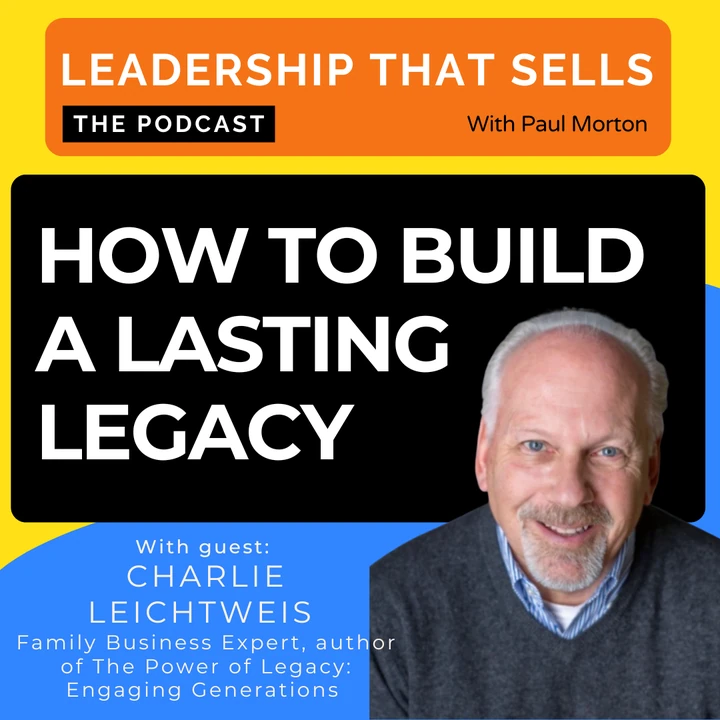
How to Build a Lasting Legacy
with Charlie Leichtweis
Show notes
Most family businesses don’t survive beyond three generations. Less than 3% make it to the fourth. Why? Because growing a business and sustaining a family at the same time is an incredibly complex challenge. In this episode of Leadership That Sells, I sit down with Charlie Likewise, business veteran and author of The Power of Legacy, to uncover the secrets to long-term family business success.
Charlie breaks down the three biggest decision-making areas that determine whether a family business thrives or fails: purpose, direction, and legacy. We explore how generational engagement plays a crucial role in succession planning, why governance is often misunderstood, and the steps every family business leader should take to ensure continuity across generations.
If you’re leading a family business and want to secure its future, this episode is packed with actionable insights.
How to build a lasting family business legacy:
- Define your purpose. Align the family and business around a clear mission to guide decision-making.
- Engage the next generation early. Start succession planning long before leadership transitions are needed.
- Build strong governance. Establish clear structures for decision-making without stifling family relationships.
- Prepare for tough conversations. Conflict is inevitable—having open discussions prevents crisis-driven decisions.
- Think long-term. Avoid short-term gains that could compromise the business’s future sustainability.
Episode highlights:
[03:10] – The shocking statistic: why 97% of family businesses fail before the fourth generation [08:25] – How to align your family and business around a shared purpose [14:40] – Why governance is misunderstood (and how to make it work for your business) [20:55] – The role of generational engagement in building leadership and succession plans [29:30] – How to balance business sustainability with family expectations
Links & Resources:
- The Power of Legacy by Charlie Likewise
- Connect with Charlie Likewise at expertsinhow.com
If this episode helped you, share it with a fellow business leader, follow the show, and leave us a review!
Transcript
Automated transcript. Speaker labels and spellings may contain errors.
Paul
30-year business veteran, some of the world's best-known companies, founder of Experts in How, helping family-owned businesses pass down the generations, author of The Power of Legacy: Engaging Generations, Developing Leadership, Planning Succession. Charlie Likewise, thank you very much indeed for joining me. Welcome to the Leadership That Sells podcast, where we help you lead first and sell more with great insights and tactics from the best minds we can find. Every leader is in sales, whether you're selling products, ideas, a mission or a vision, and great sales team in particular need great sales leaders. When managers bring out the best in their teams, targets get hit on time every time without stress.
But most sales leaders never learned how to lead. They wing it or they repeat bad habits, and the cycle continues. Sales leaders need practical, real-world ideas that fit their busy schedules, and that's why we created the Leadership That Sells Playbook course. Nine short weeks changes your world. Check it out at the Practical Leadership Academy. And now, on with the show.
Guest 1
Well, thank you for having me. I'm glad to be with you.
Paul
So you're trying to help with Experts in How organizations, companies that are owned by a family prosper, continue.
Guest 1
Yes.
Paul
That's kind of fundamental. And you shared a fairly scary statistic with me there for anybody who has a, a company under their fingertips that they're hoping to see passed down to children, great-grandchildren, et cetera. What was that?
Guest 1
Well, it, it's, it's interesting because it's difficult for people to understand how to grow a family and a business at the same time. So the statistic you're referring to is less than 3% of all family-owned businesses make it to the fourth generation. And the reason for that is because the, the process of running a business and, and connecting with a family involves decision-making, and there are three major areas where the disagreement on decision-making can actually interfere with the ability to move forward. Uh, one is the purpose, which is why are we in business. The second one is direction, which means where are we going, how are we gonna get there, and what's the risk involved that we are comfortable with. And the third one is legacy, and the legacy is what do we wanna do for future generations to provide for future generations.
Any one of those three decision-making areas which involve all the processes within family or business, any disagreement on that can, can actually stall the process of building that business and passing it along. So what Experts in How does, we work with families to help them understand how to connect the dots between the major elements of legacy building. Uh, and the book Power of Legacy that you mentioned that I wrote, I take six, from my experience, six major, uh, elements of legacy building and help people understand how to connect those. So in that six, there's governance, there's succession planning, there's family and business architecture, there's strategic planning, et cetera. But there's also one called generational engagement.
And generational engagement, in essence, is the process by which you understand and are able to connect all those other, other elements of legacy. And how that works is the family themselves, when you're running a business, you know, it's hard to run a business and build one. It's even harder to run and build a family business because not only are you taking care of the business, you're trying to manage the family. And when you're running a business, you know, pretty much you, you don't, your head's down, you're working on the, the issues for the business, and you forget to think about all the other people involved in the decision-making process. In a publicly held bus- business, the other people involved in the decision-making process are the people that work there in various roles of the business. In a family business, it's those people plus all the people in the family, some of whom which you may not even talk to or wanna talk to from time to time.
So the idea of en- engaging the generations is to help them understand what the business is, what the business does, what it does for its customers, who are the communities it serves, and how does it help society in general going forward, and what is the benefit to the family, and what are the desires of the family to see that through. All those things don't happen, like, in one session or, or, or in, in a six months or a year. Those are concepts and discussion points for family generations to have over long periods of time.
Paul
Mm.
Guest 1
And it can start with something simple like, "Okay, we're gonna have a family picnic where all the, all the siblings and all the cousins and all the, the spouses and stuff are together." And that's not about teaching them technical elements of the business. That's about letting them play together, letting them get to know each other, letting them begin to understand what their likes and dislikes are over time, because all those elements are what feeds into elements necessary for leadership development or succession planning. And so leadership development and succession planning are informed by generational engagement processes. As the, as the, uh, siblings get older, they reach the age of majority, um, then you can begin to bring in groups of people, uh, the adult members of the family into more technical discussions.
It becomes, uh, an element where you have plant tours or site tours of the business to show them what's going on, introduce them to the people that work there, let them see what the products are, et cetera. They may go out and visit customers or customer sites to begin to understand from front to back, what does this company do and who benefits from it, and why is that important? The, the founding, a foundational block within that are the family values. So the families have decided what the values are that they wanna go forward, and that's the building block on, on which generational engagement allows you to begin to determine these other elements. And then it connects into, how do I set up my governance structure? And it's interesting because governance is sometimes a bad word in family businesses. They're like, "I don't want somebody telling me what to do. Uh, I don't want somebody looking over my shoulder and seeing my confidential information about how well I'm doing." And the, that comes from a misunderstanding of really what governance
is. So when people tell me that, potential clients, I say, "Well, I understand why you say that. So my next question is, if you were buying a piece of equipment for a quarter of a million dollars, what process do you go through?" And they say, "Well, we get engineers together. We, you know, we look at the space. We get, uh, quotes from various vendors. We go through a process where the operations people approve it, then eventually it comes to me as the owner, and I would approve it." And I said, "That's, that makes sense, but that's the process of governance. That's decision-making and approval levels." And so that decision-making process comes back to those three areas that I mentioned earlier, purpose, direction, or legacy. And so those decision-making processes have to be learned over time in terms of how the family can communicate with one another, what their skill set
is in making those decisions or not, and then how do we go about improving those. And so that's how it kind of ties together. Um, and as I said in, in that book, the, the six elements are in there individually, and a lot of people have heard any, any one of them. They've heard of governance, they've heard of succession planning, but they don't know how they're connected and, and related. So what happens is, all of a sudden, the founder dies. Now we have a succession prom- planning problem. But at that point in time, there's no indication or no development of family members to fill that need necessarily. And so they go on and say, "Well, uh, we don't have anybody. I guess we'll have to sell the business." Or, "We have these three people interested in doing it, and they can't stand each other, and they won't vote for each other. So we're not [laughs] gonna do it, and we'll sell the business." And those are the things that interrupt what's going on.
Even if you have people that are willing to go forward with the business, they may disagree on the direction of the business. I think we should grow to a billion dollars, and here's how I think we should do it, through acquiring all these companies. And the other family members are like, "I'm not sure I'm, I'm happy with that risk profile. I have to borrow money. I'm beholden to other people that I haven't had to before." And all those, all those elements come about, and any of those elements are difficult for businesses to deal with. And you add the emotions of the family and whatever their history has been together, it makes it even more difficult to communicate effectively on this.
Guest 2
My wife is the youngest of five. So my wife, as the youngest of five children, um, and they got on very well most of the time, sometimes not, and they don't have a family business. They have difficulty enough deciding where they're going to eat lunch when they get together.
Guest 1
Right.
Guest 2
When you talk about the, the... I mean, and these are, these are foundational elements for any organization. Perhaps not so much legacy, if you think of legacy as continuity or sustainability, but purpose, direction, sustainability, continuity, legacy in the, in the family terms. These are fairly meaty, difficult terms to, difficult concepts to deal with in an organization where you have, and most organizations are, dictatorial.
Guest 1
Right.
Guest 2
They're hierarchical, dictatorial. You do what I tell you. I'll fire your backside so far. I can't quite fire my brother.
Guest 1
Right.
Guest 2
You know? It's difficult to promote my sister-in-law sideways.
Guest 1
Right.
Guest 2
So the emotional side of that, I mean, I can see what you're talking about, where you have your, your family picnic, and the goal I see of your family picnic is to avoid having to do that in the first place because you have a, a more coherent set of relationships that are more understandable, and the connections between each of the family members makes more sense to them themselves. Yeah.
Guest 1
Right.
Guest 2
So you're actually on a long-term trajectory here. This is not something you do y- If you get called in, you know, and, and grandpa's on the deathbed, it's a bit late. You should have started back in 1966.
Guest 1
Right.
Guest 2
You know? [laughs]
Guest 1
Right.
Guest 2
So what, what happens when... And I'm sure you, you, you may see lots of different things here. What happens when you get called in and you're, you're s- you have a situation where, I suppose, the management team, the family, isn't talking? And I see that a lot from corporate organizations that go into them, and there's just a misalignment. My favorite questions are to go in and say, "How do you make money? Who are your customers? Why do they stay?" You know? "Where do you find them?" And you write that down on a nice table, and I talk to the CEO, the COO, the CFO, the CRO, the C whatever it is, and then you go down one, and you see if they're different, and they invariably are quite different across the board.
So that's where you start. You start with that sort of alignment.
Guest 1
Right.
Guest 2
Where do you start when they're actually related? Is it the same sort of process? You can't be quite as
Guest 1
It's, it's a similar process. I do start with surveying all the members that are involved and, and the need to communicate. So first of all, I first ask them, "Tell me who the family is." And frequently, what they'll do is they'll start telling you about the people that have, are, or have been direct, only directly involved in the business. And so I say, "That's fine. And so how about cousins? How about grandchildren? How about spouses," et cetera. And I'll give you an example. One client, I asked that question, w- who's the family, and they said, "Oh, X, Y, Z people," and it was a list of 10 folks. And then I said, I asked the second question that I just mentioned, and suddenly the list grew to 27.
Guest 2
Ooh.
Guest 1
And I was asking about adults only. Uh.
Guest 2
Right.
Guest 1
So I said, "Okay, tho- those are the folks that I want to interview. Uh, first of all survey, and then interview relative to their feelings about the business, about management, about the future, their role, their objectives, what do they see the company means to them," et cetera, et cetera. And it is a separate interview, uh, and survey process for management who are non-family members as it is for family members. And when we go through that process, that dictates the interview with the people to understand and clarify their answers. And when I ask them things like, you know, "What, what do you know about the business? How do you feel about the business?" And they may say, "I'd, I've never heard about it, I don't know." But I also ask them, "Do you want to know more?"
Guest 2
Mm.
Guest 1
To really understand who's interested and what, and to what level. That begins the process that, to your point, should have begun in 1966 [laughs] on, on the generational engagement, and talking to people about all these things. But they haven't so far today, so we gotta start somewhere.
Guest 2
Mm.
Guest 1
And that's how we start. Um, it's interesting because, uh, another client of mine, uh, I, I went through that process and they gave me, you know, the list of people. And they said... I said, "Well, I'm gonna send a survey to these people." And they said, "Well, that's fine, but there's one branch of the family, w- we don't really talk to them. We don't know what happened years ago, and you don't need to send, probably don't need to send a survey because you're not gonna get anything back from them." And I said, "Well, with all respect, we, we actually have to send one to them to see if they... If they don't answer or they come back and say, 'We're not interested,' we need to know that." As it turned out, of all the people that, uh, that turned in, the only branch...
Every, most everybody turned one in, but the, the only branch of the family that turned in 100% was that branch they said, [laughs] "Don't send the survey to." And it's interesting, their first generational engagement meeting after that was a family gathering, nothing technical about the business.
Guest 2
Mm-hmm.
Guest 1
And, and the, the CEO and chair of the board called me later, says, "We had our meeting and, and everybody liked each other." He said, "We got, we got along just fine." [laughs]
Guest 2
[laughs]
Guest 1
So a lot of times over time, assumptions can, can leak into the situation and, and people don't, don't talk about it. And it's so important to give everyone a voice. It's not about consensus, but it's about giving everyone a voice so you at least understand where they're coming from and what their issues are, because those ultimately will affect the ability to create a legacy, whether it's in this business or repositioning the wealth into, to another business.
Guest 2
Mm. Do you find... I think this is possibly more, more valid, and I've seen this a couple of times where somebody has exited a business and they've got a, the [laughs] one chap called it the big green spreadsheet. And the big, the big green spreadsheet was basically if he keeps the spreadsheet in green, he can pass it on to his kids.
Guest 1
[laughs]
Guest 2
And what happened was the big green spreadsheet was very big, passed it on to the kids, and the kids basically, to use the technical term, peed it up against the wall.
Guest 1
[laughs]
Guest 2
So, uh, with the, the goal of, of dad was to, uh, create something that would last, pass it on. The kids basically said, "Well, thank you very much indeed. Gone." So you've got the, the creator, the entrepreneur, and then you've got the, I don't know what you call them, profligates or whatever it is. Um-
Guest 1
Right
Guest 2
... this legacy concept where an organization, an ins- an incorporated company, a limited company, has a duty to shareholders, has a duty to itself really for continuity, for the sustainability. When you add in the family mix, that duty I think seems to come out, my, my interpretation from what you're saying, it sounds like it becomes diluted with a view towards it's not so much to the duty to itself, but the duty or the shareholders. Well, yeah, I suppose the shareholders. But a duty to the family. So the children, the grandchildren are saying, "Well, uh, I just want mine. I want what's mine. I don't really care about this, just hand it over."
Guest 1
Right. Right.
Guest 2
Do you... H- how do you avoid the, the handcuffs? Because you see trusts, you see all sorts of different, um, methods and models of locking things down for trying to create intergenerational wealth. Without, without creating the financial handcuffs or putting things in trust where they can't actually affect it, which, which, which is where you get, you end up with professional management and trust managers and trust funds and all sorts of horrible things. I suppose it goes back to purpose, doesn't it?
Guest 1
It does get back to purpose. It, it also gets back to the idea that when people are involved, the concept of "I want mine" is, is gonna be there somewhere.
Guest 2
Mm.
Guest 1
Some way, shape, or form. And the whole issue is at a minimum, if somebody's adamant about that, you wanna know about that sooner than later.
Guest 2
Mm.
Guest 1
You don't wanna find out about that when that person says, "Okay, I'm demanding you cash out my shares of this business." And the business goes, "Well, wait a minute, the cash that I would need to do that would cost, cause me to force to sell the business."
Guest 2
Mm.
Guest 1
And so understanding that that's on the table and people may want to get to that point is something that you can plan for. So, so th- there's, there's a way to create funds, uh, what in some cases with respect to stockholders, is a buyback fund.
Guest 2
Mm.
Guest 1
And some portion of the money that would be used for dividends is put aside each time as a fund to potentially buy somebody out if they have to be bought out or want to be bought out. We have a case of that in another client. It's run by, a company run by three brothers and an uncle. The uncle is much older than the three brothers, uh, who, or the nephews basically, and he ended up never having kids. And as he got older, he also fell into ill health, and all of a sudden he pounded his fist on the table and says, "I, you have to buy me out. I've worked in this company for 40 years and, and I've created wealth. I want my piece of it." And they couldn't. They couldn't afford to do that with respect to the, the cash that would be required, and they never set aside that relative into the amount of money or the, or the disbursements that they were gonna put aside for the shareholders all along, and they could have done that in, in the meantime.
Now, we ended up talking him out of that and created a, a settlement over time process for him, uh, that would work. But that, that subject came up like out of the blue to the three, the three nephews, and, and that, you know, the whole idea of that coming at the last minute or out of the blue, I mean, lawyers, there, there was threat of lawyers being involved, and that, that right away would've destroyed the company. So- At least understanding these things. It's not that they go away by talking to each other. I mean, I can... You know, Susie pulled my hair when I was 12, and I'll never forgive her for it. [laughs] So that, that stuff doesn't go away necessarily, but understanding that it exists and continually exploring it and asking those people what their opinion is, and sometimes you get past it because their,
their initial desire for I want mine is because they don't trust anybody else potentially, or they think that, uh, they're entitled to it in a way that means that they're gonna go off and do something very selfishly for it, and they need to understand that's not for the betterment of the entire family, and they may come out of it. So again, there's some that you're not gonna come out of it, and there's some you can get, come out of it based on conversation and understanding of what they need, and going down a path that begins to provide some of that for them.
Guest 2
I mean, it's a negotiating tactic. There's irrationality.
Guest 1
Yeah.
Guest 2
Right? You wanna, you, you want, you want to confound somebody. You say, "Well, I, we have to do it by Wednesday 'cause I promised my wife." Uh, oh, what? [laughs] The heck's that?
Guest 1
Right.
Guest 2
You know?
Guest 1
Right.
Guest 2
That's, that's in my head now.
Guest 1
Right. And, uh, and, and then sometimes other generations pick up the pieces. Uh, another client, uh, had, who was in, uh, business for 74 years, and the founders came over as immigrants to the US and, and established this entertainment process and, and provided for people in a fabulous way for many, many years. Well, the fourth generation sons decided, well, they looked at the business and what they saw was their Ferraris. They, they wanted Ferraris, and so they went out and bought Ferraris, and then they went out and bought a building to house the Ferraris, to display them, and the cash drain on the business they executed to do that put the business out of business.
Guest 2
Hmm.
Guest 1
At least until the fifth generation came along and decided to revive it, but those things happen, and without knowing that in advance, you, you can't plan or try to mitigate it if you even can do that over time, and that's one of the things. So, so there's some companies that aren't going to be able to survive no matter what, but many times when that, that communication is open and that understanding is open, things can be done differently.
Guest 2
Again, you're going back to purpose. You're going back to the, you're going back to the family picnic. You know, we're family, we get together every year, and we talk about this, and we come together because this is what we do. We are the family that does this thing so that we can provide for, you know?
Guest 1
Right.
Guest 2
If, if you have enough people bought into that purpose, that's your, that's your goal.
Guest 1
That carries the day.
Guest 2
Yeah.
Guest 1
And, and just one more time, the foundation for that purpose is the original family values and how those values, uh, evolve over time. They'll evolve a little bit, but those family values are something that they need to harken back to. The, the, the purpose has to have value- values attached to it. What are, you know, what is our purpose? Why are we here? And it's founded in those values. So it's important for those to be established. It's important for those to be carried on and communicated, uh, through the generations.
Guest 2
Yeah. When I talk to, uh, organizations, and many of them have the, the values painted on the wall or worse, you have them laminated in a dog tag around your neck, right? They're not living. The values that work, that I find, can be used as a decision-making tool.
Guest 1
100%.
Guest 2
So, yeah. I want to do this, not really because it's not an entrepreneurial task or it's not a, it not, doesn't, uh, lead with the heart or whatever the heck the value is. It's, it's a decision-making tool rather than just, uh, something fluffy and nonsense, and that takes a lot of work.
Guest 1
Uh, it- it's constant work, and that's why, and generational engagements is a process that it's never too late to start it, but it also never ends.
Guest 2
Mm.
Guest 1
Which is fine. Um, and, and one of the things that's, that's tied to that i- is the concept of, of not only what the purpose is and what those values are, but the question is what do we want to provide going forward in the future for this family? And it relates to the quest- the ultimate question, which comes first, the business or the family?
Guest 2
Mm.
Guest 1
And the answer that most people don't like, but is actually the best answer is the, the business comes first.
Guest 2
Yeah.
Guest 1
And the re- the reason for that is that if the business is there to provide for the family, and if the business doesn't come first and it's not there, it can't provide for the family. So that's, that's really where, where people have to get their heads to. Um, even if I want something today, if the business doesn't exist tomorrow, I'm still not gonna get it, but I have at least have a chance of getting it if the business gets... So again, you can, you can negotiate, as you say, with the concept of even if it's for something for you, this is how it has to get there. [laughs]
Guest 2
Yeah. So you want the Ferrari? You gotta work.
Guest 1
That's right. That's right. [laughs] Right.
Guest 2
Gotta do the work.
Guest 1
You're not gonna be able to afford it or that building [laughs] if you don't, you don't make this work, and they didn't see that and it, it failed.
Guest 2
Excellent. Excellent. Uh, is there a particular message that you would pass to com- people who are working in their business right now and they can see... I mean, you talk to startup, scale-up folk, and you say, "Look, this is gonna take seven to 10 years before you get anywhere." And a lot of the times they're building businesses to sell, right?
Guest 1
Right.
Guest 2
I think increasingly it's moving, the company, the world that I'm floating around in, is moving away from taking that incredibly expensive venture capital loan or exiting off to private equity, to actually building something that's profitable and sustainable and growing and provides for the people who work there, provides for the, the shareholders, the stakeholders, and the wider family. Is it a particular message that you would give to them to have them lift their chin and look at the horizon rather than look at the shorter term, the, the potential gain, 'cause you could gain many, many millions of pounds, dollars, yen. But how, what can you do to have them lift their horizon? What message would you give?
Guest 1
Y- you know, that, that's a great question. It's sort of the $64 million question, as they say. [laughs] How to, how to get people to lift their heads, and it, it goes back to- Uh, making sure that there is a discussion and you put it in writing what the purpose is. Their understanding of the purpose of that business will help dictate, again, some of the decisions on direction. So if they have a purpose of XYZ that, that is fairly short-term, then the direction's gonna dictate a short-term plan, and they'll be able to see that by laying that out. So you lay out the strategic plan as a short-term plan. Here's, here's what you can do within that plan. Here's the financials, here's the marketing, here's whatever that goes into that, and, and that's it. And is that...
If that's acceptable to you, um, then they can j- On the other hand, here's the alternative to that which has a longer term view, and here's what that looks like, and let them decide. All you can do is present the scenarios and do as best you can on forecasting it or helping them forecast it so they can make that decision. Somebody ultimately may come back and say, "You know, I just, I don't, I just don't wanna wait 7 years. I just don't wanna wait 10 years. I, you know, that's not in my, in my head." So a- and the other thing is some people, you know, they react the way they've been treated in the pre- previous generation as well. If somebody treated them poorly and didn't ask them for their opinion and didn't value their input to the, the process of what we're doing here, they're gonna possibly do the same thing. And so breaking that cycle again comes through appropriate generational engagement discussions.
You may find that all of the cousins said, "You know, we understand what's going on here, but we really think here's some other ideas on how to get there, and we'd really like to have input to it." And the person who never asked them may say, "Oh, maybe that is something we should consider." It, it's all relative to the, the, the discussion and emotions. If somebody's set in their ways on what they do or don't want to do, then that's, you know, that's gonna be a self-fulfilling prophecy. Um, so it's important to say, how do we understand everybody's voice, and then use that input to consider what direction we're gonna choose based on the purpose? And I know that sounds like more words than, than a, than a spreadsheet answer because there's no spreadsheet answer to that, quite frankly. There's spreadsheets you can create based on the scenarios you describe, and financial analysts and other people can help you try to put the, the numbers to paper based on what you're describing, but it has to start with a common understanding of what do we really want is the purpose here?
What is the time horizon people are willing to accept, et cetera? And then the question is, make sure people don't-- understand they don't have to make the decision for all time today. There's a ways to pivot and, and there may be reason to pivot. Uh, you may be in one business and you may pivot to another business as a result of the economy, as a result of regulations, whatever. [laughs] The ultimate example of pivoting is a story about a gentleman named Alfred Nobel, and I don't know if you know this story. But Alfred Nobel created, uh, invented dynamite, and so he became extremely wealthy. And as the story goes, his brother died in France, uh, and the French newspaper mistakenly thought his brother was Alfred, so they wrote an epitaph that said, "The merchant of death has died." And when Albert saw that-- Alfred, excuse me, saw that,
he goes, "Oh my God. That, that's what people think of me? That's my legacy? I do not want to have that." So he said, "I'm gonna sell all my holdings, take all my wealth, and put it into something that's gonna benefit society going forward." And he did that, and that was the birth of the Nobel Prize. And so, you know, things, things take-- courses are not always straight, [laughs] if you know what I mean.
Guest 2
What is the idea? Yeah. Uh, man plans and God laughs.
Guest 1
Yes. Yes.
Guest 2
That's it.
Guest 1
Exactly.
Guest 2
Exactly.
Guest 1
It's not always our journey. [laughs]
Guest 2
No. Well, there is a plan, but it's not necessarily ours.
Guest 1
[laughs]
Guest 2
That's the thing.
Guest 1
Right. Right.
Guest 2
Excellent. Excellent. Charlie, uh, where can people find you when they need you?
Guest 1
Uh, my website is expertsinhow.com, E-X-P-E-R-T-S-I-N-H-O-W.com. Um, you can find me on LinkedIn as well under my name. Uh, I, I don't-- when this is published, I think the spelling of my name-
Guest 2
We'll have notes and links in the bo- the bottom.
Guest 1
Yeah. Great. Perfect.
Guest 2
I'll have your-
Guest 1
And so you can reach me that way as well. Um, and uh, I'm always, you know, interested in-- What gets me up in the morning is helping people, so I'm always interested in having a conversation with anybody who has questions about these processes or, or what they're going through. And, and I like to listen to them to understand what their issues are first, and then I can determine whether I can do something to help them or if I know somebody that can help them.
Guest 2
Can't ask for more than that. Charlie, likewise, thank you very much indeed for joining me.
Guest 1
Thank you for having me. I really enjoyed it.