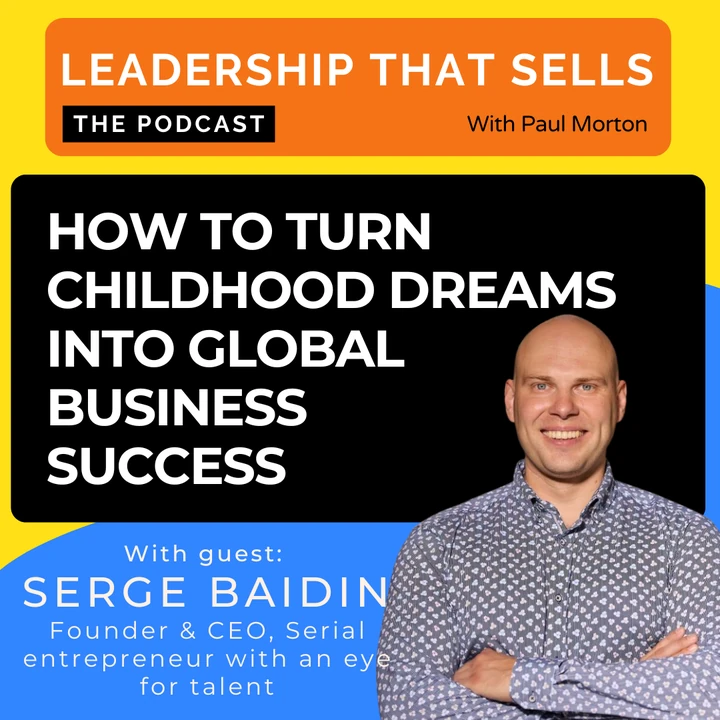
How to Turn Childhood Dreams into Global Business Success
with Serge Baidin
Show notes
In this inspiring episode, I sit down with Serge Baidin, a serial entrepreneur and CEO of Bride and Groom Video, to explore how childhood dreams and a relentless drive for success can shape a thriving career. Serge takes us through his journey, from a challenging upbringing in Ukraine to building successful businesses that bring cherished memories to life for thousands of people around the world. Along the way, he shares key insights into leadership, the importance of stepping out of your comfort zone, and why risks are the oxygen of entrepreneurship.
Whether you’re a budding entrepreneur or someone seeking inspiration to chase your dreams, Serge’s story is a testament to the power of determination, adaptability, and vision. Tune in to hear his hard-earned lessons on managing teams, building a growth mindset, and creating impact through innovation.
Episode Timeline:
[2:22] – Serge introduces himself and shares how his childhood dreams shaped his entrepreneurial spirit.
[6:08] – His first job as a construction assistant and the leadership lessons he learned at just 16.
[10:45] – From wheelbarrows to websites: Serge’s pivot to becoming a freelance web developer.
[15:30] – Why working for a fixed salary scares him and how performance-driven work fuels his motivation.
[19:50] – Serge’s take on the transformative power of feedback and the importance of acting decisively.
[21:07] – The vision behind Bride and Groom Video and his plans to help preserve memories for future generations.
[23:04] – Serge’s one key message for the world: “Today is your best day.”
Links & Resources:
- Connect with Serge Baidin on LinkedIn
- Learn more about Bride and Groom Video: brideandgroomvideo.com
- Explore Serge’s website development company Markup Us: markuppus.com
Closing Note:
If you enjoyed this episode, don’t forget to rate, review, and share the podcast. Your support helps us reach more listeners like you. Follow us for more inspiring stories and insights from incredible entrepreneurs around the globe!
Transcript
Automated transcript. Speaker labels and spellings may contain errors.
Paul
Serial entrepreneur with an eye for talent. He brings together skilled individuals, equips them with the systems, processes, and then sets them on the path to success. Currently the CEO of Bride and Groom Video, among others, Serg Bidon. Thank you very much indeed for joining me. Welcome to the Leadership That Sells podcast, where we help you lead first and sell more with great insights and tactics from the best minds we can find. Every leader is in sales, whether you're selling products, ideas, a mission or a vision, and great sales team in particular need great sales leaders. When managers bring out the best in their teams, targets get hit on time every time without stress. But most sales leaders never learn how to lead. They wing it or they repeat bad habits, and the cycle continues. Sales leaders need practical, real-world ideas that fit their busy schedules, and that's why we created the Leadership That Sells Playbook course.
Nine short weeks changes your world. Check it out at the Practical Leadership Academy. And now, on with the show. Could you expand on that far too short introduction? I mean, you've been, you've been around quite a while. What are you doing? What, what's interesting for you? What's exciting for you just now?
Serge Baidin
Hi, Paul. Thanks a lot for having me here, and it's my pleasure to contribute to your wonderful podcast. And yeah, thanks for the introduction. But in a nutshell, I'm just a happy man who fulfills his childhood dreams throughout his life. And yeah-
Paul
Hang on, hang on. My childhood dream was to be like an engine driver, right? I wanted to drive trains.
Serge Baidin
[laughs]
Paul
So you had a childhood dream of being an entrepreneur?
Serge Baidin
Well, uh, I was born in late '80s in Ukraine, and I was growing up in '90s, and in that part of the world, times were really tough, and my dad had to work hard to bring bread and meat to our table. But my mother, uh, nurtured love of freedom in me. And we didn't have much money to travel or I didn't have many things that many eight years old, 10 years old, 12 years, years old dream about, like game console or first computer. Uh, but I was reading a lot, and I was dreaming about traveling. I was dreaming about, uh, being a guy everyone listens to, everyone follows. And to be honest, I was more of an introvert, and social interactions was not my thing. But in my dreams, I was al- al- always, uh, be a leader. And of course, I wanted to be able to earn money, to be able to buy cool things, to drive nice cars, and so on.
So yeah, now currently I run two successful outsourcing companies. I run my photo and video editing company, Bride and Groom Video. Uh, I run my website development company, my childhood dream of my working with computers, uh, Markopos. And, uh, also I'm a fresh graduate, MBA graduate from Trinity College, Dublin. Uh, uh, I got my business degree from there, and I can travel the world with my beautiful wife and our five children. So yeah, I can say that I'm a happy man and I'm fulfilling all my dreams from my childhood.
Paul
Five kids? Really? Five?
Serge Baidin
Yeah.
Paul
You don't look like somebody who drinks that much.
Serge Baidin
[laughs]
Paul
[laughs] I've got two. My goodness me. Five, well, that's, that's, that's good. Number one, congratulations because I think the world needs to be repopulated with people like you, right?
Serge Baidin
Oh, thanks, Paul.
Paul
We need more of them. And the fact you started in Ukraine, you went to TCD, right? Which is a fabulous place. I know it well. And now you're in Nuremberg in Germany, where I assume, because right now it's, uh, the end of November 2024, and I'm freezing my ass off here in Hampshire in England. You must be seriously under the snow by now. Really?
Serge Baidin
Well, actually we're here because we are waiting for the best Christmas market in Europe.
Paul
Yes.
Serge Baidin
Uh, that will be here, like, in two weeks. And yeah, my kids are excited. And previously, uh, we spent two, uh, winters in Ireland, one winter in Florida, and my-
Paul
Okay
Serge Baidin
... my, my little, my, my, my little ones, they are, uh, really excited to see snow this winter. So yeah. [laughs]
Paul
Well, I know which one I might prefer, honestly. The Floridian winters are significantly nicer than some of the wet and miserable shit we get in this part of the world. [laughs] Right. Let's, let's go back a little bit here. Um, you, you, you mentioned just before we started recording that you're stepping out of your comfort zone to do this sort of stuff, to actually talk to people and share a little bit about your story. Not only, I mean, your, your message was you, you want to stretch yourself, which is good. I, I don't meet anybody who's successful at all who doesn't recognize that their job is partly to continually learn and try new stuff, take risks, be brave, make a fool of yourself, or actually
not care about making a fool of yourself, frankly. And the fact that you're doing this in what, is English your second language or third language?
Serge Baidin
It's my third language.
Paul
Your third language. I thought it might be. Mm-hmm.
Serge Baidin
[laughs]
Paul
The fact that you're doing this in your third language so, okay, it tells us even more about you So let's go back in time a little bit. Tell me a bit more about this journey. Right. What, m- of your childhood dream was the thing that drove you to starting... 'Cause it was, it's, it's a technology play really, isn't it? You're, you're a tech. I can tell just by looking at you, you're a tech, right?
Serge Baidin
[laughs]
Paul
It's the smile. So the technology thing, was that the thing that interested you? Was it the ability to make things happen with tech, or was it the outcome? Was it the business side of it? W- w- which, which part?
Serge Baidin
Well, a part of all the things, uh, made a huge difference in my life. So first, uh, I was watching movies about all those cool hackers who could hack Pentagon sites and different things, and I was saving money for my first computer, and finally, when I was 14 years old, I got one. Uh, then I wanted to learn how to, how to make money, how to earn better life for me, for my family, for my future wife and kids. Uh, and actually, my first job was not in tech. Uh, my first job was, um, an assistant, uh, at a construction site. Actually, I was that guy, uh, during my high school years. Uh, i- in Ukraine, we had really long summer holidays in school, uh, three whole months, June, July, August, and, uh, when I was 15 years old, I was as- that assistant, and builders were saying, "Hey, clean up here.
Bring this there. Uh, unload things, load things," and m- many other s- things. And the very good s- good thing here was that I was paid not just hourly wages. I was paid based on, uh, the amount of work I accomplished. And I learned the thing, and I worked really hard, and I made just decent money for 15 years old, so I could buy some cool, cool techs. I bought my first cell phone, and you remember it's 2003, and it was really cool to have your own cell phone. Uh, yeah, and it was my first working summer, and the next working summer, that construction company, uh, took another big project, and they needed four assistants, assistants, and I was asked to recruit, like, some of my friends, and I was accountable for our small team
of four, uh, high school, uh, students. And it was really very interesting because, uh, somehow those three guys, they are from a bit more well-off families, and they were not as hungry as I was, and, uh, I was motivated by money. I wanted to work more, work harder, uh, to get more, and they were about, "Mm, maybe we can finish earlier today. There is a football match on TV," and so on. And I had to realize that people are different, and they have different motivation. They have different, uh, things that drive them in their life. And at the end of that term, that three, three months term, I learned, uh, how to assign tasks, how to find things, uh, uh, that are better for this individual, uh, or things that are better for that individual, and yeah, it was my first real, uh, leadership experience.
But on the other hand, [laughs] at the end of, uh, three months, uh, I had my first working trauma, [laughs] and I cut, I cut my, uh, my wrist hair, and I couldn't work the last two weeks, and then, uh, uh, I couldn't use my hand for maybe one month or two month. And I realized, "Hmm, now, Serge, maybe you have fi- to find something different your, in your life, and you need to learn how you can use your brain and your head, not only your hands and your friends." Uh, and yeah. After that, uh, I started myself as freelance developer. Uh, I registered on freelance websites, and at those times, uh, internet was slow, and there were not many calls, vid- video calls, so people don't know who they were working with.
And I wrote that I was, like, 20 years old, uh, individual creating websites, but actually I was 16 or 17. But ti- times were great. It was easy because not many people knew how to do things, and information w- was limited, and I was so passionate about that, and I pivoted to website developer. So yeah. I was starting as an assistant to builders, then I became freelance developer.
Paul
Okay. So wheelbarrows to websites. From wheelbarrows-
Serge Baidin
Mm
Paul
... to websites. I like that. Okay.
Serge Baidin
Yeah. Yeah.
Paul
Well, I mean, the... I try to talk about leadership in this thing as, as much as we can, even though some of the conversations just go wild. But the point that, that you were responsible for your other, the other kids there You talked about a few things. You said you had to, you had to learn about setting objectives. You had to learn about managing from strengths. You had to learn about giving feedback. You had to learn about basically, you know, discipline, organization, all that sort of stuff, and you were what, 16?
Serge Baidin
Yeah, I was 16.
Paul
16. All right. What do you ... What would you have advised you at that point?
Serge Baidin
Oh, that's a very good question. Maybe not only to myself when I was 16, but maybe even 20 and 25.
Paul
Mm.
Serge Baidin
Uh, don't be afraid to give negative feedback to people.
Paul
Mm-hmm.
Serge Baidin
It's number one. And number two, uh, if you feel, uh, that you want to fire this person, you need to do it as soon as possible. Second chances, third chances, fourth chances, chances never work.
Paul
No. I, I think that's possibly my biggest learning, my biggest takeaway from all the years of management and leadership that I've had is the minute you recognize that a change needs to happen, make the damn change. Make the change. And now you don't have to be firing somebody, but it has to make a change of some description. So if somebody's not working out, you find something else for them. You move them, you train them, you do whatever. But in that role at that time, in that way, no. We ain't ever ... It's just not gonna happen. Right? I mean, I'd, I'd be really interested to find out if there was some sort of, from a sales point of view, 'cause my background's in sales as well, I'd be interested to find out if there's a percentage or some sort of data on the number of salespeople who get put on performance improvement plans, PIPs I think they're in
English, um, how many of them actually stay or how many actually get fired, you know? So, so it's ... I think when you s- when you recognize there's a problem, you have to act. That's the shorthand I think. Okay. So that's your, that's your how to advice there. Okay. So I think that's the, uh, the advice, the advice for the, for the younger Serge. Why are you ... Let's talk about this s- stepping out of your comfort zone. Okay. So you were a tech, you liked the tech. You ended up leading a small team. Maybe ended up liking that. Are you finding that as you step out of your comfort zone, you end up liking the thing that you stretch yourself for, or do you still not enjoy them?
Serge Baidin
Hmm.
Paul
What's the-
Serge Baidin
Well, uh, when I'm stepping out of my comfort zone, uh, fi- first I try to make myself love the new thing, and it helps me to step out of my comfort zone. But yeah, uh, I believe at the end of the day, when I'm becoming better and better in this new, uh, new field for me, I'm starting loving this.
Paul
Mm-hmm. So you choose to do something rather than say you have to do it. You tell yourself that you're gonna love it.
Serge Baidin
Yeah, indeed. And maybe it's one of the be-
Paul
The self-talk. It's the self-talk
Serge Baidin
... one, one, one of the bad things in entrepreneurship, that you can choose. You can choose your way.
Paul
Mm. Well, it's one of the best things, but it's also one of the worst, right?
Serge Baidin
Yeah.
Paul
Is you have to choose. There's nobody else who's gonna choose it for you. Sometimes it's just nice to be told what to do. Sometimes, "Here, do this."
Serge Baidin
Exactly.
Paul
"Okay." Right? "Take these bricks and move them over there." "Okay." [laughs]
Serge Baidin
[laughs] But yeah, e- e- even, even doing, doing that, uh, as I said, I was paid based on the amount of work I accomplished. And now I realize that in my, in all my career, in all my life, I never worked for fixed salary.
Paul
Mm-hmm. Oh, interesting.
Serge Baidin
My, my, my pay, uh, was always, uh, dependent on myself, on how much I, uh, push myself, on how much I can bring to the market.
Paul
Do you-
Serge Baidin
And, yeah, it's interesting.
Paul
I, I think that is possibly one of the transformational understandings, the difference between people who are driven and who really do great things, and most of the rest of us. And I think it's the people who turn up and do the job, and you need people to do the job. You need people to turn up, the worker bees, and do the job and go home, and that's great. You need that. But I think the ones, the transformational ones, are the ones who recognize that there is a connection between effort, between output and reward. Now, whether that reward is intrinsic, so I feel better because I've worked harder, or extrinsic, as in somebody hands me a bucket of cash rather than a small lodge of cash, I think it's still the difference. It's that when you disconnect effort and output, uh, when you disconnect output from input and you get the same amount regardless, so you're at McDonald's and you're flipping 1,000 burgers a minute, or you're at McDonald's and you're flipping one burger a minute, you're still getting paid the same.
All right? 'Cause it's not your store. If it was your store, you'd be there whacking the damn things out as fast as you possibly could, 'cause you want your money, right? So is this ... Is ... What do you think about this connection? Am I, am I missing something?
Serge Baidin
Yeah. Actually, I don't even know how it is to work for fixed hourly wage or-
Paul
You don't even know. I love it
Serge Baidin
... monthly salary. [laughs]
Paul
Who the hell does that?
Serge Baidin
Uh, but, but, but, but, but-
Paul
Most people
Serge Baidin
E- e- even this idea, uh, makes me scared. It means that, hmm, okay, uh, if I want to, uh, buy something next month, what, what, what can I do? I, I, I don't have this money and all these promotions, I need to go to my manager and ask for promotion once in some big period of time, and especially I know in, in the UK, in Ireland, uh, it's not as flexible, for example, as in the US, and there are some grades, and it's really hard to skip one grade and go faster, uh, than others. And this idea, yeah, it, it makes me scared. Uh, but when I work on myself, I know, okay, okay, I have big plans. What can I do to achieve that? And it makes my brain think, okay, if I do this, the outcome can be that. Of course there are risks here, but-
Paul
Mm-hmm
Serge Baidin
... uh, risks are everywhere, but rewards are not everywhere.
Paul
Mm-hmm. I was talking to a guy yesterday who said that risks are his oxygen, right? Risk is his oxygen. He, he feeds on risk. And it's not other- it's not reckless or crazy, it's just he needs the drive of making the choice and owning. You, you need to own the thing.
Serge Baidin
Do you need ... This idea is close to me. Yeah. I feel the same way.
Paul
Uh-huh. Fascinating. Is there, uh, an event or a mistake or something that happened that taught you the most in your life so far?
Serge Baidin
I think all my mistakes are connected to the things that I told before. I was giving people second, third, fourth chances, uh, with- without giving proper negative feedback, and somehow I was thinking that they will change, that they will do something differently. But now I realize how stupid I was and how stupid it is to expect something new if you are doing things the old way. It never works.
Paul
It's a rare beast. It's a rare beast. What are you, what are you currently working on? Other than your two, two companies. You've got Markup Us. You've got-
Serge Baidin
Yeah
Paul
... Bride & Groom Video.
Serge Baidin
Uh, currently I spend maybe 80% of my time in Bride & Groom Video, and this business is growing really fast. I'm happy with that. Actually, our business model now it's B2B, so we work with professional wedding videographers, uh, in, from all over the world. They shoot weddings, they upload their footage, and my team edits their footage. So at the end, there is a beautiful wedding film. And this Christmas, uh, I think about 3,000 new couples around the world will be watching their wedding films without any idea that some guys somewhere in Eastern Europe, uh, worked on them. And we, we have a new idea. So, uh, I see huge potential in B2C segment, and many of us have our old footage from, for example, from my wedding 10 years ago, or, uh, from our school, uh, performances or
something that is important for us, but it's still on VHS or DVD or, uh, other types of tapes, and we don't even have any devices-
Paul
Yeah
Serge Baidin
... where we can watch it right now. But there are technologies with AI now, uh, where we can digitize and we can upscale-
Paul
Mm
Serge Baidin
... the quality of video, of audio, and we can re-edit old footage, and easily we can bring back, uh, good memories to people, and we can save those memories for future generations. So right now I'm working on a new offering for B2C, and I'm building my marketing department. My editing department is al- already ready to do this, and yeah, I'm looking for, uh, people who can help me organize all my marketing efforts, especially in social media.
Paul
Well, if you're listening and you are a social media expert, do please reach out to Serg Baidin. His, his-
Serge Baidin
Yeah
Paul
... details will be in the-
Serge Baidin
There
Paul
... the episode, I'm sure. I'm sure. We need to wrap this up. Let's, let's finish on one key message from you, from your experience, from life, from business, the universe, five children, traveling the world, following your dreams. What's one message? If you had 10,000 billboards you could write one message on and everyone in the world would see it, what would you say?
Serge Baidin
I would write, "Today is your best day." It's so important for everyone. It's so important for each of us to wake up from our daily routine and from our thoughts and think, "Jesus, I'm a healthy, um, young man. I have energy. I have, uh, my friends, I have my family. Life is great, and today is my best day, so I can wake up and do things. I don't have to wait." [laughs]
Paul
That's marvelous. I like that. Today is your best day. Where can we find you? We'll put the links to the websites in the description, but where otherwise can we find you? LinkedIn?
Serge Baidin
Yeah, yeah. Please use LinkedIn. My name is Serg Baidin. Just type it, and yeah, it's written in a different way from ex-President of the US. It's B-A-I-D-I-N.
Paul
Fine.
Serge Baidin
I'll be happy to connect with you.
Paul
And we have Bride & Groom Video, and if you need your business websites built, search out Markup Us online as well. Serg Baidin, it's been an absolute pleasure talking to you. Thank you very much indeed.
Serge Baidin
Thank you, Paul.