Show notes
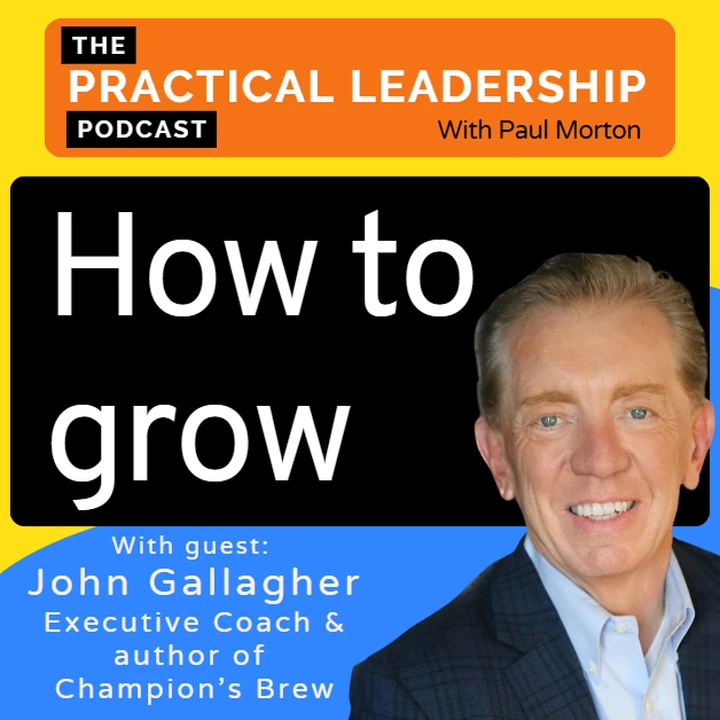
In this episode, I am joined by John Gallagher, an executive coach, host of the Uncommon Leader Podcast, and creator of Champions Brew, to explore the principles of leadership, personal growth, and the importance of intentionality.
Drawing on over 25 years of leadership experience, John shares practical frameworks for transforming leaders and organisations, from developing personal discipline to cultivating leaders who inspire and equip others.
We discuss how leaders can raise the average of those around them, creating high-performing teams with purpose.
John also reflects on the importance of faith and family, showing how personal and professional growth are deeply interconnected.
Key Quotes:
- “Good intentions without discipline lead to excuses, but good discipline with intention leads to excellence.” —John Gallagher [00:18:14]
- “You are the average of the five people you spend the most time with. So look at your circle and raise the average.” —John Gallagher [00:26:20]
Chapter Breakdown and Timestamps:
- John Gallagher’s Leadership Journey [00:00:57]
- John reflects on his 25-year journey into leadership and the influence of John Maxwell’s 21 Irrefutable Laws of Leadership.
- The Importance of Family and Relationships [00:03:38]
- John talks about his Irish roots, a recent family reunion, and the importance of nurturing relationships with loved ones.
- Defining Leadership and Influence [00:09:52]
- John shares his simple definition of leadership as influence and how he applies this philosophy in coaching others.
- The Pain of Change vs. Staying the Same [00:11:22]
- Through a metaphor about a chirping smoke detector, John illustrates the necessity of making uncomfortable decisions to achieve growth.
- The Seven Steps to Personal Growth [00:15:55]
- John outlines his seven-step framework for growth, covering decision-making, discipline, and the need for continuous reflection.
- Intentionality in Leadership and Faith [00:22:00]
- John explains how his faith drives his leadership approach, emphasizing how core values like love and empathy are key to influencing others without being overbearing.
- Raising the Average in Leadership [00:26:00]
- Inspired by Jim Rohn’s famous quote, John challenges leaders to constantly raise the average of the people they surround themselves with and those they influence.
- Future Projects and Personal Growth [00:27:40]
- John reveals his upcoming book, Excellence Only Happens on Purpose, and his commitment to continuous growth in all aspects of life.
Actionable Insights:
- Embrace Discipline with Intention: Focus on consistent daily habits—whether in leadership, fitness, or family life—that align with your long-term goals.
- Raise the Average: Surround yourself with people who challenge and inspire you to grow. Be the kind of leader who raises the average in every room you enter.
- Make the Tough Decisions: Whether in life or leadership, growth comes when the pain of staying the same becomes greater than the pain of change.
For more wisdom from John Gallagher, check out his podcast, Uncommon Leader, or subscribe to his Champions Brew newsletter:
https://www.coachjohngallagher.com/
________________________________________
When you’re ready to take the next step in empowering your managers and driving team performance, I’m here to help with the fast-to-deploy, high-impact Practical Leadership Playbook course.
- 2 x 30 minutes a week over 9 weeks – live expert led virtual sessions + group coaching to deal with the real challenges.
This program is designed to turn your managers into confident, effective leaders who inspire their teams to excel.
In the meantime, you can start making an impact right away:
>>> Download your free guide: ‘5 Steps to Transform Your 1-to-1s’
Discover practical strategies to make these key meetings much more meaningful and productive. (Hint: track them in a shared doc, put 15 mins planning + 30 mins meeting in both your calendars recurring, follow a set, repeating agenda.)
If you have any questions or want to explore how the Playbook course can work for your organisation, don’t hesitate to reach out!
Transcript
Automated transcript. Speaker labels and spellings may contain errors.
Paul
Executive coach, performance consultant, host of the Uncommon Leader podcast, author and distributor of Champions Brew, the newsletter that will equip, inspire, and encourage you as a leader. Hello, and thank you for joining me on the Practical Leadership podcast. My name's Paul Morton. I'm your host. We try to distill the hard-earned wisdom of CEOs, executives, and high performers around the world into actionable insights that you can take away and put into your leadership practices really quickly. If it's time for you to look at your own management teams and help move them from being accidental into being intentional, then in nine short weeks, the Practical Leadership Playbook course will help you do just that.
Check out the Practical Leadership Academy. And now, on with the show. John Gallagher, thank you very much indeed for joining me.
John Gallagher
Uh, it's great to be here. I'm looking forward to our conversation today, absolutely.
Paul
Well, likewise. Now, that was far too short a introduction for somebody of your experience. Would you be so kind, for both of my listeners, now one of them's my mum, and there's one other guy. For both my listeners, would you share a little bit about who you are with them?
John Gallagher
I love the, the introduction that you did. It was brief, uh, it's to the point. But if you ask me to go a little bit deeper with that in terms of that executive coach and performance consultant and some of the work that I've done, it's really been a journey for me, uh, on the leadership side over the last 25 years from when I had a mentor give me a, my first book on leadership when I was about 28 years old, 29 years old, if you will, uh, talking about The 21 Irrefutable Laws of Leadership by John Maxwell, when I didn't even know what leadership was. And once I read that book and he walked through, through that with me chapter by chapter, got a chance to learn more about how John Maxwell teaches, it inspired me to say, "That's, that's kinda what I wanna do."
I wanna make a difference with folks who wanna make a difference at a time to make a difference. And I spent the last 25 years on that journey really with a focus in two areas, leadership development from that standpoint, and then the performance consulting side, learning and mastering what I think are the, the tenets of the Toyota Production System or lean manufacturing. But frankly, using that across the board in developing people. Uh, I've y- I've worked in healthcare systems, clinics and hospitals, utilizing that performance improvement technique and leadership development, large electrical contractors, real estate, a lot of different ways, knowing that it's really not about the industry that I was working in, but it was about the desire to
make a difference and utilizing a system to help organizations have an impact. And then another side of that really for me lies in kind of who I am as a father, as a husband, uh, and the person that I wanna be, that God created me to be, that I wanna always strive to move toward that excellence as well. So that's a little bit about me. That's a little bit about my journey. Again, really looking forward to my conversation. Now, let me share a story on, on your introduction because I love, uh, the, uh, when you used the real Irish, uh, pronunciation of our name, Gallagher. I'll never forget traveling back several years ago, my first trip into Europe, going through London to come through, and the customs officer says, uh, "Mr. Gallagher, welcome to, uh, the UK." And, and I said, "It's Gallagher." He said, "Oh, not around here it isn't." I s- and I said, "I had absolutely learned the proper way to pronounce my name after about
35 years." So I appreciate that introduction, the introduction as well.
Paul
Well, it's a good strong Scottish [laughs] in there as well.
John Gallagher
Mm-hmm.
Paul
So you have an Irish background, there's a Scottish one, 'cause they're both, you can go either way.
John Gallagher
It's an Irish background for me. So we go back, uh, really three generations. So I'm a th- I'm a third generation over here in the US. Uh, my dad's fa- grandfather, uh, came over, uh, in 1930 or so from Ireland and, uh, the rest is history for us. We actually just had a family reunion where we had four generations there, uh, and about 35 of us together for the first time in about 30 years. It was a, a great opportunity to share some, share some stories.
Paul
It's a wonderful moment when you get together with family like that-
John Gallagher
Mm-hmm
Paul
... 'cause you, you remind yourself that you don't get to choose them.
John Gallagher
That's right.
Paul
You don't get to choose them. And that's... It can be hard because you, you are, you are, you are called to love everyone regardless, in fact, especially the difficult ones. And there's nothing like family. I'm not say- not talking for a moment about yours, of course. But there's nothing-
John Gallagher
No
Paul
... like family for reminding you of that.
John Gallagher
I agree with you, though. I mean, that you're exactly right. You can, you can pick your friends and, you know, you can pick a couple other things, but you can't pick your family. They are there, so you better learn how to converse with them and have a relationship with them and love them, absolutely.
Paul
Absolutely. So I, this is a complete aside, but my son has this really good joke. He says, "You can pick your friends, you can pick your nose, but you can't pick your friend's nose."
John Gallagher
There you go. [laughs] That's right. You went there, I didn't. Absolutely.
Paul
Oh, sorry.
John Gallagher
But you're exactly right.
Paul
I shouldn't have ruined-
John Gallagher
No, that's okay. Hey, that's okay. It's your show. You can say whatever you want to on your show.
Paul
Oh, it's magnificent. Um, actually, my, my son has this wonderful T-shirt as well. It's, uh, he got it from a US book that he's been reading by a guy called Jocko Willink, who's a-
John Gallagher
Mm
Paul
... former SEAL, and he talks about discipline equaling freedom. You know? Freedom, one of, one of the big Fs. And I know it's not one of your big Fs. You have fitness, family, faith, and friendship. I think you can add in function in there for job. You can add in-
John Gallagher
Mm-hmm
Paul
... function. You can add in fi- you can add... There's lots of fis, you know? So it's, it's quite-
John Gallagher
Yeah, I tell that job, I talk about it as fruiture. I've made up my own word.
Paul
Oh, fruiture. That's fruiture. Yeah.
John Gallagher
Um, but I go back and how it's planned and, you know-
Paul
Okay, I see that
John Gallagher
... you know, Jo- John 15 talks about bearing fruit. And so I, I stole from that. My logo is kind of like a tree, but I really stole from that, that if we're doing our, our things correctly, developing ourselves, developing our team, developing the systems and processes that we need to be successful as individuals or organizations, we're going to bear good fruit. Uh, and ultimately that's the, the purpose of our work, uh, is to bear fruit in others as well as, frankly, as, as an organization, uh, to have impact financially, uh, and long-term eternity, uh, in terms of the work that we do.
Paul
There is an aspect of the, the, you know, the fruit of the spirit, then you have the, by, by the fruit will you know them, right?
John Gallagher
Right.
Paul
And they're talking about children, they're talking about false prophecy and all that sort of stuff. But I think there's a... Somebody was... I was talking to someone fairly recently, and it's a good measure of a good manager. When you're interviewing a new manager for a position and you ask them, "In your last role, how many people came with you?" Right? And you look around, it's by your friends shall you be known sort of thing. Show me your friends, I'll show you who you are. It's the fruit that you produce that really defines you, whether it's your children, really, or it's your, your, your friends or the... As a leader, it's what you bring out in people.
John Gallagher
I think you're spot on, though. And a- as you were talking about that in terms of the fruit and, again, the developing of leaders, look, as leaders, and I'm not talking about just about title. You mentioned leaders in the home as parents or spouses, leaders in our community, uh, or leaders in the workplace. Regardless of how you end up defining that leadership, uh, title, uh, one of my favorite books is The Five Levels of Leadership by John Maxwell, and he talks about any of those pieces you start out as in the position side of leadership, people follow you because you have to. But as you move through the journey, if you're being intentional as a leader and you have good intentions as a leader, then there's stages you go through. So like you move from this permission... or excuse me, from, uh, position where people have to follow you to permission, and that's when people follow you because they want to.
But you move through these phases, and ultimately I refer to it as the greatest story ever told. So whether it's a question or not, it's kind of a life planning process that I work through, or how I see it is that there's gonna be a point in time where somebody's gonna ask you a question sitting in a room to name five people who have had a positive impact on your life.
Paul
Mm.
John Gallagher
Okay? And oftentimes we're asked questions like, "Who are the, the last five, uh, World Cup champions?" if you will, from a, a soccer standpoint, or Super Bowl most valuable players, and people forget about that even though it's just happened recently and the popularity that those individuals have. But over the course of their lives it becomes very easy to write down those people who've had a positive impact on your life. And the greatest story ever told to me in how as leaders I believe we should be thinking about it is when someone else writes your name on their list. That's the challenge that we have as leaders to say, "Who's gonna write my name on their list?" Even though I may never know about that, that's the type of fruit I'm looking to bear because I've made a positive impact on their life. And again, back to even your start with Jocko's, uh, book Discipline Equals Freedom, is that too many times individuals saying, "Well,
if I have to do these certain things every day, every week, every month, that thing, that seems very restricting." But actually it's that intentionality that leads to excellence in their work in giving them the freedom to do the things they want to do with who they want to do them when they wanna do them. That's the freedom that you're looking for that discipline creates.
Paul
Totally. And consistency and all that sort of good stuff as well.
John Gallagher
Absolutely.
Paul
Mm. So I mean, you reflected back when you, you took on your first leadership job and, uh, you couldn't at that point spell the word leadership. I like that. And you got a copy of the 21 Laws, worked through that with a good coach and discovered exactly what it was to be this, uh, this mythical leadership person. How would you define leadership?
John Gallagher
Well, again, it comes right out of that book in terms of what I've gone for. Leadership for me, uh, is the same way that John Maxwell, he just, he's been a big influence mentor. I've met him a couple times, but leadership is influence. Are we able to positively influence individuals in a direction that they're looking to go? So you, you mentioned the Champions Brew and what's their, uh, the, you know, the mission behind Growing Champions is really about inspiring, encouraging, and equipping leaders to be the leader that they wanna be. And so if I can do that, if I can either inspire, encourage, or equip them, uh, in a way that they will change positively to make an impact in somebody else's life, then to me that's leadership.
Paul
Mm-hmm. Mm-hmm. Okay. I'll take that. I'll take that. You-- I think we talked about discipline, we talked about, um, getting people to where they wouldn't get another one really. This idea of making a commitment to growing or deciding to do something I think comes from, well, comes from many places, but there's a strong, uh, voice in, I think it's Norman Vincent Peale when he talks about drifting and not drifting.
John Gallagher
Mm.
Paul
Most people drift through life waiting for death. How do you not drift? How do you, as you say, make a commitment to personal growth? Because the alternative, that's what they're thinking about.
John Gallagher
That's right. Well, you think you... That, that con- alternative is not really that good. And I think about this and I, I share a story, and this really, this really, uh, happened to me in the past year or so, but it became a metaphor for that first step in personal transformation being making the decision that you wanna get better. Uh, and it's a, it's a fun story, but it's ultimately, uh, and, and I'm hopeful that you can kind of, uh, connect with this, but it was about two thirty one morning. I, I was aw- awakened, uh, by my dog kind of whimpering a little bit. And that happens once in a while, thinking the dog wants to go outside, but that wasn't what it was. There was a little chirp in the house, uh, that was going on, and it started to get louder and louder, and it was actually the smoke detector letting me know that the battery- Was going low in my smoke detector, and of course that happens at two
thirty in the morning and not eight thirty in the afternoon where I really need to, you know, have the time, have the, uh, forbearance, and I'm not, excuse me, under the covers warm, uh, on a cold winter night and not wanting to get out. So I said, "Oh, it's not that loud right now. I'll just kind of wait it out. I'll fall back asleep, uh, and get, get that done." But then it starts to chirp a little bit louder and a little more frequently, and my wife next to me starts to elbow me in the ribs, uh, to get up and go do something about it. And so, you know, for me, that decision was really this: Do I choose the displeasure, okay, of in essence getting up and getting out of bed, uh, and going over, uh, and being cold and changing that, getting a ladder out of the garage and changing that at two thirty in the morning, or
do I stay in the discomfort that is the bed? And I have to, I have to know that the pain of remaining the same, okay, has got to be greater than the pain of the change itself, and that's how you make that decision. If you can define what that is for you, then I think that can be pretty powerful. That's really the start, and so I developed a framework that helps you to, uh, ultimately- I use that as a metaphor, uh, for that. You know, the pain has got to be greater, uh, than, than the pain of the change itself. But ultimately, folks can choose this. Who do they want to be, right? And they have to realize that therefore they must make a change. There's three steps. Who do they want to be? What action must they take to get there, like getting out of the bed to get that done?
But it's the so that, it's the why that is there for them that's going to get them up on a regular basis to say, "It's so that my wife won't continue to elbow me." But in the case of leadership, um, and what gets me out of the bed every day when the alarm goes off and not hit the snooze anymore is h- it's that burn that says, "I've got to get up so that I can make a difference in the lives of others." And it's something that gets me out of bed and gets me to hit the floor every day. So that decision has got to help you overcome some of that inertia, the snooze button that exists for you, the warm covers that's there and you know you need to get up, that says, "What is it that gets me up every day?" That's, that's
the first step. You've got to get there.
Paul
Yeah. And whatever drives you, I think it's got to be, it's got to be something that drives you then to the point you've- You talk about the burning platform. There has to be something-
John Gallagher
Mm-hmm
Paul
... there you go. You've then got to have the, "And this is what it is, and I need to do it consistently."
John Gallagher
Right.
Paul
'Cause there, there are very, very few things you only ever need to do once. Even flossing your teeth or-
John Gallagher
Mm-hmm
Paul
... visiting the dentist, whatever it is. You've got to do these things consistently to have, to have, to have them make any impact, whether that's, uh, your fitness, whether that's, you were talking about how you work within your family-
John Gallagher
Mm-hmm
Paul
... whether that's, uh, your, your faith practices or building friendships. We talked about these different things. They all require consistency. They all require discipline. And one of my great friends, he says, and he's a very, very free spirit, but he says, "It takes a great amount of hard work and discipline to be a free spirit."
John Gallagher
Absolutely. To be a free spirit, you're exactly right. That's so- I mean, it's such a dichotomy, right, in terms of the terms. It takes great discipline to be free and, but it's absolutely true.
Paul
If you were able to give some how-to advice, because this is what we're trying to do here. This is this practical leadership podcast. We're trying to be practical here. So we're trying to pick the brains of very wise people like yourself and come out with a good how-to. You've got a seven-stage framework here, your seven Ds, all, all around purpose and design. Can you pick, just walk us through the seven, and then maybe just pick one or two of them and we'll just dig into that as a really piece of valuable takeaway.
John Gallagher
Absolutely. So think about those seven steps and, again, they're not necessarily anything original. You know, folks will talk about how you, uh, ultimately in leadership books and when you're reading and even conversations like this, the, uh, history of all that material comes from really three books: Think and Grow Rich, The Seven Habits of Highly Effective People, and the Bible, and those three, you know, books ultimately determine many of those steps that we go through. Uh, and there's seven steps that have just been successful for me on my journey, uh, to help me get to that point that I want to be, to close that gap from where I am today to where I want to be. Uh, the first one is decision, and we've talked about that. The second is to develop a dashboard. You know, you gotta have sc- you gotta keep score. What you measure, you can manage, and what you don't measure, you accept. Once you understand the scoreboard or the dashboard you have, then you, you do a diagnostic.
What are the things that are getting in my way as you go forward? And once you understand what those barriers are, then you create a design. What are the things I need to do on a daily, weekly, monthly basis to be successful? Once you design that, then it's, to your point, you said that you gotta have the discipline to make that happen on a regular basis. So setting up in your calendar the things you need to do and making those happen. And ultimately, after those steps, when you go through those on a cyclical basis, you get to a point of, well, ultimately, I need to reflect on how things are going. What's going well? What isn't going well? What do I need to keep, start, and stop doing to, uh, be- to become, um, excuse me, to improve or to change the scoreboard? And then the seventh step is in the D, the seventh D is do it again.
You know, once you think you're done, you've done it, you've just begun, and that's really something that needs to happen. We need to repeat this cycle over and over again. Wash, rinse, repeat with regards to those disciplines. You know, if there's one that I would talk to specifically that's had an impact on me recently as I continue to grow, whether it's in my personal health or whether it's in my leadership development, you know, that's that D of discipline. We talked about that a good bit. And here's what I know. I, I think many people want to change. There's no doubt about it. But good intentions without discipline leads to excuses. And good discipline with intention, understanding that why, leads to excellence.
We talked about that word a little bit before we hit record. Excellence is something that's there, and if people can understand, if they know what they're shooting for, then those disciplines they have to do on a daily basis. The not to hit the snooze button, to get up and do your reading that you need to do, your scripture reading, your exercise, your nutrition, to, you know, drink your water in the morning to get things going, and to ultimately choose to be intentional about the relationships you're building. Those provide you the opportunity to move toward excellence. Too many times folks get tired in that discipline process, and they say that it's too hard. That's when they've got to reflect back on that decision that they made, that so that statement, that why that keeps them going. But I think that discipline process, understanding the daily, weekly, and monthly tasks you need to do to be successful in those areas that we talked about, faith, fitness, family, future, and fun, having those in your calendar,
planning those out, are very important. Because if you don't plan your time, somebody else will.
Paul
That's it. If you're not in charge of your de- if you, you're not the owner of your destiny, you're not writing your own, your own script, who is?
John Gallagher
That's right.
Paul
Yeah. 'Cause somebody is. And I would bet that if you are a drifter, that somebody is probably Twitter or Facebook, Instagram-
John Gallagher
Oh, yeah
Paul
... TV. It's your boss, maybe if you're lucky. But more likely or not, it is... You might think of them as benign influences, but frankly, would you invite the people who are behind these different platforms and contents into your house?
John Gallagher
That's right.
Paul
Would you? In fact, worse, would you invite them into your house to stand in front of your kids and whisper in their ear-
John Gallagher
Mm
Paul
... distracting them with a puppet show? No way.
John Gallagher
Amen.
Paul
No way. And yet, how many hours do people spend on this nonsense?
John Gallagher
Netflix invests how much money and, and we pay so much every month to be distracted-
Paul
Yeah
John Gallagher
... by consuming shows that just keep us engaged. It's the drama that keeps us there. And it... Look, you mentioned it, social media, the, the social media platforms. For me, it's, it's something that I have to manage on a regular basis. I can rationalize scrolling social media as a leader all the time in the name of development and I'm looking for a new idea. Absolutely.
Paul
You're researching. You're not.
John Gallagher
Absolutely.
Paul
You're really not.
John Gallagher
Yeah, that's right.
Paul
No.
John Gallagher
But we all want those. That rationalized word just means those are rational lies. So you gotta be very intentional even in that space.
Paul
Rational lies. I'm gonna write that one down. Rational-
John Gallagher
[chuckles]
Paul
... lies. Yeah, because we are not a rational entity, beings, humans. We're human.
John Gallagher
Mm-hmm.
Paul
We're not rational. We're rationalizing.
John Gallagher
That's right.
Paul
We make a decision, and then we find some random reason to make up for it. Why did you buy that new car? Uh, mileage, fuel security, safety. It was red. I like red. That's really what it is, you know? And we don't-
John Gallagher
Absolutely
Paul
... the last person that we hand it to is ourself. My goodness. So fitness, family, faith, friendship. There's, um, one of your most recent, uh, podcast interviewees, as you, you are the host of the Uncommon Leader podcast, and I can highly recommend that, and links to that will be in the description as with everything else. Uh, you interviewed a, a very interesting chap there called Kevin White, and he was talking about-
John Gallagher
Mm-hmm
Paul
... kingdom principles. And this is something that I get asked about. I was asked fairly recently by a friend, and he's a recruiter. And he said, "I'd like my business to be more of a kingdom business." And, uh, I was talking to him and saying, "Well, you don't actually have to go out and start recruiting pastors. Well, you can, but there's no money in it." How do you bring, uh, that aspect of your faith into what it is you do without taking a copy of the Bible and whacking people over the head and starting quoting scripture at them? Now, admittedly, I do use a lot of scripture. I use a lot of those principles, as you said-
John Gallagher
Mm-hmm
Paul
... the Bible, Think and Grow Rich, et cetera. These are your underlying principles. It's who you are, how you work. But bringing that, that, that side of who you are into what you do as a driver, as a pillar, how do you do that?
John Gallagher
Well, again, it, it comes back to that intentionality. Again, I, I appreciate the question. It's something that's been very important to me. You know, if I identify my co- one of my core values as faith, but I'm not, uh, exhibiting those behaviors, uh, on a daily basis in terms of what, what that, um, entails, then I'm not being true to my core values. And specifically with regards to the kingdom impact question, uh, for me, uh, being a Christian, my, my, my expectation is that I would continue to share my faith with others, grow disciples. You know, the Great Commission is, "Go and make disciples of all nations." And so my job is to do that, uh, as a Christian. Having said that, uh, that's the behaviors that we exhibit inside the Bible, such as loving others and treating them, you know, the way they wanna be treated, that are ways that I can be light and be salt to
those that are... that I come in contact with, without, to your point, beating them over the head with a Bible. But if I can share in those behaviors, I believe it's going to influence, it's going to lead others in a way where they're going to be curious, and they're gonna ask, "Hey, tell me some more." Very specific story. And I forget, I'm, I'm walking through a concrete pouring facility where they're making blocks and pipe for underground infrastructure, and as I'm having the conversation with the leader and we're walking around, um, he asked me, "So, so tell me what it is about you. There's something different." Uh, literally it was somebody I was coaching, but he asked me. I said, "Well, for me, it starts out with my faith." He said, "I knew there was something different about you. There was just something in the way that you acted that let me know that." I'm a Christian too, and it opened up a conversation for us.
Uh, to have and start sharing that word as well and how we can have influence. And when I talk to, to your point, when I talk to leaders who are interested in having a kingdom impact with their business, it still goes back to those basics of leadership and developing myself and my core values and my leadership principles, and then developing those on my team, developing the systems and processes that intentionally lead to that. And only then when I can put those things in place, can I really have long-term kingdom impact, long-term business impact that will allow me to give back in a way I should be giving back. And so I think it's a conversation that starts, uh, maybe, uh, unintentionally, but through the behaviors that I exhibit, through the disciplines that I teach others about and that I exhibit on a daily, weekly basis, it makes them curious, and they start to talk about it, and it provides me an opportu-opportunity.
Look, even outside of the workplace, I know that I also have to be more bold, uh, and more courageous in sharing that word, that if I truly believe, uh, that eternal life is going to happen and that, you know, ultimately, uh, God sent His Son for me, uh, to die for me and the sins that I have, which I know that I am a sinner, then I have to be more bold at sharing that story 'cause I don't, frankly, I don't know any better option at the end than eternal life. That's what I really want.
Paul
Who doesn't want that? On that, if you then had, let's say, 10,000 billboards painted all around the world, what would you print on them to share? What would be your one message?
John Gallagher
I love that, love that. If I had to keep it quick so that I could see the, the people could see the billboard really fast, it'd be a ha- fast, it would be a hashtag, and it would say, "Raise the average." And Raise the Average is something, it's a, it's an accountability group, uh, that I have with four other men. Uh, Jim Rohn said it, at least it's attributed to him, "You are the average of the five people that you hang around with the most." So look at who is in your circle and raise the average with those individuals around you. If you're the smartest person in the room all the time when you walk in, find yourself a different room so that you can continue to grow. But on the other side of that, and the challenge that I have in terms of raising the average, is what are you doing as a leader to develop yourself so that when you walk into the room, you actually raise the average inside of that room as well?
You're having a positive impact through your participation, through your joining, uh, the area that you're in, that when people leave, again, ultimately that leads to a situation where they may write your name on their list as someone who's made a positive impact on your life. So that's what I put on the billboard.
Paul
Raising the average. It's that commitment to personal growth. It's the commitment to your own personal growth and to other people's personal growth. Getting the best out of everyone is the, if you want to be the boss, if you want to be the greatest, you've got to be the servant of everyone else. It's the only way it works. Only way it works. What are you working on right now?
John Gallagher
You shared, we shared this off the conversation, but I am really working on, uh, writing the book, and I think both of you can... You're, you're much further ahead. You've got, you've got the cover and all that going on. Now you have to sit down and write it. I've got the idea in my head, uh, and starting to really ultimately try to assemble, you know, the thoughts of three years of writing "The Champions Brew" and, uh, two and a half years now of "The Uncommon Leader" podcast and 25 years of, of growth, uh, on my own, is putting that into the book, "Excellence Only Happens on Purpose." So I would expect to be bringing that out in 2025, probably making a, a commitment right here on this call to, to make that happen. But that's what I'm working on. Outside of my own, again, personal growth, uh, in the areas that I talk about and continuous growth in my fitness, in my health, uh, being a
better husband, a better father, a better brother in Christ as well.
Paul
"Excellence only happens on purpose." I think we can't find a better place to wrap things up right now. Where can people find you? We'll put all these links into the description, but if you let us know when and why should we get in touch.
John Gallagher
Sure. Thanks again for the opportunity to be on your podcast. The work that you're doing is so important. It's another way that we as leaders can bear fruit in the lives of others, by sharing stories and providing a platform for folks to share those stories. If folks would like to learn more, obviously you've shared "The Uncommon Leader" podcast and "The Champions Brew," uh, as two tools that I have. Uh, you can go to my website, coachjohngallagher.com, and learn a little bit more about me. You can find me on, uh, the LinkedIn and Instagram social media profiles as well. But as a, as a gift to your listeners, even though it's only two, even if your other one would call, my mom listens to my podcast and reads my "Champions Brews" as well.
She sends me when I have grammatical errors, so she's my English teacher for life as well, and I love her for that. Uh, trust me, I do, Mom, uh, as you listen into that. Uh, but again, offering, uh, your listeners a free call if they're interested in learning more about the process that I use in coaching, uh, and how I might be able to support them on their growth journey as well. It's just coachjohngallagher.com/freecall.
Paul
Outstanding. Well, on that, Coach John Gallagher, thank you very much indeed for joining me.
John Gallagher
Thank you so much for the opportunity. [outro music]