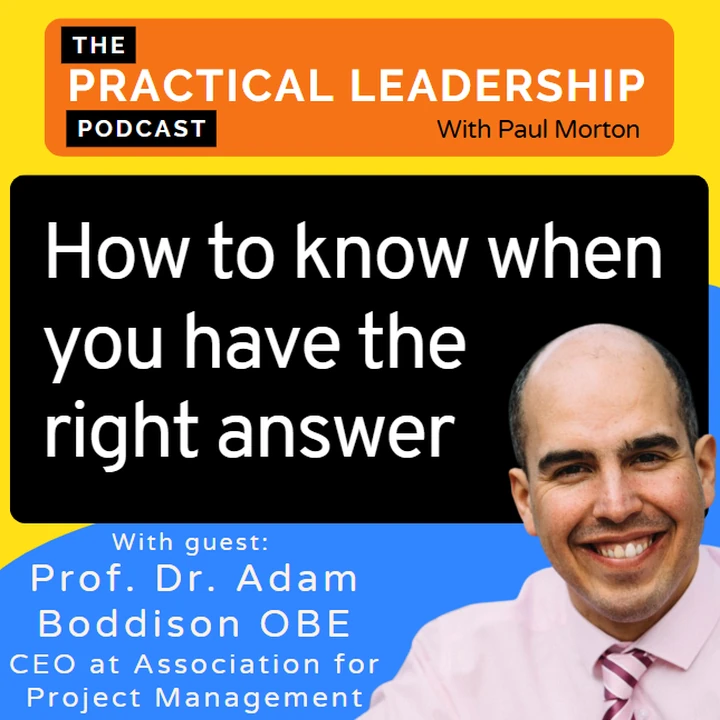
How to know when you have the right answer
with Adam Boddison
Show notes
In this episode, we dive deep into the art of decision-making with Adam Boddison, a leader with extensive experience in project management. Together, we explore how managers and leaders can develop confidence in knowing when they’ve found the right answer. Decision-making is a crucial skill for any leader, and Adam shares practical strategies and insights that help clarify this often complex process.
Key Takeaways:
- Decision-Making Isn’t Just About Data
- Adam emphasizes that while data is important, relying solely on it can lead to indecision. Leaders need to combine data with intuition, experience, and context to arrive at well-rounded decisions.
- The Importance of Asking the Right Questions
- Before making a decision, leaders should focus on asking the right questions. Adam discusses how framing a problem correctly can uncover the most valuable insights, leading to better outcomes.
- Confidence in Uncertainty
- No decision will ever be 100% risk-free. Adam talks about how leaders must learn to be comfortable with uncertainty and trust in their judgment, even when all the answers aren’t immediately clear.
- Knowing When to Act
- One of the biggest challenges leaders face is knowing when to make a decision and when to wait for more information. Adam shares his approach to balancing urgency with patience, ensuring that decisions are made with both speed and care.
- The Role of Collaboration in Decision-Making
- Decision-making doesn’t happen in a vacuum. Adam highlights the importance of involving your team and stakeholders in the process. Collaboration brings diverse perspectives that can illuminate blind spots and lead to more robust decisions.
Memorable Quotes:
- “Data gives you part of the picture, but if you wait for all the data, you might miss the window to act.”
- “Asking the right questions upfront changes everything—it’s about framing the problem correctly.”
- “It’s not about eliminating uncertainty, it’s about leading with confidence in the face of it.”
Actionable Insights:
- Trust your instincts: Data is important, but your experience and gut feelings are crucial too. Use them together to guide your decisions.
- Collaborate effectively: Don’t make decisions in isolation. Seek input from your team to get a broader perspective.
- Be decisive: Don’t wait for perfect information—it rarely exists. Learn to make decisions with the information you have.
https://www.apm.org.uk/about-us/profile/professor-adam-boddison/
https://www.linkedin.com/in/adamboddison
_______________________________________________________________
When you’re ready to take the next step in empowering your managers and driving team performance, I’m here to help with the fast-to-deploy, high-impact Practical Leadership Playbook course.
- 2 x 30 minutes a week over 9 weeks – live expert led virtual sessions + group coaching to deal with the real challenges.
This program is designed to turn your managers into confident, effective leaders who inspire their teams to excel.
In the meantime, you can start making an impact right away:
>>> Download your free guide: ‘5 Steps to Transform Your 1-to-1s’
Discover practical strategies to make these key meetings much more meaningful and productive. (Hint: track them in a shared doc, put 15 mins planning + 30 mins meeting in both your calendars recurring, follow a set, repeating agenda.)
If you have any questions or want to explore how the Playbook course can work for your organisation, don’t hesitate to reach out!
Transcript
Automated transcript. Speaker labels and spellings may contain errors.
Paul
Former maths teacher, non-practicing clinical hypnotherapist, wait for it, chief executive of the Association of Project Management, which is the Chartered Institute for the Project Profession. Hello, and thank you for joining me on the Practical Leadership podcast. My name's Paul Morton, I'm your host. We try to distill the hard-earned wisdom of CEOs, executives, and high performers around the world into actionable insights that you can take away and put into your leadership practices really quickly. If it's time for you to look at your own management teams and help move them from being accidental into being intentional, then in nine short weeks, the Practical Leadership Playbook course will help you do just that.
Check out the Practical Leadership Academy. And now, on with the show. Professor Dr. Adam Boddison, OBE, thank you very much indeed for joining.
Adam Boddison
Thank you for inviting me, Paul.
Paul
Now, that was a far too short-handed, uh, introduction to somebody like you. Can you do a better job for me?
Adam Boddison
Uh, well, I'll, I'll try. It's, it's funny, whenever somebody talks about, uh, my role as a former clinical hypnotherapist, especially if I'm on a stage at the time, I see all of these, uh, hundreds of people in the audience suddenly put their eyes down as if they're going into a hypnotic trance. But it's, of course, because they want to break eye contact immediately. It's like an impulse reaction. But, uh, yeah, so in terms of background, yes, I'm, uh, currently chief executive of the Association for Project Management, and before that, I was also chief executive of, um, an inclusion charity called the National Association for Special Educational Needs. So I've probably done about 10 years as, as a CEO. Um, my background, if I was trying to sum it up, I'd talk about that blend of education and enterprise because, as you said, I started out in teaching and research.
I've worked in charities and professional membership associations. But for me, the thing that kind of brings it all together, my real passion, if you like, is that I love to be involved with organizations and to lead organizations that really improve society in some way. I talk about making the world a better place, uh, kind of one day at a time, if you like. And if, if, if I can do that in my job, then, you know, that's the right place for me to be.
Paul
Oh, it's marvelous. There's the concept of IKIGAI. Um, may have come across that, is that you find something that you're good at, something that you're passionate at, something that adds value to society, and something you can get paid for, and right in the middle is this all reason, purpose, meaning, value stuff, and it sounds like you've hit it in the head there.
Adam Boddison
I hope so. Yes. Uh, um, I constantly re- reflect on, um, making sure that I'm in the right place. Interestingly, when I was in school as a, I don't know, like a 15-year-old, if you like, I remember being called to the careers advisor's office, office, you know, and they say to you, "What career would you like to do?" And as a kind of logical-thinking kind of guy, I, I looked at this careers advisor and I thought, "Well, you know all of the best jobs that are out there in the world, and you've chosen to be a careers advisor, so that must be the best one, right?" So I promptly said, "Well, I'd love to be a careers advisor," and was duly thrown out of said office. Uh, and, and the lesson [chuckles] I learned from that was actually you've got to love the job you do, and it was quite clear to me that she didn't love the job, uh, uh, by, by, by that interaction. Uh, and that, and that's really been a driving force behind almost every, uh, decision I've made, uh, in terms of jobs going forward.
Paul
Or love the job you've got, and you'll never work a day in your life, right?
Adam Boddison
Quite. Quite. No, I would say it's not a job, it's a way of life if you get it right.
Paul
There you go. That's it. Always like that work-life balance, uh, myth. It's-
Adam Boddison
Mm.
Paul
It's not a thing. It's an integration, I think.
Adam Boddison
Agreed. Yeah, I'd agree with that.
Paul
I mean, yeah, there are, there are people, and I, I know many of them, who go to work and they earn a wage and they go home again. Um, but that's their balance. That's how they do it. They have it as a, as a transactional part of their l- existence that pays their wages, so they can spend time with their family. The other side is you bring work home, and you're working till crazy hours in the morning because you either have to because you can't manage your time or you're incredibly passionate about what you do and you love it.
Adam Boddison
Yeah. But, but, but I think there's a trade-off as well. So I think I'd probably fall into the bring work home category definitely. But then equally, um, y- you know, I work for the kind of organizations where, you know, when it's the, the school play that... and I've got... I can't be there during the day, and there's other things that I need to be around for in what might be traditionally work time, you get that trade-off. You know, because you're working other hours, you get that flexibility to be able to be with family at other times which are traditionally harder. So I, I think, uh, all in all, um, probably work and home get a good deal, uh, both of them in, in this, in this setup.
Paul
So let's touch just on the, uh, Association of Project Management for a minute before we go any ever further here. It's the chartered body for the project profession. Now, my wife is a project manager, is a, an engineer by training. Um, and they're a special breed. The pe- they are people who get things done. Now, she and I make a great partnership because I'm the strategist and she's the executor. She makes stuff happen. What is it you do? How do you represent this body? Who are you? What are you all about?
Adam Boddison
Yeah. So essentially, we're a professional membership association, and that's made up of, of, of different parts. So there's a individual membership aspect of that. So we've got 45,000, uh, individual members, and they might be people who are, you know, in kind of C-suite type roles, kind of running billion, uh, pounds worth of projects, um, in all kinds of sectors. I mean, you mentioned eng- engineering, but sometimes it's in law. Um, uh, sometimes it's in financial services, IT projects, infrastructure, technology, communication, all kinds of different things. Um, healthcare, pharmaceuticals, you know, development of the COVID vaccine, for example. This was project, uh, professionals driving that in the background. That's why we were able so quickly. So, um, so there's all those individual members. You've got those at one end. But e- equally, you've got those who are right at the beginning of their journey. Um, and what's interesting about the project profession is unlike something like, I don't know, medicine, for example, where there's one route through, right?
You become... You go to medical school, you become a junior doctor. Uh, you kind of train, you become a qualified ge- general practitioner, and then you can kind of specialize a pediatric consultant or something like that. There's only one route through. The project profession, there are many routes in. So you mentioned about engineering. You could have a, a career as an engineer, as, um, an architect, as a surveyor, um, actually just as a sector specialist in some way, and you find that one day you wake up and you're doing projects, and then you think, "I could do this so much better if I a- actually had the formal tools and techniques, uh, that, that, that come with this." So there's the individual
side. We have got 500 corporate partners that we work with. Um, and again, these are in lots of different sectors, big organizations like the BBC, uh, like Google, Amazon, you know, those type. But then small organizations as well are, are really niche in kind of the nuclear sector and things like this, um, and everything, uh, i- in between. Um- And then last of all, we're, we're a registered charity, so we exist for the public benefit. So, you know, if, if I was listening to this podcast, I'd say, "Adam, you said you care about society, and everything you've just described just sounds like corporate stuff, right?" So what's, what's the, what's the... And we have this strap line in the organization which I absolutely love, which is why do we care about projects? And it's because when projects succeed, society benefits. And that's that join up, and it plays into that core charitable, uh, object that we had, which is existing for the public benefit.
Paul
That alludes neatly to the, um, core challenge I think many of the people who are listening to this will be suffering, which is this gap between the grand plan and getting stuff done. So you've got, let's say, society, whether it's an HS 3, 4, or 5, or an Olympic Game, or building something of, of m- magisterial infrastructure, or simply realigning a government department, or building a house, or organizing your holiday. The g- the gap between the plan and the execution, as I said before, my wife and I, the gap between the two of us is basically I come up with an idea, and she tells me why we can't do it.
Adam Boddison
[laughs]
Paul
"We don't have any money, and I'm not organizing you again, Martin. Get yourself in gear," is mostly the actual considered response. And if you're listening, darly, uh, darling, I am apologizing in advance. So this strategy execution gap, I think is something that is vital that we fill or that we make the connection between. So in your own journey of, uh, getting into a position of management, getting into the place that you are now, chief executive of an organization that oversees the wellbeing of 45,000 members, what, what... Where do you see that thing come out? Where do you see that gap happening?
Adam Boddison
Yeah. So, so I think it's really interesting, isn't it? Um, when I reflect on the differences between management and leadership, everybody wants to lead, be a leader, but no one wants to be a manager. You know, management seemed to have become some kind of dirty word somewhere along the way. And, and the byproduct of that is that project management, which is, if you're like more specialist again, so therefore-
Paul
It's an obscenity. It's an obscenity
Adam Boddison
... it's, it's, it's all... Yeah. Well, people think it's-
Paul
It really is
Adam Boddison
... you know, the... There's, like, an image problem that it has, you know, that people think maybe it's bureaucratic or it's just all these templates and things, you know, why do I need to know about that? But, but, you know, if I reflect on my own journey, so I'd done six years as a chief exec before I came to my current role, and one of the things I committed to at my interview was I said, "I'm gonna do these project management qualifications that we ask everybody else to do." Right? I've, you know, I've gotta live by, by... I've gotta really live by what I'm saying. I wanna understand this. And by the way, I didn't know I was gonna pass, right? Because this is quite a specialist thing. I did them, and what I realized was there are some things in there in terms of tools and techniques that I was already using, but perhaps not in a formal structured way.
I was... I'd kind of just learned by osmosis some of these things over time. But actually, more importantly, there was huge amounts of value from the project management tools and techniques that would help me to support effective strategy execution from the C-suite perspective. And, and it's the C-suite where I think it's really interesting. Um, if I, if we consider, for example, that most C-suites have a chief operating officer, for example, um, most of them do not have a chief transformation officer or a chief project officer, and I find that really fascinating because if we consider that most businesses and most, most leaders I talked to, most of the job they do is about change and a tiny amount about business as usual. Uh, and if that's the case, why does that not, uh, that... Why is that not reflected, if you like, in the, in the C-suite? So I think something is going to change there.
I think it's already started to change, and it's that project management which is driving, uh, this strategy execution in the C-suite.
Paul
So I'm sitting, sitting in my C-suite with my exec team around me, uh, and we're wondering why stuff's not happening. Um, so we have the grand plan. We've had our off-sites, et cetera, et cetera. We've paid McKinsey or whoever it is many millions of millions of their monies to come up with some 50,000 page, whatever it is document, and nobody's getting anything done. We, we, we're not executing. What would you advise? What would you simply advise to get started?
Adam Boddison
So, s- s- so I think there's a couple different things. So the first thing I would suggest is a maturity assessment around the competence of project delivery. Because the reality is, whether it's a strategy or whether it's a change initiative, it- it's going to be delivered through a project or a program, as in a series of projects, uh, th- again, that's trying... That's gonna bring that change. And there's also the portfolio aspect of this, which is how do we decide what things are gonna move the dial and what we, you know, what we park till later. All of these are, um, technical skills that can be learnt. Um, uh, so, so I think then about understanding within the organization, do we have the right skills, knowledge and understanding, but more importantly, um, do we have the competence to be able to deliver on that knowledge, skills and understanding?
Um, and this is where things like... So we, at, at APM, we have a, um, a, a competence framework. Um, it's freely available on the web. Anybody can download it. And one of the things we encourage people to do at an, an individual level, but you can also do it as an organizational level, is to actually do that self-assessment 'cause then you know where your gaps are as an organization. You can invest from a kind of learning and development side of things to get the organization into a place where it can deliver. So I think that's the first thing. Do you have the competence to be able to deliver in the first place? Then once you know you've got that, it's then about, my mind, effective sponsorship.
And this is really interesting. By sponsorship here, I'm talking about, um, kind of the governance, uh, and accountability and oversight side of things. So it'll often be C-suites or board, um, certainly exec directors kind of overseeing kind of change projects and so on. Um, what I find is that, uh, organizations have often invested in the project delivery side of things, but they haven't invested in making sure that their sponsors know how to be really effective sponsors. There's just an assumption that because someone's in a senior position, they must just know how to do that, right? And that might be true, but often it's not the case. So that would be the second place. You know you've got the competence in place, uh, then the second, uh, part of the jigsaw is now let's make sure that we have the right governance and sponsorship in place to make sure that we deliver on the things that we want to, to achieve.
Paul
It's, it is that Um, if you go into the conversations with the assumption that somebody knows something, nobody's ever gonna tell you they don't. But if you go into the conversation with the assumption that they don't know something, people will agree with you that they don't. It's just a... It's that wonderful, simple frame, I think. So we're gonna be doing this magical project. We've got all these fabulous project managers. We're going to teach you how to be a good sponsor, because what you need to know are the following three things. Oh, okay, I'll learn that. We're going to need you to be a sponsor. Can you be a sponsor? Uh, uh, uh, well, of course, I'm an executive, don't you know? Look at the tie.
Adam Boddison
[laughs]
Paul
Can't you tell? Every time. Every time. Whether it's the startiest startup or the most high-down board, people are just afraid of looking like a fool. If you go in with that assumption that I'm going to teach you, or I'm going to help you to learn this, it takes somebody quite special and arrogant to say, "No"
Adam Boddison
[laughs]
Paul
... "I'm already a member of the APM. I don't need your help." Maybe, maybe that could be the case.
Adam Boddison
Yeah. I, I, I tend to agree with you, actually. Um, and, um, uh, yeah, who doesn't want to get better at what they do? Um, and if there's an opportunity to get better at whatever level you're at, then people generally try to grapple that with both hands. So yeah, I agree the framing is important.
Paul
So it's that thread you mentioned right at the beginning, the combination, this confluence of education and enterprise, uh, is this continuous learning. It's this, uh, desire to continually improve, which leads to enterprises. I prefer the word company, actually, to organization or enterprise. And I know you work for an organization that's not really a company, but the word, and I probably overuse this, but the word company comes from, uh, the people with whom you break bread. It's from pan. You are in the company of other people. You know? So you are in a group of people that you wanna spend time with.
Adam Boddison
Yeah.
Paul
Right.
Adam Boddison
Yeah. I, I, I, I went for enterprise mainly for the alliteration with education. So, uh, yeah. [laughs] I take the, I take the feedback on board, though. Thank you.
Paul
It rhymes. You're a poet and you don't know it. So if we're going to extend this then, so we've gone from identifying the competencies, the skills, the knowledge, the, the behaviors, the understanding, and then going and making sure we have comprehensive sponsorship, somebody who can actually say, "Yes, I'm responsible for this. I'm accountable for this. I probably need to be consulted. I don't need to be informed," whatever it is that, that, um, uh, oversight, governance piece. How do we then put something into place that's going to be, you know, ef- effective? What could we... Give us an idea of how we can, um, understand that even if we're doing something, we want an outcome.
Adam Boddison
Yeah. So, um, uh, uh, when I, when I was a math teacher in school, I, uh, uh, used to teach problem solving. Uh, and, uh, part of this was, um, knowing when you had the right solution. Um, I think this is translatable into, into business, by the way, because, you know, there's no... usually no shortage of ideas for things that we could do. The problem is how do you know which is the right thing to do? Um, uh, and this is where some of this portfolio management come, comes into place. Or when you've started doing, doing it, how do you know it's working? Um, and, and this three-stage approach that we, uh, used in schools for, for children solving maths problems, I think is, as I say, applicable to business, and this was it.
It said there are three stages to knowing you've got the right solution. Convince yourself, convince a friend, and convince an enemy. So how does this work in a business con- content ri- uh, c- uh, construct? Um, context, sorry. So, uh, first of all, you've got, you've got your idea, your solution. You've gotta reflect on it yourself. Uh, people are quite quick to come out and say, "This is the answer." And of course, when the leader says that, sometimes that can influence what everybody else thinks as well. You know, he's the leader, he must be right. So, so I think there has to be that period of self-reflection. Am I really confident that this is the right way to go? You know, let me, let me road test it myself and, and really, really stretch that idea around. Then just kind of share it maybe with your close confidants.
It could be your leadership team. It could be, you know, coach or a mentor, whoever that is that you have around you. Uh, so friendly people who are gonna give you the, the kind of critical friend feedback and say, "Oh, actually, have you thought about this or about that?" Or, "It'd be much better if you did it this way." And then the last bit is you wanna pick somebody who is probably the person you'd least want to do business with, the person who's deliberately provocative, finds holes in everything. Um, you know, when we talk about glass full or glass half empty, I mean, they've tipped their glass down the sink, right? Uh, y- you know, it's th- this, this kind of person. You wanna say to them-
Paul
Yeah
Adam Boddison
... "What do you think of this idea?" And if you can convince them that it's a great idea, then I think you're really onto something. You're onto something that you can, you can sell to the organization, and you can probably sell externally as well.
Paul
Outstanding. Convince yourself, convince your friend, convince your enemies. It goes... I, I think that's a lovely tool. That's a pragmatic tool to use. And you mentioned at the beginning, uh, uh, earlier on, that there are these technical skills that we overlook because project management's dirty. You know? Management is dirty. It's I want to be a leader. I want to be the, you know, the, the, the great, uh, sheik of the week or whatever it is, so you can follow me into the sunset. But if I don't know how to actually make things happen, all I'm doing is shouting into the wind. I mean, the definition of a leader with no followers is just a guy going for a walk.
Adam Boddison
[laughs] Yeah. I mean, the other thing I would say is leaders need to focus on the benefits, and this is when I come back to the sponsorship role that we talked about before. Um, uh, i- it's not enough just to deliver what was in the plan sometimes. Uh, they... We, we, we have a great expression for this that we use at the, the... they use in the Netherlands, which is when you've got a project which has delivered everything it set out to deliver. It was on time, within budget, to the required quality standards and everything else, but delivers no benefits. You know, maybe because it's an IT project, and the thing it, the problem it's trying to solve doesn't exist anymore, uh, because the world has moved on, that kind of situation. And the, this expression they use in the Netherlands is, "Yes, the operation was successful.
The patient is dead." Uh, y- you know, I, I th- I, I really love this expression. It really made me laugh the first time I heard it. But, but I think this is where the role of the sponsor is so important, because they're the people who have got that eye in and out, if you like. So they've got one eye on the delivery and is it doing everything we said we were gonna do. But another eye saying, when it's finished, is it still gonna deliver the benefits that, that are intended? And if not- Then why are we still doing it?
Paul
I mean, that, that alone, that alone, I think that insight alone is definitely, is worth the episode. Yeah. We're, we're done. We can go home now. Um, then the, you're, you're coming up with some, some great, great stuff here. This is really, really valuable. If you had to then share just one message with everyone out there, whether it's in the non-for-profit or in industry or public sector, whatever it is, uh, what would that one message be? What's your 10,000 billboard message?
Adam Boddison
Oh, well, I've got, I've got s- many messages I, I would like to give. I mean, one of the things is about picking your battles, um, uh, because there are lots of things that you could, uh, you know, choose to tackle as, as a leader. There's no shortage of issues, um, or opportunities. Um, but I always say there's a sweet spot when you pick your battles. They've got to be small enough to win but big enough to make a difference, and if they don't fall into that sweet spot, I tend to leave them alone because you're either picking a fight that you can't, you can't win, and that just creates more noise, or there's no point. Uh, y- y- you know, um, and, and there's this sometimes someone, someone once pitched this to me as, you know, "Adam, don't let perfect be the enemy of good." You know, if you're pushing constantly to make something better, if there's, there's a kind of law of diminishing returns here after a certain point.
Uh, and I think that falls into that ca- same thing around, around picking battles. So, so I think that's probably the, the number one I would go for. Um, am I allowed to have two?
Paul
Of course.
Adam Boddison
Oh, I'll go, I'll go for a second one then, and this is something which I, I, I have to kind of consciously, um, try to do, um, which is to, i- if you like, judge people by their intentions rather than their actions, uh, or mostly by their intentions, uh, rather than their actions. Um, um, uh, it re- it ... Because I think sometimes you've got people who try to do the right thing but don't quite get it right and they need some help to get there. Um, you know, do we wanna penalize those people or do we wanna help them? Um, and there's a certain leadership style I think which is, you know, they've, they've got it wrong. You know, let's throw the, you know, the, the, the, the, the book at them followed by the bookshelf type thing, you know? And then there's another type of approach which says, actually, they've made a great start, and it's how do we get them to do it even better next time?
Um, so, so yeah. Uh, I, I, I think it's, uh, yeah, don't judge people by their intent. Well, sorry, do judge people by their intentions and not necessarily always by their actions.
Paul
I think there's, there's, um ... It feeds into a couple of things. One is that you want to build on strengths rather than weaknesses because you make a bigger impact.
Adam Boddison
Definitely.
Paul
And there's a lovely story, I think it's from Dale Carnegie, and he quotes this story of the chap going into the office of his big boss and saying, "I've just lost us $2 million. I just screwed up. Here's my resignation." And the big boss takes the resignation letter, rips it in half, and says, "You're kidding. I just spent $2 million on your education. Do you think I'm gonna throw you out?"
Adam Boddison
[laughs]
Paul
So that's, that's your starting point. It's taking the intent as strengths. It's taking the, the, the opportunity as strength. It's building-
Adam Boddison
Yeah
Paul
... rather than crushing. I like that approach. I like doing that.
Adam Boddison
Yeah. I, I, I, I also think there's something about, um, taking advice from places, uh, uh, where you might least expect it to come from. I, I always remember, uh, in one of, in one of my jobs, we, uh, we were developing, uh, an EDI policy, you know, equity, diversity, and inclusion policy, and we had this doc that was like 20 pages long, and it, it covered like everything you could possibly imagine around diversity and inclusion and, and, and equity. Um, it really detailed stuff about what we expected, what we didn't expect, and so on, and setting the standard. Um, and I gave it, um, to, uh, my, uh, 10-year-old daughter at the time. Said, "What do you think about this? You can have a look to see what you think." It's just a, a youngster's perspective. Took her quite a while to read through it, right? I mean, she's 10. But she, she gave it back to me with this Post-it note, uh, uh, on it and it said, "Yeah, this is all fine, Dad, but you don't need all of this.
You just need one sentence. You just need to say, 'Don't judge people and be kind.'" So we made that the executive summary of this policy. Um, and do you know what happened? Whenever I talk to anybody in that organization about what's our approach to EDI, don't judge people and be kind, that was the one thing they remembered. Uh, and that was the least, uh, place I expected to get such brilliant advice from. So young people in particular are, are just very good at cutting through the crap, you know, to be honest. They'll just, [laughs] they'll just say, "Look, this is what is really matters here." Um, so I've, uh, you know, not, not that I try and bump all of my work off to the youngsters, uh, you know, but, uh, I do try and get advice from
young people where, where I can because they, they often have a really refreshing way of looking at things, which I think we can learn from.
Paul
Is there an event, is there a mistake or something, there's a ... Something that's happened that has maybe taught you the most?
Adam Boddison
Yeah. Um, yeah, really good question. I suppose one of the things that comes to mind immediately is probably when I did my first CEO role. Um, and you know, it's a big moment. You, you wanna get it right. Um, um, and it was, uh, it was a charity, relatively small charity, but they were losing money. Um, uh, they were, they, they, they were losing money 'cause their business model was fundamentally flawed, and I was trying to really get to grips with what, what this underpinning kind of commercial issue was. Um, but I quite quickly came to realize that the issue wasn't, uh, totally a commercial issue. Part of the issue was a values issue, and the ... What happened was the chair of the board of this organization essentially had a values base which was misaligned.
So this was, uh, an inclusion charity. Um, and you had this chair who I'm sure was very good in his heyday, but effectively he was like, you know the embarrassing uncle at the party who says all the really inappropriate comments, and you're like, "Oh, I'll just distance myself"? So, you know, in his mind, he was doing nothing wrong, right? You know, uh, i- it's, uh, you know, grew up in a particular era. But actually, there's not really a place for that in today's society, and particularly not a place for that when you're running an inclusion charity and you're chairing the board. Um, and I was in my probation period as a, you know, new CEO. Um, and so I thought, how, how do I, how do I deal with this? I haven't dealt with anything like this before. So I decided to, you know, in my mind I, I've always got this mantra of do what, do what's right rather than what's easy, and I thought, "Okay, I'll have this conversation." And when I had the conversation with this guy, he kinda said, "Well, look, your, your days are numbered here 'cause I'm not
going anywhere, and I'm not gonna change what I'm doing" and, you know, "Who are you to tell me what to do?" kind of a thing. And I, and I, at that moment I thought, "I've really messed up here. I've made a b- I've made a, a, a big, big mistake." Um, you know, um, I, I have no authority to remove, you know, effective- my, my, my line manager effectively. So I thought, "What do I do?" So I thought, "Well, I need to consult the wider board," and so I started having those conversa- ... What came, Matt, was that everybody was kind of aware of this, but nobody had really wanted to tackle the problem. But now it was a, a real problem. Um, there was an opportunity to do something about it. And to be fair to the board, they did do something about it, and they moved that chair on, and we got a brilliant new chair in. Um, she's still there now effectively, uh, uh, and, and the organization's doing very well. And at the moment we made that change, the commercial fortunes of the organization also changed.
I like to say it was also down to some of the com- good commercial decisions I make as well, but that values piece I think can't be kind of underestimated. But, you know, I know a big part of this podcast is the kind of real practical, uh, aspect of things, and what I would say is I used, um, a particular reflection technique, a reflect- ethical reflection technique, if I call it that, during that period to kind of sense check myself. Am I really doing the right thing here? Is this career-making or career-breaking, what's going on? And it was a bit touch and go for a while. And that tool I call a 3P filter. Um, so, uh, a paper, parent, and pillow. So it's three questions you can ask yourself to check you're doing the right thing. So the first one is if ... It- it's almost the kind of Daily Mail test, you know? If everything, um, if everything that, uh, that I know, um, in making this decision was published on the front page of a national newspaper along with the decision I've made,
would I ... And everyone in the general public kind of knows it, right? And I step out my front door, and everybody's gonna judge me for this. Am I confident that I've made the right decision? The second one is the parent test, which is imagine as a parent you had to give advice to your child who was in this dilemma. What advice would you give to them? And the idea is that you hold your children or close friends to a higher ethical bar than you might hold yourself to. So I think that's, that's, that, that's quite interesting. And then the easiest one of all, the pillow test, the sleep test. Can you sleep easy at night with the decision that you've made? And I used that during that period, and it really helped to kind of, uh, keep me, uh, on track really to make sure I d- I, I, uh, I got the ... Um, and by the way, I use this, uh, as a story, um, that I shared when I went for my next CEO job, and I wasn't sure.
When you say to your next chair, "I removed my last chair," um, you never know how [laughs] that's gonna play in an interview. But actually it told me a lot about the values base of the organization I then went to, where they said, "Actually, we would expect you to do the same here if that happened." Um, and that, and that, so that really started us off on a, on a good foot actually.
Paul
Uh, that's, that's stunning. Really, really good. I, I do like that a lot. We're coming in for a landing here. So is there, uh, a book or a podcast or something that you recommend or gift more than any?
Adam Boddison
Oh, a good question. Um, suppose the, the, the ... In terms of books, I mean, I, I try to read in the morning for kind of development, if you like, and read in the evening for your, I don't know, fiction type stuff just to kind of k- you know, wind down, if you like. But so in terms of my morning books, one which I read about a year ago, which I still think about now, which I really like, is, is Hannah Fry's book, um, How to Be Human in the Age of the Machine. Um, so Hannah Fry, if you don't know her, she's a, a Cambridge mathematician. Um, she often appears on, you know, uh, um, uh, panel programs like Have I Got News for You and those types of things, so you, you might, might recognize her. She's a very witty kind of writer. But she talks about AI and data, obviously really topical, but she's got these great quotes in there.
So the one that really str- struck me, uh, which I remember, she talks about people being scared about, you know, AI robots becoming sentient and kind of taking over the world, and humans are kind of gonna become inferior to the robots. And she said, "Yeah." She's like, "Yeah, that's a risk, um, but it's not gonna be happening anytime soon." She's like, "It's a bit like worrying about overcrowding on Mars. Yeah, it's a risk. It could happen, but like, [laughs] you know, it's not today's risk," right? Uh, so, so I love that book, and I've read it a couple of times. That's definitely one that I recommend.
Paul
Overcrowding on Mars. I love that. Thank you. Um, Adam, how can people find you? What should they do if they decide that, uh, the APM is for them? What's the-
Adam Boddison
Yeah. So in terms of, uh, APM, if you wanna find out more about APM, our website is apm.org.uk, and they can find out there about membership, chartership, qualifications. They can become part of the community. If you're running a business, we'd love you to become a corporate partner, so, um, uh, do, do, do, do find out more information on the website. In terms of me personally, um, I'm on LinkedIn. I'm @AdamBoddison. I'm also on X and various other platforms as well. But LinkedIn is probably the main one I use for kind of, uh, uh, business discussions and tend to post some quite anything. The latest one, by the way, which is just really getting traction, just to finish, um, is I've noticed that, um, the program Suits, you know, that was made
by Netflix, had a great ... They did a great job i- in making, um, the legal profession really attractive and, uh, you know, uh, uh, the c- the dramatic side of it. You know, the sexy side of law, if I call it that. I'm thinking, where's the Netflix program about projects? Uh, so I have written to the CEO of Netflix to ask, uh, whether they would do something in this space based on an idea that I had, uh, at an event last week. So, um, there, there's a discussion happening about that on LinkedIn at the moment, which, uh, I'm sure your listeners would be very, uh, welcome to join if they, if they so wish.
Paul
Well, we'll find a link to that and all the other things you mentioned there and put that into the description. Professor Dr. Adam Boddison, OBE Chief Executive of the Association of Project Management, and all-round good egg. Thank you very much.
Adam Boddison
[laughs] Thank you for inviting me. [upbeat music]
Paul
And that's a wrap. I hope you enjoyed the show. Thank you for joining me. If there's ever anything I can do to help you on your journey, then do please reach out. You can find me on LinkedIn and all the usual sources. Do please subscribe, leave me your five-star review, and most importantly, get in touch with your comments and feedback. It's really how I grow, and that's what I'm doing this for. Thanks again. [upbeat music]