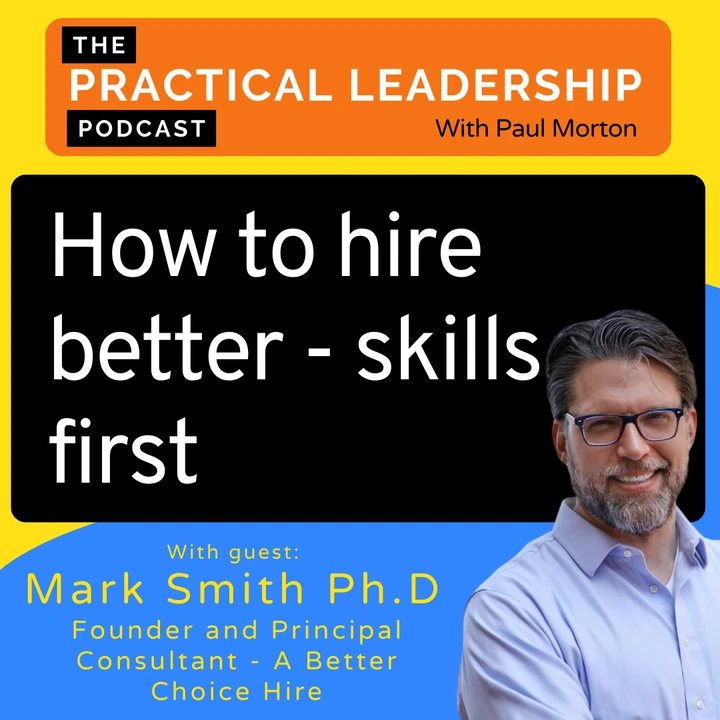
How to hire better – skills first
with Mark Smith Ph.D
Show notes
Today, I had the pleasure of speaking with Mark Smith, a respected HR consultant with a PhD in organisational psychology. Mark is also the author of “A Better Choice: The Manager’s Guide to Skills First Hiring.” We dive deep into the realm of hiring and uncover how adopting a skills-first approach can significantly improve your hiring success.
In this episode, Mark shares his extensive experience in talent acquisition and organisational assessments, offering practical advice and insights for leaders looking to enhance their hiring practices. Here’s a brief overview of what we discussed:
Introduction to skills-first hiring
Mark begins by explaining the essence of skills-first hiring, emphasising the importance of evaluating candidates based on their skills, abilities, and motivations rather than their educational background or years of experience. This approach is designed to identify the best fit for the job and the organisation.
Challenges of traditional hiring practices
We discuss the common pitfalls of traditional hiring practices, such as over-reliance on education and experience as indicators of job performance. Mark highlights how these criteria can often be misleading and suggests more effective alternatives.
Structured interview processes
One of the key takeaways from our conversation is the importance of structured interviews. Mark explains how asking consistent questions and evaluating responses in a standardised manner can enhance the reliability and validity of the interview process.
Role play assessments and pattern disruption
Mark introduces the concept of role play assessments and pattern disruption to reveal true candidate capabilities. By simulating realistic work scenarios and introducing unexpected changes, employers can better gauge how candidates handle real-world challenges.
Final tips and takeaways
As we wrap up, Mark shares his top recommendations for hiring managers looking to adopt a skills-first approach. From leveraging technology to streamlining the interview process, these tips are designed to help you make more informed and effective hiring decisions.
Join us for an insightful discussion packed with practical advice to improve your hiring strategy. Whether you’re a seasoned HR professional or a new manager, this episode offers valuable insights to help you hire better.
Key Quotes and Timings:
- “The bad hire typically occurs because it’s a bad personality fit” (00:07:57 – 00:08:05) Mark highlights that most hiring mistakes stem from personality mismatches rather than a lack of knowledge or skills.
- “And if you’re hiring, you shouldn’t really care where the knowledge, where the skills came from” (00:27:41 – 00:28:00) Emphasising the importance of skills over traditional educational credentials, Mark suggests focusing on what candidates can do rather than where they learned it.
- “How are you going to respond to kind of a realistic work situation” (00:17:01 – 00:17:23) Mark discusses the value of role play assessments in revealing how candidates handle practical job scenarios, providing a more accurate picture of their abilities.
- “Revealing true skills through pattern disruption” (00:19:00 – 00:19:14) Introducing unexpected changes in assessments helps uncover candidates’ adaptability and problem-solving skills, crucial for many roles today.
For more details and resources mentioned in this episode, check out the links in the description. Don’t forget to subscribe to the Practical Leadership Podcast for more insights and interviews with industry experts.
Find Mark here: https://www.abetterchoicehire.com/mark-smith
Transcript
Automated transcript. Speaker labels and spellings may contain errors.
Paul
Respected HR consultant with a PhD in organizational psychology, experience in talent acquisition, the assessments of job applicants, employees, author of A Better Choice: The Manager's Guide to Skills-First Hiring. [upbeat music] Hello, and welcome to The Practical Leadership Podcast. I am your host, Paul Morton, and we are talking about leadership, management, and the various lives that surround it. It's my joy, delight, and privilege to bring into my studio some of the smartest, wisest people I've been able to find for your delectation and enjoyment, and I hope that you do get a lot out of the conversations that we have here. When you realize that your management team has grown too fast or you've inherited a new team, and the fastest, best lever you have for growth and improvement is attached firmly to those managers, get in touch. I help you run management, coaching, and training programs that'll make a big difference really quickly.
You can find me at the Practical Leadership Academy website and on all the usual social channels. [upbeat music] I'm delighted to have Marc Smith. Thank you for joining me.
Mark Smith Ph.D
Well, thanks for having me, Paul. I've been looking forward to, uh, recording this podcast with you and having this conversation.
Paul
Dr. Smith. Well, I've got this problem with my elbow. Right? You ... Does it ... Do, do people ever come up to you, you ... I don't know if you advertise yourself as Dr. Smith or anything like that, but-
Mark Smith Ph.D
I rarely advertise that way, but it's funny. I w- I was recently in ... And this is weird. I, I was in a ballet with my daughter, and e- everybody had a bio, and in my bio, it listed me as Dr. Smith, da, da, da. And I had a number of people after me just assumed that I was a physician. "Oh, you're a physician. Let me tell you about this." I'm like, "Who told you I was a physician?"
Paul
[laughs] Is there a doctor on board the flight? Only if you want me to reorganize your strategic imperatives towards a new format of acquiring talent.
Mark Smith Ph.D
Exactly.
Paul
No, he can't breathe. Yeah, that's somebody else. [laughs] I love it, I love it. Uh, how did you then decide that you had to make a better choice, and what led you to putting pen to paper or typewriter to machine and go for skills first hiring? Now, I've been hiring people for years. It's a challenge, it's fun. It's the, the superpower a good leader brings.
Mark Smith Ph.D
Yeah. So I've been in this field now for, for 20 years or so, and really my focus has been, in my- my whole career, uh, hiring and how to hire better. And, and when I'm having various conversations with people and they find out, you know, I'm an organizational psychologist, and I, I work with companies doing hiring, uh, you know, inevitably the, this- the conversation will go this way. "Oh, how should we hire people?" And I'll say something like, "Well, you should evaluate the job, determine what the key skills, abilities, you know, motivations, personality traits are, and then evaluate the candidates fairly on those things and, and hire the best person." And universally everybody will, will agree.
They'll just sort of nod in agreement to the extent where they'll, they'll imply something like, "Well, everybody knows that. Why'd you just waste 30 seconds of my life saying something that everybody agrees with?"
Paul
[laughs]
Mark Smith Ph.D
But there's a next step to this, and the next step is, and education is often a poor measure of these things, and counting years of experience is also often a poor measure of these things. Now, there are gonna be some exceptions, like with, with education, if you're hiring a, a very technical person, you need to, to hire based on education. But, uh, largely I'm recommending, okay, we ignore those things, and we assess the person directly. Because when companies are hiring, "Well, I, I need somebody with a bachelor's degree," uh, well, okay, well, what do you actually need? And is there a particular major that you're looking for? And, uh, and then once you start having those conversations, then you're gonna get some disagreement. Um, and so a- again, I'm, I'm recommending for most jobs, again, not technical jobs, but for most jobs not using education as a screener.
And, uh, sometimes experience is very important, but to say, "Oh, you need 10 years for this job, and therefore if this person has seven years of experience, he or she is not qualified," I'm gonna, I'm gonna push back on that.
Paul
It's, it's funny the number of people who you still see. You get this intersection of experience and education, right? Now, I think i- in the UK at least, thankfully, I have two small kids, so I've got this ahead of me. Thankfully we're seeing a bit more on the apprenticeship route-
Mark Smith Ph.D
Uh-huh
Paul
... available for younger people, or at least degree apprenticeships as well, so you can go off and earn money and get your thing at the same time. But you're asking somebody, um, "Okay, so we need a, a bachelor's or a master's or whatever it is we need in this. When did you get that?" "Uh, 10, 20, 30 years ago." "Right. What do you remember about it?" "The name of the educating thing." "Oh, right. Okay. So why am I asking you about it?"
Mark Smith Ph.D
Right.
Paul
"You know those 10 years of e- 20 years of, 30 years of experience you've got?" "Yeah." "Uh-huh. Well, many of them were just repeating the same damn day again and again, so you don't have 10 years of experience. You've got 10 years of living the same year of experience. So that's not 10. That's one. In fact, that's minus one, 'cause you're going backwards. You haven't learned." So what do you do different then? I try to hire people exactly as you said, and, uh, my, my thing is rather than say, uh, "Here's the job spec," 'cause you go into any company, and they've got job descriptions coming out of their nostril.
Mark Smith Ph.D
Right.
Paul
And it's the same thing, and it's been copied and pasted, and it's the same criteria, the same, "We're a happy person, lovely, open company where we respect everybody, and..." And this is the copy-paste nonsense, and they're asking for a three-legged giraffe or a five-legged sheep or a unicorn with whatever. And in reality, there's only three or four jobs to be done by that person. And I say Get those clear on a bit of paper, work out how you're gonna measure them, measure them, and as, exactly as you said, hire the right person for the job.
Mark Smith Ph.D
Right.
Paul
But, but how do you measure them? What are the gaps? This is, I think, where your clever bit comes in. It's the skills-first piece. So talk us through that. Talk us through a couple of examples how this works.
Mark Smith Ph.D
Yeah. So I, I think exactly as you said, okay, analyze the job, analyze the, the organization. So, so we identify the, the skills, the abilities, the, the, the, the specific pieces of knowledge, the other sort of personality traits and, and stuff that, that you need. And you can't, can't have too many of those things. It, it's how many do we actually need? And then we assess those. And when I started, you know, computer-based assessments of candidates, that, that was... Yeah, it was available 20 years ago, but we were still sort of figuring out how to do it. And so most assessments were still, uh, paper-based. And, and then a lot of companies switched to computer-based assessments, but I think necessarily had to be unproctored computer assessments an- and that, that made a lot of companies queasy.
Okay, how do I know that this person isn't cheating? How do I know that, you know, his wife isn't actually taking this test for him? You know, how do I know these things? And, and, and these are, these are good questions. And what I've found in, in some research I did is the, the vast majority of people don't seem to cheat those things, but some do. And so 5% or so, um, would, would not just subtly cheat, but, like, absolutely, completely, blatantly unethical to, to, to, to the point that if laws were involved, it would clearly be illegal. Um, okay. But, but now technology has moved beyond there, and so now we're actually getting to the point of assessments that have either a live proctor involved or, uh, an AI proctor.
And so, so we're much better at computer assessments, and, and those computer assessments can be, uh, assessments of skills, assessments of ability. Uh, to some extent we're talking about, uh, knowledge assessments, but, uh, a lot of times the knowledge is gonna be, that's gonna be tapped during, uh, an interview component. Um, but we've got those things. So whi- which would be the hard skills, again, skills, knowledge, abilities. But what about these other pieces? Uh, the, the personality stuff, the soft stuff. Because as I'm sure you've found, and, and a lot of folks listening here, a lot of times when you're, when you're making a hire, and particularly if you've made a bad hire, it's probably not because this person wasn't smart enough, and it's probably not because this person
didn't have the right knowledge. Some of the times that occurs, but that, that's, that's the exception, not the rule. The rule is the bad hire typically occurs because it's a bad personality fit. They don't, they don't fit the organization. They, they don't interact well with, with other people. And so the real question, and the real trick is how to evaluate those things in the hiring process. Um, and to the extent, can we use computer assessments? Do we have to use i- uh, interviews or, or other things? And so, uh, we need to, to go about making sure we assess those things, and not just say that we're assessing those, nominally assessing those, but assess those in a, in a careful way, assess those
in a way that we know is valid. And so there are a lot of assessments out there. There aren't a lot of good, valid, validated-
Paul
Mm
Mark Smith Ph.D
... assessments.
Paul
Yeah. I mean, there's the, the, the, I think the famous one everybody uses, Myers-Briggs, right? And apparently Myers and Briggs invented the Myers-Briggs over a weekend, and the question from some psychologists is, that's nice, what did they do after Saturday lunchtime? So yeah, there's a distinct lacking in validity for quite a lot of these, these personality type things. When you get into role-based assessments, you know, technical stuff, um, I think, like you say, you pick up a knowledge thing fairly quickly as in this person is really superficial. Or so you said, "X. How would you do X?" "Uh, thank you for playing."
Mark Smith Ph.D
Right.
Paul
But then you get into, as you say, it's the personality piece. Now, I spent a lot of my time hiring salespeople, sales leaders. It's one thing about salespeople is they talk really well. They sell themselves really, really well. And getting beyond that, getting into the person, uh, can be quite hard. So especially when you're hiring managers, managerial talent, I think it's, it's, it's particularly challenging. If you were, if you were in this position and you're advising somebody, what would you say is a, a, you know, five-step, three-step magical guideline? What's the things to go, to go for here?
Mark Smith Ph.D
Yeah. So, so as I said, uh, carefully identify the job, identify some assessments, and making sure that they're valid. And, and again, uh, there are a lot of assessments out there. Most of them aren't valid. So, so making sure that they're valid. And validity means evidence that it's job related. And so it's not you're talking to the salesperson from the assessment company, and they tell you it's valid. That's not validity. Validity is, i- is a process, and there are, there are a couple of different ways to do it. Uh, but making sure that, that the assessment is, is valid. And, and these days those things are, like, at the top of the funnel because it, it's much more easy to, uh, to use computer assessments now than, than it, than it used to be.
You can run more people through your computer assessments. Okay, they pass it, now you've got your top 10 people or top five people, and then those are the ones that should be interviewed. And when we're interviewing, in the same way where we're talking about as- assessments, when we're interviewing, you gotta make sure that the interview is valid. And the most important piece there is that it's a structured interview process where you're asking the same questions to the different people, and you're evaluating their, uh, answers, their responses- In a consistent way. So often companies, they'll use interviews. Everybody, of course everybody uses interviews. Why wouldn't you use an interview? But you're just talking to somebody, and then afterwards it's, "Well, did you like them or not?" And, and there will be-
Paul
At least they're honest. At least they're honest, you know?
Mark Smith Ph.D
Right.
Paul
They know-
Mark Smith Ph.D
Right. Right, exactly. But what you have is a different interview for each individual candidates, and so there's no fair way to compare. And so if you don't have the reliability of the interview between people, there's no way that that, that interview process has any validity. Has it, it, it will actually predict who is the best person. And so you just need a plan going in. Okay, I'm gonna ask these questions, and we're gonna evaluate the responses in this way. So for this question, a good response looks like this. A bad response looks like that. And, and, uh, you, you put together like a scoring protocol. You have, have a rubric for each question or set of questions, and then, then you use that. And, and that can, can get you down...
Often it can get you down, you know, from five or eight people to, to two people and you go, "Okay, now, now I like these candidates. Both of these candidates, but I can only hire one of them." And then you go, "Okay, how do, how do I make that, that final choice? How do I make that final selection in the process?"
Paul
Before we get there, I think just going into this slightly ahead of the final piece is, I think like anything, it's like, it's a problem you're trying to solve, and you don't solve problems by making them more complex. You solve them by making them simpler. And if you look at a typical interview process where, let's say you're trying to hire for 20-odd people in a team. You're trying to build a team. You're hiring 10, 20-odd people. You're gonna interview 100 people for this from different stages, from telephone interviews to face-to-face or to video, and eventually into a case study. And then eventually you get a final interview, right, which we'll talk about in a sec, 'cause I know you have some special answers here. What you've got are five, six, seven different people in turn asking random-ass questions of all these different people, essentially inserting, creating chaos.
I don't mean chaos as in like, you know, oh, it's a big mess. I mean genuine, you know, a butterfly wing chaos theory.
Mark Smith Ph.D
Right.
Paul
So you're adding fractal-like complexity into a process that is already trying to discern between human nature, which in itself is intensely biased from the, from the, from the, the sub- the subjective point of view, but also monstrously complex, and applying that to an organization and a role and a, and a, and a. So I think the very least you can do, exactly as you said, is just make a list. A list of questions.
Mark Smith Ph.D
Right.
Paul
A list of answers. This is the questions we're asking consistently. Here are the answers. This is what a good answer is, this is what a bad answer is. Where on the scale did it fall? Just simplify the heck out of it. And that way you're not only getting a fairer representation, you know, you, you're also removing some of the biases and subjectivity biases that people will have intrinsically, and getting down to the right two people. So when you're... I take those two people and put them in front of you and say, "Okay, hey boss, um, these are the people I think we should hire." And Mark turns around and says, "Okay, next." But that's the bit when it becomes interesting. So Mark, what happens next at that point where we've eventually got the two in the door?
Mark Smith Ph.D
Right. Right. And you know, every hiring process is gonna be different. And, and there are, there are gonna be some where you interview 10 people and there's just one. There's one that stands out and, and that person is clear. And, and at that point I say, "Okay, you, you, you've done the, the first couple of steps. You, you've used computer assessments and, and there are some, uh, you know, other recruiters talking to them and, and they did great in the interview. Hire." Don't, don't dither, don't, don't, uh, don't do anything. Make the offer at that point. But a lot of times it's not as clear as, "Oh, I found my person." It's, "Oh, I got two people that I like equally," or, "There are three people, I don't have any idea how to tell these three people apart."
And if that's the case, and you can legitimately only hire one of them, okay, what, what else do we do? And, and a lot of times organizations, they will, they will add another interviewer to the mix. And, and even if they use structured interviews before, that other interviewer, maybe it's the boss's boss, they, they're not gonna follow the list of questions. They're just gonna, they're gonna ask whatever they think, and then they, they'll give a confident answer. "Oh, hire Sue." And, you know, and largely won't, won't be based on anything. Because the, the general recommendation that I'd heard for years is, okay, at that point, go with your gut. Go, use your gut feeling. Who do you feel most, most comfortable with? And, and, you know, maybe there is, there's some point there, if there are some people that, that, that you're not comfortable with, they probably shouldn't be in your final, final, final group.
Uh, so what I'm recommending and what I, what I recommend and, and what I, I work with companies on is, is these final few people going through a role play assessment using, uh, assessors. Expert assessors. And i- in the role play assessment, you're, it's a, "Okay, here's a fake company. Here's a scenario. You're gonna meet with this person," and that person is me or, or one of the other expert assessors. And you know, there'll be something weird about this scenario. Uh, but there's no tricks involved. It's just how are you going to respond to kind of a, a realistic work situation, and it's gonna be an intentionally provocative realistic work situation. But, uh, you know, what I've found is you get to the reality of how somebody will actually, uh, interact in a work situation pretty quick. And so, you know, if you gave somebody, uh, a personality assessment and it's like, "I like to work with other people," and, and it's a scale of one to five, and they go, "Five." Okay.
And then the next question is, "I often show up late to work," and they go, "One." Well, okay
Paul
Yeah
Mark Smith Ph.D
Th- there, there's, there's potentially there, there's a nugget of validity in there, but the majority of people are gonna fake, especially if they're salespeople. That's what salespeople are gonna fake everything. Uh, but once you start interacting them in a, in this kind of realistic role play exercise, the facade starts to fall. And then in all of our role play assessment, there's always, y- you give them a little bit of material to prepare, and then, then there's something that's gonna change in the middle of the assessment. And so they'll like, if they need to, uh, plan on, okay, this is the person I'm gonna present. And, and they, they sort of, you know, may, may sort of be ready to, to be a fake person. But then once I, once I add a new piece of information, uh, now they can't rely on their plans anymore.
And at that point, either the faking completely goes away, or they're such a good faker that maybe they're just gonna fake their way through the job. [laughs] And it might actually be okay, especially in the, in the situation of salespeople, because salespeople to some extent are, they're, they're, they're bluffing for, for their real job, uh, at least part of the time as well.
Paul
So you, you've, you introduce this element of pattern disruption-
Mark Smith Ph.D
Yeah
Paul
... to, to almost break out of the plan, and then let people reveal themselves, reveal their true nature, their inner self-
Mark Smith Ph.D
Right
Paul
... in a context related to the job, related to the industry. Um, that then you take back to the organization and say A, not B.
Mark Smith Ph.D
Well, yeah, I mean, we'll, we'll have a short report on each person. But a lot of times it will show that, yeah, you know what? This person, it seems to be, you know, better on these key competencies than, than this person. And, and yeah, I, I think the twist is yes, to, to get at the reality of the person. But for so many jobs these days, and, and it feels like more than it used to be. So many jobs these days, you know, adaptability, flexibility are, are real key components of, of the jobs. These are competencies that you need. Okay, what-
Paul
Resilience. Yeah.
Mark Smith Ph.D
Yeah. So, so I can, I can, I can measure that. And again, I'm not measuring it by asking a question, how adaptable are you?
Paul
Very adaptable, Mark. Very-
Mark Smith Ph.D
Oh, yes, I'm very adaptable. No, no, no. It, it, it, it's show me. But, but it's-
Paul
Yeah
Mark Smith Ph.D
... even more than show me. It's you don't even know that I'm asking you to show me that.
Paul
Yeah.
Mark Smith Ph.D
But I'm asking you to do things, and then I'm, I'm twisting it, and I'm asking you to respond, and so naturally I can evaluate your, your adaptability there. There are some people, you introduce new information, and you just get this blank look, like they don't, they don't understand that a new piece of information is being introduced here. When, you know, we're, we're not gonna subtly introduce that. We're gonna, we're going to introduce that because, and, and let's go to, to salespeople. A lot of times what's gonna differentiate a good salesperson from, from a poor one, everybody can respond if the client says, "Hey, I have a great opportunity for you. Let's talk about it." Everybody can respond then. Not everybody even understands a lot of times when sales opportunities come up, and the, and the client, you know, offhandedly says, "Hey, we've got this new project in a, in a different city, and, and this is the situation." And they, they never say the key word that, that would, you know, raise the antenna
for, for the salesperson. But it's an opportunity, and the good salespeople will understand that, and they'll go, "Oh, oh, that's a, that's a great opportunity for us," even though they didn't introduce it as such. And, and the other one who's really good at taking orders but may not really be adaptive, may not really be flexible, may not even recognize that that's a real sales opportunity.
Paul
If they don't use the words, uh, "I have money. Would you like some?" You know? What's, uh-
Mark Smith Ph.D
Right
Paul
I, I do like, I like this, the idea of the, the, the, the sort of pattern disruption there. We used to do a, a case study for our sales folk where we give them a real case, a real case, uh, where they had to sort of sum up as like a final presentation, and then we would bring in somebody. We'd bring in somebody. "So you're gonna meet Chief CEO. You're gonna meet VP whatever, and this is the plan. So go away and prepare for that." They come in prepared for that. There are three people here.
Mark Smith Ph.D
Right.
Paul
And you've gotta see, do they actually ask, "Who the hell are you and why are you here?" You know, "What's important to you?" You know? It turns out that I'm actually the chair of the board, or I'm, I'm just a secretary, or I'm ch- whatever it is the role was. It's always interesting to see what happens, what's the dynamic, and you, you, like you said, you disrupt that expectation.
Mark Smith Ph.D
Yeah.
Paul
And you just see, see how they, how they deal with it. Oh.
Mark Smith Ph.D
Yeah. And, and again, different people respond in very different ways. They, they may not respond to the personality inventory in a very different way. The assessment results will, will look the same for the, for the computer. But you know, the reality is, you know, people are different, and you know, we need to be able to find these things.
Paul
That's, that's an interesting, an interesting thing. When you start then, so let's say somebody's listening and they say, "Okay, I'm gonna do this. I love this idea." Right? What are the biggest challenges your hiring managers are gonna face when they start going down the skills first hiring route? Hiring route.
Mark Smith Ph.D
Well, I, yeah, I, I think it's, it's breaking the old mindset. Um, especially here in the US, so many jobs have naturally, maybe not naturally, have traditionally had, uh, an education component to them. And, you know, sales, so many sales jobs say bachelor's degree, and then, oh, if they have a master's, master's degree, even better. And, and then, um, a- and then I say, "Okay, let's not do that anymore." And they say, "Well, well, Mark, this is a remote job. I list it on Indeed, and the first day I have 250 people applying for it. They all have some sort of sales background. How do I get from-
Paul
Yeah
Mark Smith Ph.D
... 250 in a day, which is a number I can't deal with- To a number at least I can, I can have somebody, you know, actually read their background and choose. How, how do I go from, from here to here? Because, 'cause I can't deal with, with the big number. And, um, a- and that's really when we, uh, okay, we need to, we need to have some initial assessments that, um, that we can use for everybody that are gonna be valid, um, and will, will do the job of winnowing down from a big number to a reasonable number in the same way that, that education used to.
Paul
Yeah, yeah. Now, I do think that that is, is a thing. You're, you're using these crutches, uh, just to filter people out.
Mark Smith Ph.D
Right.
Paul
You see folk putting up, you know, some receptionist job in the Midwest or something. You know, 1,100 applicants for it. Whoa. And this is just a small mom-and-pop-pop company, maybe 150 folk. They don't have the capacity. I mean... And I, I preach this, I preach and say, "Look, you know, if you put a job out there and you get lots of applicants, you're, you're beholden to these applicants at least to tell them thank you, but no thank you."
Mark Smith Ph.D
Right.
Paul
Not this, you know, "We'll only get back to you if..." That's just horrible. It's horrible for the applicant and it's horrible for your reputation. But how am I supposed to deal with 1,100 people? What am I supposed to do with that? You, you triage the amount. You say, "Gotta have a bachelor's." You know?
Mark Smith Ph.D
Yeah.
Paul
Gotta have 27 years of Pitman shorthand typing for the pool, or whatever it was. You know? So you, so you're using the technology now maybe to start triaging that down.
Mark Smith Ph.D
Yeah.
Paul
You're getting to the point where you're, you're, you're making more sense of, of the, the individual.
Mark Smith Ph.D
Yeah, yeah.
Paul
Mm.
Mark Smith Ph.D
So, so let's, let's use that, that technology. And again, it wasn't that long ago that wasn't, that wasn't possible. Uh, but you didn't necessarily need it because I had a job opening-
Paul
You didn't get 1,100 applicants.
Mark Smith Ph.D
Yeah. I... Because, because if you had a job opening 20 years ago, okay, 20 years ago I was in, in grad school and I was working with Monster.com. And so, okay, Monster. So let's go back 25 years. Okay. Then you probably contacted the local paper.
Paul
Yeah.
Mark Smith Ph.D
And you had your little small, tight, you know, sort of one-inch box. Uh, you, you, you crammed in some, some words that you had a job opening and-
Paul
Cleaning lady wanted.
Mark Smith Ph.D
[laughs] Exactly.
Paul
Oh, yes.
Mark Smith Ph.D
Exactly.
Paul
Old school.
Mark Smith Ph.D
And, and I, you know, I, I think we are about the same age. Remember that. And when I talk to my kids about that, it... They couldn't even fathom that that's how you had to reach out to people. Uh, and, and you hoped that they saw this thing in this obscure part of the newspaper, and they- they even go, "Newspaper? What the heck is a newspaper? I've seen it on the movies, but I mean..." I, I was talking to my daughter the other day and I said, "Have you ever read a paper newspaper?" And she said, "No, but we, we, we, we would put it on the floor when I painted at times." And you go, "Okay, yeah, that seems about right. That seems about right."
Paul
I've actually gone out and bought a newspaper specifically to mop stuff up 'cause we just... It's terrible. It's horrible. All right.
Mark Smith Ph.D
Now, growing up, that was my, my first job. I was, I was 13 years old and I was in Kalamazoo, Michigan, and I, I was a paperboy for the Kalamazoo Gazette. And, uh, it was a, it was a great, it was a great job for a, you know, a 13-year-old.
Paul
Early start. Early start. Most insightful.
Mark Smith Ph.D
Yeah, that's right.
Paul
All right. We're gonna get one message now as we wrap up, one message out to the world. I was gonna give you 10. I was needing billboards and the biggest marker pen you've seen. What would that message be you'll share with the world?
Mark Smith Ph.D
Yeah. A- a- you know, I think where we're at now is knowledge, skills, learning are important, and probably more important than they've ever been. But colleges and universities aren't the only place to get that. And if you're hiring, you shouldn't really care where the knowledge, where the skills came from, but you need to know that your people have it. So colleges and universities aren't the only place to get knowledge and skills these days. We're in the information age. Uh, lots of people can, can learn lots of things from YouTube.
Paul
Is there somewhere that people can find you when they need help with their hiring process for skills-first hiring?
Mark Smith Ph.D
Yeah, absolutely. So, um, uh, again, the book, A Better Choice: A Manager's Guide to Skills-First Hiring. And you can, you can find that on Amazon or, or Barnes & Noble or, or other places where you buy books. A- and then my website-
Paul
We'll put a link in the description. Yeah.
Mark Smith Ph.D
Okay, great. And my website is abetterchoicehire.com. And, and there has, has a bit more about me and, and the organization and, and what we do, and there's a, there's a good sort of contact form in there. You can always reach out to me through LinkedIn as well, and I'm sure you'll have, uh, my, my LinkedIn information, uh, in the show notes.
Paul
Indeed. Skills-first hiring all the way. Mark Smith, PhD, thank you very much indeed for joining.
Mark Smith Ph.D
All right. Great. Thanks, Neil. [upbeat music]
Paul
And that's a wrap. I hope you enjoyed the show. Thank you for joining me. If there's ever anything I can do to help you on your journey, then do please reach out. You can find me on LinkedIn and all the usual sources. Do please subscribe, leave me your five-star review, and most importantly, get in touch with your comments and feedback. It's really how I grow, and that's what I'm doing this for. Thanks again. [upbeat music]