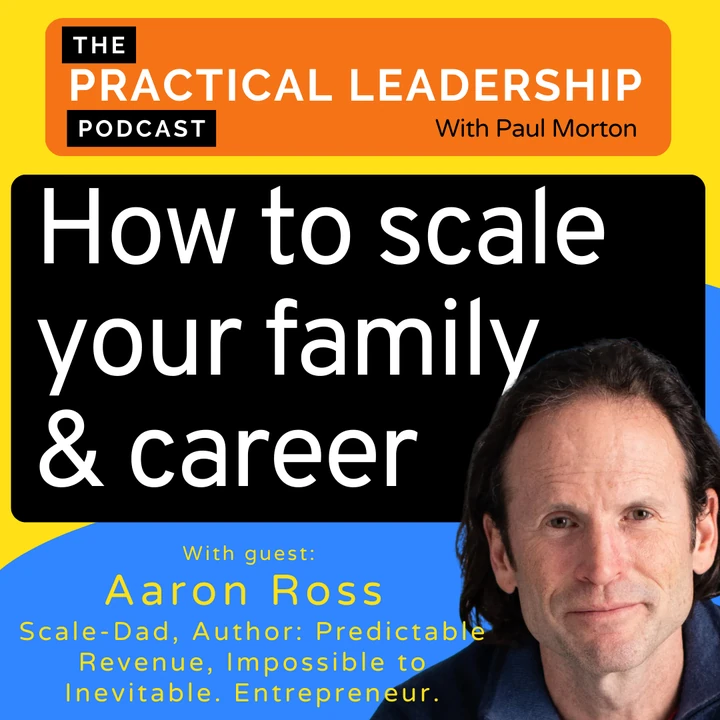
How to scale your family and career
with Aaron Ross
Show notes
In this episode, I had the pleasure of chatting with Aaron Ross. Aaron is an entrepreneur, keynote speaker, and renowned author of “Predictable Revenue” and “From Impossible to Inevitable.” He’s a father of ten and has an incredible story to share.
In our conversation, we dive into the chaos and beauty of Aaron’s life, focusing on his experiences balancing a massive family with his professional aspirations. Aaron talks about his journey from working at Salesforce to creating a successful sales system, and how his family motivated him to achieve financial success.
Key Points and Frameworks:
- Hypergrowth Model: Aaron describes his family’s growth as hypergrowth, drawing a parallel between scaling a business and scaling a family.
- Emotional Intelligence: He emphasises the importance of emotional intelligence in navigating the complexities of life and work. Aaron believes that emotional intelligence will be a crucial skill for future success.
- Love as a Practice: Aaron shares his insights on love, viewing it as a skill to be practiced rather than just a feeling. This perspective has been shaped by his experiences raising a diverse and dynamic family.
- Constraints and Determination: Aaron discusses how constraints, like having a large family, forced him to be laser-focused and determined in his professional life. He prefers the term “determination” over “discipline,” emphasising the importance of doing what feels right and following one’s intuition.
- Nonlinear Path to Success: Aaron’s career and personal life are marked by a nonlinear journey, where he often had to jump in feet first and figure things out as he went along. This approach led to many successes, despite initial uncertainties.
Memorable Quotes:
- “We hyper-scaled the family.” – Aaron Ross, discussing the rapid growth of his family. (00:03:02)
- “Emotional intelligence will be one of the defining skills for future success.” – Aaron Ross, on the importance of emotional intelligence. (00:08:20)
- “Love is a skill, not a feeling.” – Aaron Ross, sharing his perspective on love and relationships. (00:09:49)
- “Life is so weird.” – Aaron Ross, summarising his view on the unpredictability of life. (00:49:51)
- “Everyone’s doing their best, even when it doesn’t look like it, including yourself.” – Aaron Ross, emphasising the importance of practicing acceptance and appreciation. (00:50:34)
Tune in to hear Aaron Ross’s fascinating insights and stories. Whether you’re a leader, parent, or both, there’s plenty to learn from his experiences!
Transcript
Automated transcript. Speaker labels and spellings may contain errors.
Paul
Father of 10, keynote speaker, entrepreneur, author of "Predictable Revenue" with Merrill Tyler, author of "From Impossible to Inevitable" with Jason Lambkin, author of "Income Operating System" coming out some point in this year. [upbeat music] Hello, and welcome to the Practical Leadership Podcast. I am your host, Paul Morton, and we are talking about leadership, management, and the various lives that surround it. It's my joy, delight, and privilege to bring into my studio some of the smartest, wisest people I've been able to find for your delectation and enjoyment, and I hope that you do get a lot out of the conversations that we have here. When you realize that your management team has grown too fast or you've inherited a new team and the fastest, best lever you have for growth and improvement is attached firmly to those managers, get in touch. I help you run management coaching and training programs that'll make a big difference really quickly.
You can find me at the Practical Leadership Academy website and on all the usual social channels. [upbeat music] Aaron Ross, thank you very much indeed for joining me. So that was a, a, a fairly shorthand, short-changing introduction to somebody with your background. What, when you're talking about yourself, as we all want to do, it's our favorite to watch, at least it's my favorite topic, is what's important that people know about you?
Aaron Ross
You know, my first reaction is like f- I, I have no idea, you know-
Paul
Good answer
Aaron Ross
... 'cause there's just, there's so much stuff. But, like you hit some highlights. There's like the, okay, everyone says, "10 children?" I think it's important to know, too, maybe not, but it's interesting, right? They're ... First of all, we're not a religious family, 'cause that's, at least in the States-
Paul
Mm-hmm
Aaron Ross
... most big families are, are religious. That's, that's the ... Everyone ... I don't know if that's 99%, but right, not that that's bad, but we're just not. Um, five or, five of the 10 are adopted, two from my wife's first marriage, three bio kids together. So it's a, it's a... And of the adopted kids, you know, one was adopted as a baby from Florida, one is a four-year-old from China with a physical challenge, two teenagers we adopted, 16. W- one was originally from China, one from East LA, a, uh, eight-year-old from Texas. All kinds of races, all kinds of origins, all kinds of ages, all kinds of sources, so diverse. We have a d- we have a diverse family, which is-
Paul
You missed nappies. You missed diapers, didn't you?
Aaron Ross
For some of them, no. I went through four diaper stages-
Paul
Four stages
Aaron Ross
... 'cause we had five kids plus one adopted baby, and also the four-year-old when we adopted him from China was still ... 'Cause he, um, he has something called arthrogryposis, so he was in nappies for maybe like six months once we got him.
Paul
Mm.
Aaron Ross
I don't remember. Three months. I don't remember exactly. My wife went through a couple ex bonus diaper stages 'cause she had two kids before we were married. Uh, and I ne- also, I always used to ... They're, they're all my children. I never differentiate other than saying, "Hey, there's, you know, bio kids and others," and there's not like ... I never use terms like step this or ... Uh, but yeah. So we have a lot-
Paul
Yeah.
Aaron Ross
Yeah.
Paul
I mean, you either old or young.
Aaron Ross
Yeah.
Paul
You're either old or young. That's it.
Aaron Ross
That was always like my mental, which is like I'm not trying to differentiate. They're, they're all my children from different sources, and now they're aged seven to 25, so we've, uh ... The first child we adopted, I, we got married 13 years ago. Um, and so it's, yeah, went from 0 to 10 kids in, well, 0 to 9 kids in seven, like seven years.
Paul
Mm-hmm.
Aaron Ross
Eight years. And then, you know, um, three years later, so it's, it was a very ... I hyperscaled. We hyperscaled the family.
Paul
[laughs] Yeah. Uh, hyperscale, hypergrowth. The hypergrowth method.
Aaron Ross
Yeah.
Paul
Yeah.
Aaron Ross
Now, I would say that what's important is, like, that, this, this intense incub- I don't ... Incubator's not the right for- let's call it a forge, right? Forge of a family, um, which has really been my main priority, is inf- affected, driven, motivated so much, so many of the things on the business and the work side, the career side, and informed that. So they're very related, and as they get older, I'm doing, you know, they're more and more related. So they used to be-
Paul
It's a constraint
Aaron Ross
... more separate, but ... Hmm?
Paul
It's a massive constraint. I mean, if you think about a lot of people change the way that they live or change they ... When you have a heart attack, so all of a sudden you start to get fit, right? Or you lose your job, so then you start to become an entrepreneur and you start, I don't know, Burger King or whatever it was. Uh, in, in your case, you've got, well, seven, eight, nine, 10 kids. So have, "Aaron." "Yes, darling." "Get a better job, make more money. Buy a bigger house." "Yes, darling."
Aaron Ross
Yeah, had a lot of that. But I think that was, you know, if people, you know, if people ask me in the past, like how did I, you know, create su- you know, be suc- successful and make a lot of money? 'Cause I made, you know, 10 years I had to make a lot of money, so I made like eight figures, um, income. And, you know, s- I was motivated because I had kids to ... You know, I'd done a lot, you know, I worked at Salesforce and created, uh, the new sales system there. It was very successful intellectually-wise, not financially, but, you know, career-wise to start at Salesforce when it was a small company. Um, and I wrote the book "Predictable Revenue" about that. I didn't publish that book, and I didn't really make a lot of money myself yet, so the, the "Predictable Revenue" book, until, you know, I got married and we had another baby on the way, and it's like, oh, I, I have to, like, make my, you know, make more money.
So I didn't make a lot of money at Salesforce, so I started ... I mean, they were a small company.
Paul
Yeah.
Aaron Ross
When I joined, there were 150, 200 people. So, and I joined as a, you know, basically an SDR, like the most entry-level job they had, so my equity was tiny. And when I left, I stayed four years and sold a lot of my stock to pay for divorce debt from my fir- first marriage. Um, so, you know, it wasn't when I had kids. So got married, there was two kids already. They were like four and six or five and seven at that time, and then we had a baby on the way pretty quickly. I was like, "I gotta publish the book and get a partner and raise prices and consult seriously and nail my niche," 'cause up until that point, I resisted doing sales consulting 'cause I just didn't want. So kind of that constraint of having a family and having to provide really made me kinda laser focus on what, what did I need to do to make the most money with the, uh, most time efficiency?
Paul
Mm-hmm
Aaron Ross
Right? 'Cause I was n- and this episode, the constraint of had now like couple kids plus a baby on the way, and we had to get a bigger place, and so on. And then the other constraint was I was like, I learned years before just working ... I had this thing, you know, I'm not gonna ... I don't wanna work more than 20, 25 hours a week because, you know, I would get thing, more things done if I work more hours, but I would just lose sight of kinda like a bigger picture, uh, you know, these bigger ideas, like breakthroughs. So it's like how can I make hundreds, you know, high, mid to high six figures working 20 hours a week to support a family? And I was a, you know, I wanna be very active. I was a v- was, am a very active parent, not just the driving and changing the diapers and making food and, um, playing and all the things.
Paul
Yeah. Well, you have this lovely little clip I saw via the Impossible to Inevitable book, and there's a resource page that comes with the book, and there's a little clip in there on YouTube from you. It's a day in Aaron's life.
Aaron Ross
Yeah.
Paul
And it's this, this 12, 15-hour day from dawn till dusk, and it's all, all childcare, all of it.
Aaron Ross
Yeah.
Paul
And I think a day in your life, if you define yourself by that, that's a good starting point.
Aaron Ross
Yeah. Now, to be fair, now that clip, it is that we, we had a new baby. We had adopted a baby from Florida who- whose mother had been on troubled.
Paul
Mm-hmm.
Aaron Ross
Um, so the baby had to go through a detox period, and she'd wake up six times a night and feed her milk.
Paul
Mm-hmm.
Aaron Ross
And I was, my wife was pregnant with another baby. Unplan- seven of the sev- only three of our babies were planned, which was one biological and two adopted were planned. The rest kind of just happened or came to us. But that day, the clip you're talking about, so yeah, it's probably two, I don't know, two or three or four minutes, and it's just, you know, wake up and breakfast and ch- and, you know, dance classes and, and playing and so on till, and at night it's like, I think it's like 11:00, 11:30 I'm like dancing a baby and fe- To be fair, like doing a s- I probably had like one or two work calls, which are pretty boring and it probably can't really ... I don't know, it's hard to capture. So there, there was some work, um, but you know, it, it was mostly, yeah, just constant running around, exhausting. Not fun, but important.
Paul
That's it.
Aaron Ross
It's family care.
Paul
Yeah. I mean, that's, that's, that's it. It's, it's what's important.
Aaron Ross
And what's fun. Just a bit of fun.
Paul
Yeah. I mean, you don't ... Yeah, [laughs] I think sometimes that the fun comes after. You actually realize that, oh, hang on, that was actually quite fun.
Aaron Ross
Yeah.
Paul
Well, it wasn't fun at the moment, but it was, it's on reflection that that it's, yeah, that's, that's-
Aaron Ross
Yeah. It should be like-
Paul
... that's joyful. It's not fun. It's not en- it's not happy.
Aaron Ross
Yeah.
Paul
It's joyful. It's different.
Aaron Ross
Well, it's weird. Like, one thing that's, I think, important, you know, so to me if I step back, especially having seen the changes in the world and technology the last, I mean, 52, and not just the sales world, but just, you know, and I, I have like a range of kids and I see kind of what they're dealing with and, you know, my b- my belief is that emotional intelligence will be one of the defining, call it a skill, call it whatever you wanna call it, like things that you will need to be successful in life, both in order to, like make money, but also have a life you enjoy.
Paul
Mm.
Aaron Ross
And navigate the complexity and the anxiety and the confusion and overwhelm. And, um, one thing I've learned is that feelings, a lot more, to me, I feel like a lot more complicated than, and layered than we g- than I grew up with. If I think about growing up, there's kinda like people are happy or sad and there's love. And when I was younger, I thought my association, I'm, if I'm tr- trying to remember is, you know, if you think, okay, love, does that mean kinda like easy and like exciting and like romantic love? Well, now I'm like, no. That's, that's not the word lo- the word love has a lot, has a very different meaning, which would be more like dedication and commitment and an emotional bond through thick or thin, right?
'Cause I've had, you know, my teenage, one of my teenage sons was like, uh, crying on the ground with this intense anxiety over, you know, st- whatever that is, and, you know, I can ... It's like love is a practice where I'm, I'm practicing. Like, I'm not, I don't feel good for a lot of reasons, but I'm practicing loving him. Again, I say the word practice 'cause I may not feel it, but can get back into the state and like practicing love. Love is a skill, not a feeling. And so going back to this, if I circle back around to this day of so much childcare with like babies up waking me up at night, and playing too, like playing with kids in the, in the backyard and sitting at dance class, watching cute moments, and the overall day is exhausting, right? So, you know, having a big family, like the, the financial demands, the emotional demands, the physical demands are just, talk about being pushed to the wall and past it for a decade,
just at my complete limit, and then we can get to burnout later. But just saying, okay, there's can be an overall exhaustion or some overall feeling to the day or the year, but it, ev- the day is so, is so full of so many different moments of different types, frustration, sadness, joy, play, fun. And it's very easy to miss a lot of the moments because there's the overall like fog of frustration or fog of exhaustion or fog of uncertainty. [laughs] And it, it's just interesting now, like getting older, to try to be like a sommelier. How do you parse out all these different complex moments and flavors and feelings in the, in this kinda wine of life? 'Cause they're all there, and they're so easy to miss when you're younger and you're just like, "Oh, I'm happy" or "I'm sad" or "I'm anxious," and you just miss every, so many of the things.
Paul
There's a few things in what you've said there, Aaron, that you wanna unpack. And you said you're 52. I turned 50 this year, and there's, uh, the idea that as we get to about this point in midlife and you start to look for your second wind almost. It's, well, I've got all this behind me. Oh, I'm just going downhill towards death now. That's it. I'm done. Well, no. What are you, what are you gonna do with this? What do you do with this? And your previous X number of years on this planet has been gathering knowledge, wisdom, and being paid for that knowledge and wisdom-
Aaron Ross
Hopefully
Paul
... and experience. But now I think what I'm finding is that I'm, I'm almost pivoting to some extent to be rather than- I'm still paid for my experience and all, all that sort of stuff, but I'm more finding value and, uh, reward in asking good questions rather than coming up with good answers, you know?
Aaron Ross
Yeah. That plus, you know, there's that idea of, um, you know, like when I was younger, I think a lot of young people like, okay, 20s, 30s, just like so focused on like making money, career or whatever their version of their, their... or dating or, um... And, you know, I think a lot of people get to the point like I did or like maybe getting married and so on, and, you know, the way our societies work, at least the States, maybe UK- probably the UK 'cause it's pretty similar. By the time, you know, people in their 40s s- you know, could be a bit younger, a bit older, uh, I think there's this natural time where midlife crisis is a thing because you kind of get to the point of view, at least I was able to see, okay, there's a lot of societal things I carried, and they just, they get too heavy at that point. Uh, and, and my wife, the same thing. And so I think there's a natural time, at least for our societies, 'cause can't speak to others, where we get to that point of like, okay, the first half of life did tons of things, and now, hmm, what do I actually want to do for me?
I've lived a lot for other people. It could be for parents, for children, for a spouse, for partner, friends, and you know, now what do I wanna do for myself?
Paul
Yeah.
Aaron Ross
And I think it's pretty common.
Paul
It-
Aaron Ross
Hopefully
Paul
... it leads, I think it feeds, feeds and leads. Um, you talked about the love piece there and recognizing that as kind of a driver and i- is it the be all and end all? Well, it depends on what sort. And as the author C.S. Lewis, he came out and he had the book called Four Loves, and he had the four different sorts of, uh, love as, as defined by the Greeks. You have storge, which is the affection, it's the fondness, it's the familiarity with your, your, your, your brother, your sister. And I think you wrote about it actually once in the back of, I think it was Impossible and Inevitable, the occasions where you find yourself, uh, falling into roommateness with your wife.
Aaron Ross
Mm.
Paul
And you realize, whoa, stop. No, no. That's not the relationship you want. What you want is y- that's the other sort of love. That's the eros, that's the romantic love that you need there. And then you have philia, which is the, the friendship one, which is the other set of relationships that we need to, to keep us sane. I think I've always said that friends are there to remind you that you're normal, you know? Like, "Oh, whoa, you know what? It's okay. I'm going through this, too. It sucks, but it's fine." And then you have the one I think you alluded to, which is the agape, which is this, the one that's there for despite everything else. It's unchanging. It's, um... I mean, so this is the c- the Christian virtue of divine love, and that's the sort of underpinning piece that holds everything else together, okay? That's when you're talking about going off and finding yourself.
You're talking about going off and doing what matters to you and-
Aaron Ross
Yeah
Paul
... being that person.
Aaron Ross
It's also, yeah, and loving your family or people close to you regard, you know, the, the practice. I call it practicing of the pr- is, um, regardless of how they're treating you, it- it's with the kids, you know. So I could, I could love my wife. Like lots of my wife or my family can be mean to me or each other by intention or, or [chuckles] habit.
Paul
Omission. Omission.
Aaron Ross
Yeah, yeah. And you know, it's one, you know, loving them could be the way I feel about them. Doesn't mean that I'm like, I can allow them to... You know, there's weird thing about boundaries where it's I can love someone and see that they're, have a habit or like a, a thing or like a, a... It's easy with children, right? One of my, my eight-year-old's like, "Dad, I hate you." And it's like, "I love you." You know, I love her, and I can tell her that, and I can... I d- it doesn't, it doesn't bother me.
Paul
Yeah.
Aaron Ross
For some people it does bother me, but it's easier with some kids or some people. It's like I just see this as like a th- like a thing, like a habit or a way that they're expressing something they don't know how to express what they're really trying to say.
Paul
So-
Aaron Ross
And not take it personally.
Paul
Yeah. Yeah.
Aaron Ross
And-
Paul
I find it more challenging when it's, it's somebody who you expect, and maybe that's just a mis-ex- a mis- of setting-
Aaron Ross
No
Paul
... expectation in my mind.
Aaron Ross
Where they use ex- yeah, you used the word expect.
Paul
Yeah. So I, I would, I would expect or I assume, you know, I, I sort of you and me, I assume that you have greater capabilities of expression, of self-awareness than you evidently do, and you've just said something quite hurtful to me, and I'm thinking, "Actually, do you mean that or are you just kind of emotionally illiterate?" And you talked about emotional intelligence there. And if it's somebody my age, I'm expecting that you, you've worked out what life is by this point. And if you haven't, okay, uh, do I have the energy to try and help you discover this or not? 'Cause where are you in this journey, frankly?
Aaron Ross
Yeah. And you know, again, I think I don't know how many people who listen to this would be actively managing teams, younger people, younger generations-
Paul
Most, I think
Aaron Ross
... yeah, having families, and it's very easy, again, learning through experience. You know, we have a lot of different kids with a lot of different temperaments to be judgmental-
Paul
Yeah
Aaron Ross
... to, again, make assumptions, to be frustrated, and we're going to be. But, you know, having the, you can call it empathy or maybe, uh, intuition. It's like the understanding, like, again, the emotional intelligence of, at least for us, like having so many kids for so long, so many sources. I've, I think I've seen so many, a lot more variety of states of being, and so it s- gets easier to kind of say, okay, someone is acting out, and to kind of be able to understand them a bit, a bit more.
Paul
Mm.
Aaron Ross
And try rather than to kind of force them, you know, s- you know, assume they should be a certain way and do a certain thing 'cause I want them to. It's, you know, it's like working with them to, to come up with, you know, it could be like in cleaning a room, walking the dog, right? Um, someone doesn't wanna do it, and sometimes I might understand, okay, there's some, uh, task they don't wanna do, and they might have a good reason. They're sick or they didn't get enough sleep or, and some- or, or sometimes they just don't wanna do it, and working out with them to kinda, to know at least when is it something just, well, you just need to do it, and when just to lay that, just keep it that, and when to have a, a, a chat about it, right? When h- when you just, here's the law, when to have a chat, when to let them to, when to like give them some space.
Um, so I think people, we love to have simple rules. Just have them do, you know, do this, whether it's like pros- you know, salespeople or kids and ... 'Cause simplicity feels satisfying. I know-
Paul
Yeah
Aaron Ross
... I don't have to figure out this difficult situation. I just have a rule to follow. Rules should be more guidelines, and I think this is gonna be the nature of the future rather than like arbitrary rules that, you know, seem to make a lot of company... That worked in the past. Just rules are rules, you follow the rules. You know, people are growing up in a bit more complex time. They're gonna be more, they're gonna challenge the rules. Like, why is this even a rule? And wanna talk about it. And so it's kind of for yourself, it's for, for leaders knowing, again, when to lay down the law, when to have a chat, when to let somebody do it, and um, kinda looking for the best outcome of the team that way.
So I, I feel like it's gonna be a bit more, you know, of a complex swim with teams in the future 'cause then also have people in person, you have people who are remote, different. There's just more variety in the future of all kinds, and so simple rules aren't often gonna work as well as they used to, and we have to be prepared to have a bit more negotiation over how we work together and how we get to results together and whether that's with your team or whether it's with your superiors or whether it's with customers.
Paul
Again, going back, and I'm not harping on your age 'cause we're very similar, but I think there's a, an element to that of experience. And as you said, you've experienced lots of different types of kids, and in your 52 years on Earth, you've experienced and worked with lots of different types of people. And you can look at certain types of behavior or responses to stimuli and say, "Ah, that's because," or, "That could be because, so therefore I'm not gonna yell at them and chuck a shoe in their head. I'm actually gonna try and work it out." Or as you said in this case, "I'm gonna lay down the law," and you make that judgment call.
Aaron Ross
Yep.
Paul
The thread I think that comes from that to something else that you've been, you've spoken or written about is I think the understanding of cyclicality and rhythms and outcomes in that most stuff you can work out as you go. And one of your points is, you, you mentioned the nonlinear way of living. Now, you wrote a book called Predictable Revenue: From Impossible to Inevitable. Okay? So in, the impossibility turned into inevitability. You're creating something out of nothing. You're driving intentionality and deliberateness out of the chaos of life-
Aaron Ross
Mm-hmm
Paul
... because, because you know it can be done. Because you know that if you jump in feet first, you'll sort it out, you'll work out, you'll, you'll bob to the top of the fast-flowing river and raft your way down into the shallows and paddle to the edge and out you'll come soaking but successful.
Aaron Ross
Yep.
Paul
How does constraints feed into that doing what feels right?
Aaron Ross
Yeah. Well, I do, I think that starts through that, uh, you know, a lot of things that have worked for me in life, whether it was ju- you know, starting a business which failed, but that led... Do you know this, this good news, bad news story? It's, I think it's originally from China, right? Uh, I heard it from a kid's podcast but, um, you know, the, the, the short answer is, uh, there's a, a village, right? There's a man who lives there with his son. And one day a, uh, you know, a, a wild horse just appears and like, "Oh, great. We get a f- you know, basically a free horse." You know, the son says that, and the old man says, "Good news, bad news. Who can say?" And the next day the son is riding the horse and he gets, he falls off and breaks his arm. "This is horrible." And the father says, "Good news, bad news.
Who can say?" Uh, and then the next, next week the local warlord came through recruiting, basically taking men to go off to war, and he left the son because his arm was broken. You know, it's kind of good news, bad news, who can say? The whole point is like things happen and, you know, we love to think, oh, this is good news or bad news, but sometimes they just, we don't know where this thing will lead to. And we think we can predict the future, which we can't.
Paul
Yeah.
Aaron Ross
It's an illusion. Um, so a lot of, um, you know, going back to like having my business fail led me to join sales. Like I, I need to learn sales. Okay, I'll get a job at Salesforce, and that led to a great success there, all right? Um, which then led me to leaving Salesforce to kind of, you know, do other things. Got married. But a lot of what's led me to do things is if something feels right or interesting and I wanna do it, and it may, it may or may not make logical sense, right? Starting a business, that made sense. Like I wanna do it, made sense. Um, getting a j- sales job at Salesforce, a entry level job, that actually it f- I wanted to do it and it made sense to me 'cause I wanted to learn that skill and, but not sense to a lot of people 'cause I went from being CEO of some internet company or f- you call a young CEO to entry level,
uh, you know, sales job. A lot of people, their ego or I didn't let my ego stop me. But, you know, getting married and having three kids but then adopting, and adoptions fin- let's talk financially. Adoptions can be $40,000 or a few thousand depending on the source. And then, um, we always add kids or adopted and then made the money work later, right? Did we ever have enough money to kind of like have the next kid or adopt the next kid? No. So it's always like, this feels right. Do we have, uh, for, you know, adopt- we adopted a kid from China who's now, when he was four and now he's 15, or this baby from Florida or older kids. Like do we have a big enough house? No. Do we need to get a bigger house? Yes. Do we need to pay for the adoption? Yes. Do we have that money? No. But we'll just work it out. Um, so like an example was like literally, uh, you know, 2016 I think it was, we were paying for this, an adoption and we just, we knew it was really important and we didn't have the money for the last fee and so we figured, oh, we
wouldn't, we need $11,000 to like pay this last bit. And we figured out, oh, we could get, we just got, it's $11,000 on the dot by pawning my wife's jewelry, right? To get the cash and like send this last fee off. And so we're always just figuring it, we were always figuring out financially especially how to like make the family work, whether it was like by making money sometimes, using debt a lot of times ... pushing off bills a lot of times. Um, but the family was the most important for us 'cause it felt the most important. So for us it was not... I'm not saying family is the most important, I'm saying it always felt the most important.
Paul
Mm-hmm.
Aaron Ross
And made other things work even when the s- you know, the spreadsheets never worked, the finances never worked on spreadsheets. Um, um, logically and our family's like, "What the hell are you doing?" Like, it makes no sense. You're having another baby, you're adopting another this, or what are you doing? Um, but that was always just what felt right. Or moving to Europe as we moved from Ca- uh, Los Angeles to Edinburgh in January 2020, or going back to career. You know, I was r- famous in my niche around sales consulting and made a lot of money doing it. You know, again, like eight figures and, you know, with my books probably drove like 50 million to our, my businesses o- since 2011-ish. I made like 10 million out of that, which all went into the family in different forms or, or a house.
Um, but I was just like so sick of that business and I, and the partner I was in, I couldn't work with him. I was like, "I just, I just can't do this anymore," and I'll have to figure out the money, everything separately. I was just... I just, I couldn't go. Now, logically, actually, in that space of out- it was outbound prospecting, outbound training, outbound, uh, outsource, outsourcing, um, I, I knew too that I didn't want to, I didn't want to do it anymore. And I hadn't wanted to do it for a while, but it's, I had to make money and that's the easiest way to. But it just got to the point where, um, well, emotionally I was just like, done. I couldn't do it. I, I could think too like, well, there's no way I could keep this going because I don't have the energy or the interest to do another breakthrough book. I'd written a couple books, very proud of them, Predictable Revenue, and the, From Impossible to Inevitable.
Paul
The CEO.
Aaron Ross
Yeah. And it's just there wasn't anything in me or the team to be able to do some sort of breakthrough to get above the noise and to keep the brand growing, and I just didn't want to. So I couldn't work with the, and, you know, my partner anymore. You know, I just, I just wasn't interested in the whole business and the whole space and it was, it was boring and exhausting and I was just done. I just hit the wall and there's a lot of, not just the work itself, but also I was just physically and emotionally wiped out from like having 10 years of, of like babies and y- so many young kids, um, you know, just hit the wall. So again, this whole thing around how you gonna support the family, I don't know, but I can't do this, this thing anymore. So in that case, negotiated a buyout, which over a few years would give me some money in order to cr- create something new. Although after like a year, a little over more than a year, the business was struggling, so we had to stop the payments.
So there's just, again, what I've found is that even when there's a lot of fear that come up with, because we all wanna be safe, you know, I wanna have a, you know, have a baby or more babies or adopt and like, uh, but there's not enough money. Do it anyway, we'll figure it out. I have to get, I ha- at that point I have to get out of this business. It's not a want to. I guess you, at that point I had to. How are we gonna pay for things? Uh, we're gonna, we gotta figure it out. And there's, there's lots of steps and it's not like it's a simple thing, but it's like following that, what do you call it, intuition or like, we need to do something, want to do something, and timing can be hard to judge, but it may not make sense.
Sometimes it does, a lot of times it doesn't, and still doing it. Like that's really the thing I think has been, has paid off both with career, family, happiness, like e- everything for me. One of the things.
Paul
So you jump in feet first and work it out later. Now I've got a very good friend of mine who is, uh, as free a spirit. He does five state dancing. He's super wonderful, wonderful guy. And he says, quite surprisingly given when you see him from the outside, he says that it takes an awful lot of discipline to be a free spirit. It's an awful lot of work. Now you talk about con- you have this constraint. You don't wanna work more than 20, 25 hours. You gotta... What do you say?
Aaron Ross
Uh, you know, the word... So people... I just have a... Okay, I'm gonna be nitpicky 'cause the word discipline.
Paul
Cool. Yeah.
Aaron Ross
Like you look up the definition of the word discipline.
Paul
Mm-hmm.
Aaron Ross
Actually, if you do do it, if I, I could probably-
Paul
I'm gonna do it right now. You keep talking.
Aaron Ross
Yeah, keep, do it, yeah. All right. Um, and I don't know how much this really matters, but I think the word discipline, let's get, but to me it implies-
Paul
Okay. Here we go. Controlled behavior resulting from disciplinary training, self-control. Control obtained by enforcing compliance or order. The self-control gained by requiring rules or orders be obeyed.
Aaron Ross
Yeah.
Paul
And this is self-control.
Aaron Ross
Yeah. There's a lot of this that, which I think implies doing things you don't wanna do.
Paul
Mm.
Aaron Ross
A- again, there's like the enforcement of rules.
Paul
Mm.
Aaron Ross
Um, which I prefer the word I, determination, which-
Paul
Good
Aaron Ross
... it's more around-
Paul
Mm
Aaron Ross
... when you know when you're really determined to do something, you're not forcing yourself to do stuff you don't wanna do because it's part of the rules. Like discipline or disciplining, I think to me just has... I think a pe- a lot of people like that word because there's, in the online, people like this idea of there's some punishment or penalty. To, to get what you want, you need to, you know, kinda be punished or, you know, be penalized, and people who aren't getting what they want need to be punished more. There's this weird, I don't know, determination I think for me works a lot. I'm very determined in certain things and a few things where I'm very determined about creating a family that has strong bonds within itself, and very determined to be, right now to find work
that I really like to do for the sake of the work itself, and to make even more money at that. Um, so there is, again, discipline, you know, again, might be splitting hairs to some extent, but I do feel-
Paul
No, I mean words, words are important.
Aaron Ross
They are.
Paul
Words are important. Yeah.
Aaron Ross
Yeah. So just determination is if I wanna get, if I want my, to physically feel good, I'm determined to do that. Yeah, I'll get up sometimes earlier, sometimes go, you know, whatever. I'll do what I wanna, need to do, um, which is different than discipline, which, uh, again, to me feels like you're n- you're not even doing what you wanted to, to do. You're just doing things you're, you know, you're being dis- I don't know. It, it doesn't feel as helpful to me-
Paul
Mm-hmm
Aaron Ross
... in aligning with, again, who you are, what you actually wanna do, and how you're gonna do it.
Paul
Firmness of purpose and resolve. There we go.
Aaron Ross
Firmness, pur- yeah, d- you know, kind of doing what you need to do and want to, you know, to get, doing what you need to do to get what you want, I guess is-
Paul
Yeah. Yeah
Aaron Ross
... a little bit different. And I think, um- You know, I think the word discipline too, because there's so much in society and growing up around people need to obey rules that others set
Paul
Yeah. Yeah
Aaron Ross
That's where it usually comes from is I think more so versus I'm gonna set rules that for myself that I'm gonna follow
Paul
That's my take on it, however. I mean, my take is that discipline is actually self-discipline. It's I, I, I want... I don't want to drift. I wanna go in a certain direction, and in order for me to go in a certain direction, I have to do things consistently. I have to keep on doing things that will eventually get somewhere I wanna go.
Aaron Ross
Yeah. And it's, you know, look, I think it's too like finding some version that feels right to you, that feels helpful
Paul
Yeah
Aaron Ross
... whatever the word play is.
Paul
Yeah. Kind of.
Aaron Ross
Like, you know, to me also discipline a bit, um, you know, I've lived for quite a while in a space where it feels, and sometimes is impossible to have regularity in almost anything.
Paul
Yeah.
Aaron Ross
There's just constant, you know, and constant changes in schedules. Kid gets sick, school starts, school stops, kids are back. Uh, doctor's appointment. Oh, you can only get this, you know, this other appointment. You can only... It's just, it drives me insane sometimes, and there's some periods of some regularity, but, you know, so it's almost like discipline for me, I feel like, uh, I got to the point where I, I never use that word anyway, but, uh, doesn't feel helpful because I kind of feel like I need that along some sort of schedule where it tied to me, feels a bit ti- uh, usually tied to some sort of schedule regularity, um, versus determination where I'm gonna, you know, regardless of what's happening here, I'm gonna find some way through.
Paul
That I think I resonate more with.
Aaron Ross
Yeah.
Paul
So if you're finding some way through, you're, you were burnt out. You're finding, I mean, I use the word burnt out, you didn't. But you were, you're at an end of your previous-
Aaron Ross
Oh, yeah. Totally.
Paul
What are you doing now? What is, what is, what are you determined to do now? 'Cause you may-
Aaron Ross
I don't know
Paul
... have something like helping people write books. You're, you've-
Aaron Ross
Yeah. Those, so the way I describe it is, um, you know, I think it's important, a bit of the story is we have a big family. I've made a lot of money, but we still need to make money, right? Huge. It's like the bills are crazy. So it's not like I can afford to not work from... And it's 22, 2021, so it's been about three years when this, this buyout. So I left my prior business, uh, which was really almost all the money I was making. And so most of the money has been through consulting. Uh, so maybe 5 or 10% was, you know, uh, so if it's like over t- over a bit more than a decade, let's call it like a dozen years, call it like $10 million and like, uh, maybe say rounding up like a million maybe from royalties and maybe a million from speaking, and a couple million from like eq- you know, equity advisory and like six or something from consulting.
S- stuff from consulting or the business, some salary and, um, so, uh, you know, to see most of that disappear is difficult, but, you know, the golden handcuffs, but, like, I was just dead. I like, I... It was just physically make me sick thinking about going back to that type of work of actually doing sales consulting in that business and even hands-on consulting, right? 'Cause I, there's a backstory. So walking away, all right, I'll get a buyout to be a few years to kind of recreate something, then that stops. So there's been a scramble for a couple years financially. Um, oh, there's always a scramble, but even more so between, again, you know, some projects that come up or some family, so help from the, from my family, uh, from, again, like sometimes it's like just not paying bills or debt or, or all kinds of creative sources to get through this period while I figure out like what do I wanna do?
My whole thing is like I need to find, I know I need to find work, I need to find work that I like to do for the work itself.
Paul
Yeah.
Aaron Ross
What is that? So I started out with saying I, I have no idea what even what I wanna do. And I thought about this for years, but again, just so exhausted and so at the wall, I just had zero space or energy to even think about that beyond like the next... You know, it's always there's like, just so much like the family, the bills, the, the consulting work. So, you know, it took me some time, but okay, after maybe a few months or a year, I was like, okay, I know now I want to write more. I'm working on new books, speaking. I have actually a lot of speaking this year in Brazil, funny enough. Uh, you know, so writing, speaking. I wanna get people together for retreats at some point, probably writing retreats mainly around books-
Paul
Mm-hmm
Aaron Ross
... at some point. Um, coaching people on business books. I really like that. So there's all these, these pieces. It's all around kind of interesting people sharing and distilling ideas and, and then re-sharing them through speaking and, and books for the most part. Having said that, you know, the family's really important, so there's some blanks. I learned so much through the family that gets in- informed into what I wanna do and how I write and these ideas. Um, and one of the books is called "Eat Shit and Grow." It's more about this and the other's "Income Operating System." But, um, so I'm, I'm, I'm making some money. Not enough yet, um, but it, I've gotten to the point where in the past I was like, "Is there work that I would love? Is that even a thing?" And now I'm like, okay, yeah, actually there's... I can see there's, yes, I will, I have and will find work that I really like to do, that I love to do for the sake of the work itself, even if I wasn't getting paid.
Okay. Can I make as much or more money at that than I used to or do I have to trade off? Is there work I love but I make, don't make sm- much money or better can find work that I love and I make as much or more than I used to? And now like, yeah, I don't know exactly what I'm gonna do or how I'm gonna do it or how long it'll take, but now I'm like, I know it's gonna happen. I don't exactly know the details, but kind of, uh, it's gonna happen. So that's where I am. [chuckles] Uh, and I do believe, it's just weird, sometimes I'll have these knowings and for years I've felt like, okay, I'll probably found, found some unicorn-type co, co-found some kind of company that's really fast-growing. And I don't think that's 'cause I necessarily want to, but I think that's gonna happen. It's just a weird thing in life where if you, I don't know if you believe in higher power, I for sure do now at this point. But, um, you know, having a big family and so much chaos and uncertainty, there's kind of these times where, uh, it's like, okay, I don't know what's gonna happen or I don't know this.
And other times like, okay, I, now I have a belief or some feeling I can't quite explain, and I've, I've kinda gone into that zone now of things are on their... We've gone through the hardest part around at least work-wise, like not knowing this and leaving the other stuff and now, now I got clues, now I got Lego pieces and it's not together yet. I haven't built the castle or the plane, but I've got all the p- I've got a lot of the pieces and it's gonna happen Uh, that's the best way I can explain it. That's where it is
Paul
It's like you're, you're assembling a whole stack of talent, and you've got a whole stack of talent, and surrounding that is a whole mess of opportunity. And if you've got the talent and the opportunity, then all it takes is time.
Aaron Ross
Yeah, and I, I think too a lot of this is this, um, this radar, this feeling for, like, what do I actually want to do?
Paul
Mm.
Aaron Ross
What do I like to, what do I like to do? Because in the past, yeah, I mean, mentally it wouldn't be that hard to say, you know, "Okay, let's start a, a SaaS company, some company and, and do the this, that, and the other." And yeah, there... It's not saying it's easy, but I don't wanna do that. And I, I'll give you an example. In this space where, um, I really need to find work that I like to do 'cause I, of the work itself. Writing, um, writing's a bit tricky because the act of writing doesn't always feel good. Sometimes it does, sometimes it doesn't, but I like having written. I think there's famous people who've talked about this a lot. But, like, coaching is an interesting one, book coaching, 'cause I remember I was talking to people about book coaching, book coaching, and I was trading messages on LinkedIn with someone, some people around, like, their ideas and get feedback, and I'm like, "I would" ...
I liked it. I was having fun doing it, right? I really like that, and I like meeting with people and talking about ideas and so I get some energy from that. And I can tell there's like, you know, kind of like certain kinds of sales consulting or other kinds of work or, like, even online, like social posting, like I just don't like, I just don't like that. Those are sometimes I might do it 'cause I feel like I have to, but I just don't like it. Um, and like I need to focus on most of how kind of work do I actually like to do? Uh, what, what or work I would pay to do? Um, how can I have more of that? And all the stuff that it just drains me that's not interesting and feels obligatory not do or get someone else to do it for me.
Paul
Right.
Aaron Ross
And I'm still sorting through that. It's like a slow... It's like, you know, I call it the, I call it the labyrinth 'cause this is the basis of a new keynote I'm doing because I can't see past the next turn, which really every day is a different day. I can't see past, like, today. I don't know where it's going. As long as I make the right turn for today, what feels right, and sometimes I get clues around, oh, that is, like, an interesting thing, or I have a talk, I gotta put together a new talk or... So I'm still, like, gathering these things, but I don't have... There's no vision for what, where, where this is going other than the feelings. So in other words, my goals are not financial goals or this. It's like the feeling. My goal is to really enjoy the work I've got for the most part. Yeah, okay, it's not all gonna be ponies and roses, but to be, to continue to like the work and the people I'm working with and to make a lot, you know, more money at that than it was before.
That's kind of my, that's my goal. And I don't use a spreadsheet that I... And there's not like, "By three months I'll do X, Y, and Z, and by 12 months I'll..." No, I don't do any of that shit. Um, never really did. Sometimes, but it just never really worked. So yeah, that's, just, like, that's the radar is these, it's just feelings really.
Paul
Well, I think there's a lovely thing that, you know, a feeling is an emotion, and emotion, emotion comes from movere, which is motion to move, right? It moves you-
Aaron Ross
Yeah
Paul
... forward.
Aaron Ross
And, and discerning. So in the keynote-
Paul
The sum
Aaron Ross
... I, yeah, I went through this, you know, kind of my 30s was learning, and then 40s was earning, and then I, it was burning. Now, now I'm discerning.
Paul
Mm-hmm.
Aaron Ross
So I'm really exploring that I can discern, like, what kind of... Versus, like, jumping in, 'cause I totally get it. I've had my f- you know, my family or wife's like, "You need to get a job and make more money." And like a lot of the jobs, like, ah, just would, like, kill me. Like, I, that is not gonna help. Maybe in the short term, but I can j- I just know because of the feelings that it's gonna short term maybe make people feel good or, like, there's activity, but I need to continue, like... And I get royalties, like, so we have some, enough money to get by and family and so on just to keep the lights on while get more of the clarity bit by bit discerning what's really gonna be this right combination of some new business.
Paul
Mm.
Aaron Ross
And I can't predict what that is because it hasn't been done before.
Paul
There you go.
Aaron Ross
No, I'm not gonna do some SaaS, you know, this consulting company or s- I, but I, I know I don't wanna do all that. Something new I wanna do for myself that I don't know what it is, but I can, I can tell that discerning, like, that's right, that's wrong, um, and it's slow. It feels slow, right? This is over years. I don't know if it's six months away or a couple years. It's, but I f- at, again, I passed the tipping point of can I do this? Is it all, all that? But no, oh, yeah, I can do... It can happen. It's gonna happen. Don't know when, don't know how, but yeah, it's happening. And I'm glad, like I've, you know, at 52, at 52 it's like that kind of emotional intelligence or experience where if I had been in my 20s or 30s, like, I have no clue. Uh, it, it, yet at this point I'd still be freaking out because I need to know kinda, like, what's the plan and, like, where are things going and, you know, what's the spreadsheet
say and what kind of business is this and yada, yada, yada.
Paul
And if your turn-
Aaron Ross
And that's it.
Paul
And if your 20-year-old turned to you and said, "I always say, I always say, oh wow, woo," your response would be-
Aaron Ross
Oh, they do
Paul
... it's fine. It'll work out.
Aaron Ross
They do turn to me like that. They're like, "Oh," and I'm like, "F-," you know, like, "What's, do, do, what are your options?" Like, "What do you really wanna do? What do you think is important? Um, okay, the money thing, it's an, you know, don't make that the most important thing. It's a consideration." We had this c- I had this talk with my 15-year-old about college, you know, and like we don't have right yet a lot of, or any extra money to help. They have like a small college trust which would pay for not even one year of private school in the States by the kids from the grandparents, but it's enough to kinda get going. And then, you know, he's like, "If I, if I go to the States, uh, I have to pay, you know, crazy amounts of mo- I have crazy debt." Great. In, in the UK, in Scotland it'd be free. In the UK it'd be, you know, it's 10,000 pounds a year.
In the Europe... So he's like, "Okay, the financial part, that's, it's important consideration, but it's not the most important thing. What do you want to do?" "I don't know." "Okay, let's think about that. Well, what else is important to you? Do you want to live s-" "I don't know." So he, he has a list of what he doesn't want, which is a t- a lot of debt coming out of college. I get that. But what do you want? Doesn't know yet. We gotta look at that column too. Same thing if you're, like, if you have a job and you need to pay the bills, I feel that. I got 10 kids. I still gotta pay their bills.
Paul
Yeah.
Aaron Ross
So I'm not saying, "Ooh, you wanna be an artist, like quit your job and go, go to art school." What I'm saying is To this extent you can, and sometimes you're in a space where you can do this and sometimes you're not. I went through it 10 years-ish where I just couldn't even think about that. But when it starts to feel important, think like what are the things that are important to you? What do you want to do? How do you want to feel? Or maybe where do you wanna go, um, in addition to the things you don't want. And whatever that looks like, you know, it might be something that happens in a month or maybe, maybe 10 years. There's things that I've held onto and ideas I've had for like 15 years that aren't ready yet, um, like expert now. I don't know, just like, just stuff. But it's important to think, you know, to start to tap into like what do you want for yourself?
And not judge it too quickly as, "Oh, it's irresponsible," or it's this, that, the other. Like, "Oh, what do you wanna do?" You, you know, I, I'm-- I wanna do puzzle. I, like I love puzzles. I went to the World Jigsaw Puzzle Championship a couple years ago just for fun. Anyone can go, by the way. I'm not that, I'm not special. Does it... To, to me, I'm looking at Sudoku puzzles. Um, is that something... It's like I'm not attached to whether that's gonna make me money or not. Could it? And somehow I might meet someone, you know, who knows? So I think it's important like this have, you know, for anyone, an executive or anyone else, like what are these things that, these whispers you have, interests you have, things you wanna do,
things that feel important or interesting, and to kinda cultivate those and listen to those without shooting them down too quickly, without assuming, "Oh, if it's not gonna happen this month, I can't." Like, and those were a lot of these things that's working for like having kids and adoptions and writing, um, have led me over, over the years to all the things I've got that I feel successful with, which include not just career and money, but mostly family. And you can cultivate these, start earlier, honestly. I gave my 15-year-old, like, like one of his big things this summer, because school and screens squeeze out so, or when you're older, jobs and screens squeeze out a lot of this. It, it, it overtakes all your extra energy, your extra thought. So like one of his things this summer, you know, we had the screens mostly away with the kids. Um, and we have a bunch of kids at the house that can play together, and they'll do other things where it's not just like, you know, they'll have other ac- crafts, activities.
They can do some gaming together. But, um, his, I, his big sister, I asked her, "Hey, can you also," 'cause she's not a parent, "talk to your brother and help culti- like this summer, like help him come up with like he's got other interests and hobbies that he's forgotten about because of school and screens. Like, help him cultivate that if you can." In college, it takes a bit more of, I think, a gentle, uh, interest. And I think it's, if you're an ad- it's a bit trickier when you're an adult and you're a 45-year-old VP of sales at a SaaS company, 'cause maybe hopefully you have maybe a men's group of friends or a women's group or, or w- whatever your version is, around people who could be supportive.
Um, but it's pretty rare to find people who you can talk to who will, I think, be, have in a helpful way, "Oh, you want to travel, you want to do knitting, you want to be a volunteer someplace." And rather than just saying, "Oh yeah, go for your passion," kinda be a bit more thoughtful around, "Hmm, yeah, how..." You know, what does that mean, or how can you do that? Or, you know, kinda sit with it and not have to do something with it right away. 'Cause a lot of times, for me at least, these things kinda bubble for years. And I'm, I don't need, if I take, if I try to like, "Oh, I'm gonna, I'm gonna go to do this stuff with it," it kinda kills it. And I don't have the energy or I feel, "Oh, I can't do it." You know, either I don't have time, energy, or interest yet, or I do. I don't know, the time, this timing thing is weird. So I, long story short, I think it's just coming back to, for people, a lot of these things going back to like what feels right, but even it doesn't make sense.
A lot of times there are these little whispers or like hints or feelings that are so subtle and quiet, and they get drowned out by work or school and screens. But those are the things which end up at some point in time, often longer than you think or want, being these incredible sources of interestingness, joy. It could be money or things that are important to your life. That is, that's how it's worked for me.
Paul
I think the Japanese call it ikigai, which is this-
Aaron Ross
Yeah
Paul
... confluence of what you want to, what you're good at, what you're passionate about, what society needs, and what you can get paid for.
Aaron Ross
Yeah. Well, again, what are you passionate about? I think most people listening to this, and I would've said for a long time, like besides family, what does this mean? Like, I don't know.
Paul
No, I have no idea.
Aaron Ross
I don't know.
Paul
Lots of things. I like flying kites, driving my car, drinking beer, hanging out with my kids. If I can get a job that does all, all of these, it's great. Kite-flying, beer-drinking, car-drinking dad.
Aaron Ross
Yeah. Well, yeah, but again, what are you passionate about?
Paul
Yeah.
Aaron Ross
Again, it's, it's not an easy-
Paul
It's not.
Aaron Ross
And you know what? Yeah, it's, by the way, it's fine. Like, you don't have to... I think that's the thing with society, like, oh, if you're not passionate, there's this implied if you're not passionate about something, then you're missing out or there's a problem with you. Like, no, what does, you know-
Paul
Okay
Aaron Ross
... yeah, yeah, yeah, that's not how it works. And not everybody's passionate about w-work or has to be, or a lot of people don't have to, you don't have to like your family. A lot of people don't like their families.
Paul
But you still have to love them. You still have to love them. Well, there's, it's that different, there's that agape love, right? That's-
Aaron Ross
There's a legal requirement to care for them, but a lot of people don't love them. There's, well, like if, let's be honest, a lot of families, a lot of parents don't know how to express love to their kids in the, in the way of a feeling of love where someone feels loved. They don't. Did you, did you grow up with that? If you did, you were lucky. I think most, if you grew up and your parents knew how to express love where you felt cared for and felt loved, then you are a exception to the rule.
Paul
Yeah. Yeah. It's a rare thing. It's a rare thing. It's something, it's something that I, I actively cultivate at home with my children.
Aaron Ross
Yeah. It's a skill, not a feeling, I think is-
Paul
Yeah. It's, it's a thing.
Aaron Ross
I heard someone say that, I was like, oh, that, that is really insightful. It's a practice.
Paul
Yeah. It's something you learn. It's a practice. And it's like, it's the thing is one of the, one of the guidance, pieces of guidance if your, if your marriage is, uh, struggling or if you do feel like roommates is fake it. Pretend. What does somebody who's in love with their wife do? Do that shit and do it a lot.
Aaron Ross
Yep.
Paul
Do it repeatedly for weeks and weeks, and guess what will happen?
Aaron Ross
Yep.
Paul
You are.
Aaron Ross
I think that's a great point. You know, it's, one story is, you know, there's, I call it, there's like the five years of hell where, because just over this huge family, it's easy to say, oh, like, you know, like again, the cost around like time, energy... Eh, time Uh, you know, money, financial, uh, money energy, physical energy, emotional energy, just taxed. Um, you know, my wife, especially for different reasons, like five years, just, it was rough. Um, I just did my best and I got better over the years of like acceptance and love and not being romantic. Cause again, that was not something I feel like I had the energy for like notes and things, but I just did my best. And at some point took like five or six years.
I mean, we're doing amazing now. So it's, you know, yeah. I don't know. Life is-
Paul
Non-linear. Non-linear to say the least ever.
Aaron Ross
Uh, definitely. Yeah. Never. It'd be nice to have some linear something sometime.
Paul
[laughs] It should be. Yeah.
Aaron Ross
Linear. But you know, it's like, again, it's another reason I believe in a higher power because-
Paul
Yeah
Aaron Ross
... and just the, the life, all the coincidences and the way just things happen doing ayahuasca too.
Paul
Mm-hmm. Mm.
Aaron Ross
Um, highlighting. I wouldn't recommend it. Again, it's something where if you feel like, ah, you hear about something like, oh, that feels like I wanna do that, you should do it. And if you feel like, you know, it's not for everybody, um, yeah.
Paul
The Christians call it Godincidences.
Aaron Ross
Yeah.
Paul
There's no such thing as a coincidence. A Godincidence. Yeah.
Aaron Ross
Yeah. Oh, I got it in.
Paul
Hello. Speak of the devils. There we are.
Aaron Ross
My time anyway.
Paul
All right. I'm gonna wrap up with one question, which is-
Aaron Ross
Yeah
Paul
... if you can tell the world one thing, I'm gonna give you 10,000 billboards, you can write one thing all over the world for one... The whole world is gonna know what Aaron said.
Aaron Ross
Um, well, okay. The, my first react- not, I wouldn't say it's real, but I always think, God, life is so weird. Not helpful, but a help- what would be a helpful thing?
Paul
Life is so weird. That's a pretty good statement.
Aaron Ross
Is it? I don't know. It's, it's hard to express though actually how weird it is in a billboard. Life is so weird. But no, um, you know, I don't have the words, but I think the, what I would aim for is something, a way to try to remind people that, uh, people, you know, other people include, especially your family, your friends, but like everyone's different. It's more the practicing acceptance and appreciation and love might be too strong a word for this, but like acceptance or appreciation for other people, regardless of their differences. Everyone's just doing their best, even when it doesn't look like it to you, including you.
Paul
Positive intent. Something like that. Yeah.
Aaron Ross
Maybe that's it, is everyone's doing their best even when it doesn't look like it, including yourself.
Paul
We'll take that. Aaron Ross, thank you very much indeed for joining me. [upbeat music] And that's a wrap. I hope you enjoyed the show. Thank you for joining me. If there's ever anything I can do to help you on your journey, then do please reach out. You can find me on LinkedIn and all the usual sources. Do please subscribe, leave me your five-star review, and most importantly, get in touch with your comments and feedback. It's really how I grow, and that's what I'm doing this for. Thanks again. [upbeat music]