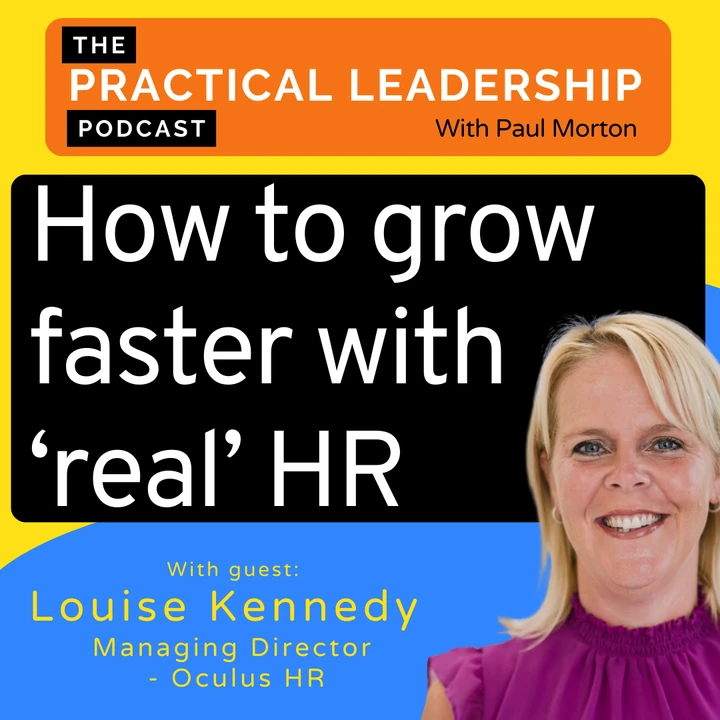
How to grow faster with ’real’ HR
with Louise Kennedy
Show notes
In this episode of the Practical Leadership Podcast, I chat with Louise Kennedy, the dynamic Managing Director of Oculus HR. Louise has built her career around ‘real’ HR, moving beyond the typical transactional functions to create meaningful, growth-oriented HR strategies.
We dive deep into her journey, from her early days in manufacturing to establishing her award-winning HR consultancy. Louise shares how Oculus HR supports businesses of all sizes, focusing on creating robust cultures and sustainable growth.
We explore several key models and methods that Louise and her team use to transform HR from a back-office function to a pivotal component of business success. One of the standout programs discussed is the “Rising Stars” program, designed to identify and nurture high-potential employees, ensuring they are equipped to lead the company forward.
Louise emphasizes the importance of understanding and addressing employee personal challenges, promoting emotional intelligence, and fostering a positive, inclusive culture. Her insights on how to prioritize personal well-being for success are particularly resonant, as she believes that a leader’s health and balance are crucial to their effectiveness.
Join us as we uncover the secrets behind ‘real’ HR and how it can drive your business to new heights.
Key elements from the episode
1. Understanding employee personal challenges
-
- “You don’t know what people have gone through before they come to work. For instance, we had an employee whose wife was diagnosed with ADHD and autism, and it significantly impacted his work life.” (17:22)
- Louise stresses the importance of recognising the personal challenges employees face and creating a supportive environment to help them manage these challenges effectively.
2. Empowering employees’ leadership role
-
- “We implement emotional intelligence assessments and training, focusing on self-confidence, resilience, and optimism to build better leaders.” (11:13)
- Louise talks about how developing emotional intelligence in leaders is crucial for fostering a respectful and effective work environment, which in turn empowers employees to take on leadership roles confidently.
3. Inside a ‘rising star’ program
-
- “Our Rising Stars program identifies high-potential employees and supports their development through emotional intelligence training, mentorship, and project assignments.” (13:50)
- This program is designed to cultivate future leaders by providing structured growth opportunities and aligning their development with the company’s strategic goals.
4. Prioritise personal well-being for success
-
- “Nourish your body and nurture your soul. Over the past 18 months, I’ve incorporated yoga, walking, and other activities into my routine to become the best version of myself.” (22:37)
- Louise underscores the importance of personal well-being, advocating for practices that enhance physical and mental health as foundational to professional success and leadership effectiveness.
This episode is packed with practical advice and real-world examples that illustrate how HR can be a driving force in business growth. Don’t miss out on Louise Kennedy’s invaluable insights into creating a thriving, people-centric organisation.
Transcript
Automated transcript. Speaker labels and spellings may contain errors.
Paul
She lives and breathes HR. Talks about real HR for a change. HR coach, managing director of successful HR management company, Oculus. [upbeat music] Hello, and welcome to The Practical Leadership Podcast. I am your host, Paul Morton, and we are talking about leadership, management, and the various lives that surround it. It's my joy, delight, and privilege to bring into my studio some of the smartest, wisest people I've been able to find for your delectation and enjoyment, and I hope that you do get a lot out of the conversations that we have here. When you realize that your management team has grown too fast or you've inherited a new team, and the fastest, best lever you have for growth and improvement is attached firmly to those managers, get in touch.
I help you run management coaching and training programs that'll make a big difference really quickly. You can find me at the Practical Leadership Academy website and on all the usual social channels. [upbeat music] Louise Kennedy, thank you very much indeed for joining me.
Louise Kennedy
Thank you very much for having me on your show today.
Paul
So that was a ridiculous shorthand of an extensive career. Tell us who you are, seller. Where are you from?
Louise Kennedy
[laughs] From where I am. So, um, I'm Louise Kennedy. So as you said, I own a business called Oculus HR, and we're based in the northeast of England. So, I live in Sunderland area. Um, so we kind of are a HR management company that provides a, a whole array of HR support. So anything from your transactional day-to-day side of things, working with small businesses, um, through to growth businesses, which is a, is a great area for us to work with, and also businesses that have already got HR departments, and we, and we fit in, and we do all sorts of work around that. Um, me, myself, I've been working in HR for 25 or so years, um, somewhere around that area. And we, uh, originally was in manufacturing, the automotive. We've got obviously the big Nissan site in, in the northeast.
I was, uh, working for a tier one supplier to Nissan. So got a real good wealth of experience. And then when we were closing the site down, took the decision 11 years ago now to, to set the business up, and it was one of those make or break, see how it goes, give it an opportunity, um, never know if you'll ever try. So it was one of those moments, and the business has just gone from strength to strength to strength. So we are, I should almost say, multi-award-winning now. So we, uh, we have several awards under our belt of, um, things like Entrepreneur of the Year, um, within the local area last year. Um, Small Business of the Year. We were shortlisted for the five in the UK for p- in the Personality Awards for HR consultancy. So we've had great successes in them. We've got another one tomorrow night, um, where it's for the NESE for Small Business of the Year.
So we've got kind of all sorts going on, but, uh, it- it's because of, you know, we do live and breathe. I do live and breathe the kind of the HR, the model of what we are. But we're very much about growth, and we're very much about, um, on a real strong business journey at the moment around, uh, our growth. Our team has expanded and got another new member on the team, um, could start next week. So, so yeah, we're, we're very much on a, on a great growth projection as well.
Paul
Oh, that's fantastic. Have you got your posh frock looked out?
Louise Kennedy
Well, they're laughing because actually, no, I haven't got that finished yet. [laughs]
Paul
Oh. Oh.
Louise Kennedy
Just keep getting things delivered. [laughs] Keep getting things delivered. But choosing another clo- another dress coming today. [laughs]
Paul
Excellent. It's a lot easier for boys. I tell you, it's a lot easier for Scotsmen as well. I just put my kilt on-
Louise Kennedy
[laughs]
Paul
... and it's done, done.
Louise Kennedy
Fancy.
Paul
Oh, that's fancy. Yes, it's not the same thing I've worn for the last 30 years. What I did get-
Louise Kennedy
Or that realism to get the same things out.
Paul
So, same thing.
Louise Kennedy
Yeah.
Paul
Same, same. I got my kilt when I was 18. I did have to have it taken out, though, when I got married. And it was like sausage in there.
Louise Kennedy
[laughs]
Paul
The bone structure's different. I was big-boned. That's my, that's my excuse.
Louise Kennedy
That's what it, that's what it'll be. Just the change of it all, isn't it?
Paul
That's it. That's it. So, um, I mean, I've worked and sold in and around HR, learning and development for many, many years. So I have great respect for really good HR. Great respect for teams who make a difference, and absolutely no damned time for the fluffy stuff that just gets in your way, right?
Louise Kennedy
Yeah.
Paul
When you talk about real HR with a capital R, and you breathe HR, that's great. Now, it's a, it can be a rarefied air, but it can also be toxic in my experience, in that it gets up its own backside, and it gets-
Louise Kennedy
Yeah
Paul
... in the way of stuff. Tell me that's not va- And I know that's not you, otherwise we wouldn't be talking.
Louise Kennedy
No. I, I think it's very much about the, the approach that you have with it. So, um, as I say, we have all sorts of different size businesses. So when you've got, um, the first, somebody taking their first employee on, we like to work with them to be able to kind of really just say, "Let's get some basics in place. You know, you know you need to do the right thing, and let's just get a contract of employment in, so everybody knows where they stand." And I think, um, as we were talking about before, uh, kind of the standards and expectations, that's what's, that's what's important to a business 'cause it underpins the culture. So, um, I've just started work with a, with a larger business at the moment, which is very well established within the area, and their, their culture is not right. It's being toxic. Um, nobody believes in HR at all.
So I've kind of got this whole big mission that actually, yes, we need to do all the transactional side of things, which is, for me, that's kind of, you know, putting in place policies, procedures, and contracts. But actually they're desperate for that. The managers want to be able to manage the people, and they want to be able to do it consistently across the board. Um, but in the same time that we're doing that, we're really then looking at the culture and actually what makes a little difference, you know? So something simple in that particular business the other day, someone had had an operation. Let's just send them a little afternoon tea, you know, through the post. Let's just make them feel kind of, you know, make them feel kind of wanted and being part of the business. And, and that's, so we did a couple of those last week. It's never been done for two or three years. The impact that that's made so far, everyone's talked about it, and we've spent £40.
You know, so we've spent very little amount of money to make an impact and actually talk about, you know, things like, uh, someone intends to apply for the job. They might not be the right person for the job, but let's interview them. Let's encourage them to be part of the business, and actually that they want to develop, and then they want to grow. So for me, it, it all integrates in together. And yes, there is some, some fluffy stuff that's there. But actually underpinning your culture into your organization really then grows everything else from it because- You know, removing away the toxic part of it, you know, taking that out or taking the negative impact that people have because all it takes is for one or two people to kind of, you know,
start sending the wrong message. But it's about how a business deals with that and how they manage the situations properly, and that's where we kind of come in. So yes, we'll come in and we'll do disciplinaries and grievances and attendance management issues. But actually, if we can un- underpin it by doing things like a re- a rising stars program or, you know, working with the leadership team around what their emotional intelligence is within the business and how it impacts upon the business, it kind of all comes together as being kind of a big cultural piece, which I think is really important for a business.
Paul
So you've got this ... I see this, this is where I was interested in talking to you, and I'm glad we're now doing this. There's an intersection here between what I think most organizations see as the transaction, and I call it the pay and the ration.
Louise Kennedy
Yeah.
Paul
It's transactional stuff that has to be in place. And at the other end of this, so you've got l- level one, which is make sure people get paid, and they're not fired inappropriately. When you have to hire, you're doing it right. When you have to fire, you're doing it right. There's ways of doing ... Some of it's quite complex, some of it's legalistic, some of it's experiential, but there's a way of doing it. And having your experience come in and do that. At the other end of the scale, as you started to talk about there, you alluded to, there's this toxicity of, you have people be toxic. It's not an organization that's toxic, it's people.
Louise Kennedy
Yeah.
Paul
Who are the same way as you don't develop an organization. You don't transform an organization. You develop and you transform people. You want some, some group of an institution or an organization to do something different, you get the people to do something different, right?
Louise Kennedy
Yeah.
Paul
And that, that, that is the essence of it. We work in companies, you know, so we work in the company of other people. The original, um, the original definition of company is compan, it's with bread. It's people that I break bread with, you know? It's this lovely idea of I eat with you.
Louise Kennedy
Yeah.
Paul
So that's who I be in company with. And so the other end of the scale, you've got the, you're dealing with the human nature. So you've got the transactional, you've got the legalistic, and you've got the human nature. You've got the cultural, as you said, and culture eats up. When I find organizations struggling with their culture, I think they tend to lean on the transactional-
Louise Kennedy
Yeah
Paul
... rather than recognizing that it's actually more, probably more simple, but also more deep-rooted than that. What's, what's your experience in, in, in, in this scale?
Louise Kennedy
Yeah. A- a- and I would, I would agree. I think there's, I think there, there's a lot of people understand ... Uh, if you probably start from the point that some of these smaller business that, that we deal with, they don't know what to say, they don't know how to say it, they don't know what interactions to have. They know they have to sit off the desks from people day in, day out, so they want to make the interactions as positive as possible to try and keep the good culture on it. Um, and I think that's where the structure enables them to be able to do that, that actually they've got a reference point to be able to say, "Well, actually, you're supposed to turn up for work on time, you know, and yous have to do that every day, you know.
Or, um, we don't want you playing with your mobile phone during the course of the day, you know. Like, we want you to be able to kind of focus on the work out of it." Some of those basic things aren't particularly wrote down anywhere, but actually some of these smaller businesses need that help and structure to be able to help them be able to manage people in situations. So kind of from a, from very much of a starting point of that, as businesses grow bigger, at that company I was talking about the other day, the, the managers had all come to me independently and said, "Nobody's managing anybody across the business consistently." You know, so they're doing something in their department, they're doing something in their department, they're doing something completely different.
And actually people like to be treated the same because what I always say is that everybody watches how everybody else is being treated and the interactions that I have. So, um, you know, the manager is the person that's there, so, you know, how it's said, uh, how interactions take place, how things are said, how positive that they are or how negative that they are, or how quickly they've lost their temper in a situation. All those things are being watched continuously. So it's for a business to ensure that actually having that structural element of it is underpinned, but it doesn't have to be wrapped up so tight that actually the business can't move and the employee can't move. I think it's the important bit. You know, we'll say to businesses, take on what you need and what you can manage. Don't go in there and have a 150-page handbook, because actually nobody knows what's in there from an employer and employee point of view. Go in there and have something that's tangible, something that makes it work, something that people pick it up and actually they know what the business is about, who the customers are, what the interactions they're gonna have, what the ways
of working are, um, you know, uh, who is is that are gonna be their stakeholders. Then move on to kind of what we expect from you and what's your standard, and then move on and have a little bit of an overview about what your policies are. Don't overload people, because actually if someone picks something up that's 20 pages long, they're more likely to read it than picking something up that's 150 pages long. And if you can start threading your culture through your business in documentation like that, being part of your appraisal process, your job description, it all, it all becomes part of the, the higher value within your business.
Paul
Yeah. So you're starting simple. You're staging the development of understanding, I think, of the, of the consumer in this case, so it's the employee in the company, and helping them to feel secure, safe in their expectations and in their employment. And how then do you, in your role as a HR coach, HR specialist, breeder of HR, how then do you help companies translate that to growth? 'Cause if I'm a business person-
Louise Kennedy
Well-
Paul
... I wanna make more money, as much.
Louise Kennedy
Yeah. And it comes down to the bottom line of what it is that we do, you know, so, uh, try- for what, what business that you need it to be. I think one of the things that we think is really important is born in at your, your senior level, because you want everyone to be on board, don't you? You want everybody from your senior level all the way through to kind of, you know, the, the lower level people in your business. The whole business needs to be on board with it. And I think for a growth to take place, that really needs to happen. So we like working with growth businesses because we can go in and we can make an impact, and we can help them with the structure as a fundamental, and then we start working with them as kind of, you know, from a leadership type,
point of view, and then working with their managers as well. So one of the things that, um, we deliver on is, uh, emotional intelligence, um, assessments and training. So an emotional intelligence assessment, um, and this works really well with a, a senior leadership group, and, uh, the company that I do the assessments with, uh, delivered it throughout, throughout the world. So the kind of a really great tool to be able to do it, but starts looking at actually the individual. They're doing an online assessment, but it looks at self-confidence, self-known, um, self-resilience, um, optimism, the, the relationships that you build with others. So there's kind of 10 key components, and you're on a sliding scale of kind of, are you already there? Are you... have you got that? Have you got that sorted, and is it a tick in that you're doing that and you're actioning it every day? Are you at the bottom scale of it? Now, what they say with emotional intelligence is that it can continue to develop un- up until you're about 50.
So where your IQ pretty much by the time you get to 25 you're done, but by the time you're 50, you've got the opportunity to continue to develop your emotional intelligence. So actually, business leaders are, as they're bringing people into a business, are looking at people who've really got that skill set now as opposed to the, the skill set of kind of the technicality of being able to do the job because the technicality, technicality can be learned, but actually to build that emotional intelligence skill set in there. So if you've got people that are drivers who've got a real good understanding of emotional intelligence, that's where it can be fed through the business because you're treating people right, you're building the relationships right.
You, you know, internally within the business, you're having the correct interactions with people. You're respecting other people. People in turn respect you because you've earned the respect from it. So it, it kind of starts feeding into however you want it from a business perspective to be. So I think, I think the emotional intelligence is kind of a, a key fundamental of it. But then also coming up with kind of actually what is your people strategy? If you're going into a business that's growing, actually what do you want it to look like now, three years, five years, 10 years? Let's make a plan to what that would be. And actually, you want your, your people are your most valuable asset to help that growth to happen. So actually, what are you gonna do to ensure that your retention rate's low and that the recruitment that you bring in are the right people, that when you onboard, onboard people, that they are the right people for the business?
There's so many aspects of it that can help, but I think understanding the business and understanding the leadership team is a good core part of it to then to be able to feed the other, the other elements of it in.
Paul
You talked about these different programs you help people build. Um, for example, your Rising Star or something like... So let's say I'm an established business, a couple hundred folk, and there's some people that I dearly want to retain. Now, my approach would be to find out what those high potentials want, uh, try and give it to them, and then gradually roll that out to the rest of the business. Because typically, if you've got somebody who's really good at something, you want to A, retain them, and then share whatever it is you're doing with them with the rest of the business. What does a-
Louise Kennedy
Yeah
Paul
... something like a Rising Star program look like?
Louise Kennedy
So, um, we've just, we've just put our, our latest one together in one of the, the businesses that we've just had agreed. And, and so that's gonna be kind of over a six-month period. Um, we're going to do, uh, an advertisement in the business to say we're doing this Rising Star program. If you're interested and it's something that you want to commit to over the next six months, please do apply for it. You know, kind of show your interest in it. So there will be kind of a, an official process to go through where there'll be a short interview in the leaders of terms, but kind of a short conversation with somebody senior within the business. Talk about what their aspirations are and how it will benefit them. Then we'll make a selection of who the people are that's gonna go onto it. Um, and then, um, this particular one's gonna have eight people that'll go on their first program of it.
And we will start it off with the emotional intelligence, um, and we'll do some coaching as a, as a first port of call. Then we'll do kind of a day introducing it, and then we'll set up what it is from a business point of view that they need. So it might be about more information about the business, how all of the different sections interact with it. Um, it might be around kind of, you know, a structure within the business. It could be around culture. But what we're also gonna feed into that is making sure that they've all got a mentor, that they'll have a couple of coaching sessions during the course of that six-month period, kind of, you know, emotion tellence, intelligence at the beginning, one in the middle, and then one at the end.
But they'll also have a project, actually. So we'll look at some objectives within the business to be able to say, "Actually, if we get this team of people to be able to do something, let's get something that comes back to the bottom line to actually show that, yes, you are making an investment, that p- these people have developed. But actually, we've had this project outstanding, so let's get them to do the project, and let's get the integration of it, and let's get them talking to the senior managers." So it starts bringing everybody together within it. But actually, you know, the succession planning in the business is a really important aspect that not enough people or not enough businesses always look at.
They always just think, "Well, we'd have to go external." So there's, there's kind of some real benefit out of it and, and we're very aware that obviously it needs to, it need, needs to make an impact upon the bottom line within a business as well from a financial point of view.
Paul
Hmm. So you've delivered these different programs to different organizations. Now, obviously, you've been building this from best practices. You've been building this from your experience. Um, in your experience, if you were talking to the leader of a small-medium company, what would be your number one piece of relevant?
Louise Kennedy
Uh, I think it depends upon the place that they're at, because they're all so different. If it was the case that I was in there kind of talking about business and business development side of things, probably the advice would be different to what it is from a, um, from a, a point of view of how the development of people and what it is that they're doing. And, and that size and scale of what the size business actually would be. 'Cause some businesses that have, maybe, sort of, 40 employees or less just really want to make sure that they've got the core fundamentals right, and they just want to steady the ship, make sure everything's okay as they're ready for growth. Other people, you know, and we would encourage people really to be saying, actually you need to look at that longer term plan that actually, do you need some kind of what we class as like a, um, a fractional HRD role? Do you need someone to come in and help you discuss what your people strategy is?
If you're gonna go from, especially in tech, the likes of the tech sector, go from 40 to 100 in the next two years, what are you gonna do to make sure that you get there and actually your people are gonna help you do it? So look at your recruitment, look at your retention, look at your benefits, look at how it is that you're gonna attract the right people and be that employer of choice. So it's kind of, I suppose, advice-wise, a bit difficult because they're all so different in the business-wise-
Paul
Mm
Louise Kennedy
... uh, in what it would be. But it is really kind of, you know, make your people the focus of what you want to achieve because they're not just a, you know, they're not just another entity. They are crucial in being able to make the development and grow your business to be able to take it forward.
Paul
So then what's the one thing that you're quite surprised that people don't know if you're talking about?
Louise Kennedy
With re- with regard to kind of HR side of things? [laughs]
Paul
Mm-hmm.
Louise Kennedy
I think it's still that some of the added, well, that the added value can make a difference in the business. You know, I think, I think people just think they just need to get by, people need to come into work, and they just need to do a job. And actually, I think people miss the point that people are people, and, you know, when people turn up for work one particular day, um, you don't know what they've done before they've got to work. You don't know ... There was one particular situation recently where the, the guy's wife was having a mental breakdown, one son had been diagnosed with ADHD, another one had been diagnosed with autism, and the guy was really, really struggling. And he came into work that particular day and didn't present well, you know, kind of had, had an argument with somebody else.
And, and you know, I think there's so many people just think, "Oh, well, what they not just turn up to work and crack on for?" But actually, you know, people have got all that baggage. You don't know what somebody's gone before they've turned up on that day. So I think it is treat people with the respect that they deserve, um, and speak to people. You know, keep that communication open, you know, making sure that you're talking all the time, but that, that you're having open conversations so there's a place that people can go and speak to, and the facilities are there to be able to support people as and when they need it.
Paul
So what's the difference between real HR and good management?
Louise Kennedy
I think it's, it's about kind of what becomes tangible. I think, um, I think good management is really strong. I think, I think to be able to make sure that you've got the right advice of how it is that you're gonna manage situations. And I think, as I said earlier on, that people don't always know what to say and how to say it and how to frame it. Um, and I think you can, you can go into and, you know, there's loads of things on YouTube and places like that, where you can go into a situation and they can be very negative, and somebody will just say something as it, as it comes into their mind. But actually it's kind of actually how can you make sure that that's done right, you know, that it's, that you are treating the people with the respect.
I think our business is very much about making sure that our people are kind of morally treated right, um, from a point of view of an employer and an employee point of view of the employees and treating the employer right as well. We're all over that. You know, so it's kind of, it's about making sure that, that, that equal side of things. So for us, it's very much about the morals. Um, it's very much about consistency. And for us, we always tell people about the, what the risk is of a situation. So from a transactional point of view, I can say, "Well, you can do this, but actually this is, this is really high risk to do this, and this might be the consequence of that. But actually these are your lower risk options." So when we talk about real HR, it's because it's, it's something that's tangible that people can understand and make an informed decision within a business as well.
Paul
I mean, there are three things that anybody in a business wants to do. One is increase your top line, make more money. Two is increase your bottom line by reducing your costs. And three is managing risk, right?
Louise Kennedy
Yeah.
Paul
So the challenge I've always had is that most HR interactions I, I see in decent sized organizations are all about the managing risk to ne- to the neglect of, uh, reducing cost. And typically, most HR interactions cost and, uh, not with, with no understanding to increasing revenue.
Louise Kennedy
Yeah.
Paul
So it's basically you've got a three-legged stool, and a lot of HR professionals think it's a one-legged stool, which is we can't have any risk 'cause you're not-
Louise Kennedy
Yeah
Paul
... it's not a balance. If you can have no risk, you have no growth. If you have no risk, you have no reward. If you have no risk, you have no business, and nobody has a job, so no ... There's no point in having HR. And HR-
Louise Kennedy
Yeah
Paul
... human resources is the wrong way around. You know, the French call it ressources humaines, which is actually just their way of putting it. But I like the R first. They're resources-
Louise Kennedy
Yeah
Paul
... that are human. And I loved when you said that. They're human people.
Louise Kennedy
Yeah. And they've got the different element. And I think for us, the ri- and I think the risk element for, for our business is really important. So I've worked, uh, automotive, you know, so it was all about, it was all about the money, it was all about the scrap, it was all about-
Paul
Mm
Louise Kennedy
... you know, kind of what our turnover was. So it was very much around the finances. And then I think having your own business, you then, you want to understand the risk in any of your situations, you know, 'cause obviously growing the business yourself and, you know, I came into, I came into this business as being I'm really good at HR. But actually, now I'm really good at being a business owner, and they're things that I've learned along the way. But I think understanding your risks in each of those stages that you, that you come across, I think, is really important. So I think if we can ... We advise a business to be able to say, actually, if this is the situation ... So another situation that we've got at the moment is, um, someone who's been in the business for 13 months, she's left. She wants to, she wants to make a claim against the business. She wants £68,000 from them. Um, she's prepared to, she's prepared to settle for 35,000, though.
So, uh, but for that business, we've kind of like protected the employer there, you know, because actually who are our clients to say, "Look, don't raise that grievance 'cause it's only gonna upset you," you know? Like, it's gonna put you in turmoil of it. Let us deal with it. Let's take this away. Right, this is what's actually wanted, but this is not our advice at the moment, you know. This is what I would do. Let's take this step. And actually, they can then lean on us because, because we're so experienced in what it is, and actually we can provide them some comfort of making sure that a process is, is done fairly, it's done in the right way, it's consistent. But actually they feel supported as a, you know, it's a couple who own the business. You know, they feel supported as a couple from what we can do to help. And we're supporting the employee at the same time. We've done the grievance. We investigated it, you know. We've listened to their side of the story.
But it, it's so ... Sometimes it's that balance left across, across both elements of it.
Paul
So you've got some good messages you want to share with some of the businesses you're working with. If there was one core thing that you had the opportunity to share as widely as you possibly could, there's 10,000 billboard that you could plaster with one message, what would it be?
Louise Kennedy
I've thinking about this. Um, I think it's gotta be around your own personal wellbeing. So I think it's gotta be whether you're a business leader, whether you're, you know, a busy parent, whether you're a senior leader in a business, whatever it is, it's gotta be around looking after yourself because the better you can be in your own personal circumstances, the better that you can be in every other aspect of your life. So, um, uh, kind of I was thinking about it kind of as towards that nourish your body and y- nurture your soul. So from the point of view of, um, the o- my journey over the last kind of 12, 18 months has been, um, kind of doing things for me, uh, understanding me more, um, doing a lot of work around the emotional intelligence, um, doing the support
with regard to, um, things like fasting, um, kind of losing weight, uh, doing yoga, doing walking. So there's some things that are now b- inbuilt into my life which are kind of, um, are consistent, and they're kind of a must-do and kind of a, a, a non-negotiable for me that actually enables me to be of a better ... You know, I've, I've got a coach now- Moved on to the second coach, but I've got a coach now who I've just been on a call with before speaking with you. All those things are kind of underpinning me to be the better version of me and aiming to be the best version of me. But by being able to do that, I can be better at home, at work, kind of, you know, supporting my team. Um, in speaking to people around, you know, the, the impact, a, a very small, uh, sto- well, not a small story for her, but I'd been talking about this at the end of last year, and a friend of mine had been unwell, and she'd said, "I'm gonna, I'm go- you know, you keep harping on.
I'm gonna go to the doctor's and go and get checked out." Anyway, it turned out she had some stomach issues, but she turned out she had leukemia. So she said kind of, 'If you hadn't have been, if you hadn't have been going on about kind of making sure that you look after yourself and going to the doctor's to be able to kind of follow up,' potentially that leukemia wouldn't have been picked up 'cause she didn't have any of the symptoms, wouldn't have been picked up till a later point. So it's things like that that actually when you're talking about it, and, uh, at a talk the other day, there was a, a lady messaged me afterwards and said, "What you said was so right. I just need to be in that situation where, um, I'm, I'm more comfortable. I'm a mom, I'm busy, I'm, I'm working, I've got a senior job, but actually I'm now gonna go off and find a coach and I'm gonna be able to get someone to, to help me process everything." Those little things make a difference
and actually, you know, if out then 10,000 billboards, if a couple of people read it and took some notice, then I think that would make a difference, would make more of a difference in life.
Paul
Nourish your body and nurture your soul. I do like. I think as leaders in an organization, our job is in part at least to make, to help people be the best version of themselves that they can.
Louise Kennedy
Yeah.
Paul
So-
Louise Kennedy
And it is, and it's providing sometimes internal in a business you can, you can provide those resources to enable it, and they can be simple things like making sure people go out for a walk at lunchtime or something, or kind of, you know, that there's, that there's just activities that are put on for people. There's different engagement things that don't cost a lot, but actually encourage people to, to look after themselves.
Paul
Where can people find you when they need you, Louise?
Louise Kennedy
So, wow, we're everywhere. Um, so we've got our website, oculushr.co.uk. So, uh, we've got that, which is, is really good. Kind of search us up on Google. We kind of come up, especially with all of our award entries and wins and things, so we come up on there. Um, but also on LinkedIn, so we've got Oculus HR on LinkedIn, and also myself, so, uh, Louise Kennedy, um, uh, F-C-I, F-C-C-I-P-D, um, so a fellow of, of, uh, Chartered Institute of Personnel Development. So that's on there. But we're also on Facebook, Twitter, Instagram. Kind of we cover all the boards with these things. [laughs] So we're continuous. But, but we have got, we have got a newsletter, um, which obviously people can sign up to on the website, so we get that out every month as well.
Um, and that's just kind of general updates of things that are taking place, you know, changes to employment law and kind of things that are happening. And then we've got our Real World HR podcast as well. So we do a little bit of everything.
Paul
Well, we'll put some links into the description, um, below this episode. I'm sure you can find that here. And all that remains for me to say is let's all go out, nurture our bodies, nurture our... Louise Kennedy, MD of Oculus. Thank you very much.
Louise Kennedy
Thank you very much. Thanks for having me today. [upbeat music]
Paul
And that's a wrap. I hope you enjoyed the show. Thank you for joining me. If there's ever anything I can do to help you on your journey, then do please reach out. You can find me on LinkedIn and all the usual sources. Do please subscribe, leave me your five-star review, and most importantly, get in touch with your comments and feedback. It's really how I grow, and that's what I'm doing this for. Thanks again. [upbeat music]