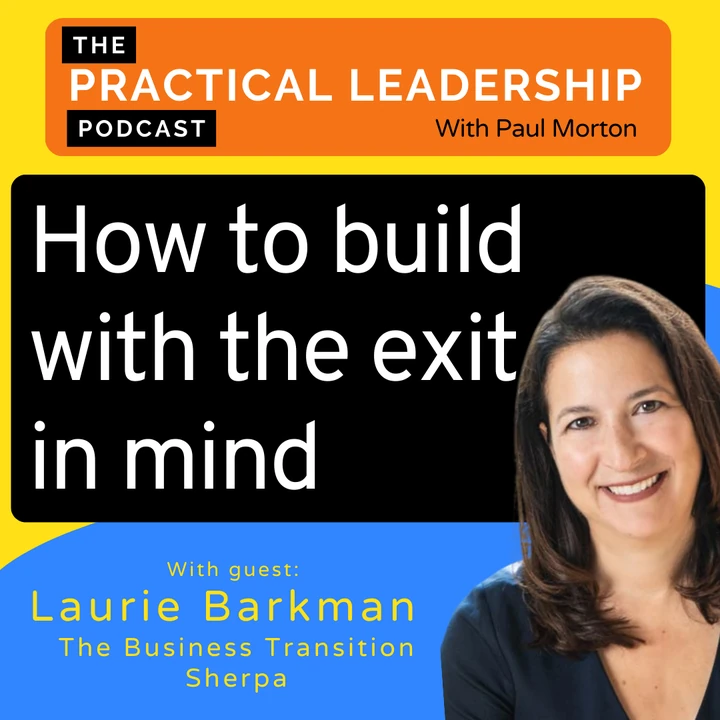
How to build with the exit in mind
with Laurie Barkman
Show notes
Today, we dive into the essential topic of building a business with the end in mind.
My guest is Laurie Barkman, author of the Business Transition Handbook and a seasoned Business Transition Sherpa. Laurie shares invaluable insights and strategies on preparing for a successful business exit.
Whether you’re a new entrepreneur or a seasoned business owner, this episode is packed with practical advice to help you plan your business journey from start to finish.
Laurie begins by explaining the concept of a Business Transition Sherpa. Think of a Sherpa guiding climbers up Mount Everest. Laurie provides similar guidance, but for business owners navigating the complex terrain of succession planning and business transitions.
She emphasises that the process should start early, ideally years before the actual exit, to ensure a seamless and profitable transition.
One of the key frameworks Laurie discusses is the “three-legged stool” of business readiness. This includes personal readiness, business readiness, and financial readiness.
She highlights the importance of evaluating these areas regularly to identify any gaps or risks that could impact the business’s value or the owner’s ability to exit successfully.
Laurie also talks about the significance of understanding what makes a business saleable.
It’s not just about having a profitable company but also about having transferable value that buyers find attractive.
This includes having solid operational systems, a reliable customer base, and minimizing risks that could deter potential buyers.
Another critical point Laurie makes is about the emotional aspect of selling a business.
For many owners, their business is like a child, making the decision to sell highly emotional.
Laurie addresses the need to balance logic and emotion in business decisions, ensuring that the head, heart, and wallet are all considered.
Key Elements Discussed
-
- Balancing logic and emotion in business
- Laurie mentions, “There’s an emotional component to this as well, right? That’s the heart and it’s hard. You know, they’ve built the business or they’ve inherited the business.” (14:51)
- She emphasises that while the financial and strategic aspects of selling are crucial, addressing the emotional side is equally important to avoid future regrets.
- Think like a buyer
- “If we understand and can think like a buyer and look at our business from the outside in like a buyer, you’ll be better off.” (8:20)
- Laurie advises business owners to view their business through the lens of a potential buyer to identify and mitigate risks that could lower the business’s value.
- Understanding what makes a business saleable
- Laurie explains, “What problem does your company solve for another company? Buyers decide the price and the private market.” (7:31)
- She stresses the importance of creating a business that is not only profitable but also has transferable value and solves significant problems for its potential buyers.
- What is a business transition sherpa?
- Laurie describes her role: “It is someone who cares so much about the experience of business owners on their journey… I’m guiding my business owner clients and people all over the world how to maximize that experience so they can have an exit without regret.” (00:18)
- As a Business Transition Sherpa, Laurie helps business owners navigate the complexities of succession planning, ensuring they are well-prepared for a successful exit.
Tune in to hear Laurie Barkman’s expert advice on building with the exit in mind, ensuring that your business journey is well-planned and profitable.
You can find Laurie and her resources at https://thebusinesstransitionsherpa.com/.
Transcript
Automated transcript. Speaker labels and spellings may contain errors.
Paul
She builds with the exit in mind, author of The Business Transition Handbook and a business transition Sherpa. [upbeat music] Hello, and welcome to the Practical Leadership podcast. I am your host, Paul Morton, and we are talking about leadership, management, and the various lives that surround it. It's my joy, delight, and privilege to bring into my studio some of the smartest, wisest people I've been able to find for your delectation and enjoyment, and I hope that you do get a lot out of the conversations that we have here. When you realize that your management team has grown too fast or you've inherited a new team and the fastest, best lever you have for growth and improvement is attached firmly to those managers, get in touch.
I help you run management, coaching, and training programs that'll make a big difference really quickly. You can find me at the Practical Leadership Academy website and on all the usual social channels. [upbeat music] Lori Barkman, thank you very much indeed for joining me.
Laurie Barkman
Oh, it's my pleasure. Thank you so much for having me.
Paul
Now, that was a very short, short, changing, far too lightweight introduction. Would you do a better job for my listeners?
Laurie Barkman
Oh, it would be my pleasure. Uh, so again, thank you so much for having me on the show. My name's Lori Barkman, and you're probably wondering, what the heck is a business transition Sherpa? It is someone who cares so much about the experience of business owners on their journey, especially what I'll call the back nine, for a golf reference. When we start out our companies, we are so enamored with the startup and getting it going, and we perhaps lose sight of what's next because it seems so far away. And then eventually what's happened, we've kicked the can for so far and so long that we find we can't do exit planning when we're exiting. It's just too late. So my mission is working with business owners to create life-changing succession stories. And how I got there, we can certainly talk about it, but that's a little bit of, uh, an explanation of, of why I say I'm the business transition Sherpa.
Because it's a movement, right? Transition is a word that inherently has a movement to it. It's from here to there, right? It's this process, and we're on a journey. I don't have all the answers. I have frameworks, and I have tools, and I'm guiding my business owner clients and people all over the world how to maximize that experience so they can have an exit without regret.
Paul
Exit without regret. Hmm, yeah. I think, uh, having spoken to quite a few people over the last, uh, oh, I don't know, 18 to 24 months, there's a lot of people who are either on the verge of just saying, "No, we're done. We need more funding, and we can't scale without it," or, "I don't want to sell because I'm not gonna get value, so therefore I keep plugging on," in some cases. Or they're even... They're, they're, they're 40-something, and they've been at it for 15 years, and their husband or their wife is saying, "Honey, we're good, right? You're just gonna give this thing up, and you can go, go, go back and work for Goldman or something because..." Now, when you're thinking, you're talking about building with the exit in mind, that reminds me very much of the seven habits, right?
So let's start with the end in mind. Some of the most interesting companies I've seen, the founder has started with that end in mind. And so, I think you get a lot of advice not to do that. You look at Saster, you look at Jason Limp, and you look at all these guys, and they say, "No, no, no, no, just build a good business. Just fine." But yeah, you know. So what do you do when you go and you talk to someone, you evaluate where they are?
Laurie Barkman
Well, the first thing is to really understand what some of their goals are and what some of their challenges are. I do assessments to take a look at three different aspects of business readiness and personal readiness. So one is a personal readiness assessment, which is a great way to get to know a prospective client and also work through some tougher questions. These are questions that they may have no answers to. They're not sure what the questions really mean, the implications of these questions. And it dovetails nicely with the second assessment, which is a business readiness. And the great part about taking these two together is they start to dovetail, especially when we start to think ahead on an exit. You know, a question like, um, how far away are you from potential exit? Eh, 10 years, five years.
You know, uh, most common answer these days is five to seven, and, uh, in the United States, and there's a dynamic around that, particularly regarding age as well as life stage. Um, the other part of this is financial. So those are the three legs of the stool. So personal readiness, business readiness. And the other thing related to, um, uh, getting started, you know, how do we figure out where we are, what ocean are we swimming in, is to get a business estimate of value. And that's one of the things I also offer, which is a really helpful tool. It gives us a baseline of, in your peer group, you know, your industry sector, uh, what is the size of your business? What are these other factors that are intangible that we can quantify and get a measurement on an estimate of value.
And an estimate of value in this particular report is a great starting point. I myself, as a mergers and acquisitions advisor, have access to databases and, and, um, comparables, so we can get access to lots of data and do a deeper dive. So that could also be something that we do. But at a minimum, we're taking a look at, well, what do we think we need in terms of financial exit, right, for us to live and live in a lifestyle that is meaningful to us? So maybe we're gonna... It, it has to do with your age, again, your life stage, right? If you're planning on exiting when you're 60 and you think you might live to 100, you've got 40 years in between to make sure you've, you know, planned, planned ahead.
So all of these things, if you have a, a financial advisor who's helping you with that calculation, that's fantastic. If not, I have some tools that we use to Back into a number, and it's the net number that counts. If you sell your business for $10 million and your walkaway number is less than $10 million, we have to acknowledge that there's taxes and, and other transaction expenses. So it's the net number, it's the maximum number. We're trying to maximize the number, but it's the net number ultimately, which is why one of my big messages in today's interview and other conversations that I have all the time is that when you have time on your side, you can create more, create more options and, and hopefully mo- those are more valuable options for you.
And one of those things is tax mitigation planning. So in the US, I know there's different tax laws than in the UK, but the same concept applies, is what can we do to help maximize that mi- that net number? And again, just to reiterate, this three legs of the stool have to all be there or else this whole plan falls down. Personal, business, and-
Paul
Boom. So you work out, is the business ready? Is the individual ready? Financials add up. Can you get a reasonable price? And do they all support each other at that point in time?
Laurie Barkman
Yeah.
Paul
So you're looking at a, an estimate of value, so it's gonna be a multiple earning profitability, it's gonna be a multiple of something, it's gonna be what somebody's willing to pay for it ultimately, right? Um, in a given market at a given point in time. And at this point in time, I think most people are finding that, oh, it's not quite what I'd hoped. I'm not gonna get 10 times on my recurring revenue after all. Darn, I'm gonna have to make a profit, if you're talking to somebody early stages. When you are then building with the exit in mind, let's say we are talking to an organization that is mature, five plus years old. You've got a well-established leadership team. They're making a bit of cash, a little bit of profit. You're gonna come in and you're gonna tell them, "Okay, ladies and gentlemen, here's the first three things we need to do." How do we start thinking about that?
Laurie Barkman
So many areas of energy and focus goes into product market fit, service market fit. We can get our head around that, right? We can understand hopefully what that means for the company. It means that we find buyers who have pain points that we are solving. We're, we're, to quote Theodore Levitt, which is a, who was a Harvard professor, and he talked about the quarter-inch drill bit versus the quarter-inch hole. What is it that customers actually want? Well, they have a problem. They, they need that quarter-inch hole, but they're buying the quarter-inch drill bit, and we're selling the, and we're selling the features of the quarter-inch drill bit, right? Or, or three s- three centimeters or whatever the measurement is. And that concept applies here as well, except I'll say it's in a different context, which is it's for your company, not a product or service, but it's the same idea.
What problem does your company solve for another company? And you said it earlier, right? Buyers decide the price in the private market. Absolutely. They also decide whether or not they're gonna replicate what you do, and they're gonna determine if they should invest the money and time to replicate what you do or to buy you. Do you solve enough of a pain point for them? Can they acquire you? Then there's a difference between price and value, to quote Warren Buffett, right? Price is what you pay, value is what you get. Is that what they need to do? And by the way, this is the conversation when, between buyers and sellers when the seller's not in the room. This is what they're talking about, so everybody should understand that. And I think if we understand and can think like a buyer and look at our business from the outside in like a buyer, you'll be better off.
Why is that? You'll see risks that are there that you probably never paid attention to. What's a risk? A risk means discount to your multiple, right? There is an inverse relationship between multiples and risk. If we can see those things and have enough time to work on them and mitigate them or acknowledge them and say, "They are what they are," that's fine. I, my neighbor's house next door sold as is because they lived there for 45 years. They didn't do as much upkeep towards the end of their life. They live in their eight, you know, late 80s, and that's understandable, right? So the buyer kind of knows, "Hey, we're getting a business, we're getting it at a discount, and that's okay." And that might be a situation also. Either we're gonna work hard to eliminate some of the challenges to price, potential challenges to price, or we're not.
Question is, is are you aware of what they are? Or are you gonna be surprised, right? Are you gonna get to the, you're gonna get to the negotiation table and then learn your contracts are not transferable, your lease isn't transferable, and so on and so on. The things that you thought weren't gonna be a problem are a problem, and now all of a sudden, your, uh, closing date, instead of being next week, is now in three months or not at all, right? So these things happen all the time.
Paul
Yeah, and your values, because you want me to innovate on what exactly? And you have staff and where? Yeah. No. And it does, it, I've seen way, I'm sure you're, you're exactly the same, same situation. Of the transactions that I've been involved in, I've seen, oh, I couldn't even begin to think of the ratio, but it's vastly more fail at the last hurdle than succeed. Vastly. And it's, it is just the nature of the beast. It's the nature of complex moving parts. How then can you, as superior being, avoid this last hurdle failure? You're starting with the end in mind. You want to make sure that you're maximizing value, you're maximizing the, the price for both aspects, that the buyer's getting the maximum possible value, and the seller's getting the maximum possible price, and it's as pleasant a transaction as possible.
Now I'm sure there's lots of stories there as well, but it's a process.
Laurie Barkman
Yeah, you know, it's, it's, it's a difficult road. It's not an easy one, and there's lots of, um, there's lots of forks in the road, and we have to choose, uh, which one to take. And I think that there's a good internal lens, right, and then there's an external lens. And on the internal lens, that's what I've been advocating for, is let's take a hard look at our, at our business from a financial perspective, from a market, market risk or customer risk or employee risk perspective. I call these the risk tripwires. In my book, I dedicated a whole chapter to it. Uh, what are the risk tripwires in your business that you are not seeing and that could be a surprise to you later? And so that's the internal view.
And the external view is how a, how a buyer's gonna look at your business from the outside, from its attractiveness standpoint, transferability, and, and risk. Every transaction is risky, right? The numbers, uh, of a success rate on, on integration and on acquisitions is fairly low. I think it's two out of 10 are kind of in the, in the column of a win, and it doesn't have to be that way. And I think for the buyer, it's as much as their responsibility as the seller. Um, therein lies this opportunity from this w- you know, uh, another one of my favorite chapters is who should own your business after you. And it's a strategic view of three different kinds of buyers at a high level. And of course, I break it down and talk about the different types. Um, many times sellers think about only one.
They don't realize there's more than one type, and they also don't recognize that different buyers have different motivations. And if we can tie in what pain points we're solving, what value we bring to the table for these different types of buyers, we also could look at our business in a different way. For example, let's say that we, we believe there's an opportunity to sell our business to a private equity firm who is rolling up companies in our ... But we also, in learning about that, are learning what criteria they have for their target, their targets. And let's just in this scenario say that one of those criteria might be having recurring revenue. Um, heuristically or, um, kind of commonly, it's 40% or more of your total revenue coming from a recurring revenue stream, which I can explain in a moment, um, versus less than 40, right?
So if we have a company that's 100% recurring revenue, chances are that business will be attractive not only to PE, but other buyers too. Um, if we have a business that's mostly project revenue and total is less than 40%, um, if we have time on our side, we can make that pivot. I've talked to lots of companies who have recognized it, had time, and made that change, and then had a successful exit. That's only one example, right? And recurring revenue, just as a definition, is contracted revenue, something like, you know, a, a video streaming service in the US, you know, Netflix, um, where you put in your credit card, and the company is charging you. You're kind of h- you have this contract. It's contracted, it's predictable. D- it can be at different time frequencies, uh, whether it's monthly, quarterly, et cetera. But we know with high certainty, and so it's easier to forecast and predict forward.
Um, for a company with one-time project revenue, very commonly construction company, service businesses, they scope a work, they, they might charge a little upfront, and then the remainder is paid when... Um, that's less predictable, and it might reoccur with an O, but it's not recurring and is valued differently.
Paul
Very much. Very much. You talked there, the lovely phrase you used, if I can remember exactly, was who's going to own your company? And a big part of the conversations I've had has been, I want somebody to care. This is my baby. I've spent 10, 20, 30 years of my life building this business. Succession. Now, if I sell this, number one, how long do I have to stick around before I can go off and buy my island? Two, who should I put in place to take it on? Because typically on companies, who buy companies, don't just buy the assets and the technology or the customer, but they buy the team who actually makes it. If I'm pivotal for that team as the founder or the leader, hmm, what next? Two big questions.
Laurie Barkman
Yeah. The what next is really tricky. I, I've talked to, uh, owners on my show. Uh, my show is called Succession Stories. I'm very empathetic when it, to these types of conversations. I like to say that there's the head, the heart, and the wallet.
Paul
Mm.
Laurie Barkman
And we gravitate very commonly to the head and the wallet, right? The logical, the me- the, the mathematical. It's a transaction. But I also recognize with my clients and, you know, in these experiences that I, I learn from and enjoy hearing from on my show, that there's an emotional component to this as well, right? That's the heart, and it's hard. You know, they've built the business or they've inherited the business. They're third generation. You know, my backstory was that I was hired in from the outside in a third-generation-run, uh, subsidiary. So I had a CEO title in a billion-dollar-plus, uh, organization. My unit was about 150 million, uh, US revenue. And I was intending to be there a long time, like 20-plus years. I was so excited. I was in my young 40s, and what happened was is when a company was ready, big, big global transportation was ready, they approached us.
We didn't know they were looking at us for six-plus years. We had no idea. But when they were ready, they approached us, and it turned into a successful transaction and a successful integration, and I was part of that integration. And then I moved on, and that's what got me my start in mergers and acquisitions and being transition sherpa, was seeing this, some- something like this so, you know, intently and up close. And, um, I mention this because, yes, of course, there was emotion when the found- the, the owners, not the founders, excuse me, it was a 125-year-old company. Um, when they, when the family literally left the building on the day of a closing, we had a cake for them. We were clapping for them in the foyer of the, of the corporate headquarters. He didn't want any of that, but I know he appreciated it, and it was, it was, it was emotional, and I can only imagine, right? Can only imagine. So I have a high empathy for people who don't see themselves separately.
For instance, their identity is very tied in with the business for whatever reason, either because of the founder status or because of family status or just status in general, right? So many times we get a feeling of power, of influence in the community.
Paul
Mm-hmm.
Laurie Barkman
There was one guy who was on my show, and the family business was fourth generation bleach, like a, like a consumer product that's sold in the, in the supermarket. And he said ... And it was not an eas- and that was not a positive exit experience, put it that way. Uh, he talks a- all about it on the show. But just to summarize, he kind of left in a, in a sad way, right? It wasn't a pleasant ex- And, and he said he can't even walk down the supermarket aisle, the bleach aisle. He can't even see his own family product. It hurts him too much. That's an example of what we wanna try to avoid. You know, no one wants that. The other ... You know, what he said was, "Yeah, we used to sponsor the baseball teams, and our family name was on the T-shirts, and, you know, now it's not.
It's just a commodity." Um, and so there's all kinds of variations of that story that are out there. Another variation of the story is people who just can't imagine a life outside the company 'cause of how they'll spend their time. I just had lunch yesterday with someone who's running a financial services firm, and his son, his younger son, is taking over, and he is literally in the throes of this, of, "Oh, well, I wanted to be involved in marketing, but they blocked me out of it. They had meetings without me. They're talking strategy without me." And I said, "Well, how does that feel?" And we talked a bit about that, and it w- wasn't feeling very good for him. And he's in this in-between space. What I try to do with my clients is, again, if we have enough time We're not only setting a vision for the business transition and who's the, might be the best fit buyer for you in the future,
we also spend time from a strategic planning standpoint on the personal side. 'Cause if we can create what I call pull factors, if we can create things that are gonna pull you into your next thing, right? What's next? We gotta define what's next. And if we don't know, that's okay. We can talk about that. What are things that might be something to pull you into? If we don't have pull factors, what do we have? We might have push factors, and those are more negative feeling. And there's correlation on price, by the way. If we have more negative things that are pushing us out of our company, you can imagine, right? Like death, divorce, um, dissolution of the business, disaster. If we have these negative things, we call them the five Ds, um, there's gonna be sharks swirling in the water if you're trying to sell.
It just makes sense, right? There's all kinds of inherent risk and challenge in the business and the situation. On the other hand, if we have things that are e- exciting for us, we're excited about that, what are we going to do? We're going to commit mentally to work on this. We're not gonna be a can-kicker. We're gonna work on it, and we're excited to work on it. So the people in their 80s that say, "I'm never leaving," well, of course they're not, they're not committed to it. Your, your body is not gonna follow, your, your mind's not. And the people in the middle, you might ask, "Well, what about retirement? Is that a, is that a pull or a pu- a push? Is it a positive or a negative? Is there a positive correlation on price or negative?" It's actually a neutral. So I think it, it sort of, it depends. And my, my warning for the folks in the middle who are finding themselves in this middle space is to not get complacent.
If you say, "Oh yeah, my exit is in 10 years," and then my follow-up question to you is, "Oh, okay, well, tell me about that. Are you gonna continue to grow? Are you gonna continue to invest? Are you gonna look to acquire a company?" "Nope, we're just gonna be as we are. We're gonna coast." Oh, okay. So you've got 10 years of coasting. What do we think your competitors are going to do? This is a real example. [laughs] I was on a webinar.
Paul
They're gonna eat your lunch.
Laurie Barkman
[laughs] They're gonna eat your lu- I was in a webinar, I'm like, I kinda put this guy in the hot seat a little bit, and he said he didn't mind, but, um, he probably did. I-
Paul
[laughs]
Laurie Barkman
[laughs] I think, I think that, uh, uh, complacency is a giant warning sign. Uh, it should be a giant warning sign to yourself. If you're looking at more, more than two years of, of complacency, that, that, that's gonna probably drift towards the negative than, than to the positive. So, um, yeah, you, you've gotta kinda set what I call about, what I talk about in the book is a transition mindset.
Paul
Mm-hmm.
Laurie Barkman
And accepting, look, 100% of business owners are gonna leave their company one day, but very few are prepared. That's the premise of this entire conversation today as well as my book, and the course that I've created is, is, is taking the book to the next level and a deeper level, expanding it and so on. Uh, and that's the message. If I can reach a million entrepreneurs with that message and they do something about it, think about the wealth creation globally for themselves, for their family. And also to tag onto that is how to have an exit without regret. So it's the head, the heart, and the wallet that ultimately I'm trying to influence.
Paul
So you, the, the course that you built after the book was-
Laurie Barkman
Yeah
Paul
... Endgame Entrepreneurship.
Laurie Barkman
Endgame.
Paul
So you're still the entrepreneur. You've built the business. You can't coast. You have to still keep making a profit. You have to still keep growing, 'cause if, things that don't grow, they die. That's it. They don't live, they die. And the endgame, though, how do you stay the entrepreneur? How can you... What do you say to somebody who says, "I'm gonna keep going for another 10 years."? Well, we're talking now about an exit, and you might sound a little bit tired, and you're gonna do it for another 10 year- ... And when is the last time you had a conversation about this? Oh, three years ago. And how long was it till exit at that point? 10 years. And before that? Four years before that. And how long was it till exit? 10 years. Hmm. Okay.
Laurie Barkman
Yeah. That-
Paul
Yeah
Laurie Barkman
... that conversation comes up. I don't usually hear the 10, I hear the three. [laughs]
Paul
There you go.
Laurie Barkman
Oh, yeah, I told my wife I was gonna leave three years ago, and it's three years now. And they laugh, they chuckle, and then they don't do anything. Uh, look, I can't, I can't force people to do this. I can only influence so much, right? If they, they have to commit. I have, I am working with people in their 40s. I'm working with people in their 50s. I'm working with people in their 60s. Um, I don't have clients in their 70s or 80s because I think a lot of the mindset for folks in that age bracket, if they haven't yet sold, they haven't yet transferred, um, they're clearly struggling with that. And, and most likely they... Actually, I should say, I mean, the opportunity I do see for, for b- the baby boomers in their 70s and, and not likely the 80s, but let's say the late 60s age bracket, um, they come and they s- to me on the mergers and acquisition side and they say, "I wanna sell now." I just got a phone call the other day from a company that is really
not sellable, as an example, and he said, um, "Hi, I wanna sell my company." I said, "Okay. Um, how many employees do you have?" "None, just me." "Okay. What's your revenue?" Uh, "300, 300,000 US annual." "Okay. Um, what do you do?" "Well, I repair machines in, in gyms, fitness and equipment." "Okay." "Oh, I've got lots of people calling me that, that I've got a valuable business." And I said, "That, that's great. I wish you all the best. I wish you all the b- the best." [laughs] Oh, and he said, "I'm in my 60s and I wanna retire." And I said, "Do you, do you intend to work for the new entity?" "Nope. I wanna retire in two months." Oh, okay. So what are we selling, [laughs] right?
Paul
That's the-
Laurie Barkman
What is attractive, what is transferable, and what doesn't have risk in that transaction for the buyer?
Paul
Tough when you see that. And then it's the sort of thing where the, the, the seller's coming to you and saying, "I wanna sell 'cause this is my pension. I've always thought that this was gonna be my pension." Whoa. [laughs] Wow. This isn't good news.
Laurie Barkman
Yeah. It, that, that, it saddens me. You know, it saddens me. And, and a lot of these companies are lifestyle companies, which is okay, right? It's a job versus an asset. If we all along the way, especially if we're the founder and we are starting this day one with an exit in mind, building with an exit in mind, we're probably very much on that page of saying, "This company is an asset, and it's part of my big picture of my net worth."
Paul
Yeah.
Laurie Barkman
And, and I'm gonna treat it like an asset. I'm gonna invest in it. I'm going to... Right? If I, if my course is, um, 1% of your revenue, if your revenue is million dollars and my course is 1% of that, that seems like a- to me a very reasonable investment to make, right? That's a, that's a, well, that 1% is as an example, something very common when we look at investing in, in different assets and asset classes, um, in terms of a management. And we don't think about our businesses as assets. So that's the other encouragement station is how to do that, how to think about that just a little bit differently, right? It can evolve from being a job to being an asset. It can, but we have to do some hard work to make that happen.
Paul
And it's gonna take you those three years. You're not gonna retire. So you've got a lot of messages here. You shared a lot of ideas, uh, um, succession, about building, the starting with the end in mind, building with the end in mind. We've got the three-legged stool of business readiness, personal readiness, financial readiness. You wanna make sure that you've got time 'cause time gives you options. I've got an option for you. If we had an option on 10, that big advert board, and you could just put one thing, share that one message, everybody, what would you want to tell them?
Laurie Barkman
[laughs] Buyers buy on their time, not yours. Will you be ready?
Paul
Yes, it's, uh, an outstanding end. Laurie Barkman, where can we find you when we need you?
Laurie Barkman
My website's the best place, I think. The businesstransitionsherpa.com can get all the in- information I talked about, uh, today. My podcast is there. My book is there. There's a digital download if people wanna get a free digital download of my book. I welcome them to do that as a listener of your show. And also my course is, uh, is there, The Endgame Entrepreneurship course, and I just look forward to people connecting with me. There's all kinds of ways to connect with me on my website as well.
Paul
Laurie Barkman, Business Transition Sherpa, author of The Business Transition Handbook, and host of The Endgame Entrepreneurship.
Laurie Barkman
Oh, thank you.
Paul
And that's a wrap. I hope you enjoyed the show. Thank you for joining me. If there's ever anything I can do to help you on your journey, then do please reach out. You can find me on LinkedIn and all the usual sources. Do please subscribe, leave me your five-star review, and most importantly, get in touch with your comments and feedback. It's really how I grow, and that's what I'm doing this for. Thanks again. [outro music]