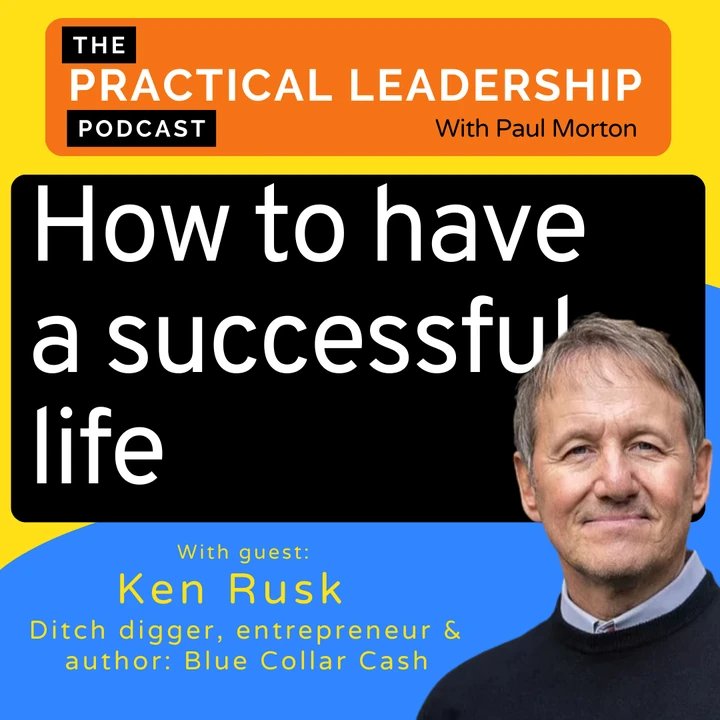
How to have a successful life
with Ken Rusk
Show notes
In today’s episode, we’re joined by Ken Rusk, a successful entrepreneur and author of “Blue Collar Cash.” Ken shares his journey from (to?) ditch digger to thriving business owner, emphasizing the importance of visualisation, goal setting, and empowering employees.
Ken introduces several key methods and frameworks:
- Visualization: Ken stresses the power of visualizing your future in detail. He encourages drawing out your ideal life, from your home to your car and vacations.
- Employee Empowerment: He believes in knowing and supporting the personal goals of employees to drive organizational success.
- Trade Jobs Advantage: Highlighting the significant financial and personal benefits of pursuing trade careers over traditional college paths.
Quotes and Timings:
- “Empower your employees fully.” – On the importance of understanding and supporting employees’ personal goals. (00:06:00)
- “The college crisis – lack of direction.” – Discussing the inefficiencies and challenges within the current college system. (00:11:37)
- “Take control – visualize your future.” – Ken explains the power of detailed visualization in achieving personal and professional goals. (00:19:00)
- “Trade jobs, a $400,000 advantage.” – On the financial benefits of choosing trade careers over college. (00:13:18)
- “Empower your team for success.” – Emphasizing the importance of empowering employees to drive business success. (00:07:08)
This is one I’ve made my kids listen to.
Join us for an inspiring discussion that offers practical advice on achieving success and empowering those around you. Tune in to discover how you can take control of your future and lead effectively.
Find Ken here: https://linktr.ee/kenrusk
Transcript
Automated transcript. Speaker labels and spellings may contain errors.
Paul
Joining me from Sylvania, Northwest Ohio, involuntary life coach, someone who tells us all that we do own our own future, entrepreneur, author, and originally a ditch digger at 15. [upbeat music] Hello, and welcome to The Practical Leadership Podcast. I am your host, Paul Morton, and we are talking about leadership, management, and the various lives that surround it. It's my joy, delight, and privilege to bring into my studio some of the smartest, wisest people I've been able to find for your delectation and enjoyment, and I hope that you do get a lot out of the conversations that we have here. When you realize that your management team has grown too fast or you've inherited a new team and the fastest, best lever you have for growth and improvement is attached firmly to those managers, get in touch.
I help you run management, coaching, and training programs that'll make a big difference really quickly. You can find me at The Practical Leadership Academy website and on all the usual social channels. Ken Rusk, thank you very much indeed for now.
Ken Rusk
Appreciate it. Uh, glad to be here.
Paul
Now, I short-changed you dramatically on my introduction. Uh, would you be so kind as to do a better job for my listeners?
Ken Rusk
Well, you know, I guess I've been accused of being called a blue-collar entrepreneur or whatever that is, and, um, it, it's real simple. You know, when I was younger, I had part-time jobs like anybody. I had worked at a bowling alley. I, I was, uh, worked at a bakery shop when I was 12 and 13, headed a newspaper route. I mean, all those things, and then at some point I realized that I could trade, like, my labor for things that I wanted for myself. You know, I grew up in a very small house with four brothers in, in, in Ohio, and my parents could give us what they could, but if we wanted more than that, it was up to us to go get it on our own. And, um, so yeah, I learned early on if I wanted that new aluminum baseball bat or a bicycle, I could work hard and go get it and, and make that happen with working for, um, in, in various jobs to earn money to do that. So, but I got serious when I was 15, and I said, "Okay, I need my first used car.
Wanna take my girlfriend out for pizza," or I would go bowling with my buddies, whatever. And, um, so my high school shared a fence with an industrial park, and there was a hole in that fence that we used to cut through to go to the carryout after school. And going through these businesses, I always noticed there was a lot of energy, and there was, you know, big-boy toys. You know, there was tow motors and, and, and, and end loaders and dump trucks and all this kinda stuff, construction stuff, which I liked. So I knocked on the door. I, I knew someone that worked there, and I said, "What do you guys do?" And they said, "Well, we're ditch diggers." And I said, "Well, I'm wholly qualified to do that." So I, um, I signed on at 15, dug ditches in the summertime, uh, worked
in the office in the wintertime after school 'cause it was convenient for me. And then what happened was when I was 18 they said, "Do you want to help us 'cause we're opening franchise offices around the Midwest?" So instead of going to college, I pieced together a suit and, um, lived out of a suitcase for about four or five years in Chicago and Pennsylvania, Columbus, and, um, opened up these businesses from scratch, literally from the ground up. And I'm, I'm 18 years old, and I'm doing this, so it was, it was pr- it was a pretty cool experience. So when I got tired of doing that, I moved to Toledo, Ohio, in a little town called Sylvania, Northwest Ohio, in 1986, and I opened up my own company and started with six people, and, um, I think we have over
200 today. So it, it's been a heck of a ride.
Paul
So you got that opportunity. This is a, uh, a thing that I think you, you can dig a little around, is that somebody gave you the... You were there. You showed your worth. You showed your value, and somebody recognized. What was that all about?
Ken Rusk
I, I think the biggest thing for me was I had two... I had, I had kinda like two mentors, if you will. Um, one of them was my father, and my father was a guy that worked very, very hard and slowly rose up in success. I mean, he, he wasn't really suc- real successful till I was about 16, but I got to see how hard he worked. I called him the, the imperfect perfectionist because he, he drove me. He was a, he was a Mar- a United States Marine, so he drove my brothers and I to, to do things perfectly, uh, whether it's shining shoes or washing your car or whatever. And I saw how his work ethic was, and I thought, "Okay, if he can do that, I can do it," and that's basically what he told us. So if you pair him up with my first boss, who was kinda the opposite of my father, he was successful, too, but he was a real playboy.
I mean, he, he lived like a rock star. And, um, I got to immerse myself in helping him buy cars and boats and helping him throw his parties, and it was really an interesting [laughs] way to grow up, if you think about it. And, um, so for me, I got to see some examples of a couple different ways to be successful and live, and live well, and be a good family man and, and that kinda thing. So it, it was, um... I, I think everyone should have a mentor, and I think you should be very careful how you pick them because they can either be good for you or bad for you. But these, these two gentlemen were the people that I think at least set the stage for me to say, "Okay, um, I'm gonna picture what I want my life to look like.
I'm gonna write it down. I'm gonna draw it out. I'm gonna create an actual brochure for Ken Rusk and his life." And I did that, and then I slowly just took each piece of it and chopped it into little pieces and parts and hit these goals and pathways one at a time, and I, I've never stopped doing it. I started thinking that way when I was 23, and I've, I've never stopped since.
Paul
Now, in your book, Blue Collar Cash, you talk about the idea of visualization, setting clear goals, and the name of this podcast is The Practical, right? So we're trying to make it practical, trying to make it useful so somebody can take things away and say, "Gosh, Ken gave me this really good idea." Can you share maybe some practical strategies that a leader or an individual could help to set and achieve something that's like a meaningful-
Ken Rusk
Well, first off, if you're leading people, the f- the first thing you have to do is you have to t- you have to get them together individually and say, "Why are you here? I need to know what you want your life to look like." I mean, Paul, why would you ever hire- If you think of the human that you hire, a typical human being, there's 24 hours in a day. Eight hours of that day they're sleeping, eight hours of that day they're working for you, and the other eight hours of that day they're doing something else, okay? Well, know what that is. What's their sport? What's their hobby? What's their family? What's their charity? What's their spiritual? What's their vacation? I mean, know those things because why would you ever hire just one-third of that person? Why wouldn't you want all of them? So I say let's find out what everyone in your organization wants for themselves first.
Help them to be selfish, and I don't mean at the detriment of somebody else. Help them to work on themselves 'cause no one, no one does that. They're just, they, uh, "H- here's your uniform, and here's your time you go to work. Here's your health insurance. Here's your time, your days off. You know, here's where you call in sick." I mean, it's the most mundane i- in inter, you know, interaction in the world. So if you get to somebody and say, "I need to know who you think you are, I need to know who you want to be, I need to know what you want your life to look like, and I want you to draw it out crystal clearly, not only for yourself but for me and everybody else to see," because there is power in collective vision. You know, there, there's power in reticular activating systems. There's power in the ability to say, "The more I stare at something, the more I begin to own it mentally, and then my brain kicks my body into this almost involuntary
chase of the acquisition of that thing." And that is a power that nobody teaches, not in high school, parents don't teach it, colleges certainly don't teach it. They teach you how to react to, to, to things, but they don't teach you how to proact, and that is the whole spice of life, is to be able to see things, go after them, anticipate them, and then have them come into your life because you've, you've just kind of, like, you've kinda, like, brought them into your mind first and then into the world second. So I would tell any leader, get out of the way, make yourself as irrelevant to your business as you can as quickly as you can by finding out what everybody else wants with inside your organization, and then let them do it. Because when you empower people like that, they will take your company way further than you can take it yourself, I promise you.
Paul
I love that. I absolutely love that. The whole concept of, uh, not hiring a third of a person, that's great. The reticular activation, you know, that's, that's the, the pink Volkswagen, right? You think of a pink Volkswagen.
Ken Rusk
Absolutely.
Paul
"Well, I'm gonna take... You know, I'm thinking of buying a pink Volkswagen."
Ken Rusk
[laughs]
Paul
Guess what you're gonna see-
Ken Rusk
Yeah
Paul
... every day from now on. Did you know how many pink Volkswagens there are? And then you've got the idea of the, it's, like, it's like an affirmation, you know, as you write down what it is you want, and you look at it, or you write it every day, or you bring it to mind, and you, you're pulling it. You, you, it, it pulls you forward.
Ken Rusk
Well, you know, there, there's been studies, Paul, which I think are really interest- So a, a, a study at Virginia Tech, they had 100 people, and they said, "Raise your hand if you have crystal clear goals." And I don't mean just goals. Uh, that word is almost so overused between soccer and hockey and football and everything else. It's just so overused. So write, write down if you have, raise your hand if you have crystal clear pathway-
Paul
Yeah
Ken Rusk
... in your life, okay? So only 20 people of the 100 raised their hand. So then they said, "Okay. Of the 20 of you that have these pathways in your mind, how many of you have them clearly written down somewhere?" Only four people raised. So four of 100. But here's the worst stat of all. They said, "Okay. Of the four of you remaining, how many of you have these pathways posted somewhere where you see them multiple times a day?" One person. And they followed those people for another 10 years, and that one person made nine times more money than the rest of them in that time period. So i- if, if it is... A- and by the way, Paul, this requires no training. It's free, okay? You have this already installed in your hard drive. [laughs]
Paul
Oh, it's, it's right there, right-
Ken Rusk
Right?
Paul
... it's my nose, yeah.
Ken Rusk
Yeah. I mean, why wouldn't you allow that magical, wonderful, in- invisible, industrious, almost undefinable power into your life to help you along? I mean, it's hard enough getting outta bed and going and do your job and even with your family and paying your bills and your, and all that other stuff. Why wouldn't you invite this mysterious power into your life to just power you along? Because the more people that you can get on your team, the better. And, um, I, I just, for leaders, I say cr- you know, you're the entrepreneur, and I get that, fine. People have called me an entrepreneur. I kinda wince at that because I'm like, "Here's a crayon and a piece of paper. Draw entrepreneur for me." I mean, i- it doesn't mean anything. It's just a concept. But if you're that entrepreneur person, surround yourself with intrapreneurs, I-N-T-R-A, who will drive your company with and for you, and then just get out of their way.
But the way that starts is by knowing what they all want and what the brochure looks like in their life for each and every one of them.
Paul
Totally. I mean, these are concepts that have been around, hidden in plain sight, but from the 1930s, when you're talking about Norman Vincent Peale, Dale Carnegie, uh, most of, like, uh, Think and Grow Rich, Interview With the Devil, all these guys, you know, these don't drift. The number of people that drift through life. They drift.
Ken Rusk
[laughs] Right.
Paul
Aimless, and then all of a sudden somebody like you comes up and says, "What do you actually do in your life?" "I, uh, uh..." Now, the best thing you said is r- right at the beginning here was you said you were an involuntary life coach, especially to young people. And if you're coming along, uh, with your background in blue-collar work, the first reaction many people are gonna have is, "Well, you should go to college, son, get a real job. You don't wanna be out digging ditches or doing something. What you wanna be is in a nice indoor job in the air conditioning," right? And frankly, my kids, I don't know, both of them are gonna go to college or university. I would imagine, though, they're starting with on, uh, with, um, apprenticeships here quite heavily.
I would be more than happy if my son or daughter leaned into a trade, picked up ele- being an electrician or tradesperson and had to struggle by on 200,000 or 300,000 a year, you know?
Ken Rusk
Yeah. [laughs] Yeah. Well, you know, it's interesting that you say that because The stats, I, I did a lot of research for the book Blue Collar Cash, and the stats are funny on college. People don't get this. So four out of 10 kids today go into college not knowing why they're going.
Paul
Yeah.
Ken Rusk
That's scary. Now, 25% of college, um, entrants change their degree in the first two years.
Paul
Mm.
Ken Rusk
That's scary and wasteful, but the worst one is this: only a third of kids that graduate with a degree ever use that degree ever. Now, if, if that was a business-
Paul
Uh-huh
Ken Rusk
... if that was a business, the CEO would be fired, the place would go bankrupt, they'd have to like sell off the parts. I mean, it, it is the most inefficient system in the world unless you know exactly why you're going.
Paul
Yeah.
Ken Rusk
I wanna study medicine. I wanna help people. I wanna be a doctor. I'm gonna go to med school, and when I'm done I'm gonna be a doctor. That's a direct line. Love it. Go there all day long. Do it. Lawyer, doctor, nurse, teacher, financial person, engineer, architect, whatever. But if you're just going to go, there's a whole lot of better ways to think about it. And by the way, you just said something that is really important. You have two kids.
Paul
Mm-hmm.
Ken Rusk
In the United States today, there's 167 million people considered full unemployment. 77 million of those people, and I added them up myself, Bureau of Labor Statistics, 77 million of those people to this day still do something with their hands. So half the population is in some type of trade skill or something involving their hands. So it almost stands to reason that one of your two children might just naturally be one of those type of people, okay? They might learn tactically. They might be better with their hands than they are, you know, with some theoretical scenario. So all I'm saying is, it- before you start pumping 40,000 a year or 50,000 a year into a college degree, which is 200,000 after four years, hopefully you didn't borrow them.
Paul
Yeah.
Ken Rusk
Well, you know, you can jump right into a trade right now and make 60, $70,000 a year. After four years, that's 200,000 on the positive [laughs] side.
Paul
Mm-hmm.
Ken Rusk
That's a $400,000 swing by the time you're 23 years of age. To put that on a kid, I mean, you gotta really be careful and at least think about this before you jump into the herd mentality.
Paul
I know. I'm sorry, you just nailed it there. That's it. You don't think about it. You're not meant to think about it. You're not supposed to think about it. You're supposed to do what you're told.
Ken Rusk
Correct.
Paul
You're supposed to sit down, shut up, learn this, go to the next thing, sit down, do the exams, shut up, go to the next thing. And then you go and work at Mickey D's trying to, trying to ask if you want fries with that because your degree, your master's degree in Scandinavian studies, he says, speaking from experience-
Ken Rusk
[laughs]
Paul
... turns out to be damn all use. Well, that's not quite true. I did eventually find use for it. But oh my goodness. So the, the, the value of the, the, the manual, the trade, the, the thing that actually adds value or creates value rather than moving s- things around, which is, I think is the difference, you can't outsource that.
Ken Rusk
Well, and the other thing is this. I mean, what people don't realize about working outside or working with your hands is there's this thing that I, I, I think I invented this statement. It's called the stand back moment, and what that means is at the end of the day, and I did this 'cause I was a landscaper working on million-dollar houses back 40 years ago. You know, when you get to stand back and lean on your shovel and look at these beautiful things that you've created, you know, beautiful rock gardens with pine trees and, and fish ponds and... I mean, you get to see this amazing stuff you created, and I don't care whether you're, whether you're, you know, creating a, a beautiful wrought iron fence for someone, or
you're doing a stone outdoor kitchen or whatever you're doing, you get to stand back at the end of the day and say, "Wow, I did that. I created that with my own two hands, and that will stand the test of time. I can come back in 100 years and that thing will be here." And I just don't think you get that on the 15th floor in some cubicle, you know, selling medical supplies-
Paul
[laughs]
Ken Rusk
... and wondering how you fit into the world, you know? [laughs]
Paul
Yeah.
Ken Rusk
So it, it really bothers me when people think, you know, it's... It, and, and, and by the way, it's unfortunately, and I, I wrote an open letter to, to parents on my website at kenruss.com. I said, "Listen, I get it. I'm a parent. You birthed your child. You s- you know, put your child in diapers. You clothed them, you fed them, you sheltered them, you taught them what you could, you protected them as well as you could. And now for some reason you think the only way to say, 'Wow, I was a successful parent,' is if they have an expensive college degree on the wall." That has never been true in the history of our economy. It's just never been true. So I say, isn't the ultimate goal an independent, problem-solving, financially savvy, financially independent, in control, you know, wholesome human being?
Isn't that really the goal? You know, um, not just an overly educated one. So I think parents have to stop and go, "Yeah, you know what? Maybe my ego is the problem. Maybe I'm more worried about telling my friends that my son went to Vanderbilt or my daughter went to Ohio State. Maybe it's me that's the problem."
Paul
Yeah.
Ken Rusk
And you're, and, and you, you're unintentionally hurting your kids in 66% of the cases, so it, it really is something else.
Paul
Well, you think the number of kids that used to go to university, even when I went to university, which was, well, 30 years ago, it wasn't that many. It wasn't half or 30%. It was like 10 or something like that.
Ken Rusk
Yeah.
Paul
And you had... We- yeah, I, I did the humanities as well, which is kind of, eh, not so useful. But it was a small percentage. There were technical schools, there were polytechnics you had over here, which all of a sudden became universities because financial incentives.
Ken Rusk
Sure.
Paul
They were financially incentivized to start charging for them. Um, I was one of the last students that got a loan, and I got, I got a grant actually, so my entire college education was free, uh, from the, from the state, so taxpayers paid for it. But now the colleges themselves are incentivized to charge you a ton of money to not... They don't really care what you do after. There are ways you could flip that incentive round. Personally, I would say, "Fine. You know those fabulous endowments? You can now, you now have to raise money yourself to pay for those kids to come to you, and they'll pay it back to you. And if they don't pay it back to you, sucks to be you."
Ken Rusk
Right. Yeah.
Paul
There you go. Incentive problem solved. You know-
Ken Rusk
Yeah
Paul
... it's called skin in the game, baby. It's called skin in the game.
Ken Rusk
Right.
Paul
Let's go back to the thing that really ... The individuals themselves. And you said two things that were fascinating. One is you alluded to personal satisfaction, and two would be in control. And I think the two of them are deeply, deeply related. People, I think, are taught that they're not in control. They just have to go with the flow, which means that they drift. They drift. They don't have this magical plan, and ergo, they get, they never get the chance to be satisfied because they're not doing something that they plan and organize and, and, and create. They don't create their own life. They don't create a, as you said, a wrought iron fence or whatever it is. If you don't create, you don't build, where's your satisfaction?
Ken Rusk
Well, y- you know, that's, that's a great point. I mean, y- y- you're either happening to life or life is happening to you.
Paul
Yes.
Ken Rusk
And that's the big difference.
Paul
[laughs]
Ken Rusk
Okay? You know, I, I, I, I love it when I hear all the if/thens going on in the world, okay? If you go to high school, and if you get good grades, and if you get a scholarship, and if you go to a university, and if you get a degree that you can use, and if you get a job that pays well, well, guess what? Then you can start living your life. That's completely backwards. If you wanna talk about control, m- you know, have your young person, or anybody for that matter, have them draw out exactly the type of house they'd like to live in, exactly the type of car they'd like to drive, exactly the type of vacations they'd like to take. Would they want a, a pet, and it would be, would it be a dog or a cat? What color? What would you name it? Okay. What type of s- um, charities would you give back? If I gave you 100 bucks in cash and said, "You have to give this away right now," what would you do with it? You know, your spiritual moment, your hobbies, your sports, your health, um, e- everything.
I- if, if you could draw that brochure out, okay, and then you say, "Okay, cool. That's the way I wanna live. I would love to ... If I could live like that, that would be so cool. That would be my comfort, my peace, and my freedom," then you've got the end game. It's, it's like a puzzle. If I dumped a, 1,000 puzzle pieces on your dining room table right now and I took the box away, you're done. You got no hope. I mean, unless you were in prison for 20 years, [laughs] you have no hope of building this puzzle, right? So why aren't you living your life according to the box? Because without the box, you have nothing, right? You have a bunch of pieces strewn all over the place. How am I gonna put these together? And if you get lucky, then you will live good. There's another if/then, right?
Paul
Yeah.
Ken Rusk
I'm saying start with the puzzle box first. Build how you want your life to look like first, and then pick one of the hundreds of different pathways to get... Because at the end of the day, and this is where I personally come in t- as a ditch digger, okay, I'm s- I sometimes think it isn't so important what you do for a living as it is what you do with what you've done for a living, meaning how are you creating that puzzle box? How are you creating that picture for yourself? Because if you are in control of your input, your output, the quality of that output, your day, your time, your schedule, your financial gain, it doesn't always matter exactly what the substrate was. I mean, I could take this company here, which digs d- we dig ditches, and I could flip it to selling windows or, or c- or selling medical, um, parts, or whatever. It's not necessarily the thing, as much fun as it is, a- as much as it is what you create and the fun that you have creating your future with it.
So yeah, I, I would say we are in a hell of a lot more control than we think we are. We just have to start with the why, and, and then all of a sudden, all those little entrepreneurial characteristics that I talk about in the book, persistence, resilience, faith, co- hope, courage, initiative, vision, charity, um, humility, all those things, generosity, those things all come out in us when we have a reason why. We just have to get that out there first and then let that take our life in directions that to me wholly beneficial.
Paul
And I think invariably the, the money looks after itself in most cases.
Ken Rusk
It, it does because when, when you have your eyes on what, you know, um, again, the pink Volkswagen, when you have your eyes on that thing, your body, your brain will find a way to go get that. I've done it in my own life so many times, whether it's cars I've acquired or golf courses I wanted to play or the boats that I have or whatever it might be, places I wanted to go. When I honed in on it, they ended up showing up in my life, and I, you know, you could call that some type of law of attraction, but I think it's an actual physical, scientific thing that your brain does which kicks your body into motion to go make those things happen.
Paul
I think it's the difference between ... You know, it's like Yoda's thing. Do or do not. There is no try. It's-
Ken Rusk
Yeah
Paul
... decide to do something. You choose to do something. Saying, "I choose to do this. I decide to." It's not, "I think I will. I might consider."
Ken Rusk
Yeah. [laughs]
Paul
I was talking to my kid, I was talking to my daughter about this just a few days ago, and by the way, if you're listening, darling, your room's a mess, but listen to this man. He's really, really smart, okay?
Ken Rusk
[laughs]
Paul
And you, boy, as well, uh, the, the two of them. So yeah, this is one of the ones I'm gonna play to the kids. They, they, they, they refuse to listen to anything else, but this is it.
Ken Rusk
There, there's a, there's a chapter in the book that has i- within it, um, two clubs. One's called the two day club and one's called the someday club, okay?
Paul
[laughs]
Ken Rusk
And I d- I describe the two day club and the someday club like a golfing country club. So I, I, I kind of analogize it to that, and, um, what they'll learn really quickly is that there's a whole lot of people in this world that just live at the someday club. They want you there. They don't want you to leave because we can all commiserate about someday we're gonna do something that just never happens, and I hope they draw the conclusion that someday never comes. [laughs]
Paul
I could have been a contender. I could have been a contender.
Ken Rusk
Right. Right. [laughs]
Paul
Oh, it's magnificent. Can I give you 10,000 billboards and the biggest marker pen you can imagine?
Ken Rusk
Sure.
Paul
And on those billboards you may write whatever it is you want to be seen by the-
Ken Rusk
Yeah
Paul
... what's gonna be on it?
Ken Rusk
One of them's gonna say, "You and only you know what your life could look like, so why are you letting other people try to influence that?"
Paul
That'll do. That'll do. Where can we find you, Ken? KenRuss.com?
Ken Rusk
Yeah, you can go to KenRuss.com. One of the things that I did that I, that I'm really pr- I'm really proud of 'cause it's working really great is I made a eight-week simple course that you can use that references the book, Blue Collar Cash. It's, it's not one of those $2,000 courses you see online. [laughs] It's $179. You get a free book with it, and it's eight 45-minute sessions, and what it does is it forces you, instead of having a shelf help book, to make my book a self-help book. [laughs] So it will change the way you think this afternoon if you start it. I promise you. I guarantee you it will. And, um, it's called The Path to a Successful Life. It follows the book, and, um, so many people have taken the course and called me and said, "Man, I, I, I get it now.
I, I now see, you know, I gotta get rid of all the noise and just put this in front of me and my life's gonna be good." So I encourage anyone out there to try it. I donate most of the money to the, from those courses to charity anyway. Um, my life was good before I wrote this book, and, um, so yeah, if you, if you help yourself out, you'll be helping someone else at the same time.
Paul
Yes.
Ken Rusk
And, um, I hope they, I hope people check it out and tell me what they think of it.
Paul
Well, we'll make sure that the links to, uh, the website and to the, the course are in the description of these episodes.
Ken Rusk
Lastly-
Paul
It just remains for me to say Ken Russ, it has been an absolute pleasure. Thank you very much.
Ken Rusk
Thank you, Paul. Happy to come back anytime. Appreciate it. [upbeat music]
Paul
And that's a wrap. I hope you enjoyed the show. Thank you for joining me. If there's ever anything I can do to help you on your journey, then do please reach out. You can find me on LinkedIn and all the usual sources. Do please subscribe, leave me your five-star review, and most importantly, get in touch with your comments and feedback. It's really how I grow, and that's what I'm doing this for. Thanks again. [upbeat music]