Show notes
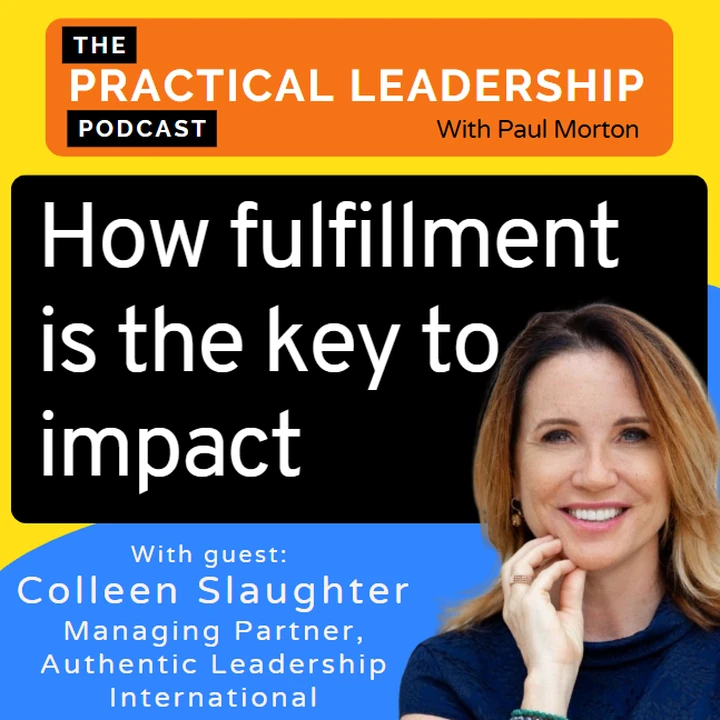
Are you successful but unfulfilled? Chasing goals but feeling empty inside? Colleen Slaughter knows that fulfilment, not just success, is the real key to making an impact. This episode dives into how to align purpose with leadership, tapping into deeper fulfillment that fuels both personal and professional transformation.
Episode Highlights
- From Kentucky to France: Overcoming the ‘Not Good Enough’ (00:01:02)
Colleen shares her journey from small-town Kentucky to France with no job or money, and the insecurities she faced along the way. This is where we first learn about the powerful forces that drove her—a need to succeed mixed with a fear of failure.
“I was an insecure overachiever. I had the NG’s—the ‘not good enoughs’.” – (00:01:24) - The Dark Side of Drive (00:03:02)
A relentless drive can backfire, especially when self-expectation becomes too harsh. Colleen shares how the same energy that pushes her to succeed can also create challenges in her relationships.
“When I’m hard on myself, I can be hard on others. It makes it harder for people to be around me.” – (00:03:02) - Balancing Strengths and Self-Awareness (00:05:01)
Recognising your strengths is vital, but overusing them can push people away. Colleen explores how self-awareness and knowing when to dial things back can make you a better leader.
“Being aware of your traits allows you to avoid alienating others, while still pushing yourself to grow.” – (00:05:43) - The Power of Imperfection: Mandela’s Mindset (00:07:19)
Perfection is a myth. Colleen references one of her favourite quotes from Nelson Mandela: “I never lose, I either win or I learn.” This mindset shift is crucial for leaders who need to focus on growth over perfection.
“Failure is just a lesson disguised.” – (00:07:39) - Leadership Through Love and Duty (00:13:32)
Paul and Colleen dive into the uncomfortable territory of discussing love in leadership, drawing on C.S. Lewis’ four types of love to highlight the importance of Agape—selfless love.
“Agape is the selfless willing of good for others. And any leadership approach has to come from that place.” – (00:15:00) - Purpose Beyond the Paycheck (00:16:30)
Fulfilment comes from within, not from external markers like money or titles. Leaders who find this alignment make more significant impacts and inspire their teams to do the same.
“I have the cars, the houses, but I’m miserable—so clearly, it’s not the outside trappings that bring joy.” – (00:16:55) - Colleen’s Three-Step Framework for Fulfillment (00:19:02)
- Clarify Your Values: Know what matters to you at the core.
- Commit to One Practice: Choose one value and focus on living it daily.
- Remember Your Worth: Fulfillment comes when actions align with who you truly are.
“Fulfillment isn’t a ‘one and done’—it’s about living your values every day.” – (00:22:11)
Resilience and Patience: The Unsexy Truth (00:24:22)
Colleen admits that she struggles with patience, but it’s a core part of resilience. Being patient with yourself and others builds the foundation for long-term success.
“Patience serves a purpose larger than just achieving goals—it helps draw people in, aligning them with a bigger mission.” – (00:24:25)
Key Quotes
- “You can’t give what you don’t have. If you’re not fulfilled, how will you impact others?” – (00:25:58)
- “Leadership isn’t about being the vessel; it’s about becoming the conduit.” – (00:14:34)
Chapters
- 00:01:02 – From Kentucky to France: Overcoming the ‘Not Good Enough’
- 00:03:02 – The Dark Side of Drive
- 00:05:01 – Balancing Strengths and Self-Awareness
- 00:07:19 – The Power of Imperfection: Mandela’s Mindset
- 00:13:32 – Leadership Through Love and Duty
- 00:16:30 – Purpose Beyond the Paycheck
- 00:19:02 – Colleen’s Three-Step Framework for Fulfillment
- 00:24:22 – Resilience and Patience: The Unsexy Truth
Call to Action
If you want to align your values with your leadership practice, explore more about Colleen Slaughter’s work on BolderMoves.com. You can also find her on LinkedIn for her weekly insights on bold leadership.
Transcript
Automated transcript. Speaker labels and spellings may contain errors.
Paul
Originally from small town Kentucky, USA, moved to France age 20 with no money and no job. Now managing partner of Authentic Leadership International, working with Fortune 500, um, leaders and Nobel laureates. She role models leadership. She brings clarity, courage, confidence into helping people to discover their highest purpose and how they can flourish. Hello, and thank you for joining me on the Practical Leadership Podcast. My name's Paul Morton. I'm your host. We try to distill the hard-earned wisdom of CEOs, executives, and high performers around the world into actionable insights that you can take away and put into your leadership practices really quickly. If it's time for you to look at your own management teams and help move them from being accidental into being intentional, then in nine short weeks, the Practical Leadership Playbook Course will help you do just that.
Check out the Practical Leadership Academy. And now, on with the show. Colleen Slaughter, thank you very much indeed for joining me.
Colleen Slaughter
Thank you, Paul, for having me. It's quite an intro. Thank you.
Paul
So Kentucky, right? Small town Kentucky. You got on a plane, you had your bag, and you got off at the other end and went, "Uh, parlez-vous anglais?"
Colleen Slaughter
[laughs] Exactly. Exactly. I was the typical American with not enough French under my belt before I landed, so I definitely felt inadequate. But I was also, I've always been a insecure overachiever, right? Meaning anyway, I've always had that, what I ... Well, I have a mentor that called it the NGEs, right? The not good enoughs.
Paul
Yeah.
Colleen Slaughter
So that was, that was ... The, the language gap, at least in the beginning, was definitely food for that, for that thought process. Yeah.
Paul
And I suppose there, there are, suppose there are things that do just feed into the sort of insecurity, the, the, the need to succeed. There's the fear of failure is the other side of that. All these, these things play off of each other, sometimes for success, sometimes for pain. You know?
Colleen Slaughter
Oh, it has both sides indeed.
Paul
Mm-hmm.
Colleen Slaughter
Yeah. Yeah, that, that, that drive within me has served a wonderful purpose. I mean, there ... Uh, uh, 99.9% of the time here when people, uh, uh, as you know, living, as I live in France, ask me where I'm from, half of them say, "Well, where is that?" But the 99.9%, "Oh, I've never met anybody from Kentucky," right? So it's not everybody from any Kentuckian necessarily that gets on a plane and comes and then, you know, like did the whole French business school thing, starting a business. Like, it definitely has had its peaks, its perks along the way, but there's always that shadow side, to your point, right? And that means being really hard on myself, and when I'm doing that, I can also be really hard on other people, and that makes it harder for people to be around.
You know, I have a way of pushing people away when I'm also being hard on myself, so I've also needed to learn how to curb that, right, soften that aspect and, and keep the drive, but keep it in a way that is more aligned with things that are important to me rather than just trying to get ahead of whomever it might be out there.
Paul
I think like any of the good things that we have in our characteristics, there's a red line. You know? Like the ... You push the accelerator too hard, it goes into the red line, your engine explodes and pops out your bonnet, right? Pops out the hood.
Colleen Slaughter
[laughs] Yeah. For sure.
Paul
Mm.
Colleen Slaughter
There's always the shadow in the light of everything.
Paul
So you talk about role modeling leadership. So, and if ... Is that ... What are the traits then? What's the, what are the things that you've had in yourself that you recognize that, hmm, this, this, this, this is useful, but if I go too far, I'm just gonna piss people off. You know? I'm gonna, I'm gonna push them away. I'm gonna ... They're not gonna want to work with me.
Colleen Slaughter
Yeah. Well, that I can list several. One is what I've already just mentioned, and I'll call it the word success or drive for success or achievement, right? And the idea of being hard with myself and then hard with others. Another is I've had always a really strong intuition, and that can translate into a strong knowing or a strong, let's say, conviction, being convicted, and that can also serve to push people away because I can seem like a know-it-all and seem un-open to other viewpoints.
Paul
Hmm.
Colleen Slaughter
And of course, I could be wrong, too, right? And that, that's been a, actually a freeing journey to learn. It hasn't been ... It's been humbling in a good sense, but not humiliating, right? It's been, it's been freeing to be like, oh, I don't have to have ... always be right [laughs] you know? So that ... You know, you know that phrase, "If you spot it, you got it"?
Paul
The one who smelt it, dealt it. Yeah.
Colleen Slaughter
Oh, I've never heard of that one. I like that one.
Paul
That's, that's, that's my son's one.
Colleen Slaughter
Yeah.
Paul
He's read it from Fox, you know? [laughs]
Colleen Slaughter
That's a great one. If you s- if you smelt it, you dealt it. I love it. Yeah, so if you spot it, you got it, so very ... More often than not, when some trait irritates me in another person, I can be sure that that's what I have, right? And self-righteousness is one of them for sure, and I'm like, oh, this must be [laughs] plastered across my chest for other people to see, you know? So yeah, for sure. I mean, the whole thing starts with what I hear you say underneath it all is self-awareness.
Paul
Hmm. Yeah.
Colleen Slaughter
Right? It's just being aware because, of course, I'm a human, too, and I'm, I'm gonna have ... I do have my foibles. Um, and to your point, learning how to balance that, right? To balance, be aware of them but not give them too much attention. Um, thank you for being there. We know you mean well. That kind of thing, like what we, we've been taught to do with fear.
Paul
Mm-hmm.
Colleen Slaughter
But also- ... focus more on my strengths and, and developing those.
Paul
Mm. Yeah. And there's a g- there's a great argument for building strengths is, above anything else. You look at a, any individual, and you say, "Well, you're at a, a three on the scale. Three out of 10 in this, and you're a seven out of 10 in that." Let's start with the three out of 10 'cause you suck. Okay, yeah. Uh-
Colleen Slaughter
[laughs]
Paul
Why? You know, what are you focusing on? And it's, it's your, it's the natural nature. Well, you're gonna go on a course, you're gonna work on things you don't know how to do, right? Okay, that's, that's one angle. Or you can look at the stuff that you're reasonably good at, take it from a seven out of 10 to a nine out of 10.
Colleen Slaughter
Mm-hmm.
Paul
And what would you rather have, a, a room full of nines out of 10s or a room full of, now not threes, but maybe fours?
Colleen Slaughter
Mm-hmm. Mm-hmm.
Paul
It's, it's a no-brainer. But it's one of those c- almost counterintuitive things. You send somebody off to fix themselves 'cause they're broken rather than to improve themselves 'cause they're nearly great.
Colleen Slaughter
Uh, yeah. Yeah. Well, that's also that insecurity thing that-
Paul
Yeah
Colleen Slaughter
... especially the high achievers, right? Of, of perfection-
Paul
Mm-hmm
Colleen Slaughter
... which is a word that makes me laugh today, but yet in my... I have moments where I fall into it as well, and believing it.
Paul
Mm.
Colleen Slaughter
And that, that... What my favorite quote, and anybody who's listening to the different conversations I've been on might get tired, I say this a lot, but I love it, Nelson Mandela, who said, "I, I never lose. I either win or I learn."
Paul
Yeah.
Colleen Slaughter
So, like what you had said earlier around failure, that's another one that makes me giggle. And so I mean, there's so many people that use that word, right? And so many people... And I certainly have done it, and used the word w- uh, perfection as well, like I said.
Paul
Yeah.
Colleen Slaughter
But really, we're chasing, we're chasing an illusion, right, with perfection.
Paul
Mm-hmm.
Colleen Slaughter
And with failure, we're afraid of something that doesn't exist. So it's like being afraid of monsters in the, in the, under the bed or something, right? So when we can really get to the point of seeing that, it's another thing that can be freeing.
Paul
It's, I mean, it's massively liberating, I think, and I, I still struggle with, um, the, m- it's, it's, I, it's the, the learning thing. So I firmly believe you can out-learn the competition. You, you need to learn lots and lots of stuff. I love learning things, but that, my red line in that is that I'll gather more information. I need to study more. I need to work on this more before I actually do a damn thing. And JFDI, which is just flaming well get on with it.
Colleen Slaughter
Ooh, I like that. New one I learned.
Paul
Just, just fucking do it, right?
Colleen Slaughter
[laughs]
Paul
Um, JFDI-
Colleen Slaughter
I like that one
Paul
... is, is, is, is core to how I get anything done, if I ever get anything done, which is, you know, s- stop, just stop fannying about. Just-
Colleen Slaughter
Just get started
Paul
... do something. Produce it, create it, build it, send it.
Colleen Slaughter
Go to action.
Paul
Yeah.
Colleen Slaughter
Exactly.
Paul
Just go.
Colleen Slaughter
Just get into action.
Paul
Bias for action, you know?
Colleen Slaughter
Mm-hmm.
Paul
And I'm fine doing that with other people. Great doing that with other people, right? In fact, I push people like a crazy thing, but see when it's for me, oh.
Colleen Slaughter
Yeah. It's where the rubber meets the road, isn't it?
Paul
Totally. Totally. And the-
Colleen Slaughter
In those quiet moments when no one's looking, and I have the option to do, go down road A-
Paul
Mm
Colleen Slaughter
... even if just a little bit, right? Or the option to go down road B. [laughs]
Paul
Yeah.
Colleen Slaughter
That's where the rubber meets the road. Yeah, which is it gonna be?
Paul
And, and I don't know whether you find this when you're actually working with other people, is that I have all these great ideas and good pro- plans, frameworks, methodologies. I can help people, I can focus, all that sort of stuff. But turning the mirror on yourself, this self-awareness thing is, is super hard. It is really super hard.
Colleen Slaughter
Mm.
Paul
Um, I mean, there's a g- great wee thing that I, I think it comes from my mum, and she says that, "You know, if you... It's really hard to read the label on the bottle when you're inside it." So if you are advising somebody else, you can see so much.
Colleen Slaughter
Mm.
Paul
You can know what's going on, or within reason, and help them. But if you're inside the bottle yourself, even though you know the answer, it's very difficult to apply that knowledge to yourself, I find. Maybe that's just me being a bit crap, but it's, it's... I find it's quite hard to take your own advice.
Colleen Slaughter
Mm. Yeah. I don't... It's not crap at all, and there's another phrase that I love about what your mother said around, when you're inside the bottle it's hard to see the instructions, right?
Paul
Mm.
Colleen Slaughter
But, you know, this begets the question of... And we can get really esoteric here, but just to keep it in words that makes it not so esoteric, right? This question of what are we made of? Like, who are we really?
Paul
Mm.
Colleen Slaughter
And for most of my life, just keeping the focus on me, right, with your question earlier, I, I really thought I was my behavior. I was my achievements. I was-
Paul
Mm
Colleen Slaughter
... all this outside stuff. And when I learned, uh, it's been in the last decade really, that there are two parts of me, right? There is the behavior piece, and certainly that can be questionable at times, right? [laughs] Like, I'm human, like anybody. But really fundamentally, there is the essence of me, too, and that, that can never be bad, right? That is unquestionably good all the time. And when I realized that it didn't matter what I did, that wasn't going to affect my worth, let's say, 'cause there's a word, worthy. In my opinion, we don't speak enough about that in the business world, by the way. Um, uh, that then all of the sudden the whip that I was getting out about myself of having to do this and y- you know, cheering myself on or forcing myself or whatever it is, right, to do the right thing, all of the sudden when I could attach my actions to the fact that it was, uh- ...
reflection of my worth, a reflection of my essence, all of a sudden it became so much easier, right? And it even started feeling better to just do the more, I'll use the word here, loving actions, right, toward myself or toward others. To do the, to d- take the actions that are gonna be better for everyone, even if in the moment I didn't get high from them, right? Because there's definitely actions that in the moment it could be TV binging, [laughs] you know, ice cream binging. Whatever it is that in the moment, whoo, I'm taken another place, right? But longer term, eh, not really great for me l- at least, right? And then there's a chain reaction that ends up happening to the people I'm in contact with.
Whereas when I just realize, huh, you know, is that really gonna help me reflect the best part of who I am, ah. And, you know, there's always gonna be the teenager in me. We were talking earlier about age, right? And, um, there's always gonna be this rebellious teenager in me no matter what, and she definitely has her say and wins over quite a bit. But more and more she's getting convinced that, eh, not so sure the immediate high is worth it, right, for a longer term bliss, let's say.
Paul
Yeah. Yeah. You use, you use worth, you use love, uh, there's also duty. Duty's a good one. These are all big, grown-up values. These are all really scary words.
Colleen Slaughter
Mm-hmm.
Paul
I think you start, as soon as you start unpacking any of these things, like we're vaguely attempting to using imperfect ti- tools, you discover, like you s- you said here, the second part of life. And I don't know whether it's, um, uh... Matter of fact, you know what, I do know whether. I think it is an age thing that you get to your second wind. And there's a book there. You get to the second wind, um, and there's a point where you recognize that your value so far has been in your accumulated knowledge and experience, and the application thereof, and that's what you're getting paid for. But your value transitions, and your worth transitions to being from the things you've learned and things you can do and how clever you are at riding your bicycle and whatever it is, into being less of a vessel and more of a conduit.
Colleen Slaughter
Mm-hmm.
Paul
And it's not what you know, but it's the questions you ask. It's the, the stories that you can tell based on the knowledge you have in order to elicit feedback, information, and experience behavioral change in other people. And you lean on love, and it's... We don't talk about love at work because if you do that too much you get a call from HR.
Colleen Slaughter
[laughs]
Paul
But there are, there are-
Colleen Slaughter
Especially in the US, right? [laughs]
Paul
Well, especially in the US. Yeah. But there are, there are, um, CS Lewis talks about, uh... He writes a book, he's written a book called The Four Loves. And there is eros, which is romantic love. Your, your, your husband, your wife. There is philia with your, your, uh, brothers, sisters, that closeness. There's storge, which is reliable love of friendship. And there's agape, and agape is the one which is sometimes called the divine love, the love of God for us all. But it's the willful, the willing of good in others. It's the selfless willing of the best in other people. And any sort of leadership approach has to, I think, come from that place. It's, "I want you to be successful, and I'm gonna work to make you successful. It's not about me." And that change from being the vessel to being the conduit, I think turns slightly, um, grayer, older people into being incredibly good leaders.
If-
Colleen Slaughter
Part, part of life stage, for sure
Paul
... if they recognize it. If they recognize it.
Colleen Slaughter
Yeah.
Paul
And if they recognize it earlier simply by telling people, "It's not all about you, by the way. Your job is to make them successful," you can kind of short circuit it. You don't get the, the life experience, and you'll get there eventually, but at least you get the behavioral aspect of it. That's, that's something comes through. In, in, in the work that you do, what do you think the biggest need is of the leaders that you come encounter?
Colleen Slaughter
Well, I think you've just pointed it. The biggest need is... Well, first of all, I do tend to attract, uh, the, to your point, those who are recognizing on their own, "There's gotta be more here."
Paul
Mm-hmm.
Colleen Slaughter
Right? "I, I have the money, I'm partner of whatever firm you wanna say, right? Multiple cars, beautiful wardrobe, multiple houses, and I'm miserable. So it's clearly not the outside trappings that other people may have told me or I thought would make me happy."
Paul
Mm-hmm.
Colleen Slaughter
"There's gotta be something more. And I know what it might be. I know what I really would love to put in the world." Not necessarily changing jobs. Some people do, right? But some people also find they can do this in their current role. "But am I still gonna be able to make, have impact? Am I still gonna be able to make sure the KPIs are met?" So that's one big question, and then for some of them it is once they start seeing that the va- that putting their values in place and getting more meaning at work actually [laughs] they can go beyond the objectives they thought they could, right?
Paul
Mm-hmm.
Colleen Slaughter
They're really creating this amazing movement because it's infectious when we're leading from the inside out. It really is. Meaning for through f- we're leading from our values and purpose rather than, "Oh, this is the list of job, job requirements," or, "These are the objectives that were imposed on me," right? They're two very different energies, and the one from values and purpose is really infectious. But then their big question is, "Okay, how do I, how do I really make this," [clears throat] excuse me- How do I make this even bigger in the world, right? How do I take this and make this sustainable going forward? So essentially it's how do I step more into my purpose and, um, and, and make other people wanna do the same.
Yeah.
Paul
Well, I try to have a how-to as a title of these episodes.
Colleen Slaughter
Ooh, I like that.
Paul
And you just named it, I think. So it's how to have the higher purpose. How, okay, what's the three-step Colleen's plan? What, how, how do you do it? Somebody's listening to this and they go, "That's me. That's me. What do I do next, Colleen?" What do I do?
Colleen Slaughter
What do I do next? Well, first is get clear on what your real values are. Now, that might seem like a no-brainer. Listen, I went to Catholic grade school and high school, so 12 years of Catholic education. At the end of that I could tell you what I thought my values were, but the truth is, as a recovering people pleaser, those were the values I thought they should be or I knew would get you to like me or think I'm a good person, right? So my journey to truly get clear on what my values are was not so straightforward as I thought it would be in the beginning, right? And then there's the values we currently live and the values we see we're not yet living but want to live, right? Aspirational.
Paul
Mm-hmm.
Colleen Slaughter
So getting clear on what those are, that's the first thing. The second is to make a commitment. Pick one that you have a more yearning to step into, and pick one practice that will help you live that value more fully, right? And, um, and so that- that's something very practical. And, and if we were to give an example, or an example would be, uh, well, one value I'm living, I gotta tell you I do not like this value, I'm gonna tell you now, [laughs] but I've chosen to live it more fully because I can see that it serves me and other people, and that is the value of patience. And why? Because [laughs] patience... A- actually if we go back to the examples earlier of the ways I can push people away, the shadow side of some of my strengths, right? Like, come on, want meaning now, don't stay superficial, let's go.
Come on, we gotta do this now, right? It, it, it serves the greater purpose that I have, which is not ever in a manipulative way, right? We know my company's has the word authentic in it. That's one of my values. But in a way which serves the purpose of drawing more people to, not to me, me, me, me, me, but to the, the, the higher message, let's say, that I really have an intention of living. Patience is gonna serve that, right? And so what does it mean for me as a daily practice? When I want to... Uh, basically it's zipping it more essentially. You know, zip it, lock it, put it in my pocket. So when I feel like I want to say something in terms of, uh, uh, encouraging people to accelerate, um, I take a step back.
Paul
Mm-hmm.
Colleen Slaughter
And that is a daily practice that's not easy. But those of us who know about the comfort and learning zone, right? So three concentric circles with comfort, learning, freak out zone, as we like to say in the US, I- I'm definitely stepping out of my comfort zone, but with time that comfort zone will expand, and so it will become easier. And so that's just my example. It could be any value out there, right? We could talk about impact. What does impact mean to you? How can you practice living it, right? So essentially it's getting clear on the values-
Paul
Mm
Colleen Slaughter
... what they are, what you wanna live more fully. It is, second one is starting a practice with one of them that helps you live it more fully. And the third is really to, throughout that process, remember who you really are. Like, what your essence is, right? Just to really keep remembering your worth, because those of us who start such a practice, it's not... It sounds easy and basic, but the truth is, it's really not fun in the moment, right? We go back to that we don't get the high right away.
Paul
Mm.
Colleen Slaughter
It takes a while. Um, the last four years I've been through some extremely deep transformation, none of which I... Well, I, that's not true. I had made an intention about eight years ago to go on such a journey, but the things that lined up in the last four years, I didn't consciously say, "Ooh, let me jump into some transformation here," right? Um, and so I can't say that those events were fun, but here's what I can say. Today, the number of people whom I admire that notice a change in me, [laughs] and it's like the butterfly to the caterpillar... Uh, sorry. To... I'm getting my thinking reversed here. Caterpillar to the butterfly, right? So the butterfly can never go back to being... I can't never go back to being that former version of me. It's just not me anymore. So that's where the high comes in, right?
A more sustainable high, if you will. But in the moment it's not easy. And so when we remember why we're doing it, right? What our worth is, what we're, uh... That is one way we can start stepping more into our purpose, because that's what helps us stay, as you're saying, more of a conduit rather than the channel.
Paul
Yeah. Yeah. Nice. I like that. I like that very much. I think there's also, you said there's patience there, but there's also resilience, which is not quite the same as patience.
Colleen Slaughter
Oh, love it. Yeah.
Paul
All right? It's the bounce back. It's the grit. It's the I think this is the right thing, I'm gonna keep doing it. I'm gonna keep bashing my head against the wall, and eventually it might break down or I'll get a concussion, you know? I'm, I'm not sure which. But the resilience side of things. Talk about, talk to me about that
Colleen Slaughter
Yeah. Well, I'm glad you bring that in actually, Paul. I'm actually going through a, you know, the, the... being rawly honest here, a somewhat of a dark night for myself recently, right?
Paul
Mm
Colleen Slaughter
And I'm so glad you brought that in because, um, patience for me is part of resilience. And initially, when I first heard resilience and leadership, again, I, I did the same as I had done with values, kind of approached it arrogantly. I got this. I know what this is. [laughs] But really, there's so much to it, right?
Paul
Mm
Colleen Slaughter
Because I've always been good with, for example, working out, right, exercising. I've always had a really good program of eating for the most part, except for my Tic Tac addiction, which I had to put to the side. [laughs] And, um, but you know, a lot of it, resilience is also about our thinking. It's what we tell ourselves. And that whole perfectionism, um, impatience, those have been part definitely of my story, and those are what keep me back, hold me back when they come up, when they rear their ugly heads, right, from sticking to that larger version of me, right? That part where I'm the conduit rather than the channel.
Paul
Mm-hmm
Colleen Slaughter
And so resilience really ties in here in that I- we, none of us, as much as we try, and I know in my 30s it worked for a time because I had a lot more energy. Uh, but you know, we can't give what we don't have, and so we have to fill our buckets, right? And if we want people to genuinely wanna step into whatever movement's important to us, right? All of which really, in my experience, ties back to two things. One is fulfillment and impact, right? We can, we can put whatever other, you know, whatever values are important to us, but both by living them more fully, we're gonna have impact and fulfillment. And so when we're fully living resilience, right? So not, you know, just going to the gym to go to the gym, but go to the gym because I know when I feel... go there, I feel so much better.
I feel empowered. That's helped me s- me be more present for other people. Uh, when I go to the beach, which is my happy place, I feel, you know, connected with nature, with something larger than me. That allows me to take a step back and be more generous with my time, right, and my energy with other people. So resilience is key. It's the thread that runs throughout it because we can't, we can't... I, I've been, I've worked with teams and individuals, in fact, I'm just back from Amsterdam, worked with a team fully in left brain, fully, fully, fully in IQ, and it limits us.
Paul
Mm
Colleen Slaughter
It limits, and with love for them, right? To bring in the L word. I really like them so much, but I, I also can feel it energetically and in the results. It limits what we can do. It limits who we can attract to wanna follow the message that we're upholding when we're just in IQ. But when we can tap into our hearts, there's the love thing again. Uh, that's also where our right brain is, right? That's where creativity, innovation, aha moments. And for that, it's slowing down. It's connecting with another d- our essence. There's that word again. And, and that, ag- the number of people before I start working with them, whether it's coaching or workshop, will, you know, at first they might think we're gonna do kumbaya, you know?
[laughs] We're gonna all go and chanting or some- And I always tease them, "Not yet. We'll do that after." But the point-
Paul
Get your accordion out later
Colleen Slaughter
Yeah, exactly. But the point-
Paul
And some greens
Colleen Slaughter
We'll do downward dog later, but right now, you know.
Paul
[laughs]
Colleen Slaughter
Um, but the point is, and when we start creating that space, a safe space where-
Paul
Yeah
Colleen Slaughter
... people can just be them and let down those barriers that we, in many cases, rightfully so, have, especially in corporate world, right? We have to protect ourselves very often. But when we start letting those down and just being who we really are and connecting with that, it's, it's amazing. Like, and it's not just me. It's easy for me to say it, right, to you and your audience, Paul, but, um, but I know you know this anyway. But, um, but for people, it's such a pl- a joy and honor to witness people experiencing this for themselves, right? That when they're really slowing down, taking better care of their hearts, their bodies, their minds, that they're so much more impactful and fulfilled.
Paul
Mm.
Colleen Slaughter
So no question, yeah. Resilience is, it's the golden thread, I would say, that runs throughout all of it.
Paul
So we have clear, courageous, confident leadership that's resilient, that we are attempting to role model to the people around us. One last thing then. Uh, two last things, but we'll get to one. If you had 10,000 billboards and you could say one thing to the entire world, what would it be?
Colleen Slaughter
10,000 bill- Go vote. No, vote. No, I'm just teasing. Um, [laughs] we won't talk politics. Um, it would be around just knowing your worth, you know, being, and being gentle with that, really. I mean that because it's, it's very similar to the Gandhi statement of be the change you wanna see, right? And without wanting to be trite with that, but it, it, yeah, it would be to just remember, remember your essence.
Paul
Mm.
Colleen Slaughter
Something like that. Remember your essence.
Paul
I like that.
Colleen Slaughter
Mm.
Paul
To thine own self be true. I like that one. Good. Okay. And then lastly, where can we find you?
Colleen Slaughter
Uh, [laughs]
Paul
Where we need you.
Colleen Slaughter
So I have that great last name that makes many people laugh, right? Slaughter. And you said earlier Slaughter. I love the way you pronounced it. Um, so my name, of course, is Colleen Slaughter. I can be found on LinkedIn. There are a lot of leaders, I get, uh, positive comments from people around the world about a bolder move of the week I do. So if you go to boldermoves.com, and it is bolder like being bold, not like the city or the rock, right? It's B-O-L-D-E-R M-O-V-E-S. In the first fold, first of all, that's my website, so please feel free to peruse and learn. But second of all, in the first fold, there's a sign-up for that bolder move of the week, which is just a, a line or two, no more than that, 'cause I know all of us are really busy, that you get weekly in your inbox. So those are the two things I would say, the website and then LinkedIn, and it would be a joy to be connected with all of you.
Paul
Well, we'll put the details into the, the description of the podcast here.
Colleen Slaughter
Thank you.
Paul
And then it just remains for me to say, Colleen Slaughter, thank you so much for joining.
Colleen Slaughter
[laughs] Yeah, thank you. Thank you, Paul. I've really enjoyed it. [outro music]