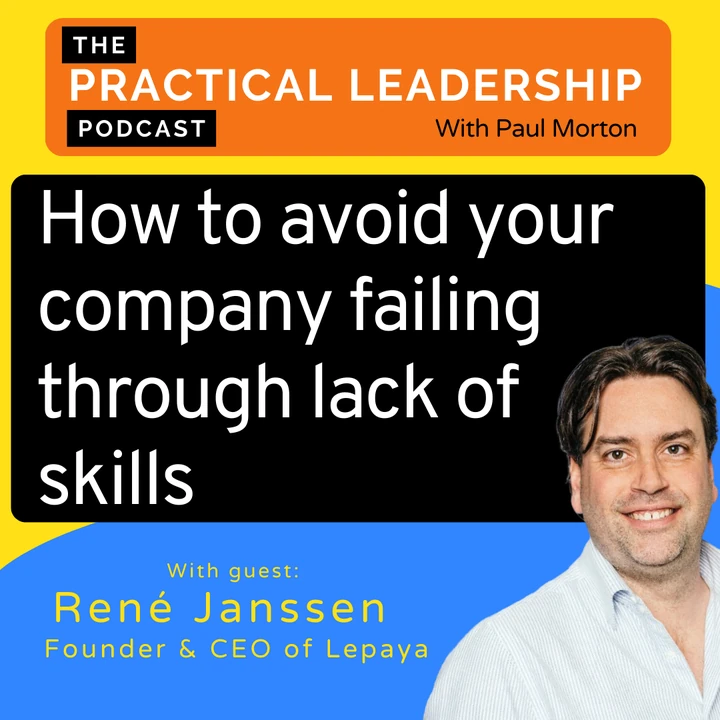
How to avoid your company failing
with René Janssen
Show notes
Introduction
Today, we have René Janssen, CEO and founder of Lepaya, join us. René has an impressive track record, having raised $85 million to support his innovative training platform. His journey spans from scaling startups to managing acquisitions by giants like Alibaba.
Summary
In this episode, René Janssen shares his invaluable insights on avoiding company failure through strategic people development. René’s experience facing challenges in scaling productivity and retaining talent, led him to create Lepaya.
Lepaya focuses on ensuring employees have the right skills at the right time, blending technology with human touch to enhance productivity and retention.
Key Models and Methods
- Right Skills, Right Time: Ensuring employees are equipped with the necessary skills at the precise moment they need them.
- Strategic People Development: Viewing talent management and development as a core strategic function rather than a reactive, operational task.
- Blended Learning: Combining e-learning with human-led coaching to address both technical and soft skills effectively.
Main Discussion Points
- Pain Points and Motivation:
- René’s drive to solve the pain points he experienced at Lazada, particularly around productivity and retention.
- The importance of experiencing pain firsthand to be fully committed to solving it.
- Challenges in E-commerce and Training:
- Issues faced in the fast-growing e-commerce market in Southeast Asia.
- The inadequacy of traditional learning methods and the need for innovative, scalable training solutions.
- Importance of Soft Skills:
- The crucial role of soft skills in driving productivity.
- The necessity of human interaction in learning these skills, even in the age of AI.
- Strategic Function of People Development:
- Making talent management a strategic priority.
- Aligning business needs with employee aspirations for mutual growth.
- Using data to measure the effectiveness of training and making iterative improvements.
- Role of Lepaya:
- How Lepaya helps organizations transition from operational training to strategic people development.
- The impact of combining technology and human facilitation to deliver effective learning solutions.
Memorable Quotes
- 00:06:37 – “If we don’t do something, who will? If not us, then who? If not now, then when?”
- 00:10:37 – “Soft skills are best learned from soft people. You need to learn how to deal with other people from other people.”
- 00:19:13 – “Collecting data on training effectiveness is crucial. Measure and be honest about the impact.”
- 00:24:26 – “What happens if you train people and they leave? Worse is if you don’t train them and they stay.”
Find Rene and Lepaya here:
Transcript
Automated transcript. Speaker labels and spellings may contain errors.
Paul
CEO and founder of an innovative category-leading training platform who's raised $85 million to avoid societal collapse in a marketplace of 3.3 billion people that you have the ability to help, and a $400 billion spend. [upbeat music] Hello, and welcome to the Practical Leadership podcast. I am your host, Paul Morton, and we are talking about leadership, management, and the various lives that surround it. It's my joy, delight, and privilege to bring into my studio some of the smartest, wisest people I've been able to find for your delectation and enjoyment, and I hope that you do get a lot out of the conversations that we have here. When you realize that your management team has grown too fast or you've inherited a new team and the fastest, best lever you have for growth and improvement is attached firmly to those managers, get in touch. I help you run management, coaching, and training programs that'll make a big difference really quickly.
You can find me at the Practical Leadership Academy website and on all the usual social channels. [upbeat music] René Janssen, CEO and founder of Lepaya. Thank you so much for joining me.
René Janssen
Well, thank you so much for having me and for this wonderful intro.
Paul
Well, I'm sure I did some short changing there, right? You know, obviously, there's much more to you than that. Would you mind doing a very brief introduction for my listeners?
René Janssen
Oh, I'm not sure if I can beat that intro, but as a, as a humble Dutchman. But, I mean, I'm a Dutch founder of a Dutch company, of a European company, Lepaya, where we, uh, yeah, help companies drive productivity and retention of their people by making sure that people have the right skills at the right time. Um, that's in a nutshell what it's all about.
Paul
Now, well, that's a good pitch, right? So that's the pitch that you train all of your salespeople. "Look, guys, all you have to remember is this. When you're on the phone, it's just this." Right?
René Janssen
And then it gets tough. I mean, right skills, right time. That's easy.
Paul
This is easy.
René Janssen
And what's right but, you know-
Paul
Do you have T-shirts? [laughs]
René Janssen
[laughs] I, I do have T-shirts.
Paul
You do have T-shirts.
René Janssen
[laughs]
Paul
I like that. So you, you said, you've said variously, um, that your reason for building Lepaya comes from your experience. Now, the best founders building the best businesses have suffered pain and have decided that, "Nope, saw that. Not enough. I'm, I'm not gonna inflict that on anyone else. I am going to solve the world's problems and fix the pain with which I am familiar." Okay? So what was the pain you were out to fix?
René Janssen
Yeah, fully correct. And, uh, I agree that, uh, that it really helps to have felt that pain before 'cause then you really go all out in, in fixing it. And, and Lepaya was a di- direct result of, uh, the previous company I was working for, uh, which is a fairly well-known company. Uh, Lazada, one of those, uh, rocket internet-backed companies that try to bring e-commerce to parts of the world where there was no previous e-commerce. And I joined them a bit over a decade ago, um, uh, when they really were starting, well, an e-commerce marketplace in the Southeast Asian countries, uh, everything south of China and east of India, where half a billion people would probably wanna shop online if there's a platform. Um, of course, that also held for the other people around the world, uh, but there was no platform. I joined them first on the commercial side. Uh, so helped kind of to scale up some of our countries, uh, first Vietnam, then Indonesia, um, into kind of becoming, well, the go-to place from an e-commerce perspective.
But what we kind of noticed is that as we grow, um, we ... The number of people that we needed to bring on board to help us scale the company, well, grew more or less in line with that, and that's of course not what you want. So 2016, um, we were sold into Alibaba, and they noticed something that I'd been telling myself, uh, as, as, as, as, as the commercial lead for one of our main, uh, main countries already, is that it was a bit odd that at 0.x% of the revenue of Alibaba, uh, we were employing, kind of relatively speaking, 10X as many employees. And even though at sub-skill you need some more people, uh, there was a clear challenge on productivity of our people, and that also led, of course, to retention issues.
'Cause if people feel they're not directly contributing, some people start to look for different opportunities, and sadly, your better people tend to look for opportunities faster than the other ones. Me having, uh, among the biggest crowds in the company, Indonesia, well, had suffered from that before, and it also had our debates with our leadership that said, "Hey, maybe we need to, um, well, enhance our focus on HR and kind of managing the workforce to really making sure that we drive the workforce to the extent that they can really, well, step up to the increasing challenges." And when the dust settles after the acquisition, I got a phone call, "Do you wanna get out of Jakarta?" Well, well, let me tell you, in any circumstance, you should answer that phone call with yes.
But when it was followed with a question, "Do you wanna move, uh, to, to Singapore, to our head office, and, well, solve the problem that, that, that, that you saw, which is how can we continue to scale the company without having to massively scale the number of people and retain the best people, i.e., take up the head of HR role?" I said, "Well, I don't know much about HR. Uh, I've been a client, if nothing else, but I do think there's a big problem and, uh, I'd love to help, help address it." But there's many things that feed into productivity, but in very simple terms, being clear on what you expect from people, uh, in certain levels or tenures in the company. Not that that depends in the whatever manager, uh, they report into, but be more or less, um, uh, fair and consistent about it is, is one of them. But at the moment you start saying, "Hey, as a sales leader or as a VP or as a starting trainee, this is the level I expect you to operate at before you can make a promotion," well, the immediate next step comes, "Okay, these are my gaps.
How can you help them fix that?" And that's what I started to look for. So I had five, six thousand people across eight countries. Uh, I suddenly had skill gaps identified, and then the question is: How can you fix that? Well, these were in the times that there were a lot of e-learning players come up. But I think there's a great market for e-learning players, but, uh, one of the, one of the key characteristics is that typically one in 10 people engages in some of these, uh, e-learnings. If you have a fundamental challenge and your solution, uh, is only used by 10% of people, it doesn't fly. So the only thing I could turn to was traditional learning companies, but this being Southeast Asia, this being the tech world, uh, just doing multi-day offsites in, uh, fancy hotels for training purpose didn't seem to fit the bill. So I started to look for solutions where I said, "How can I upskill my people, uh, in a way that makes as much use of technology as possible?" But where
that regards human communication, where that regards leadership, where that requires management capabilities which are neatly human, we still bring in coaches, trainers, facilitators to focus on exactly these elements, uh, that are unique to us. Now, how do you bring that together? That's what we started to roll out, huh? Focusing first on middle management, a tough spot where a lot of things come together, and then rolling it up to more senior management, going down to trainees, and really making sure that you start building a coherent set of capabilities and skills across the company. Long story short, huh, I think I like building things, but if you need a great HR, HR director, I can give you the names of some great people out there. So after a couple of years, uh, in that role, I done a lot of building. I left, um, and also thought, "What's next in my career?" And I thought, well, if I couldn't find, huh, a great kind of leadership or skills-building solution out there, there must be other people suffering from this.
So founded very opportunistically Paaya to help clients with the exact same problem I faced. How can you, with... in today's day and age, right skills, right time, help people to be effective and, and therefore typically also happier? 'Cause when do you go home with a smile on your face if you had a good day's work? And if you suffered and it was tough, well, it also has impact on your personal life. So I think it's one of those issues that helps society but also that helps every single individual in the work.
Paul
And frankly, if we don't do something about it, who will?
René Janssen
Exactly. Exactly. If not, uh, if not us, then who? If not now, then when?
Paul
Exactly. Change happens when people stand up.
René Janssen
I agree.
Paul
Totally. So you've got then the experience of the startup, the scale-up, the acquisition by the, the billion-dollar Alibaba, the international growth there. Worked in human resources. I like ... I actually quite like the words human resources. If you flip it around, it turns into resources that are human, and I think it starts to make more sense that way. 'Cause if you think of humans as resources, eh, it's, it, it's, it's less, it's less personal. And I think-
René Janssen
To be fair, I was always fan of the teams that, uh, rebranded HR teams into people teams 'cause made it more specific what it's about. Thoughts? If you turn it the other way around, then I think there is ... It, it has that same ring that, uh, that we're trying to get to. I agree.
Paul
There you go. And it, it is, it is the people piece that I think differentiates what you're trying to do at Paaya from pretty much everything else in the market. And you say that 1 in 10, um, 1 in 10... I mean, I, I've, I've worked in, worked with many different learning organizations, learning vendors, et cetera, and it is typically 10 to 20%, if you're lucky, organic usage of these different systems. But quite frankly, you could get 10 to 20% of anyone to do anything because they're gonna be interested in the next shiny thing. Turn this thing on, somebody's gonna push the button just to see what happens, right? So that's not, it's not impressive. It's not useful. If you're trying to effect meaningful strategic change and only 1 in 10 of the people are actually with the program, you ain't gonna get very far very fast.
So there's this disconnect that I think most people have in their organizations between what they're, what they're... They got this fabulous plan. They've hired lots of wonderful people. And yet, and yet just not quite firing on all four cylinders.
René Janssen
But the question indeed is, why are you not firing on all these cylinders if that's in place? And ultimately, the question is, how can you make sure that people are collectively successful with each other? It's not about his hard skills, huh? A marketeer being great at SEO, a developer writing great code is only useful in isolation. But when you connect those things together, uh, writing website based on the v- on the, on the, on the value prop of sales that's coded in the right language and that's attracting your right MQLs, that's how you start to get, uh, an organization to grow. But all these difficult, hard skill words that I dropped in there, those you can learn pretty quickly, and those you also will learn on the job 'cause that's what your direct feedback is gonna be on. But ultimately, this flow starts to happen only if you sit together, if you're aligned on your goals, if you identify the bottlenecks, if you do your stakeholder management properly, if you can, uh, charge the troops, if you need to change something and we're all going in the same
direction. Those are all very human skills, and those human skills, huh, are much harder, um, to acquire since, huh, there's a reason in the past they were called soft skills, and the soft skills are typically the hardest things to get, uh, to get right. And the way in which we're teaching those soft skills are still a little bit stuck in, in, in the past. So in essence, it's about, uh, then drilling down into what are, uh, the challenges that are stopping people from, from, from being more productive, which is not on the hard skills front. It's on that collaboration, uh, front. And an interesting statistic I always find is the number of connections that we interact with kind of on an annual basis. If you go all the way back, huh, about 25, 30 years to the mid-'90s, uh, the average professional would interact with about 100, 150 different individuals over the course of a, o- o- over a
year in a professional setting. That today has gone up to 450. That's about threefolded. That means your effectiveness just in dealing with information with others and making decisions and getting alignment and all of that, huh, has probably even many folded 'cause those people, they didn't come at you in one-on-ones, but they came into at networks. Yeah, so there was an exponential growth in how to be effective. And well, if you're being honest, I look 25 years back, I don't think the way in which we teach human effectiveness, leadership, interaction, social skills, has seen an exponential growth, and that's what's necessary.
Paul
I think that soft skills are best learnt from soft people, you know? They... You need to learn how to do things, how to deal with other people from other people. Yes, you can pick up theory. Yes, you can understand model, um, but you need to have it in the context of a human example or at least a human who you can ask questions of, who can phrase things in the right way and reframe things in your context. So it's this, the coaching, training, that combination that makes... That is, it is how we've done things forever. You've learned how to best get along with your fellow cave dwellers from other cave dwellers. You didn't read about it by looking at the drawings on the wall, you know? You could have learned about hunting from looking at the drawings on the wall because that's a technical skill, right? But how do you get on with other humans? How do you pick this up?
René Janssen
Exactly that. And then I think we luckily in a day and age that technology can play a role Yeah. 'Cause there's, of course, theories that make sense, there's an approach that makes sense, and, uh, some people would acquire that knowledge and that understanding better by looking at a study on paper or by look- watching a video about it. But then actually getting into that practice requires real-time feedback, and even in the age of day, uh, in the day and age of AI, where you can get some useful feedback out of this. I mean, if you would have AI running on this call, uh, I would be able to get the feedback that says, "Ah, maybe you're talking a little bit too fast, uh, and not dropping enough pauses in, and maybe," luckily it's a podcast, but, "You're moving your
hands a bit too much," and all of that, huh? But kind of if you push that one level deeper and say, "Hey, how are you g- really gonna get in front of a, let's say, challenging crowd and take them along on a change journey?" Well, I really think and hope, huh, that that's still gonna be human, and you do need other humans to learn that kind of, uh, interact-
Paul
So you've got two layers that I can tap into here. Two layers of wisdom. One is your own experience in many large organizations, some small organizations. You've started your own company. You're now the CEO of a fairly reasonable-sized, fast-growing organization, raised a ton of cash. People believe in you. You ha- only have to return three times investment. [laughs]
René Janssen
Exactly. Almost there. Almost there. Yeah.
Paul
Almost there. Almost there. Um, and then, and yet, and the bonus is that you get to talk to very many organizations. You get the feedback from all your sellers, you get the feedback from your network, your information, and the people you're learning from. You're evidently a learner. If you gathered all that together, what would be the most valuable thing that you could pass on to some other manager or leader in another organization? What's the one okay thing to do?
René Janssen
No mean a word, isn't it, Paul?
Paul
To pass on.
René Janssen
The struggle with one. Yeah. No, so I think it is really seeing, yeah, talent management, learning and development, people development, as a strategic function. So the moment you're responding, huh, to business leaders saying, "Hey, my team is not doing well at X. Can we get a training on Y?" Huh? You know you're very far from the mark. Uh, what you would love to do is get an assessment, hey, what does an organiz- what does our organization probably need today in terms of skills, where we are still falling short against our own standards and maybe against some industry benchmarks? And then let's push ourselves to make the analytical jump to, uh, what are some of the areas we need to develop more into? So what are the skills that we're gonna need in one, two, three years from now? Be very strategic and thoughtful about it.
It's not an easy exercise, but I always say, it's an easy exercise. I would do it myself, 'cause that's where you need really smart people to help you out with that. And once you have kind of those gaps, uh, be very considerate in offering your people not just one career track, don't believe in it at all, or one growth track, but also not just all kind of training opportunities out there. But say, "Hey, there's four or five kind of key directions that we need to develop our workforce into. Uh, this is what you can choose from given where you stand today, and that's the direction you can evolve into." So very much kind of finding the balance between having people pick and choose what they enjoy, also based on their personal aspirations and where they wanna go in life, but linked to, uh, the
business objectives that you have. And if you get those two together, so clarity what you need, and finding that real push/pull, seeing what do people want and what do you need as an organization, I think those are gonna be the organizations, huh, that out-compete their competitors, uh, over the next couple of years.
Paul
Yeah, I mean, I, I, I say deliberately that the highest leverage task anyone can perform in leadership is, is people development.
René Janssen
For sure, yeah.
Paul
You know? If I take you, who is good at something, and turn you into somebody who is outstanding at that thing, I take good and I make it outstanding. Across the board, I move the needle incredibly powerful, you know?
René Janssen
And the beautiful thing is you actually move it twice. 'Cause this person is, one, today and tomorrow, uh, gonna be happier and more effective or better at what they do. But because as an organization you invest in them, they're also likely to stay longer, huh? So-
Paul
Exactly
René Janssen
... actually, the value you create multiplies.
Paul
There's a third level to that as well, which is the, most organizations, most people don't think truly. They, they don't play chess, okay? You move the thing once, and then something else happens. Most people think about the move, and maybe about the other thing. What happens after that move? What happens after that move is you've trained the person, which is great, so then they're likely to stay, which is great. But if you've done that and that person's a manager, you've just improved the lives and the performance and the productivity of the cascade of teams that go below that person. That's powerful.
René Janssen
That's why you start to-
Paul
Yeah. This is, this is luck surface area, right? There's an idea of luck surface area. People like to be lucky, right?
René Janssen
Yeah.
Paul
So you go where the luck is. You want to give somebody one job performance, one, one potential pathway forwards. Well, you don't wanna give them 50, as you said, but give them five.
René Janssen
Exactly.
Paul
The organization, you've now made the organization five times as lucky.
René Janssen
Yep. And this is-
Paul
That's powerful
René Janssen
... that's super powerful, and, uh, if I'm gonna drill it down, it's all about you need quiet hiring. Uh, so figure out what skills you need in a couple of years from now. Uh, don't then go out and hire these people, but slowly build the organization and your workforce in that direction. Uh, we all spoke and thought about quiet quitting, which is of course something no organization is looking forward to, but the quiet hiring, the exact opposite, uh, is I think what, uh, what a lot, a lot of companies should focus a lot more on.
Paul
So quiet hiring, building people up from inside. You said people development needs to be a strategic function. How do I do that? I've got an organization of 250 people. Uh, what, what's, what are the three things I need to do to make this a strategic s- set of activity?
René Janssen
Everything starts, uh, of course, with some top li- uh, top level aligning that this is a priority. 'Cause if all your team meetings are gonna be about sales for this quarter and about a product roadmap for maybe the next quarter, uh, and, and, and, and at best you speak about the next performance management cycle, uh, if it, if it regards the HR function, you're not gonna get there. So I think truly being convinced that this is important is step one, and well, there's many ways to do that, but, but it starts there. If then you're convinced that that's the step, the question is, are you properly resourced, huh, for this? So do the people that make up, let's say, your people function or your HR function, are these operational people that run your salaries and your performance cycles and plan trainings, or are these people that fundamentally understand what you're after as a business and can translate that into interventions, whether that's training or learning or performance management or the comp and ben
plan that will meaningfully drive those, um, um, that can meaningfully drive, uh, these, these, these business goals one step forward. They will not one-on-one be the driver of that. Uh, I mean, if you drop your, increase your prices tenfolds, you can train your staff all you want, but your sales are not gonna go up. But the best-developed sales force will yield bigger results than other teams. So but do you have the right capabilities, mindsets, uh, experience in your HR teams to drive that forward? And then do you set them the right task? Uh, so if you go about asking them, "Hey, can we do this massive capability needs analysis," which builds, uh, on the old training needs analysis, which was all about asking people what they want to learn, yeah, probably you're not gonna get them. But kind of compiling where do we stand today, uh, leverage tools that can make, uh, assessments, also leverage research reports that from all industries have already quite
neatly mapped out what your likely gaps are gonna be and complement it with insider data, uh, then you have a good basis, and that you can build your skill trajectories on. And the last thing I'll add to that is ultimately data, data, data, data, data. Uh, because ultimately, if you start, um, collecting a lot of data on not just who did what training, but where can we measure that it moved the needle, uh, which behaviors were actually put in practice, uh, can we do... You really wanna be strategic about this kind of A/B studies 'cause it's, uh, even if you're just talking simple large training, uh, programs, you're not gonna roll them out all at once. Uh, so if you say, "Okay, we start in this business unit or we start in this country or we start in this team," uh, can we say that in the six months after, uh, the training, let's say, in customer service, uh, first-time resolution rate has gone up?
Or if you talk about leadership, uh, has the retention in the teams that those leaders have entered programs, um, uh, yeah, the retention has, has gone up. Or can you really just make it very specific what do you wanna achieve, and do you wanna kind of make the effort, which is typically pretty small, uh, compared to the effort you're, you're, you're, you're putting into the whole kind of initiative on measuring and being honest to yourself whether you're driving success, and do you then wanna act on that? 'Cause in my experience, uh, especially first times, you're not gonna get everything right. You see some very promising results, and in other domains, you're not gonna see any results. Well, what does that cause?
Are we, uh, training the wrong behavior, or is it not being applied in practice, or are we trying to measure the wrong results? But it takes a while to really become kind of an organization which internalizes this, and it, it, it starts, and my circle is there, but from aligning the organizational top level around this. So it's not something that an HR team just does. It's something that the management team or the executive team needs to do and needs to put the time, resources, commitment, focus in place to make it.
Paul
Thank you. How to quietly hire, how to make it strategic. I think th- there are two types of HR person. One is the professional HR who does pay, who does benefits, that sort of thing, and this, and that's a professional person who's come from that background, who's great, but typically very disconnected from business. The second, which I've seen be quite successful, is where you have a professional business person step into an HR role for a year, eighteen months, two years, something like that. And that can bring a lot of insight, but yet, but disconnected from the fundamentals of how you, how you manage. But you can support people like that because they bring a lot. And it's, what I've seen really, really effective is where you have sales or marketeers in that role because they're used to, exactly as you said, they're used to, um, developing pipelines.
They're used to developing programs, testing things, and understanding that stuff needs to iterate. You don't put it in place and it runs for twenty years. You put it in place, you test it, and then you fix it and fix it and fix it and fix it, and you're never done. You're never done.
René Janssen
I fully agree with you, Paul, but I'm gonna add two things to that. So the first, uh, and then having stepped outside in, into an HR role myself, um, I, I've... I'm a big fan, and that's also why I was allowed to step into it, uh, because the organization shared a vision of having non-HR people step into an HR role. But, uh, also beyond kind of, let's say, what I tend to call people operations, yeah, the, the, the salaries and the payment admin, there is science to it. Uh, so adult learning is a science, but also comp and benefits. Uh, there's lots of research already what works and what doesn't work. People engagement is, of course, not a new subject. So balance out, I would say, the people that really know the organization with the people that have the craft, uh, of-
Paul
Yes
René Janssen
... that you need in HR space, and make sure they cross-fertilize each other, 'cause that's ultimately where the power is gonna be for, uh, that the power, uh, or the, the, the value is gonna, uh, blossom. Um, and, which was the second point I was gonna mention, um, yeah, those sales and marketing people, I think there's one important skill typically is less prevalent in HR teams. It's actually just those simple sales skills. Uh, so the fact that something is available doesn't mean that the other party sees the value of it, and even just getting that cross-fertilization going. Uh, I think, uh, one of the first books I read, uh, on, uh, on learning and development by a, a lovely Israeli professor, uh, had a whole chapter about marketing your L&D programs.
And I was like, "Why does that make sense?" And I was like, "That makes total sense, and in essence, it's one of the more important, uh, function of it." 'Cause if you're sitting in a plant far away and getting those emails from corporate HR, uh, these are the, the emails that typically drop easiest into your tra- your trash, uh, your trash bin. Uh, so how do you make sure that you communicate the value and the impact and not what you're doing? And that's not something that always come naturally.
Paul
And it's such a low bar. It's such an easy thing to step over because the bar is very, very low. If you build it, they will not come. If you build it and sell it to them, you might, you know. What's in it for me? Well, here's a testimonial, here's a feedback, here's a case study-
René Janssen
Exactly
Paul
... and here's a... It's just stuff. It's just simple, simple stuff. Okay. We're going to, we're gonna move to wrap up. So in the context of this, how does Lapaya fit into this? idea that people development needs to become a strategic focus?
René Janssen
I think we do, we do two things there, right? I think by... We try, I try, let me make that very personal, to put that on the map, uh, by being out there, by speaking at many HR conferences, by speaking to you today, which are really explaining not just why I think it needs to be strategic, uh, who cares what is strategic and tactical, operational, but what the value is that I think we can unlock by moving, uh, into that strategic operation. Uh, ultimately, I think it's, it's a matter of life and death on company, uh, on company level. So the most competitive ones will, will get this right. Um, but then secondly, there's that big now question, and those are huge questions. Uh, the question is, what should I now do tomorrow? And, uh, both in terms of focus priority, and then how should I execute on that on a company-wide or sometimes even global scale? That's exactly what we do as a company. So once you have decided as a company that this is important, and you're gonna move away from training as an operational kind of, uh, function to learning
and development or upskilling as a strategic imperative, give us a call, and we'll be there to help.
Paul
If you had 10,000 billboards all around the world and you wanted to share just one message, what would it be?
René Janssen
Ooh, ooh. It's a tough question to ask me on the spot. I'll tell you, uh, that there is the reason my marketing team gets a lot of freedom, 'cause, uh, [laughs] they tend to look at my input and smile and nod and say, "Thank you for your input, and now we continue with our business." So this is definitely not my, my, my, my forte, but if I make it gimmicky, uh, I would go back probably to some version of the meme that you have seen floating, uh, all around the internet, huh? What happens if we train people or develop or upskill our workforce, uh, and they leave? Well, that's by no means worse than if you don't, uh, than if we would not upskill our talent workfor- our workforce, and they stay.
And I think ultimately it's as simple as that. Uh, um, the right companies will, will continue, uh, more and more will continue to very strategically invest in people. And, uh, today, uh, if, if, if, if not, uh, if not today, then when should we invest?
Paul
Well, if not today, then when is probably a fairly good phrase to put on your billboard.
René Janssen
Bit generic maybe, but you know, that's why I have the marketers. They can make that a bit more concise even. Yeah.
Paul
René Janssens, CEO and founder of Luppaya, thank you very much indeed for joining.
René Janssen
Well, thanks for having me.
Paul
And that's a wrap. I hope you enjoyed the show. Thank you for joining me. If there's ever anything I can do to help you on your journey, then do please reach out. You can find me on LinkedIn and all the usual sources. Do please subscribe, leave me your five-star review, and most importantly, get in touch with your comments and feedback. It's really how I grow, and that's what I'm doing this for. Thanks again. [outro music]