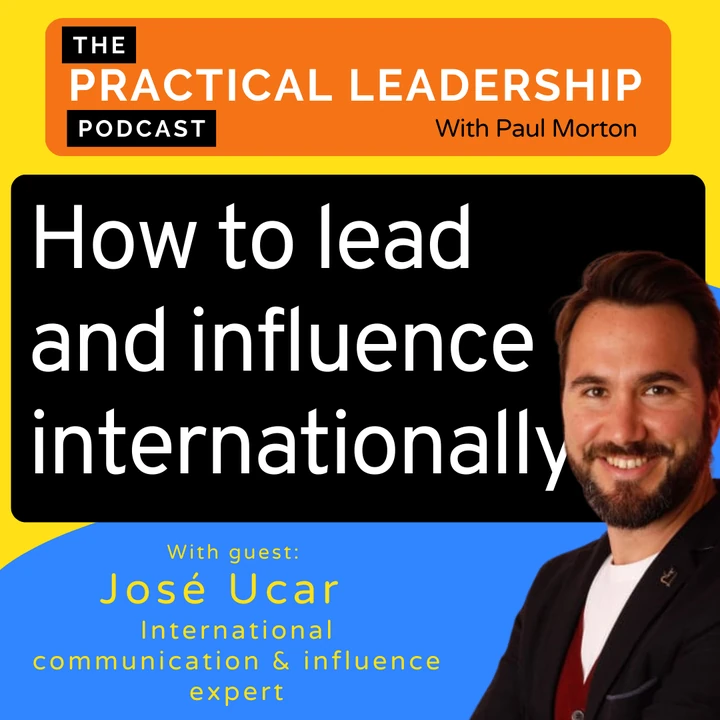
How to lead and influence internationally
with Jose Ucar
Show notes
In this episode, I had the pleasure of speaking with Jose Ucar, an international Amazon best-selling author and expert in global influence. Known for his Latin flair, Jose is a master communicator and coach who helps leaders navigate the complexities of international leadership.
Summary
In our conversation, Jose shares practical frameworks and methods to improve international leadership and communication. Drawing from his extensive experience, Jose introduces us to his “SIMPLER” and “FOAM” frameworks, designed to enhance effective communication across different cultures.
Key Models and Methods
- SIMPLER Framework:
- S: Slow down – Focus on the person in front of you and slow down your thinking.
- I: Intentional Influence – Communicate with intention.
- M: Multicultural Lens – Engage openly with curiosity about different cultures.
- P: Preconceptions – Recognize and clear preconceptions.
- L: Language – Be mindful of the proficiency level of the other person.
- E: Energy – Engage with contagious and compelling energy.
- R: Reflection/Reframe – Reflect on interactions to improve.
- FOAM Framework:
- F: Flexibility – Adapt to different realities and environments.
- O: Ownership – Take responsibility for communication outcomes.
- A: Adaptability – Align communication styles to build rapport.
- M: Mind the Gap – Recognize and bridge communication gaps.
Main Discussion Points
- The Importance of Intention and Reflection:
- Jose emphasizes the need to be intentional in every conversation. Reflecting on interactions helps leaders improve their communication skills and influence.
- Navigating Multicultural Communication:
- Understanding and respecting cultural differences are crucial. Leaders should engage with curiosity and adapt their communication styles to bridge gaps.
- Building Rapport and Connecting Emotionally:
- Effective leadership involves connecting on an emotional level. By understanding others’ perspectives and showing genuine interest, leaders can create lasting influence.
- Flexibility and Ownership in Communication:
- Leaders must be flexible and take ownership of their communication. By adapting their approach and being responsible for the outcomes, they can improve their effectiveness.
Memorable Quotes
- 00:06:08 – “After every interaction, if we want to be more intentional and get better in our communication, we can always have a moment of reflection.”
- 00:13:49 – “If somebody doesn’t understand, it’s your fault. It’s not that they don’t understand you, it’s that you haven’t explained yourself clearly.”
- 00:21:40 – “Leave people better off after interacting with you.”
- 00:18:27 – “Respect and acceptance are key to connecting with people from different cultures.”
Conclusion
Jose Ucar provides valuable insights and practical frameworks for enhancing international leadership and communication. His “SIMPLER” and “FOAM” models offer actionable steps for leaders to improve their influence across cultures. Tune in to learn how to lead and influence effectively on a global scale.
Find Jose here:
Transcript
Automated transcript. Speaker labels and spellings may contain errors.
Paul
International Amazon best-selling author of Global Influence. Someone who knows exactly how to simplify, improve and amplify international leadership. The influencer of choice, the communicator of character. Hello, and welcome to the Practical Leadership Podcast. I am your host, Paul Morton, and we are talking about leadership, management, and the various lives that surround it. It's my joy, delight and privilege to bring into my studio some of the smartest, wisest people I've been able to find for your delectation and enjoyment. And I hope that you do get a lot out of the conversations that we have here. When you realize that your management team has grown too fast or you've inherited a new team and the fastest, best lever you have for growth and improvement is attached firmly to those managers, get in touch.
I help you run management coaching and training programs that'll make a big difference really quickly. You can find me at the Practical Leadership Academy website and on all the usual social channels. Jose Ucar, thank you very much indeed for joining me.
Jose Ucar
Paul, what a pleasure to be here today as I like to call myself the communicator with a Latin flair. That's me.
Paul
I love it. I love it.
Jose Ucar
[laughs]
Paul
Mm.
Jose Ucar
It's a pleasure to be here, and I really hope the audience takes something of value at the end of our chat.
Paul
But that's the one thing that we try to do. The clue's in the name. It's the Practical Leadership Podcast. The idea is that we're gonna try and extract from your enormous brain some moments of value that they can take away and use immediately. And you are all about, as is in your book, influencing globally, which is basically how my job as a leader or as a manager is to influence people. I can tell them what to do, but they won't listen. If I persuade them that it is in their interest, that's more, that's more valuable. My challenge when I was doing this was I was speaking English. I speak some other languages, but mostly speaking English. And I was talking to the Brazilians, and I was talking to the French, and I was talking to the Norwegians and to the South Africans, to the Japanese, and I thought I was being clear, but I was not.
So help me out. Where do we start? What's it all about, Jose?
Jose Ucar
Where do we start, people? I have a lovely story, but I'm not going to go into long. But the premise of everything I do was a long time ago inspired by a great leader that helped me be where I am today. His name is Alan. He's a good friend of mine today, and he was very good at doing what I'm about to show and share with you. And just so you know, he used a version of what I'm about to tell you in a very short timeframe. So imagine I met him in the city of San Sebastian in Spain, and we traveled together to Bilbao, which is an hour away. During that time, an English guy with a very Cockney accent, and here the Venezuelan with a very strong Spanish accent. And 20 years ago, roughly, my English wasn't as good and I was more accustomed to different type of English. Again, international communication at play. During that time, Paul and audience listening, he managed to learn enough about me, about my motivators, my values, and he managed to influence me
to come and work for him in the UK. That was back in mid-2000. That moment, that hour changed my life. That hour got me. Of course, there's been some, some other, you know, things happening throughout the time I've been in the UK and traveling, but that moment was the beginning of the career and what I do today. Why am I sharing this, hmm? Because that's our role as leaders, hmm? Long term, that's what we're looking for. It's not just the fact that they listen or don't listen to us right now. It's the fact that we will help them evolve and get to places they don't even, they cannot even imagine.
Paul
That, the very definition of leadership is getting people to somewhere that they would not get on their own and extracting greatness from other people in the process. You know?
Jose Ucar
That's-
Paul
And I like conversation. That one conversation you had. My mom says, "Never underestimate the power of one conversation to change your life." Doesn't have to be this one, but one of them will.
Jose Ucar
Yeah, absolutely. And that's why I still remember that one. I'm, and I'm so passionate about that one conversation that we had. And I didn't know where it would take. Anyway, going back to what Alan did, in a way, I'm going to, I created a model which is called the SIMPLER, the SIMPLER steps. Okay? So these are steps that you can follow when you're communicating with people from different cultures, from different countries, people with accents. And the S of the SIMPLER is all about slowing down. Very si- slowing down. And this is not just slowing down because I'm going to speak slow. No, you slow down your thinking, and you begin to focus on the person that's in front of you. Then the I, I'm gonna give you a summary of it to span too much on each one of them.
Then the I is for intention. Influence. Effective communication is about intention. Where am I going with this conversation? It's not just random. What am I looking for? What do I want at the end of it? How can I, especially as leaders, how can I impact that person positively? Then we are international, right? Alan from the UK, Jose from Venezuela, living in Spain at that moment, having a multicultural lens. He asked me where I was from towards the end of the conversation. Multicultural lens you will always find, especially nowadays, people from different cultures, different backgrounds, different accents engage openly with curiosity. That's the M. Then the P, preconceptions. We are full of preconceptions when we hear accents, when we engage with people from different countries or even from, you know, our same city. We are loaded with preconceptions. So by recognizing those preconceptions that we have, then we can go, as I like to say, to an encounter with a human being with a Clean, you know, piece of paper, yeah?
White canvas, nothing in there, and then you just then, going back to intention, you focus on the person. Then the L for the language. Especially for English-speaking people, you know, you do it as a first language, be mindful of the level of proficiency of the other person, okay? When you have that multicultural lens, you empty preconceptions, you are intentional, you slow down, you can begin to connect better. Because back then, people, and Paul, when Alan spoke quickly, I wouldn't get not even 1%-
Paul
Mm
Jose Ucar
... with his Cockney accent, okay? Then the E of the SIMPLER, we get into the E now. It's all about energy. But then energy, what do you mean, Jose? Energetic engagement. Alan didn't come holding me or anything, but his energy was compelling, was contagious. The, what he was transmitting to me in terms of, you know, his interest in what I was saying, was extremely engaging. And finally, which is something that I don't know whether he does it or not, but I recommend in order to close that loop of the SIMPLER, is the reflection process. Reflection or even reframe. Reflection because I strongly believe after every interaction, if we want to be more intentional and get better in our communication, become more influential, become better leaders, we can always have a moment of reflection.
How did that go? Is there anything I could have done differently? Is there anything I need to reframe, change the meaning of that situation in order to improve? And that is what I took away, apart from many other things from that conversation, in terms of easy-to-apply and follow steps. So there you have the SIMPLER to change people's lives. I leave it there.
Paul
Jose Iturralde, thank you for joining me. Here we go. We're done. That's it. We'll just finish there. Oh, my goodness me, what value. How's that? SIMPLER. Slowing down, intention, multicultural lens, preconceptions, language, energy, and reframe or reflect. I love it. Absolutely love it. Okay, practically then, that's the model. These are the things that I need to think through. This is, this is what I need to begin to internalize. And like any good model, I can see that you can simply try one at a time. So today I'm going to just make sure that I'm slowing down my thinking and my speech. T- tomorrow I'm going to be slowing down my thinking and my speech and making sure I'm paying attention and actively listening with intent. The day after, I'm going to consider, and then so on and so on.
But I've got 10 direct reports in 10 different countries, and I want to get my message across to all of them. I want to influence them such that they want to do what we want to do. We wanna go in one direction. We want to take our teams. So typically, we're talking to managers, leaders here, who have in their, in themselves, multicults. How do we then, how do you get your message in the most influential, most successful manner? What's, what do we do with-
Jose Ucar
I'm thinking about two, two things I can share. Give me one moment. Which one would be best right now? Let's try this, Paul. I, I call this the, the FOAM framework, okay? F-O-A-M. And I'm gonna call... Uh, well, I decided to call it the FOAM because many of my interactions throughout my time of travels, leading and speaking, many of my human interactions have gone really well, okay? But there have been some that gone the complete opposite, and it felt as it was, it, I was just, just burning. I mean, flames. It's all I could sense, you know, those interactions really not working and going, you know, apart. And I, as I started writing the book, those situations would come to mind. I mean, those two situations, you know, engagements that didn't really go well. What, what could I have done differently and, you know, started reflecting. And I came up with the, with the FOAM to put out that fire that I perceived during those engagements.
And the F of it, which then will apply to our human interactions and to answer your question, the F stands for flexibility, okay? What do I mean by flexibility? We are always creating a reality, okay, through our values, through those preconceptions that we spoke about, through our beliefs, okay, experiences that we've had in the past with different people. So my invitation is to be very flexible in terms of how you carry that reality and apply it to different environment. If you're speaking to a person from Venezuela or a person from the States or a person from the UK or a person in Sweden, it's important that you're mindful of the reality you're creating in terms of flexibility because you might be interpreting
things in a Venezuelan way when you're communicating with someone in Sweden. But you still may not know exactly what is it in terms of the Swedish behavior. So flexibility will give you that openness, okay?
Paul
Mm-hmm.
Jose Ucar
It goes as being in the moment, and what am I perceiving from that person? Am I perceiving a threat, a misunderstanding? What's going on? Flexibility is key. Then I go on to, if I follow the FOAM, flexibility in terms of your interpretations of things. Then the O is ownership. I strongly believe in ownership when we communicate between the two of us right now, in the audience, people across the world. Because if that communication piece doesn't go well, okay, just like, you know, you're trying to put out that fire, at least that's my interpretation of it, then if it doesn't go well, you go back to it. You own it. You don't go blaming the other person. "Oh, you know what? The American didn't understand me. Oh, you know what? The people in India, they don't get me." No. What you do with ownership and flexibility combined, you go back and think, "What didn't work?
How can I change my way? How can I change my approach? What can I try different?" Because especially as the leader, you are the one in charge of influencing that human being, and you cannot give up. That's the O in terms of the ownership.
Paul
Mm-hmm.
Jose Ucar
And then I go into the A, that here is all about adaptability, okay? I'm going with flexibility. I'm owning the message. How do I adapt my communication? How do I find the alignment with that person? Very simple. I bring loads of energy because I'm very Latin, okay? But if every time Especially without knowing the person too well. Every time I brought up that level of energy and Latin Americanism to my engagements in the UK, in Sweden, in some countries which, in Germany, it has broken rapport. So the adaptability piece is, how can I connect to their energy? How can I connect to what I'm perceiving? That's why flexibility is so important. And then you can get them to your side and to your end and c- begin to explore what you are like as well.
But adaptability is key in order to create rapport. And then finally, Paul, just to wrap this up, every time we go and interact with people, every time in communication, there will be a gap, okay? And the M of the FOEM process or steps is just like they say in the Tube in the UK, in London, mind the gap. Just mind the gap because there will always be one, and your role as the leader is to bridge that gap. And that gap is not the one gap. It will be there w- today. Tomorrow it can change because we're emotional beings, and we're always changing. That's why flexibility, ownership, adaptability, and always minding that gap is key to communicate with anyone worldwide. So what I'm doing with this, people, is challenging those, again, preconceptions, the fact that because I'm Venezuelan, I'm always late, for example, or I'm very fiery, hmm, or the fact that the person in India is going to be
a bit more composed and will pay more attention and be more, you know, attentive and follow instructions. What I'm doing with this is that it's adapting to every human being, okay? And challenging the umbrella approach under which, woo, we place everyone. So it's challenging generalization. I'll stop there because I think I've shared enough for now. Over to you, Paul.
Paul
That's, that's pretty good. That's pretty good. Flexibility, ownership, adaptability, and minding of the gap. I think when you're trying to get a message across to somebody, I think, yes, absolutely taking ownership of the fact if somebody doesn't understand, it's your fault. It's your fault. It's not their. It's that they, it's not that they don't understand you. It's that you haven't explained yourself clearly. And it goes to, it goes to the, the golden rule, you know? So we started off with the iron rule, which is might is right. And then we went on to the wooden rule, the silver, an eye for an eye. And then you have, don't do any bad things to people. But then right 2,000 years ago, you get, "Do unto others as you would have them do unto you," which people misinterpret slightly because they neglect the fact that you don't treat other people the way
that you want to be treated, but you treat other people the way that they want. And if you take that into your messaging, and you take ownership and responsibility of communication, the gap, ownership of the gap as much as the message, it's exactly what you're talking about, and understanding what you need to hear in the manner that you need to hear it, matching your energy, ma- I love this. This is such good stuff.
Jose Ucar
Of course.
Paul
It's brilliant.
Jose Ucar
I'm liking, I'm loving the, the way in which you're explaining and following it up. And yes, it, it is about communicating. I mean, doing to them, as you said, in terms of what they need, how they do it, okay? Because then we become very influential. When we get into their world, then we can lead them also to come out, come out of that box, if that's a box, for instance, or stretch and explore some other areas of their personalities, of how they do things, expand on their skills. But then that is what you're doing. Lovely, I mean, love the explanation. Just creating that connection by-
Paul
Yeah
Jose Ucar
... by doing, doing unto them what they, yeah, I don't, I cannot even rephrase it or anything. So that was fantastic. There goes.
Paul
Well-
Jose Ucar
There goes my English skills today.
Paul
And I'll take that. I'll take that. Well, there's the idea that we're connecting to people, and the way that you connect with them is by showing them that you care about. You don't have to like them. I always used to say that. You didn't have to like the people you work with, but you do have to love them. You actually have to care about them to the extent that you will build them up, you will help them to grow, that you will make them successful, whether you like them or not, because that's your job. Um, and it's this idea, agape. It's this, the willful goodness that you want to see in other people. And making that connection, I think, requires an emotional connection. The root of the word emotion is, I think it's something like movare, which means to move. And if our jobs are to move somebody from point A to point B, where they would not get on their own, we can only do that by pulling them, right?
You can't push. You can't force. But you pull, and you pull by an understanding and a connection, as you said, with the emotion. Now, my challenge for you is this: if you and I are talking, we are of a cultural understanding where we are open enough to share just enough of our emotional world that we can connect. But there are many cultures where it is, it's closed, or it is more reserved, and making that emotional connection is almost impossible. In those cases where the culture is quite fundamentally different, I think some Asian cultures versus some European cultures, so, uh, th- those sorts of challenges can be really difficult to, to deal with. When you're talking to people, can you give us an example, perhaps, when you're talking to people where they have, like, let's say an American and what's going on?
Jose Ucar
Well, there is something here, and I like when it comes to the culture or the barriers as well that we put up or the masks we wear. I'm giving you different things. They all create what I call a bubble, okay? So we're presenting ourselves in bubbles out there into the world. The culture can be one of those bubbles. And what I've always looked for in my human interaction as a leader and as a trainer, a coach, and also as a human being, is to understand the bubble in order to burst it, okay?
Paul
Yeah, what?
Jose Ucar
It doesn't, it's not something that- Will happen overnight. It may never happen, but I will give you an example. I worked for many years, not, sorry, not for many years, for a couple of years, let me be more precise, with an incredible lady from India. Incredible. But at the very beginning, she wasn't that incredible because based on the cultural element and her household, she wasn't supposed to speak up. She wasn't supposed to... And she was working for me back then. This is why I believe this is relevant. She wasn't supposed to share her points of views. She wasn't supposed to come up with ideas. She wasn't supposed to put herself out there, okay? So that's the bubble she presented, and a high level of lack of confidence. That was the bubble.
Two years later, applying some of the things I've been sharing, okay? With loads of good questions and good pulling, but always with the intention of, of how can I get through this? How can I burst at least part of that bubble, if not every? I got through to her. The culture didn't change. The culture remained the same every time she went back home or, you know, logged off one of these calls. But during our interactions, she became more interactive, way more dynamic, to the point, Paul, and audience listening to this right now, to the point where she even ran some of the live events I was running on Zoom. I had a, a show where 10, 15, 20 people would attend. It wasn't massive, and I left her to run some of those shows when I didn't have time. So all the beliefs and all of that which was within that culture, you can begin to get people to come out of it, okay?
It takes time. It takes patience. On occasions, it may not work, but if you still believe, you will connect with the human being behind that, and then you can help them unleash that greatness, which I think is a version of what you mentioned before. But then it's, that's why I like bursting the bubble because you just go tick, and then you know, oh, it's not, it's not there yet until it go pop, and you get to what's behind it, and you unleash potential. Does that answer that question, Paul?
Paul
It does, I think, in part.
Jose Ucar
Great.
Paul
I think there's, there's an aspect that I'm both comfortable and uncomfortable with here. And I, I, I-
Jose Ucar
Mm-hmm
Paul
... you need to bear with me as I try to work out what I'm trying to say.
Jose Ucar
Absolutely.
Paul
There's the idea that, yes, we have to get through the culture to the individual, but part of me wants to say that we have to not assume cultural superiority in a way, in that our culture is the one that permits open expression of ideas, et cetera. And that in order for somebody else to do the same, we have to break through part of their culture in order that they can express themselves in our way. Now, I'm no great-
Jose Ucar
Mm-hmm
Paul
... liberal and believer in anything nonsensical, but I'm just conscious that we all have an intrinsic value, and everyone's experiences makes them whole. How do we respect that some individual is whole in themself and still communicate and still create and still work with them?
Jose Ucar
Yes. No, absolutely. And I start, respect is a big thing. Respect and acceptance I would say are some of my values. And I may need to provide, provide more context here as well because these are some of the things that she said she wanted to do. And she said, "You know, I want to..." There, there were things that she wanted to do, and this is why the generalization, right? When we go and generalize because then I'm not speaking about every culture, but then through conversations, you get to explore, "What do you want? How can I help? How can be part of it?" And when it comes to international communication, I strongly believe it's important that all of us in our way, okay, step out of that what, what a culture could be restricting us in doing and explore some more things. If I was stuck in my culture and the way in which I do things, I wouldn't be speaking to many people out there.
I wouldn't be engaging, you know, with loads of different cultures because they just know what I consider the right thing to be. So my, my invitation with what I do also, Paul, is, hey, we have our cultures. We are whole in the way we are, yes, and there is also the opportunity for us to expand and explore and connect with out there, with, with what is out there. Because then otherwise, we all operate in our bubbles, and we are whole in our bubbles, but then we don't mix.
Paul
Oh, very nice. Very nicely done. So we've got some really valuable frameworks here. We have the simpler framework. We have the foam framework. We have the idea that we need to connect, burst the bubble here with respect.
Jose Ucar
Yes, and acceptance. Yes.
Paul
And acceptance. Respect and acceptance is a powerful one. If you had an opportunity to share one, if I gave you 10,000 bill and you could write one message all around the world, everyone would see, what would that message be?
Jose Ucar
I go very slowly with this. Leave people better off after interacting with you. That would be my message. Leave people better off after interacting with you.
Paul
I like that. That's very good. Very good. Now, where can we find your book?
Jose Ucar
My book, Paul, is available anywhere from Amazon to any other outlet. If you just type, uh, Global Influence on Google, you will find the different options. Potentially mainly Amazon, but it's available on Barnes & Nobles and W.H. Smith, et cetera, et cetera. So it's out there.
Paul
And where can we find you when you, we need you to come and help us build stronger international relationships or adapt the way that we speak?
Jose Ucar
I'm gonna make it very easy for everyone out there. You may have heard about Google, yeah? It's been around for a while now.
Paul
It's been around.
Jose Ucar
Yeah. [laughs] So if you type my name, Jose Ucar, J-O-S-E U-C-A-R, you will find my website, my blogs, publications, podcasts, interviews, like, you know, the one I'm having with Paul today. Joseucar.com is my website. I'm available on different social media channels. But then Jose Ucar on Google, you will either find me or my dad, and my dad hasn't got as much hair as I do.
Paul
[laughs]
Jose Ucar
That's how you will be able to tell the difference. That's how you're telling us apart.
Paul
Then it just remains to say, Jose Ucar Jr., thank you so much indeed for joining me.
Jose Ucar
My pleasure. Thank you, Paul.
Paul
[outro music] And that's a wrap. I hope you enjoyed the show. Thank you for joining me. If there's ever anything I can do to help you on your journey, then do please reach out. You can find me on LinkedIn and all the usual sources. Do please subscribe, leave me your five-star review, and most importantly, get in touch with your comments and feedback. It's really how I grow, and that's what I'm doing this for. Thanks again. [outro music]