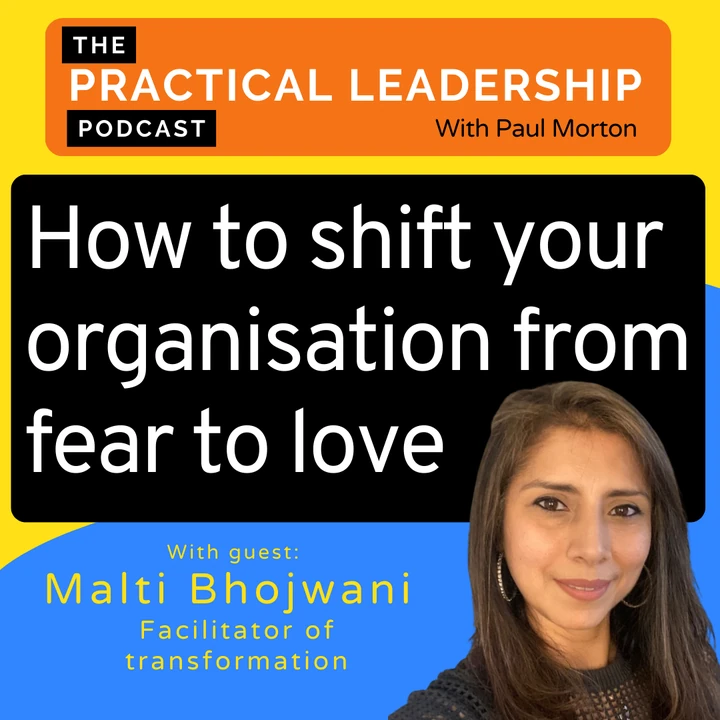
How to shift your organisation from fear to love
with Malti Bhojwani
Show notes
In today’s episode, “How to Shift Your Organisation from Fear to Love,” we’re joined by Malti Bhojwani, a seasoned executive coach and author, who shares her expert insights on transforming workplace environments.
Malti introduces us to impactful frameworks for fostering a shift from fear-based to love-based organizational culture.
She emphasizes the importance of leaders beginning this transformation by introspecting and shifting their own mindsets.
Key steps include:
- Creating Vision and Tension: Identifying a ‘promised land’ or a ‘burning platform’ to motivate change.
- Evaluating Current Practices: Assessing current behaviors and practices against desired outcomes.
- Adopting Love-Based Practices: Encouraging behaviors rooted in trust, transparency, and accountability.
great quotes:
- “Organizations don’t transform. People do.” Highlighting the focus on individual change within organizational transformation. (00:02:28)
- “From fear, including micromanagement and control, to love, which includes accountability and trust.” Discussing the shift from restrictive to expansive organizational practices. (00:05:04)
- “Behaviors are driven by mindset.” Underscoring the need to change underlying beliefs to alter behaviors. (00:03:45)
This episode is a must-listen for leaders looking to cultivate a more dynamic and supportive workplace atmosphere.
Join us as we explore how to navigate this crucial shift in organizational culture.
Find Malti here:
Transcript
Automated transcript. Speaker labels and spellings may contain errors.
Paul
I choose joy, she says. She knows how to rewire your mind for fulfillment and authenticity. Accomplished executive coach, senior advisor to McKinsey, and author of Mastering Your Life. Hello, and welcome to the Practical Leadership Podcast. I am your host, Paul Morton, and we are talking about leadership, management, and the various lives that surround it. It's my joy, delight, and privilege to bring into my studio some of the smartest, wisest people I've been able to find for your delectation and enjoyment. And I hope that you do get a lot out of the conversations that we have here. When you realize that your management team has grown too fast or you've inherited a new team, and the fastest, best lever you have for growth and improvement is attached firmly to those managers, get in touch.
I help you run management coaching and training programs that'll make a big difference really quickly. You can find me at the Practical Leadership Academy website and on all the usual social channels. Malti Bhojwani, thank you very much indeed for joining me.
Malti Bhojwani
Thank you for having me.
Paul
Now, the introduction was far too sh- far too cursory for somebody of your experience. Would you be so kind as to properly introduce yourself to me?
Malti Bhojwani
Thank you, Paul. Yes, my name is Malti, Malti Bhojwani. You got it right. I am Singaporean, so I live in Singapore. I was born here, um, but I've lived in Australia. Coaching, uh, since my early 30s. What got me there was, uh, yeah, I was ... I found myself young, divorced, uh, looking after my daughter mostly by myself, and really questioning life and wondering how I got myself into this mess, as that, that's how I perceived it back then. And then I stumbled on a lot of, uh, life-transforming books and workshops and teachers, and I was, uh, I, I was bought in. I was like, "This is what I wanna do for the rest of my life." That's what I thought. "I'm gonna go out there, and I'm gonna become a coach." And so I did. I embarked on that journey, and I, yeah, managed to, to get a lot of accreditation and studied a lot, and I started coaching. And then slowly, that developed from one-on-one coaching.
It developed into coaching groups and teams and organizations. And I met, um, yeah, firms and consultas- consultancy firms like you ex- you mentioned earlier, uh, like McKinsey and others. And I've been supporting clients with team, team alignment, bringing teams together. So it's like the same. It's still coaching, but it's coaching for the team and mainly on a long journey.
Paul
So the challenge, I think, is when you're coaching one person. No, that's not true. Not the challenge but the joy when you're coaching one person is you see individual transformation. If you're, if you're fortunate and you ask the right question, you see individual transformation. The challenge is to affect meaningful organizational change. You need lots of individual, and there's only so many hours in the day. So how do you then, in the context of a big group of people, get them all to want to change? How do you change one person's mindset without using a stick? How do you change a team of people's mindset without using lots of sticks? What's, what's the shift in mindset that you can affect that then leads you to be able to do stuff for the company who's actually paying the bill?
Malti Bhojwani
Thanks, Paul. So Richard Barrett, who is another, yeah, really great teacher in this field, he has a great quote which says, "Organizations don't transform, people do." So from there, if, if a leader wants to transform his organization, his or her organization, the first thing that they need to do is introspect and look at what's going on internally for them and shift their own mindset in order to lead this transformation. So I think it begins there. And then to your question about time, so change only happens when there is an impetus or some kind of a tension. Like, either you have this promised land that you wanna get to, or you have this burning platform that you want to jump out of. So often what we do is try to bring that tension into the room. Let people see that, oh, where do you wanna be?
What do you wanna create together? What is your aspiration? What are your values? What are your pur- what is your purpose? And then we have that, and then we create ways for people to start looking at, "Oh, where are we now? So what are we doing now that will support us in getting there? If we just put in, you know, more resources, more time, we power up the fu- the engine, and we just keep going as we are, will it take us there? Or is there some kind of upgrade that needs to happen, um, within us as a team?" So I feel that that's where people start to see that, okay, we need to start behaving differently. And if we need to start behaving differently, then we all know that behaviors are driven by mindset. We are motivated by our thinking, our fears, our thoughts, our beliefs. So the transformation has to happen there underneath the behaviors before you can transform an organization.
Paul
So it's pain or gain. You've got pain-
Malti Bhojwani
Mm.
Paul
Or you want-
Malti Bhojwani
Mm-hmm
Paul
... to gain, right? I'm being really glib and shorthand here. We've only got 30 minutes, so let's get it done.
Malti Bhojwani
[laughs]
Paul
You've got pain or gain. So you either want to achieve something new or different, or you've got a problem that you want to fix. So you're looking to fix something within yourself so that you can then in turn fix the behaviors with ... You're, you're manifesting, which will hopefully result in resolve, resolution to the pain or to a new way of doing things moving towards the gain. Um, you mentioned fear. I would also talk about love. They are the two sides of the same coin. You have this continuum of emotion between fear and love, and everything else is shades. When you're looking at, um, let's say, a, a, a gainful transformation where you're looking to grow, help people grow, which of fear or love, or what aspect of the mindset shift do you think is most important, and how do you get it?
Malti Bhojwani
Yeah. There's, again, a lot of research out there, but I will simplify it the way you did. It's like either you are operating from fear, which includes ... In organizations, it would include micromanagement, control, uh, manipulation, bureaucracy, blaming, finger-pointing, uh, risk-averse. So all the things that are very limiting. Or you're operating from love, which is expansive, accountability, ownership, trust, transparency. So you're either, you know, operating from things that limit you, hold you back, creates entropy, waste of energy within you and the organization, or You're operating from purpose, love, so above the line. That, that's how I, yeah, I would say it.
Paul
I can see, I mean, you've got ... You said you, you've spent some time with McKinsey there. I can see definitely a four box McKinsey graph with fear, love, pain, gain. In which box do you find yourself-
Malti Bhojwani
[laughs]
Paul
... with little red and green dots. I can see an exercise like that.
Malti Bhojwani
Yeah, two-by-twos.
Paul
Two, a nice, nice two-by-two grid there. Okay. The people that you deal with, the people who are the most, um, influential in most organizations are the leaders, the managers in those organizations. It's their mindsets, it's their leadership skills or lack of skill that leads people, leads the organizations towards the gain or holds them back in the pain. What is the shift in mindset then for those leaders that they need that's what's missing?
Malti Bhojwani
Yeah. It's different for each leader. I believe that in the fact that they've made it that far in their careers, they have definitely acquired, cultivated some really awesome attitudes, values that they're living, and that's how they got to where they are. I, I, I, I like to trust that, that they wouldn't have reached this level of, of working with people because it requires so much more than just their tech skills and the abilities that got them hired in the first place. In order to lead people, they obviously have learnt to collaborate. They've learnt to press that pause button and learn to not just blow up and react. They've learnt to be more composed, more calm, so that they choose responses that will be helpful to the teams that they lead.
'Cause as a leader, you are touching lives every single day. You are role modeling, whether you know it or like it or not, you know? Whether you like it or not, people are watching and listening to you, gleaning from you. And so you need to really be mindful and be caring in how you are going to be perceived. Another great quote comes to mind. Yeah, like you, I love to read as well. Uh, Viktor Frankl, right? Between a stimulus and a response, there is a space, and in that space is that, is that opportunity for us to choose. And I think that that is the key, the ability to find that space for ourselves, um, take that breath, um, and then this is gonna open a whole new conversation because it's breath is the only thing in our
autonomic nervous system that we can actually influence. So if we can actually, you know, take that deep breath and pause in that moment, we are now able to, to choose where we wanna go from here versus just running on this autopilot.
Paul
Autopilot's a good one. Autonomic, no, autonomous. I can't even say that word. I haven't had my coffee.
Malti Bhojwani
[laughs]
Paul
The automatic bit of your nervous system, yeah. I think not choosing is all equally a choice. It's an choice out of ignorance. It's one of those I-don't-know-what-I-don't-know thing. But as soon as somebody has brought to their attention that you need to be deliberate in your actions, deliberate in your responses, and before you choose what you're gonna do with a task that's come to you, before you respond to the, the stimulus, you have, you have a second, everyone has a second. President has a second before he pushes a big red button and the missiles are flying. You have a second before you choose whether it's vanilla or strawberry that you're gonna have in your ice cream. You choose. If you choose not to choose, that's equally a choice, but it's not a very good one. How, I think, and I, I'm afraid I keep going in the hows because the hows are the transformational bit.
The, the what is important. We identify with what. But unless you ask people the how, they, they sit and they say, "Oh, this is what I would do." No, no, do or do not, Padawan. There is no try. Do.
Malti Bhojwani
Yoda.
Paul
Oh, yes. How? And I've forgotten the question I was gonna ask, and it was really, really good. Darn. Oh.
Malti Bhojwani
[laughs]
Paul
You ask, what would, what would you ask you at this clever point in time? H- what, what's the how behind that?
Malti Bhojwani
So I have a how that just, uh, I just, uh, realized as you were speaking about autopilot. Wouldn't it be awesome, like, wouldn't it be amazing if we could reprogram the autopilot to do what we want it to do versus what we don't want it to do? So what if we all learnt how to reprogram that autopilot that used to do a certain thing that we have now discovered, oh, this is not helpful. This is not, uh, impactful. This is not gonna take me to where I wanna be in my leadership, in my life. Uh, and if we could reprogram that autopilot into something that will be more productive, helpful, joyful, and all the good stuff. So to me, that's one of the magic things that we can learn for ourselves. It's age old. Um, it's in our scriptures. I think lots of gurus and teachers have taught it because it's, to me, it's the, it's the truth. It's reframing, uh, how we think because yes, thinking is automatic, but like you said, if we can take that pause, even in our thinking, and pause and, and just start to wonder, what, what am I thinking?
Is this helpful? Is this train helpful? Are these questions I'm asking myself, are they going to help me grow, expand, transform, or are they taking me further and further down, um, a rabbit hole? So being able to identify, pause, notice my thinking, and then find a way to start reprogramming, for the lack of a better word, reprogramming so that my go-to, my go-to in the future becomes a new habit of thought that I create which is helpful versus-
Paul
Mm-hmm
Malti Bhojwani
... unhelpful.
Paul
Yeah. There's a, there's a line from Psalm 23 which is, "As a person thinks, so will their heart be." So it's the power of thought, I think, is recognized in that the things that you think about. If we knew how powerful our thoughts were, we would be very careful about the things that we think about. There's, um, our great friend who is a very large man. He likes his pies and his beef, but he also loves his mountain biking. And he says that he's very, very careful not to stare straight ahead, but to stare slightly to the side. 'Cause if you're going down a path and there's lots of trees and you look at the tree, you're gonna hit the tree. Don't hit the tree. Trees hurt, he said. The thing that you're staring at, to try and avoid it, is the thing that you end up hitting.
Malti Bhojwani
Thank you, Paul. I love that, and it reminds me of another one of my favorites, which is worrying is like praying for what you don't want. Again, taught to me by one of my teachers who learnt it from, if you've heard of, uh, Maharishi Mahesh Yogi, the founder of transcendental meditation, uh, so I believe it came from him. Um, but I write it everywhere now. I love it because it really helps me realize that by worrying, we're thinking of all the things we don't want, but we're giving so much energy and so much focus on what we don't want that we are actually making manifest the thing that we don't want.
Paul
Yeah.
Malti Bhojwani
It's exactly like your story about the mountain biker, right? You're heading straight for the tree instead of looking for the gaps. So how about instead of worrying, we replace it with ... I'm not saying, you know, to just be an optimist and to not think about risk. Obviously, when you're running businesses, you have to be, um, I mean, you have to, you have to be careful. You have to mitigate, for sure. But I think all of that comes naturally anyway to a lot of leaders. What doesn't come naturally is the other side of the coin, which is, great, I've done everything I've, I've needed to do, my due diligence. I've done everything to ensure that this project will not fail. Now, the rest of this energy is much more powerful if we spend it on what we do want. I find this especially powerful for parents 'cause, you know, like I, my daughter lives overseas, and my tendency used to be to worry for her.
Worry when she drives, worry when anything, you know, worry, worry, worry. But when I learnt this, I was like, "Malti, stop it," you know. "Stop worrying. Stop seeing these horrible potential things. Instead, just see everything that I'd love her to experience." So what I do now is I send, instead of worry, I just send positive thoughts, imagine her having a wonderful drive, a wonderful day, a wonderful workday. I find that it's just so much more fun. [laughs]
Paul
Yeah. Yeah.
Malti Bhojwani
Yeah.
Paul
And we can probably get into the psychology of manifestation or the, the, the power of effective prayer or whatever, but it works. It really works, I find. It really works. Focusing simply and clearly and honestly and repeatedly on the things that you actually want drives you to pay attention to them, and you pay attention to them by doing things, back to the how, and doing things repeatedly and consistently gets you further down the road. Now, let's not talk about goals versus systems. I'm a big believer in systems rather than, uh, on the journey rather than the destination 'cause ultimately the destination for all of us is death. So let's put that off as long as we can and enjoy the glass of wine on the way, right? But the process of thinking and focusing on the stuff that you do want to have happen and the good things, the incentives, the opportunities rather than the problem.
I think successful execs, successful leaders, successful managers are opportunity-focused rather than problem-focused.
Malti Bhojwani
Absolutely. Totally agree with you.
Paul
So where do you take it from there? What's the I choose joy three-step method for happiness? When you wrote about this in Mastering Your Life, okay, you talked about rewiring your mind towards fulfillment, rewiring your mind towards authenticity. How do you do it practically?
Malti Bhojwani
Hmm. So practically, you know, if we understand just a little bit of, uh, brain science and frequencies, we have a, a few, uh, briefly talk about four. You know, we, when we're multitasking, thinking logically, solving problems, we're operating at beta. When we start to focus on one thing, single-pointed fo- focus, then it's alpha brainwaves, as in they have slowed down. And then there's theta, and that's when we become extremely creative. We can access our creativity, our memory. We have insightful moments. Um, you know, whe- when do you have your most, like, creative moments, Paul? Like, what are you doing, if I may ask?
Paul
I, I have a technique that I use to answer questions or find the creative spark, and it's in the first five minutes of wakefulness. I'll go to bed, and I've got a little pad, this little pad here on the side of my bed, and I'll write, how do I, or what is the thing and the question, and I'll go to sleep on it. In the morning, you wake up and you're still, "What's my name again? Who, who, where am I?" in that slightly fuzzy space. Doesn't always work. You remember the question, and I just jot down whatever comes to mind. No editing. Scribble a ton of stuff, bullet points, nonsense sometimes. Then you go back and you work out what you said, and that invariably answers the question. Invariably comes up with a, "It should be a blue triangle.
Oh, that's, that's it. That's the thing." So I think intentionally looking for those moments of purity and clarity and simplicity in thought, for me, that's one.
Malti Bhojwani
Yeah, absolutely. And if you look at the science of it, that's when we're in theta.
Paul
Mm.
Malti Bhojwani
Theta. So when we just wake up, when we're just about to fall asleep, or in the shower for some people.
Paul
Yeah.
Malti Bhojwani
And then there's another one called delta, which is around intuition and empathy. To your point, I think having ... I think what you're doing is, is the answer. So, you know, we work our bodies out in the gym when we want to achieve our physical goals and keep ourselves healthy. We do things in nutrition. We do things that work for our mind. Um, but I don't think we do enough to access our spirit, to access our creativity. And having this kind of practice, a daily practice, I don't want to be prescriptive, so I think prayer, meditation, mindfulness, whatever it is for, for you, having that will give your mind, your brain waves, the opportunity to sink into these finer levels of purity, and it's there where we start to access insights that we could not have found using logic alone.
So to answer your question, I think that's where we reframe and rewire our minds, in those finer, purer states. So if we are intentional about it, we start to plant, plant the thoughts that are helpful, or we plant the questions that are helpful. Slowly, they become habitual. So I notice now more and more, not all the time, but more and more things that used to really upset me and rock my center, uh, people, things, situations, um, ever since I've been practicing, I've noticed that instead of going to blame and shame and guilt and why and who shoulda, why shoulda, coulda, all of that, I find myself practicing the questions instead. So instead of reacting, one of these questions would just pop up, which is, hmm, I wonder what's going on in this person's life that they are behaving this way today, or what do I really want to create in this situation, or how do I want people
to remember How do I want my loved one to remember this day or this incident? And these questions help me to choose a response, coming back to Frankl's work, that will help, that will help the situation, or at least diffuse it in that moment so that we can then go away and think about it and, and problem solve it using all the facets of our mind.
Paul
Yeah. Yeah. And I think bringing not just the moment of pause, I mean, the moment of ... It's like your mum probably told you, "Before you lose your temper, count to 10." Right? So you count to 10. And in the counting to 10, what do you do? You take two or three breaths at the same time, right? So there's a pause. But then what do you do with the pause? How do you go from pausing and not snapping at the person in front of you who's just done something dumb, pausing and thinking, "Are you all right? Can I help you? Let me carry that for you," you know? And you're helping them carry their burden, carrying the, carry the f- if it's physical. But mostly you're, you're positioning yourself to, "Let me help you carry. You're weary. You're, you're down." You know? And you put yourself in a position of service-
Malti Bhojwani
Yeah
Paul
... rather than conflict. You're moving from this-
Malti Bhojwani
Love it
Paul
... fear of somebody's confronting you, and you're confronting them, and they're confronting me, and I'm confronting her, and she's confronting me, and it's getting worse, and this, to, "I don't necessarily like you, but I'm gonna love you," you know?
Malti Bhojwani
Yeah.
Paul
Talking about the, the different sorts of love here. You have the eros, the romantic love, my wonderful wife, we just have 14 years. The storge. You have philia with your friends. But you also have agape, which is the willful willingness for someone else to be good, to have, uh, t-t- the willing of someone else's goodness or good for the other person eventually. Go ahead.
Malti Bhojwani
Yeah, no, I love that. And I think that's so important coming back to, say, leadership. When we start to see people in their higher potential, we start to see that when people do things in a way that maybe i- is not the way you would have done it yourself, but you start to see that everyone has their own gifts, and you allow, you're willing to let them express their gifts their way, and that's operating from love. I, I love how you said that. Sorry for overusing the word, yeah. [laughs]
Paul
I, I was talking to, um, wonderful chap who we were talking about operationalization of love in the work. And that's a great episode. If you haven't listened to it yet, go listen to it. Man, it's wonderful listening. Operationalizing love in the work. Um, and we don't use the word because we're thinking, "Uh-oh, HR are gonna get involved." Yeah, it's not that sort of... It's not that one. It's the other one, right? And it's this, uh, I, I will you well. I will you well.
Malti Bhojwani
Mm.
Paul
I will see you well. I will have you be successful as a leader. Your success is my success, and your failure is my failure. And-
Malti Bhojwani
So what comes to mind now is courage 'cause I think courage also comes from heart, right? The word, the origins of courage. And that courage is the, is if there was a line between fear and love, it's, it's courage to overcome that fear, not go into any kind of, uh, blame, shame, guilt, all the fear emotions. But to find the courage to take ownership of that moment, and then to come from somewhere else. And like you said, you know, if we don't want to get HR involved, then don't want to use words like love. We- words like ownership, like purpose, um, joy, trust, collaboration, just all these words are elements of love also being expressed in the workplace.
Paul
Mm-hmm. Mm-hmm. I mean, we go to the root of the word emotion, and it's movare, to move, right? So our emotions move us. And we are, yes, we all, we all think we're rational beings, and we're not. We're rationalizing beings. We, we make up our minds after we've made the decision. And this is why I ... Look, this is why I made that decision. No, it's, you're fully [audio stutters] Right? So we have procurement departments to protect us from our worst emotions, um-
Malti Bhojwani
[laughs]
Paul
... and processes that try and beat the emotions out of our organizations. But we are fundamentally emotional beings. And if we can help people around us move from fear over the line of courage in towards love, and I think that's part of the, the, the transformation journey we can take an individual on. And that people don't change ... Sorry, organizations don't tr- transform, but people do. Yes, that's, that's very true. And you can't get them to change without him to change. Hmm. What ... Would you have a piece of advice for people who are perhaps inheriting team and navigating-
Malti Bhojwani
Mm
Paul
... the challenges surrounding?
Malti Bhojwani
Yeah. I've done, done a lot of that sort of work where these people get promoted, and then they inherit a team that already existed in a machinery and organism, organization, organism that was already functioning. Um, so I don't want to say advice, but my suggestion would be to be humble, to listen, to really, really listen, to create that space and time to listen to and see the organization that is the team that exists, and look at what is really working, how people are feeling. And to your point, emotions, so what has been, what has been driving them, um, why they behave the way they do, why they have processes that they have. And often there's a hangover from previous leaders, so people might have inherited some fears from the way they were led before.
So listen, really listen. If I were the leader, I would really find time. I'm not just saying like a 10-minute chat or one lunch, but really invest a lot of time in getting to know everyone in your team, understanding. Because you can only change or offer to change or transform something when you have given it the honor of having seen it for what it already is. So you actually show and appreciate what exists. And then on top of that, you know, you earn the right to assert yourself, or you earn the right to offer advice and change only after you have fully seen what the other is. So I think that's the most important step.
Paul
I love that. You've earned the right to-
Malti Bhojwani
To assert
Paul
To start change only after you've shown that you understand what something actually means.
Malti Bhojwani
Yep. You've listened. Really listened.
Paul
Yeah. What are you working on right now, Mal?
Malti Bhojwani
I am enjoying these podcasts very much. So I'm enjoying podcasts right now. I am working with many teams and, uh, many of them have been, uh, very committed, um, individuals, large groups that come together. They're not teams. I would call them groups. They work for the same organizations, but organizations that really believe in personal development for leaders, where we take the time, really take the time, and don't talk about business or results, but we really take the time to support people in making the shift, the one that we've been talking about, you know, from, from fear to love. So that's what I've been doing. I've been traveling around the world doing that and loving it. Um, another thing I'd like to share is that I recently published my latest book. I've written about three. I say about because some of them were translated.
Um, the latest one is called Mastering Your Life. There are two versions. There was the longer version, which I wrote during COVID, and then I wrote a shorter version, or I edited the longer version. And Mastering Your Life came right after my father had died, and I almost lost my mother a year later. And, um, and I was quite shocked when I thought I was losing my mom. Um, when my dad passed, it was a very different experience of what I thought it would be, and hence it started to inspire my book where the closing chapter is called Dying in Dignity, 'cause I really experienced my father dying with dignity. He made it to almost 80, but he, he knew he was going, and that's another very unique gift. I consider it a blessing for me and my siblings and my, my daughter, my nephews, and me. 'Cause we had time, my mom, we had time to spend with him.
He knew. I'm sure it wasn't easy for him, but he did it with so much dignity. You know, he knew he had about 10 or 12 days left, and we got to spend time with him, and it was beautiful to see him go, ready to go, no regrets, kind of like, "All right," you know, "See ya." It was, it was beautiful, and it inspired the ending of my book, which is called Dying With Dignity. And then when my mom almost died, and she didn't, um, I just, I turned 50 that year, and I called the opening chapter of the book Living in Joy, 'cause that's when I made the conscious choice. I think I was already doing it, but it became more conscious, and I was able to articulate it. I used to live to survive life, you know, running away from all the things that were scary and dangerous. But it, it inspired me to shift from surviving to really enjoying, being in joy whilst I live out the rest of my years.
So Living in Joy, and then the pages in between are Mastering Your Life. [laughs]
Paul
How can people find you? How can people buy the book?
Malti Bhojwani
The book's available on Amazon, on Audible, so e, paperback, and Audible through Amazon all over the world, I hope. And you can find me anywhere on Instagram, it's Malti Bhojwani. Uh, LinkedIn, it's Malti Bhojwani. I have a website, which is maltibhojwani.com. So if you just type a version of my name, spell it however you do, you might stumble on it. [laughs]
Paul
Wow.
Malti Bhojwani
Um, yeah. That's where you can find me.
Paul
Well, we'll put all of the, uh, various details, links, et cetera, into the, the description in this, uh, episode. Mastering Our Life, Rewiring Our Mind. Worrying, like praying for the things you don't want. Well, I'll tell you what, let's pray for the things we do want.
Malti Bhojwani
Let's do that.
Paul
Enjoy. Malti Bhojwani, thank you very much indeed for joining me.
Malti Bhojwani
Thank you very much, Paul. You have a lovely day. [upbeat music]
Paul
And that's a wrap. I hope you enjoyed the show. Thank you for joining me. If there's ever anything I can do to help you on your journey, then do please reach out. You can find me on LinkedIn and all the usual sources. Do please subscribe, leave me your five-star review, and most importantly, get in touch with your comments and feedback. It's really how I grow, and that's what I'm doing this for. Thanks again. [upbeat music]