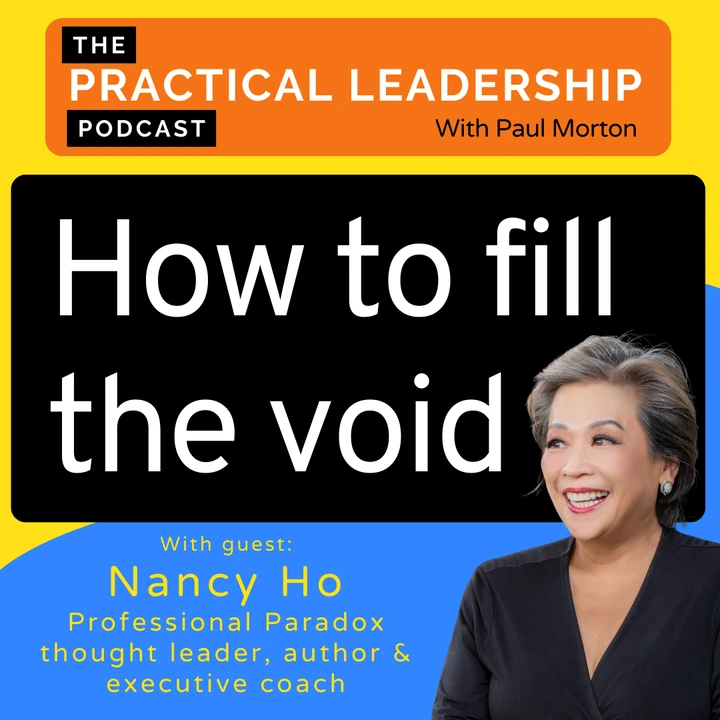
How to fill the void in life
with Nancy Ho
Show notes
In this enlightening episode we’re diving deep with author and coach Nancy Ho into: “How to Fill the Void in Your Life.”
Nancy, a seasoned life strategist and coach, brings her profound insights into addressing the often-unspoken gaps experienced by successful professionals.
During our conversation, Nancy outlined several key models and methods:
- Exploring Childhood Roots: Investigating how unresolved childhood experiences can influence present feelings and behaviors.
- Addressing Pain Points: Recognizing and acknowledging personal and professional challenges rather than masking them.
- The Facts Approach: Focusing on the undeniable facts of one’s situation to guide actions and emotions.
Impactful Quotes and Timings:
- “It’s not about the present problem… it’s about the childhood.” Exploring how past experiences shape current feelings. (00:06:49)
- “We manage… and then we manage better.” On learning and evolving through life’s challenges. (00:07:16)
- “Living a life with no regrets.” Nancy’s life philosophy in her own words. (00:01:37)
- “Despite professional success, I feel this void. I wake up with it.” Nancy addresses the deep-seated feelings of emptiness that can persist despite outward achievements. (00:14:56)
- “All our feelings come from thoughts created in the moment.” She explains how our immediate thoughts shape our emotions, underscoring the connection between mind and mood. (00:21:29)
- “Thoughts have no power until we give them attention.” Nancy highlights the control we have over our mental engagement and the power of our focus. (00:22:33)
Nancy mentions the classic short book from James Allen published in 1903 and now in the public domain: “As a man thinketh” available here: https://leadershipthatsells.com/resources/
Find Nancy here:
- https://www.linkedin.com/in/nancy-ho-exec-coach/
- nancyho.net
Transcript
Automated transcript. Speaker labels and spellings may contain errors.
Paul
Look outside yourself and not in. Bridging the gap between professional success, personal fulfillment, making sure that life is not a zero-sum game. Author of Success Redefined. Hello, and welcome to The Practical Leadership Podcast. I am your host, Paul Morton, and we are talking about leadership, management, and the various lives that surround it. It's my joy, delight, and privilege to bring into my studio some of the smartest, wisest people I've been able to find for your delectation and enjoyment, and I hope that you do get a lot out of the conversations that we have here. When you realize that your management team has grown too fast or you've inherited a new team and the fastest, best lever you have for growth and improvement is attached firmly to those managers, get in touch.
I help you run management, coaching, and training programs that'll make a big difference really quickly. You can find me at the Practical Leadership Academy website and on all the usual social channels. Nancy Ho, thank you so much for joining me.
Nancy Ho
My pleasure.
Paul
Now, that was far too short an introduction and, and obviously I missed so much in your 12 years of life. Um, and you just said you recently celebrated a magnificent birthday. Would you be so kind, introduce yourself properly to my listeners?
Nancy Ho
Sure. I'm Nancy Ho. I'm a life strategist, a transformative coach and executive coach, and a thought leader in the paradox of success. And, uh, I've been in this business for the longest period as in my entire, or most of my entire adult life, 27 years. There's only one thing I'm interested to do. That is to take a person, and of course when I say an individual doesn't necessarily means individual, the individual that runs the company, that manage the company, from point A to point B, whatever that means for the person, and living a life with no regret.
Paul
Living a life-
Nancy Ho
That's the only I've been doing all my life. Adult life, yes.
Paul
Living a life with no regrets. You know, I think that's possibly something that the more I speak to people in their mid-life, especially s- execs, senior people who have been successful, they've got the money, they've got the position, they've got the power and all the, all the trappings, they turn and they say, "And yet, and yet, Nancy, there's something missing."
Nancy Ho
Yes. And that something missing often is not even so-called tangible. That means they can, you know, measure it. Okay, for example, if someone says that, "Oh, I do not have enough wealth," all right? Uh, "I do not, uh, have a, a good relationship." Something is ... I mean, relationship's not as tangible, but something you can actually even describe it in the sense of tangible. But it is often, um, a feeling that is awful, but they cannot quantify, okay? Of course, the, the best way they can describe is like void. Something just don't sit well. Something is just missing. And, uh, again, you know, they go through the list, everything tick. They tick the box.
Paul
Mm.
Nancy Ho
They tick the box, right?
Paul
Yeah.
Nancy Ho
Uh, so it often even they feel bad talking about it because it's like, hello, you tick the box and what is your complaint? But they can't help that go to sleep, probably can't go to sleep, suffering from insomnia of some kind, having that disturbed mind, waking up just not feeling joyful, not feeling good. And it's not that they want to be ungrateful for the life they have, but they can't help but feel bad. And this is so common, particularly in the developed countries.
Paul
It's a, this is a first world problem, isn't it? Loneliness-
Nancy Ho
First world, yeah
Paul
... is a first world problem.
Nancy Ho
You're right.
Paul
Depression is a first world problem.
Nancy Ho
You're right. You're right.
Paul
It's the void. You know, you're staring into the void from your penthouse flat with your lovely cars and your gorgeous family and whatever, and there's nobody you can genuinely talk to because anybody you turn to and say, "And yet, I, I'm missing something," and exactly as you said-
Nancy Ho
Right
Paul
... the response is-
Nancy Ho
Right
Paul
... "How dare you? How dare you be missing something?"
Nancy Ho
Exactly. You know? So, a- and, and really they, like I said, they do not ... It's not that they want to, to, to, you know, pick on, you know, nitpick, but really the feeling is so real. I'm not trying to sound morbid here, and we have seen around the world, you know, partic- like say the Hollywood star, they have the looks, they have the body, have the power, they have whatever you want describe. But why they overdose? Why they become a alcoholic? Okay, unfortunately, some of them even take their life. Not that I'm saying we all will end up doing that, but as an example that they've got it all and then it's just too much for them to handle. And of course, you know, we have this amygdala, the emotional brain. Once it's activated, it's like fight or flight. But what is there to fight when I've got everything [laughs] and I'm complaining?
And flight, where do I run away to? I run away what? All right? They still have responsibility. They know, uh, they, they, they, you know, they, they, uh, at the height of the company, they need to do this and they, they are in the leadership role, they have to have responsibility as a, as a family man, and so on and so forth, or, or woman, whatever case. So the other flight for some of us, you know, Hollywood stars, people that we know of, so the ultimate flight is take their life because that gives an appearance like I solved my problem.
Paul
Yeah. Permanent solution to a temporary problem.
Nancy Ho
Yeah.
Paul
This too shall pass-
Nancy Ho
Yeah
Paul
... is, I think is a good mantra.
Nancy Ho
Correct.
Paul
This too shall pass.
Nancy Ho
You're right. You're right.
Paul
You're fighting, you're flighting. You're fighting the only thing left to fight, which is yourself. You're running-
Nancy Ho
Correct
Paul
... you're fly- you're flying from the only thing left to run from, which is yourself.
Nancy Ho
Correct.
Paul
And if you're trying to run away from you, what is there?
Nancy Ho
What is there to run? W- where else to run? You get me? And it will surprised you that a lot of this feeling is not about the present.
Paul
Mm.
Nancy Ho
It's not about the problem in, in the organization, the problem with your general manager or even your wife or your children. It has the appearance it's about the present- But what it is actually, a lot of times, the trigger comes from, I mean, that's the trigger. The, the, the presence, the trigger, but the root cause comes from the childhood.
Paul
Yeah.
Nancy Ho
Yeah. Very subconscious.
Paul
Mm.
Nancy Ho
So therefore we cannot see it.
Paul
Well, the nice thing-
Nancy Ho
It's not-
Paul
... a learned activity, this is a learned response to something that's happened, okay? So you- something's happened. You've learned a response to it, but the nice thing about that means you can learn the solution.
Nancy Ho
Okay. We manage, okay? Life is not hunky-dory.
Paul
No. [laughs]
Nancy Ho
Of course.
Paul
A good word.
Nancy Ho
Of course, it's-
Paul
A very good word, hunky-dory.
Nancy Ho
Yeah. Yeah, it's not hunky-dory, right? It's not called life, right? Life is challenges, and that's great. That's how we grow.
Paul
Mm.
Nancy Ho
So we learn to manage, and then we manage better. So we learned all kind of skills and techniques and strategy and all that. All that's all very positive. But when we cannot manage this, like I said, again, you know, this strange feeling, all right? Um, then it's something wrong, the childhood. And I don't mean that a person has to have some dark, you know, really dark childhood, violent or anything like that. May not. You see, just, just to give you a very simple example. When we ... Okay, when we're young, right? Um, we go to school. We- we went to school, and then we ha- just have to get better grades, you know, and so on and so forth. So sort of so-called the, the obvious fire fight, you know? [laughs] That we get better, we get better, and then okay, we go get a job. We graduated and then okay, um, uh, boy meets girl, then we get married, and then we have children, and then end of fire fight, the fire ...
So a lot of things are being suppressed. They're not being addressed, okay? So therefore, this feeling always come up only when we are much older, and more so when we are more successful because it's like, okay, you know, the, the fire fight or the busyness of getting this, achieving this, you know? So on and so forth. Okay. Now all that is done. Now what? Just like a athlete. Just like athlete, right? After they got the ... They, they, they go to Olympic game and win the gold- they become the gold medalist, right? They got the gold medal, and then now what? And now what? [laughs]
Paul
Yeah. What, what mountain is there left to climb?
Nancy Ho
Correct.
Paul
Was it Genghis Khan, he stood... I'm not sure if it's Genghis Khan or, or one, one of the conquerors.
Nancy Ho
Right.
Paul
Stood at the doors, looking out and cried because there were no worlds left to conquer.
Nancy Ho
Correct. But this is something the business school don't address.
Paul
Mm.
Nancy Ho
This is something, yeah, it's just something that just keep going. Just keep going. You know, going for the, the, your dream, you know, your desire and, you know, uh, be positive and so on and so forth, right? So this is, we have been conditioned that way, and it's not negative. It's positive, right? Of course. You know, one mustn't just waste their life away. You know, we want to live life to our fullest potential. All that, all granted is, is good, but what I'm saying is when people do not address what may, um, be an issue in their life, okay? It will pop up somewhere. And that also will show up in their leadership also, okay? That will also show up how they lead the team.
Paul
Okay.
Nancy Ho
Or how, or, or some gaps, it show up. So when I work with, uh, the C-suites like yourself, you know, C-suites, uh, mid managers and all that, the one thing I do is just I just sit and listen to them. Listen to them as I'm listening to gaps, okay? My work is a bit different. I don't go and talk about leadership and all that. I know you're expert in that. Uh, I, my, my, my role is more so I listen to gaps. All right? I will just listen, listen, listen. Then, okay, I become their, their sounding board. Then say, "Okay. Wait a minute. All right. What you just said, I can see there's a gap. I can see this would then have this, uh, whatever repercussion or consequences." And you'll be surprised that they go, "Oh, I didn't, I didn't realize that."
Paul
Mm.
Nancy Ho
You know? Or they may have a conflict with, their, their senior managers, for example, okay? And often, you know. So how do they deal with the conflicts? Aggressive? Passive? [laughs]
Paul
Mm.
Nancy Ho
You know what I mean? Right? Uh, again, a zero-sum game, right? I win, you lose. [laughs] That kind of thing.
Paul
Or, or you win, I lose, 'cause if I, I'm, I'm not doing well.
Nancy Ho
Oh, exactly.
Paul
Yeah, yeah.
Nancy Ho
Exactly.
Paul
You know why.
Nancy Ho
All right. Or, uh, my way or the highway. You know, [laughs] that's just ... Right? So you see the struggle.
Paul
Yeah.
Nancy Ho
You see the struggle in the world.
Paul
Paradox of success. Mm.
Nancy Ho
Yes. That's why I call it paradox of success. So address all this, all right? I think it's obvious enough to know what is success. It's all, you know, it is not like in this-
Paul
It isn't, yeah.
Nancy Ho
Yeah, exactly. So I, that's why I, I am the thought leader of paradox of success, uh, where I actually look at all this that is not obvious at all.
Paul
Okay. So you, you wrote a book, uh, Success Redefined. You wrote it with Jack Canfield, who was-
Nancy Ho
That's right
Paul
... the guy behind Chicken Soup for the Soul, if anybody's old enough. And if you're watching on video, if you're watching in the podcast, you can hear Nancy holding up her book. [laughs]
Nancy Ho
[laughs] If you're watching the video, you can see that, yeah. [laughs]
Paul
Yeah. There we are. Um, so you, you redefined success. How do you redefine success? So you've got your problems. You recognize what they are, but in order to actually fit that within a framework that doesn't fight against itself, how do you redefine success?
Nancy Ho
First I have to look at, okay, first I look at pain points. What I call them pain points. All right? Uh, so we, we have to expose our pain point.
Paul
Okay.
Nancy Ho
That means we have to acknowledge what it is and not, like, brush it under the carpet and think that everything is fine. Just, just, just, you know, forge on and be positive. You know? Uh, things will just, you know, get better. It's, it's not ... What I call it the fake positivity.
Paul
Mm.
Nancy Ho
Uh, the other day I was doing my group coaching, and it was interesting that I said this. I said, "You know, we, we know, we, we heard about this 1,000 times. Don't be emotional, be logic, right? Be logical, be rational." And I said, "Often being logical may not work." And they did.
Paul
Yeah.
Nancy Ho
I had 35 people, all right, in my group, and they go, "What?" I said, "Yeah, because it's your logic against my logic."
Paul
Mm.
Nancy Ho
"My rationale against your rationale. It may not." Correct. I mean, sure, don't be emotional. Sure, that, that's, that's true. Don't be emotional. But logic may not necessarily work because it's my idea against yours or your perception against my perception, one of those. Then of course they look at me, they, "Then what works?" I said, "Factual." So I've lived my life factually.
Paul
Okay.
Nancy Ho
You cannot debate facts.
Paul
An objective fact. Well, the objectivity-
Nancy Ho
Just fact
Paul
... is difficult. [laughs]
Nancy Ho
Okay. I mean, facts as for example, like, [laughs] okay, just using what was facts like, uh, if we drink, if we take any rat poison we will die. That's a fact. [laughs] I mean, somebody wants to debate that and try it, okay, fine.
Paul
Okay.
Nancy Ho
That kind of fact.
Paul
Fine. [laughs]
Nancy Ho
Exactly. The, that kind of facts I'm talking about.
Paul
Yeah.
Nancy Ho
Right? The sun rises, right? Technically it's still wrong. It's a expression, right, the Earth evolve around the sun, but as expression we say the sun rises, which is-
Paul
Mm
Nancy Ho
... still a, so that is a fact. That giving metaphor was the fact. So the fact is des- despite my professional success, I feel this void.
Paul
Mm-hmm.
Nancy Ho
That's a f-
Paul
Mm-hmm
Nancy Ho
... right, it's real because I wake up to it. I go to sleep with it, right? So that what I'm trying to say, that the fact of like s- it's real, so address it. Don't pretend it's not there or it's just one of those thing or distracter. All right? Go drink, go eat, you know, distract the mind and do something else to feel better. That's a bad thing to do. Or the stress is getting the better of you. Your, the health is just deteriorating. Why? Simple. Our brain produces chemical. Feel good, good chemical; feel bad, bad chemical. So good chemicals are, you know, dopamine, oxytocin, serotonin, all that good. Hence why I look good, okay? [laughs] Because my brain produces good chemical, I'm that happy Nancy. All right.
Paul
Right. See-
Nancy Ho
So what's the bad chemical? Cortisol. Corti- cortisol are regarded as slow poison.
Paul
Mm-hmm.
Nancy Ho
It will attack our organs, so a lot of senior executive say, "God, I got this acid reflux."
Paul
Mm-hmm.
Nancy Ho
"Where does that come from?" Right? Or they have a outbursts of eczema, hypertension, insomnia, right? Again, the body does not lie. When the body gives you all the signal, this affects, that's what I'm saying.
Paul
Right.
Nancy Ho
This affects something is not right. Because, for example, sleep is nat- just like thirst and hunger, it's natural.
Paul
Mm-hmm.
Nancy Ho
Right? Thirsty, we drink water. In time to when feel hungry, we eat. But when a person can't eat or eat too much, ah, the body is telling you something.
Paul
So listen to the facts.
Nancy Ho
Correct. That's what I mean by the facts. So it's not my fact of fact, but it's the fact that it's happening.
Paul
Mm-hmm.
Nancy Ho
It's happening, right? Who do I want to, who do I want to fool? Myself, really. And I often say that i- if I'm no good, I'm no good for anybody. So even I can be sitting at the height of this big organization and I'm not feeling good. If I'm not feeling good, how do I, you know, manage my team? I'm not good. If like, now I'm not feeling good, I can't talk to you properly. Of course can't. I'll go like, "Ooh, I'm nursing my headache," or I'm nursing, you know, something not feeling, feeling right. Or fact, there are really some unresolved traumas.
Paul
Mm.
Nancy Ho
Fact. Yeah?
Paul
Yeah.
Nancy Ho
It doesn't go away if you don't address it. So this is what I do with all the senior executives. I look at facts. So every day, uh, you know, I run my own personal practice. It is my office. They will come to me, uh, in person. Of course I do Zoom also, but, uh, often they come to me in person. All right. And I sit and I go through all these facts with them and then we address that. Just like this morning I have this lady, she's very successful, but, uh, she somehow attracted the wrong kind of men to her life. She's 45, but then da, da, da, without needing a lot of details when... And I actually said to her, "The reason why you r- attracted wrong kind of people, and that's not only wrong kind of men, also the wrong kind of clients," right?
Paul
Yeah.
Nancy Ho
Because as I listen to her, you know, she would attract clients that would kind of so-called take advantage of her. Uh, of course my term, I said, "You know, can't you see that this lady is using you?" "Oh, really? I can't even see that. I thought I'm just being nice."
Paul
Yeah, yeah. Okay.
Nancy Ho
Yeah, yeah.
Paul
So we're exposing and acknowledging pain points. No fake positivity-
Nancy Ho
Yeah
Paul
... no cheerleading. Nah, I don't like cheerleading.
Nancy Ho
Yes.
Paul
You're listening to the objective facts around your situation, your life, your body telling you these things.
Nancy Ho
Mm-hmm.
Paul
So we're on our journey to redefine success.
Nancy Ho
No, then we have to deep dive where did that come from.
Paul
Where it came from. Okay.
Nancy Ho
To address it, okay? Then only when you do that, then we can rewire so-called our, our, you know, thinking, our approach. That's success redefine.
Paul
Then we rewire. Ah.
Nancy Ho
Yes.
Paul
Okay. Okay. So-
Nancy Ho
Everything has an end with the way we think.
Paul
Ah. I think if we actually knew how powerful our thoughts were, we'd be very cautious about what it was we thought.
Nancy Ho
You're right. You're right. You know, the, the very classic book by James Allen, As a Man Think, T-H-I-N-K-E-T-H, As a Man Thinketh with a T-H behind. Uh, James Allen is a classic, a very thin book. All right? You, you, I, you could actually search it and download it-
Paul
Mm
Nancy Ho
... for free. You, you don't gonna have to buy it, but it's a classic book. It, I will call it really the Bible of thinking. [laughs] The Bible of thoughts. That was the book before everything else or any other books that came out with whatever else. You know what I mean? It's the-
Paul
1903.
Nancy Ho
Yeah. That old, yeah?
Paul
1903.
Nancy Ho
Exactly.
Paul
So 120 years old.
Nancy Ho
That's a-
Paul
A lot of books have ... A lot of things have. Yeah.
Nancy Ho
Yeah, yeah, yeah. That's the origin of all that and, you know, where we come. So, so success redefines because that, okay, then you rewire the way you think. And not only just that, and what's very powerful, all of our feelings is coming from thoughts created in- ... the moment.
Paul
Mm.
Nancy Ho
I'll say that again. All of our feelings is coming from thoughts created in the moment. So we do not create thoughts. It's universal. Well, it, it, it was here before we were born [laughs] all right? Nobody create thoughts, you know? So-called it was here before we were born, all right? So therefore, knowing this principle, I will call it this principle, then we don't have to pay too much attention to some of these thoughts because it's just thoughts coming and going. Thoughts has no power until we give it, right?
Paul
That's, yeah, that's very, very profound. I mean, from the, the, the James Allen book, I mean, this, uh, there's a quote from I guess Proverbs 23 is, is, "As a man thinketh, so is, so shall he be." Right?
Nancy Ho
Yeah.
Paul
"As a man thinketh, so shall he be," the quote.
Nancy Ho
Right.
Paul
And then you got-
Nancy Ho
Yeah
Paul
... um, Dale Carnegie who built on that.
Nancy Ho
Yes.
Paul
You have Norman Vincent Peale who built, built on that.
Nancy Ho
Correct.
Paul
You have all these people in the 20s, 30s who were looking at this power of thought as-
Nancy Ho
Correct
Paul
... ancient. And exactly as you said, the thought has no power unless you give it attention.
Nancy Ho
Correct.
Paul
Beautiful.
Nancy Ho
So they even really understand this principle. Some thoughts are just, you know, pass, you know, passing by, you know? It's just like we walk down the street, we see people passing by, you know, take no notice, right? Then only when we use our deliberate thinking, like planning, problem-solving, looking for solutions, then our mind become very sharp because we're not cluttered with all kind of thoughts that we put attention. That's how we use our mind, so-called.
Paul
So that overcomes the... These are, these are the foundational mindset, foundational, not even mindsets, foundational understandings.
Nancy Ho
Yes, correct.
Paul
The foundational understandings.
Nancy Ho
Correct. Correct.
Paul
For you, yeah.
Nancy Ho
You see, so, correct, you see, a lot of people overthink. So when you overthink, the mind is cluttered. So when it comes time to really use your mind to solve problem, I mean, can't be that sharp, right? Because it's so cluttered.
Paul
Yeah.
Nancy Ho
But if my mind is so cl- um, blank, for lack of expression, blank because it's not cluttered, kind of blank, so when I need to use it, I become very sharp, very alert, agile. But if my mind is so cluttered, it's not possible. It's just like the room we are in, if we have a lot of furniture and all cluttered, how we m- maneuver our way out, right? We can't.
Paul
Mm.
Nancy Ho
The same here. And unfortunately, we cannot see. The room if it's cluttered, we can see physically, right? We can see. But the mind, we cannot see. So that, again, can make us actually make us feel bad for no reason, and this part of it is may not even come from childhood. It's just coming from overthinking and overthinking and overthinking, and just clutter our mind, and then we become, our mind become dull instead of sharp.
Paul
Yeah. Yeah. Yeah. I mean, I think there are ways, relatively straightforward ways of uncluttering your mind in the moment, things like deep breathing, gentle meditation, prayer, whatever works. In the moment, you can open your mind because it's, the, when you have this amygdala shouting at you and saying, "Run, look, a lion," whatever it's saying to you, you're not creative. You cannot create. You can't imagine your way out of the problem.
Nancy Ho
Right.
Paul
You can only imagine yourself in the moment with a lion in front of you that you have to run from. And if you don't run from it, your body is saying, "Well, you didn't run from it. You haven't used all these helpful chemicals I was giving you. I gave you cortisol, which is really good. It pumps fat and sugar-
Nancy Ho
Yeah
Paul
... into your blood so you can run.
Nancy Ho
Yeah.
Paul
But you didn't run. You sat on your ass. So now the cortisol is gonna give you a heart attack. Is that okay?"
Nancy Ho
No, I like this example what you just gave. If it's the real danger of the lion, then that cortisol is to save our life.
Paul
It's useful. That's what it's for.
Nancy Ho
Exactly. But, but what if it's not a real lion? It's a perceived danger. Ah, then your brain keeps producing the cortisol. That's the killer.
Paul
Literally. Literally the killer.
Nancy Ho
Yeah. It's a perceived danger, right? It's a perceived danger. It's not a real danger. Sure, a car coming your way, a lion coming your way, you know, a real danger is to save our life, right? All the blood that rushes to our limb, we run now or we, we, we, we fight with the lion, whichever the case, all right? The real danger, and that should be the case. But the problem in our life, how many times do we have the real lion in front of us?
Paul
Very rarely.
Nancy Ho
And-
Paul
We do have, we have things that look like lions a lot. We have this sensory environment around us that overloads us all the time with all these things that we think look like lions, but they're not.
Nancy Ho
Correct.
Paul
They're sort of... And exactly as you said, there are so many things that are in our own heads already that are-
Nancy Ho
Correct
Paul
... that are going, "Arr, arr," you know? And-
Nancy Ho
Yeah
Paul
... reality, you gotta just take, say, "It's not a lion. It's a kitty cat. Off you go."
Nancy Ho
Exactly. So that's what I mean by, again, fact.
Paul
Mm.
Nancy Ho
See what I mean? Facts.
Paul
Yeah.
Nancy Ho
Right? Yeah, so, so I would like to know that your listeners to really, uh, sit back and know how to differentiate between facts, perceived idea.
Paul
Yeah.
Nancy Ho
You know? Of course, everything is perception, but again, like I said, facts are facts, you know? It's not perceived. It's facts. Like the lion is a fact, right? A car is coming. I thought I could cross the road, and then s- you know, instinctually, all right, saw the car. Sure, that's a fact. [laughs] Right? I don't go, "Really? Did I perceive it? Did I imagine there's a car?" [laughs] I mean-
Paul
Mm
Nancy Ho
... that to me, no, that's a fact.
Paul
You imagine it-
Nancy Ho
Um
Paul
... someone send you to hospital.
Nancy Ho
You know? So, so, uh, that is really very much, uh, overlooked because, uh, you know, as we become more successful, we become, you know, higher in the hierarchy. We tend to be, um, focus on getting things done.
Paul
Yeah.
Nancy Ho
Things done. Every day is about getting things done, which of course is important, but then again, you know, the mind again can get cluttered, uh, sometimes get confused, sometimes get even, uh, we fool ourself.
Paul
And the confusion thing I think is important because when we are, when the, when our minds are not where they should be or they're not open and relaxed enough that we can be creative, we tend to look to the wrong places for things. We look inward for solutions when we should be looking out at the environment. We look ... outwards for solutions when we should be looking inwards into ourselves. So we said, I think you used the word inside out.
Nancy Ho
Yes. Correct. Inside out. And you see, we are not children. We know so much that we don't even know what we know. [laughs]
Paul
Yeah.
Nancy Ho
No, really, we know so mu- so much, so much that you don't even know what we know because it's just like we have this big library, right? But then when we have a clear mind, then we are able to retrieve that file easily, see? But then again, with that confusion or the cluttered mind or the perceived danger all the time, I'm at the edge, then I'm always like, you know, uh, uh, uh, the pers- uh, the perceived danger, like the lion, the lion, the lion. So I'm always panicky, and you know I've got a lot of clients, right? They come to me for anxiety attack, a panic attack. There's no real reason. They, they wake up in the middle of the night, like, uh, their chest, it's like, you know, "Oh, my God, it's so tight."
Paul
Mm.
Nancy Ho
Almost like a heart attack, but it's not a heart attack, but because of the, you know, the, the panic. And then you see the sympathetic nervous system is the active part. Then the paras- the parasympathetic nervous system is when we are resting. So often it's when we are resting, all that not good stuff show up. That's why insomnia, you know, hypertension, eczema, or, you know, panic attack, anxiety shows up when we are at rest, when we take a holiday.
Paul
Mm-hmm. Yep.
Nancy Ho
You see? Because we have this very... Most of us have this resilience that when we are at something, that no matter how challenging, we just have that power to go on.
Paul
You get done. You get it done.
Nancy Ho
You get done. You get done. You know? And it's like, oh, y- you even... A- and then, you know, your, your, your brain is pumping all that, you know, uh, good chemical for you to fight it. That's all good, but when you rest and relax, it's like, uh, you crash. You crash.
Paul
You get sick. I mean, I don't know how many times I, I used to go on holiday, and I would get sick. True.
Nancy Ho
Yeah. Yeah. Correct.
Paul
My immune system goes, "And relax," poof. Uh, okay.
Nancy Ho
That's the parasympathetic nervous system.
Paul
Yeah, yeah.
Nancy Ho
Yeah.
Paul
Thinking, thinking.
Nancy Ho
Again, these are fact.
Paul
Mm-hmm.
Nancy Ho
Biology is science. You know what I mean? But people will not want to look at it. They'll just go for the what? Doctors. Get some medication.
Paul
Have a pill.
Nancy Ho
Have a pill, you know? No. And the w- the treatment is not in the parasympathetic nervous system. It's in the sympathetic nervous system.
Paul
The active. Which is nice because you can control it. You can't do anything about your breathing rate. You can't do that, but you can fix your sleep, and you can fix your nutrition, and you can fix your exercise. You know? You can do these things.
Nancy Ho
Correct. Exactly.
Paul
Or your, your, your, your meditation, your, your prayer life, or whatever it is you wanna fix. You mentioned something about get- accessing these little compartments of knowledge, and there was a chap, building on the idea of, uh, James Allen and Norman Vincent Peale and all these guys, there's a chap called Jose Silva.
Nancy Ho
Yes.
Paul
And he write... Yeah, you know him. And, and he writes about, um, uh, thought control, mind control, and you think it, what, you can, like, control people's minds? No, no, no, no, no. No. You control your own. It's to control your own. It's to access your, your f- your fount of knowledge, and if you get in this position, and this is the motivating factor for an executive, do you want to perform better than you are now, even at your fighting best? Well, yes, of course, I do. Then relax.
Nancy Ho
Let me give you the, the reference of this, uh, Jose Silva. I was teaching the Silva Method course for 12 years.
Paul
I love it.
Nancy Ho
[laughs] I'm, I, I was the director of s- of Singapore for this program.
Paul
[laughs]
Nancy Ho
And the science, again, the fact, and why I've been teaching it for a long time, the science behind it is to put ourselves in the optimum brainwave called alpha.
Paul
Alpha.
Nancy Ho
Yes. So when we are in the optimum brainwave, in the alpha brainwave, we are creative, we are product- we are relaxed, we are not panicky, you know? Uh, even at our awake state, I'm not talking about sleeping state, we are sharp at the alpha, right? There are four brainwave. Delta, which is like, you know, when you see children, they sleep, and it's just like a log.
Paul
Mm-hmm.
Nancy Ho
Yes, exactly. Right? So that's the delta. Then the theta is our childhood memories. This is what I meant by when I take someone to get to the root cause, we go to theta brainwave. Then the alpha brainwave is where we can also be in the alpha brainwave, not only when we are sleeping but also awake, and that's the optimum.
Paul
Mm-hmm.
Nancy Ho
Bad news, beta. Beta brainwave, the higher someone is in that brainwave, all right, the more confused, the more cluttered, the more angry, uh, the more upset, the more depressed. I have deal with very depressed people and, uh, and I measure their brainwave is high beta.
Paul
Mm-hmm.
Nancy Ho
Th- they, they are, like, not doing anything. You know? They're not doing anything. They're so depressed they don't do anything, but their brainwave is going high. When you are overthinking, it's in beta brainwave.
Paul
You're overthinking.
Nancy Ho
Meditation-
Paul
Yeah
Nancy Ho
... deep meditation, alpha.
Paul
Alpha, exactly. And in alpha, you access everything else.
Nancy Ho
Correct. Correct.
Paul
You can ca-... There was a lovely study. It was, I think it was some monks, and they studied the, the brain activity of monks in deep prayer.
Nancy Ho
Mm-hmm.
Paul
And their brains were going nuts. It was full-on alpha, and you'd think these people sitting in, in med- meditative poses, nothing. But wow, their brains were lit up like Christmas trees in full alpha. It was wonderful, and it's exactly this of accessing. I think from a motivational point of view, I was talking to somebody this afternoon about how do they help somebody else in a stress situation, somebody on their team deeply stressed, overworking, not exercising, not eating well. What do they say? Is that, "You need to exercise and eat more," you know, but they're not gonna listen. But I think an angle could be, "Do you want to do even better?" "Well, yes, I want to work even harder." Then relax.
Nancy Ho
Correct, correct. If we think about it, right, you are, and all your listeners, right, have a think. When we do we get the best results in our life? When we're relaxed. When do we get our best opt- ultimate results, you know, the optimum results? When we're relaxed. When we become, like, desperate, exasperated, even the kind of results we get is not ideal.
Paul
It's the, it's the runners or the athletes- The athlete's a sprinter. Now, Usain Bolt, fastest man on Earth-
Nancy Ho
Right
Paul
... doesn't run at 100%. He aims at 70%.
Nancy Ho
Mm-hmm.
Paul
Yeah. 'Cause if he runs at 100%, he's too tense, he's too focused.
Nancy Ho
Yeah.
Paul
He's aiming for this flow state, you know?
Nancy Ho
Oh, right.
Paul
If you, if you know horses, there is walk, trot, canter, and gallop, but then there's a mythical state, this, the glide, which is the one beyond the gallop where they've gone and they are, they're almost floating. You know? So there's the effort is, it's effortless. It's this, this... When you see somebody who's an expert at something, and you just watch beauty of what they're doing. Doesn't matter. I had a bricklayer laying a wall. He must've been 70 years old with his team around him, and he was doing a curve. And he said, "I'll do the curve. I'll do the curve." And he was laying bricks, and it was just a thing to watch. It was beautiful. It was a ballet of bricks and mortar, and he was just laying these things like he'd done it for 50 years.
Nancy Ho
Exactly.
Paul
When you see the experts, they get into this flow state, this alpha state. There is not a problem you can't overcome. There's not a situation they won't have an answer to. There's nothing they can't achieve.
Nancy Ho
Exactly. Yeah. That's why I run this program called Effortless Success. [laughs] I do, and that's all about the flow state, as you just mentioned. Yeah. I mean, if you watch a ballerina or you watch a gymnast, you know, you go, you watch all those people, they're all in the flow state. But the moment they want... Uh, one, one typical one is the pa- parkour. You know the parkour? They jump walls and everything else? The people that jump walls and jump, jump buildings-
Paul
Oh, yeah, yeah. No, crazy
Nancy Ho
... and stuff, they, they are in the flow state.
Paul
Yeah.
Nancy Ho
The moment they think, they won't correct. So as leaders-
Paul
Mm
Nancy Ho
... be in the flow state.
Paul
Mm, that's easy.
Nancy Ho
Be the conductor, you know? [laughs]
Paul
Nancy, what else are you working on right now?
Nancy Ho
What else I'm working on? Personal branding.
Paul
Mm.
Nancy Ho
Personal branding is not what, um, I, I don't know about the, in UK, uh, particularly in this part of the world, right? The, the, the way they go about personal branding is about social media. It's not. Social media is just a platform, all right, for one to be able to so-call, uh, you know, uh, kind of like showcase, kind of like, you know, put yourself out there. But the personal branding, again, has to come from the inside. To start with, your strength, weaknesses, your USP. What is your unique selling proposition that you can put on the table? That gotta come first.
Paul
Yeah. Yeah, yeah.
Nancy Ho
Then you've gotta make yourself visible, and the strategy of making yourself visible and everything that we represent, we talk about, everything else come from our USP. That's personal branding.
Paul
There's no point advertising something if you haven't got something to advertise.
Nancy Ho
Correct. Right? I mean, you know, we, we, it, it gotta be congruent. So day in and day out, I'm congruent what I have talked about over the last maybe half an hour or more, right? Say, as I literally say the same thing. If you go to my LinkedIn, I say the same thing. I say that, of course, in a different form or to express it, you know, uh, different stories to it and all that, but that's who I am. That says a life strategist. All right. This is what I do. So there's life strategist. There's executive coach. Right. The title always can be similar, right? How many titles are there in the world? But then your representation of who you are is your personal branding.
Paul
Exactly, exactly.
Nancy Ho
Yeah.
Paul
If you had 10,000 billboard all around the world, big advertising billboard-
Nancy Ho
Right
Paul
... and you could write one thing on all of them for everyone in the world to see, what would it be?
Nancy Ho
Okay. It's interesting you ask this. Embrace our shared hu- humanity. We are more alike than different. In fact, we all want the same thing: respect, love, understanding, peace, and ultimately, you know, joy. So embrace our shared humanity.
Paul
I love it.
Nancy Ho
What do you think?
Paul
I think it's magnificent. You know, as are you, Nancy. And where might people find the magnificent-
Nancy Ho
They can go to LinkedIn. Yeah, they can go to LinkedIn, search for Nancy Ho, Singapore particularly if you, you know, want to be specific. Uh, my email is easy. Or, or my website to start with easy, nancyho.net. Yeah, nancyho.net. Can... You know, easy to remember, right? And I'm happy, uh, to have a conversation with anyone out there, uh, that, uh, um, I do this complimentary thing, you know, having a deep dive conversation and, uh, that's my life work. And especially for the rest of my life, that's the only thing I want to do, to impact on somebody's life so that they will live a life with no regret.
Paul
I can't finish better than that, Nancy. Thank you so very much-
Nancy Ho
Thank you
Paul
... indeed for joining.
Nancy Ho
Thank you very much. [upbeat music]
Paul
And that's a wrap. I hope you enjoyed the show. Thank you for joining me. If there's ever anything I can do to help you on your journey, then do please reach out. You can find me on LinkedIn and all the usual sources. Do please subscribe, leave me your five-star review, and most importantly, get in touch with your comments and feedback. It's really how I grow, and that's what I'm doing this for. Thanks again. [upbeat music]