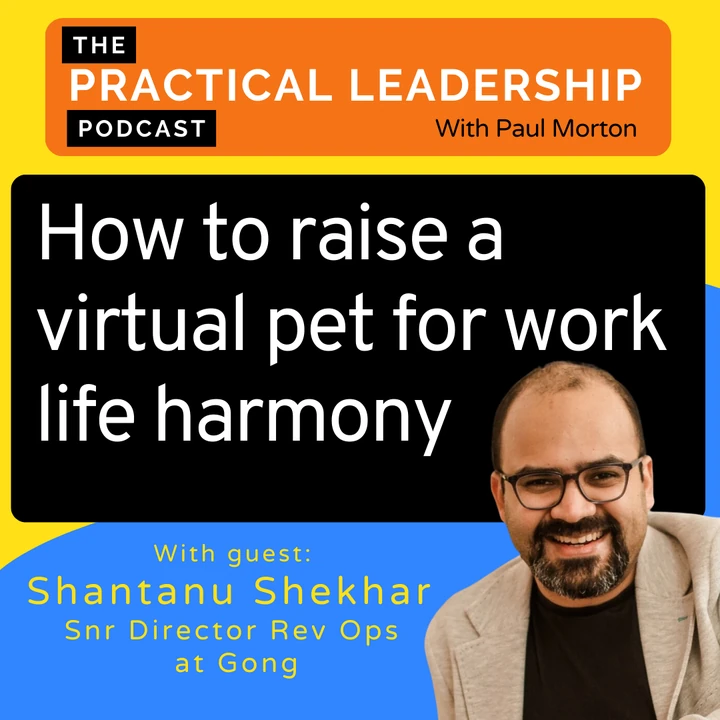
How to raise a virtual pet for work life harmony
with Shantanu Shekhar
Show notes
In this episode, we dive into a fascinating discussion with Shantanu Shekhar, an experienced leader in revenue operations, who shares his insights on how to drive success as a manager.
Shantanu’s three-pillar approach, focusing on people, process, and purpose, creates a balanced and effective management style that fosters growth, accountability, and belonging within his teams.
Shantanu dives deep into the importance of Process, Purpose, and People:
🎯 Process: Streamline your team’s operations for agility and efficiency
🎯 Purpose: Motivate your team by aligning individual goals with the company’s vision
🎯 People: Nurture talent, foster growth, and build a supportive work environment
Tune in to learn about his strategies for weekly stand-ups, providing ongoing feedback, and creating a safe space for both professional and personal growth. Plus, hear some valuable advice on having tough conversations and embracing radical candor in the workplace.
Don’t miss this engaging conversation filled with actionable tips for aspiring and experienced managers alike!
——
Find Shantanu here:
https://www.linkedin.com/in/shantanushekhar/
When you’re ready to boost your new manager productivity with me: https://leadershipthatsells.com/
Transcript
Automated transcript. Speaker labels and spellings may contain errors.
Paul
[upbeat music] Hello, and welcome to the Practical Leadership Podcast, where I interview great leaders and try to extract their wisdom and experience for you to learn from, and hopefully avoid making their mistakes. Check out practical-leadership.academy because you want to help your new managers succeed with hybrid or remote working. [upbeat music] Shantanu Shekhar, thank you very much for joining me.
Shantanu Shekhar
Delighted to be here, Paul. Thank you so much for having me.
Paul
Well, would you be so kind as to introduce yourself to my wonderful audience?
Shantanu Shekhar
Of course. So I'm Shantanu, Shantanu Shekhar, as you mentioned. Uh, I'm actually in the revenue operations space, and the reason I bring that up is there was a recent study, I think LinkedIn and CNBC did it together, that the fastest growing job in the US is actually head of revenue operations. So very excited to be in this, I would say, almost nascent space, but really exploding. Um, and I, and I know you've, you've been in, in this world for a long time, Paul, so I know that in, in parts of SaaS, this is now quite a crucial role. So yeah, very, very excited to be here. Um, I can go on and on and talk about revenue operations, but at very high level, that's what, that's what I've been doing for the better part of a decade. I've been a management consultant in a past life. I'm sure that'll come into our conversation.
Uh, and then on the personal side, I'm a, I'm a father. I have a four-year-old, and living in Ireland for the last eight years and very excited to be here.
Paul
Well, RevOps is the, the heart and soul of a good, well-functioning revenue organization. I mean, revenue operations together with, uh, sales engineers-
Shantanu Shekhar
Mm-hmm
Paul
... are, I think, the most effective levers for getting salespeople to do what you want. 'Cause you can't really just ask a salesperson to do what you want. They're, they're, they're-
Shantanu Shekhar
[laughs]
Paul
Typically, they're kind of prima donna-like, which is what they should be. You know, they're actors.
Shantanu Shekhar
Yes.
Paul
It's a performance profession.
Shantanu Shekhar
Absolutely.
Paul
However, they're not always the most data-driven types, and if they are, then finding somebody who's the most relationship-driven on the other side of that is quite hard. But if you've got the RevOps team-
Shantanu Shekhar
Mm-hmm
Paul
... and your sales engineers, you can point people at the right direction because you show what good can look like. You model that. You, you, the enablement happens, and they can see why good should look like that.
Shantanu Shekhar
Yes.
Paul
What's in it for them?
Shantanu Shekhar
Yes.
Paul
So you're modeling both the action, the, the, the practice, the, the performance-
Shantanu Shekhar
Mm-hmm
Paul
... and the benefit. If you do this, and here's what you do, look how much money you can make.
Shantanu Shekhar
Love it. Love it. And I, and I love what you just said because, and I, I have an acronym which I've, I love, which is WIIFM, what's in it for me?
Paul
Totally.
Shantanu Shekhar
And I think a big part of, and I think you just mentioned, obviously we, we talk about people being data-driven or not being data-driven and how you really tie that together. To me, a large part of my own role and folks in, in similar roles as mine is maybe 20% is actually getting the data, the insight, the, the story. 80%, as you said, is literally getting that change and, and getting the change to really embed across, which is all about communication. Uh, so love, love what you just said there.
Paul
And if you've got a four-year-old, then you know all about communication.
Shantanu Shekhar
Oh, absolutely. That's, that's, that's the tougher job. [laughs]
Paul
[laughs] See, the thing-
Shantanu Shekhar
That's routine kind of stuff, yeah.
Paul
I, I mean, I think, I mean, I've had kids now for 11 years. My mo- obviously, my eldest daughter is 11.
Shantanu Shekhar
Yeah.
Paul
And the difference in my communication abilities, the way that I've personally developed over the last decade and a bit, is immense because you have to really put yourself in the shoes of the other person. And-
Shantanu Shekhar
Absolutely
Paul
... and it's not just who they are or their background, it's their, their, their level of comprehension.
Shantanu Shekhar
Mm-hmm.
Paul
So if you're trying to talk to a four-year-old-
Shantanu Shekhar
[laughs]
Paul
... uh, than most salespeople. No, that's not true. That's not true. Um, because, well, salespeople are busy. They're focused.
Shantanu Shekhar
Yes. Yes.
Paul
They're determined. They're driving them towards something.
Shantanu Shekhar
Yeah.
Paul
You've only got a limited amount of head space, so you've got to keep things super simple. It's, it's one of the reasons why somebody like Donald Trump was such a powerful communicator, 'cause he spoke in 10-year-old language, you know?
Shantanu Shekhar
Absolutely.
Paul
That's the sort of thing. Yeah.
Shantanu Shekhar
And, and know your, know your audience. That's, that's literally the number one rule of communication, right? Know your audience, tailor the message, and it works, it works for a four-year-old as well as for, like you said, the, the most seasoned salespeople as well.
Paul
Farty four-year-old. [laughs]
Shantanu Shekhar
[laughs]
Paul
Shantanu, what was your journey to becoming a people manager?
Shantanu Shekhar
Right. So, so I think the journey I'd start with, and I was very lucky actually, or fortunate I would say, even in, in the early part of my career, I was, I spent about five years at Bain & Company-
Paul
Mm-hmm
Shantanu Shekhar
... which is the management consulting firm, and they are really focused on coaching and people management. And about a year and a half, I was a young, wet-behind-the-ears associate consultant, but within about a year and a half in, I was already managing a couple of people. And now a lot of, a lot of different companies have a supervisory role or where you're responsible for somebody's output, but not really managing managing them. I think what I loved about Bain was even for someone who's so new to role or so new to even working, you start really by managing people. You start caring about their professional development. You are responsible. You get upward feedback. So all of that started about a year and a half then, and I really believe in those five years, by the end of those five years, I was managing a couple of case teams where you had seven people or... And that entire focus on not just being given the opportunity to lead and manage, and really manage people, but being given
the tools on how to think about it and really learn that as a mix of art and science. We, I keep going back to sales. Like, just like we say sales is a mix of art and science, I would say people management is, is definitely a mix of art and science, and that's, that's how my journey began. And then- Since then, I've pretty much been managing people, um, all my professional career since then. Uh, for the better part of a decade I've been in the tech space. Um, I was at LinkedIn for a while. I've- I'm now working at Gong. Um, and even now I've just been, I've, I've been taking the learnings from my first few years and then adding on from different places. In LinkedIn we had this phrase, "Every single employee deserves a great manager." So just how, how you-
Paul
That's nice
Shantanu Shekhar
... start building towards that, so yeah.
Paul
Every employee deserves a great manager. Writing that one down. Okay, interesting. What then did you pick up as you were developing in your own career?
Shantanu Shekhar
Mm-hmm.
Paul
What sort of advice would you then turn and give to somebody in that same position?
Shantanu Shekhar
Got it. And I, and I'll probably, I'll... And this is the number one advice that has stuck with me across, like I said, there's been a lot of things I've learned on the job. There are people who have, through osmosis you pick up things that different people talk through, and obviously there are reams and reams of training and sessions I've gone through. Um, the one thing which has stuck to me the most, and this is early on when I was about a year or so in LinkedIn, um, and I'll actually name this. This, he, he now leads LinkedIn's EMEA and LATAM business for, uh, the B2B sales and talent solutions, Olivier Sabella. And he talked to me about how leadership and management are two very different things, and people often conflate the two.
Paul
Mm-hmm.
Shantanu Shekhar
And the reason I'm going there is leadership is all about, let's say, being inspirational, being motivating, think about being a thought leader and driving a lot of, I would say, a vision and mission for your team and so on. But as a manager, there's an diff- there's a diff- there's an element of having to roll up your sleeves and really drive process and accountability, and really build a very, I would say almost a, a build a very clean way of connecting what's the bigger picture, what's the 30,000 feet view to what does this mean? Again, we, we, we, I go back to WIFM. What does this mean for me-
Paul
Mm-hmm
Shantanu Shekhar
... as someone working in your team? What should I be doing? How should I be thinking of, and I, and I'll, I can go into details, but more around what is my week gonna look like, my month going to look like, my quarter going to look. So building that mechanism, the science part of it, which goes with that art or vision that you're going from leadership. That, that, that difference is, is massive, and I think lo- my advice to any- anyone who's new to management is making sure you're able to define what your mechanism of being a manager looks like, and how would you operate day in and day out. How would that, how would you give that clarity to, to your team?
Paul
So basically know what, know what your role is. Know w- why are you there. What are you adding to that team that they wouldn't otherwise get?
Shantanu Shekhar
And that's, and that's fair. Exactly. And, and there's, I think there's, there's value add, like you rightly said. A large part of, and again, because I started off in management consulting where a successful people manager was also adding a lot of value to the actual output. And, and again, in consulting the, the output was worth millions of dollars quite often in terms of slides. So there's like, okay, how are you thinking about, is, is, are you answering the right questions or not? And, and it's adding value and making the fi- finished product look better. In, in sales when you come out, it's obviously how are you showing up in front of customers. There's value add there, and that's what I would call almost on the thought leadership side. To me the, and it goes back to the 20% output, 80% communication.
To me there's a massive element in being a successful manager in driving process leadership. And process leadership is, okay, have you thought about what your overarching goals are? How do you work backwards from there? What are, what are your, and I, and I don't want to use an acronym for the sake of it, but what are your SMART goals for the week? What are, what are, what are your OKRs for the quarter? What are you doing in the month? What does that mean in terms of the anatomy of what a week in your role looks like? So literally dri- driving that, that together, especially for people who are new in role coming into your team, but also for people who've done it in a certain way in a certain company, it might not translate into your role.
So building that process and predictability and defining what it means, and then helping them navigate through how to communicate that across the org is crucial.
Paul
Hmm. The difference between leadership and management. Yes, very much. Um, there's a great definition from a chap called Joe Owen, who was, uh, one of my guests a while ago. He's a great leadership, uh, management writer.
Shantanu Shekhar
Mm-hmm.
Paul
And he says, "Leadership's about getting people to where they would not get on their own."
Shantanu Shekhar
That's a good one.
Paul
Yeah.
Shantanu Shekhar
That is a good one.
Paul
Um, the other ones that you've, I'm sure you've heard of as well. And then by the way, there's nothing wrong with the SMART stuff or the OKR stuff. I mean, the simple things-
Shantanu Shekhar
Yes
Paul
... are brilliant.
Shantanu Shekhar
Yeah.
Paul
The magics, the, the, the basics are, are magic too. That's the whole point. If you, you need to do the basic-
Shantanu Shekhar
Yeah
Paul
... things, you need to do them really, really well. And, and if you want to learn how to do them really well, come along to my master class and my course, and you'll find out more. Anyway, that's my ad.
Shantanu Shekhar
Love it.
Paul
Um, yeah, 'cause I, I do courses-
Shantanu Shekhar
[laughs]
Paul
... coaching for new managers.
Shantanu Shekhar
And, and I'm sure-
Paul
The other thing I'm sure people have heard is, um, that the idea is leaders do the right thing and managers do things right.
Shantanu Shekhar
Mm-hmm.
Paul
You know? So you've got, you're leading people towards the, the brighter-
Shantanu Shekhar
Yeah
Paul
... sudden uplands, but you're managing them to get things done.
Shantanu Shekhar
Yes.
Paul
There's a chap coming on as a guest, um, fairly soon, uh, Garin Hess, who's the CEO of, uh, an interesting company, uh, in the US called ConsenSys. And he talks, uh, about basically getting stuff done. That's the objective. Everything else can get out of the way. It's getting stuff done. Leader or manager, both of them actually are responsible for getting stuff done.
Shantanu Shekhar
Absolutely. And I, and I think what you just said about getting... And I don't know if, if, um, you've seen this Venn diagram that Jeff Weiner, the CEO of LinkedIn, used to talk about. He had this-- 'cause you mentioned getting stuff done. He had a intersecting Venn diagram of people he likes to work with, and it's basically people who think big, get stuff done, and have fun. And, and I think that's the intersection of what essentially as a, as a, as a leader, you're trying to motivate people towards. But you need to-- That getting stuff done is the job of every manager. And, uh, like you said, it, there's sometimes things can sound quite basic, but one very simple approach I use, and I, I give...
I know a lot of people have like, this is my playbook of how, how, how to use me as a manager, because it's like, it's the manual of me when, when someone joins my team. But to me there's, there's really three buckets to it, which is process. I talk about process leadership being important. It's literally what, what is our deliverables? What are our tasks? We do, we do literally a work planning session every, every Monday. So there, there are elements of my week which look then similar, and then my team knows that this is how we will operate and communicate internally, but also externally. So you have like a work plan. You, you align on things and so on. Second is, to me, purpose. And purpose is where-- this is where the leadership element feeds into, into, into management as well, because you might have had a leader show something big and, and there's a very big vision for the team.
What does it mean for me as a, in my role? Like you mentioned, if I am, if I'm in rev ops, if there's someone else who's a solutions engineer, what do I need to do in service to that bigger goal? So therefore building that purpose, and I, I use that for any, any core projects that are going on, ha-having check-ins around that, and how do you really drive towards. And the last one to me is all about people, and that, that's foundational, right? 'Cause again, being, being a, being a manager, having the ability to drive people and having the ability to motivate people, not just from a, from being an inspirational leader, but really understanding what's going on in their lives, where, what, where their, their aspirations are, both short term, near term, long term. Sometimes the aspiration might not even be in the role that they're in, might be in a different company. But as a, as a manager, do you then wear the hat of the employee you're working with?
And how do you really drive their success is, is in that bucket. So that's the three buckets, and I go through tho-those in more detail with them.
Paul
Well, let's go through them in a little bit more detail just now. Just break it down, just one level down, okay?
Shantanu Shekhar
Mm-hmm. Yes.
Paul
So process, purpose, and people. Your three Ps.
Shantanu Shekhar
Three Ps.
Paul
Very cleverly done.
Shantanu Shekhar
You've, you've, you've, you've caught on there, Paul. [laughs]
Paul
That's the stuff. See, you can't play anything past me. Right? So process-
Shantanu Shekhar
There you go
Paul
... uh, deliverables and tasks, work planning. Like gi-give, give somebody who's new to this-
Shantanu Shekhar
Yes
Paul
... some pointers about how you go about do that. You said you do a weekly stand-up.
Shantanu Shekhar
Mm-hmm. So, so I would do... And, and, and, and I would, I tend to do this both within my team as a manager, but I also then try and extend this to the broader teams that I'm working with as well. But literally to me, getting that Monday, uh, it could, depending on the size of the team, half an hour, one hour, where you're really covering three things. Number one, um, it's, it's more of a connect and a check-in point for everyone to come together as a team. It's important to build that rigor and process. But on what are our most important and urgent, um, tasks for the week and, and even for the month ahead, which are all in service to a broader plan which you've already built, right? So there's a, there's, there's been a, this weekly cadence is, is almost like a check-in point to a broader plan or quarterly vision that you already have.
But using that, that's one. Second, you almost, I, I would say we, we live in a world where there are often meetings that we work towards or core, um, core decision points that we're, we're literally building towards. What are the key activities and events coming up this week and next week? Just having that one shared view. What that also helps us get a, get a conversation is, "Oh, you know what? Oh, Paul, I'm working on the same piece that you're working on, but in a different lens. Let's try and combine forces." So just having all of that in one place, it's really great to get collaboration where needed, help where needed, and that's one piece. And the third part to me, I actually call this virtual pets. And it's a, [chuckles] uh, it's a part where, again, goes back to everybody is a person, uh, and has different, different,
uh, different aspirations which drive them. I literally do a-- Again, this is the consultant in me coming out. I have, I have actually three metrics everybody has on what they want. For example, for me, the three metrics are I want to, uh, sleep for a certain number of, number of hours a day, exercise for a certain number of hours. And again, these are specified metrics with number of hours per week. And I, I plan to have dinner X number of times at home with family. So those are things which... And, and somebody could have, like someone on my team running a marathon, or somebody else has, well, I want to learn the piano. So you, you really drive towards their aspirational goals and, and really have that moment of personal connection, but also then make space for it so you understand why somebody is doing a certain thing in, in the week.
Paul
So you're almost helping people to hold themselves accountable for their personal goals-
Shantanu Shekhar
Yes. In a way
Paul
... in a business environment.
Shantanu Shekhar
In a way.
Paul
How does that work?
Shantanu Shekhar
Giving them, giving them, giving them room to do that, because, and, and again, to me, um, and I mentioned and I didn't go into the people side. To me, a large part of- Working. And I-- you might have read, uh, there's, there's this great, great bish-book which talks about how people like, uh, Google in the past and a few others have really built that space for teams to really build an, um, almost a safe space where you're, you're really encouraging e-each other to do great things. And a large part of that comes from having the ability to be yourself. And to me, that's a very, very important personal value I hold, belonging. And, and, and, and I think it helps the team know each other, belong. And yes, you're holding yourself personally accountable, but in-- it's not in, like, it's not in a, um, nitpicky way.
It's more like, "Oh yeah, I need, I need to make space to do that." Yeah.
Paul
Interesting. That's really nice. You're making, you're making public space for people's personal goals and helping them to s- the, the interesting bit is helping them to stay accountable to it.
Shantanu Shekhar
Mm-hmm. And then that's why-- And it goes into process because you're-- it's at the same, it's in the same meeting where we're talking about our professional goals for the week-
Paul
Mm-hmm
Shantanu Shekhar
... talk about our personal goals. It's great.
Paul
And does it work?
Shantanu Shekhar
It does. It does. In fact, it's-- I've had a-- And I've been using this for a long time. And, and again, I won't, and I won't, I won't claim this was my own brainchild because, again, Bain did this really well. We had the concept of virtual baby, uh, over there.
Paul
[laughs]
Shantanu Shekhar
When I brought, when I brought a version of it over, uh, one of my, one of my teammates was very, very scared of talking about babies, so we made it virtual pets. But, but I've seen it work really well. There's, there's a past teammate of mine in the previous role, he actually learned Spanish. He held-- He had that as a, as a goal. He had not been as successful making time for it before this happened, but he did this for six months. He learned Spanish. He had like, "I have to do Duolingo for X number of hours every week." Um, I myself have been a lot more, I would say, a lot more real towards my goals because I'm like, "Okay, now I'm putting a metric towards it," similar to the way you think of a work goal.
Paul
Is that-- I mean, I, I can see that working in, uh, a RevOps team-
Shantanu Shekhar
Mm
Paul
... where you are, by definition, a data-driven-
Shantanu Shekhar
[laughs]
Paul
... bunch of chaps and chapesses.
Shantanu Shekhar
That is fair.
Paul
Basically, you're all geeks, right?
Shantanu Shekhar
[laughs] That is fair.
Paul
Nerdy, geeky types who like Excel.
Shantanu Shekhar
Very fair assessment. [laughs]
Paul
That is a fair assessment, isn't it? It totally is. Um, how's that gonna work with the other sides of your organization? Most, I mean, mind you, management consultants, I suppose, they're kinda softly, softly as well, aren't they?
Shantanu Shekhar
[laughs] Too fair. Again, the ones I work with all, all even more data-driven than some of the folks I met in RevOp. So I think you're right. There's probably a, an element of who I've s- I've tried this out with. Uh, but when and if I do lead a non-data-driven team, I do plan to try this out. So I'll, I'll let you know how that goes then, Paul. [laughs]
Paul
It's fantastic. One of the, the companies I'm working with just now, um, very, very f- is full of creative, creative, creative people.
Shantanu Shekhar
Mm-hmm.
Paul
I'm just wondering if that would actually fit for them. Interesting thought. That's fabulous.
Shantanu Shekhar
Right.
Paul
Attention to time. Wow. Okay. All right. So that's your how-to advice then.
Shantanu Shekhar
Mm-hmm.
Paul
Virtual pets.
Shantanu Shekhar
[laughs]
Paul
Wow.
Shantanu Shekhar
Love it.
Paul
Okay. Um, was there a particular event or maybe a mistake or something that you learned most from?
Shantanu Shekhar
So I think... Have, have you read the book "Radical Candor" by any chance, Paul?
Paul
Yes.
Shantanu Shekhar
And one of the things I loved about "Radical Candor," it talks about how in a role as a manager, it's important to care personally, but also challenge directly. And I think the, one of the toughest parts of being a manager is having to do tough conversations. That's pretty much, I think, core to the job. A successful manager needs to have tough conversations. And I had seen, like, early on in my career, I'd seen some really tough instances, and probably the toughest conversation a manager has to have is to let someone go. It's, it's, it's timely given, given the environment we're in these days in tech especially.
Paul
Right.
Shantanu Shekhar
But before I had to make the decision myself and go through that, I closely saw a peer of mine go through that process, and, and she had to unfortunately let someone go on the team. And then, and it was her first time as well when I'd seen this happen. And it wasn't the most, um... The person who was, who was laid off was surprised. Um, they didn't, they didn't expect it. They probably had an inkling of something going, being off, but the way that entire process went, and obviously it just left a very, very strong, overpowering impression on the broader team, and this is, like, ages ago. So I learned from that. I've unfortunately had to do this more than a couple of times myself, um, because sometimes, and this is, I'm gonna use another f- I, I, I love how I keep, um, quoting Jeff Weiner in, in, in any, any interview.
But, um, Jeff Weiner used to have the, have this phrase. It's a, it's a very American phrase where in baseball, quite often you have a pitcher who's, who can keep pitching for the entire match. But you, there's a time when you need to know when you have to take the pitcher out because the pitcher is tired, but the pitcher never wants to stop pitching. So that's, that's the f- that's the example he brings in and says, "Sometimes the person might be in the wrong role, which is not right for them," and so on. So having that mindset of just knowing, okay, you know what? If you are making that decision, it has to be right for the person you're making that decision for. But also second, that person can never be surprised. That's the learning I took away.
If I have to ever let anyone go, it should not come as a surprise. And in fact, the three people I've, I've, I'm, I'm thinking of in the last, um, of those three people who I've, I've had to have those direct conversations with Um, one of them I'm, I'm actually still in regular touch with. Um, the other two are not as regular. They're in different, they're in different geography altogether. But all of them, literally the conversation to let people go, we had an-- we had a half-an-hour-long chat and then went for a, for a drink afterwards. So it's just something which I've taken away, and I think it's the least we can... If, because that is, that is a, that is the toughest decision. It's-- But it is the toughest decision for the person who's being impacted.
The more, the more it is one, number one, the, the... If I just leave one thing with anyone, and that's something I've taken away after that, when I'd seen what happened, was it should not be a surprise.
Paul
No. No.
Shantanu Shekhar
So.
Paul
I mean, the, I, I deliver, um, two sections in my, uh, new manager course.
Shantanu Shekhar
Mm-hmm.
Paul
One on difficult conversations, which builds on giving feedback.
Shantanu Shekhar
Yeah.
Paul
So basically, a difficult conversation is a carefully planned feedback session.
Shantanu Shekhar
Mm-hmm.
Paul
'Cause if the feedback hasn't worked, you have to first of all look at yourself.
Shantanu Shekhar
Mm-hmm.
Paul
You as a manager have not been clear enough.
Shantanu Shekhar
Absolutely.
Paul
That's, that's the first place to look. It's not, "Oh, they're not doing what I've asked." No, it's, it's more slightly to be you being a bit crap, frankly.
Shantanu Shekhar
Yes. Yes.
Paul
And especially in a virtual environment where it's really difficult to give feedback or even set expectations-
Shantanu Shekhar
True. True
Paul
... definitely really good. And then on, uh, I call it firing with compassion.
Shantanu Shekhar
Mm-hmm.
Paul
Right?
Shantanu Shekhar
Mm-hmm.
Paul
Um, and you don't mess about, you don't dance around, you don't say, "Oh, I have to let you go. I have to, um, we have to reconsider." We're down, right size it, up size, screw you, basically get out the door. That's where they're healing. So you might-
Shantanu Shekhar
Mm-hmm
Paul
... as well just use the words, "I've decided to..." Not, "We are considering your-"
Shantanu Shekhar
Yes. Yes.
Paul
Sort of shut up.
Shantanu Shekhar
It's you. Yes.
Paul
"I have decided to fire you. Today will be your last day." Right? Own it.
Shantanu Shekhar
I agree.
Paul
Do it or don't do it. Oh, no, and by the way, don't say, "I'm really sorry to have to do this."
Shantanu Shekhar
Yeah.
Paul
"I know how you feel. You're really valued here." You're not really sorry-
Shantanu Shekhar
Yes, I agree
Paul
... that's why you're doing it. You don't know how they feel-
Shantanu Shekhar
Exactly
Paul
... 'cause it's the worst thing that could happen to them professionally.
Shantanu Shekhar
Exactly.
Paul
Oh, I heard somebody once. I was sitting next to an HR person. Yeah. Uh, and he said, um, what was it? Something like, "Oh, I know this hurts just now, but it'll be the best, you'll realize this could be the best thing that's ever hap-"
Shantanu Shekhar
Oh, no.
Paul
Shut up. Now, as it happens, it might well be the best thing that's ever happened to them, but at that moment in time, they want to take your eyes out with a spoon.
Shantanu Shekhar
[laughs] That is fair. That is fair. And then, and-
Paul
So.
Shantanu Shekhar
And that's why it's important. I, I love what you said about it, feed- feedback, and I think that's probably the most important thing to always provide early and often.
Paul
Mm-hmm.
Shantanu Shekhar
Whether it's positive or constructive, either ways, right? And I think that, and that's something which I think is, is something I, I, I take away from what I, again, saw in that one experience. And again, I, I know it is, it is always a tough, tough, tough, tough conversation to have. But the moment, the moment you can have that... And I go back to the process element of it. You have scheduled check-ins on a weekly basis.
Paul
Mm-hmm.
Shantanu Shekhar
On a Friday, make room for 10 minutes for you to give feedback, for you to ask for feedback. On a monthly basis, talk about longer term career, how you're doing. So, like, literally, and that's where the process element of my people process, uh, and purpose comes in, is like, literally there are things that you can schedule for, so there is no, there are no surprises across the board. Very important.
Paul
Yeah. Yeah. I mean, for the, the whole one-to-one thing, which is the really the only lever you have to move your business forward is your one-to-one with your individuals. So you have a repeating agenda.
Shantanu Shekhar
Yeah.
Paul
Same damn thing every time, and you have a shared document that you work on.
Shantanu Shekhar
Yeah.
Paul
Right? So you, C-U-F-C-P is the thing I use. C-U-F-C-P, right? Check-in-
Shantanu Shekhar
C-U-F-C-P.
Paul
Right.
Shantanu Shekhar
Like it.
Paul
So you check-in, updates on anything that's going on.
Shantanu Shekhar
Mm-hmm.
Paul
Feedback, if you've got any. C-U-F, C is for coaching, and then-
Shantanu Shekhar
Nice
Paul
... P is for planning.
Shantanu Shekhar
I love it.
Paul
And you're planning, you take the ownership forward. Coaching, uh, check-in, update, feedback, coaching, planning.
Shantanu Shekhar
I love this plan. I'm actually gonna use this, Paul.
Paul
So simple.
Shantanu Shekhar
Love it. I love this.
Paul
Simple.
Shantanu Shekhar
It's, it's great. I, I have my own, one of my bits. It's not, it's not an acronym. I'm loving this.
Paul
[laughs]
Shantanu Shekhar
As you see, I have, I have, I have a fondness for acronyms and frameworks. Um, I think this is very, very directly applicable. So yeah, this is, this is great.
Paul
Well, you got, you got MFE as well, which is a great one. You heard of that one? MFE? My favorite acronym.
Shantanu Shekhar
[laughs] I didn't know that one.
Paul
Or NEFA. There's not another flaming acronym.
Shantanu Shekhar
Oh my goodness, yes. [laughs]
Paul
No more flaming acronyms. Yeah.
Shantanu Shekhar
No more.
Paul
Management consultants. Oh, that's what it is. That's what it is. All right. What are you working on at the moment?
Shantanu Shekhar
It's a couple of things. So, um, and again, for, I, I don't know if most... And I know that you're one of the most listened podcasts in the UK. So, um, for the benefit of-
Paul
Oh, if only. If only. Yeah.
Shantanu Shekhar
[laughs] For the, for the benefit of your listeners, uh, what Gong does is basically a, a B2B SaaS company, but our predominantly our product helps customers who are, who are in a customer-facing role-
Paul
Mm-hmm
Shantanu Shekhar
... unlock the reality behind their customer-facing conversations, right? So it's, it's basically using, um... Let's say if, if this call was being recorded, let's say this was a sales call, you could actually go back in and get insights, which would be AI driven. You could use it for, for understanding the possibility of this deal closing. You could use it for, let's say if I was a salesperson, my manager could coach me on how to, how to be a better salesperson and find nuggets there. That's a very basic definition, but there's a lot more. We, we expand that to forecasting on a revenue intelligence side. We're even going towards prospecting. So, so a lot basically on the B2B SaaS side. So in a nutshell, my product is my job because revenue intelligence is what I've been doing for the better part of a decade now, uh, and even maybe beyond that when I was a consultant.
And- Really what I'm, what I'm, I'm working on right now, if I think about, and it goes back to having those OKRs and, and, and coming back to the priorities, rather than going into a big thing for everything, the, the three big things for me this year, even if I think about, um, number one, and it, it feeds back into what we're thinking of as a company as well, we are moving towards being that big revenue intelligence platform. And for me, it starts with a new product that we're launching, uh, which is gonna be on the prospecting side. So that's something which we're gonna call Engage. It's an engaging name, I hope.
Paul
Mm-hmm.
Shantanu Shekhar
And, um, that's something I'm really excited about. Uh, second, to me, mapping back to my role, but how can I, in my role, help us really go in and engage more with customers? As you rightly said, Paul, the traditional revenue operations, um, professional is someone who's happy being, being behind a laptop churning out data insights and making massive impact. Uh, I'm lucky to be in this role where our customers are actually people like me. So how can I communicate with them and help our, help us really build that? So that's something I'm, I'm trying to do. In fact, um, I'm hosting a dinner later this week where we're kicking off with a small rev ops community for, for, for, for us in London. Um,
and then the third big piece is... And, and, and obviously this is, this is a year where, um, across the, ac- not... I mean, we're obviously, I'm talking from a very B2B SaaS tech mindset. Um, the last six months have been a bit of a turmoil, to say the least, in, in the, in the, in the macro environment for us. So trying to make sure we are set up from a operational sense. We are building. We're still, we're still a very young company. We're building, we're actually expanding. We st- we set up our European offices only a year and a half ago. So how do we continue to expand within is something, while keeping an eye on the macro, what does it mean for us and what does it mean for us from a people perspective? And the same three buckets, but if I just think about that in terms of more really operational, what are the systems and processes we need to build here, and how do we continue that international expansion?
It's gonna be big.
Paul
It's enough to keep you busy.
Shantanu Shekhar
Enough, enough to keep us busy. Yeah. [laughs] For sure.
Paul
And Gong's a fabulous product. I mean, it's a, an absolute superb product. Uh-
Shantanu Shekhar
Appreciate
Paul
... I've used it with a number of different clients. It's really, it's quite intense what you can get out of it, so.
Shantanu Shekhar
Appreciate that, Paul.
Paul
What then are you reading or listening to at the moment that you would like to share?
Shantanu Shekhar
Great. So I think, and again, I, I referred the book I thought, uh, would be... So I tend to read more, I, I read two very competing genres. So I, I read, like most of us, I read, I read the, I love reading business books to just be a better, be a better manager, be a bit, be a better professional in my job. And it, and three which really jump out to me there are The Culture Code, if you've heard that one. That's, that's the one I'd taken the example of earlier. And as well, I really like how the examples that they've brought in and how they can connect to how you can succeed and learn from companies who have been successful. These are the three things they did really well. So that's one. Uh, second, I'd, I've really been
focusing on being a better, um, better, better communicator as well in terms of, like I said, to me 80% of the job is communication and 20% is, is the actual art of it. And, and to that, I really liked Starting With Why or Start With Why or the other thing. And, and that to me, again... And I, I love these books which have these examples that you can bring in and, and connect. Uh, and the third one I'm actually reading right now, uh, is, is more on the execution side. It's called Amp It Up. It's by the, by the current CEO of, um, Snowflake, Frank Slootman, and it talks about his journey, but also how he's, he's been a, I don't want to use the term serial CEO, but he was the CEO at ServiceNow, made them big.
He was the CEO at, uh, Data Domain, made them big. So, and then, and now he's at Snowflake. He was there before their IPO and, and, and a big part of his story, like he's this, he was this kid from Amsterdam or somewhere in the Netherlands who moved to the US, um, and really went in and drove a culture of driving impact and, and execution. So just trying to learn how, uh, how they do it. So that's, that's my main genre, let's say. But then the second side I do, I do dabble in the, if I call it the Lord of the Rings genre which is more on the fantasy side. So yeah, big... So in that, um, I don't know if I've, I'm, I've been reading the Name of the Wind series. It's, it's an interesting, uh, s- it's an interesting mix of, it's, I think it's Lord of the Rings meets Harry Potter meets Game of Thrones.
That's, that's what I'd call that.
Paul
Name of the Wind.
Shantanu Shekhar
Name of the Wind.
Paul
Name of the Wind. Love it. Name of the Wind. I'm writing that one down. I'm always looking for new things to read.
Shantanu Shekhar
Yeah.
Paul
I just finished reading The Hobbit to my kids. You know?
Shantanu Shekhar
Love it.
Paul
Just great fun. Absolutely great fun. The, the terrors of the, the forest of Mirkwood.
Shantanu Shekhar
Oh. [laughs]
Paul
And of course, because it's my kids, I get to do all the voices, you see?
Shantanu Shekhar
That is amazing. I, I can so imagine you're doing a great job of that.
Paul
[laughs] I'm, I'm sure, I'm sure that's a, um, I'll take it as a compliment. Okay.
Shantanu Shekhar
It is, it is meant to be one. [laughs]
Paul
[laughs] Oh, cracking. Uh, what would you like to thank the young Chintanu for doing?
Shantanu Shekhar
Hmm. I think I'd, I'd say two things, um, really. Number one, I think as, as you can tell, I, I'm from India and I think, um... And I, and I grew up, I grew up, my, my dad was in the Indian army, so we moved around a lot in India. So that gotten me an interest in just traveling In fact, Dublin is the longest I've been in one place. I've never been for such a long time in one city. So, um, in my younger days, I, I traveled a lot, so I, I obviously... I'm from India, studied there. Then I, I started working in Singapore. Then I-- whenever I got a chance to move, I would just... I would be the one to put my hand up. Oh, there's a project in Kenya. I actually did a, a project in Kenya, lived in, in Africa for a while. I did six months in San Francisco, which is actually what got me interested in tech.
So there's like literally thank-- I think what I'd really thank my younger self was for being open to trying out new geographies and exposures, and finally, that's what got me to Europe as well much before I was 30. So I think that piece around being able to understand different cultures, being able to adapt your message to the right audience because there's, there is a reason behi- the reason why everybody in different geographies, cultures, backgrounds might react differently to the same statistic or fact is something you have to learn and adapt to. So, so I think I really thank myself for that. Uh, and the second one is I've, I've probably mentioned Bain like 10 times in this, in this interview.
Um, I think when I was making the decision as a, as a youngster, there were, there were a few friends who I kn- who I, who were like, "Management consulting? Are you sure you want to go in and..." And, and back then, we used to work 80-hour workweeks.
Paul
Sell your soul.
Shantanu Shekhar
Um, it's, it's, it's exactly.
Paul
Sell your soul.
Shantanu Shekhar
Yeah, exactly. Are you ready to sell your soul for, for, for, um... And again, at that point, at that point, your, your fir- your first job after college or after B school is like your job for life, right? That's such a big decision. Um, and to me it was like, I know it's gonna be tough, but I think the, the, the toolkit I learn will be, will be helpful in, in the future. And I, I really cannot thank my younger self enough for going through those tough few years of really working hard because there are things which I really value, the toolkit that I picked up there.
Paul
Outstanding. And lastly, as we wrap up, how can people find you? What are your coordinates?
Shantanu Shekhar
So I think the best, best thing for me, again, the other name which I use as much as Bain probably is LinkedIn. Uh, and I'm quite active on LinkedIn. Uh, it's, it's, it's m- my, my URL is the way my name is spelt. Um, and yeah, I'm quite active there, so LinkedIn's the best place to connect to me.
Paul
Well, we'll put your, yeah, we'll put the, your LinkedIn connections in the description of this, uh, episode. Shantanu Shekhar, thank you very much indeed for joining me.
Shantanu Shekhar
Thank you, Paul. Absolute pleasure to be here.
Paul
[upbeat music] That's a wrap. Thank you for joining me today. Your homework is to leave your five-star review and please, any comments you have. You really help me to improve every day, and it also helps people to discover me online. You should check out practical-leadership.academy because you want to help your new managers succeed with hybrid or remote working. [upbeat music]