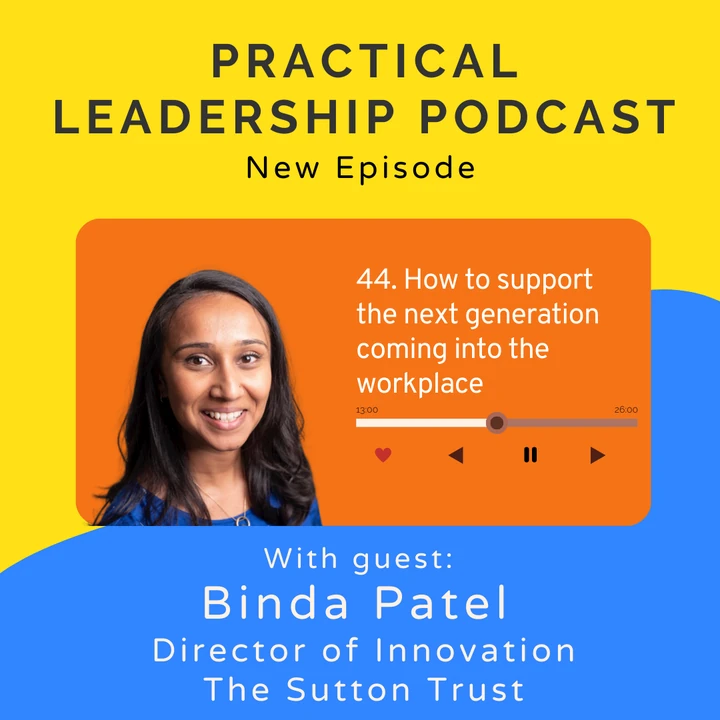
How to support young people coming into the workforce
with Sutton Trust
Show notes
Binda Patel is the Director of Innovation at the Sutton Trust and the Sutton Trust that champions social mobility through different programs, research and influencing policy, news and opinion.
She was in the front line when covid sent the world to hell.
She is also a trustee at Arts Emergency, a charity that supports and mentors young people interested in arts and the creative sector.
Both are important in Binda’s eyes and both are linked to her passion for social mobility.
She has worked with the Diana Award, which gave her with opportunities to grow and develop her skill set. She is also a big advocate for young people who are often not given the platform to share their voices and feelings.
We discus the impact of covid on the social mobility of young people, and how SuttonTrust did some amazing stuff when it all went to hell.
I get a little annoyed (!) that our response to covid was to close down all the youth groups, universities, schools, and play parks, which, besides being unnecessary even at the time, has hindered our kids from developing.
Binda and her team at the Sutton Trust are doing amazing things.
Be sure to visit them and Binda here:
https://www.linkedin.com/in/bindabhudia/
Transcript
Automated transcript. Speaker labels and spellings may contain errors.
Paul
[upbeat music] Hello, and welcome to The Practical Leadership Podcast where I interview great leaders and try to extract their wisdom and experience for you to learn from, and hopefully avoid making their mistakes. Check out practical-leadership.academy because you want to help your new managers succeed with hybrid or remote working. [upbeat music] Bunda Patel, thank you very much for joining me.
Sutton Trust
Thanks, Paul. Thanks for having me.
Paul
So you are currently director of innovation at the Sutton Trust, and the Sutton Trust, it says, "Champions social mobility through different programs, through research and influencing policy, news and opinion." And you're a shiny new minted trustee at Arts Emergency. Which of these is the most important one?
Sutton Trust
[laughs]
Paul
Oh, I can't ask you that. You can't answer that one.
Sutton Trust
Oh.
Paul
It's a terrible question. [laughs]
Sutton Trust
[laughs]
Paul
Which... I mean, how are they linked?
Sutton Trust
Yeah, really great question. So Sutton Trust is a charity that obviously I'm employed at, but one that I've followed for many, many years. Like, it's been going for over 25 years. Um, it's always been in the background to a lot of the work that I've done in my career. Um, even before I joined them I was kind of on the peripheral supporting on various projects and reading their reports and their research, and it really influenced the, the landscape in which we work in, particularly around kind of social mobility and getting more people aware of what that means and kind of, or how, how they can make a big difference in, in the workplace but also in their communities and trying to champion young people. So it's definitely a, you know, really big passion of mine. But with Arts Emergency, I actually, um, came across them through a colleague that, you know, started to work there and, and really at the beginning of that journey that she had with them, and I was fascinated.
It's such a brilliant cause to be able to support and mentor young people who are interested in arts and the creative sector, which is typic- you know, quite hard to, to kind of get into, and it's definitely a kind of close-knit kind of, uh, environment. You have to know people, you have to have the cultural capital, the kind of financial backing to sometimes work in some of those jobs. Um, so it's brilliant to be able to take some of the experiences that I ha- get through working at the charity and taking that into a smaller organization and really making a bit of, a big difference at a trustee level. So both are equally important in my eyes and, and, yeah, a real passion of mine.
Paul
How did you get into the whole social mobility, championing of the young person?
Sutton Trust
So I, I started, um, I, I, I studied at university and, and I've always done lots of work with young people. I was a, a, a youth leader growing up, and so I've always had this, you know, huge affinity to, to, to young people and supporting them in their development and really coaching them and helping them to gain access to sometimes those opportunities that often would, would not always be available to them. And so when I got to university, I was really lucky. I, I met, um, uh, Mark, who was running this organization at the time that was really focused on supporting young people with accessing those really, um, you know, great opportunities that often wouldn't be available to young people who come from those types of backgrounds, and that's really where that journey started in terms of that. I didn't know it was social mobility back then. It wasn't necessarily a term that was used.
It, it was really about kind of how can I make a big difference to young people and really influence the, the decisions that they make and empower them to, to make those decisions, um, that are right for them. So yeah, it's always been something that's kind of been a bit more innate with me around wanting to help people, and it's just lovely that I can do that through my job and my career, but also through some of the extracurricular things that I do in terms of, you know, supporting as a trustee. Um, I work- did a lot of work with the Diana Award when I was younger, and they provided me with fantastic opportunities to really grow and develop my skillset and, and really gave me that confidence, um, as a young trustee, but also in terms of public speaking and being a big advocate for young people who often, you know...
You know, young people are often not given that platform to be able to kind of share their voices and share their feelings, and so I've had lots of chances to be able to do that for them. So yeah, that's, you know, a little bit about how I came to kind of the work that I do.
Paul
So a lot of the people listening to this are gonna be, um, leaders, managers in organizations with, you know, regular staff, all that sort of stuff. Um, social mobility I don't think is a concern of-
Sutton Trust
Mm-hmm
Paul
... the, the majority really, because I suppose if you're listening to this, you probably are socially mobile. You've got a job, right? 'Cause I promote this on LinkedIn. People on LinkedIn all have jobs. Well, most of them do, and they're otherwise are looking for one, and then hopefully you'll find one really, really soon, and I'll talk about that in another podcast. Um, the people that you are helping, that you are targeting, um, I think we've had a few years of horror for many of them. All of a sudden, these people were not just, you're not just trying to help people who, to become socially mobile. You're just help- trying to help them survive. Everything was ripped away from the young people around us. I mean, my kids are thankfully, they're, right now they're 9 and 11, so three years ago when all this nonsense started- They were a lot smaller and less impacted by it, so we could look after them at home.
Of course, I'm talking about the whole, the, the whole COVID, or rather the response we had to COVID.
Sutton Trust
Mm-hmm.
Paul
And the first thing that we did was close down absolutely everything that all the young people around us relied upon. All the youth groups, all the universities, outreach, all the schools, all the play- we closed play parks, for goodness' sake, and stopped them talking to each other, stopped them being able to develop. We stopped, we stopped, we stopped. And it's, I think we're only just discovering how difficult it is and has been and continues to be to restart them. And we're gonna be picking up the bits from these kids, these young people, for decades. I'm convinced of. The Sutton Trust did some amazing stuff when it all went to hell. Can you tell us about that?
Sutton Trust
Yeah, definitely echo everything you've just said. It, it was a really difficult time for everybody, but young people, and particularly those from low socioeconomic backgrounds, so those that don't always have-
Paul
Shafted.
Sutton Trust
Yeah. [laughs]
Paul
Sorry. I'll use the word.
Sutton Trust
Yeah, no. [laughs] Um, you know, they were disproportionately impacted by COVID and all of the, the kind of aftermath of COVID as well. Um, the research that we, uh, produced during the pandemic from kind of focusing on the early years through to kind of school-aged children, to those that are sitting GCSEs and A-levels, to those that are going to university, and then those that are entering the job market, every bit of that research that we did on each of those different areas highlighted the impact that COVID was having and will continue to have on those young people, and the disproportionate, you know, impact, particularly on those that come from low-income families. And we, you know, we, we're feeling that aftermath even today, and we will, as you mentioned, we'll feel that for decades to come because, you know, while the world goes back to kind of in person and people being able to do, you know, whatever they
want with no restrictions and travel and eat out, et cetera, the impact on education for these young people and the impact on their access to opportunities is something that they are gonna live with for forever. You know, the, the, the lack of access to, you know, the education that they missed out on, the, the lack of access to opportunities in terms of extracurricular. All of those make you who you are. You know?
Paul
Mm-hmm.
Sutton Trust
All of those exposures, that education, those opportunities to kick a ball around or take part in, you know, your school play or, you know, whatever it may be, they all make us who we are. They shape who we are. They shape our character. They give us those really essential skills, and so many of these young people have not had access to those opportunities. And we're feeling that now because we're seeing that in terms of academic outcomes for these young people. We're seeing that from the early years and the kind of, uh, the, the delay in terms of reading and engagement and the r- readiness for schools that teachers are reporting to us. We're seeing that from the employer perspective. So those young people who were taking A-levels and going through university and coming out the other side and now are entering the job market, lots of the employers we work with are saying that they're see, they've seen a huge shift in the support that those young people need.
There's much more of a pastoral need to support them in terms of, you know, helping them transition, helping them, you know ... Because they may not have had those job opportunities growing up and, um, you know, in those really formative years when you, you, you, you know, you learn how to, you know, get that job after school or that, that job on the weekend or take part in those opportunities in the summer, for example. So lots of those opportunities and that access to, to those skills development and really have disappeared and, and we're seeing the impact of that now, and it's, it's that impact that will be felt for these young people for, for decades to come. Um, so it's quite sad.
Paul
All through their life. Mm-hmm.
Sutton Trust
Yeah.
Paul
Yeah.
Sutton Trust
Exactly.
Paul
All through their life. All through their life.
Sutton Trust
Yeah.
Paul
I got some friends, um, from primary school actually.
Sutton Trust
Mm.
Paul
And they told me, uh, there's three of them went to the same class, different class to the one I was in, and they all said that they all struggled telling the time with a, with a conventional analog clock. And they said, and I believe them because I, I, I know who they were talking about, it was because of one particular primary school teacher-
Sutton Trust
Mm
Paul
... and she just never bothered. Everybody else could, but in that class they didn't. So for six months while this crazy woman was on her last legs and getting kicked out of the school or whatever was happening, she never bothered to teach them how to tell the time. And of course, yes, of course the parents should have done it, but that's not the point.
Sutton Trust
Mm.
Paul
My point is that that impact has lasted, and now I'm fucking, whatever it is, 12 and a half years old.
Sutton Trust
[laughs]
Paul
And so are my friends, and they struggle to tell the time because of something that happened to them 40-odd years ago. Now, when I talk to some of my neighbors and the kids around here, teenagers, uh, from the ... They're, they're now in their 20s, something off to college like you said. Some of them are 19, some of them are 16. My kids. And you have a combination of responses. Some of them are still afraid. Some of them ... One, there's one girl I know still wears a mask.
Sutton Trust
Mm.
Paul
Right? There's fear. The fear, they still fear. They, they still feel. You have anger that this was ripped away from them. We chained ... Play parks closed. We chained ... We collectively, it's not COVID, by the way. I'm gonna pick you up on that, Vinda.
Sutton Trust
Mm-hmm.
Paul
It's our response to COVID. It was a public response to COVID. But what we as a nation chose to do To the m- the, the, the, a v- a group that doesn't vote, a group that has no voice. We chose to do it to these children collectively, and pointed at them and were afraid of them, and these little sods had no chance of getting it, or if they did get it, it had no damn impact on them. And you can hear in the tone of my voice I'm distinctly unimpressed, by the way. If you are in- if you were involved, if you were the one, one of the ones advocating for closing schools or all this rubbish, come and see me after class.
Sutton Trust
[laughs]
Paul
But we are where we are. And you talked about the pastoral needs, and the challenge that we have to deal with because of the Muppets who dealt with this and the way that they dealt with it. How do we effectively help, uh, an, an enormous section of the population who is now transitioning into work? 'Cause that's what we deal with, right? I help with-
Sutton Trust
Yeah
Paul
... management, with leadership. That's what I can do. That's why I'm doing this. I do this because I looked at my, my daughter who said, "Oh, can I get a job, Daddy?" And I was thinking, "You're 11. You've gotta wait 'til you're 13. But, aye, absolutely. I'm gonna kick you out. You get a paper round or something." Um, and I saw, I sat and I thought, "God help her if she ends up with some numpty manager like me when I come out the door." And if I can help with the new managers or the fresh managers and help them to do their jobs better, then that can, I can, I will change the world in my own wee way.
Sutton Trust
Mm-hmm.
Paul
How do we offer, as you said, that pastoral support? What is that that they need? Do they need a hug? What, what are we looking at? What can you advise people in companies to do?
Sutton Trust
Uh, it's, it's definitely a, a balance, um, recognizing that young people who may be coming into your workplace will not typically be the same types of young people that you may have onboarded, you know, five years ago, for example. So it's really looking at-
Paul
And, sorry, in, in what way?
Sutton Trust
In what way will they be different?
Paul
Yeah, yeah.
Sutton Trust
It'll be the, maybe their readiness for work. It may be their anxiety levels or kind of mental loads. It... Looking at them as individuals and understanding where they've come from and what their needs are, and that kind of blueprint model that lots of businesses will, will tend to have around how they induct and onboard young people will need to be much more nuanced because there will be these differences, because there wi- will be some young people who have been quite significantly impacted by, by the kind of aftermath of COVID and all the things that have happened over the last few years. And there may be some people who aren't as impacted, and therefore you have to be, you know, as an organization but also as a manager, quite responsive to, to those needs of those individuals.
So some of the things that businesses can do is, is look at that onboarding process and really get a sense from these individuals that are joining them, you know, what, what are your needs? You know, w- if you've worked somewhere before or if you were at university, you know, what support did you receive that you found really helpful that we could mirror, for example, or emulate for you? I think it's that, you know, the, the kind of... I come from a small organization, so we have the ability to be much more agile in the way that we create these, um, you know, policies and processes. So it's, it's easier said than done, I think, and I know that there'll be people listening to this who come from large corporate business environments where some of these things may not be easy, but it's about how you advocate for these things to happen within those bigger organizations and making people aware.
And we've got huge reports and research that shows a lot of that impact on those individuals. But drilling down to some of those, that, that agility in the way that you manage and onboard these young people, really thinking about what their needs are, understanding that pastoral support, it, it look, it couldn't, it can look quite different for different individuals. So for someone, maybe setting them up with a buddy, for example, could be really helpful, someone who's a year or two years ahead of them that really, you know... And, and when I mean matching them up, I mean really looking at those characteristics, their background, and finding someone who they can look up to and, and be that role model for them.
It's also thinking about, um, you know, when you're onboarding that individual in your organization, you know, how are you doing that? Are you creating an environment where they feel that they can come and, and ask questions and learn and get feedback and, you know? So I think it, it's a big piece there. It, that pastoral need being more than just kind of that hug. [laughs] It's about really checking in on them, offering them that wellbeing support, um, giving them, you know, pointing them in the right directions, for example, if they're not sure about, "Well, I'm struggling with this particular aspect. I've never worked anywhere before. How do I get access to some of these things?" And so I think it's just that bit more mindfulness around these individuals and the fact that some of them may have gone through quite tough situations, and really coming to that with a open mind about how you can actually help them to, to kind of do well in your
organization.
Paul
Do you know, in a way, what you're talking about there I would hope would be present in a really good onboarding program anyway. Uh, almost in the way, you know, you go to a hotel and they have all the disabled handlebars inside the shower, all that sort of stuff, 'cause it's there 'cause that's what they do, and you end up using it 'cause it's actually quite convenient.
Sutton Trust
Mm-hmm.
Paul
Or you go up the ramp if you're a bit tired. C- for the wheelchair ramp, you walk up the wheelchair ramp 'cause it's there and it's convenient. These things go into good design- You know? So good design incorporates the things. It's like, it's like the, um, uh, people did want to divide the world up by, you know, Gen X, Gen Y, and all this.
Sutton Trust
Mm-hmm.
Paul
And what you end up with is just good design, or people who just like to be connected, or people who like the analog, or... This is thinking about things in a better way. And this, the idea of having a nuanced approach with an onboarding program, that is essentially cookie cutter in most cases, especially if you're in a large organization.
Sutton Trust
Mm-hmm.
Paul
Here's your onboarding, boarding, here's your onboarding program slapped. That's you. Um, but actually, I mean, things like the buddy is great. Things like pre-boarding. Before you start-
Sutton Trust
Yep
Paul
... have somebody reach out to them, you know?
Sutton Trust
Yep.
Paul
Things like you said, the background, making sure that you don't have some random middle-aged Scots bloke talking to a 19-year-old Tunisian girl. Eh. You know?
Sutton Trust
Mm-hmm.
Paul
"Je parle français un little," but, you know, it's not exactly that useful. You want somebody who's got at least a, uh, an age or, um, some background connection. The connection's important. That, that sort of thing I think is important. But, uh, but I do want to, to think about more the pastoral aspect, and especially in this, this environment where we are still suffering from the aftermaths of the response to COVID. Or rather, in one hand, and I do get angry about this, really, but I get very... I'm, I'm, I'm a, an optimist.
Sutton Trust
Mm-hmm.
Paul
A terrible optimist, you know? Um, critical optimist, but an optimist nonetheless. And one of the stuff, well, some of the stuff that come out of our response, our reaction to this, is things like working remotely. All of a sudden, overnight, it was normal. And it wasn't just acceptable for a couple of days a week or something, it was like, "Right, ladies and gentlemen, boys and girls, holy moly, we've got to get on with this and make it work." How can you offer pastoral care to someone you've never actually met?
Sutton Trust
Yeah. It's def- very, [laughs] very good question, and definitely a big challenge. Um, at the trust, we onboarded, I would say, nearly five people remotely who we'd never met, and all their interviews took place online. Um, all of their onboarding took place online. And it's definitely a mind shift for a lot of organizations around how you, how you do that. Um, and it was definitely one of those, you know, w- it was a transition for us as well, and we definitely did something extremely well, and other things where we learnt along the way. And I think it, it's ex- exactly that again, around understanding what the needs are of that individual. Because, you know, onboarding somebody in person is very different to onboarding someone online.
You know, it, it, there's, like, no personal connection, there's none of those cues that you might get from someone when they're in the room with you. And so it's making sure that, you know, that onboarding process, the design aspect that you mentioned, Paul, is such an integral part of, of that process to making sure that, you know, that, that whatever you're pulling together the, in that, in that onboarding process, it's really designed around that individual and understanding what their needs are. So the pre-onboarding is so, so useful to get that touch point in with them to understand, you know... Have a set of questions, for example, that you might ask a new joiner around what their needs are, what things that have worked for them in the past, what additional support would they like from you, and what parts of their job are they excited about, or what parts do they feel a little uncomfortable maybe with about.
Paul
Anxious. Mm-hmm.
Sutton Trust
And anxious about. Exactly. And getting a sense from them as an individual what they want-
Paul
Mm-hmm
Sutton Trust
... and building those, you know, those, those road steps into the onboarding process. And, you know, their probation period as well. It's such an important part that, that, that support doesn't just stop once they're in and they've done their induction for three days and, and off you go, you know. That support has to continue. Um, and when it's online and, and when it's, you know, virtual, it, there are certain elements that do become slightly trickier. But it's always about those regular touch points, I think, because, you know, we lived in COVID for three years, and everything went online, and we still managed to produce incredible outcomes, you know, and managed to do lots of really positive things. So it can happen. It's just all about that mindset and that design. And when it comes to remote, like some of the things that we found that have really worked is really giving those opportunities for those individuals to connect with other people from different parts of your business.
It may not feel like they need to do that, because it's not essential to their job, but it's such a valuable thing to help them build those networks. So I would often book in half-an-hour coffee, you know, virtual coffees with, um, you know, between a, a new join, a new member joining the team and someone else who, who doesn't work directly in our area of work. But someone in fundraising, for example, or someone who works in the development team, or someone who works in our research and policy team. And, and those half-an-hour touch points littered throughout their, you know, first few weeks can be such a valuable thing for them to be able to, A, learn about different areas of your organization.
But trying to mirror some of those things that would happen in an office environment over lunch-
Paul
Mm-hmm
Sutton Trust
... or in, you know, over the, in the kitchen and while you're making coffee. And it's thinking about how you replicate some of that in an online environment. We also did a lot of things where we grouped a lot of the new starters together, and we gave them the opportunity to meet up online and, and, you know, we, we gave them the chance to organize events. And so we did, you know, virtual murder mystery [laughs] um, activity for, for all of the staff. We had a Sutton Trust cookbook that was initiated by some-
Paul
Fabulous
Sutton Trust
... the, the, the newbies that joined us. And so it's thinking about, you know, how we can, yeah, make them feel at home, you know, and really give them that, that, you know, that, that culture and that environment that we would typically have in person, but trying to emulate as much of that online as we possibly can. And then when you do move back to kind of in person or hybrid in the way that we work in our organization, it's really investing in those opportunities for those connections to happen in person, and making sure that- The right steps are there for them to be able to do that and transition from being only virtual and only online to then being in the office a little bit as well. So, you know, we often, we have a fun committee at the trust, and they're actually a lot of our interns who, um, join us every year. They're, they're in charge of kind of organizing social events, and, and they love it, and it's brilliant because it really gives them a chance to work together, but also in a really fun social environment
and creating something for the organization that everyone can get involved in. They, you know, will ask everyone for their ideas and thoughts and really giving them some purpose to kind of those social interactions and them leading on those, which I think is, it's just a nice way to kind of really make them feel part of our organization and the culture that we're trying to create for them, so.
Paul
I like that. So you're trying connecting with other people in different parts of the business, mirroring the in-person moments that matter online where you need to, uh, and just doing your best to consistently bring people together. Mm. Fun committee, committee of fun, director of fun.
Sutton Trust
[laughs]
Paul
Are you having fun yet?
Sutton Trust
[laughs]
Paul
I'll give you money until you start having fun, otherwise the beatings will continue. No, I, I love that. I really love that idea, getting the interns in to do something like that as well. That is good. Okay. Hmm. What... So let's, let's think of this as a, we think we've got the how-to here, which is how do we help the young people that we see coming through and into our organizations find their feet, find their position in the, in the organization when they are or may well have been troubled, damaged, missed out, neglected? Um, trying not to get annoyed again. But how, what do we need to do with them that really we should be doing with everyone?
Sutton Trust
Agree.
Paul
'Cause the opportunity here, the optimist in me says that this is a learning opportunity, and we can learn from this to do better not just by these people, but by everyone. Make, uh, remodel the onboarding, remodel the support that we make available to people coming through into our organizations so that they can feel part of something bigger than themselves, that they can have the opportunity to master the new tasks, find purpose in work. Hmm. Good. Well done. Well done, you. What are you working on at the moment?
Sutton Trust
So as director of innovation at the Sutton Trust, it sounds like a very glam job title. Um, [laughs]
Paul
Fabulous.
Sutton Trust
So, um, we, we are a think tank/do tank, and I love that we can take lots of our research and kind of all of the evidence around some of those challenges that young people face when it comes to, uh, their education or accessing jobs and progressing. Um, and so I take a lot of that, and I look at where the gaps are in the work that we do and try and pinpoint kind of where we could add most value by doing something a little bit different to what we may have done in the past. So not just programming, but actually let's think about how we can tackle this issue here in a, in a unique way. You know, let's see if we can rock the boat here a little bit or, you know, shift the dial a little, a little bit on some, some of those issues. Um, so two big projects that I'm leading on, I led on the creation of Sutton Trust Online, which is our digital platform, um, which was essential during the pandemic-
Paul
Mm-hmm
Sutton Trust
... and a real success of kind of, yeah, that partnership model where we were working with lots of organizations and really cultivating all of the great work that was going on and creating a platform for young people where they could come and get really great advice and connect with their peers and get support from our universities and the employers and everyone that we work with. So that, that was a really big project that I led on, um, just before the pandemic, became essential during the pandemic, and then has now become so embedded in our organization that it, it's, uh, hard to see what life was like before the platform was there. So brilliant to see that, and that's exactly what innovation is about, you know, testing a few things, piloting it, trialing it, seeing how it works, and where it does work, thinking about how you scale and expand and embed.
Um, so yeah, another one of the projects that I'm working on is really looking at the apprenticeship space and how we can really shift the dial with some of the challenges that young people face with accessing some of those apprenticeships, particularly young people who come from low income families are not always accessing the kind of higher, higher level, level fives and six, um, uh, apprenticeships that are available to them. So kind of looking at some of the challenges there and where we can add, I guess, the greatest impa- make the greatest impact and have the, the most value add there. So that's a big project that I'm kind of working on at the moment. Um, and then also looking at the pipeline and thinking about what, where else does our work take us. You know, at the trust, we, we have innovated from the very beginning, you know, from not just our research, but also from our programming and the seed funding lots of organizations that have gone on to do incredible
things now. So we're thinking about that pipeline and how, you know, are there some brilliant things that are going on in our sector that with a little bit of support from us, but maybe financially or through kind of that critical friend, maybe that support around evaluation and scale up, could we then find the next big thing that we could then support and, and work on? So that's the kind of work that I'm doing, and it's really exciting, and I'm really glad that, you know, as an organization, we've made a huge commitment to supporting this new pillar of work. Um, work that's always happened, but just really committing to that in our strategy and thinking about how we can make a big difference in a, in, in a bit more of a unique way than we,
we typically would have done through our research policy programming work. So that's, yeah, that's in a nutshell [laughs] some of the things that I'm working on.
Paul
That seems not to, that'll keep you busy for a while.
Sutton Trust
Yep. [laughs]
Paul
[laughs] Excellent.
Sutton Trust
Definitely.
Paul
Oh. Are you reading or listening to something that you'd like to share?
Sutton Trust
I love a good podcast, Paul, if I'm honest.
Paul
I'm so glad.
Sutton Trust
I'm s- I'm sure you're really pleased to hear. Um, I'm a, I'm, I'm-
Paul
Like and share this one, and rate it as highly as you possibly can. It helps people to find us.
Sutton Trust
I, I, I'm glad you took that little, little nudge in on, on to, on promoting that. Um, but I'm a mom of two, and reading, I don't always have the time of reading the things that I want to read. I'm often reading chil- b- books to my children. Um, but what I do have time for is definitely listening to podcasts, either on my way to work, on my way home. Um, and I absolutely love listening to, um, Rob Beckett and John Wilkins', um, uh, podcast on parenting, and it is an absolute joy, and I just absolutely love it. Like, it is fantastic. It was the thing that got me through lo- lockdown, and got me through maternity leave and, you know, the transition into work, and it's just great to hear the experiences of other parents, and in a really funny and, yeah, charming way that they do.
So that's one that I love.
Paul
Excellent. Thank you very much for sharing. Thank you. Uh, I think... Was there something that you would like to thank young Binda-
Sutton Trust
[laughs]
Paul
... for having done?
Sutton Trust
Yeah, young Binda. How young do I go? Um, [laughs]
Paul
Yeah.
Sutton Trust
So I, I guess then, I was reflecting on this and thinking a bit more about, about it, and I guess it, for me, it, it, I had that, that confidence, that quiet confidence when I was growing up, and I was really encouraged by my family, but also the people around me, to kind of always take those opportunities that came at me. I was really lucky. I went to a fantastic state school. Um, and I had teachers who were just so encouraging and just would always be like, "Just do it. It's really good. It, you know, it will help you, and even if it doesn't end up being what you want it to be, you tried it." And, and I think what I'm really thankful f- to my younger self for is, is listening to that advice, but also then taking it on board and actually saying yes, because so many brilliant things have happened to me in my life because I've just said yes
and kind of given it a go, and just being quite open to where things take me. Um, so I'm just really glad that I had that kind of, yeah, that direction from, from my teachers and the people around me, like my parents, my brother, everybody, um, to, to, to say yes and, and have that confidence to just be like, even if it doesn't work, even if it's not quite right, but just give it a go. Um, so, so yeah. So that would be my, yeah, my m- my little bit of advice back to myself. [laughs]
Paul
And then lastly, as we wrap up, how can people find you?
Sutton Trust
Me on LinkedIn. I'm under Binda Budhia Patel, which is my maiden name, but if they type Binda in, there's not many of us around, so I'm sure they'll find me. Um, definitely visit the Sutton Trust website if you're interested in learning a bit more about what we do as an organization. We've got, you know, oodles of really great research. If you're a leader in your business and you're thinking about how you can make social mobility, you know, a really key agenda or want a bit of advice, just reach out via the website, and you can get in touch with me or anyone else at the organization. Um, and we'd be more than happy to have a conversation with you about that, so.
Paul
Marvelous. All those details will be in the notes in this podcast. So click downstairs-
Sutton Trust
Great
Paul
... subscribe, rate, connect with Binda. Binda Patel, thank you very much indeed for joining me.
Sutton Trust
Thank you for having me, Paul. [upbeat music]
Paul
That's a wrap. Thank you for joining me today. Your homework is to leave your five-star review and please, any comments you have. You really help me to improve every day, and it also helps people to discover me online. You should check out practical-leadership.academy because you want to help your new managers succeed with hybrid or remote working. [upbeat music]