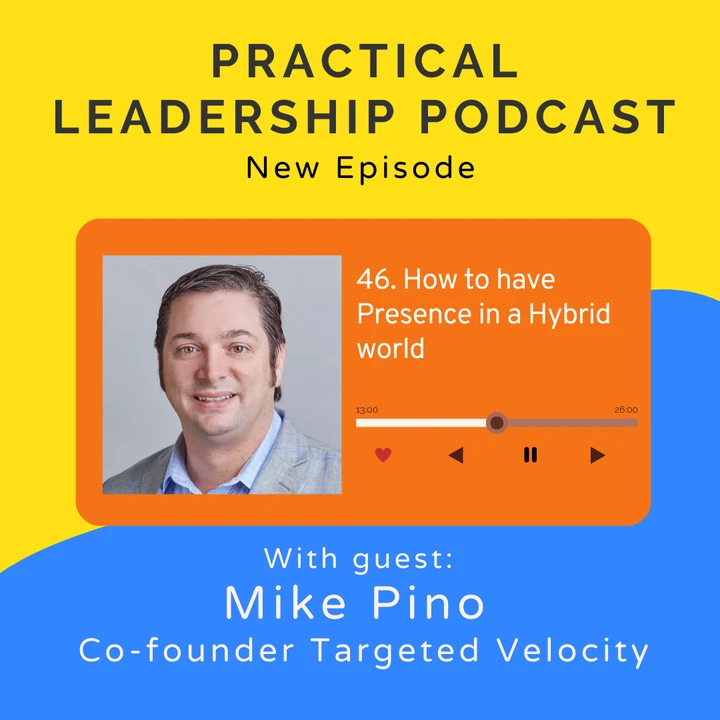
How to have Presence in a hybrid world
with Mike Pino
Show notes
In this episode, I had the pleasure of chatting with Mike Pino, a futurologist, about the future of work and the challenges that new managers face in today’s business environment. Here are some of the highlights from our conversation:
– We talked about how technology is changing the job market and what that means for the future of work.
– Mike stressed the importance of insight and wisdom in the knowledge age, and how these qualities can help leaders navigate uncertainty and change.
– We also discussed the challenges of communication in a hybrid work environment, and how leaders can adapt to ensure their teams stay connected and engaged.
– Throughout our conversation, we emphasized the importance of effective communication, social sensitivity, and continuous learning in leadership.
– Mike shared some great insights on how testing and learning can help leaders deal with uncertainty and volatility, and how this skill can increase social sensitivity and improve communication.
Overall, it was a fantastic conversation, and I hope you enjoy listening to it as much as I enjoyed recording it!
Find Mike here: https://www.linkedin.com/in/mikepino/
TIMESTAMPS
[00:01:08] The Future of Work | Discussion on the impact of technology on jobs and the future of work.
[00:03:50] Insight and Wisdom in the Knowledge Age | Importance of insight and wisdom in the knowledge age, and the value of applied knowledge towards wisdom.
[00:08:24] Challenges for New Managers | The challenges faced by new managers in the current business environment.
[00:08:37] New Manager Challenges | Mike discusses the challenges faced by new managers in the current business environment, including economic uncertainty, remote work policies, and managing equitably.
[00:13:29] Digital Mindset for Managers | Mike introduces the concept of a digital mindset for managers, including the importance of presence, immediacy, and trust. He also discusses the use of strategic ambiguity in communication.
[00:16:38] Building Connection through Communication | Mike provides an example of how to use communication to build connection and trust, emphasizing the importance of tone and context in remote work environments. Paul points out a flaw in the concept.
[00:17:29] New Manager Challenges | The challenges faced by new managers in the current business environment, including unintentional ambiguity and the importance of clear communication.
[00:17:38] Communication Skills for Future Leaders | The importance of being able to articulate oneself succinctly, clearly, and in a way that is actionable, and how this skill will separate different kinds of leaders over time.
[00:20:56] Leadership in the Knowledge Age | The changing nature of leadership in the knowledge age, including the need to ask tougher questions, work through complexity, and learn faster, as well as the importance of understanding one’s place in building the customer experience and delivering on the impact for the business.
[00:26:01] Asking Tough Questions | The speakers discuss the importance of asking tough questions and how to frame them properly to get the desired answer.
[00:28:23] Social Sensitivity in Leadership | The speakers talk about the importance of social sensitivity in leadership, including understanding power dynamics and creating moments for team performance.
[00:30:50] Recommended Books | Mike shares four books he is currently reading, including “Mix Signals” and “Awe: The New Science of Everyday Wonder.” Paul also shares some of his favorite books, including “How to Win Friends and Influence People” and “Think and Grow Rich.”
[00:33:35] Abductive Reasoning | Mike Pino discusses the importance of abductive reasoning in the knowledge age, and how it is becoming more critical for us to experiment and learn fast to act on something.
[00:35:52] Applied Knowledge and Wisdom | Paul and Mike Pino talk about how applied knowledge eventually becomes wisdom, and how wisdom is not just pure logic, but a very human and learned thing.
[00:36:58] Finding Mike Pino | Paul asks Mike Pino how people can find him and how he can help them, and Mike Pino shares his LinkedIn and Twitter handles, as well as his fascination with amphibians.
Transcript
Automated transcript. Speaker labels and spellings may contain errors.
Paul
[upbeat music] Hello, and welcome to the Practical Leadership Podcast, where I interview great leaders and try to extract their wisdom and experience for you to learn from and hopefully avoid making their mistakes. Check out practical-leadership.academy because you want to help your new managers succeed with hybrid or remote working. [upbeat music]
Mike Pino
Me, me, me, me, me, me, me.
Paul
[laughs]
Mike Pino
Don't ask me to sing. Uh, that's one of the w- three ways I make the world a better place.
Paul
Oh.
Mike Pino
I don't sing in public, I don't dance with anyone but my wife, and I won't tell you the third. [laughs]
Paul
[laughs] That's, uh, that's where you stop.
Mike Pino
[laughs]
Paul
Oh, dear. Deep breath. Mike Pino, how you doing? [laughs]
Mike Pino
I'm doing fabulous. How are you doing, Paul?
Paul
Oh, cracking. All the better to speak to you today. [laughs] I was ... Uh, you're a futurologist in the future of work. Is there a future to work? Who knows?
Mike Pino
Uh, well-
Paul
With GPT taking over, who know?
Mike Pino
You know, I, I, you know that my PhD's in computational linguistics.
Paul
No.
Mike Pino
My work's in computational linguistics. So, so I, I don't think it's taking over yet. We don't-
Paul
Mm
Mike Pino
... we are a long way away from artificial general intelligence and generalized intelligence. What it will do is it will a- augment and accelerate, and I don't think people are ready for that yet either. Uh, but I don't think it, we're, we're gonna see a lot of jobs disappear. I think what we're gonna see is people starting to realize that some of the stuff that they're doing doesn't need to be done that way. And quite frankly, there are a lot of things that we do that we don't need to do that way. Like, for instance, there's an awful lot we do with spreadsheets that I look at and say, "Why are we still doing that? We have this technology over here that could just automate all of this. Why are we doing that?" Uh, and I think that it's going to help push those conversations that needed to happen maybe a decade ago.
Paul
Do you know, I was, I was talking to a chap today, and he was saying, "I'm, I'm data-driven." And I was like, "I'm not."
Mike Pino
[laughs]
Paul
"Well, no, don't get me wrong, I love my data and all that. But I prefer to be data informed." And every time somebody comes along and says, "Oh, a report, uh, a spreadsheet, uh, uh, API integration of..." I say, "That's fine. Well, good for you." How are you going to decide based on that thing? 'Cause if you're not going to decide something, why are you bothering? And that, with the whole magical GPT shenanigans out here, is where you can ask a question and say, "If a thing does a what, how many of these are going to do that, and what do we need to know in order to?"
Mike Pino
Mm-hmm.
Paul
"Ah, well," it says, having access to 12 different sources of data, sucks it in and says, "17 apples by Tuesday." That's the interesting bit.
Mike Pino
Well, you're, you're right about that. That's actually where technology far exceeds human ca- capability. Uh, we are good at trend spotting and pattern sensing. M- technology's better.
Paul
Mm.
Mike Pino
So long as what you're training it on and how you're training it and the way that you're actually organizing what's it being trained on is done in a meaningful way. But I, I think that I wouldn't wanna say I'm data-driven. I would wanna say I'm inset, insight oriented.
Paul
Ooh.
Mike Pino
And what I mean by that is that, uh, an insight is actually where you're taking knowledge and you're, you're, you're taking data, you're, and you're taking knowledge, you're combining it to form wisdom. And wisdom to me is more important than, than knowledge in this game. We've moved away ... I, I think that as we've digitized a lot of the world, access to data and information is less important than access to applied knowledge toward wisdom and applied wisdom. And I, I think that that's really the trick here, is that we're, we're now in that, that, in the knowledge age. We're moving away from the industrial age. We will still have an industrial, uh, capability, and that will always be part of some of the things that we need to do.
But as we move into the knowledge age, by and large for a lot of the work that people do, that humans do, what it will become more valuable over time is less the, the force erg kind of work. And erg is actually a technical physics term. Um, [laughs] um, and less the force erg work and more of the knowledge work and more of the what I call wisdom work. And that's really where you're taking experience and meaning and applying it with knowledge to create insight.
Paul
Mm. Mm. Insight and wisdom. Um, I think you're right. You were on the money when you said we, we're, we're a long way away from the general, uh, AI. I mean, honestly, people say, "Oh, it's, it's gonna take over the world." Well, you know what? It might well take over some bits of it.
Mike Pino
Mm-hmm.
Paul
And it's unfortunately going to inform a lot of idiots, uh, and malfeasant types to further impinge upon our liberty, our freedom, our independence, our free will, not that we have much anymore. We certainly don't have opinions anymore. We, we have our opinions assigned to us at birth these days. Um, but I think the, the, if and when we ever, ever get anywhere near general intelligence, it'll be right up there in the news with the second coming of Christ and the landing of the aliens, really.
Mike Pino
I, I, I think before we get to artificial generalized intelligence, we're gonna see the real breakthroughs are gonna be in computational linguistics next. And those ones are gonna be where machines can start to use human language as well as humans can. And that place becomes a really interesting time. This is the reason why a lot of people are thinking that, um, how we'll interact, there's gonna be more voice control. I think that it'll be more language control. I'm not sure how we'll do language and whether that's a plugin to our, our, you know, our, our brains or whatever. That remains to be seen, but we're probably not... We're, we're still at least a decade away of really significant breakthroughs in, uh, computational linguistics, psycholinguistics, some of the stuff that we actually know that exists out there, but we're still early days on.
Paul
Mm.
Mike Pino
So what does that mean? That means that, yeah, I wouldn't get too worried about it now, but your point that there will be malfeasance, there will be malevolent, malicious actors that take advantage of this technology to, uh, use the system against itself, that will actually prove a lot of the places that we have real problems. And I think that one of the biggest challenges that we should be applying some of this technology toward is cyber, because we are, we are, quite frankly, incapable as humans to, uh, be able to address some of the patterns that we're spotting in the technology that people are, are using these kinds of, uh, these kinds of techniques. And where the, the real trick is gonna be is that, that sort of imagination combined with this technology in cyber, I think that that's really where you're gonna see a lot more of this activity in the very early days.
And unfortunately, it's going to mean that we're probably gonna see a lot of people doing some very nasty things, um, between what we have in our social networks and what we have in our banks and all of that jazz. And, uh, I, I just hope that we are smart enough to be able to get in front of that as fast as we can.
Paul
Mm. I mean, you're trying, you're gonna try and regulate it. We're gonna in- insist that we manufacture one buggy whip for every gasoline-powered petroleum-type vehicle. We're going to make the loom, the spinning jenny, the-
Mike Pino
That didn't work so well, did it? [laughs]
Paul
It doesn't, doesn't really.
Mike Pino
And, and, and the point, the point was is when we put the, uh, the fake horse head on the front of the horseless carriage, it didn't make the horses less anxious around the hor- the horseless carriage. It just actually made us feel kind of foolish driving around a car with a fake horse head in the front.
Paul
Like, do you know, I'm waiting for the man with the red flag to come back in front of the electric cars. You can't hear the bloody things. They're humming along behind you, and you think, "Oh, good God, what was that?" Give me a nice diesel engine vrooming behind me so I can hear it.
Mike Pino
[laughs] Well, you know, there's something about actually less noise pollution, but I, I agree with you. There's actually a risk, uh, because we're so focused on our phones when we're walking around that, you know, [laughs] that, that could be a problem, couldn't it? [laughs]
Paul
How, how... I mean, the, the topics I try to, to, to shoehorn into these discussions are typically around new managers, people coming into management for the first time.
Mike Pino
Mm-hmm. Mm-hmm.
Paul
Right? What chance do they have these days?
Mike Pino
Wow. But you, you wanna talk about a very candid and, and big challenge ahead of us. First-time managers, new managers are in probably one of the most difficult positions ever. And, you know, I actually was a new manager in the period between, uh, in the early 2000s, right before the, the dot-com crash of 2000, going into 2001, and then 9/11 in 2001.
Paul
Mm.
Mike Pino
So that 18 months was just horrible, uh, to be a, a first-time new manager. But now add on to the economic uncertainty that new managers are coming in with, they're also dealing with, uh, what is, what is work? How is work going to be organized? Is it... What, what does this really mean when we say hybrid? What is, what is, what are the, what are our policies around remote? How do we manage equitably, uh, in our workplaces in a way that, uh, how do we bring performance out? How do we make sure that people that are remote feel that they're part of the team? And I, I think that we are failing our first-time managers dramatically, uh, and we're, we're failing to scaffold them. We're failing to prepare them.
We're operating as though, you know, uh, people can figure it out, and it's probably some of the hardest work that I've ever seen to try to do. Um, and, and so I think that there's a huge opportunity and a huge challenge ahead of us, and the opportunity is for us to think of different ways to scaffold and improve, uh, first-time managers. But I also recognize that this is... We're setting a lot of folks up for failure, and, and it's not quite fair if you really think about it that way.
Paul
Do you know, I'm afraid I don't quite concur-
Mike Pino
Oh, okay, good. Let's, let's go through this
Paul
... that this is a new phenomenon.
Mike Pino
All right.
Paul
It's just not a new thing. We've been rubbish at this forever. It's got... It's w- It's like the, like the, the, the, the AI thing. It will, and has, as many changes have in the past, it will exacerbate problems. It will amplify problems. You amplify failure. It's like a small startup, and I work with lots of startups, right? And they say, "I'm gonna scale now." I say, "No, no, no, no, no. You're not. See, if you scale right now, you're gonna scale something that doesn't work."
Mike Pino
That's right. That's right.
Paul
You're gonna scale failure. You're gonna amplify failure. Your electronic magical tools will basically make what you're doing bigger and worse. And so what we've found, I think, the same as you found, 'cause I found exactly the same point because I, I was a manager in 2001, right? "Congratulations. Here." What the hell are they? They're people. What am I supposed to do with them?
Mike Pino
[laughs]
Paul
Right? Uh, "Oh, you'll be fine. You'll be fine," and that was the extent of my management training. So that's kind of like, though, is kind of what I try and do is I, I try to, as you said, scaffold. I've got an 18-step program for new managers. See it online at the internet services near you. Um, where I try to help people with the same stuff that I would have wanted 20 years ago, frankly.
Mike Pino
Mm-hmm.
Paul
Which is the basic. Now, it might be basics in a hybrid environment, which is a little different.
Mike Pino
Yes.
Paul
But what it is, is not fundamentally different. The fundamentals are-
Mike Pino
I-
Paul
... you have to know people.
Mike Pino
Yes.
Paul
Start with knowing yourself. You have to manage your time. You have to set objectives super clearly, hold people accountable, give them feedback, follow up, hold one-to-ones, all those shenanigans.
Mike Pino
Mm-hmm.
Paul
And you have to do it well. You can't just be okay, because in the past you could be okay. You could be okay because you were in the office, and if you screwed up, you saw the instant feedback.
Mike Pino
Mm-hmm.
Paul
But where are you right now, sir? Mike, where are you?
Mike Pino
I, I'm in Pensacola, Florida, in my office.
Paul
Pensacola, Florida. Nice and warm. I'm in Hampshire. Not New England, but Hampshire, old England.
Mike Pino
Uh-huh.
Paul
So we're about, what, 3,000 miles away, but we could be working as best buddies. However, if we put the phone and electric television down now, oh, what did he mean? What did he say? I'll just either sit on my backside or I'll just make it up as I go along, and all of a sudden two days are wasted.
Mike Pino
Well, you know, I, I... There's a really great article that, uh, Professor Seidel neede- Neely wrote about this, uh, and it's, it's really... I think that part of this is actually a new way of thinking about being a manager in hybrid, and the way she, she calls it is, uh, she, she calls it digital mindset.
Paul
Mm.
Mike Pino
I, I tend to think of it as presence, and I think that one of the first things that we actually need to do differently to teach our, our first-time managers is to really focus on your presence. So i- it's, it's hard to deal with remote and, uh, hybrid conditions with volatility and uncertainty. All that's true, but there's, there are things that you can do to manage the communication, to manage other things about it to do it. And so what she actually wrote about, she gave, uh, three concepts, uh, in her idea of digital mindset in this article that was in LinkedIn. I'll send you the link afterwards.
Paul
Mm.
Mike Pino
Uh, but she basically said, um, short, small, frequent updates to build presence. That's the first thing. So y- you have to be very conscious and consistent about doing this, and it's gotta be done for people whether they're in the office or out of the office. You do it the same. The second is, in short bursts, you gotta use curiosity to build a sense of immediacy. And she builds upon a work of Professor Eric Eisenberg, uh, who's at the University, I think, South Florida, uh, and, and he's, uh, focused on strategic ambiguity in communication. Now, that sounds kind of fun, so let's actually dig into this, uh, and unpack it a little bit. Strategic ambiguity. There's a-
Paul
Mm
Mike Pino
... there's a term in rhetoric that's known as amphiboly. Uh, this term is actually a deliberate ambiguity, and it's actually the most powerful thing that we can do in writing, in writing ad copy because it forces us to actually read the, the sentence twice. So I'll give you an example. Let's make smoking history. That's actually a famous ad campaign, okay? Does that mean let's smoke so much that we actually make smoking history?
Paul
[laughs]
Mike Pino
Or does that mean let's make history of smoking? That is, let's get rid of smoking. Now, the sentence as it stands forces you to have to reframe or rephrase, and what is the meaning of that? In fact, actually, a little bit of strategic ambiguity is critically important when done periodically because what it does is it creates immediacy. It also forces that, "Hey, I'm not on autopilot. I have to think about this for a second." Uh, and the third, a- and this is a really an important one, is communicate on their timeline, not yours. Because what you're trying to do is build building blocks of trust. And to do that, you have to think about it from their context. So if you're gonna drop something that's going to make them think, "What did he or she mean by that?" You don't send it at the end of the day. You send it at their beginning of the day, and you follow up or you, you try to build in. So if these are the kinds of messages that you need to deliver, think about when they're being delivered and in what context they're being delivered and how you're gonna follow up on it.
So those are those three things. Short, small, frequent updates for presence. The second is immediacy through this, uh, strategic ambiguity, and don't do it often, but do it just enough that it starts to build the immediacy. So it's presence, immediacy, and trust.
Paul
Presence, immediacy, and trust. Okay. Can you give me an example then in this, this leadership context of some amphiboly-
Mike Pino
Ah
Paul
... strategic ambiguity? Go on
Mike Pino
How would, how would you, how would you use that?
Paul
How would you use that?
Mike Pino
So let's, let's see. You know, let's have a chat later on today, Paul, because I think that we actually need to dig into this some more. That's it. What do I mean by it? Now, if you saw that written, "Let's have a chat about this," there's a lot more that we need to dig into.
Paul
Right.
Mike Pino
What's my tone?
Paul
Yeah.
Mike Pino
Because if it's written, you don't hear my tone.
Paul
Mm-hmm.
Mike Pino
I gave you my tone when we're talking like this, but you-
Paul
Yeah, yeah
Mike Pino
... and you're seeing my face, but you're not seeing any or hearing that tone. So if you just get the sentence, there's more to dig into this-
Paul
I haven't done-
Mike Pino
... that's going to-
Paul
... enough to provide this for you. Uh, I'm lacking or-
Mike Pino
But-
Paul
You're genuinely curious
Mike Pino
... but you're not, but you're, but you're not actually... You're, you're... Yeah. So, so now it's like-
Paul
Yeah, yeah, yeah
Mike Pino
... okay, so now I have to actually... I'm, I'm going to come in prepared for this conversation.
Paul
Mm.
Mike Pino
And you as the leader and, and the person both should be coming prepared to this conversation. But when you do that, what it's doing is creating the moment for connection.
Paul
Mm-hmm. I think that's a beautiful concept. I think there is a flaw.
Mike Pino
Okay. I, I... Well, I just came up with this on the fly, so-
Paul
No, no, no, no, no
Mike Pino
[laughs]
Paul
Not that phrase. No, your physiology is beautiful. Be- please.
Mike Pino
[laughs]
Paul
Psycholinguistics.
Mike Pino
Yeah. [laughs]
Paul
This, this, this. Yeah. Sheesh. No, I think the challenge is that the strategic ambiguity, uh, intentional strategic ambiguity, uh, is probably gonna be overweighed by the fact that most people are unintentionally consistently ambiguous.
Mike Pino
Ah, well, there's that problem, and that's-
Paul
Right
Mike Pino
... actually, early first-time managers have a real problem with that. You're absolutely right about that.
Paul
First time m-
Mike Pino
Yeah Yeah, so, so I, I would, you- you're probably right about that, and as you start to go further up the ladder, uh, those bad habits you learned earlier, uh, just get amplified. You actually never really got the opportunity to work on that. I do think that this is actually one of the big opportunities on the horizon. I think that more and more, the ability to articulate yourself succinctly, clearly, and in a way that, that's actionable is going to be what separates out different kinds of leaders over time. And I, I think that you're probably right about this, that, that the strategic ambiguity without understanding whether or not you're [laughs] unintentionally ambiguous most of the time, that's a, that's a really good call-out, Paul.
Thank you.
Paul
I think as well, if you think of the audience, of people, the collection of people coming through into management just now. And the reason I started all that was that my daughter came to me, and she's 11, and she said, "Daddy, can I go and get a job?" And I'm thinking, "Damn right. Out you go. Gotta wait a few years yet, petal. So you gotta wait, you gotta be 13 here before you can go out and get a paper round or something."
Mike Pino
Mm-hmm.
Paul
Then I started thinking, oh, God help her, like, if she's wa- she meets me when I was that, this just jobby on legs of management.
Mike Pino
Mm-hmm. Mm-hmm.
Paul
And I occasionally reach out to people and say, "I am so sorry for having treated you like absolute rubbish as my learning guinea pig when I was learning how to manage people." But the, so the reason I started is I thought that this would be a good thing for me to try and fix the world by fixing new managers out here. And I think the great positive thing that's coming is we have all these people coming through into management now whose primary modes of communication is written.
Mike Pino
Mm-hmm.
Paul
You're thinking, "Hmm? What?" No, it is. It's written, and it's short form, high intent-
Mike Pino
Mm-hmm
Paul
... deeply social, text messaging, and it's WhatsApps, and it's Facebook-
Mike Pino
Mm-hmm
Paul
... SnapChat, whatever the hell it is. Pick your device of choice, but it's short, pithy, direct, high intent and, to your point, full tone-
Mike Pino
Mm-hmm
Paul
... and intent and meaning.
Mike Pino
Mm-hmm.
Paul
And they can convey with the emoji of choice or with a, with the momentary use of language and f- format and phraseology. I'm going into this, I'm, I'm deconstructing a text message, for God's sake. But going into that short form text there, these people, these younger people are going to be phenomenally well-equipped for this hybrid environment if we let them.
Mike Pino
You're, you're right about that. You know, in fact, actually, I think that they are better suited for that kind of work because they've been conditioned. If they've been conditioned, not everyone actually is conditioned to the, the, the kind of short, pithy and having to deal with, uh, the, you know, basically growing up emotionally around pithy statements rather than ha- you know, spending 16 hours with, with your friends until you figure it out as you're growing up, right? Uh, which is more what y- our generation would be more likely to have happen. Um, you know, as, as these things are, are changing, I think that you're, you're really pointing out to something that the one thing about that I, I'd say that n- they're not prepared for, and this is also true of a lot of leaders in our generation as well, and, and I, I don't mean to make this generational, but I do mean to make it about leaders.
I think in general, leaders need to learn how to ask tougher questions and to be able to work through complexity to get answers in hybrid. And I think that that's actually something that all of us are gonna have to learn differently. And so, you know, and I, I think this is, uh, Linda Gratton actually did some great stuff on this, and, and so I'm gonna channel some of her work in, in what I say here. But, um, it's, it's really about i- in asking these harder questions and listening to the answers that are, are emerging and then working through the complexity, what you're really doing is you're connecting values and principles. Um, you're also trying to focus on understanding where the value is, the work we do for customers that we serve, how it ties to the skills and capabilities that we have, and what's important or special about the way that we do it.
Because all three of those are actually coming more and more. The thing that hybrid is really exposing is something that's always been true, but we haven't really talked about. It's that edge that's closest to the customer is the edge that actually is the experience of the customer, right? The brand experience is actually part from that, that interaction with whatever touches the customer. Um, and being able to understand your place in building the customer experience and your place in delivering on the impact for the business, uh, this is how, how a leader has to operate differently, and part of that's y- y- it's no longer about you're not a leader 'cause you have the answers, you're a leader 'cause you know how to ask tougher questions and get people to work through this. And I think that that's a huge shift in orientation.
It also means that as a leader, it's less about having an opinion and more about having, uh, uh, recognizing when things aren't working and how to make it safe, how to fix those problems that we're trying to solve. And I, I think the, the last piece of how leadership is changing, and I think that this is also something that I don't think a lot of people are re- ready for, it's about learning faster, in my mind. It's, it's about what have you learned from the hypothesis we articulated, the problems that we framed, and the things that we've tried, and how do we make sure that we share them in a way that we're not re- uh, that other people aren't repeating what we've done, that they're, they're building on what we're learning. So how do we do this in a social way? Now, the good news is if you've been socialized in this pithy way, you understand some of the components that other people don't.
But the other pieces are still the, the, the bigger pieces, which is really framing a problem, thinking through it, articulating where we actually generate value, and then finally being ready to ask the hard questions and work through complexity.
Paul
Mm. I think there are some definite challenges.
Mike Pino
[laughs] Yes.
Paul
Definite challenges.
Mike Pino
But this is a fun... It's a fun time.
Paul
It is. It is.
Mike Pino
It's a fun time to, to be... I mean, look, I, I... There are certain things about this time that scare the, um, heck out of me. I think that, you know, there are a lot of things that are happening, uh, globally, uh, that are just, when you watch this, um,-
Paul
I know it
Mike Pino
... are, are... Yeah. Y- y- you know, it, y- you start to look and say, "Okay, we are a, a completely globalized world, and we are, we are really not playing very well with understanding how to apply science effectively in, you know, health issues." Uh, and these are going to have impact on all of us if we don't actually learn how to, uh, deal, address this at a global level. And this is not just with, you know, pandemics of a kind, but it's also, you know, what we're doing, uh, ecologically, for instance. And these are the kinds of problems that we're a- we're gonna have to solve, and the way that we solved problems before won't work anymore. I think that we're gonna have to have a different way to solve these kinds of problems, that, that we have to think systematically, not, you know, small, solve this problem, then solve that problem. I think we have to think about things in terms of systems, and that's going to be a hard thing for all of us because we're not quite wired to think systematically.
Paul
We, we are, we are the, the last species. I'm, I'm sure there are ravens out there that are-
Mike Pino
[laughs]
Paul
... better at that than, than humans. I mean, we like to think that we're rational s- a rational species, and we're absolutely not.
Mike Pino
[laughs]
Paul
We are a rationalizing species.
Mike Pino
Yes.
Paul
We post-rationalize decisions that we make with our big toe. You know? There's, there's...
Mike Pino
Yes.
Paul
I think the, going back to the, the, the intelligences or the, the augmented computerized systems, we have to find a better name, 'cause it's not AI. It really, really bloody isn't.
Mike Pino
No.
Paul
Um, helpful computer things. HCTs. There we go. I've got a new one. Helpful computer things.
Mike Pino
Okay.
Paul
Um, it'd be great to ask them all sorts of good questions, but the answers they come back with, and I've tried this a few times, 'cause, you know, you see prompts on, on Twitter or whatever it is, and you poke about. You try some of these things, and then, but the biases inherent in the system are quite astonishing.
Mike Pino
But you know what? One of the fastest growing new positions for ChatGPT is a structured querist.
Paul
Prompt engineering, that's all.
Mike Pino
A prompt engineer is another name for it.
Paul
Mm.
Mike Pino
Fastest growing position, and it's how do you ask a question in a way to get the answer that you wanna get?
Paul
Yeah. Yep. Mm.
Mike Pino
And what's funny about this is that you start to realize how bad we are at asking questions.
Paul
Yeah.
Mike Pino
[laughs]
Paul
Yeah. Going to your point about asking tough questions, there's, I think there's a, there's a challenge not only in frame, 'cause of course you can ask any question you like, and you'll get exactly the question, the answer you want. I mean, I've been working in sales, marketing, and stuff like that for years, so I know exactly how to ask a question, right? You, you, you frame it, you contextualize it. Then you ask them. So you ask one or two questions beforehand, which gives you the frame, and then you ask the thing you want the answer to is, and, uh, and that's what you get. So what... Your favorite color is blue, right? Yes, it is. So, uh, what's, what's the sky like out there? It's reasonably blue. Your favorite color is gray, right? Yes. What's the sky like today? It's a bit gray, even though it's the same damn color. You know? You just frame that sort of stuff.
Mike Pino
Mm-hmm.
Paul
Um, but when we're thinking about tough questions, difficult questions, not only do we struggle with not wanting to ask them because we're fear of hurting people's feelings, when we do ask them, the people that we do ask, 'cause feelings are hurt.
Mike Pino
Mm-hmm.
Paul
You know? Their feels are offended by me-
Mike Pino
Mm-hmm
Paul
... saying, "Have you done the work yet?" "But, but how can you ask me?" "Because I'm your boss, you know? Pull it out, sunshine. Get on with it. Have you done it yet?"
Mike Pino
I... Well, I mean, you shouldn't ask that question ever.
Paul
No, well-
Mike Pino
You, you, that, that question's actually something you should already know.
Paul
That's the beauty.
Mike Pino
And if, if you already know the answer-
Paul
Mm
Mike Pino
... the question should be, "Help me understand-
Paul
That's right
Mike Pino
... why this isn't happening."
Paul
This is the framework, right? So you give the framework for giving difficult conversations is-
Mike Pino
Right
Paul
... "Are you on track?" "Yes." "Brilliant." "No." "What do you need to be to get back on track?" That's easy enough. Uh, "This is what I've observed."
Mike Pino
Mm.
Paul
"This is the impact it's had. Help me understand where you are..." And that's, that's easy, right? That's the, that's the thing. But even that, why do you want to understand? Surely you... I mean, goodness me.
Mike Pino
Well-
Paul
Prompt engineer humans, that's what we need before we get onto the computers.
Mike Pino
Ah, well, you know, [laughs] emotions are a very tricky thing, aren't they? I mean, when you really get to it, understanding the social sensitivity is a critical thing for collective intelligence. In fact, actually, if you're going to generate collective intelligence, if you're going to bring people together to generate collective intelligence as a team-
Paul
The most wonderful thing. I love it
Mike Pino
... you actually have to start... It, you don't have to have complete trust in each other. In fact, actually, a little bit of uncertainty creates the tension that you need to generate even more insights if you're looking for, for really important insights. But-
Paul
Conflict. Creative conflict
Mike Pino
... it, it's called creative friction. It's been called a lot of different things, right? So I, I, whatever you wanna call that, i- i- if you're, if you're too comfortable with each other, you get to groupthink.
Paul
Mm-hmm.
Mike Pino
And if you're uncomfortable with each other, you don't engage. So it, there's a space in between there that you need to be. But once you actually figure that space out, there's a social sensitivity, and the social sensitivity is just like you and I actually understand each other, and we understand that part of... Y- and one of the easy ways that you could teach a machine, and you could do this right now in Zoom. There are tools that you can apply to Zoom that basically say, "Help me understand who talked more, who talked less. How many people talked over each other? What's the, the frequency of the talking over each other?" Because the conversational turn-taking isn't nec- I- is, if there's someone that's commanding the conversation, you as a leader should be focused on bringing people into the conversation and understanding when to and when not to, uh, bring someone into the conversation.
Paul
Including you.
Mike Pino
Yeah, it, well, that's part of also, you know, thinking through that, the, the, the understanding how to build that kind of moment. That social sensitivity, being aware of that, it's also being aware of when people feel that they can't contribute or that they are not in the position to contribute. And some of that's has to do with power dynamics.
Paul
Mm.
Mike Pino
Some of that has to do with fearing, feelings, uh, whether that's feelings of inferiority or some, some other kind of feeling that people may have. And so that social sensitivity as a leader is, is actually really hard, and you don't... You can train that, but it takes time. And what you're really training people to do is to pay attention to some of the signals that, that people are giving. And in a hybrid environment, you're not gonna get those signals so easy. [laughs]
Paul
Mm-hmm. Mm-hmm.
Mike Pino
So, so how do you actually, how do you create those moments for that to happen? But the, the long and the short of this is if you really wanna create a collective, a team performance, and you're really interested in generating a team as a leader, then you have to be thinking about these kinds of things.
Paul
What are you reading right now? Four books a week?
Mike Pino
[laughs] Yeah, I, I've been for, for the past 20 years, I read about 50 to 70 a year. So yeah, about-
Paul
Mm
Mike Pino
... probably spend about two to three hours a day online materials, books, and journals. But the four books, and I'll show you, but the-
Paul
Okay
Mike Pino
... benefit of the people on the podcast-
Paul
Uh, we'll put the video up as well
Mike Pino
... uh, so [laughs] well, you don't have to. So here's, here's one. It's called Mixed Signals. Uh, this is, uh, how incentives really work.
Paul
Oh, fascinating.
Mike Pino
This one, uh, is The Things We Make, and this one's about, you know, how invention, the, the, the background to invention and how things really get invented.
Paul
Uh-huh.
Mike Pino
Uh, that one, those are two. Here's three. Um, uh, and this one I actually love. I absolutely adore this book. Uh, this is, uh, Dr. Keltner's Awe: The New Science of Everyday Wonder and How It Can Transform Your Life. And I honestly think that there's something here for leaders as well, and, and for people leaders, people that, people that need to think about leaders. How do you actually take the understanding of something that's bigger than all of us and bring it into the conversation? And then the fourth book, and this is the book that actually I think you were just bringing up earlier, and I, I think that this is probably the number one biggest problem facing most business middle management.
The Elements of Choice, and this is-
Paul
Mm
Mike Pino
... about why we deci- the why the way we decide matters and how to think about decision-making a lot more cr- uh, clearly. So these are the four I'm reading, uh, this month.
Paul
Wonderful. Well, I'll tell you, I've gone back. I do, I go, I've tried to go back to the books that I've got on my shelf. We were talking earlier on about taking books off like a fine wine just at the right moment. And, um, I go back and I keep going back. I keep returning to the same things. I keep returning to Drucker.
Mike Pino
I love Drucker. I got a whole series of them up on the shelf up there on the back left there.
Paul
Jim Collins.
Mike Pino
Yeah.
Paul
And Charles Handy.
Mike Pino
I got Handy back there. Yeah.
Paul
Lovely man. Wonderful.
Mike Pino
Yep.
Paul
Not doing so well these days. Um, and I think you were talking and saying some books could be journal articles. Some could be, well, blog posts. Some books could be-
Mike Pino
[laughs] Yeah
Paul
... really, uh, most of the ones that I return to. And the book that I give away the most every time I see it, I buy a copy at a charity store so I can give it away, How to Win Friends and Influence People.
Mike Pino
It's a, it's a fabulous book. That's a great one.
Paul
Think and Grow Rich.
Mike Pino
Mm-hmm.
Paul
These, they're 1936, 1937, these books are, and they're still in print.
Mike Pino
Mm.
Paul
Anything over 50 years old, whether it's fiction or fact-
Mike Pino
Mm-hmm
Paul
... right? That's the stuff. Go there. Start there. That's my-
Mike Pino
I'm looking at my, uh, my side shelf here to think of some that actually fit that bill. And-
Paul
Good
Mike Pino
... one of them is the Whitehead Process and Reality. I, you know, that's a, an old '50s era science book. I'll pull that up.
Paul
Yeah.
Mike Pino
Uh, off this shelf over here. And, uh, that's exactly, you know, this is the, um, the collected writings of Whitehead, but I think that some of the stuff that he was talking about, the practice of science, is actually becoming more and more critical for us. And the reason why, we're in, we are en- encountering more and more frequently uncertainty and volatility. The answers that we had before don't work anymore, and so now you have to use the scientific method. You have to experiment to learn fast, to act on something. Uh, if you wanna get really philosophical about it, it's not inductive reasoning, it's not, uh, deductive reasoning. It's called abductive reasoning, and this kind of reasoning is actually when you don't have the, the, the full understanding of the context that you're in,
and you, a- and you have to use, uh, a series of principles to test whether something is true or false to be able to move forward on it, and you wanna do it as fast as you possibly can. And so it's a, it's a, it's a practice that we don't do a lot of. But, you know, we used to play games when we were children, uh, you know, 21 questions and things of that sort, that I wonder whether actually someone that's really smart might actually do something clever and integrate that. Because I think that this kind of skill is needed more and more, not just at an interpersonal le- at a, at a personal level, but also an interpersonal level. 'Cause the more that you can actually start to use that same thing, the stronger your social sensitivity will, will increase.
'Cause if I'm looking at your face and saying, "He's saying to me, 'I have no freaking idea what you're saying, Mike.'" [laughs]
Paul
[laughs]
Mike Pino
And I'm going to back down and I'm going to ta- he hasn't said a word in seven minutes. Maybe I should stop. [laughs] And these, these kinds of things only happen when you actually are in the practice of testing and, and, and, and learning. Testing and learning, testing and learning. And I, I think that we're gonna need more of that, not less of that going forward. It's not that ChatGPT are gonna make things easier for us to actually press a George Jetson button and be off with it. Um, I think that we're actually gonna have to really think differently about what, what buttons we need to press and why.
Paul
I think we have to wrap up on the last thoughts that applied knowledge eventually becomes wisdom, and perhaps wisdom, reason isn't pure logic.
Mike Pino
No.
Paul
That's a very human thing. It's a very learned thing. It's involved. And I think there's great hope for us yet, no?
Mike Pino
I couldn't agree with you more, and I think that that, that's the old DIKW triangle, right? The data, information, knowledge, wisdom. And the top of that is, uh, is enlightenment, right? And, and I, I think that there's something about that, um, that, that we... The more that we start to connect these things and we really focus on empowering, enabling people really m- and really meaning it, not merely just to execute for some sort of short-term goal, but towards actually a mission, not a goal, right? The more that we actually start to do that as leaders, I think the more successful we're going to be as leaders. If we can help people find their purpose in the actions that they're taking, the more that we're actually being a really good leader.
Paul
Lastly, as we wrap up, how can people find you? How can you help them?
Mike Pino
Uh, I'm on, uh, LinkedIn at, uh, www.linkedin.com/in/mike-pineau. So, uh, eight letters with a little hyphen in there. Uh, or I'm at Twitter. I have the handle amphiboly because, uh, I'm, I'm really actually, uh, fascinated with amphibolies, and, uh, if you ever wanna tag me that you found an amphiboly and you wanna send it to me, it'll, it'll give me such joy for a few days. Uh, the last one someone sent to me was, uh, "The pig is ready to eat," and I thought that that was a good one.
Paul
[laughs] Excellent.
Mike Pino
[laughs]
Paul
Excellent. That one we will end on. Mike Pineau, thank you so much for joining me. That's a wrap. Thank you for joining me today. Your homework is to leave your five-star review, and please, any comments you have. You really help me to improve every day, and it also helps people to discover me online. You should check out practical-leadership.academy because you want to help your new managers succeed with hybrid or remote working. [outro music]