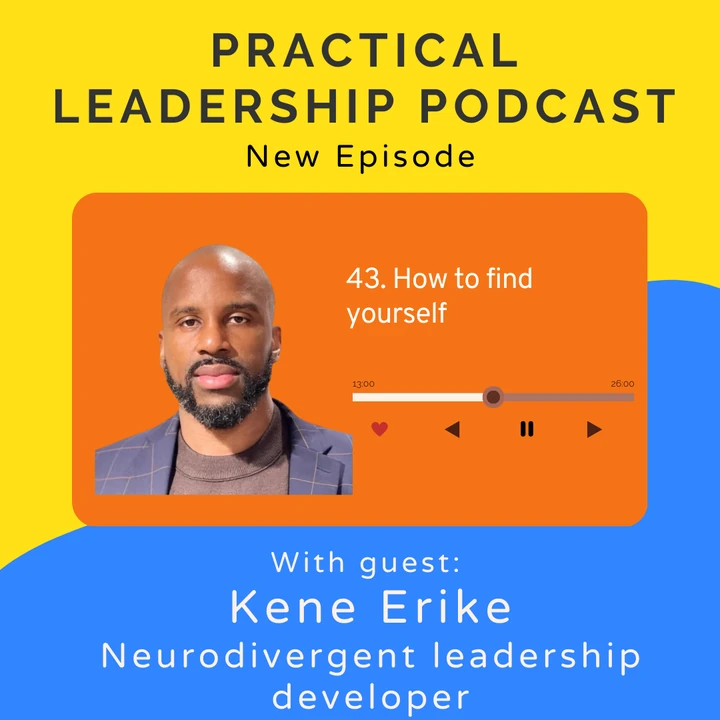
Show notes
We talk about a lot. I’ve never met a neurodivergent leadership developer before.
In this great episode, Kene Erike and I discuss the significance of the number 33, mental maturity, goal-setting, and the importance of having a purpose.
We cover the need for introspection and self-awareness, as well as the value of creating systems and habits that help achieve goals.
Kene shares his work with the neurodiverse community, helping them maximise their potential and overcome challenges.
He also talks about his upcoming audiobook, which focuses on building stronger relationships and fostering cooperation.
Don’t miss it.
————
You can and should find Kene here:
https://keneerike.com/
https://justtaptheglass.com/
Insta: @k.e.consulting
Transcript
Automated transcript. Speaker labels and spellings may contain errors.
Paul
[upbeat music] Hello, and welcome to The Practical Leadership Podcast, where I interview great leaders and try to extract their wisdom and experience for you to learn from, and hopefully avoid making their mistakes. Check out practical-leadership.academy because you want to help your new managers succeed with hybrid or remote working. [upbeat music] Kenechukwu Erike, Kenny.
Kene Erike
That's a good effort there, Paul.
Paul
Good to have you. Good to see you.
Kene Erike
I, I appreciate that, Paul. Thanks for having me on the podcast. I appreciate it.
Paul
Ah, it's gonna be fun. Would you be so kind, would you introduce yourself?
Kene Erike
Yes. Uh, as you so eloquently put it, my real first name is Kenechukwu, K-E-N-E-C-H-U-K-W-U. It means thank God. That is a tribe in Nigeria, the Igbo tribe, I-G-B-O. Most people call me Kenny. Um, I've always been into things related to helping people solve problems with how they relate to each other. My work now with my company, KE Consulting, centers on leadership development. In essence, what we do is we take whatever your unique barrel of skills and talents are, and use those to help you form better relationships with people around you, and to be a more effective leader in your personal life. Whether that's as a better family member, better partner, or just in the context of business and career.
How can I do a better job of managing people around me? How can I do a better job of advocating for myself on the job? So that's much of what I do. It's a little short introduction, yes.
Paul
A barrel of skills.
Kene Erike
Yeah. Barrel skills and such, yeah.
Paul
Bucket of skills.
Kene Erike
Yeah.
Paul
Wheelbarrow.
Kene Erike
Some people like barrels, others like buckets. Depends how much you-
Paul
I don't know. It's good
Kene Erike
... carry.
Paul
I like, uh, yeah, I th- I think, I like thinking of, um, talent ... I, I ripped this off from somebody a, a long time ago and I can't remember who it was.
Kene Erike
[laughs]
Paul
The talent stack, the skill stack, the talent stack, just like, uh, American pancakes.
Kene Erike
Oh.
Paul
So you got all these pancakes lining up, big pile of them-
Kene Erike
Okay
Paul
... covered in gloopy sauce.
Kene Erike
All right.
Paul
And each one is your individual talent, and you add them all together, and that's exactly what makes you unique. So your combination and your thickness on your-
Kene Erike
Mm-hmm
Paul
... your selection of skills is exactly why you are very, very special.
Kene Erike
True. That's actually a nice analogy of how to put it. And the funny thing is just like a stack of pancakes, at any given time, as long as you recognize the stack of talent is there, you can adjust it in any way. Maybe I want to take this talent apart by, i.e., not spending as much time on it, and I want to focus on this talent instead. So there's all sorts of things you can do with that stack of talents, just like pancakes, which I happen to like. So, yes.
Paul
I'm, I've got this picture of a bucket of pancakes now.
Kene Erike
[laughs]
Paul
You know, hang on, we want a bucket of skills, right? Or is that a talent of pancakes, or a stack of cups?
Kene Erike
I, I started with the, the barrel of skills, and then you, and you counted buckets. So ...
Paul
Yeah, okay. All right.
Kene Erike
Yeah.
Paul
All right, yeah. We're, we're good.
Kene Erike
Yeah. Hopefully it worked.
Paul
I have a problem with food analogies. It's, it's getting close to dinner time here in the UK.
Kene Erike
Uh-huh.
Paul
So I'm, I'm getting hungry, you know?
Kene Erike
Oh. It'll do that. [laughs]
Paul
What would you say then as a leadership expert, as a guru, as a practitioner in the art and the sport of, uh, personal individual development, what would you advise somebody who's new to the game to do?
Kene Erike
First thing I would say is know what your goals are. 'Cause not every person in some sort of leadership context has the same goal. Maybe if you're heading up a team, a sports team. Like for example, I play a lot of football, so the QB's usually the leader of the group there. Not every team is the same. Do I wanna focus on how we can start scoring more points? Do I wanna focus on limiting some of the inner s- uh, internal squabbles that come from who's playing as much? That's, uh, one example. Know your goals. In the context of business, maybe it's actually growing the business. Maybe, like many people-
Paul
Yeah
Kene Erike
... when you get into your teens and 20s, it's deciding, well, what kind of business do I wanna go into? How can you be a effective leader if you don't even know where you wanna go? So the first thing I would say is figuring out what your goals are in that leadership space, and then trying to figure out what the best style of leadership is for you going forward. Some people are more authoritative. Unfortunately, those don't always work. Depends on the particular context. Others are more collaborative in the sense of like, "Hey, I wanna do whatever I can to build up other people around me, and make it so that they value my presence. And in turn, I'll get a lot of respect and value from them in return." So I'd say that definitely the first thing is decide where you wanna go and what sort of goals you're trying to accomplish.
Paul
I think that applies situationally, applies organizationally.
Kene Erike
Mm-hmm.
Paul
I mean, you've got, I think the two angles there. If you're going into a, an organization, uh, like many in the last few years where growth is paramount, don't give a damn how much you spend, just make it happen. Go off and you can take $100 million and pee it up against the wall as far as we concerned, as long as you damn well grow. Or, well, again, that's venture cap- venture businesses, right?
Kene Erike
Mm-hmm.
Paul
Or you've got, for example, um, traditional companies where we all try to make money, right?
Kene Erike
Mm-hmm.
Paul
Or private equity backed stuff where it's profitability. EBITDA. I wanna make, I wanna see EBIT. I wanna see the contribution to profit. That's, that's more important.
Kene Erike
Uh-huh.
Paul
Or is it a given management circumstance that you've gotta work in? Is there a, a merger? Is it a, a, which division? So understanding what the organizational objectives are, and then the situation you find yourself in. Is it, is it a startup? In which case it is probably growth Is it a startup of a family unit that you're working in? In which case, it's probably profitability. Is it a turnaround? Is the place a disaster?
Kene Erike
[laughs]
Paul
In which case you have to come in as you're the knight on the back of the horse-
Kene Erike
Yes
Paul
... and fix everything. Is it a restoration? Is it a scale-up? So those angles, I think, pull it... You, you gotta, you gotta play to the position you find yourself in. So not only do you have your personal goals, but you got the organizational and the, the situational ones.
Kene Erike
Very true. And funny enough that you mention that, I think it's a good segue. I would actually highly recommend some of Paul's products if you go to his website, Leadership website. I'm actually taking one of his courses right now, so I'm, like I said, I'm always one to throw out assists there, like Jason Kidd. So-
Paul
I'll take it
Kene Erike
... definitely, yeah.
Paul
Practical Leadership Academy, ladies and gentlemen. I don't, I don't normally plug it in the middle of the things, but do please visit.
Kene Erike
Yeah.
Paul
There's an advert before and afterwards. I tack them on.
Kene Erike
And, yeah-
Paul
But there's no... That's brilliant. Thank you. I appreciate it.
Kene Erike
Exactly. I had to mention that because what you say is so true. 'Cause it, it's so different. Like, let's say you were coming in, you were now gonna be the leader of GE. This is a decades-old company that's already on top, and they've got billions of dollars under their control. The style of leadership that you would need there would be much different than, say, "Hey, you know, I wanna start an e-commerce company that ships furniture from China to Americans." Like, it's a wh- it's a whole different thing. Like, the kind of work you're gonna have to do and what sort of insight and research is necessary to keep things afloat and just get things going. So you make a very good point about leadership not being uniform across all contexts.
Paul
Yeah.
Kene Erike
Mm-hmm.
Paul
It's, I think it's one of the harder things, especially if you're new to the game and you're still trying to find out, you're still trying to reconcile yourself with, "Oh, I'm the boss. That means I'm important."
Kene Erike
[laughs]
Paul
"I'm the boss. Me, me, me, me." And no, you're not important. Nobody gives a damn about you and your mom.
Kene Erike
Exactly.
Paul
They're the only people who think it's important. Yeah.
Kene Erike
No, I really agree with you there, Paul, though, 'cause I found that most of the time the people who adopt the leader as first among everyone, they tend to be the leaders that people dislike.
Paul
Mm.
Kene Erike
Like, no one wants to be talked down to. Even if you were talking to a child, like a child's not going to take a certain sort of authoritative voice at them. Like, no one wants to be talked at. No one wants to be treated as though they're less than. And a lot of times, a lot of people get this misconception that leaders mean that, "Oh, well, I'm in the position where I tell everyone what to do, and I'm gonna be glorified." Well, no. Like, ironically, you find throughout history the best leaders have been people who e- exalt themselves... Excuse me, not themselves. Exalt others above themselves and put the mission first before their own self-aggrandizement, so.
Paul
But power. Power.
Kene Erike
Yeah.
Paul
Having power over mere mortals as the new first line manager.
Kene Erike
Mm-hmm.
Paul
You know? That's a thing.
Kene Erike
Yeah, it dri- drives people insane, so.
Paul
Uh, it does. It does.
Kene Erike
Yeah.
Paul
Um, there was a, a lovely chap who said that if you're making decisions from a position of ego, then you are almost undoubtedly making bad decisions. You can use ego as strength, but personal strength. You can use it to get up and do things. You can use it to drive you. But if you use it as a decision-making tool, it's a decidedly unwise tool to be using.
Kene Erike
It's true.
Paul
Yeah.
Kene Erike
I, I've, I've got personal experience with that, as well as knowing and studying-
Paul
Good job
Kene Erike
... how other people have handled being in positions of power and influence and letting their ego and willingness to either maintain some sort of veneer or just to exercise authority over people, and that just drives the whole thing down in the wrong direction.
Paul
It's... It can be mean.
Kene Erike
Mm-hmm.
Paul
Right, so know your goals.
Kene Erike
Yeah.
Paul
Know your goals. How? How do you simply find out what those are?
Kene Erike
All right. I'll give you a bit of controversial advice, but I know-
Paul
Love it
Kene Erike
... it's 100% true.
Paul
Oh, big time.
Kene Erike
There's... I would say definitely knowing Christ plays a huge role in that, 'cause if this is the, the God that created the entire universe, and He's had a plan for you from the beginning, He would be the best source of finding out, well, what was I made to do? What were some of my goals? And just spending time alone learning the word, developing your own relationship cor- with Christ will help with that. Beyond that, taking time to do introspection on your own. That's something you don't, you, you can do by yourself to say, "Hey, what are some of the things that are really important to me value-wise? What are some of the things that when I was younger I want to see come to pass?" And this can give you an idea of how
to know what sort of goals, what sort of positions you wanna find yourself in. Because if you can start out by just getting, hey, like, okay, I wanna take a trip to one state in America. Well, where? You wanna go somewhere hot? You wanna go somewhere cold? You wanna go north, west, east, south? You get an idea. Say, "Okay, I wanna take a trip to Chicago." Now you've got a baseline there. You... Are you gonna take a bus? You gonna fly? You gonna drive? So once you start thinking about your goals and who you are and your values, it starts to create a defined path, and that's one way you can really do a good job of figuring out what sort of goals you wanna pursue.
Paul
Keep talking.
Kene Erike
I try. I can always... Yeah. I would definitely say that... And it's not really a streamlined process, linear process either. I think a lot of times in school, I'll say high school, college, people have this mindset that, "Okay, well, I'm on the plan. I'll go to school, and while I'm in school I'll learn how to get a good job, and I'll learn what I wanna do." It's like, well, you find that, well, one, lots of people, their degrees don't actually translate to what they end up doing 10 years down the road, which is laughable. I, I know that myself. And You just, you're an evolving person, especially through your mid-20s or so, which is, and, and this will be like a little sidebar, which is why it's always dangerous to get married before like your mid-20s because who you are at, say, like 20 is probably gonna be different who you are at 27.
And just getting to know yourself, putting yourself into different experiences are going to encourage you to learn more about yourself, what you care about most, what the people around you that you care about care about most. And these are all things that can color your perception of what's a good outcome for you, how you can achieve that outcome, and what's most likely to bring you life fulfillment and contentment going forward. And as you place yourself in these fields that are most likely to jive with who you are, you're much more likely to figure out what goals matter most to you and do a better job accomplishing those goals and becoming the kind of person who is a good, effective leader.
So all these things work. Introspection helps there.
Paul
Knowing Christ.
Kene Erike
Mm-hmm.
Paul
To know your goals.
Kene Erike
Yeah.
Paul
Finding the greater purpose, finding the higher power.
Kene Erike
Yes.
Paul
Introspection, knowing thyself.
Kene Erike
Mm-hmm.
Paul
You know? Physician, heal thyself.
Kene Erike
Oh, yeah.
Paul
Knowing thy leader, leader, lead thyself-
Kene Erike
Yeah
Paul
... um, before you can think of leading others. And I think if you are struggling, if anyone struggles with it in a personal relationship or some, something they're trying to do with somebody else, the first place you need to look is inside.
Kene Erike
Yes.
Paul
'Cause normally the first, the, the root cause of most problems is you.
Kene Erike
Yes.
Paul
Not them.
Kene Erike
Exactly.
Paul
You are screwing up. You are the ass.
Kene Erike
Yeah.
Paul
You know?
Kene Erike
It's true.
Paul
If you are surrounded by assholes, hmm, look in the mirror, sweetheart.
Kene Erike
[laughs]
Paul
You know?
Kene Erike
Yep.
Paul
The fact that it's not a linear journey. Um-
Kene Erike
Mm-hmm
Paul
... and you're talking about 20 versus 27.
Kene Erike
Mm-hmm.
Paul
There's a magic number, 33, which you may have heard of if you've done your Bible studies and you're thinking around the world. 33 was the age at which Christ was crucified.
Kene Erike
Mm-hmm.
Paul
33 is the, the levels of, uh, mas- masonry, as in Freemasonry.
Kene Erike
Wow. Okay.
Paul
Right?
Kene Erike
That's a good fact. I learned that today.
Paul
33 is the number of vertebrae we have in the human body. Uh, 33 is also seems to be the age at which your brain finally neurologically matures. And I swear that at about the age of 33, I got smarter because stuff just went click in my head and I went, "Oh, that's what it's about." And really-
Kene Erike
That makes a lot of sense, Paul. I, I didn't know that part about the, um, age of mental maturity. That makes sense. The vertebrae thing.
Paul
It's a magic number.
Kene Erike
Yeah.
Paul
It's magic.
Kene Erike
Great-
Paul
Yeah
Kene Erike
... coincidence/non-coincidence there. That's... No, it really makes a lot of sense. If you study a lot of histories, I know in the Bible as well, there are a number of prominent characters that came to age in their early 30s. Like David, he assumed the kingship I think it was at age 30. Um, there's a few others. Joseph, once he got out of prison. So that's a really good-
Paul
It's an interesting thing, isn't it?
Kene Erike
... thing, yeah. May have to change my jersey number to 33. [laughs]
Paul
Well, there you go. There you go. Uh-huh. And if you think about it, I mean, the, this... Go back to the Bible stories where you really, we don't really hear much about what the big man himself did between being born, wandering around and learning as a little boy-
Kene Erike
Mm-hmm
Paul
... and then boop, up he pops again, aged about 30 something.
Kene Erike
Mm-hmm.
Paul
With his ministry, ready to rock and roll. So it took him a while to mature. That maturity thing's interesting.
Kene Erike
That's a good point. No, it makes sense, and it's definitely... I, I think if more people heard that as you say it, it gives hope. 'Cause there's all sorts of people in their 20s and teens who are like, "Well, what do I do with my life?" And, "Is there something wrong with me not knowing that what I wanna do?" It's like, well, if we're all still growing and the age of mental maturity is actually 33, then that actually gives you some explanation as to why you have that uncertainty as well as some consolation so you don't get panicked and start making foolish decisions. So.
Paul
There is a slight bugger with the whole thing in that up until not very long ago, the average age of death was like 35. So congratulations, you're mentally mature. Good night. [laughs]
Kene Erike
[laughs]
Paul
You're done. [laughs]
Kene Erike
I'm glad about the medical advancements that have pushed that way forward. So.
Paul
Oh, I think it's down to basically s- sanitation. Not, not-
Kene Erike
Mm-hmm
Paul
... not crapping in your garden is more or less it. [laughs]
Kene Erike
Exactly.
Paul
I think is a big guess. I'm sorry. So introspection, though, knowing yourself-
Kene Erike
Mm-hmm
Paul
... before you can possibly begin to know other people. Looking in yourself-
Kene Erike
Mm-hmm
Paul
... and trying to understand where, where you're going. There is an argument, though, that says that goals are counterproductive, and the thing that you wanna be working on are the systems to get you there.
Kene Erike
That's actually a very good point. I get... I actually understand whoever said that why they said that because a lot of times either you pick the wrong goals or you're focused too much on said goal and not about the micro steps that are gonna let you accomplish them. The systems thing is actually perfect. That's, um, that is probably the chief reason why people don't accomplish a lot of goals or they end up unhappy. It's just like, "Well, I wanna drop 10 pounds." January 1st rolls around, it's like, "By February 1st, I'm gonna be 10 pounds lighter." It's like, okay, well, how are we gonna do that? Are you gonna starve yourself? Are you gonna go on one of those yo-yo diets? The way that people tend to create lasting change in their lives is to create systems that curtail a lot of the behaviors and the influx of different stimuli that are gonna work against achieving that goal.
For example, let's lose, uh, let's use the 10 pound example. You can do things like create systems where, all right, I know I go to work ... Well, let's say it's a remote worker who's fortunate in that way. I have to sign on to my computer at 9:00 AM. I am going to set out my workout clothes at night every day. So as soon as I get up and get ready, let's say they get up like 6:30, they get ready, I'm gonna have my clothes staring at me, and it's gonna make it that much harder for me to not either go outside and exercise or go to the gym. That's one system you can set up. And when I go shopping every week, I'm going to decide, hmm, am I gonna continue to buy ice cream and pizza, or am I gonna start cutting out a lot of these non-fibrous carbs most of the time that I'm not working out?
So I'll start loading up on chicken, beef, fish, eggs, bacon. Bacon's always nice. Exactly. And I will stop buying as much candy and ice cream. That's another system. If you can't ... If it's not in the house to eat, you're not gonna eat it. That works, too. Accountability system, that's another way you can do a system. It's like, hey, I've got this friend who's into fitness, he plays sports, and I'm gonna say, "Hey, every other week, I want you to ask me how many times I exercise and how many times I ate this sort of food that I'm not supposed to be eating." Like, you don't wanna ... That's another sidebar. You don't wanna eliminate foods completely, 'cause that will just, mentally that'll screw you up. But you wanna get it yourself to a place where most of the time you're eating the right foods that are gonna go with your goals.
And even that can be in flux depending on what your goals are. But yes, you have this accountability system where this friend will check on you a couple times a month to ensure that you're doing what needs to be done. So I completely agree with the systems part. 'Cause a lot of people think they're gonna will themselves to accomplishing the goal or right when you first put a goal out there, there's always this jolt of energy inside you. It's universal. You're really excited. It's like, "Yeah, I'm gonna accomplish this." And that's how people feel for the first day or so. But your emotions are capricious. They're gonna change from time to time, especially given the circumstance. So you want something that's more solidified and rock that's going to encourage you along the goal. And that's where having good systems comes in so that even when you're not feeling like you gotta do something for your goal, that it's gonna be harder for you to not do that thing because you have systems in place to act as guardrails.
Like in a bowling alley, you have those guardrails for the terrible bowlers who [laughs] just throw the ball in the gutter every other roll. [laughs] That's what systems do for you. They act like that guardrail. So-
Paul
I leave dents in the thing. I tell you, my kids are better. My kids are nine, nine and 11. They, they're better bowlers than I am.
Kene Erike
Oh. [laughs]
Paul
The, the, the nature of the systems, I think, and habit, you're talking about habit here. You're trying to create habits-
Kene Erike
Mm-hmm
Paul
... or systems that lead to habits. I think there's finite in that if you try and add to what you do, you're kind of destined for failure.
Kene Erike
Mm-hmm.
Paul
I think you can replace.
Kene Erike
Yes.
Paul
The same as in persuasion.
Kene Erike
Mm-hmm.
Paul
I can't, I can't ask you to stop doing something. I can give you something else to do.
Kene Erike
Mm-hmm.
Paul
I can't easily say, "Well, I'm going to add a task into my day." I can replace, oh, I don't know, I can replace having a bacon sandwich for breakfast by going down the gym.
Kene Erike
Mm-hmm.
Paul
Now, that's the thing I'm gonna do, and I'll have one when I come home.
Kene Erike
Yeah.
Paul
Or on the way back or something like that, you know.
Kene Erike
Yes.
Paul
So you can replace, you can, you can swap things and swap, swap them out.
Kene Erike
No, that's a really-
Paul
I think just learning that as well is, is quite a good way of dealing with the people around you.
Kene Erike
Yeah. That's a really good point, Paul, because we only have a limited amount of cognitive resources. So-
Paul
Small brains
Kene Erike
... go back, yeah, to go back to your stacking example, you can only stack so much. It's much more effective to get rid of some of these pancakes rather than keep adding more of these pancakes. And that's where knowing where your goals comes in is like, all right, what's really important to me? What needs to be done? And what are some of the things I'm doing now that I can get rid of and replace things I want? Like, I actually myself, I spent some time in the hospital, and that's a whole nother long story, back in 2018. And one of the things I did while I was laying there just thinking is like, you know what? I need to think about what needs to be done and what I need to get rid of and what sort of people I need to get rid of as well. What things are less important to me? And just get an idea of like, what's most important will help with that process.
Like, all right, like do I really need to be going to these meetings that I'm kind of just showing FaceTime at, and then I, I don't really care what happens? No, I need to do this. Do I need to be participating in this activity that I kind of sort of don't care about? No. Get rid of. Get rid of. Just like, uh, I can't remember Bruce Lee's quote about, um, I can paraphrase it, about something about getting rid of the essential, the unessential. Chopping things away so you can be really good at things that matter most. So I think your point about not adding too much makes so much sense, Paul.
Paul
The, the goal thing, I think people might confuse goal as being an objective. So you've got ... Your organizations have smart objectives, right?
Kene Erike
Mm-hmm.
Paul
S- so, s- oh, come on. So it's simple, measurable, achievable, realistic, or re- uh, relevant, and time-bound. You know, that's an objective. We want to measure something with it, or at least observe something observable.
Kene Erike
Mm-hmm.
Paul
And I think goals in the context of knowing thyself- Maybe if you think, uh, if you talk, uh, if you read something about, from Napoleon Hill, you know, Think and Grow Rich or the, um, Interview With the Devil. Fascinating stuff, and he talks a lot about definiteness of purpose.
Kene Erike
Mm-hmm.
Paul
So not necessarily I wanna lose 10, 20 pounds, but my purpose, my definite purpose is to live healthily.
Kene Erike
Mm-hmm.
Paul
That's my goal, is to live healthily, and to achieve that, I will set things in motion and follow the following systems.
Kene Erike
Mm-hmm.
Paul
Is that a, a flavor of this? Am I missing?
Kene Erike
No, that makes a lot of sense. Funny enough, you mentioned Hill. He wrote one of our classic books, Think and Grow Rich.
Paul
Yeah.
Kene Erike
So he had a lot of good content, and that makes sense though, 'cause it's... The better that you get a handle what's important and what you wanna do, what needs to be done, the better you can kind of avoid some of the things that, whatever, not even the real devil, but other devils in your life that might steal your time and energy or trying to get you to do. So that makes a lot of sense.
Paul
Mm. Yeah, that's fine. It's, it's a, it's a good idea.
Kene Erike
That's a good one.
Paul
He, he, he also talks about the people who don't do that as being drifters.
Kene Erike
Oh, yes.
Paul
Drifting through life. We all drift from time to time.
Kene Erike
Mm-hmm.
Paul
But unless we have this definiteness of purpose.
Kene Erike
Exactly, and that's where that introspection and knowing yourself really help, 'cause it kind of keeps you going in the right direction, and even, and even a more tragic sense when you lose people, when people pass away, or heck, when you even separate yourself from people. That kind of jolts you awake. It's like, hey, you know, things change. Change will always be a constant, and I need to remember that this life is not permanent. It can change at any given time, and that sort of thing, reminding yourself periodically, 'cause you tend to forget it. You just get caught in the, uh, mundane nature of daily life. You forget that things are open to change at any time. These kind of events remind you, like, "Okay, I'm not immortal.
At least I don't know that yet, and I need to remember that I need to have things that are keeping me moving along in the ways I wanna go rather than be a drifter." So really good point there, Paul.
Paul
Memento Mori is the, sort of the slave standing holding the laurels behind the champion coming back from the battles in Rome would, would whisper in the ears of the emperor, "Memento Mori. Remember, thou art mortal."
Kene Erike
Oh, yes.
Paul
Remember you're going to die.
Kene Erike
I've heard that anecdote before, and it makes sense. Yeah.
Paul
Yeah. You're going... Yes, you are mortal. You are, then, going to die. Interesting.
Kene Erike
Mm-hmm.
Paul
You sound like a very well-read person. What are you reading right now? What are you listening to? What can you inspire us with?
Kene Erike
Well, I would say, I would say thank you for the compliment. I do read a lot. Let's see. I haven't read any-
Paul
Tom Clancy. Come on, tell me it's Tom Clancy.
Kene Erike
Nah, I've never really been into fiction that much. I think the last... It was a, it was a book on some Russian war I read. I don't remember the name of it. It was two years ago, but the last dedicated fiction reading I did was The Hunger Games, and this is, like, 10 years ago. One of my friends, Mike, turned me onto it. I read the whole trilogy. When it came out, I was like, "Whoa." Not the crappy movie that came out in recent years.
Paul
[laughs]
Kene Erike
The, the, the books are excellent. What else do I read? Um, uh, the last couple books I read were, um, The Millionaire Minds and The Millionaire Next Door. Tom-
Paul
I love The Millionaire Next Door. My father-in-law gave me that when I married my-
Kene Erike
Oh, yeah
Paul
... my wife. He said, "Here, read that."
Kene Erike
[laughs] Keep your marriage together.
Paul
I was, "Okay, Dad."
Kene Erike
Yes. It's a great book.
Paul
Wow.
Kene Erike
And I've read it, like, a handful of times-
Paul
Yeah
Kene Erike
... because it's, it's useful to just remind yourself of what's in there in terms of, like, okay, this is what it says about how a lot of millionaires find their careers and businesses, how they handle common financial issues. So I'm a big fan of those books. Uh, I would definitely read the Bible regularly.
Paul
Mm.
Kene Erike
Different scriptures popping out of my head. There's some blogs I read. There's one, the guy's name is... First name Robert. Can't remember his last name. Living Stingy is the title of the blog, and I read that periodically. In essence, it's a, he's a patent attorney. He started out writing a blog on how he saves money on different things, and then over the years, it's morphed into his ruminations on life, uh, some politics, some of the mistakes people make, uh, business. It's a fascinating read. The guy is a voluminous writer, and he's got hundreds of articles. I'm at least a year behind on what, what he's read. I think the last thing I've wrote, or I wr- I read from him was in 2021 or so, although I read it recently, but I like to read them as, like,
they're there, and he's got a huge library of content there. So that's one thing I read. I listen to a lot of Andrew Wommack. That's a Christian minister. awmi.net. Shout him, him out. There's another minister I listen to some of his content. He focuses a lot on relationships and how people relate to each other. His name is Kingsley Okonkwo. Li- lives in Nigeria. Who else? There's probably some other things I c- I can't think of right now, but I, I like to li-
Paul
You're gonna have to give me some of those links. I'll put them into the notes of the podcast, definitely.
Kene Erike
Okay.
Paul
We'll, we'll share those links out with people as well.
Kene Erike
Okay.
Paul
For sure.
Kene Erike
I'll, uh, I will mark those and remember those.
Paul
Mm-hmm.
Kene Erike
And a lot of it is I do my own writing as well, like for some of my articles. So I do research. I'm like-
Paul
Mm
Kene Erike
... "What am I thinking about writing about today?" So actually, within the next couple days, I'm gonna finish an article that I'm gonna put out probably... We're recording this in early to mid-February. I'm gonna put out an article the week of Valentine's Day on different things on how people can deal with loss around Valentine's Day. I'm gonna do a little personal introspection and throw that in there. So I've, I've, I always read a lot of things related to how people relate to each other and-
Paul
Mm-hmm
Kene Erike
... solving issues in that area. Yeah.
Paul
Well, uh, kennerike.com-
Kene Erike
Yes
Paul
.../blog has all your articles. We'll have a link to that as well.
Kene Erike
Yeah. That's, um, my, my company website, and then it links to my personal blog as well. It's-
Paul
Good
Kene Erike
... justtaptheglass.com, and I've got hundreds of articles on a bunch-
Paul
Wow. Fabulous name, Just Tap the Glass. I love it.
Kene Erike
Yeah. How the name came about was, it was based on pet care and poker. So in pet care, they say if you have fish, you're not supposed to tap the glass 'cause it's very disturbing to their ears. And in poker, there's a term called fish, which are bad players, people who don't really understand the theory and strategy behind the game. And because there's a lot of luck involved in individual poker hands, there are gonna be many times where you lose to someone who played their hand poorly. And rather than get upset at them and shout at them like, "Well, how could you play this way? Why'd you, why'd you do that?" You're not supposed to do that because it encourages them to not only know the mistakes, but to improve on their mistakes, and that's actually gonna make it harder for you to win in the long run.
So you're not, you're not supposed to let fish know they're being fish. And how the Just Tap the Glass name came about is like, it was like a play on just investigating your environment and being willing to engage in things that you're not necessarily supposed to do if they're beneficial to you. So that's how that, that blog game- name came about, and I've got a bunch of work there. So if you- but kennerike, K-E-N-N-E-R-I-K-E.com links both to the, the articles I'm posting on my company website and links to some of the reader favorites from my personal blog.
Paul
What are you helping people with? What are you working on?
Kene Erike
Well, a couple things. So I have a particular specialty in neurodiversity. In essence, these are folks who have different cognitive challenges, whether that's ADHD, Asperger's, autism, anything on the spectrum. And I have a number of clients that I help with both being able to identify some of their talents and abilities and to use them in a way that can maximize what they have available to them as well as get rid of some of the hindrances that are preventing them from fully displaying what they can do. 'Cause the neurodiverse community is very underserved, so I always felt a particular touch to help folks in that area. So I do a lot of work there. That's, um... If people check out my company pa- you can see some of the work we offer.
And I'm actually releasing an audiobook. It's-- I've already finished it, but it's just I'm going through the machinations of having the distributors put it out on different, uh, websites. And that book is gonna be based on my first book, No Doesn't Always Mean No. Of course, a title like that needed a subtitle. Strategies for Influencing Behavior and Winning Cooperation. And that was a nod to one of Dale Carnegie's famous books, which is one of my favorites. Essentially, the book is all about understanding how to grow strong relationships with people around you and how to create plans and actions that encourage people to support what you wanna do as well as create stronger bonds between people.
That book came out about 10 years ago, and I had always had it in mind to create an audio version of the book, but I had just forgotten about it. It- things just slip through the cracks when you're living life and doing things. And so in November, someone reached out to me and was like, "Hey, you know, I'm interested in the book, but you don't have it on audio." I was like, "Oh, that's right. I meant two years ago create an audio version of it." So I was like, "Let me do that now." So in December, I did the work of creating the audiobook and enlisted someone to narrate it. So it's been finished. It's come, putting it out there. Probably be widely available, I'm gonna say in March, conservatively. Maybe before then, probably March. So that's one thing I'm working on, the audiobook based on the, the first book.
And down the line, I'll have another book coming out on the seven elements that create strong bonds between people. I haven't come up with a title for it yet. That'll come to me eventually. And there's gonna be a section in there on how singles find spouses that feel like they're made just for them, so really going big game hunting there. That's some of the stuff I'm working on. Yeah.
Paul
Fantastic. Thank you for sharing.
Kene Erike
Mm-hmm.
Paul
What would you like to thank the younger Kennerike for doing?
Kene Erike
Good attempt at the name. I like that. That's bold. Ironically, that's, that's something I would mention, being willing to experiment. 'Cause I-- there were definitely times-- I had my own insecurities, but there was always-
Paul
The will
Kene Erike
... an element of me that was willing to experiment and try new things. That's how you learn how-- Like for example, I play a lot of football now. I used to be afraid to play football until like sixth grade, and I'll shout out to my sixth-grade teacher, Mr. Napadano, if somehow he ever gets ahold of this. He used to have a program for the sixth-grade boys, like I think once a week we played different sports before school, and eventually we played football. I was like, "Oh, this is actually pretty fun." So I tried that. I got into it. I've just been into it for, in some capacity since then. I would definitely say being willing to do things that might, that push my comfort zone. That's another thing in terms of the experimentation thing. So it's not like, well, conventional wisdom says you've gotta do this, and this is how you're supposed to do it.
It's like, well, wait a minute. Like why? Just 'cause people have always done it that way doesn't mean you have to do it that way. You experiment, you try new things. I've had different issues with different companies when I like doing different work. If they don't treat you the right way. I had a, a story related to eBay thing I post on my website. Um, in essence, eBay mistreated me in a way, and rather than just took it, take it, I reached out to New York Times and had them write a piece about it. So that got a lot of wheels moving.
Paul
Do-
Kene Erike
Just being willing to ex- yeah, be willing to experiment. Maybe I should tell that story. We, we have time to tell the story? I can tell the story if you want.
Paul
Well, tell the story. What the hell? Come on.
Kene Erike
Okay. So I used to manufacture and import commercial kitchen equipment, gymnastics equipment, hydroponics equipment, and I would regularly sell my stuff on eBay. It's better than Amazon for certain purposes. Sometimes Craigslist too. And anyone that's familiar with how the eBay process works, when there's a dispute between buyers and sellers, eBay is very buyer-centric. They will tend to land on their side even when you have a mountain of evidence on the seller side saying what the seller is saying is true. There's a few reasons to do that, just 'cause there's many more buyers than sellers, so I get that from a business perspective. Anyhow, I sold this mini donut machine, which at the time was one of my p- more popular items that was being sold. I sold it to this lady. She claimed that the machine didn't work. Now I need to give you some background on this.
Um, the machine required a very specific electrical environment to work. It's not the kinda thing you can plug in at your house and it'll work. You need to have a commercial ampere outlet there with enough amps to make it work. And I, I would display this boldly on my links, on my, um, my, uh, my eBay ads as like, "You need to have X, Y, Z for this machine to work correctly." 'Cause I knew there's p- gonna, people who are gonna buy it are not gonna understand that. "Well, oh, well, I plugged it in. Why doesn't it work?" Well, it's 'cause you don't have enough electricity feeding the machine, so it's not gonna work. Anyhow, lady bought the machine, said it didn't work. Uh, filed a claim. eBay sided with her, beside the fact that I actually sent the video to eBay showing the machine working before it was shipped to her.
Anyhow, so they were set to give her her money back, which is like around $1,500. It's, it's an expensive machine and it's like 80 pounds, so it costs a lot to ship too. Uh, I filed an a- appeal knowing it wouldn't go anywhere 'cause eBay's gonna appeal against itself. No. They're just gonna side [laughs] with the buyers. Like, all right, I'm not gonna sit here and take this loss. So I reached out to, uh, the columnist, uh, his name was The Haggler. I don't know if you're familiar with New York Times. Uh, he used to run columns there. It was like, um, a consumer affairs reporter. I think every week on the Sunday Business Times his column would appear. It was one of my favorite columns to read 'cause it was always fascinating stories. Anyhow, so I write this guy a pitch. It's like, "Hey, I got this story to tell that you haven't told in your, your Haggler columns before." And he's like, "Hmm.
Interesting." So I gave him the story. He runs it. It's months down the road, he runs the story. And then I'm, um, then I remember the next morning eBay executives are calling my phone saying, "Hey, hey, we wanna talk, wanna talk." I was like, "Oh, okay. You guys wanna talk now that I've told the whole story?" And even e- yeah, even within that article, he did some research on me and he found my book and the title of the book. He mentioned it there. I never mentioned the book to him, which I was flattered to him. I was like, "Oh, wow. He mentioned the copy, the name of my book in the article." So I got my money back eventually, and I got m- some nice press, and I have this nice pelt on my wall to show, all right, my clients, like, this is how you can attack X, Y, Z. Asymmetrical warfare without actually using guns. So-
Paul
Well done
Kene Erike
... it was a nice coup for me. So that's a story of where experimenting went really well. And I would, so I would, to bring it back to your question, I would say that my younger self being willing to experiment and not take things as sacrosanct, I thank that younger Kenny for, yes.
Paul
Lastly then as we wrap up, how can people find you? We've got kenneyerike.com.
Kene Erike
Yes. Uh, that's my company website, KENE Consulting. It's K-E-N-E-E-R-I-K-E.com. I have a Twitter that I don't use often, but occasionally I post things. I'll, I will definitely post the article I mentioned here about the Valentine's Day thing. So that's @K-E-N-E-E-R-I-K-E.com. I have a YouTube page as well that I've just started using. I made it a while ago, but I never really put anything up on it. It's, uh, KENE Consulting. Uh, I can put the link there s- somewhere.
Paul
Yep.
Kene Erike
And what else is there?
Paul
We'll find you on LinkedIn, I'm sure.
Kene Erike
Yeah. Oh, yeah, LinkedIn. Put my name, K-E-N-E-E-R-I-K-E or KENE Consulting. You can find me there. My web- my personal blog, justtaptheglass.com. So that's where I'm there. Ironically, I'm not much of a social media person, but I figure there's some use in it, so put it there.
Paul
Kenny.
Kene Erike
Yes.
Paul
Keneerike.
Kene Erike
Yeah. Absolutely.
Paul
Thank you very much indeed for joining me.
Kene Erike
Thank you for having me, Paul. It's a great podcast. [upbeat music]
Paul
That's a wrap. Thank you for joining me today. Your homework is to leave your five-star review and please, any comments you have. You really help me to improve every day, and it also helps people to discover me online. You should check out practical-leadership.academy because you want to help your new managers succeed with hybrid or remote working. [upbeat music]