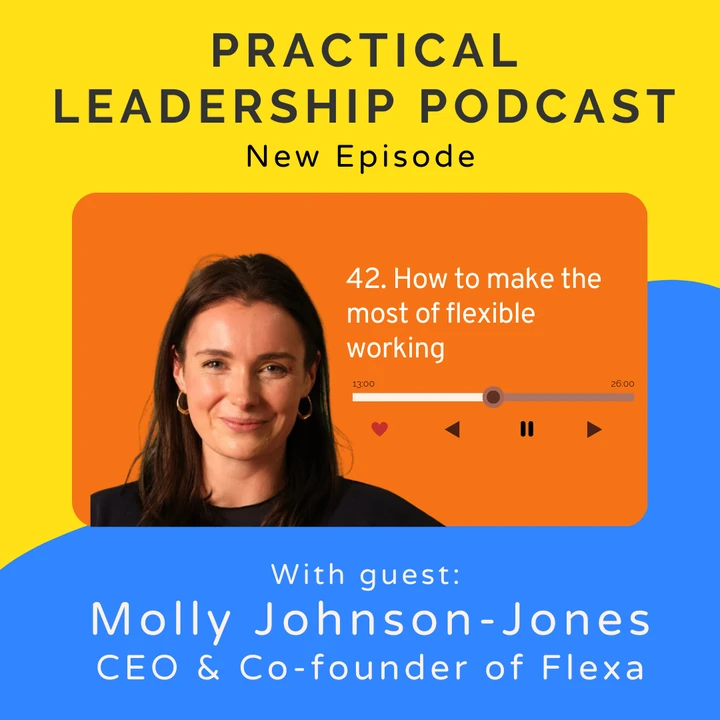
How to make the most of flexible work
with Molly Johnson-Jones
Show notes
In my latest episode, I had the pleasure of talking with Molly Johnson-Jones, CEO of Flexa, about how to truly embrace and make the most out of flexible working. Flexa is a company that specializes in helping organizations create genuinely flexible working environments, and Molly has some fantastic insights to share.
Molly and I discuss the importance of setting clear expectations and frameworks to help employees thrive in a flexible environment. We delve into the common misconceptions about flexible working and the importance of transparency in job descriptions. We also touch on how crucial it is for senior leadership to role model flexibility and lead with trust.
Are you curious about how to improve your organisation’s flexible working culture or want to learn more about the benefits of offering genuine flexibility to your team? Then this episode is perfect for you! Molly’s enthusiasm for flexible working is infectious, and her insights are invaluable for any leader looking to create a more adaptable and resilient workforce.
So, grab your headphones and join us for an engaging and informative conversation that will have you rethinking your approach to flexible working. Don’t miss out on this chance to learn from a true expert in the field! Listen now to the Practical Leadership Podcast’s latest episode with Molly Johnson-Jones.
You can find Molly here:
https://www.linkedin.com/in/molly-johnson-jones/
https://flexa.careers/
———————
Perform better as a new manager – or learn to get promoted for the first time – visit : https://leadershipthatsells.com/
Transcript
Automated transcript. Speaker labels and spellings may contain errors.
Paul
[upbeat music] Hello, and welcome to The Practical Leadership Podcast, where I interview great leaders and try to extract their wisdom and experience for you to learn from, and hopefully avoid making their mistakes. Check out practical-leadership.academy because you want to help your new managers succeed with hybrid or remote working. [upbeat music] Molly Johnson-Jones from Flexa, thank you so much indeed for joining me.
Molly Johnson-Jones
Thank you for having me.
Paul
So you were a veterinary assistant?
Molly Johnson-Jones
[laughs] Back a very, very long time ago [laughs] when I was 15.
Paul
You grew up on a dairy farm.
Molly Johnson-Jones
I did, yeah. Grew up on a dairy farm.
Paul
My best friend when I was a kid, his family had, uh, all the best Friesians you could ever possibly ask for. Place stank, but it was a stink of warmth, and we had big Coke bottles full of raw milk every day.
Molly Johnson-Jones
Yeah.
Paul
Marvelous. Marvelous.
Molly Johnson-Jones
Kilos of cheese. Kilos of cheese in the fridge. Um-
Paul
Unbelievable
Molly Johnson-Jones
... liters of ice cream. [laughs]
Paul
[laughs] So and then when you grew up, you want to have a home for old dogs.
Molly Johnson-Jones
That is what I still want, and that's what I'm aiming for when, um, we eventually, hopefully, sell Flexa. That is my dream, is to be able to own an old dog's home. [laughs]
Paul
Any particular breed?
Molly Johnson-Jones
Uh, no, just all of the dogs over the age of nine that people don't want to adopt 'cause of all of the insurance difficulties and the fact that people want a puppy. I just want to bring them all-
Paul
Uh-huh
Molly Johnson-Jones
... into a home and have enough money to be able to look after them.
Paul
Well, if you need anybody to give you a hand on that, just let me know.
Molly Johnson-Jones
Yeah. [laughs]
Paul
I'll be out there walking them every day.
Molly Johnson-Jones
All the volunteers, it'd be brilliant. [laughs]
Paul
Yeah. Totally. I'll be right up there. Would you then, apart from my kind of sojourn off into the animal world, animal kingdom, would you, [laughs] would you introduce yourself a wee bit for me?
Molly Johnson-Jones
Absolutely. So currently not working, um, in the animal industry. But, um, I'm Molly. I am the CEO and co-founder of Flexa Careers, and Flexa is the global directory of verified flexible companies. And what that means is we enable people to find their ideal companies based on working environment. So whether it's remote first, with the option of a dog friendly office and flexible hours, or hybrid one to two days a week but with flexible hours so you can pick up your children from school. Put those filters on, and all of the companies that match exactly that will come up.
Paul
So, um, I- I'm a senior exec at Unilever, for example. How do I become certified as a flexible working space? What do I need to do?
Molly Johnson-Jones
So the company itself, um, someone in maybe employer brand or DEI or talent acquisition or HR generally, um, will come to us and say, "Hey, we think we're flexible. Um, can we join Flexa?" And we have a two-stage kind of benchmarking process. The first one is very objective. It's a sort of quiz that we've built based on millions of different data points that assesses the company against the market, and the company needs to score above 50%, so above average, uh, in terms of flexibility to be eligible. But we don't just take a company's word for it. So all companies on Flexa have been verified by employees. So then a second, uh, more subjective quiz is sent out anonymously to a statistically significant sample of employees.
They take that, and that's ranking a company in six different areas. The six areas that, through extensive research, we've understood to make up flexibility, and that's location, hours, benefits, work-life balance, um, senior leadership role modeling, and trust and autonomy as well. And each employee kind of rates that on a sliding scale. We compile all those averages, and that becomes the Flex Score, which is the basis for a company page on Flexa.
Paul
So you basically just told our audience how to create a flexible organization.
Molly Johnson-Jones
Exactly. Based on those six areas. They're the, they're the key areas to focus on to create true flexibility.
Paul
Now, you're the CEO of Flexa. What was your journey to becoming a manager of people in the first place?
Molly Johnson-Jones
Definitely, um, didn't expect to be doing this when I left university. Um, I studied geography at Oxford, um, a notoriously [laughs] useful degree, um, and went straight into investment banking and equity research, where I worked for about two years. The reason that I left investment banking, which I thought was my dream career, was because I was sacked. Um, the reason for that is I've had, I've had an autoimmune disease since I was 18, which sometimes means I, I can't walk. Back then it was about, about once a week, where I literally, like, physically couldn't stand up. Had to, like, put cushions on the floor to be able to get to the bathroom. I couldn't come walk properly. Um, so obviously couldn't get into an office. And they said, "Oh, well, we're open to flexible working requests, so why don't you ask to work from home one day a week?" So I did, and 10 days later they put a settlement package in front of me, sacked me, and told me to leave immediately.
And I was like, "Well, weren't really open to flexible working requests then, were you?" [laughs] "Should've, should've just avoided, uh, avoided all of that hassle." But then I went into, um, obviously looking for a company that would enable me or empower me, allow me to work from home one day a week, which back in 2016 wasn't normal. But it was impossible to find that information, so I started working, went in to lead a, uh, food retail research team, um, in a market research company. Flexibility was allowed, like, I wasn't sacked for it, but it wasn't encouraged. Like, culturally, it was very unusual. Um, then I moved into strategy consulting. It was exactly the same, you know, "Why are you working from home again?" And I was like, "Oh, my illness doesn't just go away." [laughs] "It will keep cropping up, sadly." Um, so again, it was allowed, but it wasn't, it wasn't culturally accepted.
And then I eventually, um, moved to be a strategy consultant elsewhere, in fintech actually. And, um- It was just I found a company that it was, it was a total cultural shift. I was able to work from home two days a week, come in a bit later if I didn't feel well, and no one asked any questions. And I was like, "Gosh, this is such a change." It's amazing how much of an impact that can have on someone's life. I was ... didn't feel guilty anymore. I was getting less sick as well, 'cause it's obviously you're not in that kind of vicious cycle of not being able to control your working environment. Um, which then got me thinking, you know, why aren't these companies shouting about this? I didn't know about it until I got there. Um, and why are thousands and thousands of people going through this? And this was pre-pandemic. Um, why are they going through the same process as me? Like, why is this so difficult? Which led us to that I met Maurice, who's my partner, as in romantic partner and business partner, and, um, he was working at a flexible
company as well, and he was like, "I feel like would make sense if we solve this problem," given that you have it from a personal perspective, and he understood it from an employer perspective. Um, and we launched three weeks before the pandemic, which obviously three years later, pretty, pretty amazing, um, growth in terms of the demand for flexible working and the supply of flexible working too.
Paul
Well, that's an interesting journey.
Molly Johnson-Jones
[laughs]
Paul
Pretty weird. Okay. Oh, by the way, we can, we can arm wrestle over who's got the most useless de- degree.
Molly Johnson-Jones
[laughs] What's yours?
Paul
I have a master's in Scandinavian studies.
Molly Johnson-Jones
That mi- you might win. [laughs]
Paul
Mm. It's kinda like having a degree in chocolate sculpture. You, you-
Molly Johnson-Jones
[laughs]
Paul
... say it to people and they say, "Wow, that's really interesting. Um, uh, what do you do with that? [laughs] What's that for?" Yeah. My wife says it's a degree in tobogganing.
Molly Johnson-Jones
[laughs]
Paul
So you- you've, you've gone through this, this, uh, heck of an experiential journey. I mean, that's, that's a founder story and a half. I mean, that is a founder story and a half and three-quarter. And y- your first one they said, "Oh, we're open to flexible working requests," and they were. They didn't lie to you.
Molly Johnson-Jones
Yeah. [laughs] They were, yeah.
Paul
They were just gonna say, "And as soon as you make one, we'll kick your arse out the door and don't let it hit you on the way out, by the way."
Molly Johnson-Jones
Yeah.
Paul
"Here's a fiver for your taxi fare." [laughs] My goodness. But yes, it's, it's ... A- and I must admit to being one of those crappy employers previously-
Molly Johnson-Jones
Mm
Paul
... who when faced with the trying to build up a top-class team, I wanted everybody in the office.
Molly Johnson-Jones
Yeah.
Paul
And I think it was a wonderful woman called Amanda Nolan, who's, uh, a great, uh, consultant and expert in ed tech and L&D, and she was, she was giving me a really hard time about that. She gives everybody a hard time about stuff she doesn't like. She's wonderful. You should meet her actually. Um, saying that, well, if you want top talent, you have to go where the top talent is and let them work as top talent will.
Molly Johnson-Jones
Mm-hmm. The top talent can demand a lot.
Paul
And don't be such an arse about it. And I was being a bit of an arse about it, and saying, "Well, no, it's culture, it's values, it's bringing people together, it's trust, it's all that." And I do still think you need to have folk come together.
Molly Johnson-Jones
Mm. I do, I definitely. I'm, I'm not anti. I think when people hear flexible working, they're like, "Oh, that means anti-office." Very much not. I think, uh, remote and in-person work are fundamentally complementary and very important.
Paul
That's it.
Molly Johnson-Jones
It, it's about finding the cadence of that in-person and remote, kind of that balance that works for you as a company, and then attracting the individuals that also agree that that is their balance too. It's about matching that cadence.
Paul
So in the context of what I'm trying to talk about in this, in this, um, podcast, if you were coming into an organization as a first-time manager and faced with trying to build this team remotely or hybridly or any of the 27 different variants of flexible working that we can come up with, I'm sure you've got a definition, what would you advise someone who's all of a sudden in this position?
Molly Johnson-Jones
I think probably the most important but also most difficult thing to do is try to objectively look at output.
Paul
Okay.
Molly Johnson-Jones
I think people assume that if somebody doesn't want to come into the office every day, or when they're told to, that might be four days a week, whatever, um, that they're less committed to their role, and I think that's a really legacy belief just because go back three years and the default was five days a week in the office. And working from home was associated with people who had other commitments and needs outside of work that maybe would potentially detract from their ability to do the job, which is definitely what I came up against. And I think now that we're in this new sort of way of working where there is more freedom and there is more choice, we need to treat people as adults and look at their output. And if that person says, "My best way of working is, you know, three days a week in the office and two at home," well, within whatever framework you're operating, um, in your company, as long as they are still
meeting your expectations in terms of when they turn up, you need to look at their output and think, "Well, if they're saying that's how they'll get their best work done, then I need to believe that it is," and only judge on performance, rather than being able to see them and have a coffee with them and sit next to them. That doesn't really mean anything.
Paul
I think as well when you have ... when taking on this, uh, management role in a flexible working relationship, 'cause I think it's more of a relationship than an environment really, and you mentioned cadence there rather than balance. We talk about the home-life balance. And it's, it's a, it's a cadential thing. It's really a, there's a rhythm and you need to, you need to try and create. I think as a, as a, as a manager who's trying to put something like that in place, there's ... You have to be really, really good at managing.
Molly Johnson-Jones
Yeah. And you have to be really good at managing expectations as well. And I think-
Paul
Setting them, managing them, following up on them, getting the output, and being clear about when. 'Cause you had crappy managers or average managers who could get away with that in an office.
Molly Johnson-Jones
Yeah But they can't now because it's-
Paul
Mm-hmm
Molly Johnson-Jones
... measuring performance has shifted to being so output based. Um, and I think for managers that are, you know, managing people for the first time in flexible environments, it is exactly as, as you and I both said, like, it's about managing expectations and being super clear. I think what a lot of companies and managers fall down on is they won't be super clear about expectations. They won't be really clear about the, the framework within which there is freedom. So, like, if you really want people in the office two days a week, but you're gonna offer flexibility in terms of coming in, so you can come in at 10:00 or you can come in at 8:00 and leave at 4:00, be clear about that because people need boundaries in order to be able to exercise their own freedom. They need to understand within what framework they can operate because total freedom gives people anxiety.
It makes people worried about what they can actually do. Being clear about it, um, and putting that on paper and saying, like, "This is what we expect of people, and around that you've got total freedom, you know, just to get your best work done," that is the way to nail managing somebody in a flexible environment.
Paul
I did an experiment in my last, uh, last big role where we had, uh, open vacations, you know, unlimited vacations.
Molly Johnson-Jones
Fair.
Paul
We tracked it. Yeah, we still tracked it, and guess what the now average number of vacation days people took was?
Molly Johnson-Jones
Dropped down I'd say after that, so probably-
Paul
It, it w- yeah, it did. On average it dropped. There was a couple of people who took, like, 30 days, but the peak was, like, 26.
Molly Johnson-Jones
Yep.
Paul
But we offered 25 corporately, and people-
Molly Johnson-Jones
Yeah
Paul
... were taking the 20. So I changed it and I said, "You need to take at least 25," because that's the... that's, that's on the docket.
Molly Johnson-Jones
Yeah.
Paul
It's exactly your framework there. It's like kids. I mean, um, if, if, if you're listening and you have children, you know what I'm talking about. It's framework and boundaries and expectations and more expectations and just a few more expectations, and people love that.
Molly Johnson-Jones
Yeah. It helps people to thrive in an environment where they feel that they have choice, and that is really important. Obviously setting a framework where it's, like, five days in the office, 9:00 till 6:00, that's not really gonna make it.
Paul
[laughs]
Molly Johnson-Jones
But giving people a, a framework of that minimum expectation, saying, "Around that you exercise your choice. You do you. We trust you," and feeling trusted-
Paul
Mm-hmm
Molly Johnson-Jones
... about it is incredibly important for people to be able to perform at their best.
Paul
Mm.
Molly Johnson-Jones
And to, to remain engaged as well. Like, it's one of the key, um, factors in employee engagement is feeling trusted.
Paul
I think you get a sense of care as well.
Molly Johnson-Jones
Yeah.
Paul
It's almost like a duty of care, but you get a sense of care that, "Oh, you can do what you like. It's open. It's free. You just, you do..." And what I hear from that is, "I really don't give two craps about you. I haven't even bothered thinking through what you can and can't do. I'm just gonna let you do whatever you want, 'cause then it's less work for me."
Molly Johnson-Jones
Exactly, and I think it's helping people to understand... well, encouraging people to see that you have created an environment that you've really, really thought about and that you have tried to make the best possible, both for your business in terms of achieving those goals and/or team potentially achieving those goals, but also for the individual. And I always talk about it, it's, it's about creating an environment where you offer maximum choice within a framework that takes into account business goals.
Paul
Help us out with, uh, a how-to then, okay?
Molly Johnson-Jones
Sure.
Paul
So you've mentioned at the, the, the top here you have your Verified by Flexa. I can see the big sticker there behind you. If you're w- not watching on YouTube, you should be. Um, although I did say that I have a face for video earlier on in this, I, I'm, I'm not wearing my makeup so I apologize.
Molly Johnson-Jones
[laughs]
Paul
Um, Verified by Flexa means that you have a number of points that you have to tick off.
Molly Johnson-Jones
Yep.
Paul
That's fine. How do I go about... w- We talked about how do you, how do you want these elements, that's fine. What's the most important one or two? How do I go about starting? What's really gonna make a difference? 'Cause everything, you know, everything you do starts with the... the 80% is, uh, makes a difference starts with the 20% of effort.
Molly Johnson-Jones
Yep.
Paul
What do I do to make the biggest difference?
Molly Johnson-Jones
Uh, first of all set, I think, the, the minimum commitment to flexibility that you're gonna offer in terms of hours and location. So you could start off with something that you're super comfortable with, isn't gonna make you worried. So that might be you can work two days a week from home, and our core hours are going to be 10:00 till 5:00. That's your minimum commitment to flexibility. That's what everyone gets. Um, and people can come into the office more or work more set hours, whatever they want, but that is your minimum commitment to flexibility, or maximum choice if you flip it around. Then once you've got that set, communicate that everywhere. Make sure people know it. Make sure in your onboarding processes you are reiterating that. Make sure it's on job descriptions, your careers page. Make sure every manager knows that that is happening, and that if somebody does want to only come into the office two days a week, then that's fine.
You cannot see that as them being less committed, so culturally it needs to start to be communicated. And then the next two most important things, first of all, is that senior leadership need to start role modeling that. Even if senior leadership's default is I want to be in the office five days a week and working 9:00 till 9:00, like I know so many founders do. Um, making sure that even if you do want to work, and, like, I'm definitely guilty of being online all the time, but I go to the gym at lunchtime, I walk my dog, and I show people that I do that, and I show people that sometimes, you know, I'm not feeling so well, like with my autoimmune disease, and I will be less communicative. Uh, but I role model flex- the flexibility that I need, which means that it becomes much more culturally accepted and people feel comfortable in working flexibly, and it becomes part of your culture much more quickly if senior leadership are embodying it.
Um, and then the final thing I would say to make a step into creating that genuine flexibility is make sure that you lead with trust. So don't assume- That somebody is going to break your trust. Let them break it if they're going to, and you'll be surprised because they probably won't.
Paul
It was, uh, Ronald Reagan's thing when he was talking about the, uh, Soviet disarmament, trust yet verify.
Molly Johnson-Jones
Yeah. [laughs] Exactly that. It's let, let people, let people operate in their own way and you will actually be surprised by how hard they will work, if you've hired the right people. [laughs]
Paul
Well, that's it, you know, hiring right g- I think gets rid of 85% of your people problems.
Molly Johnson-Jones
Yeah.
Paul
Which is a challenge. And which means that you should be talking to Flexa.
Molly Johnson-Jones
Absolutely.
Paul
Yeah.
Molly Johnson-Jones
Transparency is the way to ultimately hire people that want to work in the way that you want to work. I speak to so many people and they're like, "I went through four hours of interviews, and then I found out that I have to be in the office five days a week. I've wasted my time. I've wasted their time. Like, what was the point of that?" Let people make an educated decision about whether or not they want to work for you, because then you are going to hire better matched people, and you're going to be able to retain them better as well.
Paul
I mean, hy- you, you see job ads, I mean, I'm talking about the stuff. You see job ads saying, "Hybrid working environment," you know, uh, "49 and a half hours in the office, and half an hour fag break."
Molly Johnson-Jones
Yeah. [laughs]
Paul
Well, not quite. I'm exaggerating, but not much.
Molly Johnson-Jones
Yeah. And then they think that that is an attractive proposition.
Paul
That's super flexible. It's not. They crap. Try again. Yeah, okay. What are you working on right now?
Molly Johnson-Jones
In the business at the moment, we're thankfully not fundraising. [laughs] We raised last year, um, kind of early summer of last year, so we're in a good position from that perspective. Um, which I'm, every, you know, every founder will relate to the fact that it's incredibly time-consuming, um, and sometimes very stressful. Um, we've actually just finished our big hiring drive, so that's also nice. Um, because, again, hiring the right people, as you said, is so important, but it takes an enormous amount of time. And we don't have, um, like a people team. It's all done by us as hiring managers. Uh, so we're in a very nice period actually, where we get to focus on growth, which is something that I really enjoy having proper time to do without distractions.
Paul
Was there a particular event or mistake that taught you the most?
Molly Johnson-Jones
I don't think there was one particular event. I think managing people has taught me a lot about myself. Um, and I think it's understanding, you know, why I've historically managed people in the way that I have and why that's all shifted. And I think interestingly, um, probably the thing that's taught me the most is that often the reasons that you get frustrated with people, or you react badly to situations, is either because it's a reflection of a trait in yourself that you might like less or not want to face, or it is because you've worked so hard doing the opposite that that's almost become part of your identity, and so you push back on people that don't work as hard on that.
Paul
I mean, for founders in particular, I mean, I've dealt with an awful, awful lot of entrepreneurial CEOs, and nobody is as passionate as you. Nobody works as hard as you. Nobody cares as much as you. And one of the hardest things, I think, and I coach people on this, is to recognize that that's actually okay.
Molly Johnson-Jones
It's normal. Like, you literally, there is no one who has as much at stake as a founder. Like, you've-
Paul
Yeah
Molly Johnson-Jones
... probably given up a, a decent job with much more earning potential [laughs] than you currently have. You are working more hours than you ever did, and you probably left that previous job 'cause you're like, "I wanna do my own thing, and I want people to stop telling me what to do." When actually investors tell you what to do, your clients tell you what to do. You probably get told what to do by more people than you ever did before, but your entire future is tied up in that. You want to create something big. You care about it. There's probably a story behind it. And so ultimately, you know, your entire future and everything, and what you've sacrificed is, is at stake. And so naturally you have emotional, financial, situational risk attached to all of this. Um, and you wouldn't want any of your employees to be under that level of pressure, so don't try and make them feel it.
Paul
It's good to hear. What would you like to thank young Molly for having done?
Molly Johnson-Jones
Probably having a pretty high risk tolerance, [laughs] I think is probably the biggest thing, and I've had that since I was probably a, a teenager I reckon, and saying yes to as many opportunities as I could. Sometimes too many. Um, and I'm always kinda guilty of sometimes kind of taking on too much and losing direction. But I think that that gave me a lot of resilience, um, and ability to keep pushing forward even when things are difficult.
Paul
Is there a particular method you use for prioritization, for getting to the nub of things?
Molly Johnson-Jones
[laughs]
Paul
Choosing?
Molly Johnson-Jones
There probably should be, but, um, no, I'm much more sort of intuition-based, which is why thankfully I've got a team that is less like that [laughs] and much better at prioritizing through, you know, rational, rational argument, um, and data and reason. But, um, a lot of the kind of, uh, steps and moves that we made in the very early days were led by, like, what felt right. And I think that's useful to have that as a steer. But yeah, you always need a team that has different traits to you, I think, as a founder. [laughs]
Paul
But my lucky pen says that this is the right method.
Molly Johnson-Jones
[laughs] Exactly that. Thankfully that doesn't really happen anymore. [laughs]
Paul
And lastly, as we wrap up, what are your coordinates? How can people find you? Where should they go?
Molly Johnson-Jones
Um, find me, I'm a bit of a shameless, um, LinkedIn influencer. So please do follow me to hear all things about flexible working and being an entrepreneur who also happens to be female. Um, because it is a very different experience, I think, um, for women kind of running businesses. Um, and in terms of Flexa, if any companies are like, "Oh, yeah, I do, do have a flexible working environment, but I'm not really shouting about it. I'm not using it to my advantage," um, then just get in touch because it's pretty cheap, um, and very, very, uh, low effort to get onto Flexa and start shouting about that and really reap rewards.
Paul
And as somebody who works flexibly, my wife works flexibly, it's, uh, it's a thing. And it's not something you can find, and it's not something you can just assume or presume that in any organization.
Molly Johnson-Jones
No, definitely can't. And I think lots of companies, we see it on LinkedIn at the moment, 68% of companies have ticked the remote box.
Paul
Mm-hmm.
Molly Johnson-Jones
And then you go onto, um, those job descriptions, and apparently, someone's done a lot of extensive research, only 18% of them are actually fully remote. [laughs]
Paul
[laughs]
Molly Johnson-Jones
So you can't trust what you see.
Paul
Molly Johnson-Jones, CEO of Flexa. Hopefully future dog home owner, but, uh, doyenne of the flexible working office.
Molly Johnson-Jones
That's great. [laughs]
Paul
Thank you so much for joining me.
Molly Johnson-Jones
Thank you very much. [upbeat music]
Paul
That's a wrap. Thank you for joining me today. Your homework is to leave your five-star review, and please, any comments you have. You really help me to improve every day, and it also helps people to discover me online. You should check out practical-leadership.academy because you want to help your new managers succeed with hybrid or remote working. [upbeat music]