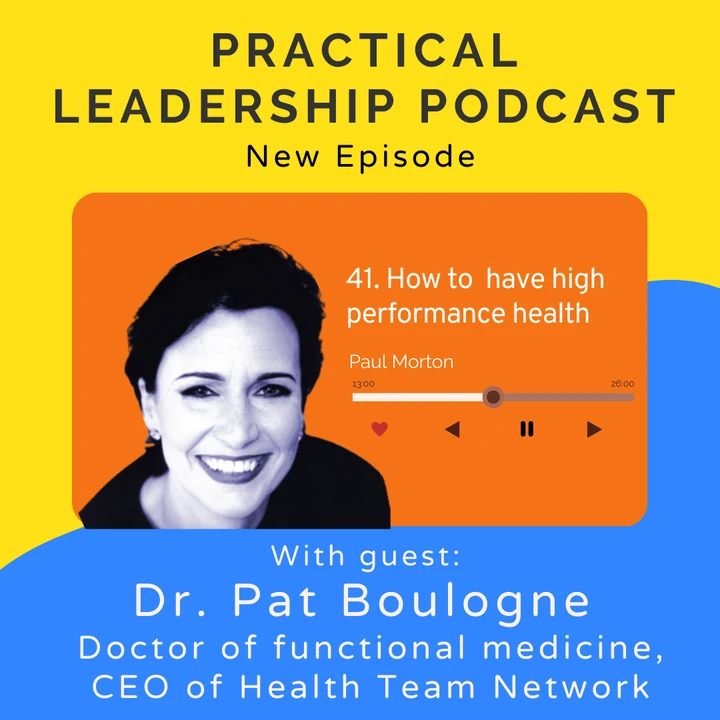
How to unlock high-performance health
with Dr. Pat Boulogne
Show notes
Dr. Pat – why am I fat and lazy?
Believe it or not, Dr. Pat has an answer…
Dr. Pat Boulogne is a doctor of functional medicine, CEO of Healthteam Network and a “coach with a mentor’s heart”.
In this episode, I had the pleasure of interviewing Dr. Pat Boulogne, a lifestyle medicine expert and chiropractor, who shared her insights on the importance of maintaining a high-performance lifestyle to achieve better health and success. Dr. Pat talked about the five pillars of health: positive mental attitude, diet, exercise, sleep, and posture, and how addressing our weakest link can lead to significant improvements in our overall well-being.
Some key takeaways from our conversation include:
• The importance of nurturing ourselves before we can nurture others, and the role of mindset in achieving our goals
• How daily habits and simple exercises can improve our posture and core strength, leading to reduced pain and stiffness
• Her upcoming collaborative book, “Deck of Cards,” where Dr. Pat shares her tips for improving business and health.
Dr Pat says:
“If you don’t nurture yourself, you can’t nurture somebody else.”
“Sometimes hiring a coach with a mentor’s heart help you know where exactly to spend your time, energy, and money.”
“I just love to see people thrive. I get a lot of joy from seeing people succeed and win.”
Dr. Pat emphasized the value of persistence and consistency in achieving a high-performance lifestyle. She believes that with the right guidance and a strong foundation, individuals can reach their greatest potential in less time.
I thoroughly enjoyed our conversation and look forward to the release of her book, “Deck of Cards.”
If you’d like to learn more about Dr. Pat Boulogne and her work, you can connect with her on LinkedIn, Facebook, and Instagram, or visit her website at www.Healthteamnetwork.com.
Transcript
Automated transcript. Speaker labels and spellings may contain errors.
Paul
[upbeat music] Hello, and welcome to the Practical Leadership Podcast, where I interview great leaders and try to extract their wisdom and experience for you to learn from, and hopefully avoid making their mistakes. Check out practical-leadership.academy because you want to help your new managers succeed with hybrid or remote working. [upbeat music] Dr. Pat, thank you so much for joining me today.
Dr. Pat Boulogne
Oh, I love being here. [laughs] It's gonna be fun.
Paul
So you're a fantastic person. No, I, I don't say that to all the girls, I really don't. But you are a mentor, a coach, a, a lifestyle strategist. You've been a physician. Now, that's not an easy thing. A physician for three and a half decades. That's, like, almost older than me. [clears throat] Uh, no.
Dr. Pat Boulogne
[laughs]
Paul
Tell me a little bit about yourself.
Dr. Pat Boulogne
Well, you know, I love to help people, you know? I thrive and I like to see people thrive, um, as their ultimate goal. Making massive differences in people's lives matter to me. And, um, and, you know, the... One of the reasons why I still do what I do is because, besides making those massive difference, it's easy for me, a God-given gift is to be able to synthesize and make things simple, so that when people have challenges, I can help them get to their goals safer, quicker, and with more simpler solutions to make sure they stay unstuck and they can reach all the goals that they wanna have in their life.
Paul
So in the context of the things that I like to talk about, and you're here, so, you know, I get to ask the questions.
Dr. Pat Boulogne
Mm-hmm.
Paul
Um, I deeply believe, and I advise everybody that I coach and mentor, that the first person that they have to ta- take care of and pay attention to is themselves. Now, that's both physically and mentally. Mentally, because the person that listens to us most is us, so our self-track, our self-talk has to be positive, it has to be meaningful, and it has to be consistently good for us. It's too easy to be negative. And physically, frankly, if I... you allow me to misquote the title of your last bestselling book, why am I fat, sick, and lazy? Well, I have to look after myself before I can look after other people. It's to be physically good, mentally good. Help me out here, Dr. Pat.
Dr. Pat Boulogne
Well, you know, you have to know your bottom line, and a lot of people don't understand what their bottom line is anymore, you know? And that, that's, that's a line of, you know, go back to basics. You know, if you ask people what their basics are, they really don't know what basic health is really all about. So that's what... You know, when you're looking at, like, where to start, or, like, why am I always exhausted at 2:00 in the afternoon, or I feel like I need sugar or something, I crave something sweet at 10:00 and at 4:00, you know? And why do I feel like I need to go down and take a nap, [laughs] and go outside and hug a tree and meditate, um, and get some fresh air, is because we aren't... We don't know what our bottom lines are. We don't know what it takes to truly be healthy and how to acclimate that and, you know, ignite that switch underneath that so that we can do
those things that are basic for us consistently so that we get better results.
Paul
So what are the things that I need to be doing consistently to get those better results before I can reach out and look after the people that I am charged with looking after?
Dr. Pat Boulogne
Well, I think we had a conversation where I told you that my father always said, you know, "You, you can't nurture somebody else without nurturing yourself first."
Paul
Hmm.
Dr. Pat Boulogne
And you have to be able to... You know, like wh- when you're in an airplane and those yellow things come down for oxygen, they don't tell you to put them on everyone else first. As a parent, they tell you to put yours on first, and if someone's struggling, you put them on second. You know, there's a reason for that, right? And it's because you have to have that, that strength and you have to have that foundation and stability to be able to help others. Because when you do that, you're able to think better, feel better, move better, and you're able to live longer, and with an easier fashion than always be feeling like you're going on a treadmill or a hamster kind of wheel and going uphill. So when you have that, you know, you have y- there's more blessings for not only you, but everybody else around you.
Paul
So what are the... What, what, what are the component parts then that we can break this down to?
Dr. Pat Boulogne
Okay.
Paul
I mean, I'm looking here for, as I said, I was looking, we, we're looking for, like, a how to, right? Make this easy-
Dr. Pat Boulogne
Right
Paul
... for everybody. But what do we-
Dr. Pat Boulogne
Okay
Paul
... where do we start? What are the bits?
Dr. Pat Boulogne
So you have to understand what health is and what health isn't. So health is being at your peak performance all the time, mind, body, and soul, or spirit, whatever you wanna call it. You know, and when you do that, you have to look at, you know, what are the components that I have, have going for me? You have to have a positive mindset and a positive mental attitude, and you have to couple that with, um, uh, superior wellness initiatives, which for me, when I'm looking at the definition of health that I just said, I'm pairing that down to diet, exercise, sleep, proper mental attitude, I'm mentioning that twice because it's so, so important, um, and also a properly functioning nervous system and proper posture, because you can't have a properly functioning nervous system if you have a poor posture.
You know, ultimately something's gotta give. So having those five pillars-
Paul
I'm just sitting up straight here, you know, just to make sure I'm... Yes.
Dr. Pat Boulogne
[laughs]
Paul
Like my mother always said, "Sit up straight, Martin. There we go."
Dr. Pat Boulogne
Everybody does that. [laughs] When we talk about posture, you can see people shift in their seats as they're... all of a sudden they're aware of it. And a lot of people, we get, you know, we especially, like, take a drive down the M5, right? [laughs] Um, and all you have to do, or the 25, and just look in the car next to you, the person's slumped over with their head leaning forward. Well, your head weighs about, like, the size of a small bowling ball, which is about 11 pounds.
Paul
[laughs]
Dr. Pat Boulogne
And so, you know, try carrying that bowling ball around with you in that position all the time. Your body's going to adapt to that. And it's, you know, it's just like as opposed to adapting to something that's more structurally sound. Structure is function. Yeah.
Paul
So diet, exercise, sleep, PMA, positive mental attitude.
Dr. Pat Boulogne
Mental attitude.
Paul
I love that.
Dr. Pat Boulogne
You know?
Paul
Positive mental attitude, nervous system and posture. Diet, I think... Well, let's, let's go, let's take us on a journey. Let's go for diet.
Dr. Pat Boulogne
Okay. So, you know, um, how when I'm teaching those five pillars, I always start with positive mental attitude. And each time that I'm coaching with somebody and we're going through that process, 'cause you have to know you have con- total control of what goes in your mouth. Um, if you eat poor things, you will eventually damage your intestinal tract. And if you do that, then you're gonna have a whole host of other things happen. That's a whole nother episode [laughs] um, on your podcast. But ideally, you know, you want to, you know, eat really well, have superior nutrition, um, so that you can assimilate the things that you eat so your body can utilize them properly. So when you have... And, and that portion is like, you know, no sugars. I mean, uh, sugar is really, in all research relates back to inflammation, it's more addictive than cocaine, you know?
So getting sugar out of your diet is a very good thing to do, and doing it consistently. Um, other things for the diet is just like, you know, hydration. You need hydration for every pillar of the health that I spoke about. You know, good guy. [laughs] You know? Because it helps detoxify toxins, it helps you sleep better, as long as you're not drinking a liter of water before you, just before you go to bed. Um, but some people do that because they're trying to get that number in. And how you know how much water you drink, and I don't know it in your system, metric system, but it's 50% of your body weight in ounces. So if you weigh 150 pounds, which is around 72 kilos, I think, then, you know, you need to have 50% of that, you know?
Um, and which would be 75, uh, ounces of water a day. Um-
Paul
Do you know, I really wa- I wanna do the maths here.
Dr. Pat Boulogne
Okay, go ahead.
Paul
So 75 fluid ounces in milli- liters is two liters. There you go.
Dr. Pat Boulogne
Okay. So, so it helps you, um, you know, digest your food, it helps you sleep better, it helps you bathe your body so that it has the hydration that it needs. A lot of injuries that people have, physical injuries they have are because of dehydration.
Paul
Hmm.
Dr. Pat Boulogne
So, and, and then a lot of people say they don't like water, so the, the, you know, what can you do? Drink it with a straw. Put some lemon juice in it from, from fresh lemon. You know, simple solutions that you can do so that you can get the amount of water that you need a day for all functions of your body. Um, and then eat really clean. I mean, look at like, you know, when you eat something and an hour and a half later you're tired or exhausted, you gotta take a look at the food that you ate just in that last meal so that you can... Then you'll say like, "What was it that I ate that made me like totally wipe me out, and now I feel like I have to go home and I get... need to take a nap?" Or I'm-
Paul
Like rice
Dr. Pat Boulogne
... have brain fog, like you have brain fog, that type of thing.
Paul
Yeah.
Dr. Pat Boulogne
It all relates, you know, back to diet. Diet's so... It's a key component, but in order to do the diet correctly and be consistent, you know, you have to have the mindset for it, you know, in order to be successful. You know? And having that mindset and the positive mental attitude about like how I'm gonna do it. I, I intermittent fast.
Paul
Sure.
Dr. Pat Boulogne
I do it for 18 hours at a time. Um-
Paul
Yep
Dr. Pat Boulogne
... so, and, and but the key components in making, here's a real good trick and tip. In order to make intermittent fasting really work better, you know, and, and have even better results, you have to hydrate. So getting all that hydration in during that, you know, time span, um, not the eating time span, but the whole, you know, 24-hour type thing, is essential to making the, the intermittent fasting, um, portion of it work even better. You know, and-
Paul
Do you know that? You've just enlightened me because I did... I, I do that too. I've been doing this for a few years now.
Dr. Pat Boulogne
Mm-hmm.
Paul
Um, and I typically, I'm sitting here with a big pint glass of water. Uh, you know, weird enough, we're, we're on, we're in liters and miles and kilometer meters and centimeter inches here. The UK is one of those wonderful messed up places when it comes to measurements. Um, so I'm sitting here with a pint glass, half a liter, whatever it is, and the days when I'm doing the intermittent fasting and I'm drinking like crazy are great. The days when I'm not, I struggle.
Dr. Pat Boulogne
Mm-hmm.
Paul
I never thought about it was something as simple as hydration. There you go.
Dr. Pat Boulogne
There you go.
Paul
I've become way smarter already, Dr. Pat. I love it. Okay.
Dr. Pat Boulogne
[laughs]
Paul
PMA, diet, then where are we on to?
Dr. Pat Boulogne
So exercise, you know, a lot of people-
Paul
Okay
Dr. Pat Boulogne
... I have a, I have a rule called, um, the rule of one, and so when people first start to go exercise, it's actually getting out there. So like people who even have brain trauma and, and that type of thing, the, that, you know, so just getting out and moving and doing one thing, like walking one block, or if you live in a building and you have crappy weather and it's raining all the time, you know, you can take the steps, you know, up. You know, like you don't have to take the steps if you live on the third floor, you don't have to take steps all the way up to the third floor. Just take them up to the first floor and then get on the elevator.
Paul
Hmm.
Dr. Pat Boulogne
No one's gonna know. [laughs] And it's like, it's just like, you know, the, you know, who's gonna know? It's like no one's gonna know except you, but you can celebrate any type, any time you have a win, you know, for that. And taking, being able to take care of yourself and having the energy to sustain you through even your toughest day is really important to have. So these tips that we're doing right now are really very essential. Um, and they're so simple. It's just being-
Paul
The celebration. I love the celebration. There was a guy, it was, um, I think it was a neuroscientist from- Forgive me, I can't remember, BJ Fogg, and he was talking about tiny habits and his idea of trying to fit new habits in with old ones, and a way of celebrating the micro successes by physically patting yourself on the back, smiling a big cheery smile, yes.
Dr. Pat Boulogne
[laughs]
Paul
I know. It, and just say, "Way to go, Paul. Look, you sharpened three pencils this morning, yay." Whatever your goal happens to be, you micro celebrate. You do that, and it builds, and it builds, and it builds, and it builds.
Dr. Pat Boulogne
Mm-hmm.
Paul
Mm.
Dr. Pat Boulogne
It does, and a lot of people, you know, we forget to celebrate, you know, our wins on a regular basis 'cause sometimes, you know, you're solo. You know? You don't have a boyfriend, you don't have a husband, you know, you don't have, you know, um, and you're, you know... Somebody asked me one time about meeting my friends. I said, "They're all around the world. If you wanna buy a ticket," [laughs] you know, "I know exactly where we should go first." [laughs] You know, type of thing, because I had... I went to, when I went to school, a lot of my colleagues are international. They're not, you know, in the United States in my backyard, you know, kind of thing. But, you know, but in, in doing things in your life, you have to have, you know, th- that mindset part of it, and know which part of your brain is trying to derail you is really important.
You know? So the, you know, p- back to the PMA part of it, because the exercise you could just go out and walk. You can walk... The rule is, my rule is, don't wanna exercise, don't have to go to a gym. Alls you have to do is walk as fast as you can, as far as you can, for as long as you can. That's my solution. Do it once a day. You know?
Paul
Love it.
Dr. Pat Boulogne
And, you know, and it's, it's simple. So as if that means, like, you know, taking a walk for 10 minutes around the block, walk, doing the step thing that we talked about before. So when we talk about the brain, though, that, that, to jumping into that w- component out of the five, and that mindset part of it, you've gotta know which part of your brain it's talking to. So it's really divided into three brains. So there's a primitive brain, which I call the lizard brain, um, there's the mammalian brain, and there's your conscious brain. So you're, um, you were born with the primitive brain, and the primitive brain's always trying to save you from something, from the saber-toothed tiger. It's always the one that's gonna go like, "Uh-oh, thinks time to get out of here." [laughs] You know? And it, and it beat hook. Um, it's for flight fight, it's for, you know, um, for, uh, fornication, it's for all those things that, you know, are basic instinctual things.
You know? That also can play against you, especially if y- when you're playing out things that happened to you in your life. 'Cause when you have an event happen, the emotional component of that event is stored in the mammalian brain. And so whether if it's a bad event, then it's stored there. That's why you say like, "Oh, I don't date men like," you know, "I, I don't date those kind of people." You know, it's because I've had so many bad experiences-
Paul
Mm
Dr. Pat Boulogne
... my brain, my mammalian brain said, "That's it." Or, "I don't want to go into that profession," you know, or, "I don't want, I don't wanna be a leader. I don't wanna lead a, a, a, you know, a segment with my group of management people because I don't feel comfortable in that because my experience was when I was in college, I gave a talk and everyone laughed. So I don't have..." And it's, it's just buried super, super deep in you.
Paul
Yeah.
Dr. Pat Boulogne
So unless you start creating new experiences that are positive and then weigh heavy on those positive experience so the other experiences diminish, the mammalian brain is always chatting with the, uh, lizard brain, you know, because it's going, "Oh, don't forget."
Paul
Keep you safe.
Dr. Pat Boulogne
"Remember that-"
Paul
Keep me safe.
Dr. Pat Boulogne
"Remember that time," you know?
Paul
Mm.
Dr. Pat Boulogne
And then you, it's also talks with the conscious brain. So when you're in your conscious brain is where you do your affirmations, and you do all those positive, like, sayings that you have of, you know, the sticker on the, you know, the bathroom window, "I am James Bond, 007," you know? [laughs] And, and things like that. I have Jane, though, not James. And, [laughs] and, um, so when you're looking at your conscious brain, your conscious brain is telling you, "I am, I can, I will, I must," you know, and, "I am awesome. You know, I'm a leader. You know, I'm a doctor, I'm a leader. I help sick people get well and help well people to maintain their wellness so they can go out and they can be bigger and better than they ever thought possible, and make them even more awesome." You know, but if I didn't have that conscious brain telling me that, you know, I would've never made it through chiropractic school.
[laughs]
Paul
[laughs]
Dr. Pat Boulogne
'Cause there, there are times when I have, like, was study- like a- and/or acupuncture college and where I studied in with herbs and the Chinese medicine at the same time, the Oriental medicine. 'Cause in England you either studied one or the other. In the States you can study both at the same time, and I studied in Mandarin. So my brain was really fried when I finished that course. But be able to relate that to that, it was such an enriching experience that I have another tool I can help support people have even a better foundation, 'cause you have to know what your foundation is.
Paul
So you studied in Mandarin?
Dr. Pat Boulogne
I studied, uh, formulas in Mandarin.
Paul
[non-English speech] Very good. Very nice.
Dr. Pat Boulogne
You know, and I was able, 'cause it, they said you could study in English or you could study in Mandarin, and I thought I would like to, you know, learn something. I, I don't know how good of an idea that was-
Paul
Oh
Dr. Pat Boulogne
... 'cause there's, there's some things that I understand. I can read it for m- for formulations.
Paul
Wow.
Dr. Pat Boulogne
Um, but the, you know, but, you know, and I know when certain, when I see certain words, like, oh, that number is, means white and also means the number eight. [laughs] It just, it just depends on how it, that one word is used in the sentence. You know? It's just like-
Paul
Right
Dr. Pat Boulogne
... what does white and eight have to do with each other? [laughs] It's nothing, you know, but in Chi- in Chinese, uh, symbolism it does, you know? And so that was a big, you know, that big part of it used up a lot of brain power for me at that time. But to stay focused on that, I just thought it was, you know, if I was going to go to... And my reasoning was if I was going to send somebody with a script to a Chinese pharmacy, I wanted to be able to write it out in pinyin so the person who was reading it would know what it is.
Paul
Sure.
Dr. Pat Boulogne
You know, as opposed to doing it the other way around.
Paul
So we've had positive mental attitude, diet-
Dr. Pat Boulogne
Yeah
Paul
... and exercise. What's next?
Dr. Pat Boulogne
Um, sleep.
Paul
Mm.
Dr. Pat Boulogne
Um, and so s- sleep is essential, and one of the ways to get good sleep, um, a lot of people are sleep deprived, but there's, it's an epidemic.
Paul
A lot of people. Most people are. I don't understand how people can get by on, like, you know, less than 11 hours a night.
Dr. Pat Boulogne
[laughs] Well-
Paul
I'm kidding
Dr. Pat Boulogne
... maybe not 11.
Paul
No, I'm kidding.
Dr. Pat Boulogne
But the, the average is seven to eight.
Paul
Yeah, that's true.
Dr. Pat Boulogne
For some people it's nine. But the, um... And some people don't, they, they're up in the middle of the night, and they're, they're doing stuff, and it's that light stimulation. It's like the light that I have on for here right now.
Paul
Mm.
Dr. Pat Boulogne
You know, I would never have that light on when I, after, like, 9:00 at night, you know? And so I'm really conscious about... There's glasses that you can wear during the daytime.
Paul
Mm.
Dr. Pat Boulogne
Like, you know, the, in the, in France, they have the shields over the lights that are yellow. They sell glasses that have that same kind of yellow tint-
Paul
Mm. Mm-hmm
Dr. Pat Boulogne
... are really good for bright light, and amber ones are really good for nightlight, um, so that if you're watching TV. So it doesn't stimulate the body to think it's up, it's early, when it's not. And-
Paul
Phones. I think phones seem to be a thing. You know, people, everybody's got their-
Dr. Pat Boulogne
Yeah
Paul
... phones in their bedrooms and all that, huh?
Dr. Pat Boulogne
They should turn their phone on to, um, to, you know-
Paul
Off
Dr. Pat Boulogne
... uh, airplane.
Paul
Yeah.
Dr. Pat Boulogne
Because it emits electromagnetic radiation.
Paul
Mm-hmm.
Dr. Pat Boulogne
You know? And so I have on my necklace a thing that is an EMF blocker, and I ha- wear it all the time.
Paul
Mm.
Dr. Pat Boulogne
I get this, I rarely... You know, the only time I don't have this on is when I'm taking a shower. But this is a, a device, and they also have them for telephones, that you can have a sticker on the back. There's an R2-
Paul
Mm-hmm
Dr. Pat Boulogne
... that is a sticker that goes on the back of your telephone that blocks electromagnetic radiation, because it affects how you sleep in your bedroom, you know? And, you know, and also, you c- you don't need your telephone on unless you're expecting an emergency, you know, and you can put it on airplane mode in order to shut down that blasting that you're getting right near your head. Um, so, and also having the room dark. I mean, you wanna tip, have the room dark. Um, some people can, it doesn't bother them, but a majority of people who have a difficult time sleeping always talk about how dark the room is. And having a bed that supports you so that when you're laying on it, you know, we have curves in our body, and some beds are so hard you're falling into the bed as opposed to the bed coming up and supporting you. So that is a, a big thing, too.
And also looking at the clock. So y- uh, turn off the TV, turn off the things that you, you know, that might be too stimulating for the brain so the brain can function, um, better, like, when you're sleeping, 'cause that's when the brain detoxifies, and that's when melatonin is at its highest. It surges when you're going into deep sleep. There's four stages of sleep. One and two is when you kinda think you wanna go to sleep, and you're kind of feeling j- j- jut moment. You know, everybody, when I explain this to people, I go, "One moment that you feel it's kinda like you're up and you're still starting to fall asleep, and you can feel your eyes, like you're falling into that first higher phase."
And the phase three is, uh, that sleep pattern, where it's deep sleep, and that's where you revitalize, you repair, you know, for the next day to be able to hit the ground running. You know, if you get up and go to the bathroom and you have a hard time, you know, going back to sleep, then you c- you know, haven't woke... You haven't got into the right sleep in order to do that. And if you get awoken during the, like, the deep phase of sleep, that's when people woke up. You know, you ever take a nap and wake up and going, "Where the heck am I?" [laughs] That feeling, everyone's done that. And, you know, and it takes you about a half hour or something like that to get back into mode. It's because you woke up, you slept too long on your nap.
Paul
Mm.
Dr. Pat Boulogne
You know? The naps are only should be, like, no longer than 30 minutes, so set your timer for 30 minutes so that you wake up, you know? And if you, like, wanna wake up to it in a really cool way, it's just count out. When the timer goes off, shut it off and count out from one to five, you know, talking to yourself and doing the affirmation. You know, um, like, "I'm gonna count to five. One, two, three, I'm gonna wake up feeling better than ever before, wide awake, on my number, and moving forward." You know? And then you say, "Four, five," eyes wide open. You're up.
Paul
Yeah.
Dr. Pat Boulogne
Get moving. And, you know, and just, and you jump out of bed. It's amazing when your-
Paul
Yeah. Wow
Dr. Pat Boulogne
... you know, when your brain, your body starts listening to your conscious brain when it's telling [laughs] you those things like that. It works really well. And when you're sleeping, and as soon as you close your eyes, you're in a delta kinda mode anyways, so that you're more suggestive to, like, positive things like that. So that's why people listen to meditation tapes during that time, so they can get the best rest possible. And sometimes you can meditate for 20 minutes, so in that, around 20, 30 minutes, and wake up as if you had a full night's sleep. And so that's, you know, that's why the importance of napping under that sleep title is really, really important, you know, in order to get there. I have other, tons of other tips, you know, for that piece. I've taught a lot of, um, sleep retreats and that type of th- thing.
Paul
Okay. This, this is, this is, uh, turning out to be a wonderful package. Positive mental attitude, diet, exercise, sleep. Bring us home, number five.
Dr. Pat Boulogne
Bring us home on, you know, that, like, structure is function. And, um, you know, when you have good structure, you know, you'll have good function. A year ago, I was practicing in a guy's office and covering for him while he was on vacation, and this kid who was 21 years old, um, couldn't bend over and touch his knees. He was 6'2" and couldn't because he sits at a computer all day long, slunk. And, you know, and so, there you go again. [laughs] And so structure is function. So like when you, when we hold ourselves up, we have micro muscles doing their exercising at the time. You know? There's a way to, for people to do, um, deep breathing, because when people... Uh, a- and what it does is it helps, um, keep the strength of the pelvic, uh, floor. And, you know, and that's that deep breath in where you, when you breathe in, and deeply, your diaphragm should go down.
Which activates the muscles around the waistline, which is a natural way to, like, you know, shape your waist. Again, if you're in that intermittent fasting thing, just do five or 10 of them a day. It's, like, not hard. [laughs] Um, you know, when you breathe in, push down, hold it, you know, and let it go. That breath is really important. You know, it helps all those... It's, it's the reason why you do two of the things for endurance and strength and flexibility. You know, having that core strength is so essential to being healthy and having your organs function as high as possible, 'cause no one ever knows. I mean, part of the definition of health in Webster and Merriam dictionary, or Merriam and Webster's dictionary, is that health is y- your organs are functioning 100% of the time, but nobody knows that. You know, but this helps you, you know, m- make the fluids in your body, that breathing, move up and down and bathe all your organs that need to be bathed.
You know, it's just the little things. And structure, I mean, when you look at somebody who... Um, when I was in high school, the nuns used to make us put books on our heads and walk across the room for posture training.
Paul
Mm, yes.
Dr. Pat Boulogne
And, [laughs] and, you know, that's, and 'cause we needed to learn how to stand up. We needed to know that when we backed ourselves up to the wall, that the space between the small of your back and the wall should only be as thick as your hand here, you know? And so it, and that's, and that's what it should be. And so and also, people look so much healthier, and they look so much... They look like they have vitality. They look attractive, and people are attracted to people who have very good posture.
Paul
How do we who sit at our desks all bloody day, how do we fix our posture, Dr. Pat?
Dr. Pat Boulogne
Well, one-
Paul
How can we train ourselves better?
Dr. Pat Boulogne
Well, the front of you are flexors, when that's what you're exercising when you're sitting. Um, you're ex- exercising your extensors when you are standing. So you can do things like if you had a desk, [laughs] if you do, if you have a desk-
Paul
Can't see you on the podcast, but I'm actually doing... Go, go to YouTube and watch the video. All right. So here we go. Standing up.
Dr. Pat Boulogne
Okay. So if you have the, you know, if you're standing up, and you take your hands and put them next to you, and then you turn your hands so your thumbs are up behind your back-
Paul
Okay
Dr. Pat Boulogne
... and pull your hands all the way back up.
Paul
Like that?
Dr. Pat Boulogne
Pull your arms so that you're... No, no, no. So your arms are straight, and you just put them up behind you.
Paul
That way?
Dr. Pat Boulogne
Yep.
Paul
Oh, wow.
Dr. Pat Boulogne
You know?
Paul
Uh-huh.
Dr. Pat Boulogne
You know? And then you just can ho- you can hold that position and then try to put your thumbs together.
Paul
There?
Dr. Pat Boulogne
W- Yeah, but don't bend your arms.
Paul
Oh.
Dr. Pat Boulogne
You're ch- you're cheating. [laughs]
Paul
Oh. Hang on.
Dr. Pat Boulogne
You know?
Paul
I'm gonna go that way. No, I'm going.
Dr. Pat Boulogne
It's just like, and, and, and keep your chin up
Paul
Oh, hang on.
Dr. Pat Boulogne
Always, always look where you're going.
Paul
Okay.
Dr. Pat Boulogne
When you're doing an exercise, always look where you're going.
Paul
This way?
Dr. Pat Boulogne
You know? And so-
Paul
Oh, I can feel that.
Dr. Pat Boulogne
Yep. Yes. And it's just like, it will tone up all the back of your arm. The other thing, too, is that before you-
Paul
Ooh
Dr. Pat Boulogne
... before you get out of bed in the morning, something that you can do, it takes only seconds to do, is you take your pillow out, you bend your knees up so your feet are flat, but they're close to your butt-
Paul
Uh-huh
Dr. Pat Boulogne
... and, um, and you press your head into the mattress.
Paul
Mm-hmm.
Dr. Pat Boulogne
And you don't press it with your chin down or up. It's just flat head to the mattress. And you'll feel it, and then you do, you slightly turn your head to the right, do the same thing, come back to the center, and then turn to the left and do it so it's three positions, center, right, left. And then, and do 10 of those a day before you get out of bed, right?
Paul
Mm.
Dr. Pat Boulogne
But you're gonna be, but you're gonna be pressing your head against the mattress.
Paul
Yeah. I can visualize that.
Dr. Pat Boulogne
Right? You know, I sometimes do it at a red light in my car. [laughs] You know, es- if I'm traveling, 'cause, like, I'll notice that car thing, like I'm not sitting up straight. You know, the other thing to do since you're in that position is get your elbows really tight in towards your waistline, and then do a reverse bridge, where you're lifting your, you know, your butt up off the bed-
Paul
Mm-hmm. Yeah
Dr. Pat Boulogne
... on that, in that reverse bridge position, and hold that for 10 seconds, and then do a minimum of four of them. And that's with your knees apart. When you get good at it, you can do it with your knees together. But, uh, when they're apart, you know, what that does is it triggers your extensor muscles that help you stand up straight.
Paul
Right.
Dr. Pat Boulogne
It's a simple, and it also is very good. I, I have given that out so many times to people who have low back problems.
Paul
Mm.
Dr. Pat Boulogne
'Cause a lot of times they're going, "Oh my God, I'm so stiff in the morning when I'm getting up out of bed." Do that first, and then that p- that stiffness will start to go away because your core strength around where your s- uh, spine meets your sacrum is gonna start getting stronger with doing that. So that, those are your extensors, and it triggers out your glutes and your, your hamstring, 'cause you can't do that pick your butt up part unless you have strong extensors. But it's a-
Paul
Well, you-
Dr. Pat Boulogne
... it's a, it's a great little exercise to do every day, and then it's, it's like one and done.
Paul
What was your dad's saying?
Dr. Pat Boulogne
My dad's name is John.
Paul
No. Oh, yeah, it was my son's name. What was his saying? Was it your father's saying or your grandpa?
Dr. Pat Boulogne
If you don't, if you don't nu- Grandpa, not my, my father. Uh, if you don't nurture yourself, you can't nurture somebody else.
Paul
Right. If you don't nurture yourself, you can't nurture anyone else. Positive mental attitude, diet, exercise, sleep, posture. My goodness.
Dr. Pat Boulogne
It's those five pillars of health, you know? And, you know, and what I help people do is look at where their weakest link is in that, and I help them, you know, correct that, and then we look at, you know, how that mindset affects all aspects of their life so they can reach their greatest goals in less time, and that's what I help executives and entrepreneurs with.
Paul
So what are you working on right now?
Dr. Pat Boulogne
Well, I just finished authoring a collaboration and a book that's going to become, that's coming to publish, and, um, it is called Deck of Cards. And, um, my understanding is I am the jack of diamonds or the jack of hearts, uh, in that deck. And, um, what we talk about in there is, you know, the idea of, like, how to, um... There's tips in, in the book. There are tips, uh, for business and health to be even better and to get more out of your own personal life and how you contribute that to others.
Paul
That sounds fantastic. When's it out?
Dr. Pat Boulogne
Um, they're, like, finishing up with, I think they need about maybe, like, eight or nine more people, something like that. And then when that's done, they'll, they'll come together. So I would probably say maybe in a couple months, um, could be, I'm not really sure, but it will be coming out. And when I do that, it'll be... I will certainly post it in the appropriate places. Um, but it was fun to do 'cause, like, you know, you're thinking that 500 words is... 'cause that's what their chapter title is, like, right around that. You think that 500 words is like, "Oh, that'll be easy." It was tough. [laughs] It was really... It wasn't as easy as I thought it was gonna be. Um, but it was really, you know... It, it would just span, um, a portion of, like, you know, like, how do, how, where do I start? 'Cause I'm always talking about where to start, you know, and going back to basics and your foundation.
So it, it was part of that and, like, but how do I get to that other part of the high performance health? Like, how... 'Cause sometimes you need help. You know, sometimes, you know, hiring that coach with a mentor's heart or the mentor or the coach, whatever works for you is something really important because then you can expedite that time, you know, and that, the, where, and you know where exactly where to spend that time, your energy, and your money, and you can get it done faster, you know, safer, and simpler. That's what, you know, that's all about.
Paul
Following on from that, how do you help people? How can people find you? How, how can we come and knock on your door and say, "Dr. Pat, I need you"?
Dr. Pat Boulogne
Dr. Pat, I need you to come to the UK. [laughs]
Paul
Yes.
Dr. Pat Boulogne
We're gonna have a retreat. Um, [laughs] so people can find me on LinkedIn, um, under, uh, Dr. Pat Malone. I have a Facebook page, you know, um, that's, uh, the link at the end of facebook.com is Ask Dr. Pat. Um, but LinkedIn and, um, Instagram are the same. Um, for some reason Facebook won't let me change that. [laughs] And so I'm not arguing with them anymore about those kinds of things. Um, but those are three ways to specifically find me. Um, and, um, you know, and then, you know, also on my website, you know, healthteamnetwork.com. I just, um, published my website. There's still some, uh, glitchy, you know, a little bit of glitches here and there in it, but for all intents and purposes, the information's there that people can find out more,
be able to reach out to me. On the front page, there's a great, my favorite part of this website is on the front page there is a microphone, and if you click on that microphone and record your question, it comes to me directly.
Paul
I love that.
Dr. Pat Boulogne
It's good.
Paul
That's great. Well, I'm gonna put links to all of these things in the notes here-
Dr. Pat Boulogne
Mm-hmm
Paul
... on the YouTube and on the podcast and the blog posts as well, so you'll be able to find Dr. Pat wherever you want her. Um, can I ask you one final question as we wrap up?
Dr. Pat Boulogne
Sure.
Paul
What would you like to thank the young doctor, well, pre-doctor Pat for doing?
Dr. Pat Boulogne
Being persistent.
Paul
Persistence. Mm-hmm.
Dr. Pat Boulogne
You know? Persistent and inconsistent. Um, because that's, uh, when I've asked people, you know, I had a homework assignment one time and go, "Ask your friends and family, um, and tell them that they, you know, they don't, you know, they don't have to, like, sign in or whatever. Just ask them what their five words that they would use to describe you." You know, and, um, one of the words is, I, I always call these your superpowers, right? I'm incredibly trustworthy. I make sense of, uh, convoluted and challenging situations for people. I'm persistent, and I'm very consistent. And, you know, and I just love to see people thrive. You know, so there's just like, I love, I have, get a lot of joy from seeing people s- you know, succeed and win.
Paul
Dr. Pat Malone.
Dr. Pat Boulogne
[laughs]
Paul
Thank you so much for joining me.
Dr. Pat Boulogne
You're welcome. I loved it. [laughs] Such a great time. [upbeat music]
Paul
That's a wrap. Thank you for joining me today. Your homework is to leave your five-star review and please, any comments you have. You've really helped me to improve every day, and it also helps people to discover me online. You should check out practical-leadership.academy because you want to help your new managers succeed with hybrid or remote working. [upbeat music]