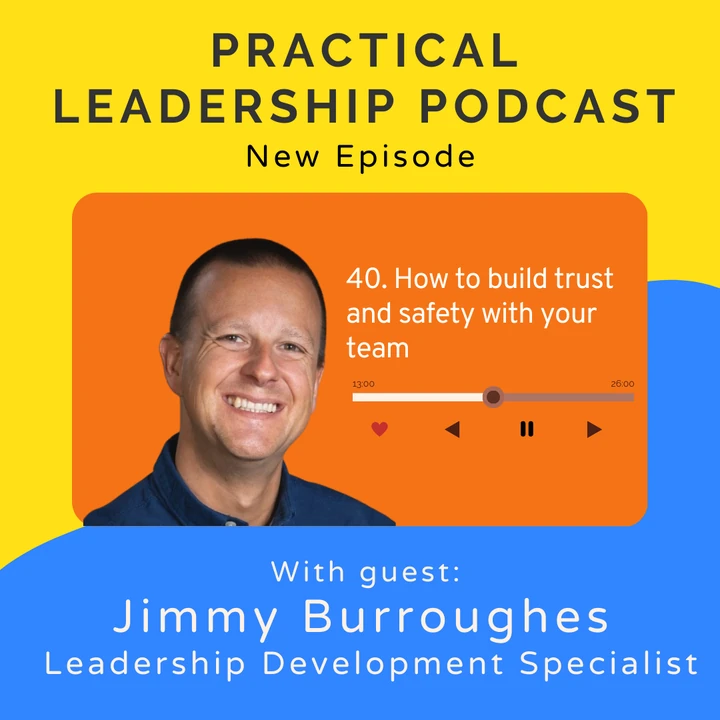
How to build trust and safety with your team
with Jimmy Burroughes
Show notes
Jimmy Burroughes, a former British Army captain turned Business Leadership Management coach.
Jimmy shared his journey from his first management role during the Gulf War to becoming a coach, and we bondedn on the importance of focusing on the basics and building on solid ground. (A house built on sand…)
He described the leadership training at Sandhurst, which is all about building trust, consensus, communication, and connection. He says that a leader’s job is to seek ideas and input and gain subject matter expertise from those around them, but that the responsibility to make the decision ultimately rests with the leader.
We also discussed the importance of building trust in the workplace, starting with safety, both physical and psychological. Jimmy shared his seven-point plan for building trust, which starts with safety, followed by authenticity, listening, embracing different perspectives, challenging assumptions, staying focused, and following through.
We wrapped up the conversation with five practical takeaways from the podcast, including focusing on the basics, being humble, communicating and connecting, seeking input, and taking responsibility.
I hope you enjoy this episode as much as I enjoyed making it.
Come with me and let’s dive in and drink from Jimmy’s fountain of hard-earned wisdom.
You can find Jimmy here:
jimmyburroughes.com | https://www.linkedin.com/in/jimmyburroughes/
—–
When you’re ready for that promotion – join my new manager masterclass here:
Transcript
Automated transcript. Speaker labels and spellings may contain errors.
Paul
[upbeat music] Hello, and welcome to The Practical Leadership Podcast, where I interview great leaders and try to extract their wisdom and experience for you to learn from, and hopefully avoid making their mistakes. Check out practical-leadership.academy because you want to help your new managers succeed with hybrid or remote working. [upbeat music] Jimmy Burrows, thank you very much indeed for joining me.
Jimmy Burroughes
Thank you m- for the opportunity to be here.
Paul
Wow. Captain. Captain in the British Army, uh, then general manager of several very successful multimillion-dollar organizations. And now for the last six years, a business leadership management coach in situ. I mean, there's quite a lot of things we agree on. One big thing that I think, uh, I think we're aligned on is the m- beauty and the magic of the basics.
Jimmy Burroughes
Oh, absolutely.
Paul
Building your foundation upon rock and not upon sand. So-
Jimmy Burroughes
I, I agree completely. [laughs] Yes.
Paul
So I mean, I, I paraphrased your, your illustrious career today undoubtedly, and did you no end of injustice, but tell us what, what was your journey to your first management role?
Jimmy Burroughes
Good question. Um, well, m- maybe if I talk about the destination, um, as to the f- the first, of the first management role, and then we loop back. Um, the, the first management job I had was, uh, in Gulf War II in Iraq, uh, bowling up to Kuwait Airport and hitchhiking up to Shaibah Airfield, um, using, uh, an RAF pickup truck as my, my Uber, my taxi of the day, back in 2004. And, uh, feeling like a, uh, a bit of an imposter, 'cause I turned up about two days after President Bush had declared victory. So it was, um, apparently the war was over, and I, I turned up this fresh-faced, young, uh, second lieutenant, age 23, 24, um, only to be met by these kind of thousand-yard stare, had been awake for three days driving across the desert soldiers and, and other officers.
So I was a boy to their, their man. Um, and a- and I think that was kind of the biggest wake-up call as a, as a, a, a manager, feeling out of place, feeling not prepared, feeling an imposter, a sense of imposter syndrome. And a lot of those things that I've just mentioned have sort of, uh, characterized my journey since then. And obviously the run-up to all of that stuff was university and, and Sandhurst, uh, the Royal Military Academy. Um, some trade training. Uh, I chose to be a, a, a logistician by trade. Didn't use that skill very frequently, but, um, ended up going through that, that training process. And then ended up in, in Iraq and, and had a wonderful, uh, six years in the military. When you, when you said captain, I was thinking, "Goodness me, that was a lifetime ago." [laughs] It's, it's, it's a lot of water under the bridge and a lot of miles on the knees since then, but it's been, uh, it's been a great journey.
Paul
Fantastic. When... I mean, you've done 44 weeks of serious hardcore training at Sandhurst. Boil it down to 10 words.
Jimmy Burroughes
10 words. Um, it's learning what you're capable of and inspiring others to achieve what they're capable of. It's probably more than 10 words, but two sentences. Um, you'll have to give me the flex on that [laughs] for putting me on the spot. Um, but yeah. It's, you know, you, you spend 44 weeks learning about leadership. You spend 44 weeks learning what that means in terms of the skills of being a leader, uh, of, you know, initially 30-odd soldiers when you hit the ground running. But also the responsibilities and the values and the morals of leadership as well, and I think, you know, where the, the military does leadership really well is it instills the sense that leadership is a journey of service, uh, where you need to build trust, build consensus, communicate,
connect with your people, uh, and inspire them to perform. It's not about standing on top of the tank shouting, "Follow me," until driving off into the desert. It, people think it's very authoritarian. Actually, it's very discussive. But you learn at Sandhurst that your job is to make the decision. You're there to seek ideas, you're there to seek input, you're there to gain, um, subject matter expertise from those around you, but your job is to make the decision. And, and it's something that I've kept with me and I, I still use in, in our program, uh, is taking that responsibility to have all the ideas and all the answers off the leaders and instilling the responsibility to, to serve their people and to make decisions on the direction which give clarity and vision to everybody to go where they wanna go.
Paul
I mean, having spoken to a number of other, um, military-trained types who've been through Sandhurst as well, I mean, uh, for, for those of you who don't know who are listening, Sandhurst is the epitome of leadership training. It is the, the cathedral of leadership training. It is the, the home of the British Army. In fact, it's actually just around the corner from where I am. I'm in Fleet in Hampshire. Aldershot is just over the way, and-
Jimmy Burroughes
Mm-hmm
Paul
... Sandhurst is not that far up the road. It's where the British Army sends their, uh, potential officers to learn how to do their job.
Jimmy Burroughes
Yeah, absolutely. And, and, you know, and it's, it's very competitive to get into.
Paul
Mm.
Jimmy Burroughes
And it's, it's a tough year. You know, you're working six days a week for initially kinda 20 hours a day, and then it kinda sinks down to a, probably a 12-hour day. But you're always on, uh, out in the field on exercise, where you're three to four days with no sleep. Um, it's designed to be a stressor environment because, let's face it, leading soldiers in battle is a stressor. And so they need to instill the capability to think and cope and make decisions under pressure. Uh, but yeah, the, all those names you mentioned, Fleet and Aldershot and, uh, Sandhurst, they're all kind of, you know, the old stomping ground. Uh, sadly, it's changing a little bit now. They're, they're all housing estates [laughs] rather than, rather than being army bases, but that's, I guess, progress.
Paul
It is what it is, and it's, uh ... Well, the, the pubs are still there.
Jimmy Burroughes
Mm-hmm.
Paul
All the good pubs are still there. All the squaddies and all the, the various different types coming around. Yeah. So the, the, the thing that I get to take away from the various people that I talk to who have this sort of military background is decision and indecision, and the thing that they are, uh, warned against is being indecisive, and because that terrifies the life out of the people under you. Um.
Jimmy Burroughes
Y- I, I couldn't agree more. Uh, and if we put a, you know, put a corporate lens onto the military context, the, the, the environment that most leaders are now operating in is highly volatile, or highly uncertain, highly complex, and, and ambiguous, and we, we know that word, VUCA.
Paul
Mm.
Jimmy Burroughes
And, and what that can create is vulnerability, uncertainty, confusion, and anxiety.
Paul
Mm-hmm.
Jimmy Burroughes
So there, we call that VUCA, VUCA minus. And so our job as a leader in those circumstances is to create vision and understanding and clarity, uh, and essentially excitement or, uh, we, we call it, um, a moment of excitement. But it's, it's that, "Okay, I know where we're going. I know what we've gotta do. I know my role in it, and I'm prepared to get on with it." And if you can give that to your people through inspiring and giving them clarity and vision and understanding, amazingly, they do a better job for you. If they're all ... You know, i- if ... I ca- I use a lot of m- maritime analogies and, you know, if nobody knows where we're sailing the boat, everybody's pulling ropes in the wrong time and the wrong place, and the sails are pointing in the wrong direction, and the boat doesn't go very far.
If everybody's been briefed and is clear on where the boat is going and which direction is north and which direction we're sailing and who's doing what when, because they've had a good briefing, all of a sudden, the ship magically goes fast and wins races or gets across the Atlantic or, you know, whatever goal we're going for. And I think the military's very good at giving you that capability, is to give that briefing, is to give that initial ... We, we call it an O group, an orders group. But essentially, it's the, "Hey, guys and girls, this is what I need, need us to do. These are the things that we're gonna do if, if it doesn't quite go to plan. Let's get on with it. You're gonna do this. You're gonna do this. You're gonna do this." Um, everybody knows what everybody else is doing as well, which is something that doesn't often happen in the corporate world.
And when everybody knows what everybody else is doing, if something goes wrong, we can also support them. And, and there's these beautiful, what would you call them, methodologies that you can pull out of military leadership that apply in the corporate world. They just have different names and different labels, and all I, I guess what I've spent the last few years doing is, is leveraging a lot of that skill and knowledge I, I picked up 20 years ago and turning it into a corporate, uh, business leader's mindset, context, and, and program. But as you say, it's doing the basics right. Um, and Ways of Working is, is essentially just helping leaders have the conversations that make a difference, and they're generally basic conversations. They're not easy conversations, but they're simple.
Paul
It's the, the, the challenging conversations is where you earn your money.
Jimmy Burroughes
Yep.
Paul
That's where the, the, the rubber hits the road or the, you know, your yacht hits the ocean or whatever. And by the way, if we're sailing, can we not go north? Let's go south. It's a bit, bit peaky right now.
Jimmy Burroughes
[laughs] Towards the Caribbean would be quite a nice about, right? [laughs]
Paul
Aye, I'm thinking of the sun, thank ... Uh, right now. That could be quite nice. When you're talking at Ways of Working to ... You, you, you're typically dealing with sort of middle man- middle managers, senior managers?
Jimmy Burroughes
So we tend to go tiers one to four through a business.
Paul
Mm.
Jimmy Burroughes
So CEO, their reports, their reports, their reports.
Paul
Yeah.
Jimmy Burroughes
Um, the, the program is applicable at more junior levels of the business as well.
Paul
Mm.
Jimmy Burroughes
But what we're tending to see is we're trying to shift culture.
Paul
Mm.
Jimmy Burroughes
So we're about creating a high-performance culture, and it's very hard to do that from the middle of a business. So we tend to work in larger organizations, you know, 1,000 people plus, who have a leadership team who've said, "There's, there's some gaps here." And there's some really obvious gaps at the moment. Uh, teams that were formed during COVID where the manager slotted in all the teams. There's some ... You know, there's been new staff, and they haven't done the basics right. They haven't got those basics set up. So they're all working hard, but they're not necessarily working effectively. Uh, so we'll sit with the leadership team, and then generally, the leadership team will say, "Can you come and do this with our teams?" And then they'll say, "Can you come and do this with our teams?" And we can just keep cascading through the business. And literally now, we're just at a, a point where it's a scale game.
You know, we don't w- the demand for the program is, is high enough that it keeps all of us busy. And we could probably go wider and deeper through businesses, but the, the reality is we don't have the, the resource to do that. So we're now looking at how do we do this asynchronously or digitally to allow that further cascade through the organization where they might not necessarily need the hands-on facilitation-
Paul
Mm
Jimmy Burroughes
... and the hands-on guidance. They can do some self-paced, and we can drop in facilitators at key points.
Paul
So if I can then lean in and see if I can suck out something for nothing, right?
Jimmy Burroughes
Sure.
Paul
Ways of Working, um, very respectable organization. I hope, and I'm sure, you are reassuringly expensive, but come on, give us a freebie. What would you advise, uh, a, let's say general team number one, you're coming in. Uh, what, what's just the advice that comes to the tip of your tongue most frequently when you're talking to folk?
Jimmy Burroughes
Uh, without a doubt, um, we always start with trust.
Paul
Mm.
Jimmy Burroughes
How do you c- ... And, and trust is a really ethereal concept, uh, for most leaders. So they aren't ... They know when they don't trust somebody And they kind of feel when they do trust somebody, but they don't know how to go about building it. And so when we start the program, we do a, a 60-point diagnostic, which is where are you sitting on, on all these metrics that, that we measure before and after the program? And m- I can almost guarantee every single time that most of our teams are sitting at level two out of four in trust. So there's, there's four levels. Um, cognitive trust, which is where you've got a degree or an MBA or you got hired, so I'll trust you that much. Um, then we have an aligned level of trust, which is where most teams are, which is, well, we have to work together on the same type of stuff, so let's trust each other that much.
Then we start digging a bit deeper, where we start talking about problems, mistakes, worries. Uh, and so we, we, we sink ... And the, and, and you can understand as you go deeper into trust, the consequences could be darker. Um, but also the, the output, the, the return on investment is greater. So that requires some vulnerability. That requires some human connection. That requires safety to be created. And then our final, our deepest level of trust is our emotional trust, which is where we start talking about fears. Uh, it's where we talk about, um, opportunities. It's where we talk about leaving or make or break situations. And it has this beautiful, um, meta- what's the word? Mnemonic care, and we want to sink people into care.
And we have a seven-point tool that we share with leaders from day one, which is essentially how do you build trust using these seven different levers that you can pull, and which ones are gonna make the biggest difference for your team. And we nearly always start with trust because when you get trust, everything else starts to kind of slide in the right direction. And from trust you can build connection. From connection you can build performance. So they're the three pillars of the Ways of Working program is trust, connection, and performance. But you start with trust because if ... This, you know, it's like we talked about the sh- the shaky house on the, on the rocky foundation. You can't do high performance stuff if everybody's watching their backs, if everybody thinks they're gonna get fired, if everybody thinks everybody else is out to get them, if they don't feel safe to
speak up and share their opinions. W- all of the corporate metrics around wellbeing and innovation and curiosity and p- and performance delivery, productivity, um, shareholder returns, when you compare an organization with high trust to an organization with low trust, it's like comparing chalk and cheese. So we focus on trust initially, and, and if any, any leader that's thinking about, "Well, what can I do with my team?" I would advise trying to build trust and to say, "We'd be happy to help." But it's, it's, you know, it's a case of understanding where I'm c- where am I currently sitting in that care model and what are some levers. And we've got blogs that are written about it that people can, you know, access for free to find out the basics.
Paul
Well, I'll certainly share a couple of links, uh, in the notes of this episode to, to enlighten people. Can you give us a couple of how-tos then? So out of your seven-point plan and the care, I'm not asking you for your entire methodology of course, but what ... Um, I'm, I'm looking around at my team. Perhaps I don't feel as trusted or I don't feel that I trust. Now, I've always thought it was kind of binary. You either do or you don't. I thought, I suppose you ... It is binary because you either trust somebody with your emotions or you don't. You trust somebody with a fiver or you don't. You know? It's not complete- a completely binary unit. On your, on your seven-point plan and on the ways you work, where would I start to build trust with my team?
Jimmy Burroughes
So we start with safety. Um, so the, the seven-point plan, it uses the mnemonic SERVICE because we talked about service at the start, so I think it's a good way to go. Safety comes in two buckets. Uh, you've got physical and psychological safety. So from our perspective, the number one thing you need to do is, is the workplace I'm working in trying to kill me? And I, I say that, you know, without being flippant.
Paul
No.
Jimmy Burroughes
There are many environments where people don't feel safe, physically safe in their workplace, and it's very hard to give your best work and create connection with people if you're in a fight or flight mindset because there's vehicles driving at you or you're worried about losing a hand. And you know, when we talk about health and safety, one of the businesses I work with is a construction company, and they have a fantastic safety record. And when they started out they didn't. And one of the things was because they p- kept on having people cut fingers off and, um, injure themselves and get run over by trucks and, you know, all sorts of horrible things happened. And so when new starters started in the business, when you talk to teams in the business, when you talk to managers in the business, they're like, "Yeah, you know, sometimes people get hurt." That's not a great context for people doing their best work, and it doesn't engender trust that my leader cares about me if I, if they don't try and keep me safe, if they're not doing everything within their power to keep me physically safe.
The other half of, of safety is, is psychological safety. And this essentially, the, the analogy we use is if I stick my head up acro- above the parapet, above the, the ledge, am I gonna get shot? And again, when we see leaders who don't invite opinion, who scream and yell at their teams, who don't have one-on-one discussions about your family, your home life, your whole person, people don't feel psychologically safe. Um, if people are being fired all the time for small things, if people are being asked to work, uh, when they haven't been ro- rostered on, if people are being not given pay rises when they've been told they've been, they've done a really good job, um, no bonuses this year despite knowing the management is making money, all of those little things erode
psychological safety. And so again, we, we kind of talk about in the program how can you How can you have a human-level connection with that person, and how can you do what you say you're gonna do? How can you be authentic and genuine? And how can you invite people's opinions and embrace them without shooting them down? And then I know that people are gonna be prepared to put their head above, above the parapet, and they won't feel like they're gonna get shot. And it is literally that kind of sinking into the, we call it the amygdaloidal response. It's the fight-
Paul
Mm
Jimmy Burroughes
... or flight or freeze response, um, which immediately shuts down productivity and creativity and innovation. We know this. We lose all prefrontal cortex capability. All the smart part of our brain shuts down because we're just in survival mode, and that's not a great way of creating a high-performance culture. So we start with trust, and the start of trust starts with safety.
Paul
Excellent. That's an excellent place to start. Was there, talking about safety, was there an accidents and things, was there an event or a mistake perhaps that taught you the most?
Jimmy Burroughes
That's an interesting question. Um, I, I remember when, when I first became a, a GM, I went into an organization, and when I was hired, I was kind of told that the executive was taking a risk on me, and I was, I was an outsider to the industry. And I w- they were taking a risk on me, and the team that I was taking on was ripe for, uh, restructure because they were old-fashioned and they had an old-fashioned way of doing things, and it was time to modernize them. And I was hired because I was the young gun. And I took that to heart that, right, I need to go in there and restructure this. I need to go and fix this. And I didn't spend enough time listening to the subject matter experts around me. I made the mistake of thinking I knew better than those leaders that had been operating in that business, and I, I guess I, in a way
I dismissed their knowledge and their experience because I knew we were trying to change it, and I didn't take them on the journey as effectively as I could have do, could do. And I learned from that because when they had all departed in the restructure, it was a real challenge to create a new team because the p- the survivors felt like we'd essen- essentially assassinated the management team and left them hanging. And it was a really valuable insight around the concept of listening to your people and sort of revisiting that in my own mind, but also then taking that into the consulting world. If you're gonna restructure your team, doing it really respectfully, building safety, building trust with the people you're doing it with. It's not a personal decision when you restructure and people lose their roles, but you do need to listen and do the best possible restructure you can do.
And that's not to say the restructure wasn't successful. It was hugely successful, but the cultural impact of the way I went about it as a, as a leader wasn't ... You know, I look back with some regret, uh, that I could have done a better job. And I learned from that, and I've taken that through into all of the consulting and coaching that I do when, when we talk to teams about have we got the right people in the right seats on the bus? Okay, if you haven't, we need to do this in a really effective way.
Paul
That's a, that's a, a very ... As long as you learn, I don't think it matters so much that you're making the mistakes. Although, you know, you impact people's lives fair enough. As long as you learn, it kind of validates the experience and it validates the, the, the, the challenge.
Jimmy Burroughes
I agree completely. Um, and, and one of the things I've spent the last couple of years working on is, is an abundant mindset. And part of that, yeah, and it's interesting, I was on a podcast yesterday talking about exactly this. I don't believe that there are mistakes. I think there's experiences, and I think there's tools for the toolbox. And at la- a later point in life, if you encounter that situation again, you should lean into your experience, and you should use the tools that you've built up in your younger years to not make that same mistake. You know, you can count it as an error in the moment, but from that, from day one after that error, it's an experience. And people who spend their lives ruminating about their mistakes also undermine their productivity, also undermine their high performance.
And so it's around drawing a line and going, "Yeah, I did that, but now I've got that battle scar to chalk up, and next time round I'm gonna do a better job, and this is how I'm gonna use it." And it's that integration of those new til- new school- new, new tools and experiences into your behavior that is where we see leadership development really t- start to take a step forward.
Paul
It's always the learning where you can apply the learning that makes a difference, I think. I mean, the-
Jimmy Burroughes
Absolutely. We r- we run a model, um, in all of our programs called PEARL, which is plan something, explore something, assess its progress, reflect on it-
Paul
Mm
Jimmy Burroughes
... and learn, lock it in.
Paul
Yeah.
Jimmy Burroughes
Um, so next time you go into the plan, you've got, you've got the benefit of that lesson learned.
Paul
Yeah, I love that. I love that. And see, I mean, for different people when they have to deal with knowledge acquisition in some way, shape, or form, some people need to talk about it, some people need to teach it, some people need to do something with it, some people need to write it down, some people need to, you know ... But you've got to actually do something with it. I mean, um, I'm like you, I'm quite certain I'm surrounded by books every day, all day. I love my books. But the bugger is you then go off and you read something fabulous and new and you think, "Oh, it's life-changing. It's magnificent. I love it. It's gonna be ... That's the new me." And then three weeks later you can't really remember what ... So actively I go off and I try and write precis of things.
I, I turn them into courses or videos or I do something with it.
Jimmy Burroughes
Yeah.
Paul
Otherwise it's just gonna sit there. You know?
Jimmy Burroughes
One of the things I do, I, I think we talked about this a little bit earlier, I've got, um, I have a highlighter now, and I used to be a person who didn't deface books, but now I, I highlight-
Paul
Oh, totally
Jimmy Burroughes
... my books.
Paul
Yeah.
Jimmy Burroughes
'Cause I'm like, "What was that thing again? I just need to flick back through and, and pick it up."
Paul
Yeah.
Jimmy Burroughes
'Cause as we, as we reach our advanced years, the memory isn't quite what it was to be able to access things.
Paul
Uh, it's a hi- highlighter and a bright neon Post-it notes stuck in the thing
Jimmy Burroughes
[laughs]
Paul
My bookshelf looks like a disaster zone, I tell you.
Jimmy Burroughes
[laughs]
Paul
We used to have these be- these beautifully lined up, n- really neatly. No, not a chance, I'm sorry. I scrawl all over these things.
Jimmy Burroughes
[laughs]
Paul
They're mine, you know? They're mine, I can do what I like. That's it. What are you working on at the moment, Jimmy?
Jimmy Burroughes
What am I working on? Um, I guess there's two things that are really exciting me at the moment. No, no, probably three things 'cause I, I like to keep myself busy. Um, we've, we're going through a process of expanding and expanding and expanding with Ways of Working, and I think one of the, one of the most exciting parts of, of Ways of Working for me is businesses that are turned on to the idea of doing culture a little bit differently. Um, most organizations are purely chasing profit, KPIs, productivity, and we chase people. So when organizations are thinking, well, we, you know, we've kind of rinsed as much as we can out of everybody, we need to do something a bit different, we need to think a bit different. Oh, we've got this resource that isn't performing. How can we do something with them? And we come in and say, "Well, let's, let's unwind all the stuff that's not working for you, and then start to wind up the stuff that is working for you,"
and we can do those contiguously at the same time. And oh, look, all of your numbers have increased as a result of this. Then that's pretty exciting, right? And so Ways of Working as a, as a concept, and we've now created a community around it, so we run a monthly mastermind. We invite all of our cohort leaders to come along and share their ideas, to network, to build connections with other people in other industries globally. Uh, we have, uh, a, a blog that, that goes alongside it where we share some of our best thinking. So I'm really excited about how the community is growing and how more and more organizations are con- are, are becoming involved with, with what we're trying to share, a new way of thinking about it. And we worked with just over 4,000 leaders last year, so it was, you know, it's, it's picking up momentum.
The, the second piece I'm super excited about, although it's a slog, is, is finishing a book. So we worked, uh, over the last couple of years we worked with about 30 organizations and did research on the performance factors that were driving people into burnout or if they changed some stuff that were driving towards high-performance cultures. So we've created a book which is essentially a, a very practical, very down-to-earth narrative of, if you do these five things, and here's some ways you can do those five things, like very simple steps, simple conversations, then you will see burnout diminish and you'll see performance increase. So that will be, the aim is to get that out by the end of March. Um, we're in third-round edits at the moment, and it literally is just a case of me sitting down and track change accepting and, and making sure that all the illustrations line up and working with a, an amazing team to help us get that ready for launch.
And yeah, can't wait. Very excited by that one.
Paul
Great. And what's the third?
Jimmy Burroughes
The third one is, it's a podcast. Uh, so-
Paul
Fantastic. I love a podcast.
Jimmy Burroughes
Yeah. It's a surprise. Um, again, this was around how do we expand the community thinking, the, the Ways of Working message to an even wider audience. And often, you know, people are very busy. They don't have time to come along to one of our webinars. They don't have time to come to one of our mastermind sessions for a, a taster, and we offer a free guest pass to anybody for their first session just to see if they like the way the community operates, but some people don't have time for that. So we say, "Well, we know people commute. We know people go to the gym. We know people walk their dogs. Maybe we can invite some experts from organizations all over the world," and we've got some fantastic people lined up for this podcast, to share specifics.
So we've got an expert in how AI is affecting organizations. We've got an e- expert in how talent management can be m- done better by leaders. And these are just, again, just sharing practical things that you can do as a leader that are gonna shift the dial, and they're all dressed up in the Ways of Working mindset and community thinking. So people can have access to the type of people we work with, um, but also have access to that type of thinking, which hopefully will just turn a little light bulb on in their head. I love your little light bulb next to you. Um, turn the little light bulb in their head where they go, "Oh, I can do that. I'm gonna do that when I go to work today." And that starts the journey of building trust, building connection, and building performance.
Paul
Marvelous. Are you reading anything? You listening to anything interesting just now you want to share?
Jimmy Burroughes
Yes, always. Um-
Paul
Good
Jimmy Burroughes
... I'm, I'm, I'm fully in love with this amazing book by, by Daniel Coyle. Hope, there we go. Daniel Coyle. Um, it's called-
Paul
Culture Code
Jimmy Burroughes
... The Culture Code: The Secrets of Highly Successful Groups. And-
Paul
Mm
Jimmy Burroughes
... you know, it's, having done this, all this research around high-performance cultures, um, reading some of the stuff that Daniel has written about connection, about vulnerability, about safety, about trust, uh, so much, so much of it lines up. Um, and I'm, I'm dying to get him on the podcast to, to talk about some of the things that he has researched 'cause there, there's a lot of overlap in our thinking. And, um, he writes it in a really nice way that is extremely accessible. You know, you could probably plow through the book in two days if you sat down and read it, but actually there's a lot of joy in going back and rereading the stories that he tells. And he did research with, you know, Navy SEALs and NASA engineers and, um, large telcos and, uh, amazing businesses.
Um, so fully respect and love his stuff. The, um, the other, the, the podcast that I, I listen to a lot is, is a guy called James Wedmore, who's a business coach, and he's, he's into the spiritual side of leadership, um, and running your business. And so, uh, I'm fully in his community and, and love the way that he Talks about the more, um, the internal journey that a lot of leaders need to go on. And it isn't about the what you do, it's about the what you feel. And, uh, and so I've, again, I, I love to absorb and synthesize from multiple sources, and he's been a great influence in, in how Ways of Working community's evolved. So, uh, yeah, he- th- they'd be the two pieces that I'm probably very excited about at the moment.
Paul
Wonderful. Thank you for sharing. If we go back to you, what would you like to thank the younger Jimmy for doing?
Jimmy Burroughes
That's a great question, and I, you know, I did think about this question quite a lot. Um-
Paul
I can't take credit for it. I stole it from a wonderful lady called Liz Guthridge.
Jimmy Burroughes
Oh, amazing.
Paul
She used it on me, and it just, it just stopped me in my tracks. So it's a lovely one to use. I'm gonna keep talking until you nod and say I've got the answer here. Are you ready? We-
Jimmy Burroughes
No, I do have the answer. I, I, I-
Paul
Excellent. There you are. Go for it.
Jimmy Burroughes
[laughs]
Paul
[laughs]
Jimmy Burroughes
No, I planned this one out. It... the, for me, it was the try things. When I was, uh, when I was a kid, I was, I had the, the great opportunity to go to a boarding school where we, well, obviously, had to be kept occupied as, as, you know, unruly teenagers in the evenings, and we were there on the weekends as well. So there was always an activity or something to try. And I think that ability to kind of dip my toe in the water, learn a little bit about something and, and broaden my h- holistic experience was super valuable. And so when I moved into the professional part of my life, the career part of my life, I had the same kind of thing in the military. We, I, I was posted every 12 to 18 months to a new job, so I got to try lots of things.
And then when I moved into the corporate world, again, I was able to try lots of jobs. I, I don't think I stayed in the same industry for more than a few years. I worked in, um, HR consulting. I worked in the dairy industry, but literally from supply chain and warehousing through to milking cows on farms and sales management. And then I worked in banking, and then I worked in tertiary education. And so it was always this belief that, well, I'll just try that, and I'll find a way to make it work. And I think that's the thing I thank my younger self for, is, is having the, the courage just to try something because I was interested in it and because it sounded exciting, and then absorbing enough that it built out my toolbox. And those people who, who I work with now, they're, they always say something along the lines of, "Well, Jimmy, you've always got a tool for everything." And I think it's because I tried so many things when I was younger that I just built up this box of skills and experiences and tools that I could now share and integrate
or create a metaphor from. And so that's the thing I'm the most grateful for, is just having those opportunities.
Paul
That's marvelous. And lastly, as we wrap up, Jimmy, how can people find you?
Jimmy Burroughes
Uh, multiple ways. Um, I'm on Instagram, Jimmybleadership. Uh, my website is jimmyburrows.com. And I'm on, I'm pretty active on LinkedIn, um, just as Jimmy Burrows. And we post there, you know, few times a week just to share some of the things we're thinking. If people are interested, they can subscribe to the blog through the website. And, uh, more than happy to have a, an initial conversation with anybody who's interested in, in the type of stuff we do. And if you're interested also to come along to one of our Ways of Working Masterminds, again, we're happy to extend a guest pass to people for their first session because we know that people wanna kind of taste it before they buy it, and I would do the same.
Paul
Jimmy Burrows, thank you very much indeed for joining me.
Jimmy Burroughes
Thanks so much, Paul. I really appreciate the opportunity to share and to have this great conversation. [upbeat music]
Paul
That's a wrap. Thank you for joining me today. Your homework is to leave your five-star review and please, any comments you have. You've really helped me to improve every day, and it also helps people to discover me online. You should check out practical-leadership.academy because you want to help your new managers succeed with hybrid or remote working. [upbeat music]