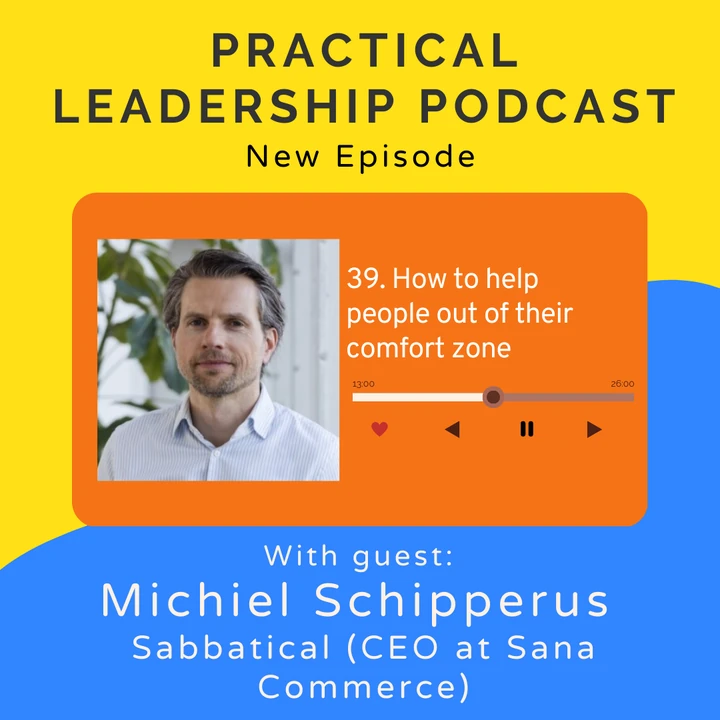
How to help people get out of their comfort zone
with Michiel Schipperus
Show notes
From part time student to CEO.
Learn how CEO of Sana Commerce Michiel Schipperus made his move and how he hires for success.
When the future minister of finance of the Netherlands offered Michiel his first management job as a part time student, he thought he was joking.
He wasn’t.
23 years later, Michiel is on a well-earned sabbatical, mulling over who to chose as the next CEO of B2B eCommerce success story Sana Commerce.
When you’re hiring anyone – make the hiring process it as close to real as possible, he recommends:
- Find out if they have a learning mindset – give candidates a real business case to work with.
- Find a trusted person to judge their suitability for a management role – and believe them!
Join me for a very interesting conversation with a very experienced practitioner of the arts of leadership and management.
You can find Michiel here:
https://www.linkedin.com/in/michielschipperus/
Transcript
Automated transcript. Speaker labels and spellings may contain errors.
Paul
[upbeat music] Hello, and welcome to the Practical Leadership Podcast, where I interview great leaders and try to extract their wisdom and experience for you to learn from and hopefully avoid making their mistakes. Check out practical-leadership.academy because you want to help your new managers succeed with hybrid or remote working. [upbeat music] Michael Schipperus, thank you very much indeed for joining me.
Michiel Schipperus
Yeah. Thanks for having me.
Paul
So you're currently the CEO of Sana Commerce. You've been in B2B e-commerce for about 20-odd years. Sana Commerce is from, what, 2007, about 15 years on.
Michiel Schipperus
Yeah.
Paul
And you're busy leading the team of about 500 people in goodness knows how many countries, except that you're not-
Michiel Schipperus
Exactly
Paul
... 'cause you're on a sabbatical.
Michiel Schipperus
Exactly.
Paul
What's that all about?
Michiel Schipperus
Yeah.
Paul
How do you, how do you go about taking a holiday? A what? A sabbatical. What does that mean?
Michiel Schipperus
Yeah. Good question. Um, I asked myself about a year ago the question, like, how, how long do I still want to be the CEO of Sana? And the answer that came to me said, "Hey, let's do one more year and then, uh, find someone to take over." So I've been basically with the same company for 23 years. So I started when I was just 18 years old at this company, and that, uh, eventually transitioned into Sana Commerce. And that, you know, I've been running that company for, for let's say 12, 13 years or something. So, um, yeah, I felt I needed a break. So, uh, here I am.
Paul
Fabulous. Do you have any exciting plans? What are you doing?
Michiel Schipperus
No, not, not yet. It's only week three, so I said I'm not making any plans. I would just, like, keep my calendar open and just see, see what happens. Well, I will be doing some traveling with my family, so I'm really looking forward to that, uh, after summer, I think so. Uh, but until that time, I'll just, I'll just keep things open.
Paul
That's marvelous. I mean, it's a, it's a wonderful example as well. We can all aspire to that. So-
Michiel Schipperus
I, I think so. I think so. Yeah. I think it's good for, um, founders, CEOs who have been running the business for a long time to, to take a break. And actually, I was interviewing for my successor, and I spoke to multiple great candidates, and they confirmed for me actually it was very good, not just for me but also for the company to, to bring in someone new with fresh energy, fresh ideas, who has been exposed to a lot of different companies. Uh, so I felt more and more confident about taking this step, not just for myself but also for the business.
Paul
There's an, an interesting edge to that. I mean, I work with lots of different startups, and I've had the, the, the pleasure, the challenge, the interest of working directly for quite a few entrepreneurial CEOs, people that almost like yourself have been brought up in the one company.
Michiel Schipperus
Yeah.
Paul
So they're 22 out of business school, start a company, and they've never been brought up properly.
Michiel Schipperus
Mm-hmm.
Paul
They've never been told or taught how you can and cannot manage people.
Michiel Schipperus
Yeah.
Paul
And typically, they're absolutely shit at it.
Michiel Schipperus
[laughs]
Paul
And they bring me in to be this, like, the guardian angel around their teams and stop them, um-
Michiel Schipperus
Mm-hmm
Paul
... it's not abusing their teams. That's horrible, these wonderful people I've worked with. But to, to, to help them to temper their approach-
Michiel Schipperus
Yeah
Paul
... and just sort of tone that down. But you've been working in Sana and its predecessors 23 years. Your journey to being a people manager is quite interesting 'cause the first person who gave you that job was a very interesting person with great experience himself, and you must have learned a lot.
Michiel Schipperus
Mm-hmm. Mm-hmm.
Paul
Can you tell us a little bit about that story?
Michiel Schipperus
Yeah. Sure. So, um, when I ... So I started working for this company when I was just 18 years old, and, um, there was, um, uh, this company was, like, 30 people, was in the, in the midst of the dot-com bubble. Um, and, um, the person that brought me in was the founder of the business. Uh, his c- his name is, uh, Jan Kees Aerdt, and he, um, he hired me. And, and from day one, he gave me a lot of responsibility. Even though I was just working there part-time, like two days a week, he was giving me a lot of responsibility and, and, and, um, uh, just letting me find out what I could and couldn't do. A lot of freedom there. And, um, uh, so for six years, I studied at, uh, the university here in Rotterdam in the Netherlands. Uh, and in these six years, I also had this part-time job, and I had him as my mentor.
Um, and, um, um, and, and the interesting thing happened when, um ... Uh, so I, I worked for six years as a part-time job, then in 2005, I graduated. And after being two years in a full-time job for the same company, um, he left, and he went into politics. So he became the State Secretary of Finance in the Netherlands. He later became under Minister of Finance in the Netherlands. Uh, he became the CFO of KPN, uh, the, the largest, uh, telco in the Netherlands. Um, so, uh, yeah, he, he was already someone with, with a lot of, uh, talent, a lot of knowledge, experience, and he really taught me a lot from day one, and he really, uh, allowed me to, to, uh, make a lot of mistakes, uh, throughout these years.
But, uh, he was always pushing me. He said, "Oh, uh, if you ... You know, just, just give it a try, right? Right? Just, just go for it." And even if I thought in some cases like, "Hey, but this is not something that I think I can do," he said, "Well, well, just give it a try and see how it goes." And in many, many situations, it went actually quite well. So for instance, I recall, uh, that one time, um, I, I think I worked for the company just, like, two years. So I was 20 years old. I was working there part-time, and, um, there was a team of system administrators, and their manager left. They left, they left the company. So the team was out without a manager, and, um, uh, Jan Kees felt none of the people on the team was able to manage that team So, um, at some point he said, "You know, um, Michiel, can you maybe take over the team?" And I thought he was joking.
Uh, I really thought, because like I said, I was just working part-time just two days a week, and this was a, a, a team of full-time people, very experienced, uh, system administrators. Um, and I had no experience in system administration. Uh, I thought he was joking, but he wasn't. Uh, so that's what I did for I think about a year or something until we hired, uh, externally, uh, a manager for the team. Um, I managed that team and, um, I learned a lot, and it went, went pretty, pretty well, I must say.
Paul
Have you ever put anybody else in a similar position?
Michiel Schipperus
Yes. Yes. I- it's, for me, like, I, I, you know, I, I enjoyed this so much that I have made that part of my management practice to, you know, uh, how do you say that? Uh, throw people in on the deep end. Is that how you say it? Like-
Paul
No, totally. Head first
Michiel Schipperus
... and then see how they go.
Paul
Head first.
Michiel Schipperus
And, yeah. Head first. [laughs]
Paul
Sink or swim.
Michiel Schipperus
And I've, I've done it m- m- multiple times, um, uh, where, uh, you know, people got a lot of experience because I felt they were, um, they were up for it. They were capable of doing it. Even in some cases they, um, uh, they didn't know that themselves. Um, so, um, I, I remember a couple of years ago we were building a new product basically within the Sanic Commerce team. Um, and, uh, I asked, I had also, uh, someone just doing the research what that product should actually, um, uh, be, and then when the research was done, I, I asked him, like, "Hey, why, why, w- um, could you please set up, build a product basically? Ha- you know, uh, build your team, and together with the team build a product, and you lead that team." And he was like, "Oh, um, yeah, do you think I, do you think I can do that?" I said, "Yes, I think so. Uh, and if not, we'll find that as well, and we'll try to help you, and, uh, what's the worst that can happen?" Um, so, um, yeah, I think that's one of the, the, the fun things and great things of being a startup
scale up, that you can fail fast and you can, you can do a lot of these things, and even if things go wrong, they will not have a huge impact on, you know, on, on, on a lot of people or on the business. Um, so you can still, um, you know, uh, do those kind of things.
Paul
I think one of the s- one of the most powerful things you can hear from anyone, especially your manager, is, "I believe you can do this."
Michiel Schipperus
Yeah. Yeah, yeah, absolutely. Absolutely. And one of the, yeah, it's also one of the things I've learned. If you... And it's not just with pushing people to go beyond what they think themselves they can do. Um, it's also if you give them something to live up to, um, something you see in them, in general they will, you know, start to believe it themselves, and they want to live up to that expectations, right? Uh, so if I tell someone, like, "Hey, you are, I think you're a great manager," um, and they'll start to think about themself, like, "Hey, maybe I am a great manager. I want to be a great manager. I want to live up to the expectation of you that I am a great manager," right? So it's, um, yeah, it works, works in multiple, uh, multiple ways, but I, I've seen it work so well and, and some of the, um, most senior managers that we have in our company, they, they really started also, uh, when they just,
even when they were still in school or when they just finished school, and they got responsibility early on and they enjoyed it a lot, and they excelled at it, and they grew, grew, grew throughout the ranks. Um, so there, there are a lot of examples of that in, uh, in our business. Um, and I, you could say that everything started with me getting in that, you know, position when I was just 18 years old and working part-time and, and being pushed out of my comfort zone and, and I've always felt that I want to pay that forward.
Paul
So you've carried that almost as the red thread. It's taking talent where you find it and making them work harder than they thought they could.
Michiel Schipperus
Yeah, and not just, not just harder, because that might have a negative con- connotation-
Paul
Yeah, it's just-
Michiel Schipperus
... but giving them more challenge-
Paul
Push harder
Michiel Schipperus
... like, yeah, exactly.
Paul
Yeah, yeah. Mm-hmm.
Michiel Schipperus
Uh, exactly, like, like really, uh, challenging them and, and, and to be honest, it, it doesn't, it's not that it always works, right? I've al- also have examples where people came after me, like, after let's say a couple months, half a year, maybe a year, and say, "It's, it's overwhelming. I don't feel this is the right environment for me. Uh, I, I would like to have more structure. I need somebody who will give me a plan on this, this is step one, step two, step three." And, and that's maybe the, the, the downside of my management style. So I like to push people, give them a lot of responsibility, um, of course coach, coach them, but in the end I need people around me that are, uh, kind of self-starter, that, that don't need me to, uh, create, uh, or lay out this roadmap for them on the different steps that they need to take.
And, and I've also had people come to me and say, "Hey, uh, this is not for me. I, I'm looking for a company with more structure and somebody who does a little bit more hand-holding." And that's fine. So it's not only, um, uh, only a great story of successes, to be honest.
Paul
There's, um, it, it's something that the special forces use sometimes as well, and I've s- I've read a few books about this, and it's that they tell the teams that they are elite. You are an elite team, and exactly as you said, they then-
Michiel Schipperus
You want to live up to that
Paul
... continue to live up to the reputation. There's nothing like living up to your reputation to, to stretch you.
Michiel Schipperus
Yeah. Yeah.
Paul
Actually, I think almost in, I had some great advice once, was try and find 20% of your time. That's something I do when I coach and consult people is always try and find 20% of your time extra, and you find it by delegating.
Michiel Schipperus
Yeah.
Paul
So it's delegating stuff that should be delegated, which is stuff that you shouldn't be doing and somebody else could do better-
Michiel Schipperus
Yeah
Paul
... and stuff that could be delegated that would challenge somebody else to help them to grow. And then finding that balance for yourself is how much is too much. And the advice I got was if you are not sitting on the edge of your seat going, "Holy crap, I'm a bit worried-
Michiel Schipperus
Yeah
Paul
... about this"-
Michiel Schipperus
Yeah
Paul
... then it's not enough.
Michiel Schipperus
Yeah.
Paul
If you're not uncomfortable with the, with, with the power that you've delegated, with the tasks that you've delegated, and- It's like Ronald Reagan's thing. You know, you trust. You verify, but you trust. But you verify.
Michiel Schipperus
Do you mean on the, on the giving, do you mean on the giving end that you're on the, on the edge of your seat or on the receiving end?
Paul
Both.
Michiel Schipperus
Yeah, yeah, both.
Paul
Both.
Michiel Schipperus
Yeah, no, I would say the same. I would say the same. Like, like, uh, indeed, you will just de- if you think it's possible, delegate, and then, but also, like you say, uh, check in and make sure that, that if things go completely off the rails, that you can, um, uh, manage that. But, uh, so yes, uh, if you can, delegate. Uh, but also on the receiving end, what I like is w- I think we say it in Dutch is you have to walk on your toes, stand on your toes to make it, make it happen, right? And, and there are multiple effects. I think people grow faster, uh, es- especially the people that like to have a lot of challenges. They grow faster, uh, but they're al- also more likely to stick around, is, in my experience. So, um, um, also now for my successor, I had multiple options, and, um, uh, one option was maybe very experienced, and, and this
person could easily do the job. Uh, but then I'm, I, I would be wondering, like, after one, two, three years, will this person still be engaged and, and, and, uh, uh, challenged by the job, right? Uh, and on the other hand, I had someone who didn't have this exact position before, but I thought that, uh, this person could do it. Uh, and then I know if he or she takes this role and, uh, has to, you know, stand on their toes, like I'm saying, or have to sit at their edge of their seat, like you're saying, um, they will, um, they're more likely, I think, to, to, um, enjoy the journey and to, to stay around.
Paul
I think that's, that's a big part of the, the idea of the tour of duty. So when you're hiring people these days-
Michiel Schipperus
Yeah
Paul
... you're, you're not hiring anyone for a job for life.
Michiel Schipperus
Yeah.
Paul
Apart from you.
Michiel Schipperus
Yeah, yeah, yes. [laughs]
Paul
Nobody gets hired for a job for life.
Michiel Schipperus
No. Yeah.
Paul
And I, I think-
Michiel Schipperus
Half, half a life. Yeah. [laughs]
Paul
Half a life, half a life. There you go. Well, you're on sabbatical now. Retirement's next, huh?
Michiel Schipperus
Yeah.
Paul
[laughs] Maybe not. Maybe not. But I mean, there, there's an entirely different conversation about maybe we should-
Michiel Schipperus
Yeah
Paul
... go back to hiring jobs for life.
Michiel Schipperus
Yeah.
Paul
Maybe we should.
Michiel Schipperus
Yeah, yeah.
Paul
Organizations shouldn't be thinking, "Oh, I'm gonna sell and exit. In three years, I'm done." Boom.
Michiel Schipperus
Yeah.
Paul
No.
Michiel Schipperus
I don't like that either. Um, and I like the concept of tour of duty. I, I, I read the book from, uh, the, the LinkedIn founder that wrote about tour of duties indeed.
Paul
Yeah. Yeah, yeah.
Michiel Schipperus
And, uh, I think it's a good concept. And, um, and, and that's also what we always try to do with hiring at least to, to align on, okay, what's our horizon, right?
Paul
Mm.
Michiel Schipperus
Is it three years, four, five year? And, but yeah, of course, it's, um, uh, maybe a candidate during the interview process will say, "Oh, I'm looking for three to four, four, five years." But then if something else comes by, some people are more likely to, to, uh, jump ship. Uh, so it's a hard part. But I li- I like the whole concept of that.
Paul
Mm.
Michiel Schipperus
But, and, and indeed, like he writes in the book, it has to, it has to come both ways, right?
Paul
Yeah.
Michiel Schipperus
Um, so g- yeah, you, uh, have to mutually agree on that, on that term and make it, make it work and make sure that this person, it will continue to grow within this, uh, specific, uh, um, time is, that is set for the tour of duty.
Paul
And I think if y- if you're recognizing honestly with somebody that it's gonna take you a year to get... well, basically to find out where the coffee machine is.
Michiel Schipperus
Yeah.
Paul
It's gonna take you... Year two is where I want you to really make an impact. Three is you are sailing, and three and four is where you're preparing for the next role.
Michiel Schipperus
Yeah.
Paul
And four onwards, ideally it's in a new role within the company, but if it's not-
Michiel Schipperus
Yeah
Paul
... then bless you. Have, may, may the wind be fair at your back, and, uh, good luck.
Michiel Schipperus
Agree. Agree. Fully agree. And I, I, I'm always so, um... how do you say that? Um, I don't believe the people that send resumes and they say, "Oh, I worked for one and a half years, I make this impact, and I did, did, did this, and I-"
Paul
Yeah. They do.
Michiel Schipperus
I don't believe that. Like, just, like, like what you're saying-
Paul
[laughs]
Michiel Schipperus
... um, I've never seen anyone make so much or a lot of impact or, uh, within one and a half years. They, it, like you said, it takes time-
Paul
Mm
Michiel Schipperus
... to, to, to build things up, to get to know the company, to build your team, uh, to get things running, and then, then to really see the results of that. Um, so yeah, I agree. I think that, that, that concept works. But it's, it's har- it's not easy to find the people that have that mindset. Um, um, yeah, and if you, if you scan through resumes and you see how many of those consist of, um, you know, tenures of, like, one and a half to two and a half max years, if you have to filter them all out, there, there are a few candidates left, to be honest. [laughs]
Paul
It's a challenge. I mean, on one hand-
Michiel Schipperus
It's rare
Paul
... on, on one hand, you see a lot of younger people now with the 18-month tenures in different roles. And part of me says, "Well, that's 18 months not found out." Right?
Michiel Schipperus
Yeah.
Paul
You've been there for 18 months.
Michiel Schipperus
Yeah.
Paul
And after 12 months, they said, "You're not quite right. We're gonna give you a chance." Three months then, "Nah-
Michiel Schipperus
Yeah
Paul
... we really need to double down." Three months after that, "Good night. Goodbye."
Michiel Schipperus
Yeah. Yeah. [sighs] Yeah.
Paul
It's, it, it's really hard not to look at it like that. Maybe, maybe it's my age and background and whatever, but-
Michiel Schipperus
Yeah, I agree
Paul
... it's hard.
Michiel Schipperus
No, I agree.
Paul
Mm.
Michiel Schipperus
It's, uh... but it's how it works, but it makes it tough to, to of course, uh, grow a business.
Paul
Mm.
Michiel Schipperus
Because people that are leaving after 18 months have, have, have not contributed a lot. So, uh-
Paul
Yeah
Michiel Schipperus
... only costing time and money.
Paul
Yeah. And they, they take all of that in, that, um, institutional knowledge with them that they've gathered over 18 months.
Michiel Schipperus
Yeah.
Paul
They're, they're only just getting going.
Michiel Schipperus
Yeah. And, and the relationships they have built-
Paul
Yeah
Michiel Schipperus
... inside, outside the company, they're all-
Paul
Plus.
Michiel Schipperus
Yeah.
Paul
The whole thing.
Michiel Schipperus
Yeah.
Paul
If, if we go back to your idea of you're, you're, you're picking people to push, how do you... and I'm looking for the how to here, right?
Michiel Schipperus
Yeah.
Paul
How do you pick? What's the sort of characteristics you're looking for when you're looking to choose someone to promote, to push, to-
Michiel Schipperus
It's, uh, yeah, I, I don't think it's new, but y- uh, you, uh, w- I want people with a learning mindset. So what we always do in the interview process, and I would recommend any company to do, is to ad- inc- include at least one part, we call it a business case. So it depends on what kind of role you will be in. Um, we ask you to prepare something, and if you are, like, in sales, we will do a role play as a business case. If you're in, um- I don't know, in a, in a more strategic role we'll give you a more strategic assignment that you have to go through, and then we want to see how you actually, uh, perform in that specific situation. And that's very relevant, and you get... You, sometimes we have great candidates we think in the, in the early stage, and we're like, "Wow, this is the best candidate ever." And then they totally mess up the business case, and we're so happy that we, we, we had that r- that as part of the, um-
Paul
Mm-hmm
Michiel Schipperus
... interview process. But, uh, in relation to your question, it's even just as relevant to see how they deal with feedback. So of course after they did the business case, we tell them like, "Hey, this went well. This went..." And how they respond tells us a lot about their learning mindset. Are they, like, eager to learn more about the feedback? Are they... How are they taking it? Are they... Or do they become def- defensive? And that tells us a lot because, um... And, and, and typically of course we hire the people that are very open to feedback, that want to get know, want to, want to improve, that are happy to get the feedback. And, um, in relation to your question, um, uh, if you want to p- pe- put people in a position where they have, um, they get a lot more, uh, get a lot of responsibility compared to the experience they have had before, you want them to be coachable, and you want them to get feedback not just from their manager but also from their
peers. Um, and, um, so to have that mindset to not just listen to managers but also listen to peers and, and to people in their teams, and to, to be looking for that feedback to improve their game, that's, that's absolutely crucial I think for putting people in, uh, in, in, in, um, in such, uh... or pushing people outside of their comfort zones.
Paul
So you use the information you've had, the knowledge you've gained through the origi- original recruitment process, and then everything you've seen about them during their tenure up to that point, so. And-
Michiel Schipperus
Well, if we don't, if, if they don't deal with feedback in the right way during-
Paul
Yeah
Michiel Schipperus
... the business case process, we don't hire them.
Paul
Yeah.
Michiel Schipperus
So I think that's one of the ways to get people in, bring people into the company that have this learning mindset, and that even if they're in a job that is hard for them, that they're challenged, that they, they will fail at certain points, they will quickly gather the feedback from the people around them to improve, and that's how they can perform, uh, or quickly adapt to the new situation and learn and grow.
Paul
Yeah. Yeah. I mean, there's, there's nothing like taking on a team or beginning to be a manager for, A, doubling your workload, and yes, having to learn as-
Michiel Schipperus
Yeah, and then, then-
Paul
... absolutely no help
Michiel Schipperus
... it's key if, if, if your manager tells you, like, "Hey, you need to get better at delegating," or you, and, and not to be defensive or not feel-
Paul
Mm-hmm
Michiel Schipperus
... like, oh, I'm not performing well-
Paul
No
Michiel Schipperus
... to, but to grab that with both hands, say, "Hey, that's great information. I want to learn. T- please tell me more. How can I, how can I delegate more?" And, and, and that makes all the difference, um-
Paul
Exactly
Michiel Schipperus
... especially if you're early stage, early in your career.
Paul
And was, was it, uh, mani- hiring the right person eliminates 85% of your people problem?
Michiel Schipperus
Uh, yeah. Absolutely.
Paul
Okay.
Michiel Schipperus
Absolutely. Yeah. I mean, those are, uh, of course, uh, there are so many people who, who s- who tell this story, and, uh, but I can say myself it's absolutely, and that's also why it makes sense to spend more time in the hiring process to be, well, not 100% sure. You will never be. I've, I've hired maybe 1,000 people, maybe more in, in my tenure, and I still even in my last years I've, I've done mis-hire. So, uh, but, uh, in general to spend more time to be more certain about a hire definitely pays off, especially if they're, uh, in a manager position. And we have someone for people that we hired as managers or that we promoted internally as managers. We had an internal business coach, someone that we really trust to make that assessment. Uh, and every time we didn't listen to her we regretted it.
[laughs] Uh, so, um, yeah, so, um, to... Because this is so key and, and, and, and indeed if you hire the right people resolve 85% of your people problem. Well, those people problems if you hire the wrong manager will be, you know, five to 10 times bigger because you'll have problems with all the people that, that are in his or her team, and also in the future, uh, in, in the new people that, that he or she will hire. So, so we have had that before, and the manager was gone and the team was there, but then, you know, also the team w- wasn't good, so we were-
Paul
Big mess now. Yeah.
Michiel Schipperus
Yeah.
Paul
It's a-
Michiel Schipperus
We, we had this heritage that, th- that we-
Paul
Right
Michiel Schipperus
... need to deal with. So, uh, yeah, if you want to scale a company, you, uh, you need to bring the right people on board, but especially the right managers.
Paul
Yeah. Yeah. It's, I, I think, um, learning to hire well is a, is a great skill, but like, like you, I mean, I've made any number of mis-hires. I mean, I, I'm terrible about falling in love with people.
Michiel Schipperus
Yeah, yeah, yeah.
Paul
Just be like, "Oh, he's-"
Michiel Schipperus
Love at first sight
Paul
... " ... he's fantastic."
Michiel Schipperus
Yeah, yeah, exactly.
Paul
"He's amazing. He's wonderful."
Michiel Schipperus
Yeah.
Paul
"He's totally..." Oh my God, what is he doing in the bathroom? And he's doing a line of coke or something, God awful.
Michiel Schipperus
Oh, yeah. [laughs]
Paul
And, and that's why he was so excited.
Michiel Schipperus
That, that, but, uh, yeah, yeah.
Paul
Right. Okay.
Michiel Schipperus
Energetic. No, yeah, that's a good one. But there, uh, so if I could give your audience, like, two very concrete tips, that would be in the hiring process do an assessment where you take, you know, just take something from a day-to-day, the day-to-day job and give it to them and let, and, and let them see how they perform. Um, and second, um, uh, find someone who you can really trust internally or externally to make the judgment, uh, is this a manager or not. So that's typically, like, more like a AR, uh, HR coaching kind of person that is able to, to... You know, our, our business coach does that with role playing, uh, to get to f- also to feel how they will respond to certain situations. And, um, yeah, that's, um, that, those two tips I think I would give any, any, anyone, uh, looking to grow the team.
Paul
I totally back them up. I had a wonderful, wonderful woman called Theresa, Theresa Wood. And if you're listening, Theresa, how you doing? We should have a cup of tea. Um, Theresa had the, just the most phenomenal sense of people, you know?
Michiel Schipperus
Yeah.
Paul
She, she, she was almost like She would smell them out and say, "No."
Michiel Schipperus
Yeah.
Paul
"Don't go near them."
Michiel Schipperus
Yeah.
Paul
"Don't go there. Don't go there."
Michiel Schipperus
Yeah. And, yeah.
Paul
Oh, yeah.
Michiel Schipperus
And like I said, if you make the mistake there, you're, you're, you're in trouble. And, uh, yeah, yeah, yeah. No, it's great to ... If you, if you have such a person that you can rely on, it's, uh, very valuable.
Paul
That's great. So was there an event or was there a mistake that perhaps taught you the most in your career?
Michiel Schipperus
Um, yeah, the most is always putting a lot of pressure, but, um, um, uh, what I've learned is, um, uh, um, I am, I am someone who, who didn't experience a lot of hierarchy before when I was younger. I was ... Like I said, I was working with Jan Kees when I was just 18 years old, and it always felt like I could go to him for anything, and we could joke around and, and about all sorts of things. Um, but I started to notice as our business was growing, um, that people felt hierarchy. And I'm not, I'm not ... I, I don't feel it, I don't see it, I'm not sensitive to it-
Paul
That's 'cause you're the boss
Michiel Schipperus
... but it's there.
Paul
You're the boss. Of course you don't feel it.
Michiel Schipperus
Exactly. Exactly.
Paul
We don't have any politics or hierarchy, he says from his-
Michiel Schipperus
Yeah
Paul
... ivory tower.
Michiel Schipperus
[laughs]
Paul
Or your private jet.
Michiel Schipperus
Exactly.
Paul
[laughs]
Michiel Schipperus
Exactly. And I was ... A- you know, even, you know, for most of the years, I've always sit, been sitting on the same floor with everybody, so there's no cubicles, there's no walls. Everybody sitting ... But still, it's, it's there, right? And, um, that's something that I had to learn. So I could, for instance, be at a, um, at a Friday afternoon drink in the company, and I could make a joke about, uh, someone. "Oh, but we're not going to extend your contract anyway. Ha ha ha." And the person was, like, also laughing, like ha ha, and then, uh, the next day or next Monday sitting with HR and say like, "Uh, am I getting fired?" And I like ... And I heard that late- I went up, "Yeah, I'm just ... It's a joke. We're just ..." And but because, yo-
Paul
Mm-hmm
Michiel Schipperus
... um, he felt like, you know ... It's, it's not that I, how I felt about it that, that, that he felt about it. I think there is many multiple instances. And over time, I had to learn how people, uh, look at or looked at me in that position, and that I have to be more careful with, uh, my words but also with my actions and also ... You know, one coach once told me like, "Everyone in the office knows what you're wearing." I was like, "Serious?" "Yeah, everybody knows it because they all ... Their eyes are on you, right? Even if you don't experience it yourself." So I've become much more, uh, aware of, of my position, how people look at me, more careful with things, not just the jokes, but also with other things and kind of the, yeah, what you, uh, what you signal.
And, and in addition to that, uh, I've alway- also start ... Uh, in, yeah, in, in, in addition to that, I noticed or I came to learn that if people come to me with feedback, that they have to go probably over a pretty big hurdle. So one thing I did, I, I, I invited people to give feedback and then said, "Okay, let's have a meeting. I want to know." Or, "Send me an email, whatever comfortable for you, and, and tell me what you see about, you know, how I perform and what I could do better." Um, so that was helping a bit, but, um, it also, um ... Uh, what I learned about it is also that if people comes to me with feedback, um, it's a big deal for them. And early on I would say, oh ... I, I, I had one, one, one person I was managing coming to me and say, "Hey, you always drop new ideas on my plate.
When we have our one-on-ones, you always, 'Oh, did you think about that? Did you think about that? Did you think about that, please?'" Uh, and he, he said, "I'm so overwhelmed by that, all those ideas that you have. Could you please stop dropping new ideas every one-on-one?" Uh, and of course it was great feedback, and of course I ... But, um, he ... Uh, and I stopped doing it. Um, but l- only later on I noticed actually what a big deal that was for him. I thought it was something like, "Hey, we can improve our relationship. Can you s- please stop doing that?" But he was, you know, maybe that's a little bit exaggerated, but on the verge of, of, you know, a burnout, for instance-
Paul
Mm
Michiel Schipperus
... um, because I was so overwhelming. And I wasn't, one, I wasn't aware of it, and second, when I got his feedback, I thought like, "Hey, on a 10-point scale, this is a three to four issue," and it was actually an eight to nine issue, if you know, in terms of intensity.
Paul
Mm.
Michiel Schipperus
And, and, um, I think that that's one of the things I learned a lot from is like, yeah, the impact that you're having is, uh, much, much bigger than you, uh, think. And, and, and because of the hierarchy that I don't see but it's there, uh, people will not easily go up to you. So if they take the step to address it with you, it's a much bigger issue, and it deserves that kind of attention. Um, uh, and, and that, it was very insightful for me, for me.
Paul
Yeah. I mean, ha- trying to build ... And you're talking about having the learning mindset there. I mean, trying to build a, a culture of continuous improvement, which is kind of an, kind of an arsey way of saying basically you always want to get better at everything you do.
Michiel Schipperus
Yeah, of course. Yeah.
Paul
It's coming from the boss.
Michiel Schipperus
Yeah.
Paul
Whatever level you are on the boss, but coming from the boss saying, "Can I have some feedback?"
Michiel Schipperus
Yeah.
Paul
"How did we do in this? How did this ... " You know, an after action review for this call, this presentation, this whatever it was. What went well? What would be even better if ... And what about me? "And nobody ever gives me feedback. Would you give me some, please?"
Michiel Schipperus
Yeah.
Paul
And you make a point of it, 'cause if you do it, they'll do it.
Michiel Schipperus
They will do it. 100%.
Paul
They do it. Everybody does it.
Michiel Schipperus
Yeah, 100%.
Paul
Right? All of a sudden it becomes normal.
Michiel Schipperus
Yeah.
Paul
So it kind of takes the sting out of the feedback hurdle it takes to give your ... What, giving your boss feedback? Really? "Hey, uh, Michael, you know when that call you're there, y- you made this really rude joke, and it made me, uh, embarrassed," or whatever it was.
Michiel Schipperus
Yeah.
Paul
And you're thinking, "Oh, oops."
Michiel Schipperus
Oops. Yeah. And then how you deal with that is also sends-
Paul
Yeah
Michiel Schipperus
... a very strong signal.
Paul
Exactly.
Michiel Schipperus
So yeah, no, f- fully agree. Fully agree. And, um, yeah, I think we have succeeded at, at building that culture of where people want to constantly improve and where people are comfortable with giving each other feedback, but it's something that you need to keep- Feeding the machine. Uh, you need to keep doing that, um-
Paul
Never done
Michiel Schipperus
... because otherwise you might lose it. You're never done. No.
Paul
Mm-hmm.
Michiel Schipperus
It's never, never, never finished. No.
Paul
So you're working on a sabbatical right now.
Michiel Schipperus
Yeah. [laughs]
Paul
Are you reading? You listening? Are you just chilling out?
Michiel Schipperus
Yeah, reading. Uh, I, I had a lot of books that I didn't, um, get to, um, uh, because I, I always like to read, but there were always new ideas of books that I should read coming in faster than I, than I could process them. Uh, but now I'm kind of like I picked up a couple books. I'm not sure in which direction my interest goes. So in the past it would be all about running a business, improving business, and, and, and, and getting topics for there from, from that. But I'm not sure if that's the, uh, the mindset I'm in right now. So I'm, I'm kind of ... I picked up a few books, and after a couple of chapters I'm like, "Hmm, maybe later." Uh, so I'm still figuring it out.
Paul
There's, um ... I'm gonna make two recommendations for you, by the way, right?
Michiel Schipperus
Good. I like it.
Paul
But I've got, I've got a lovely couple of ideas around books, 'cause I'm surrounded by books here.
Michiel Schipperus
I see.
Paul
And I absolutely ... I, I live to read and to absorb information and to enjoy it. And you try to take things on board. And you read something and it goes, "Oh, this is fabulous. It's gonna change my life." Straight out-
Michiel Schipperus
Yeah
Paul
... the window.
Michiel Schipperus
Yeah, yeah.
Paul
You've gotta capture it, and then do something with it or speak about it or write about it.
Michiel Schipperus
100%.
Paul
One of these things.
Michiel Schipperus
Yeah. Yeah.
Paul
You've gotta either do something, write about it, or, or speak about ... You know, that's the thing. There's a lovely Japanese word I've, I believe is correct. I may well be wrong. It's called tsundoku. Tsundoku is the pile of unread books.
Michiel Schipperus
Oh. [laughs] Yeah.
Paul
Tsundoku. And somebody else introduced me to this concept of fine wine. Now, don't get me wrong, I do like a glass of wine. But you should consider your bookshelf full of unread books in some cases as just the right book waiting for just the right moment-
Michiel Schipperus
The right moment
Paul
... in your life.
Michiel Schipperus
Yeah.
Paul
So you're not gonna drink all the wine that comes into your house. Oh, my God, I'd be dead. But you want to go to your shelf and pull out just the perfect bottle for the perfect moment.
Michiel Schipperus
Mm.
Paul
The perfect book-
Michiel Schipperus
I like that analogy. Yeah
Paul
... for the perfect moment. So you can go and select just the right thing. So that's ... I, I, I like that. Michael, what would you like to thank young Michael for do- having done?
Michiel Schipperus
Yeah. It brings me back, I think, to what we discussed earlier, to having that learning mindset and that openness to, uh, to feedback, uh, even if it sometimes hurt a little. Um, also because, like for instance, all, every time when, uh, an employee leaves the business, we've always had HR do an interview with him or her and go through the different steps. And, uh, and it wasn't always easy [laughs] to read them, especially people are, like brutally honest. They, they were giving us feedback that they normally, uh, never gave us. And, and sometimes it hurt it. But it, it, it allowed me, I think, to get their, see through their perspective how our company was working and what could be improved. Uh, so I'm very happy that I will always continue to, to read those things, to, to sometimes speak to those people afterwards.
"Hey, give me the feedback. Can you, can you elaborate on that?" Um, to, to continue to ask for feedback because always ... Also because I started doing it, I think, when I was rather young, um, it, it made me more and more comfortable, uh, with it over the years. So yeah, I'm happy that I've done that because it, it, it has, uh ... At one hand I've learned a lot from it, and then the other hand it has built my, um, um, habit, um, uh, of, you know, continuously looking for feedback and then, and, uh, making it part of my routine. That's the word I was looking for.
Paul
Wonderful. And lastly, just as we wrap up, where can people find you? Let's say they wanna come and work with you, they wanna get in touch with you.
Michiel Schipperus
Uh, LinkedIn. Yeah. So, uh, look me up on LinkedIn. Um, I think that's the easiest way to, to connect.
Paul
Great. Michael Superus, thank you very much indeed for joining me.
Michiel Schipperus
Yeah. It was nice meeting with you. Thanks, uh, thanks Morten. Good luck, uh, Paul. So good luck.
Paul
[upbeat music] That's a wrap. Thank you for joining me today. Your homework is to leave your five-star review, and please, any comments you have. You've really helped me to improve every day, and it also helps people to discover me online. You should check out practical-leadership.academy because you want to help your new managers succeed with hybrid or remote working. [upbeat music]