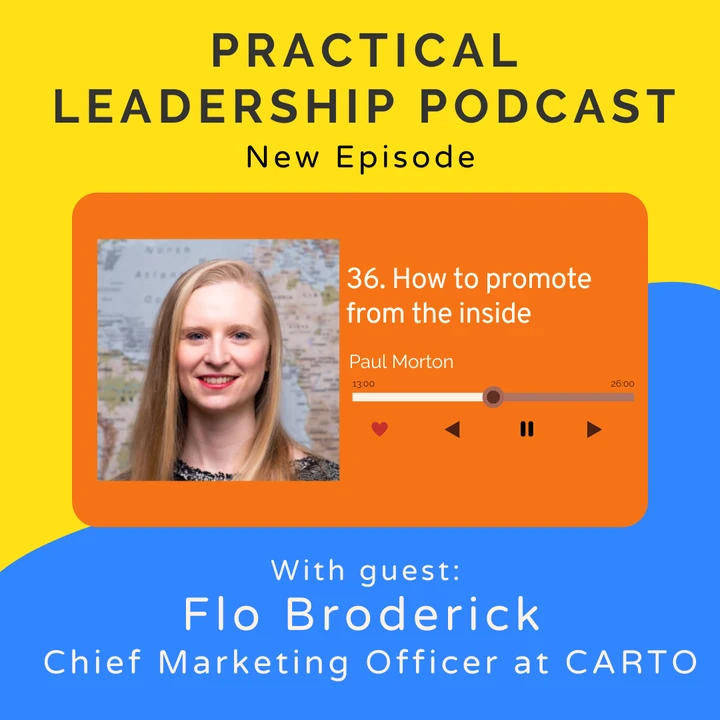
How to promote from inside
with Flo Broderick
Show notes
Flo Broderick likes to promote from inside, although she says it is a difficult balance to make.
After all – that’s where she came from.
Do you hire just the right experience from outside, or look at the talent you already have, recognise that it’s the choice with the fewest unknowns and help them to grow into the role?
We also talk about why you should over communicate. Again, and again. How you should go to work to be respected, not to be liked and why Slack is the new canteen.
When the mike was off, she came up with one more gem: Do the work no one else wants to do.
And – when you’re younger, use your holidays wisely. The list of different things Flo did is wild!
Find Flo here:
https://www.linkedin.com/in/flobroderick/
When you’re ready – help your new managers be more successful and productive: https://leadershipthatsells.com/
Transcript
Automated transcript. Speaker labels and spellings may contain errors.
Paul
[upbeat music] Hello, and welcome to the Practical Leadership Podcast, where I interview great leaders and try to extract their wisdom and experience for you to learn from, and hopefully avoid making their mistakes. Check out practical-leadership.academy because you want to help your new managers succeed with hybrid or remote working. [upbeat music] Flo Broderick, thank you very much indeed for joining me.
Flo Broderick
Happy to be here. Thanks for having me, Paul.
Paul
Would you be so kind, uh, as to introduce yourself?
Flo Broderick
Sure. Um, so Flo Broderick, and I work as chief marketing officer of a SAS company called Carto, um, based here in the UK. Um, the bulk of our team are based in Spain and the US, uh, and quite a few of us here in the UK. So that's me.
Paul
So you've had a heck of a journey though. I mean, you've been around ... Well, I'm not gonna ... I would never allude to anyone's age these days. It's not, you're not supposed to do that. But you've had some serious heavyweight roles, uh, in big companies. How do you make the leap from massive enterprise into startup?
Flo Broderick
Um, well, I'm very happy to have had experience in both. You know, to have been in a massive company is really, really useful when you go to then a much smaller scale-up company like Carto, and you need to sell to those giants, um, 'cause you then understand, uh, how many different departments they have for different things, and how many different operating businesses, and how they all interact. Um, but yeah, it was an amazing experience at Telefónica, 'cause it's such a global business. I was based in Madrid and lived there for six years. Um, and-
Paul
Muy bien. Muy bien.
Flo Broderick
Muy bien. Muy bien. Um, and met my husband there, so, uh, a lot to thank, uh, Telefónica for that time. Um, not that I met him at work. But, um, [laughs] but yeah.
Paul
Telefónica, an international dating agency-
Flo Broderick
[laughs]
Paul
... and telephone provider.
Flo Broderick
Exactly, yeah. [laughs] So, so it was incredible, and I'd kind of done my five years at Telefónica, and was at one of these massive conferences, Mobile World Congress in Barcelona, and I happened to meet the founder of Carto, um, who I didn't know was the founder. And I was demoing Telefónica's data visualized on this massive, amazing Microsoft Surface screen, uh, visualized in Carto, and I didn't realize that I was demoing his product to him with our data. Um, and the rest is history, and I ended up going over to Carto, again, based in Madrid at the beginning, but then, uh, I moved to the UK while still at the company.
Paul
So it is really useful you've got the big, big company background so you know how to sell to them. But the, the transition for you as, uh, an employee, as a leader, as, as somebody who needs to execute against plan, I mean, Carto's a decent sized company, but it ain't Telefónica. How do you [laughs] going from ... I mean, you go there, and hopefully they gave you a laptop when you started and all that sort of stuff. But there's, there's that, it is the transition from, "Well, I've got a team for that," or, "There's a process for that," to, "Okay then, I need to work out how to do absolutely bloody everything."
Flo Broderick
Yeah, no, that's very true. And I, I think it's one of the things I love about working at Carto, is, uh, just how close you are to seeing something delivered. Um-
Paul
Mm
Flo Broderick
... when you're a, a small fish in a big pond like Telefónica, obviously there's just so many layers of, of management, and there's a lot of bureaucracy, to be honest, um, even though it, it's an incredible organization. Um, but I love getting stuff done. And so when you work in a company the size of Carto, um, you can get a lot of stuff done very quickly. Um, and there's just a great bias for action in the company. Um, and you don't lean on consultants and agencies all that much. Yeah, we work with some, but, um, you, you can hire really great people. And I think that's one of the things that really shocked me when I got into a smaller company, was you think that in a big br- when you've got a big brand, you can attract all of the best talent, um, because you can afford it, and because you've got all of these robust talent management systems and whatever.
But actually, when you get into a scale-up, there's so many really talented people that are there because they love that component of bias for action, being able to get stuff done, being able to deliver on a strategy rather than, like, talking about a strategy. Um, and that was something surprising, was just how awesome the talent was when you got into a smaller company.
Paul
Did you find ... And I'm talking here from a, a personal question as well, 'cause I come from a reasonably large company. It was small, then went big, and then I'm going back and I'm working with lots and lots of little scale-ups and startups and stuff like that. And one of the s- the startups in particular is I, I go in there, and you, you, you're talking about a strategy, and then the founder says, "That's great. It's a good idea. Let me know when you're done." You're thinking, "Oh, I've actually got to do it." Uh, you ... "Oh, r- I, I remember how to do work. I do." 'Cause work previously was at an entirely different level, whereas this is now you've got the, you've gotta come up with the idea, and then you've got to find out and work out and actually deliver against what you said.
Flo Broderick
Yeah. No, it's true. And I, but I love that. Um, I, I really love that, um, because I, I, I ... One of my big philosophies is that, um, you know, be a doer. Um, and I think if you can be a doer in an en- environment like ours, then, you, you know, you're worth, worth a lot within the company.
Paul
Yeah.
Flo Broderick
Um, because sometimes getting things done is difficult. You have to persuade people. You have to meet deadlines. Sometimes we're working with external partners, like we work a lot with cloud companies who are giants now as well, and you're dependent on them. We launched a campaign with AWS yesterday. We launched perfectly on time, and actually it was super, super easy with AWS. But sometimes you're dependent on other things that you can't control, and, um, that's tough, but there's fine arts to getting people to all move in the same direction. Um, a- and I, I love that part of it. And I think on the s- the word strategy, um, I have to say for me, when it's interviews with a candidate, sometimes strategy's a bit of a red flag word at times. I think there's lots of people that want to, uh, work in strategy, and they wanna be involved in the strategic decisions, and they want to do strategy.
And you hear that too many times in an interview, it, I think for the environment that we're in, it can be a little bit scary because sometimes frankly, it's just rolling up your sleeves and Jumping into an Excel and sorting out some data quality on something for Salesforce, or something really unglamorous. Um, a- and that's what the job's about. So, uh, so yeah, I love that part of it.
Paul
Bias for action. [laughs] Get shit done, basically.
Flo Broderick
Exactly. You got it.
Paul
Yeah. Totally. Love that. How does that, how did the change influence or, if you reflect on how you were managing people, uh, as the global head of marketing at a multi-billion dollar, hundreds of thousands of people company, then you're now chief marketing officer at a itty-bitty startup in comparison. How does your, your management style change? How does your leadership style change?
Flo Broderick
Yeah. I think, first of all, it's you're so much closer to the goal. Like, in a big organization sometimes there are competing goals. Uh, whereas when you're in an environment like this, we are going after X million more ARR this year, and that's what everybody wants at the company. There's no discrepancy across the organization. So it's just much easier to set goals as the leader of a team, because everything has to feed into that. And it, you know, in the context of marketing, that's we need this many ops, this much pipeline, and we need to convert this percentage of it, and we all row in that direction. Um, so in terms of how that affects leadership, it's just very easy to set that. And I think whenever you ask candidates in interviews, like, "What is it that you want from your manager?" They pretty much always say the same thing. So I just want my goals to be really clear, want transparency.
Um, it's the one that comes up the most from my experience at least. Um, and that's just very easy to do, um, in an environment like this. So, um, I think as well, um, performance management is easier in a smaller organization. At the end of the day, when investors give you money and they say, "You're going after this revenue target," um, you need to run a high-performing team to get there, and you can't hang around and perhaps have dead weight like you can in organizations. Um, and so you need to have very candid feedback conversations very quickly, uh, uh, in this, this environment. Um, and I, and I think that's really great for anybody's development, because if you, if you're waiting for every six months for a check-in to have those conversations, um, you know, you can't in this environment.
And you need to actually course correct along the way. Um, and I love that. I love that direct feedback that I get from my manager, our, our CEO. Um, and I think that's really important, and that's what helps you grow faster and have a faster career trajectory at the end of the day. 'Cause if you, uh, smooth out the rough edges faster in what you're doing, then you can bring value faster.
Paul
I think the dead weight thing is, is a big one. Uh, and in some big companies that I know quite intimately, um, friends and family and stuff, they have people on their teams that they call cannon fodder, right?
Flo Broderick
Right.
Paul
You know you're gonna hire, and you know you're gonna fire, so you want to have people that you can essentially get rid of, so you have cannon fodder. Okay, boys and girls, 10% off the board. Done, right? Well, I know who's going this year.
Flo Broderick
Yeah.
Paul
Yeah.
Flo Broderick
No, it's, um-
Paul
Good practices, eh? Good management practices. That's the stuff. Treat people like cra- anyway. [laughs]
Flo Broderick
[laughs] No, I, I, I know what you mean. I think the, the other thing on that is that, um, we have a, if y- y- in, in teams, so this is something, like, one of my feedbacks I once had from a, a manager was like, "Don't expect everybody to be like you and to care as much as you." Um, so I, I have to say I really care. I get to my desk and I care about the things that I work on, and so sometimes if people aren't that as invested, I can get a little bit frustrated, and that's something I'm working on. But, um, something I've, think I've learned over the years is that, uh, there's, there are different roles. Like, some people do want to be given the list and to get through their list, and there are some people that want to come with 10 ideas to put on that list. Um, and I, I don't like the, the term plodders. I don't think in our environment there are very many plodders at all, because we, we don't plod.
We're going after rapid growth. Um, but, uh, there are different types of people, and you need to have those contrasts in teams.
Paul
Yeah. Yeah. I mean, some people just wanna do the job.
Flo Broderick
Mm.
Paul
And still passionate and engaged and all that, and every, you know, just then want to go home to their kids.
Flo Broderick
Yeah.
Paul
Yeah. Mm.
Flo Broderick
Yeah. And I'm sure that individuals, like, I might be like the way I am now, but I might see the world very differently in 10 years. Um, and that's something that I will get my mind around at the time and make those decisions as we go along.
Paul
Yeah, yeah. Oh, we're still young. We're still young yet.
Flo Broderick
[laughs]
Paul
There's time. What would you suggest, then, to somebody coming into Kartu? What sort of management advice do you give to people who come into Kartu as a manager? 'Cause you're on the senior team, and you look at them and say, "Look, in order to succeed here, or in order to succeed as a manager-"
Flo Broderick
Mm-hmm
Paul
... "you need to do these things."
Flo Broderick
So the, my number one would be over-communicate. Um, I think, uh, well, our, our CEO does this very well, is like you need to repeat things again and again, um, to show that things aren't changing and we're being consistent in our S word strategy. Um, uh, so you know, lots of people love email. Lots of people love Slack. Uh, so get the m- get the message to people on Slack, on email, in calls, say it in one-to-ones, say it in group environments so that people hear the same thing again and again. Uh, that's really important. Um, the second thing I would say, um, and this is a difficult one, uh, is go to work to be respected, not necessarily to be, to be liked or loved. Um, great if you can be both, but it can be challenging, because we're running a business and, um, and we have goals to go after. But, um, I think the most important thing is that- People respect you as a manager.
Um, and when they, when they move on to the next role and they look back, they really feel like they learned from that role. Um, so I think that's an important one. And I think in the remote environment that so many-
Paul
Mm-hmm
Flo Broderick
... people are in now, um, you know, Slack or whatever tool you use at your company is kind of the new canteen, um, in that, um, you can't just use Slack to put work messages. You know, um, in our group that we have, marketing and SDRs at Carto, um, you try and have the odd conversation, particularly for those people who are not in a hub in an office that occasionally see people, that is non-work. Like, what are your Netflix recommendations at the moment, or what's everyone cooking this weekend, or whatever it might be. Like, you need to remember that not everybody is in, having the same level of watercooler conversation, as they say in the US. Um, and so I think that's a, a really important thing to maintain, and you need to make the effort.
Paul
I like that. I do like that. I mean, and I'm conscious actually 'cause when a guy posts something in our Slack, um, and he was asking for pictures of the insides of people's fridges, I'm thinking, "Am I enabling some really weird fetish here? Or what's going on?"
Flo Broderick
[laughs]
Paul
I, I don't know. I think he's doing something for one of his kids or something.
Flo Broderick
That's a good one. I like that.
Paul
Yeah, pictures of the insides of your fridge. It's the, "Okay, fair enough. I'll do that." So it reminds me that when we're done, I'm gonna go and take a picture of the inside of my fridge and send it to Dimitri.
Flo Broderick
[laughs]
Paul
So, [coughs] so okay, let's go. Slack is the new canteen. Mm. Yeah. And the whole cadences thing, the, the remote side of that is trying to get people to be consistently together and have those connections 'cause th- that is... it's not just that's where, you know, the watercooler's where the ideas happen. It's, I think it's where trust builds.
Flo Broderick
Mm. Yeah, or, or understanding the external context of somebody that's within your team, right? Like, we see the work people on Zoom and, um, uh, you know, you have those Zoom conversations, you've got an agenda, you get through it. Um, and as much as you have a little bit of small talk, it's not the same as, you know, "Oh, I'm in the office today. Should we jump out and get some lunch and have a completely non-work conversation?" So, and you hear what, what people are carrying, and everybody's carrying something, um, whether that's some kind of personal issue or something that they're working towards or whatever. Um, and it's more difficult in a remote environment to understand what people might be carrying, and therefore how that might affect things at work.
Paul
Yeah, yeah. You have a, have an internet lunch, you know?
Flo Broderick
Yeah.
Paul
A lunch on Zoom or something like that.
Flo Broderick
Well, it's a-
Paul
Yeah, my wife used to work at Cisco. So many, many years ago, she used to work at Cisco, and they had in the coffee shop, in the coffee area, you know, you help yourself to a cup, cup of coffee before they... Um, and then they had this, the massive screen there 'cause they were the first people to have the, um, big screen, um, live Zoom essentially. It was Webex they had. The Cisco Webex. And they had that from London to Singapore to, uh, Amsterdam to wherever it was. So you could have the, a, a cup of coffee and be looking through a digital window at the guys in Amsterdam.
Flo Broderick
Wow.
Paul
That was really cool. I like that idea.
Flo Broderick
That is cool.
Paul
So you're, you're connecting offices as well as, as people, so it was quite cool.
Flo Broderick
Yeah. That's very cool.
Paul
So if you've got this, uh, set of advice that you give to people, over-communicate, go to work to be respected, and, uh, you're trying to, trying to understand the context, trying to understand the, the whole person in the canteen, the digital canteen we've got. If there was some how-to advice, uh, if there was some first aid you had to give to, to a new manager, what would that be? How to do what?
Flo Broderick
Well, I think the obvious one would be how to do your one-to-ones. Um-
Paul
Ooh. Love that
Flo Broderick
... there's, [laughs] there's an obvious... I mean, it's, this, one-to-ones don't go well if they're not planned, um, I, in, in my opinion. Um, so I really love just using a Google... We're completely on Google at Carto, and so we use Google Docs for one-to-ones, and you can have a checklist. And Google's got this lovely new feature where whatever's on that checklist, you can assign an owner afterwards. Um, and so from each one-to-one, you come away with, you're like, "Okay, I'm accountable for these two things I need to do, uh, and you've got these two." Um, and Google then surfaces reminders in your task list or your Gmail, um, which I find really useful to just keep on top of all the things that I need to do coming out of one-to-ones. Um, and it just gives you that structure for the meeting. Um, and even if you've got the kind of six to eight points that you're gonna go through, you've still got five mins to chat at the end just saying, "Oh, how are you feeling?
How are you doing?" S- s- you know. So I, I think be organized about them and make sure you come out with that accountability on the, the to-dos.
Paul
I like that. I mean, I think you've got so few levers you can pull when you're actually trying to direct an organization. Uh, the cascade of the one-to-ones I think is just, if they're done well, is one of the most powerful things you can do. There's a, the, I've got a little, um, um, shorthand. It's not a mnemonic. It's a thing. CUFCP is mine. So check in-
Flo Broderick
Mm-hmm
Paul
... how you doing? Update, this is the, the top-down thing. Uh, feedback, if you've got any. Coaching, if you need to do, do any. And then planning your next steps.
Flo Broderick
I like it.
Paul
So you've got just a tack, tack, tack, tack, tack, and you go through that, and you both plan.
Flo Broderick
Mm.
Paul
So if you're doing like a, a half hour one-to-one, it's 50 minutes of, of preparation and planning for both of you. You know, 'cause otherwise, you know, you know that one time you don't come planned or, or prepared, the other person comes up, "Well, here's my con- concise agenda. What's yours?" You're thinking, "Oh, God."
Flo Broderick
Yeah, yeah. I know what you mean.
Paul
Yeah.
Flo Broderick
But it's, I think it's very important to make the, make sure things are moving, um, and there's good direction.
Paul
Yeah, absolutely. Was there a, a, an event perhaps that y- that led you to learn some things in particular?
Flo Broderick
I couldn't pin this down to one event, um, but I think one of my big learnings, and it's been six years at, at Carto now, um, is how do you balance the whole hire externally versus promoting talent from within? Um, and I've only got six years of samples to look at, but generally speaking, my stories of, um, promoting really great talent from within has tended to work better. Um, and I think that sometimes, um, we obsess about people having the credentials of having done this at this phase, they've done 10 to 30 million, and been, you know, at a certain type of category of SaaS or whatever. Um, and actually just sometimes the best person for the job is sat there right in front of you within the organization. Um, and that's something I, I kind of keep in my mind whenever we're thinking about hiring and internal promotions now.
Um, and I th- saw a p- a post on Jason, that Jason Lemkin did recently about, you know, it's where you have the least amount of unknown. Um-
Paul
Yeah
Flo Broderick
... uh, so I think I, I've made mistakes on that in the past, and also when you're in a rush to hire for a certain role, um, because it's, you know, causing a lot of disruption internally by not having that person in place or whatever. So, um, I think I've made my mistakes there, and I'll learn from them. I'm sure I'll make more of them, but, uh, it's been, it's been a really interesting journey in that respect.
Paul
I think the day you stop making mistakes is the day you die.
Flo Broderick
Probably. [laughs]
Paul
The, the balance, that's a very, very good point on the balance from hiring externally and promoting. I think when you start to think more, especially now 'cause we're all, everybody's remote or hybrid or whatever we're calling it, the capability the organizations and teams have to pull an external resource for tasks or projects, or even quasi full-time things, you can go off and outsource an awful lot of stuff before you really need to hire a new external. I mean, it's gotta be entirely deeply valued at the organization. The thing that you're doing has to be intrinsic to the organization for you to validly warrant the expenditure these days.
Flo Broderick
Mm-hmm.
Paul
And then the least, the least unknown, if you're hiring somebody, let's say you've got, y- you're looking for a new person in your revenue team, and you say, "Oh, well, you know, nobody's really got that particular sector, sales cycle, ACV," whatever it is. But, as you said, Jeannie is sitting over there, and she's damned close, but doesn't quite have the chops for it yet. Get her a coach. Get her a mentor.
Flo Broderick
Love that.
Paul
I spend a lot of my time coaching and mentoring people who are just on the cusp or have just, they've been, thankfully they've been given the opportunity, but they're sitting there going, "Holy crap, I have no idea what to do next." That's okay, 'cause you talk to somebody like me in this situation, and I can help you out just a little bit.
Flo Broderick
Yeah.
Paul
And particularly that, you know, help them fill in the blanks. But they're the one. They're the one.
Flo Broderick
Well, and you can, you can feed them some of the tasks-
Paul
[laughs]
Flo Broderick
... you would be giving to that new hire, see how they do with it. You know, only small things. You're not asking them to do the job before they get given it. But start feeding some things, testing the waters, and-
Paul
Yeah
Flo Broderick
... that can work quite well to see is this person ready.
Paul
And if they're not, I've done that before with the leadership stuff. You give somebody the leadership task and you think, "You are a phenomenal individual contributor, and that's really where you should stay 'cause people ain't for you," and sometimes they recognize that as well. It's a very good self-awareness thing too.
Flo Broderick
Mm-hmm.
Paul
Right?
Flo Broderick
Yeah. Particularly in sales, the IC to leader thing is such a, a jump. Um-
Paul
It's huge
Flo Broderick
... so that's a good point.
Paul
Yeah. What you working on at the moment?
Flo Broderick
Well, um, we are kicking off the year. Um, we are very excited at Carto, um, because we have some really exciting partnerships with cloud partners, uh, Google Cloud, Snowflake, AWS, for example. Um, and so a lot of our focus this year is gonna be on partner marketing and partner-enabled sales. Um, and it's really great because that they have such traction as organizations, and they, um, give us a bunch of co-marketing opportunities, which is, you know, in a year where everybody's talking about cost efficiency and recession, it's all very doom and gloom, uh, we're going into this kind of how do we keep our CAC low, uh, and how do we grow the business in really efficient ways, and partner marketing's a fantastic one. Um, and there's a lot of other things that, that we do that have worked pretty well in the past year.
Um, you know, our product team has been rolling out, uh, and you know, the context, Carto is a spatial analytics platform, so visualizing and analyzing data on maps. Um, and so, um, another thing is working out which verticals are gonna have the use cases that are still gonna be super present through, through a recession. So for example, one of our top use cases is retail site selection, so where shall I put the next 10 McDonald's in the UK? Where's the white space to do that? And the reality is there are, there are gonna be winners and losers with the recession. Um, CPG companies, for example, will probably be, some of them in particular will do very well because people will be spending less in restaurants, and therefore will be less expansion of quick service
restaurants and actually more spend on certain types of groceries. And so we're working out how do we make sure that our marketing and sales strategy res- revolves around those market changes, and making sure that all of our marketing materials speak to those pains and, and trends.
Paul
Very interesting. Very interesting. Is there anything on your bedside table just now? Are you listening to any interesting podcasts? What would you share? How can we all become as smart as you, Flo?
Flo Broderick
Well, I don't know about that. I mean, I actually try, like to try and switch off a bit when I'm outside of work and not spend my entire time reading business books and stuff.
Paul
What do you like, what do you like to do?
Flo Broderick
Um, I love cooking
Paul
... channel.
Flo Broderick
I love cooking
Paul
You're cooking? I've, I've forgot, I tell you, I've got a chicken soup on the hob right now. It's gonna be delicious.
Flo Broderick
Sounds lovely. Um, so I, I really love... I mean, I, every morning, uh, in the shower I listen to the FT podcasts. I get my daily-
Paul
Uh-huh
Flo Broderick
... kind of what's going on in the world, um, from an economic and news perspective. Um, but the... I, I've really been listening quite a bit to, uh, Off Menu recently, uh, which is they get a celebrity on and ask them what would their dream kind of death row menu be. Um, I listened to Jamie Oliver, and I listened to Martin Freeman the other night, and that was great. But I love cooking because it gets me away from screens. Um, and I'm there, and I love how it's immediately gratifying. Like, you chop some stuff up, you cook it, and gives you a great deal of satisfaction. And I last year got as a present a machine called a Thermomix, which is not that huge in the UK yet, but very big in countries like Spain, Australia. Um, and it's this amazing kitchen assistant.
Um, it weighs, chops, cooks, kneads bread, makes meringue. It does everything. Check it out on Google. Watch a video.
Paul
Thermomix. Love it. Off Menu sounds fun. I like that one.
Flo Broderick
Yeah, that's a good one.
Paul
The, the... Although the instant gratification thing, I tell you, I made some ox cheek yesterday. I started on Saturday with that. You've gotta marinate it for, like, three days. I had marinating it in Guinness. You're feeding it Guinness.
Flo Broderick
Um-
Paul
You know, this, this thing. Oh, it's fabulous. Delicious.
Flo Broderick
Delicious.
Paul
Marvelous. Last, last thing for you then, Flo. What would you like to thank young Flo for doing?
Flo Broderick
Um, so I think on this one I would say, uh, for using my holidays wisely. Um-
Paul
That's great
Flo Broderick
... what I mean by that is I think, uh, you, you have these long Easter, Christmas, summer holidays as a kid when you're at school and then when you're at university. And, um, you know, partly due to economic circumstances, um, I was always hustling through the holidays and finding part-time jobs and finding ways to, like, learn things in the holidays, not necessarily academically, but, like, life skills. And so, um, I did a lot of nannying for children, uh, in different countries and learned different languages through that. I worked at Blockbuster Videos. I worked as a quizmaster in a pub. Um, I somehow asked a friend of a friend of a friend to get internships in different places. Volunteer at the local newspaper. Volunteer for the local MP. Like, the, the long list of things that I did, and I very often think that I learnt way more from all the co-curricular stuff.
And at university, you know, being president of Spanish society, ballroom dancing, did cricket, all of that. Coaching cricket to kids, all of that. I learnt way more from that than some of the academic stuff because, uh, it teaches you how to work with people, work with people from different walks of life, um, people from different countries. Um, and when you get to a, a leadership role, all of that becomes more relevant than what's the capital of 40 different countries, or what's the main river in these continents. Um, no offense to geography. Um, but I think there's a lot to be said that regardless of your economic circumstances, you should be trying to do stuff with your holidays. If, if career's gonna be a big thing to you and it's one of your life anchors, just go and get it and never be afraid to ask for something, 'cause the worst that can happen is somebody says no. Um, and I, I got a lot out of that.
Paul
Marvelous. Lastly, what are your coordinates? How can people find you?
Flo Broderick
Um, I'd say LinkedIn. Um, I don't tweet that often. I am active on Twitter, and I read a lot on there. But Twitter's Flo Broderick, uh, hash- um, @flobroderick, and then Florence Broderick on LinkedIn. Um, and always happy to chat.
Paul
Flo Broderick, thank you very much indeed for joining me.
Flo Broderick
Pleasure. Thanks, Paul. [upbeat music]
Paul
That's a wrap. Thank you for joining me today. Your homework is to leave your five-star review, and please, any comments you have, you really help me to improve every day, and it also helps people to discover me online. You should check out practical-leadership.academy because you want to help your new managers succeed with hybrid or remote working. [upbeat music]