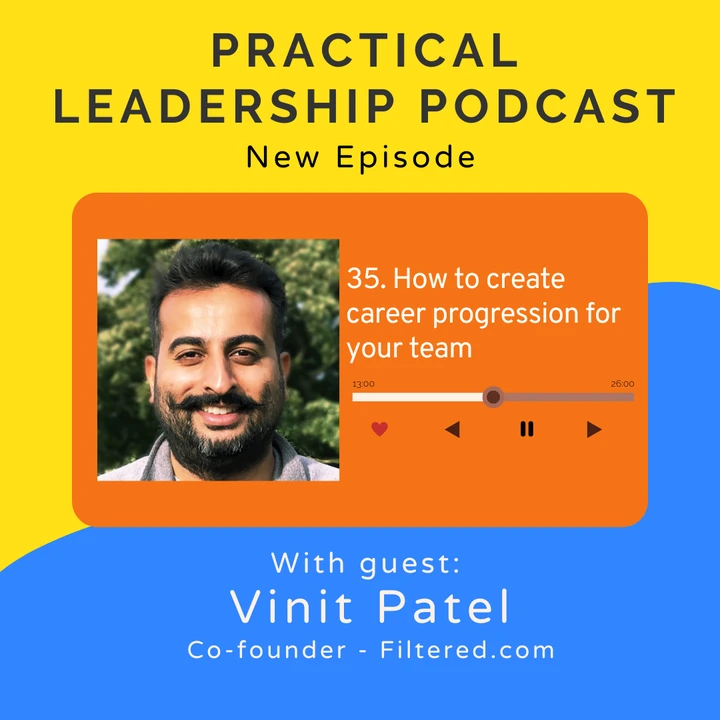
How to create career progression for your team
with Vinit Patel
Show notes
Vinit Patel co-founder of Filtered.com keeps on going by working in bursts, and designing his job so he takes on different roles every so often. He thinks it’s a great thing for anyone in any company to do.
He recommends everyone should find a coach or a mentor to act as a sounding board, and that you should go easy on yourself. It’s not all your fault!
You should ask for help. Try your line manager, HR, or an experienced manager from your past.
Vin finds that when he writes his issue down, it’s cathartic and can be emotional – self coaching towards solutions by putting process and structure around the problem.
We get into the meat of progression frameworks, why it’s important to build them and some good tools to use .
You can find Vin here:
https://www.linkedin.com/in/vinitrpatel/
———
When you’re ready to help your new managers become more productive – join me at:
Transcript
Automated transcript. Speaker labels and spellings may contain errors.
Paul
[upbeat music] Hello, and welcome to the Practical Leadership Podcast, where I interview great leaders and try to extract their wisdom and experience for you to learn from, and hopefully avoid making their mistakes. Check out practical-leadership.academy because you want to help your new managers succeed with hybrid or remote working. [upbeat music] Vinit Patel, thank you very much indeed for joining me.
Vinit Patel
Thanks for having me, Paul. Pleasure to be here.
Paul
Well, can you, would you please, would you introduce yourself?
Vinit Patel
Sure. I'm Vinit Patel. I'm co-founder of Filtered, a learning technology business, and I've spent much of my career, the last 15 years, working in, investing, helping s- startup businesses.
Paul
Well, where did you get to at Filtered? I mean, so far you've been out there for, what, um, 127 years, right?
Vinit Patel
[laughs]
Paul
I think these journeys, they, they feel like that sometimes. I mean, so many founders and so many, uh, senior people in, in startups, it's like, "It's, it's ... I'm still full of beans, but oh my God, I've been at it for, like, like 26 years," or however long it feels.
Vinit Patel
Yeah. It's, it's ... I'm not-
Paul
How do you keep your energy going?
Vinit Patel
I'm not sure it's accurate to still call us a startup, but it's very much a startup in, in, in, in all respects apart from maybe the length of time that we've been working on it. Um, mostly because we've done a bunch of different things in the last 13 years. How do I keep the energy up? Um, I think the short answer is [laughs] I think the short answer is working in bursts. So for me, um, and I think this has helped my own personality and the things that I'm good at and like doing, it's often been a different focus or a different role every six to 12 months. Um, that hasn't really been by design. Um, initially I was COO for a long time, so that just required me to focus on and do different things in the business, and that often did change every six months or so. Um, but, but more recently it has been a more sort of designed thing that I've done to switch things up and to, to, to make that the source of new energy and to try and keep things, um, going.
Paul
I suppose you can do that in an organization, number one, where, A, you're the owner. Number one, A. Number one, A, where you're the owner. Number two, B, where, um, it's small enough-
Vinit Patel
Mm-hmm
Paul
... that you have, um, the oversight and the ability to do all these different things. But it is, I can see it's a lot ... it's a wonderful idea. A lot harder to do in a s- a bigger organization. You can't quite jump from being the head of legal to being the chief sales person and-
Vinit Patel
Yeah. I think, I think bigger companies, not, not maybe the massive ones, but I think bigger companies are, are noticing and realizing that a big part of talent retention requires them to create these, uh, diagonal career journeys for people and, you know, do a lot more horizontal stuff moving into different roles, adjacent roles. Um, and actually, I, I tell most new people that join our company, or anyone that's looking to, to develop and, and stay with us, look at the profiles, look at the LinkedIn profiles of most of your colleagues and people that have worked here before. They have all had the opportunity to and been very encouraged to, to move around. So it's definitely a trait of a small business, and I think the best small businesses, um, do it well and make, create those opportunities. Because it, it, it ... I think it works well for everyone.
It helps the individual get a much broader and different perspective. The business benefits from it as well. But actually, that person going around has so much retained knowledge, um, that it can really help new and emerging parts of the business develop in ways that it wouldn't have done, um, had it been a brand new team. Of course, there are some, you know, cons to it. Sometimes you might not have such an experienced person in that role. Often the case for me. I'm typically brought in to do the zero to one stuff, right? I am not an expert in demand generation, which is the role that I'm doing now, or wasn't an expert in customer success when I first started doing that a few years ago, right?
But you apply yourself and y- and, and crucially, I think, you, you lean on others that have done the, done it and, and been there before to, to kind of, um, assist your own efforts.
Paul
I think it's, if you, you said leaning on others, it's a great thing always to find a coach, mentor type person, somebody who can coach the best out of you, but mentor you in your deficiencies or mentor you on the, the, the, the functional stuff that you actually need to know how to do. Diagonal career, I love that phrase. Um, there's, um ... If you think against the bigger companies, normally you get the, the high po- potential types, these high pos, the fast tracks. These are the boys and girls who get shoved off to Singapore for six months, and then off to Bangalore for six months, and then they're in the Tokyo office for six months. They're working in supply chain, they're working in legal, they're working in HR, they're working in engineering, so that they are being groomed on the path to divisional
leadership and all that sort of stuff. Being able to do that in a smaller company is quite a powerful, quite, quite a powerful advantage. As you said, you get that breadth of understanding, if not necessarily the depth, but you certainly get the breadth of understanding across an organization that really builds institutional memory, that makes it very, very attractive. It's a very attractive proposition from an employee-
Vinit Patel
And, and hopefully it allows you to tell a much more compelling career story and career journey when you're out there looking for your next gig, or if you've got a side gig or side hustle where you're advising other companies or peers or you're coaching yourself, or you want to go and create a bunch of content about what you've been doing. You know, whatever it might be, whatever your stick is, um, you know, you've got to be able to have those experiences is more likely to, uh, spark your creativity to allow you to, um, unearth new opportunities for yourself. Um, so yeah, I think I've definitely benefited from that. It, it helps obviously being a founder, but, but I've also m- Tries to massively encourage others to take a similar approach
Paul
Mm-hmm
Vinit Patel
... um, including certain members of the existing team, um, who, if they're listening to this now, um, will know exactly who they are. [laughs]
Paul
No names, no pack drill.
Vinit Patel
[laughs]
Paul
Yeah, it's, it's, um, I was talking about this not that long ago, it's the idea of a functional promotional path as well. Is that if you got somebody in a job and they think, "Well, the next job I have to, the next promotion step in my career is a promotion to be a manager," and you're looking at them going, "I am never giving you a team to manage because you hate people," or, "You're just not that sort of person." So what do you do with them? Well, they quit and go off somewhere else. Eh, if you can give them a functional promotional path, you're saying, "Well, actually, I'm gonna give you experience here. I'm going to let you deepen that or go diagonally, go somewhere else, go from demand into customer, go from something to..." You know, that's-
Vinit Patel
100%. I mean, I'm just thinking about the g- you know, we're a team of, what, 25, 30 people right now. Easily half of that team that's been with us for at least two years, some of them who have been with us, uh, shorter, have already done that and are doing that today. And I, I think actually we as a small business, and probably most startups generally, don't fully appreciate ourselves or value ourselves how important and useful that is to members in the team. Not everyone is cut out to be a team lead or a team manager at that point in their career, or possibly any point in their career. Sometimes you kind of have to do it to know that, to, to, to work that out for yourself. I, I can fully understand that. But like you say, actually the more, um, helpful thing might be to have a, a stint in another area of the business.
Um, uh, ultimately it goes to show that you're responsible enough and are considered to be an expert even i, i- in that business, in, in that domain, to be given those new additional responsibilities. I think it's a huge thing. Um, and actually we as business owners, as founders, as managers, should do more to support and encourage that, and to formalize it to the, to the extent that we possibly can so that it's seen as a thing that people do rather than just a, "Oh, by the way, maybe you should go off and do this now." [laughs]
Paul
Mm-hmm.
Vinit Patel
As an afterthought, you know. Be a lot more intentional and proactive, um, about those developmental paths.
Paul
Yeah. I, the, the, the intent behind these things I think is always questionable. And so many times you look around and you think, "Ah, that guy over there, she, she, or he or she was really, really clever because that's what they did." And then you speak to them and realize they fell on their ass, they had no damn clue what they were doing, and it looked good because the outcome was good, but what you didn't see were the three other bits of rubbish that happened. So yes, we can make these things intentional, but as you discovered, just doing it because you needed to do it is probably the driver that you need.
Vinit Patel
Yeah. Yeah, 100%.
Paul
So on that journey you've been on, at what point did you first become a people manager?
Vinit Patel
Um, I'd say it was quite early on. So when the business started 2009, it was just the three founders, um, working together alongside each other. And then about three years in when we were starting to grow the team is when we started to hire people, and then, you know, I became a first-time manager properly. And I remember my CEO, Mark, who you know, giving me this little orange book, it was HBR's, um, 50 Tips to Being a Good Manager, and it was so cute and nice. It was, you know, had a, a little hard back, it would fit into my pocket, and I w- and I made it a thing that I would open up every day on the, o- on the train i- in- into work to, like, just read a few lines about this new tip. And, and I remember distinctly thinking, "I wonder how many of these 50 things I'm actually doing day to day." And going through it and thinking, "Uh, maybe 10 if I'm lucky." [laughs] Like, wow, there's a lot of stuff that I need to do as a manager, and I've still got my actual job to do and a bunch of other stuff to do as
well. It, it was quite daunting. [laughs]
Paul
Well, that, that, that, do you know what? I think if you're doing 10 out of these, the, the HBR 50, that's, that's probably a measure of success.
Vinit Patel
Probably, I'm probably exaggerating, it's probably more like two. [laughs]
Paul
[laughs] It's, uh, even that, even that, I tell you. I mean, the number, I mean, we were, we were talking about that, is that I boiled down the, what I think the management tasks are. They're, they're none... It's highly subjective, but the, the essentials down to about just over a dozen, 18 or so things you really, really need to be able to do, like setting objectives, giving feedback, holding people accountable, all that sort of stuff. And even more so when you're now remote, you actually have to not just be okay at them, you actually have to be good at this because you're remote. You could be kind of a half-arsed lazy manager in an office because you get instant feedback, instant gratification if it goes well, and an instant, "The hell?" if it goes horribly wrong.
If you're remote, you don't get those signals. You don't, you just, you just miss on, you miss them all the time. So you have this duty for productivity and as well as the care of the people you're w- you're working with to actually get the basics right. Mm-hmm.
Vinit Patel
Yeah. Yeah. That's, that's so true, and it's, um, and it's really hard to figure that out for yourself. [laughs] It takes a long time. And that's, and, you know, I, I was a manager for the first time in a, in an office, right? Not in a, in a remote environment. So I, I would struggle to, to empathize with someone who's a remote first, uh, people manager now, um, for the first time, because there's a lot more that I think, um, is different and is harder in many respects. So if you've got some frameworks and ways in which you can apply yourself, then, you know, grab 'em, take 'em, use 'em. [laughs]
Paul
Yeah, totally.
Vinit Patel
That's right.
Paul
What, what frameworks or advice or something, what would you give as advice to a first time people manager just now then?
Vinit Patel
There's a few things. I think, um, I would seek out a few, not too many, although I think that's probably not too much of a risk for most people. I would seek out a few, one or two people managers who you have seen or come across, even if it's not ... Maybe even better if it's not in your, in your existing company, that you can use as a coach or as a friend to just help you out, to be your sounding board, to go and just riff with. Because I remember when I, when I was that first-time manager, someone who I'd seen operate another business, I remember messaging her and saying, "By the way, I'm a, I'm a manager. I've just become a manager. Like, what do I do? [laughs] What do I need to do? 'Cause I've seen the way that you operate with your team, and it's amazing." Like, I was part of her team as a consultant for a bit.
I was like, "This is, this is incredible." I lo- I just loved her approach to how she managed people. Like, I'm not sure I could be that person yet, or, or possibly even ever. Like, you know, help me out here. And, and she, she, she was great. She gave me some bits of advice. Um, and then, you know, I, I was sort of off on my journey and, and, you know, figuring a few things out for myself. And I think that, that made a big difference, knowing that, that I had someone that I could pick up the phone to or send, send a text to, just be like, "By the way, I'm just struggling with this. What would you do?" And, um, yeah, it was, it, um ... Yeah, so, uh, uh, Rachel Spedding, if you're, [laughs] if you're, if you're listening to this by any chance, thank you. That was you, by the way, [laughs] um, over 10 years ago. [laughs]
Paul
Rachel, we're gonna come knocking on your door next.
Vinit Patel
[laughs]
Paul
So seek out a coach. Seek out a coach and a mentor. So you get a coach who can unlock your potential, and a mentor who can maybe fill in some of the blanks.
Vinit Patel
Yes. Yeah, that. The other thing I would say is, um, go easy on yourself. I think it's really, really, um, easy to just be quite hard on yourself, to, uh, to think that, um, that you're, you're failing or not doing a great job. Um, so yeah, go, go easy on yourself, 'cause I think in the early days I often felt that, oh, like, how my team performed is a direct reflection of me, and that's not always the case, right? I mean, often it possibly is, but actually sometimes, um, the situation that you're in or the people that you've inherited, you, you may not have hired them, and this, that, and the other, you can find yourself in a pretty tricky situation very quickly. And I've seen, and I've sometimes experienced, whether it's a first-time manager or even as an experienced manager, oh, my goodness, like, this is not this person, or the way that we are operating here is not up to my standards.
Um, this is gonna reflect really badly on me, right? Um, and I, and I think at that point, you sort of do need to just first do your best to look after yourself, and then secondly, very importantly, go and speak to your own managers and the, and the leadership in your te- in your business and be like, "By the way, I don't think this is working. Let's try and figure this out together." Rather than what I think a lot of first-time managers and inexperienced managers do, is sort of hide away in a corner and think that they can ki- try to figure it out themselves. Um, again, I, I would find myself in some of those situations because I like to be a reasonably self-sufficient kind of person. Don't, you know, I'm not very often the person that will ask for help or go looking for help, uh, uh, as, uh, you know, i- in that way. Um, so, so yeah, I'd say sort of go easy on yourself.
And, um, and, and, and again, sort of echoing the theme of the first point, seek out help and go take these problems as you come across them and h- and, and, and see them to other people in your business, because there's a good chance there's others, um, that are either thinking the same thing and/or have the advice and the experience to help you navigate some of them as well.
Paul
So how do you go and ask for help? It's easier said than done. I mean, ego's a big thing, right?
Vinit Patel
Ego's a big thing, yeah. Ego is a big thing. Um, one thing I-
Paul
Who, who do you ask first? You came up with that as an idea, so let's say who do you ask, and how do you ask them, and what are you asking?
Vinit Patel
Um, usually I would say your direct line manager should be your first port, port of call, right? So whoever, whoever that is. Um, if you're, if you're in a small business and you're lucky enough to have a dedicated people or HR person that might be able to offer some advice, put them on the list as well. Um, a- and/or, because sometimes your peop- your direct line manager and/or the, the HR people person, if they exist, may not be that experienced themselves. It's often the case in small startups. Ideally then, um, uh, seek out someone who is experienced enough. If it's not the CEO themself, um, there might be another leader within the business. And say, "Hey, this is the problem that I've got right now," and then list it out.
And I ... And again, ideally, write it down. Um, so write it down. Write down what you think the problems are, what you've done to try and resolve them, what you think needs to happen, um, and any questions that you've got, even if it's just, "I really don't know what to do next." Because I think in writing it down, you also give yourself an opportunity to process what it is you're seeing and feeling and experiencing, rather than just spewing it all out on a call or over a coffee with someone. It allows you and your brain to sort of, to the extent that it can, structure and process some of these things. Um, and a lot of the time you'll probably find, as I did and, um, still do, it's quite an emotional thing. [laughs] And the process of writing it down allows you to sort of separate some of the emotion, um, as well.
Paul
So it's almost like self-coaching. You're sort of ... One of the, one of the best questions you can, I think, um, ask yourself is, "If this was happening to somebody else, what would I advise?"
Vinit Patel
Yeah. Exactly. Imagine you've got a friend coming to you-
Paul
Mm
Vinit Patel
... with a problem that you have. What would you say to your friend? And imagine you're doing it over a beer or a coffee or whatever, and you really care about them, your friend, right? What would be the advice that you give? 'Cause I think when you then think about it in that way, you're hoping, you're hope- hopefully giving your friend the best possible advice, but in the best possible way as well. Um, some of which might be stuff like, "Go easy on yourself. You know, don't make this your own problem. A problem shared is a problem halved." All those sorts of things, right?
Paul
Oh, yes.
Vinit Patel
Um, and I, and I think the other thing, um, and this is a different sort of thread, but I think it's one worth exploring. Um, if, if it's about performance, if the issue is about performance and/or about progression and where, and then ... Because that's the other thing. As a first time manager, sometimes, uh, um, it depends what the problem is, right? And if it's a problem that you relate to or that you've experienced yourself as a, as an individual contributor, um, one of the, one of the problems, challenges that I've experienced over the years is one of progression. Like, how do I give this individual or this team that I now have and run and I'm responsible for a sense that there is more than just their current job for them to go after, either because they're coming asking me or because I want to open their eyes to it, or because they're trying to figure things out themselves.
Like, you know, which direction should my career go in? And, um, and I think progression and progression frameworks, um, as a sort of a, a hard, uh, sort of, um, black and white way of, of, of it manifesting are a thing that a lot of startups do often overlook and don't pay enough attention to, and we've certainly been through that journey, um, and continue to today.
Paul
Yeah. It's, it's all about them, isn't it? It's all about the people piece. I mean, all the biggest challenges that ... I do, I coach and mentor, um, all sorts of leaders and managers, and the biggest, knottiest challenges are never the technical, architectural, structural, organizational stuff. Yes, territory planning. Yes, yes. Yes, compensation stuff and things and, um, partner conflict. So these are, these are really knotty, complicated things when you've got multiple moving parts, plus legal things, yeah. But then it's all about the, "But she wants a promotion and I don't have one, and I, if she quits, I'm screwed because she's the only person who knows how to do X. What do we do? How do we give more money?" W- w- w- what is it? What's the conversation? How do you hold ... They're the toughies.
Vinit Patel
That's right.
Paul
They're the ones that actually sit on your lap and stew.
Vinit Patel
Yeah. Yeah, you, and you go to bed thinking about it. You wake up in the morning thinking about it.
Paul
Yeah.
Vinit Patel
It occupies your mind, especially if you're, like most people, I think, um, you know, you care about, uh, the, the individual in the, in the, in the team. And it's a lesson that I learned quite, um, quite well last year, um, the hard way when s- um, when I inherited our customer success team. Um, it was a, uh, a f- a few funny things that happened. Inherited a customer success team, but without any customer success managers, uh, because for various reasons, uh, they had left. And so started 2022 with a book of business that I needed to go away and expand, and no CSMs, but had three brilliant implementation managers, and we were shifting the business model. So initially, first quarter was like, "Let's just leave things as they are, work very hard, and see where we get to." Clocked a few wins, great. Got to Q2, and then for other reasons, the product team were just flying and doing great stuff.
It became clearer to me that actually these implementation managers were more like CSMs, um, than implementation managers, so, you know, let's have a conversation and let's find a way of, of, of, you know, um, moving them into CSM roles if it's the right thing to do for them and for the business. Went through all of that stuff, and for someone who's got a strong bias for action, I was actually doing it what felt like a very slow way. You know, having lots of meaningful conversations, trying to get lots of different perspectives, writing down lots of stuff, making the plan as clear as possible, and did this over a good few months. Um, except for one thing, um, uh, which was, okay, yeah, we'll, we'll, um, we'll ... It's, it's sort of a bit of detail here. It's whatever level you are in our progression framework at Filtered right now, we'll transpose you onto that, into the, into the new role, and then, you know, off you go.
So got going in mid-August with this new team, all the CSMs, uh, hiring a- another CSM, and the plan was, right, everyone gets their own accounts and off we go and we're working. Simple. The one thing that I had failed to fully grasp and, and appreciate was how much each of those individual now CSMs, how, how much each of those individual people were not clear about their own progression in this role beyond me saying, "Oh, yeah, you can, you're now gonna be customer success managers at Filtered," and, you know, and off you go. And it then sort of came to the fore, like, within a week of me making these changes, that the development plans that I had in my head for each of these individuals wasn't made clear to them.
But the, also the progression framework that we had, which was a fairly generic thing within Filtered, was just that. It was too generic. It wasn't meaningful enough. So I had CSMs looking at this thing and thinking, "Oh, I'm actually now more this level, now I'm more this level. What about this? What about that?" I was like, damn, like, I've really not helped by keeping things vague on this front. And, and not helped by, um, not helped by, um, not making it clear what the next six, nine, 12 months beyond looks like as a CSM within Filtered. So that's the stuff that was sort of stewing, right? And I was like, "Damn, I've really, like, cocked up here [laughs] . How do I make this, um, useful and, and valuable to each of these, um, individuals?" And so very quickly got to work building out a progression framework, but building out in a way that,
um, made sense to them and their roles, but also for what we needed in the business, um, for the nuances of our product and the way in which we were developing. Our CSMs weren't quota carrying, but they were much more product specialists, so I needed to make sure those sorts of things were reflected, and reflected meaningfully. Um, and had it not been for this brilliant thing called Progression App, um, uh, which had a lot of stuff in its library and then it used a bit of GPT-3 before it became a, a hot thing, uh, to, to, like, really build out some stuff. Incredible. Like, I would not have been able to do what I needed to do in the time that I had, uh, without it. But the outcome is the most important thing, because it meant that I could then have, soon after, it still took me a good few weeks to get to this point, conversations with each of those individuals about, "Okay, what do you think of the
framework as a whole? Cool, looks about right. Great. Where do you see yourself, first of all?" Rather than me saying where, where I think you should be. "Okay, great," you know, "we're broadly aligned." And in all cases, we were broadly aligned. Some cases where we weren't on some of the specifics, I was like, "Why do you think you're there right now?" You know, "What, what do you, what examples do you have to show that you, you know, you're hitting that particular bit of the framework?"
Paul
Mm.
Vinit Patel
"Okay, cool. Um, let's, let's figure out a way in which we can, you know, um, get you there." And that became, oh my God, like, maybe it's because of the slightly difficult, um, period that I had before that, but that became such a, uh, an important moment, I think, um, for that team and that, and, and our relationship together, that it allowed us to then focus on the future meaningfully. Um, and to a large extent, um, relieved a lot of their concerns about, right, what does progression look like for me in this role? Um, a really simple thing, looking back at it, you know, I should've, this should've just been part of the plan for the changes that I needed to make. No one called me out on it. I think most other people that I was taking this to in the business were like, "Yeah, I'm sure Vidhas kind of figured it out. I'm sure it's fine" [laughs] .
But actually, um, I hadn't, and it wasn't until the team had come back to me and told me what does it look like that, uh, that it made a huge difference.
Paul
Well, I think you should give yourself, as you said, you go easy on yourself. You're allowed.
Vinit Patel
[laughs] Yeah. Take some of my own advice.
Paul
Yeah, took what... Yeah. In that you caught it in the best way, which is you had the open conversation with your team, who came back and said, "Whoa, we're missing here something, boss. This is, this is not quite a thing." "Okay. Well, let's dig in and find out how it can be a thing." And the fact that you did that rather than truck on regardless 100 miles an hour, and you only find out when half of them quit.
Vinit Patel
Yeah. That's a fair point.
Paul
It's a win.
Vinit Patel
Yeah. Oh, yeah, that's true.
Paul
It's a win. There you go.
Vinit Patel
I'll take that.
Paul
[laughs]
Vinit Patel
Good.
Paul
Tell me then, what else is working on at present?
Vinit Patel
Yeah. So, so I just wanted to say, the other thing is, um, uh, in my long spiel there, I, looking back, I think progression is something that we put off at Filtered for a long time.
Paul
Mm.
Vinit Patel
When we did it, we put in something fairly generic. And at the time it was great because it was going from nothing to something generic. Fine. But then actually now, what we're going through right now is, is more specific frameworks. So there's lots out there, and if you use them and you use them well, they can, they can, they can make a huge difference. Um, anyway, um-
Paul
Well, which ones are you using? Let's, let's take a plug and get some advice from you.
Vinit Patel
Yeah, sure.
Paul
So you're using, what was it? Progression App, you said?
Vinit Patel
Progressionapp.com is excellent. Um, they only started a few years ago, and now they can cover most roles in most businesses. The other one that I've frequently gone back to is, um, Stack, Stack Overflow. So Stack Overflow-
Paul
Mm-hmm. Yeah
Vinit Patel
... actually have a lot of job descriptions. That's the other thing, right? Like, we all obsess about job descriptions. I can't actually stand them. I think they're pretty useless, to be honest. They're, at best, frozen in time. Very often poorly written, and they don't really reflect, and don't give a sense of progression. What's coming next? W- you know, what should you have done prior to that? Which other directions can you move in? Diagonally, for example. Progression frameworks, if they're done well, can, can, can, can help you there. Um, so yeah, th- those are my go-to. I'm, I'm sure there are others out there. Um, some of the HR tech that we use have some built in, so we're currently using Lattice.
Um, we were on FifteenFive before, but Lattice do have some built in. Um, but yeah, my, my favorite, um, so far is, um, Progression App.
Paul
I will definitely have a look at that. It's, it's a thing. I mean, it's a, it's a question I think that a lot of people just, they sit on. If you think about it in your own context, you're sitting there as an employee perhaps. What's next? That's it. What's next? What's next after this? "Well, I've only just been promoted an hour and a half ago. I have to get my head around my job." Yeah, even still, what's next?
Vinit Patel
And what do I need to do to get that next thing?
Paul
Yeah.
Vinit Patel
That, that's the, the missing thing, I think. And, um, a, a, a development plan, horrible bit of sort of HR jargon, but it's a thing-
Paul
Mm
Vinit Patel
... and it's a thing that, you know, um, if, if you care about it, you should take seriously. Um, it doesn't mean anything unless it's steeped in something realistic, right? So some, some, uh, things that you need to have gone and achieved or done or had a go at doing. Um, and if you're just making them up on the fly, it's really hard as a, as a manager, and especially as a first time manager So if you can look at something and point to it and be like, "Ah, these are the things you kind of need to do to, to help move along," then you, you really do help yourself and you help that person because you can have a, a much more objective, um, conversation.
Paul
So that's what you've been working on at present, is building out your pricing plans.
Vinit Patel
Um, well, yeah, kind of present-ish. It was a sort of a thing that was, was, was, was, uh, was occupying my mind a lot over the back end of last summer. Um, in terms of what I'm working on right now, I mean, the ... a bunch of things. But actually, one thing kind of left field that I've become very interested in, and it's now sort of manifesting itself into a thing, is following and studying, um, certain sales and commercial thought leaders through LinkedIn.
Paul
Hmm.
Vinit Patel
Um, so I'm gonna share something in the next few days. Um, and, and actually I found that if you follow the right people, then you can actually sort of learn for free because if they're, they're talking about the stuff that you care about and you value, then it's just a simple case of opening your LinkedIn feed, consuming that content, using it even, banking it, um, to form your own playbooks and whatever you wanna do. Um, but crucially, you know, just absorbing it. Um, and I think, yeah, uh, again, that's another shortcut that I take to my team is, like, if you wanna become a, a, a master in this craft, then follow the right people because there's a good chance that they're talking about the stuff that they're
seeing day in and day out, and you can learn a lot from them. Um, there's a, again, another shortcut to learning and development, which I, which I know you know a lot about. [laughs]
Paul
Well, it's free mentoring, isn't it?
Vinit Patel
Exactly. It's free mentoring.
Paul
Just mentoring.
Vinit Patel
Yeah.
Paul
It's ... I mean, the, the very essence of Filterd is that content is not the actual problem, right?
Vinit Patel
I'm glad you plugged us and not me. [laughs]
Paul
Absolutely. If anybody's looking for a solution to having too much e-learning content shite floating around their company, go and talk to Vin and the team at Filterd-
Vinit Patel
Yeah
Paul
... 'cause they will th- plow through it, chuck out 90% of it, and leave you with the stuff you actually need and want.
Vinit Patel
You couldn't have said it better. [laughs]
Paul
There we go. I'm sure there's a better pitch there for you.
Vinit Patel
I don't know.
Paul
Um, if ... What would you ... What, what are you reading right now, Vin? What are you reading? What are you listening to, podcasts?
Vinit Patel
Um, I've gotta ... I must confess, I'm not a big reader, and I will often listen to, um, pretty terrible music on Spotify. Um, but I do, yeah, podcasts and Audible books. Um, I, I, yeah, I go kind of, uh, kind of ebb and flow. But, um, uh, I, I like the stuff that the Revenue Intell- like, the, the Reveal Gong podcast puts out is really good stuff.
Paul
Hmm.
Vinit Patel
Um, and, and of course your podcast. [laughs]
Paul
Of course.
Vinit Patel
Your others. Um, cannot forget that. Um, uh, one of the best books ... So if you're in sales and in sales leadership, The Qualified Sales Leader by John McMahon, um-
Paul
Yes, he's good
Vinit Patel
... w- is brilliant because, again, you know, much like the, the content, um, much like your, your content, it's, it's short bite-size enough that you get a lot of high value from it without having to invest tons and tons of time. So, um, yeah, that's a, that's, that's a go-to, actually. Um.
Paul
I enjoyed that. That's a good book. Good. What would you like to thank young Vin-
Vinit Patel
Oh
Paul
... for having done?
Vinit Patel
Uh, that's a good question. Young Vin, um, whose hairline was about, yeah, [laughs] three centimeters further down [laughs] than where it is right now. [laughs] Um, I actually think that, uh, one of the things I would thank myself for doing is, um, saying yes to a lot of opportunities and to lots of people and to new projects and new ideas. I think for me, um, much like, you know, I, I mentioned at the earli- earlier part of this, um, this chat, was having lots of experiences that you can rack up and, and take with you. Uh, you, you know, you, sometimes you seek them out, sometimes they come to you, and if you can say yes to them or you're just open to the idea that there's a bunch of different things that you could do, um, especially early on in your career, whether you're, whether it's because you're a first-time manager or it's a, you know, your first new role, or you're just first into, into the workplace, um, I think it's a wonderful
thing to be able to take all of that energy and enthusiasm and to soak it all up. And so having the attitude of sort of saying yes, even if it feels a bit scary, I think is a, is a, is a brilliant thing, um, if you can get yourself there. It's a bit different later on in life, though, um, kind of, um, ironically, because then you kind of need to get good at saying no, which is actually [laughs] quite hard. And doing saying no well, and, um, uh, and, and focusing on things. But I think generally, yeah, I would definitely thank myself for, um, being open to lots of different things.
Paul
I think that the discomfort zone, you know? Every- everybody's got a comfort zone, but it's the discomfort zone, actually being aware of that, and finding that if you're in the discomfort zone, it's generally a good thing. You're, you're uncomfortable because, let's say as a manager, you've delegated too much and you're thinking, "Oh, God, they're gonna screw it up." Well, then you know what? That's exactly where you should be 'cause you're learning and they're learning. You've, you're, uh, making a decision and you're not sure. "Oh, goodness me, it's really ... The consequences could be ... " That's a good place to be. 'Cause if we are all sitting in our comfort side, you're just bumbling along, aren't you?
Vinit Patel
Yeah, exactly. I think [clears throat] it's different for different people at different parts in their life and their journeys. Um, now, when we, when we've had both of our kids, I've definitely at that point wanted to be slightly more in my comfort zone than my discomfort zone. [laughs]
Paul
Oh, yes. That's different.
Vinit Patel
But the, yeah, that's
Paul
That's entirely different.
Vinit Patel
Yeah.
Paul
Your children are not allowed to make you discom-
Vinit Patel
Yeah, exactly
Paul
... discomfortable.
Vinit Patel
But those-
Paul
Is that right?
Vinit Patel
... those life moments, those life moments, uh-
Paul
Yeah
Vinit Patel
... they weave into your work life, right? So yeah, finding, finding the right times to switch modes I think is an important thing as well.
Paul
Then lastly as we wrap up, how can people find you? What are your coordinates?
Vinit Patel
Um, through this podcast. [laughs]
Paul
Of course.
Vinit Patel
Through, uh, through you. Uh, LinkedIn, so Vinit Patel. Um, there aren't many of us, but there are quite a few of us. It's a fairly popular surname. Um, website, you know, I work at Filterd, so you can come to filterd.com. I am on Twitter, but I'm not particularly active, uh, on that. Um, but yeah, LinkedIn's, um, the main one if, uh-
Paul
Lovely
Vinit Patel
... if, if you should want to come out and, um, chat to me.
Paul
And why wouldn't they? Vinit Patel, thank you very much indeed for joining me.
Vinit Patel
Thank you, Paul. [upbeat music]
Paul
That's a wrap. Thank you for joining me today. Your homework is to leave your five-star review, and please, any comments you have, you really help me to improve every day, and it also helps people to discover me online. You should check out practical-leadership.academy because you want to help your new managers succeed with hybrid or remote working. [upbeat music]