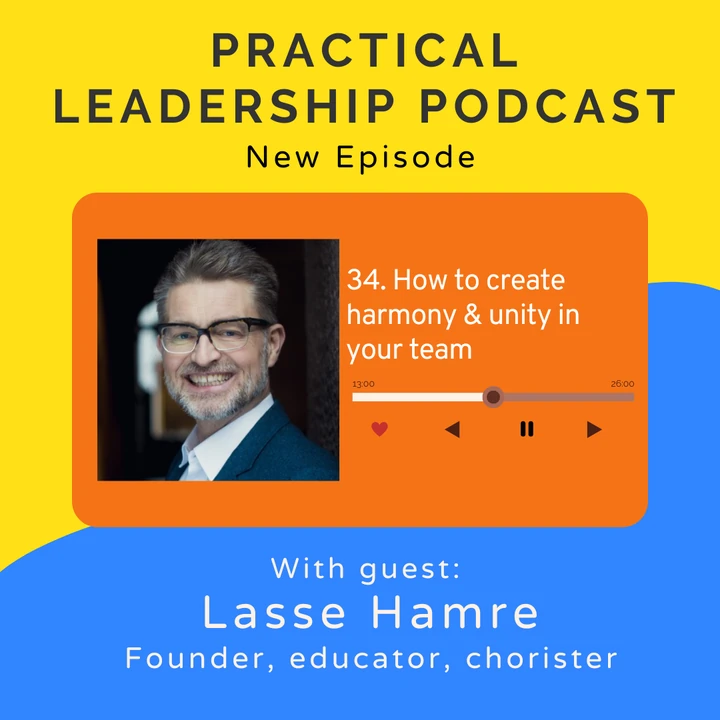
How to create harmony and unity in a team
with Lasse Hamre
Show notes
I recently interviewed Lasse Hamre, co-founder of TASK.NO, and he shared some valuable insights on teamwork, trust, experimentation, freedom and responsibility. Here’s a quick summary of our chat, complete with some funny direct quotes, tips and numbered lists.
Lasse is a true believer in the power of teamwork. As a singer and a military veteran, he has a unique perspective on what it takes to create something beautiful and powerful as a group. According to him, the key to success is to listen to the pulse of the team and to understand where you fit in.
Here are some of the other takeaways from our conversation:
-
Trust is everything: Lasse believes that trust is the foundation of any successful team. He said “if you want to create something with a group, you sort of have to listen to the group as a whole. And maybe there is room for a soloist somewhere. But the soloist couldn’t have become a soloist if it wasn’t for the group.”
-
Experimentation is key: According to Lasse, experimentation is crucial for growth and progress.
-
Freedom and responsibility go hand in hand: Lasse believes that true freedom comes with responsibility. He said “It’s wonderful. I have to tap into the right tune and the right rhythm and to have the same beats as everybody else in the group and be part of something bigger.”
-
Lasse sees the choir and his team as a product, and he believes that the audience is not there to listen to him, but to listen to the choir. He said “So the product is something we made together.”
So, if you’re looking for some inspiration on how to create something beautiful and powerful as a group, look no further. Lasse’s insights will help you build trust, experiment, and find your place in the team.
Find Lasse on
Twitter: https://twitter.com/LasseHamre
and on LinkedIn: https://www.linkedin.com/in/lassehamre/
and on his website: https://task.no
—–
When you’re ready – upgrade your new managers with my short, high-impact, practical group coaching: https://leadershipthatsells.com/
Transcript
Automated transcript. Speaker labels and spellings may contain errors.
Paul
[upbeat music] Hello, and welcome to the Practical Leadership Podcast where I interview great leaders and try to extract their wisdom and experience for you to learn from, and hopefully avoid making their mistakes. Check out practical-leadership.academy because you want to help your new managers succeed with hybrid or remote working. [upbeat music] Lasse Hamre, thank you for joining me.
Lasse Hamre
Thank you for, uh, inviting me to this podcast. I'm curious about what we're going to talk about.
Paul
Well, let's start. Would you introduce yourself, please?
Lasse Hamre
Lasse Hamre. Lasse is the same as, uh, Larry in English or Lawrence. Um, I'm educated in educational science, and I founded this company I'm working in right now. And I have many roles, have had many roles in this company. And at the present, a business development role, which I really enjoy.
Paul
When we met many years ago, you were the head guy.
Lasse Hamre
Yeah.
Paul
You were the top dog. So when did you actually first become a people manager?
Lasse Hamre
Well, I think, uh, I have that in my DNA sort of, because since I was very, very young, I have, uh, taken initiative, uh, to do stuff. So I have had a leadership role in the Red Cross Youth for many years. Uh, and, uh, on a voluntary basis. And it came easy to me to take initiative and say, "Let's do that," and people came along and, and did it together with me. So that is something that, uh, uh, that I enjoyed for a long time. And I, I actually was, um, uh, got all the way up to the, the board of the Norwegian Red Cross as, uh, a leader of the whole youth organization. So that, that is something I'm very proud about. But, uh, professionally, I started, uh, as a manager when I founded this company [laughs] in 2003. So that, that came very abruptly.
But, uh, you had, you started, you have to figure things out and, um, and I think, uh, uh, my leadership style has been very much influenced by what I know about learning and change and development.
Paul
If I could define you, I would be, you would be somebody that I would go to to get stuff done.
Lasse Hamre
Okay. Thank you.
Paul
Right?
Lasse Hamre
[laughs]
Paul
Oh, absolutely. Absolutely. I mean, you've got a background. You've got a phenomenal background. I think you were underplaying it. And you've got a background in the military.
Lasse Hamre
Yeah.
Paul
You are the one who's possibly educated every educational professional in Norway. Everybody I speak to in Norway knows you. They know ... 'Cause you used to, you used to lecture on this, didn't you?
Lasse Hamre
I did. I had a meeting with one of my former students last week and, and he's working, uh, as an, uh, headmaster you can say for all the departments, uh, in, uh, in the Norwegian government. So he has a very prominent role. So we had a very good conversation. And I also learned a lot from the military about, you know, what is strategy, what is tactics, and it's the same in business. Uh, but they have a very practical approach to it. So that's, that's interesting, and I like the practical approach to, to leadership. It has to be practical.
Paul
As an educator, and you'll have seen this through the military, and practiced this obviously as an educator of education professionals, and your desire is to improve other people, what is the first thing that you tell new managers or new people leaders to do?
Lasse Hamre
I say trust your team, because if you don't, there's no [laughs] ... You can just walk out the door and leave. Because it's the team who does the job for you. So you have to trust them. It's the most important thing, um, because it's the team. If you trust the team and you manage the team to work well together, they can do magic. And I have an example to, to share with you, Paul. I might have shared with you before, but I, I learned this when I was working at the Swedish Military Academy in Stockholm. And, uh, and they trusted the cadet with their own learning, their own learning process. So instead of telling them, you know, what to do, they invited them to create their own plan for learning their profession as captains milit- or platoon leaders.
So an example here is very interesting. They, they, they took the new cadets out to the coast, and they demonstrate how to, to, to win a bridgehead along the coast to a, a, a fortified bridgehead. And they were supposed to ... They, they watched an exercise, uh, with a, a more mature team coming in on a, a, a, a ship, uh, which is called a fast assault craft. CB90 class. It's, uh, it's, uh, it's not too big. It's very fast, and it can stop, uh, on a dime almost because it's, uh, has these water jet engines. And you just reverse the water, uh, the water stream and then it stops. This is something you would like to, [laughs] to have when you are approaching a enemy, uh, area. You don't want to slowly end up by the coast. So stop abruptly, jump, uh- ...
assure and, and secure the bridgehead. So, uh, the young cadets came up there on a Monday and saw that exercise, w- how it was done. And when the exercise was over, the teacher came to the cadets and said, "So today it's Monday. On Friday you will have to do the same. So here are some manuals, here are some books, here are some expertise. You can, you can talk to these men, my, my teachers, and here is the assault craft. You're welcome. See you on Friday."
Paul
[laughs]
Lasse Hamre
[laughs] Isn't that motivating?
Paul
Uh-huh. What happened?
Lasse Hamre
Well, they, they had to start by planning their own learning process. "So how I going to approach this problem? We don't know anything about it, but we have all the means we need to be able to learn this. It's avail- it's made available from, for us from our teachers." Uh, so they create their teaching plan. They scheduled in the teachers. They, they had study circles. They, they, they, uh, yeah. And when they created their, their learning plan, they needed to sort of slice up the task in different subtask, tasks. What do we need to know to be able to do that task? And they slice it up in different subtasks, and then they invite the teachers to come and teach them the different stuff, and they, they made it on a Friday. Can you imagine how motivating it would be to be part of that team and be given the trust of a, a assault craft for millions of
crowns?
Paul
I mean, that's an exercise not solely in trust. You, you take immediate ownership of the challenge-
Lasse Hamre
Mm
Paul
... and perhaps because you're being trusted.
Lasse Hamre
Mm-hmm.
Paul
And then your job is to disassemble the problem to its component parts, learn how to follow each one. That's, that's an interesting, an interesting approach. What you trying to ask?
Lasse Hamre
Like I, I have a, I have [laughs] an example from a, a large, large Norwegian and international company that I've had a conversation about, uh, the question of recruitment. So we all know that, uh, getting the best brains is almost impossible at the moment. It might be easier if, uh, the economy is stopping up, but, uh, still it's very hard to get the, the best brains. So when you, when you m- want to, to, to move your business into new areas, how are you going to deal with that? And, um, and they came to us and said, "How should we think about it? We can't, we can't just recruit people because it's just, uh, you know, um, businesses overbeating each other in wages, and because you don't have the people." And then you come to the question of skilling and reskilling and upskilling and all these things.
How, how can you do that best possible way? And this company, they wanted to get into hydrogen, um, uh, the hydrogen i- industry to, to power vessels and use hydrogen as a, as a clean energy source. And I said, "But w-" And I was inspired by the, the story from the Swedish Military Academy, and I said, "Why, why, why can't we just make an experiment? We can make it virtual." Uh, and we ... Because everything can be made virtual now. You have, you have virtual modules of everything. Let's create this hydrogen factory, and we invite the people working in your company to be part of that experiment to big this, build this virtual model of this factory, and then we run simulations on it. And how would, how, how would that work? How would we, uh, the production, uh, work? How would the sales work? How, uh, would, uh ...
What kind of staff would we need? And we can manipulate that in the virtual model. And it's sort of a s- training exercise, but it's also very motivating and rewarding because you get the ability to try out a future and to learn along the way we go. And this is also what happened when I founded the company. I'd never, I've never founded a company before. I just had to trust [laughs] a group of people that I gathered to create this, and we made it. [laughs] Yeah.
Paul
How did you do it? What, I mean, how did you go about ... I mean, it's easy enough just to say, "Okay, we'll just trust them to do it. We'll just trust them to experiment." I was talking to somebody the other day actually whose feedback from an exercise he did in something very similar was, "I can't trust my team. They're full of idiots."
Lasse Hamre
Yeah. Yeah.
Paul
It was a big corporate.
Lasse Hamre
And what did you-
Paul
He was a big corporate. He was saying that this is the way you need to do it. You just need to trust people that they're going go, that, that it's going to work. And the feedback he got from this big corporate was, well, people in the big corporate was, "My team are full of idiots."
Lasse Hamre
Yeah.
Paul
And number one is what the hell are you doing there, and why did you hire them in the first place, right? But-
Lasse Hamre
[laughs] Yeah. Yeah, yeah. Well, the, the, I think the, there is a question, uh, that comes before that, and that is how do you build trust, and what can the leader do about that? And, uh, it, it's a leadership task. So the leader should ask, uh, him or herself, "What can I do to build trust?"
Paul
Well, you can't ask the question without answering it.
Lasse Hamre
[laughs] Well, uh-
Paul
What did you do to build trust? I mean, you started this company, 2003. There you were. 2003 you are, you were what? 19 years old, right?
Lasse Hamre
Well, uh-
Paul
Maybe not quite
Lasse Hamre
... the, the, the, the, uh, maybe, maybe I'm too radical, I'm not sure. But when we founded this company, it was based on some, on, on some values. And w- uh, how did we create these values? We were originally three founders. And we had a process where we went deep, deep, deep inside ourself. And, and the question to ourself was, "What is the one thing that is so important for me that if I feel that this value is attacked, I would fight very strongly?" And for me, that was my freedom, my freedom to do what I like, to do what I believe in. So I think that sense of, uh, uh, having freedom, uh, has, uh, actually stayed in the company f- until today. But then people ask me, "But don't you have anarchy [laughs] at work if there is freedom?" But I believe that the freedom is just one side of a two-sided coin.
On the other side, it says responsibility because you cannot be free without taking responsibility for everything you do. That's what freedom is. You can't blame anybody else. So if you connect these things, it's very rewarding because you have the freedom to do what you like, but you have to show responsibility for that freedom that you, you have and, and deliver what you are supposed to deliver and show you're worthy of, of having that freedom. Uh, I don't like micromanagement, so I think the alternative of trusting people is, uh, much better. [laughs]
Paul
Okay. So you build trust by having a clear set of values.
Lasse Hamre
Yeah.
Paul
You determine your clear values by understanding what's more important to you, what would you fight for than anything else.
Lasse Hamre
Mm-hmm.
Paul
And understanding both sides of the coin of whatever, whatever that value set is.
Lasse Hamre
Mm-hmm. Yeah.
Paul
How else do you go about building trust?
Lasse Hamre
Yeah. Okay. So, uh, I have to think-
Paul
You wanna trust your team, right?
Lasse Hamre
I, I have to think now, Paul. You ask very good questions. So I think also, um, to build trust, you need to show who you are. I, I need to show myself, uh, to my team, to be personal about my, my life, my, uh, my status. I'm married to a man. So I have to ... And it is, it doesn't take courage to say this now, but it did when I was younger. But I think, uh, you know, showing who you are, what you believe in, how you live your life can take courage from anybody, um, for many people. And, and you should show that courage because then you also invite the other team members to be who they are and to feel safe about who they are. That's, that's, that's building trust on a personal level.
Paul
So once you've got this trust, what can you do with it?
Lasse Hamre
Every time I get a mission, uh, I usually start with, uh, uh, to put that mission into the group. And the first question I ask is, "How should we think about it? How should we approach this? How should ... " And I think that comes from my learning approach, you know. How do we, how do we work with this question together? And then we have a discussion about that first before we start solving the task because then we have sort of a plan on, on how, what, how we're going to work to solve a problem. And, and I'm in the consulting industry, so there are always new cases that we've never done before. And we have to, you know, have a conversation about how should we as a team approach this problem.
Paul
So you're asking the, it's the, the meta question-
Lasse Hamre
Yeah
Paul
... about the, okay-
Lasse Hamre
Yeah
Paul
... the situation itself. How do you approach it?
Lasse Hamre
Yeah. And the question is very, very important because what we are looking for is an answer. And, uh, I would like to, to quote, uh, Matrix, which is the film which was very important to me in the '90s. "The answer is out there, Neo. It's looking for you." So what you have to do is, you know, to create an atmosphere where we can find the answer because the answer is always there in the some situation somewhere. And to find that answer, that's a team effort. I have to trust my team to find it because I don't find it alone. I need to have that conversation, the different perspectives, the different competencies, and also the, the quite specific things that we have ahead of us. People see different things i- in, in, um, a pitch for instance.
Paul
In your long and illustrious career so far, has there been a particular event or a mistake, something that's happened that you've learned something from?
Lasse Hamre
What is the, what is the thing that is common from all these mistakes? And it usually boils down to one thing, and that is that I didn't clear with, uh, the group what expectations they had about what we are going to do right now. Uh, so when, when you ... I don't know if this is a good example because it was quite messy and I was ... It was very embarrassing, but it was a very prestigious project for the Red Cross. They wanted to create a training program to, uh, to raise the competence and awareness within Red Cross about sexual abuse. And we came to, uh, this, uh, working group, um, with a methodology of how to create a training program, and they wanted something completely else. And I don't really know what they wanted, but they were so offended that they almost screamed at us. And I think it is also because the, the,
uh, the subject matter is very delicate and it's a lot of, you know, different emotions coming through, and we didn't really check that out before we started. I could easily just have asked, "So what are your expectations to this meeting?" And it would never have happened the way it did. It was very embarrassing, very, very embarrassing. [laughs] Uh, but sometimes I forget it, still forget it. You check the expec- ex- uh, expectations and, and then- Uh, the risk is there. We can end up in very unpleasant place.
Paul
There's a lovely question, um, that somebody suggested that you ask of the people around you, uh, which is, "How would you like to be managed?" And then talking to your boss and saying, "I would like to be managed like this."
Lasse Hamre
Yeah. [laughs]
Paul
And I think the expectations that you are clarifying there, not necessarily desire, because how would you like to be managed? Well, completely laissez-faire, leave me alone, just pay me money. Or you go to your client and you're asking, "What is it you actually want?" And I think the second part of asking the question is actually listening to the answer.
Lasse Hamre
Yeah.
Paul
It's easy enough to say, "Oh, w- w- what is it you actually want?" Training courses.
Lasse Hamre
Mm.
Paul
Great. I can do training courses.
Lasse Hamre
I like to think that that is one of my superpowers, uh, [laughs] to listen into a group. Sometimes, you know, I, uh ... Many times I, I walked into completely new groups, opened the door, walked into the group, and the, the same second I know exactly how this group is feeling. It's nothing magic about it. I think it's just, um, a lot of, lot of experience. And I think also it comes from my experience as a singer in a choir because the ma- most important thing when you sing in a choir is to listen. It's even more important than singing.
Paul
Is to create ... I mean, you're trying to create harmony. I mean-
Lasse Hamre
Yeah
Paul
... you're, you're, I think you're one of the founders of one of the largest, most famous choirs in Norway. Um-
Lasse Hamre
Yeah, I was one of the founding fathers.
Paul
Yeah.
Lasse Hamre
So I wouldn't brag of my, uh, participation in the actually setting up of the choir, but I was there from, on the first rehearsal, and I've been into every production for 18 years. Yeah.
Paul
That'll do.
Lasse Hamre
Mm-hmm.
Paul
That'll do. And the next Christmas performance is gonna be on NRK. It's gonna be on, front and center on the Christmas schedule, so that's gonna be amazing, with the, the Norwegian Philharmonic Orchestra. It's brilliant. Um, but singing in that choir, and I love to sing as well-
Lasse Hamre
Yeah
Paul
... you are, you're trying to create harmony, so it's not one voice. It's one voice among many. And using that perceptive ability you have to make sure that you are singing the right note at the right time, does that help you pick out-
Lasse Hamre
Yeah
Paul
... the, the, the sentiment or the, the, the sense of what's going on in a group?
Lasse Hamre
So the choir is trying to create, uh, a product, and the product is the experience of the listener or of the audience. And, and my voice doesn't matter i- i- i- in that sense because, uh, they're not there to listen to me. They're there to listen to the choir. So we perform as a group. I become part of the group, uh, and I sort of blend into that group and create a harmony together with my co-singers. So the, the p- the product is something we made together, and I think this is a very nice thread to go back to where I started, to trust in the group. Because if you, if you want to create something with a group, you sort of have to, to listen to the group as a whole. And, and, uh, uh, maybe there is room for a soloist somewhere. But it, the soloist couldn't have become a soloist if it wasn't for the group. So you have to sort of give credit to everybody to take responsibility for their part and become part of the, the, the, the, the big work that we, we do together.
Yeah.
Paul
Is that being responsible for your own part to, not to the exclusion of everybody else, right? I've gotta do my job as part of the team.
Lasse Hamre
Yeah.
Paul
But I think when you think about how most people approach teamwork, they think about it as I need to play my part, so I'm going to do my thing.
Lasse Hamre
Mm.
Paul
I'm gonna do it, my thing, very, very well.
Lasse Hamre
Mm.
Paul
But what you're talking about is going into a room, into the choir, into the team, with your ears and your, your senses open to understand where you fit.
Lasse Hamre
Yeah.
Paul
Does that mean that you submerge yourself?
Lasse Hamre
Yeah. I sort of get that feeling sometimes. It's, it's wonderful. So what I, I have to, I have to tap into is the, is the, the right, uh, tune and the right rhythm, and to have the same pulse as everybody else in the group and be part of something bigger. And it, it's so wonderful that it almost make me cry. But sometimes you feel that also when you have, uh, you work together as a team, that people really listen to each other and, and they, they are trying to make something bigger, uh, than each and every one of the team members could have done, uh, for themselves.
Paul
Listening to the pulse of the team. What would you like to thank young Lasse for doing?
Lasse Hamre
Yeah. Well, I, you know, I was a young guy. I didn't know my place in the world. I tried different stuff. Uh, but I'm very happy that I found my, uh, way into choir at the age of 11 as a young soprano. [laughs] Now I am second bass. Uh, but having that journey and a long career in a choir, that, that, um, I didn't realize that then, but now, uh, I see that it really has, uh, influenced, uh, who I am and how I think about the world and, and being member of different groups.
Paul
My son just started to sing yesterday.
Lasse Hamre
He did?
Paul
On Tuesday.
Lasse Hamre
Oh. It warms my heart.
Paul
Yeah. He, he just joined the Velmead Voices, and he came back all aglow.
Lasse Hamre
[laughs]
Paul
It's wonderful to see. No, that's nice. So you're grateful to your younger self for joining the choir so that perhaps that has influenced your sense of harmony, of rhythm, of unity, of team. Lastly, just as we wrap up, how can people find you?
Lasse Hamre
So they can find me on Twitter with my name, Lasse Hamre, and also on LinkedIn. I try to post, uh, my opinions about, uh, learning there. So if you're interested in, in how I look at that, you can look at my LinkedIn. And, uh, we also have a webpage, task.no. We have translated everything into English. So if you're curious, have a look there as well.
Paul
Marvelous. Well, it just remains for me to say from military to choir through teamwork, trust, experimentation, freedom and responsibility, Lasse Hamre, thank you very much.
Lasse Hamre
Thank you, Paul. [upbeat music]
Paul
That's a wrap. Thank you for joining me today. Your homework is to leave your five-star review and please any comments you have. You really help me to improve every day, and it also helps people to discover me online. You should check out practical-leadership.academy because you want to help your new managers succeed with hybrid or remote working. [upbeat music]