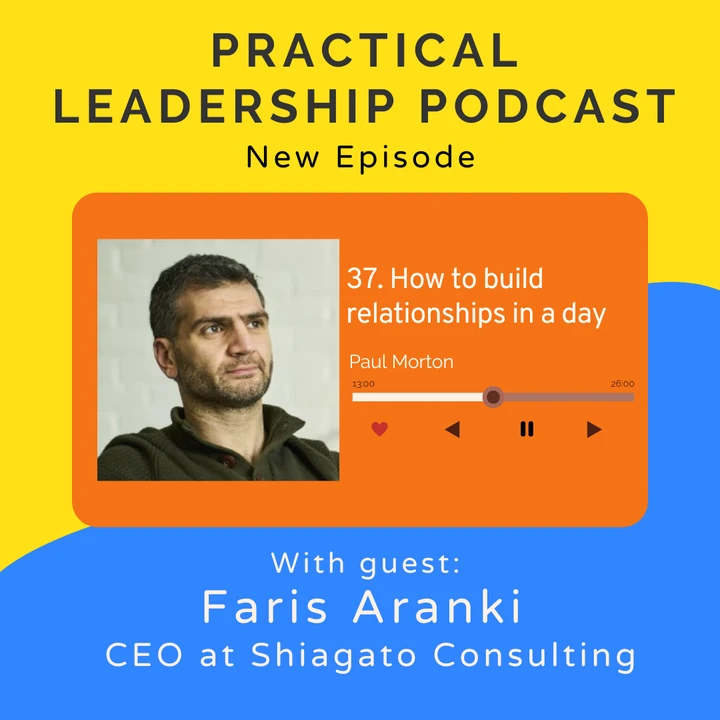
How to build relationships in a day
with Faris Aranki
Show notes
Teaching taught him to be prepared for anything! (Has he met my kids?)
Knowing you don’t have to know the answer helped him become a better manager.
Faris Aranki, CEO of Shiageto consulting is an advocate of Pre-Mortems (a great technique for avoiding disaster by thinking through risks in advance).
He also suggests that you can build a relationship faster than you might think. There are a few things he does to force the relationship to evolve at speed:
- Find something – anything – in common
- Find joint tasks to work on (force this if you’re the boss)
- Set people up to learn together by making the tasks more challenging than they might expect
As a learner by nature – Faris also suggests making whatever you absorb stick by either: Doing it again and again, Speaking about it to an audience, or Writing it down multiple times.
You can find Faris here:
https://www.linkedin.com/in/farisaranki/
—-
Raise the potential and productivity of your new managers with my New Manager coaching: https://leadershipthatsells.com/
Transcript
Automated transcript. Speaker labels and spellings may contain errors.
Paul
[upbeat music] Hello, and welcome to the Practical Leadership Podcast, where I interview great leaders and try to extract their wisdom and experience for you to learn from and hopefully avoid making their mistakes. Check out practical-leadership.academy because you want to help your new managers succeed with hybrid or remote working. [upbeat music] Faris Saranki, thank you very much indeed for joining me.
Faris Aranki
Paul, thanks for receiving me. Is that right? [laughs]
Paul
Yeah, well, be received any way you like. It's just like being in the receiving line of Her Majesty, you know. Thank... Well, His Majesty now. Yes. Nice to meet you there, Faris. Very nice to meet you. Would, would you introduce yourself, please?
Faris Aranki
I would love to. Uh, hello to all of Paul's listeners and this fantastic podcast. I'm Faris Saranki. I'm the CEO of a company called Sheer Ghetto Consulting, which is a small, innovative consulting firm which does strategy and emotional intelligence. Basically, we get teams working better together and buying into the same ideas so you can actually deliver on your strategy. Uh, loads of fun, um, but I've got a, um, you know, quite a journey to get here, which has involved, uh, working as a strategy consultant for multiple years, working in the energy industry before that. And a long time ago, Paul, I started as a high school teacher, uh, teaching the two glamorous subjects of maths and economics, uh, around the world. So, um, hopefully, that will give me a range of stories to share with you today.
Paul
I think that's a decent foundation. That's definitely a decent foundation. I mean, Centrica, Ernst & Young, Baringa, uh, and, and yes, I mean, uh, where else do you want to go from?
Faris Aranki
[laughs] Yeah, certainly. Uh, plenty of company experiences in different companies, but also when you're a consultant, you go in and out of organizations-
Paul
That's the thing
Faris Aranki
... so you absorb a lot of information. That's, that's one of the reasons I love it. Um, and, uh, you unashamedly borrow good techniques and, uh, learn about bad techniques so that you don't recreate them. Um, so I like to think I'm a walking encyclopedia of good and bad management practices.
Paul
Well, there's the good artists borrow, great artists steal. I'm, I'm an unashamed thief of other people's good ideas.
Faris Aranki
[laughs]
Paul
With credit, of course, where you can remember where you found them.
Faris Aranki
Of, of course, of course.
Paul
Where you... [laughs] Absolutely. And, and in terms of the, the, the bad practices, oh my God. I mean, I've always thought that there is a trail of destruction, uh, left behind, well, me in particular, but every bad manager out there. A t- trail of destruction, all these people that you were experimenting on unwittingly and unknowingly over the time, you know, trying stuff out. What, what was the point in your illustrious career where you first ended up being a manager, manager of people?
Faris Aranki
Which de- it depends how you define manager, uh, Paul.
Paul
Well, then you do it. This is the thing.
Faris Aranki
If I'm honest, if, y- you know, when you asked me that question, uh, earlier in our prep call, um, I was like, oh, it's probably gonna be when I transitioned at Centrica into managing a team, um, of call center agents. You know, at Centrica, they had a fantastic, uh, thing where they, you had to work on the shop floor at some point early on in your career, um, and, um, before you got into sort of more, um, cerebral jobs. And so I transitioned from being a call center agent into running a team of 20 agents, and that was a baptism of fire.
Paul
Wow.
Faris Aranki
Uh, Paul, I remember my first meeting. I did one-to-ones with everyone in the team, and there was this, uh, uh, older chap who'd been a call center agent for 30 years, whose opening sentence to me involved multiple swear words, uh, which, uh... a- and the, along the lines of, "What the hell have you got to teach me? You're, y- you're not even old enough to shave." Um, so-
Paul
[laughs] Excellent
Faris Aranki
... it was a very tough confrontational to, to inspire, motivate, and lead those people. But actually, the reason I reflected is, do you know what? Um, the reason I could handle that conversation was because for five years I'd spent every day managing 30 little people into learning.
Paul
Oh.
Faris Aranki
Um, and, and they'd bring their challenges every day. They would bring their [laughs] reasons they couldn't do their work. They would need motivation, inspiration. So actually, being a teacher was fantastic for secretly teaching me how to manage others.
Paul
My mom was a teacher for, I don't know, 35 years, something like that. She retired as a, as a headteacher.
Faris Aranki
Yeah.
Paul
Um, and it's one of the reasons I got into digital learning, and I've, I'm a, I'm a consummate learner, I call that myself. You know, I like to learn lots of new things. I have huge respect for teachers, given that I've got sm- two small children right now.
Faris Aranki
Yeah.
Paul
And the amount of crap that they have to go through.
Faris Aranki
[laughs]
Paul
Uh, the work, the work that gets in- that is involved in the prep and the concepts, like they're being on stage.
Faris Aranki
Mm.
Paul
I mean, I mean, managers, leaders are on stage anyway. You're always performing, not necessarily faking anything, I don't mean that, but you are there as a presence-
Faris Aranki
Yeah
Paul
... and present, and being present all the time is very tiring. But, well, with 30 little people. Aye, good. What's your biggest takeaway from that? How did you transfer? Or how would you advise somebody? What would you take away from being a teacher and then advise somebody being a new manager that would, that would, uh, yeah?
Faris Aranki
I think the transition... Um, I mean, I learned very, many valuable lessons as a teacher. One is, at, at, which transfer as a manager. One was be prepared for anything. Um, you know, literally you cannot, you cannot think through every scenario that might be presented. Uh, and usually they're around m- emotional and things that, things that are happening to the person. And, and, and by the way, you, you don't have to be an expert at those. As a manager or as a teacher, there's no way I could have dealt with all the challenges that were going on at home, and, 'cause I wasn't trained. But it is about being the first port of call for that and knowing how to get others to come in and help you, or sort of being a signpost, uh, to the right sort of sources of help. But a lot of, a lot of teachers, a lot of early managers think they have to solve every problem, and that can overwhelm you and, and consume you.
And that, and, and, and you need to kind of just shift and say, "Actually, no, I'm just, I'm just kind of like the switchboard operator." Um, that they first call, and I need to know where they can get help. So that was a key lesson because I, you know, early days I tried to solve every problem and beat myself up 'cause there's a lot of, lot of stuff that goes on when you have 30 children each coming from different homes and different, different challenges. Um, and then another key lesson is while in your head you wanna be the cool, fun, um, really approachable, lovely person because you think that's who you are, it actually sets you up to, to be a lot tougher if that is your, how you come across initially.
You know, I was told very early on by one of my fellow teachers who pulled me aside and said, "Look, you've made a mistake here. You've tried to be the cool young teacher. They're now gonna walk all over you because you cannot dial it back to be the tough." He said, "You always gotta start tough, uh, uh, lay out the rules, and then you can ease up. You can never do it the other way around." Um, so he was almost like, "This first year of your teaching career is a write-off 'cause now the kids are just gonna trample on. But next year you have to learn from this." And I think it's the same as a manager. You know, while you wanna be everyone's friend, while you wanna be everything, you have to lay out the boundaries, the, the, you know, the, the rules of engagement, and then you
can ease up. But you have to be very clear and transparent to people what you expect from them.
Paul
I was, I was talking to, um, v- very smart lady, uh, Flo Broderick, fairly recently. She's a CMO at, uh, Carto, and she was saying that you go to work to be respected, not necessarily liked or loved.
Faris Aranki
Yeah.
Paul
You know, which is, I think it's a good way of putting it, yeah. I mean, and, and that, and you ... the fact that you don't need to know the answers. As, as soon as you learn what coaching is and you discover just how incredibly powerful half a dozen good questions are-
Faris Aranki
Mm
Paul
... and as you said, then signposting people towards resource, signposting people towards other people, and not needing to know the answers. The best part is that you could look, well, I suppose if you want, you could look great by not knowing the answers.
Faris Aranki
Yeah.
Paul
What do I do about this? Well, I don't know, what would you do?
Faris Aranki
[laughs]
Paul
What's the situation? Well, it's this. And what, what would you think you're ... What's stopping you doing that? That. Where do you want to get to? Here. Mm. What are your options? That one. Which one do you think you could do first? This one. When are you gonna start? Tomorrow. That was wonderful talking to you, Paul. Okay, fair enough.
Faris Aranki
[laughs]
Paul
That's it. That's the gig. So if you were to say how to be prepared for anything-
Faris Aranki
Yeah
Paul
... how do you prepare yourself for anything? You can't prepare yourself.
Faris Aranki
Well, uh, h- y- you ... No, you can't. Yeah, I mean, you can, right? I do a lot of, uh, pre-mortems with companies nowadays, which is, um, a pre-mortem is you, you, you pick something and I, I can see you nodding, but you pick something and assume it's failed, and then you run through all the reasons it might have failed. So you could do an element of that. But I, um, and, and a, a healthy bit of that i- is prepared. But what I mean by being prepared is actually, is more on your side, your own self-awareness, your own self-preparedness. Like, like I said, my initial reaction when all these challenges came at me was, "I must solve all these things." And part of it was addressing why was I reacting like that, you know?
And, and kind of understanding myself and putting in place some techniques to go, "Actually, that's okay. I don't need to do that." So, you know, so it might be that you really stress out, so how do you calm yourself? Or it might be that you become super frantic, so how do you, how do you keep focus, right? So a lot of that being prepared for anything is actually understanding yourself and applying some self-management. Um, so I think being a, a, you know, for early managers, a lot of it is about learning more about yourself as much as it is about managing your team.
Paul
Physician, heal thyself-
Faris Aranki
For sure
Paul
... first of all.
Faris Aranki
Mm. Yeah.
Paul
I mean, a l- a lot, and a lot, I think, of what leads from knowing yourself leads you then into understanding other people. If you really want to understand other people, you have to start with knowing yourself because you are other people in many ways, shapes, and forms. But you need to do that. You need to build those relationships.
Faris Aranki
Yeah.
Paul
And I think it can take a very long time to build a good enough relationship where you get to the point where you can have those sorts of conversations, so people will come to you. Now, do you think there's ... Is there a sh- is there a way of building relationships faster?
Faris Aranki
Oh, 100%. Uh, a lot of what I do today is about building relationships very quickly, um, because, uh, um, companies, teams are far more successful when people are all collaborating, working well, and there's a level of trust. Now, what's the simplest way to, uh, to build a relationship quicker? Um, it is the fact find something you have in common with the other person. Really, really simple technique. When two human beings find something they have in common, they are more likely to work well together or better together, I should say, and it can be anything. Uh, so, uh, so, you know, a really quick exercise I do with every team or at the start of every meeting is literally get into a pair, get into a three, and you've got five minutes. You have to find the most interesting fun fact that connects the two, three, four of you, and the team that comes back with the most interesting fact, it can't just be we're all human beings,
uh, will win a small prize, right? So this gets, A, the creative juices going. It gets teams to sit there going, "Right, uh, what foods do you like? What films do you like? What, where, which countries do you travel to?" They literally rattle through in five minutes about a, a, a week's worth of conversations.
Paul
It's brilliant.
Faris Aranki
And suddenly you've got people going ... And that will form the conversations after the meeting in coffee groups at, for the rest of the week. Um, and, you know, you hand out a small box of chocolates or whatever, but the real prize is suddenly you've got 20 people who maybe only knew each other a little bit or not at all having a whole bunch of conversation starters and, and reasons to look out for each other and, and just care a bit more about the other person.
Paul
I love that. So find something in common. I mean, that goes to, oh, what's his, um, it's Robert Cialdini on-
Faris Aranki
Yeah
Paul
... influence and persuasion, and one of the big things that people like is, is liking. I, I, I want to be, I want to agree with people who are like me.
Faris Aranki
Yeah.
Paul
Yeah.
Faris Aranki
Yeah.
Paul
So this is the, the, the social aspect of it. What else could you do to, to shorten that relationship-building thing?
Faris Aranki
So, um, yeah, I mean, these are, these are simple things. So find ways to, to get connect and, and, and find joint tasks to work on. The sooner you stop looking at each other in the eyes and you're both looking at the same thing together, the, the quicker you'll develop a relationship, right? And I think we all know this. We've, we've all seen this. Y- you think of the, the job interviews you've been to in the past or things where you st- or, or a first date or something, and it all starts with, "Oh, who are you? Where are you from?" And then suddenly you start talking about, "Oh, don't you hate it when this happens?" And y- so you move from the eyeballing each other to sh- a shared experience or, or working on a common thing.
So the sooner you can introduce that... And as a manager, y- you, what's great is you have the lever to introduce those tasks to your team, right? So sometimes I call these sometimes speed bumps. I encourage new managers to create small tasks, even if they're not necessary, to bring people together, right? And it's why people often groan at team bonding sessions 'cause they're the kind of clunky version of these. Um, but that, that's why they're effective. And I actually sometimes say to teams, "I don't care whether you like or hate this. You will grow closer [laughs] at the end of it, even if it's just for your c- shared hate of me, um, and this stupid activity." And they all laugh, and then they'll get to the end and, and...
And that's why I have senior executives doing stupid things like kung fu i- you know, in fields. I have them singing at the top of their voice, even if they hate it, because, you know, I know they will be closer for it after the small task.
Paul
Yeah. Um, the singing thing actually I think is incredible. I mean, I, I love my music and I've, I've been doing amateur dramatics forever, you know, singing and dancing and musical theater and all that sort of stuff. But I had a, a wonderful singing coach come to a team event once, and she had us all singing, and we were doing, like, three-part harmony.
Faris Aranki
Mm.
Paul
And this is just a random bunch of people that I've hired over the course of a few years, maybe 20 of us or something like that, and oh my golly gosh, the bonding, the out- the, the, the positivity. And the song was good as well. Y- uh, what, what was it? Um, uh, «And I have got» ... So we do the one, this, the one, this tag at the end of, um, uh, Ghostbusters II, where the big things want... Anyway. It doesn't really matter.
Faris Aranki
[laughs]
Paul
But it's this fabulous uplifting song.
Faris Aranki
Yeah.
Paul
People would just really, really enjoy doing it.
Faris Aranki
Yeah.
Paul
I mean, everybody was getting into it. Even the people who go, "Oh, I don't sing. I don't do in harmony."
Faris Aranki
Yeah.
Paul
Everybody's getting into it. But you're right. It's, when you have this, these shared, these shared moments-
Faris Aranki
Yeah
Paul
... that's incredibly powerful. Mm. Wonderful. I like that. So how do you build a relationship could be, that's, that's a fast way of doing it. Okay.
Faris Aranki
Yeah.
Paul
Was there an event or a mistake perhaps that taught you a lot?
Faris Aranki
Oh, God. Uh, yeah, loads of them. Um, and they still happen all the time, but [laughs] um, do you know what, uh, yeah, uh, and it depends what, what kind of learning you think. You know, I've had, um, uh, events where I've screwed up, uh, massively. Uh, and, and most of these events are where I've failed, you know? I'll be, uh, I'll be honest with you. Um, I was, uh, I was on another podcast. I know you shouldn't talk about another podcast when you're on a podcast, but I was on another podcast recently, Paul, which was called The 10 Greatest Lessons You've Learned In Your Life.
Paul
Mm.
Faris Aranki
And initially I went on this podcast and I thought, "I don't have 10 lessons to share." Um, and, uh, I started jotting down lessons I'd had in my life, and when I looked down at the piece of paper, there was about 42, and I went, "Oh, now I have to pick 10 of these." And it-
Paul
[laughs]
Faris Aranki
But the common theme between all 42 was they were all when I'd screwed up massively or something had gone wrong. N- not, very few of them when we're, were posit- you know, when a massive positive thing had happened and I'd learnt from it. And that's, that's the reality of life, right? Uh, you trip up, you learn. Um, and actually I do a lot of, uh, training, coaching at the moment, and I actively use this as a way to accelerate learning. Like I bruise egos very early on. I set tasks that are designed for people to not succeed so that they-
Paul
Oh
Faris Aranki
... you pique their interest to actually learn and go, "Do you know what? Maybe I'm not as good as this as I thought I was. I should pay attention here." Um, uh, and again, I'll be transparent about that, um, because you'll always get someone go, "No. Well, I can do this. I can do it." Um, so yeah, I could literally reel off loads of failed a- activities. So I guess, I guess what kind of learning are you, are you after? You know, it, um, um... And I can, I can dig up an experience from my, from my past where I've failed that has given me a learning in that arena.
Paul
Do you know what? I think what you just said was actually meat enough.
Faris Aranki
Mm.
Paul
There we are. The, uh, the, the idea of putting something, putting people in a situation intentionally and with positive intent and with, you know, due care and attention to everything else, where they have to work, and then you hook that into the, the joint task to work on, and you hook that into the finding something in common. There is this, this theme here that I think is, is, is coming out as we talk here, Ferris, of, of getting people to a place where they wouldn't otherwise get on their own.
Faris Aranki
Yeah.
Paul
You know?
Faris Aranki
Yeah.
Paul
Mm.
Faris Aranki
And, and, and I ref- uh, going back even further in our conversation about, um, you know, what makes a good manager and how do you handle things, a lot of it comes from my self-awareness. I really have kind of reflected on what helped me move the dial and get a bit better, and I really put myself in, in the position whenever I'm designing something like how would I feel at this v- very moment? I'd be, "God, this is boring," or "Good, God, this..." Or whatever. A- and so I use those feelings to get the best out of people, um, and really redesign things to, to get the, um, to really change the dial for them.
Paul
Yeah. I think it's, it is, frankly, it's the only way to fly.
Faris Aranki
Yeah, exactly. Exactly.
Paul
Mm. What are you working on at the moment?
Faris Aranki
Uh, so I'm working on some super exciting stuff. Um, I ... What I love about the work that I do is it's quite varied, so I'm working with a professional services firm on new, um, training programs for their new managers. Um, I am working, uh, on a large change program for a drinks company, um, so how do you get people excited by what is an IT, basically an IT change, uh, but is gonna impact all their lives, um, and make sure that they, they feel positive about it. Um, I am working with a bunch of tough-nosed traders, um, to get them to work better as a team. So, um, you know, it's very varied. But equally, I, you know, I like having a bit of a portfolio career, so I, uh, do a lot of, uh, speaker, uh, events and, uh, even have the privilege of a friend asking me to
write a few chapters of his book. So, um, lot, a lot of things that keep me busy, and I guess I'm one of these people that if I have time in my diary, I'll go, "Ooh, I'll do a new project," um, which is probably a very stupid way of living my life, and, uh, my family usually try and talk me down from it.
Paul
It keeps you off the streets. You could be dangerous.
Faris Aranki
It keeps me off the streets, yeah. Uh, yeah, very much.
Paul
Yeah. You'd be roaming the c- roaming the, the local neighborhood going, "Consultant available."
Faris Aranki
[laughs] Um, yeah.
Paul
Curtains are shutting, the doors are locking as you're walking past. No, no more change.
Faris Aranki
Yeah. Yep. Yeah. The Child Catcher in Chitty Chitty Bang Bang was-
Paul
That's the one
Faris Aranki
... a model of me.
Paul
Lollipops.
Faris Aranki
Yeah, yeah, yeah. [laughs]
Paul
Strategy lol- strategic lollipop. Oh, okay. Yeah, we're, we're taking that one too far. Yeah.
Faris Aranki
For younger listeners, that reference is very dated, but don't worry.
Paul
[laughs]
Faris Aranki
[laughs]
Paul
What are you reading just now? What do you listen to?
Faris Aranki
So g- a, a key part of my, uh, working week, working day is like, like, you know, I have six work phases I call it, and my diary is blocked out, and one of them is absorb, absorb new information. So I try and do an hour a day of knowledge absorption. And for me, um, nowadays, it, it much more comes from articles, newspapers, um, and it's quite varied. So I, I've signed up to a variety of newsletters, and every day I set aside, uh, an hour to read different articles, and they are quite varied. Some are business, uh, articles, some are psychology newsletters, some are from the world of, uh, media, uh, because, um, I love ... I don't know what I don't know, and I love a wide variety of knowledge, uh, because I never know what one piece will be useful.
Now, the key is on, with absorb is, is active learning. So not just reading all these things. I've actually got to do something with it. So, you know, I'll maybe read three articles a day that really resonate. I'll either then summarize them so that they stick, or I'll turn them into a talk, or I'll somehow organize, arrange an activity out of them. But otherwise they just go in, and I know me, and it's about reinforcing that learning. Um, so yeah, really, [laughs] really varied sources, you know. So just this morning alone I've read about, uh, aerospace, um, some new advancements in, um, in, uh, biomedical, and, uh, a bit of crypto, uh, worlds. And now none of those am I an expert in, but I'm fascinated to learn about, have a little bit of knowledge in each of those areas.
Paul
I love the idea of the active learning 'cause I'm very conscious as well. I mean, I, I, I love to read all sorts of stuff like that, and there's a ... I, I try for a book a week and it's a bit-
Faris Aranki
Yeah
Paul
... bit, bit much, frankly. Um, more like one every two and a bit, or maybe three, something like that, 'cause you got other stuff to do. But if you just trawl through something or you're picking the highlights of whatever, it's pointless because ... Well, for, pointless for me anyway. I've gotta, I try to turn it into either a, a, a course or a bullet-pointed list or something that I can teach somebody. That's the biggest one for me is if I can turn it into something I can teach or share in a coaching session with somebody-
Faris Aranki
Yeah
Paul
... around a topic-
Faris Aranki
Yeah
Paul
... and then coach-
Faris Aranki
Yeah
Paul
... on that framework or that idea, that's how I get it stuck in my head and find it useful, 'cause what, what's the bloody point otherwise?
Faris Aranki
Well, yeah. I mean, well, you, you can just, you can look back and say, "I read 52 books this year" and-
Paul
Well, good for you. Good for you.
Faris Aranki
Yeah. Well, good for ... Oh, well, I mean, dated, but yeah, you're absolutely right. And, and I think this is a key part about knowing yourself. A lot of us haven't, haven't worked this out yet. Well, I, until I was made aware of this, like what kind of learner are you?
Paul
Yes. Mm-hmm.
Faris Aranki
You know? There's the three t- the three type ... Obviously we all absorb by ... But how do you reinforce that learning? Like you said, it's either you're a doer, so do it 100 times. So if you read a manual on golfing, go and practice your swing 100 times if you're a doer.
Paul
Mm.
Faris Aranki
If you're a speaker, go and explain that technique you've just learnt to 100 people.
Paul
Mm.
Faris Aranki
By the time you've explained it and put it in your own words, it'll be crystallized in your head. Or if you are a writer, write it down in 100 different ways, and 100 is just a, a number I picked arbitrarily.
Paul
Mm.
Faris Aranki
Yeah? But, but you've got to know which of those three things really help you crystallize your learning and go and apply it, and a lot of people haven't got that missing step and haven't really thought about it.
Paul
Mm.
Faris Aranki
So knowledge just goes in and then is quickly lost.
Paul
'Cause when nobody's ever taught how to learn.
Faris Aranki
No.
Paul
No. Really, it's a big thing. I mean, I, I've worked with L&D for years and years, learning and development, and most people in learning and development are psychologists or have backgrounds in training and that sort of stuff, and that's great, but one of the things that we always forget to teach people is how to actually learn. You've st- folk have struggled through exams or, or came through university, whatever. They, they sit the exam and, uh, my goodness me, I could not tell you a damned thing about Scandinavian children's cinema.
Faris Aranki
Yeah.
Paul
But yes, I do promise you, I sat an exam on it and did very well.
Faris Aranki
[laughs]
Paul
But with a ... It's, it's how to learn, exactly that point. It's a very good point. Mm.
Faris Aranki
Yeah. And you, and you were telling me earlier before this podcast about your, one of your excellent, uh, training programs where you've broken it down into bite-sized 25-minute segments, and I love how the balance is 5, 10 minutes of learning and then actually applying it or coaching around it, right?
Paul
Yeah. Yeah.
Faris Aranki
Because that should be the balance. Absorb a little, practice a lot. Um, a- and, and you know, you think how we're taught at school, it's actually sit and absorb for two hours- Uh, and then-
Paul
Yeah
Faris Aranki
... oh yeah, go and do some homework on it on your own without any help or guidance. Oh, all right. Okay.
Paul
And thankfully at the moment, I mean, there's lots of people talking about, um, how bad our schools are and all that, but thankfully at the moment my experience with my kids is that they're very action-oriented. It's very, very... The bias is for, uh, for, for using the thing.
Faris Aranki
Yeah.
Paul
They're not sitting there doing
Faris Aranki
Yeah, yeah, yeah.
Paul
They're actually learning, "Hello, my name is," and, "How about you?" So they're actually doing it.
Faris Aranki
Yeah, yeah.
Paul
Hopefully, long may that continue because the k- my kids are only in junior school just now, but they're moving up. I, I don't see it continuing, unfortunately. I think I can imagine the high school is back to, "And this is the table of elements that we will now memorize the name," but, well, you know, all that sort of nonsense. Hopefully not, but we'll see, we'll see.
Faris Aranki
Yeah.
Paul
What would you like to thank younger Faris for doing?
Faris Aranki
Well, I would like to thank him-
Paul
Yeah
Faris Aranki
... um, [laughs] for taking the risks that he took. Um, I wouldn't be here today without putting myself into some uncomfortable positions, which at the time I really, uh, was like, "Why am I doing this?" Um, but, you know, I now have a mantra which is run towards the wrecking ball, um, because I, in hindsight, can look at all the benefits I got from tak- you know, taking that risky step, which at the time, you know, now w- I wouldn't consider risky, but for, you know, 13-year-old me, uh, you know, going and talking to someone who, you know, uh, I, I felt was like, "Oh my God, my world's gonna end," uh, to, you know, 17-year-old me going off, uh, traveling around the world and, and living in a random country and these sort of things. Um, you know, I'm really glad that I took those risks, and I'm reaping the benefits today.
Paul
Lastly then, your coordinates. How can people find you?
Faris Aranki
They can find me by just, uh, tossing a coin in the sky. No, uh, [laughs] two pla- [laughs] just-
Paul
Throwing a dart. [laughs]
Faris Aranki
Throw a dart. Uh, the best places are come visit my website, uh, company website, which is, um, uh, www.shiageto.com, and Shiageto is S-H-I-A-G-E-T-O. Um, or the other really great place that I hang out a lot is LinkedIn. Um, so Faris Saranki, Faris Saranki. Um, look me up and, uh, let's, um, just keep the conversation going there.
Paul
Faris Saranki, thank you very much indeed for joining me.
Faris Aranki
Thank you very much, Paul Morton.
Paul
That's a wrap. Thank you for joining me today. Your homework is to leave your five-star review and please any comments you have. You really help me to improve every day, and it also helps people to discover me online. You should check out practical-leadership.academy because you want to help your new managers succeed with hybrid or remote working. [upbeat music]