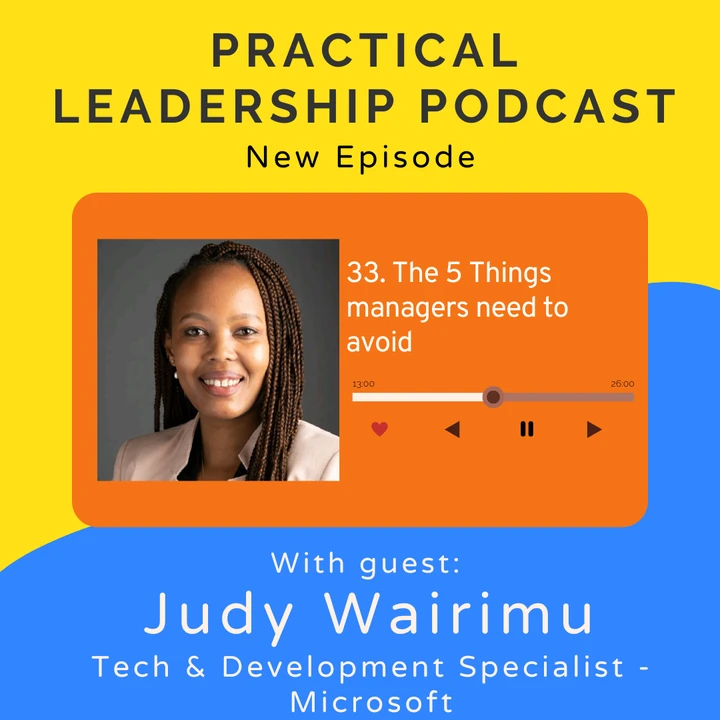
The 5 things managers need to avoid
with Judy Wairimu
Show notes
Brain-crush alert!
Riffing and role playing with her father on his work challenges, and the product of many mentors – Judy Wairimu has a clear list of five big things managers need to avoid:
1) Over emphasising your own goals – aim to empower others and build their trust instead
2) Have the courage to avoid protecting your own image – ask when you don’t know
3) Don’t turn competitors into enemies – assume positive intent and look for a 3rd dimension to a challenge
4) Include others in your introspection – bring advisors into your context to help you
5) Don’t wait for permission to become a leader.
I have to admit it. I have an enormous brain-crush on Judy Wairimu.
Since Camiel Gielkens kindly introduced us, she’s been and continues to be inspirational.
You can find Judy here: https://www.linkedin.com/in/wairimug/
Transcript
Automated transcript. Speaker labels and spellings may contain errors.
Paul
[upbeat music] Hello, and welcome to the Practical Leadership Podcast, where I interview great leaders and try to extract their wisdom and experience for you to learn from and hopefully avoid making their mistakes. Check out practical-leadership.academy because you want to help your new managers succeed with hybrid or remote working. [upbeat music] Judy Wairimu, thank you so much indeed for joining me today. I mean, we were talking previously, you, you, you come out with basically this litany of wisdom you shared with me when we spoke last time. You, you're talking about overcoming barriers to excellence, empowering the goals of other people as part of that journey, being able to and knowing how to ask
other people for support and advice on your journey, and even asking them to hold you accountable to keep you going.
Judy Wairimu
Yeah.
Paul
Can you share a little bit of your journey to achieving this wisdom? Where did you get to? Where have you come from? What's going on?
Judy Wairimu
Yeah. So first of all, thank you very much, Paul, for inviting me. I think these are absolutely exciting conversations to have that, um, sometimes we don't stop to reflect, but it's always good to, to, to hear this, this thought process and, and kind of share across for different people what they've experienced. Um, I'd say, um, when it comes to leadership, for me, I, I look at it straight from how I grew up, and I like to, to say that I'm a product of the individuals that have worked hard to get me to where I am. I've had very influential people, um, in my life, starting from my, my parents, specifically my father, who has taken a lot of time to coach and mentor me, um, not necessarily on per se certain jobs, but more on, um, ethics,
aspects on leadership, aspects on, um, how to influence and some of the challenges that you'd face. He would literally come to me with his, uh, challenges at work, and we would role-play. You know, we would actually role-play different situations that, uh, could emerge from that. So... And I've had multiple mentors in my life who have given me an inlet into their leadership style and their experiences, and I've gotten to learn a lot. So a lot of what I've gone through has, has actually come from input from different individuals, and I'm very, very thankful for that. And so-
Paul
Sorry, Judy. I, I, I never do this. I have to apologize. I'm interrupting you-
Judy Wairimu
Yeah
Paul
... 'cause I need to ask you, how old were you when your dad was role-playing with you? 'Cause I've got a young daughter as well.
Judy Wairimu
Yeah. Yeah.
Paul
How old were you?
Judy Wairimu
10 years old.
Paul
10?
Judy Wairimu
10 years old. 10 years old. We would play office, we would play, uh, it... For me, it just sounded like a game, but, you know, when, when I, I do retrospect a lot of these things, and I do discuss with my dad about this, and he'll tell me, "Yeah, I was having a hard time at work. You know, I was trying to determine if I'm going to, to leave my job because I didn't have a supportive manager, and so I was trying to find out different perspectives." So, um, I don't think we need to look at it so much in the sense of the intricates of the job, but it's the aspects of the human relations and the interpersonal connections that are so important to learn from an early age because they're tools that you evolve with and that you build and, and finesse, um, as you go on.
Paul
That's fabulous. 10 years old.
Judy Wairimu
[laughs] Make it fun. [laughs] Make it fun.
Paul
Well, it is-
Judy Wairimu
You definitely can.
Paul
No, that, that, that's magnificent. Sorry, I interrupted you in full flow there. It was magnificent, but I really just-
Judy Wairimu
Yeah
Paul
... wanted to know. I mean, 'cause I, I can imagine, I... You've, you've inspired me there. I can imagine actually having or trying to have these conversations with my kids, and I, I'm doing all of the stuff that I do with a view to trying to help, you know-
Judy Wairimu
Yeah
Paul
... help, help the planet upskill and be ready for my two when eventually they come into the world of work, right?
Judy Wairimu
Yes.
Paul
Um, but I've never actually thought of, of, of doing something with them now.
Judy Wairimu
Give it a try, Paul. Give it a try. You'll be surprised how much they actually can simplify problems for you. They can put some things in very interesting context, you know. [laughs] Try it. Try it. [laughs]
Paul
Fantastic.
Judy Wairimu
Yeah.
Paul
So you're the product of many mentors, I think, wow.
Judy Wairimu
Yes.
Paul
And many opportunities.
Judy Wairimu
Yes. Yes. I'm the product of many mentors, and what I can say, um, and from our last discussion, I, I do seek out to read different aspects that kind of help me to reflect on, on my areas, and specifically, the five areas that, that I have seen and I've tried to apply. So we talked about last time, um, the idea of overemphasizing personal goals and how as a leader you need to get to a point where you are actually empowering others to achieve their goals in order for you to achieve yours. And it is not to say that you do not have, you know, uh, financial aspirations, you do not have certain ambitions. Those are very clear. But if you are so shielded by, by, by, or so jaded by the idea of how your personal goals need to come to life, then you cannot be able to see
how actually you can bring them up by bringing other people with you or helping other people along the way in order to be able to achieve your goals. So this has been very important for me, uh, especially very early when I, when I started leading teams because I would have some teams who were not even direct reportees to me But I needed to get a certain task or activity done. So how do you influence individuals without having direct control over them, you know? So you had to start to align interests. You had to start to really lean in and listen and be willing to solve their problems. And when you solve their problems, you literally see the transformation where you can ask for anything and the people will follow you.
They will give it to you within the, the extent that they're able to. Um, and it creates as well a sense of loyalty. You start to build a network of people who are very loyal to you because they have worked with you and they can trust, not necessarily the quality of your work, it's not about that, but they can trust your word. That when you do say something, you will follow through. When you do say no, you mean no. When you do say you will look into it, you will look into it. When you do say that you will get back to us by a certain time, you do get back to us by a certain time. And those small things we might not consider that important for yourself or the other person is absolutely critical. So sometimes let's not overemphasize our personal goals. Let's lean in and let's find out what does the other person need to succeed.
Paul
So building trust by doing what you say you're going to do.
Judy Wairimu
Yeah. Yeah. And you know, funny enough, Paul, if you go to a bunch of middle school students and you, and you ask them this, this is very obvious, you know? Be like, yeah, it's, it's a very obvious thing. But it's not as practical when we actually come to applying it because we are so into our minds and into our worlds and what we want to achieve and what we must get, um, that sometimes, yeah, we just don't do it.
Paul
Marvelous. All right. You said five things. Number one-
Judy Wairimu
That's number one
Paul
... don't overemphasize your own goals.
Judy Wairimu
Yeah.
Paul
Deal with the others. Help other people. Empower other people to, to meet their goals and build trust-
Judy Wairimu
Yeah
Paul
... in the process. I love that. All right.
Judy Wairimu
Yeah.
Paul
Number two, come on.
Judy Wairimu
Number two, protecting your own image, your own public image too much. And I'm guilty of this one.
Paul
The ego, the ego. The ego is-
Judy Wairimu
Yeah.
Paul
Yeah.
Judy Wairimu
I'm, I'm guilty of this one. I remember my very-
Paul
You're isn't
Judy Wairimu
... first money, like, real manager meeting that I was invited to when I was new to my, to my company, and I was very excited, and I was green and had all kinds of ideas. And the organization, my, the, my organization tended to use a lot of acronyms of SPSSes, and then we're gonna ask DXPV to then do XY. You know? And everybody seems so sure of themselves that somehow we were all speaking the same language. And I couldn't ask a question because I felt like, I mean, everybody knows. Clearly, I'll be the only one that doesn't know, right? Um, only after the meeting to kind of do a debrief with one of my colleagues and say, "Okay, so what exactly are we doing?" And he wasn't clear either. [laughs] And then we all kind of looked foolish because-
Paul
Uh-huh
Judy Wairimu
... we were not quite clear exactly what was to be done after, right? And it's also sometimes this requires one person to ask to give courage to the others to do the same, and there's nothing wrong, you know? We, we think it's as bad, we, we think it's really crazy, but you know what? It's actually not as bad as we think. You just kind of have to make, um, sort of like muscle memory to just ask someone, "Okay, hold up. Pause. One step back. What does that mean? Explain to me a little bit more. Why do we do it the way [laughs] we do it? I don't understand," you know? Um, so that has taken a while for me to, for me to deal with. And I would say part of the reason, uh, I understand is, um, as well when you're coming in, um, on a cultural perspective, at least from my part of the world. So I, I operate across Africa and Middle East, and you will find that the status of women and women of color as
well might not necessarily, uh, in certain professional and technology landscape, might not necessarily be that well-respected. And so when you come in from this position, you are tired of having to always explain, uh, or justifying why you are in the room. And therefore, there is a certain fear that if you do ask a question, then it's, it's perhaps predispose people to think that you don't know and you shouldn't be in the room, you see. Um, I have had leaders who have been very conscious of this, and I don't know whether they've done it because they're aware or it's because they're just so- such natural leaders. But I have had leaders in the room who then will pose an- the question as if it is themselves who do not know because they do understand the environment
and the context of the individuals they have. And I aspire to be a, to be a leader like that, whereby I'm so in tune to the individuals that I have in my team that I know possible areas that I can preempt. And so I've had managers who say, "Please explain to us that a little bit more." Or, "I've noticed that, Judy, you've been a bit quiet on this topic. We really wanna hear what your thoughts are here." Right? So I love when leaders are able to do that, and I aspire to be a leader who can be able to actually create that forum, um, of inclusivity for, for the people in the room who I know might be in a position where they cannot speak out.
Paul
It's, it is, it's, it's the inclusit- the inclusivity side of diversity. We are all caught up in the demographic side of diversity, whether you're male, female, Black, white, whatever. And, uh, fine. Okay, that's a thing. It's the contents. It's your background, your experience, that, and your knowledge. That's the thing, and bringing that out Making that, in-including that or including the lack of that-
Judy Wairimu
Yeah
Paul
... into the conversation. If you're-
Judy Wairimu
Yeah
Paul
... if you're there, part of this team, and you don't have that knowledge that we all assume, that in itself is valuable. It's telling us that we're speaking gibberish jargon. It's not clear. It's not simple as it should be.
Judy Wairimu
Yeah. Yeah.
Paul
It takes a great deal of courage, though. Doing that-
Judy Wairimu
It does
Paul
... not protecting your ego takes a great deal of courage. Being the one who says, "I, I, I don't know. What, what is an accrual exactly?" You know? Uh, whatever it is.
Judy Wairimu
It definitely d- does take a, a lot of courage. And, um, I, I sometimes also go back to elements about how we reflect about ourselves. Um, some people will bring spirituality into it. You definitely can. Um, it's about that self-reflection and that, uh, self-interrogation as well, where you get to a point where you realize that you can never know everything, and that you can never control everything, and that it is okay. And therefore, your role as an individual is to be able to immerse yourself and expose yourself and connect with individuals who can be able to give you that extra mile. So it's, it's really a psychological aspect. Of course, there are social aspects to it as well, uh, as you rightly mentioned, on inclusivity and other areas that come into play. Um, but on a very personal level, it's, it's getting to the point where I, I am okay without knowing everything.
Um, and I am okay relying on others. And that has been a journey itself. It is not, it is not something that I can tell you that you understand and you get it by tomorrow. I mean, I de- depending on the different context, I have to catch myself sometimes trying to, to falling into that particular, um, issue. So-
Paul
Yeah
Judy Wairimu
... it's a journey.
Paul
It's, um, in part, what is it? It's the serenity prayer, I think it's called. Uh, God, grant me the serenity to accept the things I cannot change, the courage to change the things I can-
Judy Wairimu
Things that I can
Paul
... and the wisdom to know the difference.
Judy Wairimu
To know the difference. Yes.
Paul
That's it. And the wisdom to know the difference.
Judy Wairimu
That's what it is.
Paul
I like that.
Judy Wairimu
Yeah. So there's a lot, there's a lot, um, um, I understand. I have f- I have a much better appreciation as to why spirituality becomes very, very important, um, in someone's life. I understand why.
Paul
It's, I mean, I, I, I think a lot of, um, most faiths, th- the, the core of most faiths is self-knowledge. It's self-knowledge-
Judy Wairimu
Absolutely
Paul
... self-understanding. Because you can't, you can't-
Judy Wairimu
Absolutely
Paul
... experience the, the might of the spirit of whatever your choice is-
Judy Wairimu
Yeah
Paul
... without actually having a first clue of who you are and what you're all about.
Judy Wairimu
Yeah.
Paul
So it's a self-reflection is the first step to the journey of.
Judy Wairimu
Exactly.
Paul
Yeah.
Judy Wairimu
The third thing is-
Paul
Third thing
Judy Wairimu
... yeah, the third thing that I've, I've had to, to also reflect on was, um, not turning my competitors into enemies, you know?
Paul
Mm-hmm.
Judy Wairimu
Because, um... And you know, competitors can be in so many different ways. It can be the-
Paul
Yeah
Judy Wairimu
... the classical competitor in terms of a corporate setting and your counterpart in another corporate. You know, it could be that, or it could be just somebody in your team who challenges you and pushes you, right? Um, and we tend, again, because of the self-preservation, we can tend to interpret, um, a challenge as a threat, and therefore miss out on the opportunity to connect and to lean in, um, to the people. Um, and it's also a very two-dimensional way of looking at situations, you know? Because we, we want to know, is it a threat? Is it a friend? It's, it's, it's, it's too absolute. Yet we do know that there are many nuances or there are many areas, there are many things that can fall in the gray area of how you interact with competitors or perceived competitors at sea. Um, and so sometimes, um, I, I have taken the time whereby when I do meet
someone within my, my network who, w- I, I would say pushes me or at least seems to compete with me, um, I first look at my mindset of, can I presume they wish me well? Let's start there. I walk into a room and presume that people want me to succeed. They wish me well, and they want me to succeed. So I, I want to come in with a mindset of positivity, first of all. And then I want to understand. I want to understand, what is this person really saying? Because you could be completely wrong yourself. You could be completely off base. This person might actually be sharing very good insights that could be put in place, but because we are so in love with our ideas or we are so far along in a certain project, we're not able to listen. Um, it, it, uh, you know, we're in a fearful situation. We're fearing, uh, losing our jobs or looking silly, you know? So this two-dimensional aspect of, of looking at competitors, I think, um, really clouds the judgment.
Um, and so, yeah, positive mindset, lean in. What is this person really saying? And then which leads to, uh, my fourth point is involving other people in your retrospection. Because you don't wanna do some of these things alone. Because sometimes you can hear what your competitor is saying, but you're not able to properly interpret it because for whatever reason. I don't know, because you're in, you're in fear of losing your job or something Um, but you're doing this self-reflection alone. You're having this conversation alone only. And I would really guard against that. I'd say bring people you trust into these conversations. Um, I started something interesting that I, I, uh, someone recommended is I hold a dinner, I cook a nice meal, and then I, I invite some of my friends, some of my workmates, people
I trust, together, and the idea is I share what it is that I'm struggling with, right? Without sharing too much, you know, if any personal details, but just share what am I struggling with. I have this situation at work. I'm not able to inspire people. Productivity levels have dropped. Um, I'm not able to speak to this other department. We're not in sync. Uh, it's, it's giving me a heartache, and I, I'm, I just don't know how else to do. I'm being criticized in this way or that way. What do you think? And so you get this diverse feedback, uh, from individuals who are even outside of your context, who can then, you know, give you a more independent view of what, of what they think can be done.
So I'd say, yeah, so don't turn competitors into enemies, and, uh, don't walk this journey alone.
Paul
I love, I love you said bring people. You cook them a nice meal. Bring people into your context for advice. There's a lovely word, um, when you think about the word company, and in the company of somebody, you have companions, and the root of it comes from with bread, com-pan.
Judy Wairimu
Yes.
Paul
And it's people that we break bread with and share meals with.
Judy Wairimu
Oh, God. I'm definitely using that, Paul.
Paul
Yeah.
Judy Wairimu
I'm using that one for my next event.
Paul
Companion.
Judy Wairimu
That's like-
Paul
Companion
Judy Wairimu
... com-pan. Yeah.
Paul
So let's eat together. I love it. It's my favorite thing to do with the people I work with-
Judy Wairimu
Okay
Paul
... and my friends, you know?
Judy Wairimu
Yeah.
Paul
I, I used to say that you didn't have to like the people you worked with, um, but you did have to love them, and you have to cherish them and take care of them and be responsible for them.
Judy Wairimu
Yes.
Paul
But actually, the older I get, no, I want to like, I want to break bread with the people I work with.
Judy Wairimu
Yeah.
Paul
It's too short.
Judy Wairimu
That's very true. [laughs]
Paul
Companion.
Judy Wairimu
And, and you know what? It's actually not as bad as we think.
Paul
No.
Judy Wairimu
You know, we, there's a perception, we think, "Oh, you know, I spend too much time with them already. I don't wanna get it all that." I mean, fine, yeah, you could say that, but there could be one or two people there that you could actually get a bit closer, you know? Um, but I, I, I've seen the power of meals work. Food, food works.
Paul
For interviews as well, it's great.
Judy Wairimu
[laughs]
Paul
You want, if you're not sure about somebody, or well, you, you are sure, but you wouldn't do it. Yeah, if you're sure about somebody, but you want to be really sure, you go for dinner with them and see how they behave.
Judy Wairimu
Yeah.
Paul
Do they have good table manners? Not good?
Judy Wairimu
Yeah.
Paul
No? No. Then they're not coming. Sorry. [laughs] You don't use that knife like that, you're gone.
Judy Wairimu
You're gone. [laughs]
Paul
Uh-
Judy Wairimu
The food works, food works, and it removes the formality, and it, it, uh, allows people to a bit more, be a little bit more vulnerable and share a little bit. Yeah.
Paul
Yeah.
Judy Wairimu
The last piece, which I must say I am still working on-
Paul
Mm
Judy Wairimu
... um, is waiting for permission, and this, and let me ex- and, and let me explain what I mean here.
Paul
Yeah.
Judy Wairimu
So, you know, when you, when you're a leader, you, you have the power that you have within the position that you, that you're in. Um, but even more importantly is the influence that you can command without that position. Um, and many people tend to think that this aspect of influence is predominantly tied to a title, and tied, and therefore subsequently, the higher you move in your corporate or the more established you become in your, in your specialist area and more recognized you are, then you think that then you have more influence. So you might have power, but not necessarily more influence. And differentiating the two has been quite difficult for me because sometimes I would, um, I would feel like I have no authority to request
and to ask for certain changes in certain ways that we, we run our business because I would feel I'm interfering too much in that person's other docket. Despite, of course, understanding as a professional that my role and what I have been hired to do is to be able to advance a certain, um, certain, uh, criterias or certain KPIs that I must meet in a certain way. Um, but I realized you can get much more from the influence than the power itself, and I've seen people in my team very successful in doing that, and you do not necessarily have to have the authority, the formal authority weight. So we tend to, you know, patience is a good thing, you know? It, it's good to keep your head low and, you know, get in the grants and work hard and do that. It's, it's fantastic. Do it. But if you do it for too long, expecting someone to pat you on the shoulder, expecting for someone to recognize your effort, sometimes it doesn't come like that.
You have to influence people around you, and you must, you must be able to get them on your side in a manner that you're not using your apparent power. Because once you use power, you lose it, right? Really, if you think about it, once you use your power, once you have to use your power, you lose your power because then people notice, and people see that you are only able to move this because you are the boss. But I want you to move this, and I want you to do things not because only I'm the boss, but because you understand the vision and you see what is in it for yourself in this vision. And therefore, you will walk this journey with me no matter how difficult it gets. And this is a philosophy even outside the corporate, in family, you know?
Um, yeah, and I, I don't know about you, Paul, but in my family, it's, we're a big family. It's a huge extended family, and we have all kinds of issues to deal with. [laughs]
Paul
What family doesn't?
Judy Wairimu
[laughs] We're very many. And, um, and sometimes you'll find that we, we, we, we have a, an approach of where the oldest person or whoever has the, the apparent authority gets to say much. But where I have seen some of the most influential people are the ones who can be able to just speak, you know, give ideas, lead from the front, yet they're just a random guy at the side, you know? But people listen, and they listen because they trust you, and they trust you because you have a track record. So instead of, you know, sitting back a little bit, especially for, I'd say, young managers or people who are, who are just getting into mid their career, um, I'd say, uh, take, take some serious time considering
within your, within your workplace or within your, your, your structures, how can you, how can you lead? How can you influence without waiting to be given some kind of permission or authority to do it?
Paul
I love that. The real power comes from that, th- that what you've got from other people. Other people can grant you that power. Yes, of course, you have the delegated authority.
Judy Wairimu
Yeah.
Paul
Yes, you have titles and all that, but as you said, it's, it's ... I think the power to effect change comes from the trust-
Judy Wairimu
Yeah
Paul
... you have with people, your track re- record, as you said, is a good way of doing it. Um, it- do you think this, this idea of influence as well, especially in, uh, uh, professional life, do you think that's, it can be a boy/girl thing? 'Cause you know there's good s- there's some good reporting and statistics on job applications, and your average man will apply for a job that he's maybe, like, 5% qualified for, but your average woman apparently wants to be 95% qualified.
Judy Wairimu
Yeah.
Paul
So that's, that's almost this you're not ... You're, you're waiting for permission. You're waiting for the pat on the back.
Judy Wairimu
Yeah.
Paul
You're waiting for somebody to come and say, "Yes, you are ready for this. Yes, you should do this."
Judy Wairimu
Yeah. Yeah.
Paul
There isn't, you know-
Judy Wairimu
It, it, it's true. It's true. And, um, and, uh, it is the social aspects of, or the rea- the social realities, um, that, that we face. And, um, and there's small things we can do. For example, I, I do see nowadays, uh, some job descriptions will write there at the bottom and say, and put the statistics of the number of women and men who apply and then it will say, "We particularly encourage-
Paul
Yeah
Judy Wairimu
... [laughs] women to apply for this role." Some of them will go to that extent of writing that, you know, to, "In case you were thinking you are not good enough, you better try," right? Uh-
Paul
I, I like that, and that's not, that's not-
Judy Wairimu
Yeah
Paul
... um, what do you call it? What's the, what's the negative thing? It's, like, the, it's like the positive discrimination. I don't like-
Judy Wairimu
Mm-hmm
Paul
... saying, "Oh, we're only going to have, uh, uh, women applying for this." And you say, "Well, no."
Judy Wairimu
Mm.
Paul
You want the best people applying for this.
Judy Wairimu
You want the best people.
Paul
There's no reason that you can't say, "And you might be one of the best ones, so-
Judy Wairimu
And you might be one of them
Paul
... give it a go."
Judy Wairimu
Yep. Put the statistics there then, and then say-
Paul
Yeah
Judy Wairimu
... you know, "Some people are thinking they can't do this 'cause they ... You, you, if you think you can't do this because you don't meet 100% of, of the requirements, we would encourage you to-
Paul
Yeah. Exactly
Judy Wairimu
... still apply," you know? So I've seen some people do that. And, um, you know, [laughs] it's, it's, it's actually a very tough one because, um, you'll find as well, uh, when we talk about putting women in boards, you know-
Paul
Mm
Judy Wairimu
... and, uh, there are different studies that have been shown, you know, you put one woman in a board and productivity, productivity drops. Uh, you, then you put a second woman in the, in the same board, and then pro- productivity still doesn't improve, but you have to put a third woman for you to ac- start to see the impact of, of, of that, and then you see productivity and profitability actually rise, and you ask yourself why. I think there definitely are clear social issues that, that we have. Um, the good thing is that many organizations today are aware. The problem is perhaps they are, they're not aware what to do about it. Um, I think there's a lot of trial and error the different organizations are, have put in place. Uh, personally, um, what I try to do is spend a bit more time and a bit more emphasis, um, trying to seek out individuals who I know, or at least I, I know within our
area might, might not necessarily not be included. And so I will try personally to do a bit of coaching there. Within my teams, um, I will set challenges. I will say, "You know what? We've got a special project here. It's coming up, and, uh, I'd like you to take it up, you know? And, um, and I'd like you to, to take the lead. Like, just this other, this is what's available. Try it out." I think it's, it's constant reinforcement that has to be done. Just a bit of encouragement, um, and it starts from a very young age, um, and we consistently do this until we start to see some changes. In- incremental, incremental changes.
Paul
Mm. Kaizen, 1% better every day.
Judy Wairimu
1% better.
Paul
Oh, wonderful. What are you working on at present?
Judy Wairimu
So right now, so I'm part of a team called Tech for Social Impact at Microsoft, and, uh, we are a very interesting team across the world, but I cover the Africa region. And we are, we basically tackle the hardest problems that we have in our region to do with social impact, and how can technology be used to help this. So one of the key things that we're trying to do right now is we are doing massive, massive technical skilling for, um, individuals within the Africa continent. Uh, because we want to be able to build capacity, but at the same time, we want to build relevant skills or re- or context-specific skills that, uh, people can be able to build a livelihood out on. And, um, it, it is actually a very interesting journey because you find that it's not enough to say that the content is there and it's free, but you have to think a step further.
How do you access this? You know, you find that the inequalities we have is that folks don't have devices, don't have laptops, don't have mobile phones, you know? Or if you have a mobile phone, it's not a smartphone, or if you have a smartphone, you can't a- you can't afford the cost of data. Or if you can afford the cost of data, there's no connectivity in your area. So you find the aspect, this aspect of saying we want to build skills among people tells you that we need to take a s- a, a couple steps closer to the people to realize the pains and the journeys that they go through. And so things that you can presume are easy to do are actually much more systemic. So, um, that's what I'm working on right now. How do we skill, um... how do we build, uh, very strong technical skills for African youth, um, for the future?
Uh, it's very exciting and rewarding. Um, and I think, um, these are the engagements that I think as more corporates and individuals get into, um, not only have a social impact, but also have an economic impact because then you have more skilled people who can then create forms of employment and entrepreneurship that then be able to create economic activities for a wider range of individuals. So that's, in short, um, what's happening right now.
Paul
Mm. And harnessing the innovation of, uh, an entire continent.
Judy Wairimu
Yep. Yep.
Paul
Yeah. Mm-hmm. What are you reading? What are you reading or listening to? Podcasts or...?
Judy Wairimu
Yes. Uh, I'm actually reading, uh, a book, uh, suggested, uh, by Camille. Uh, uh-
Paul
Mm.
Judy Wairimu
Uh, C- Camille, your friend.
Paul
Yes.
Judy Wairimu
Um, and it's called, uh, Rationality [laughs] by Steven Pinker.
Paul
Ah.
Judy Wairimu
Rationality-
Paul
Steven Pinker. Yeah, okay
Judy Wairimu
... What It Is, Why It Seems Scarce, and Why It Matters. You know, we're in such an age where information is so easily available, and, uh, there is so much, um, so much happening at the same time, you can never quite know what's true and what isn't. And it's kind of some form of... there's a little bit of madness I'd say, you know, because we, w- we are pushed with so much information, it's so hard to discern what is where, and you don't know what is, you know, you don't know w- where, what stands where. And I, what I particularly like about this book is because, um, it starts to remind us, uses a lot of numbers, statistics to try and show us that the world is in a better place than where we were.
However, of course, there are certain, there are certain things that we have to deal with, such as climate change, but then it starts to make you understand the psychology as to why there is such inactivity or inaction from people despite knowing these issues are a problem. Um, and it makes you really question how you reason out your, your problems or how you reason out your issues where you are. Um, so I love this book. It's, I'm st- I'm still at the beginning stages, but it raises a lot of questions about why do we think the way we do? What is this dissonance in our minds?
Paul
Rationality.
Judy Wairimu
So-
Paul
I like that
Judy Wairimu
... Rationality and Why It Matters.
Paul
Good. What would you like to thank the young Judy for doing?
Judy Wairimu
Ooh. Ooh. Lots of things. The young Judy was full of such big dreams and ambitions. Sometimes I wish I could go into that idealistic Judy back in the days because I had, um, so much excitement about the future and the positivity on it, and it, and it really drove my confidence to know that, you know what? I'm destined for something, so for something good, something big. You know, I always had that, that perception. And of course, with life, you know, you can get a bit jaded and reality sinks in and, you know, you start to see, you know, the, the, the realness of the world and a little bit of that idealism is shed away. Um, but I would then challenge the newer Judy or the older Judy to remember why, uh, she was so excited and to remember why she was so idealistic to begin with, right?
Not to lose that, because I think, uh, in general, in our quest to, to, as we be- as we're old and we're experienced, we, we tend to be too, too bogged up, you know? Um, too pessimistic sometimes. And so I would challenge the, the older Judy and many other Judys, um, to, you know, go back to a little bit idealistic. It's good, you know? Let's, let's dream of something better. We can always do that.
Paul
That's marvelous.
Judy Wairimu
[laughs]
Paul
Bring the idealism back. And then lastly, as we wrap up, Judy, what are your coordinates? Where can people find you?
Judy Wairimu
Yes. Um, so you can definitely chat to me on LinkedIn. It's probably the best place. I have an Instagram account, but I use it mostly for shopping, so I don't think you'll get much-
Paul
[laughs]
Judy Wairimu
... of a response from me there. Um, but you can definitely find me on LinkedIn. I don't know my LinkedIn offhead. I would need to check.
Paul
Well, we'll find it, and I'll put it into the notes in the podcast.
Judy Wairimu
And then you can put it there.
Paul
Yeah.
Judy Wairimu
But that's probably the best place to reach me. Send me a message. Um, I'd love to hear, uh, what your journey is or has been as a young manager or how you are trying to navigate that aspect of your life as well. Um, and I'm happy to chat.
Paul
Judy Wairimu, thank you very much indeed for joining me.
Judy Wairimu
Thank you so much, Paul. This was actually a lot of fun. I really enjoyed myself. Thank you for the opportunity. [upbeat music]
Paul
That's a wrap. Thank you for joining me today. Your homework is to leave your five-star review and please, any comments you have. You really help me to improve every day, and it also helps people to discover me online. You should check out practical-leadership.academy because you want to help your new managers succeed with hybrid or remote working. [upbeat music]