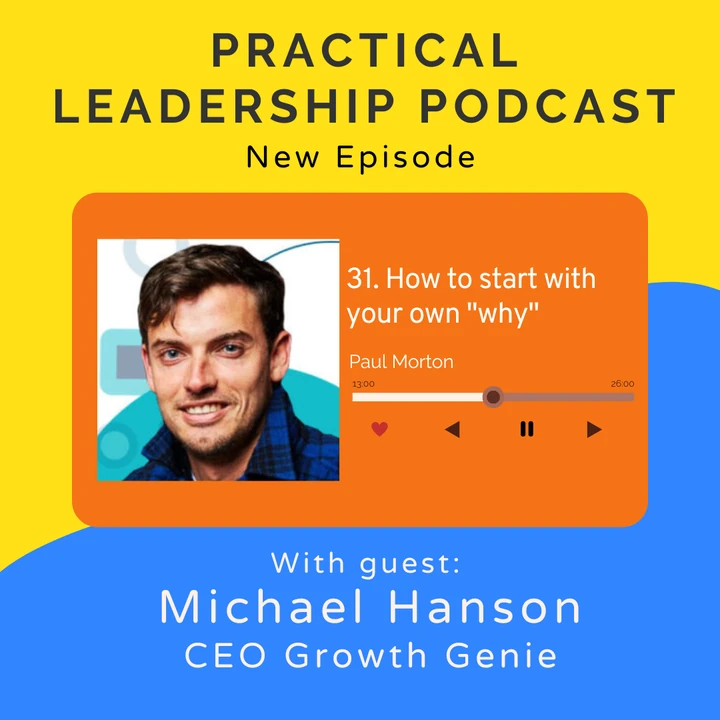
How to start with your own why
with Michael Hanson
Show notes
Michael Hanson’s dad taught him to “just do it”.
He thinks we need to start with our own purpose before helping others find theirs.
Through a distinctive and varied career so far, covering four countries and teaching, being a talent scout, political consultant and now successful entrepreneur, Michael says Humility was his best and hardest lesson.
Socrates’ wisdom “I know that I know nothing” together with avoiding making assumptions about people drive him and his business.
Find Michael here:
Transcript
Automated transcript. Speaker labels and spellings may contain errors.
Paul
[upbeat music] Hello, and welcome to the Practical Leadership Podcast, where I interview great leaders and try to extract their wisdom and experience for you to learn from, and hopefully avoid making their mistakes. Check out practical-leadership.academy because you want to help your new managers succeed with hybrid or remote working. [upbeat music] Michael Hanson, thank you very much indeed for joining me. You've been a teacher, a talent scout, an A&R man, right, political consultant, sales guy, and now serial entrepreneur. That's a, a fairly involved and varied career, and you've done it in what, five, five different countries? Is that about right?
Michael Hanson
Uh, I'm trying to count the countries. Yeah, four or five. I can't... I can't-
Paul
Four or five
Michael Hanson
... remember how many now. My memory's not very good, unfortunately. That's... [laughs]
Paul
Well, with that, that amount of experience in there, I can, I can understand why. What point in that illustrious career, varied, illustrious career did you first have to start managing other people?
Michael Hanson
Yeah, I think it was, um, about, I think it was 2014, so what is that? About eight, eight years ago.
Paul
Mm-hmm.
Michael Hanson
Um, I was, uh, an account manager, um, leading a, a small team. It's actually my first, I think, role in kind of like tech, uh, software. Um, and then it w- I guess it was also one of my first times, 'cause I think there's two sides to leadership, right? You've got managing an internal team, which I was doing a small team of a couple of people, but then it was also, like, managing accounts, right? And I actually think the best m- like, client managers or account managers, they challenge their clients as well. Um, so I think that was... And I worked with, uh, the old head of sales, 'cause we would kind of work on, like, renewals, upsales together as well, and she taught me, she was like, "Look, you've got knowledge that the client doesn't have." And actually, the most rubbish phrase in business is, like, the customer is always right.
The customer often doesn't know what they need, right, and you do, so you need to, like, challenge and, and that was a good, good learning experience for me, is often, like, the tougher conversations need to be had from, like, a leadership perspective. Um.
Paul
I mean, that's where you earn your money, isn't it? I mean, the, the, the difficult conversations, that's where we all actually, when, when, when the rubber hits the road and we, we, we truly earn our shillings. And the customers-
Michael Hanson
Yeah
Paul
... I mean, in the sales side here, the customers are experts, but they're experts on their problems.
Michael Hanson
Yeah.
Paul
They're not experts on how to fix them. That's why they're talking to you.
Michael Hanson
Yeah.
Paul
But how do you s-
Michael Hanson
Yeah, 100%
Paul
... how do you see the, the, the idea of, of managing people or leading the people and leading your customers? Where, where's the overlap?
Michael Hanson
Yeah. Well, I guess we were quite a small company, so I was doing both. You know, you've often got, um, you know, bigger companies who may have a sales director, head of sales, whatever it is, and they're more just focused with the internal team, and then the, the individual practitioners are the ones actually, like, speaking to customers, et cetera. Um, I was kind of wearing multiple hats, so a lot of the, as you said, I've had v- various different roles I've done in my career. Um, and a lot of those have been at startups, right, so I've had to wear, like, multiple hats. So, um, yeah, it can be a bit tricky, and I think it's just about organizing your day and saying, "Hey, this is the time I'm gonna speak with my internal team, and this is the time I'm gonna
speak with my customers," so.
Paul
Mm-hmm. You called it a practitioner there. I love that. Yeah.
Michael Hanson
Yeah. That's more like if it, if it's, uh, a sa- like just a... I'd say just a salesperson, I think being a salesperson's a very difficult job. But if they're 100% dedicated just to selling, we call that a, an individual practitioner. And we see often, 'cause we target, we sell to, like, heads of sales, chief revenue officers.
Paul
Yeah.
Michael Hanson
Sometimes a, a VP of sales is actually [laughs] just really a, a salesperson with a fancy job title. And I've been that in the past. I've been a VP of sales and I've just been selling. Um, so yeah, we see that a lot.
Paul
But it's, but it, there's... I don't know, maybe I'm digging something where there isn't actually gold to be found. But the fact that you call a practitioner means that there is a practice, which means that it's something you get better at. Which is, there's, there's more to it than just... I mean, 'cause it's, I think the, another term is an individual contributor, right? The IC or something.
Michael Hanson
Yeah. Yeah.
Paul
The, the practitioner means there's a practice, there's, there's... It's a profession. It's a, there's, there's depth to it.
Michael Hanson
Yeah, 100, 100%. I, it's like anything, right? And I think that's why often athletes make good salespeople, is because they're just-
Paul
Mm.
Michael Hanson
Um, athletes are used to, like, training really hard, and it's the same with sales. You're not just gonna one day, like, pick up a phone or get on a sales call and smash it. It's like a process of, one, getting coached and, like, asking for feedback, and two, just the more you do it, the better you'll get. And even I look at, you know, not even five, six years ago, things I was doing, like, two, three years ago, they make me cringe, right? So yeah, it's a constant process of evolution, and I think, you know, we work with hundreds of sales people now at my company, and I find the, the ones that don't perform the best are the ones that have a big ego 'cause they think, "Oh, I know everything," right?
And they're, they're not gonna evolve and they're gonna get left behind. Um.
Paul
Yeah. The best ones I've ever found, and I managed lots of sales teams, the best sales people I ever found were the ones who were desperately hungry for feedback and coaching and development.
Michael Hanson
Yeah. Agreed.
Paul
The ones that really wanted to grow. And I, I, I don't think it's... I, I think it's something that very easily translates to, to o- o- other people and other successful people as well, as people who really want to develop themselves or they see that they're on a journey. Not particularly one with, uh, goals or targets, but it's about the journey that they want to improve. And again, that goes back to the sales thing. I mean, sales is absolutely a target-driven, uh-
Michael Hanson
Yeah
Paul
... practice, profession. But if you get hung up on trying to hit a number, uh, it rapidly comes up and bites you in the backside.
Michael Hanson
Yeah
Paul
... I think it's more the practice, the, the, the journey, the, the things, the processes, the things that you do every day that compound. I think-
Michael Hanson
There's that qu- there's that quote, isn't there, "Life is a journey, not a destination."
Paul
Mm-hmm.
Michael Hanson
Um, and sales, sales is a great example of that, right? So it's like people that like playing the game versus like hitting their targets, they're the ones that often do the best.
Paul
That's a finite or infinite games, isn't it? So if it's a finite game-
Michael Hanson
Yeah
Paul
... it's got, it's got, uh, an end. The infinite game, that's the one we all wanna be on, on.
Michael Hanson
Exactly, yeah.
Paul
Yeah. So people on this journey then, and like you, um, 2014, you stepped into a role where you had to ... You were suddenly responsible for other people's, uh, outcomes, uh, other people's, uh, work, and in some way you were responsible for them. What advice would you give to somebody in a similar situation?
Michael Hanson
Yeah. I think, um, I think definitely humility is, is something. And a- and again, it's one of those weird things that you don't wanna say you're humble 'cause that almost makes you less humble, right? [laughs] But I would like to-
Paul
Humble brag, isn't it? It's the humble brag
Michael Hanson
... yeah, humble brag. I would like to think I've got-
Paul
I'm so humble, me. I can-
Michael Hanson
Yeah. [laughs]
Paul
Nothing-
Michael Hanson
But for- forget comparing to anyone else, just comparing myself to, you know, 2014, so I would've been twen- 25 then. So I'm 33 now. So looking back at that, I would say, looking back on my younger self, I think I thought I knew a lot of things that I didn't really. And there's that quote, I think it's by Socrates, like, "The wise man is the one who knows nothing," or thinks he knows nothing. And it's, it's going back to that, and I think sometimes maybe as a manager or even with clients, I would think I knew the answers to things 'cause they worked well in the past, but every situation, every person is different. And then I also think we make that mistake as managers is everyone is a different personality, and you can't just replicate the things that work for you for other people. So you need to, like, go into what are their strengths, what are their weaknesses, what do they need to work on.
So I think that was definitely a learning curve for me as a manager.
Paul
Uh-huh. So you find ... You've ... So humility and focusing on the other.
Michael Hanson
Yeah, exactly. Yeah, and just not thinking ... I, I think as, and sales is a great example of this, right? There's so many examples of, like, incredible salespeople, account executives, whatever they're called at their companies, who, like, smash it. They're closing millions. And then the, the CEO or VP of sales or whoever it is says, "Oh, obviously we're gonna promote them. Let's give them a promotion and they can manage people." But the thing is, is actually they're good at sales, but they're not good at people management. And they get frustrated 'cause they're like, "Why can't he do what I did last year?" Like, "Why can't she do this?" It's, it's really annoying, but they're lacking that empathy, which is like everyone's gonna sell in a slightly different way,
right?
Paul
Everyone's gonna do everything in a slightly different way, aren't they?
Michael Hanson
Exactly, yeah.
Paul
And, and then the sales, I suppose like any situation, there's always ... There has been. I think we're becoming a bit better at it generally speaking. It's typically always been the, the best coder or the number one salesperson or the highest achiever who gets ripped mercilessly out of their performance zone and shoved into having to look after other people, and all of a sudden they stop performing. And the company itself has lost the output of that top performer because they're now flapping about trying to look other, look, look after other people, not recognizing that their job is in fact not to do that, n- not to do the job, but to get the job done.
Michael Hanson
Yeah.
Paul
Yeah.
Michael Hanson
100%. Yeah, it's a good point. I never really thought about it outside of sales as well. I guess I've thought about it with, like, football managers, right?
Paul
Mm.
Michael Hanson
Like often ... There are a lot of ... Nowadays there are a lot of footballers who are good managers, right? But they're former footballers, but then there's also a lot of ex-footballers who are terrible managers, and even there's a lot of football managers like, I don't know, José Mourinho, who never, like, really played the game, right?
Paul
Mm.
Michael Hanson
So like that, football is quite a good example of that as well.
Paul
I think any performance sport, I mean, uh, and, and sales in particular is a performance profession. You are, you are. You have to perform. Um, I, I, I think that, uh, if you take that high performer, you need to find a high performer who has, as you said, and empathy, who has humility, who has, again, as you said, the ability to look at the other as an individual and not expect that, "Well, I'm a data-driven person, so therefore success in this role means that you too must be a data-driven prefer- person." Whereas maybe for somebody else it's about building relationships, it's about something else. And knowing not only is everybody unique, but knowing how to get the best out of them, and actually not even knowing, but burning for it, being, having a desire to do it.
Because so many-
Michael Hanson
Yeah
Paul
... folk think that the next step is management, and it just, it isn't.
Michael Hanson
Yeah. That ... It's a good point as well. What, so one of our clients, um, she's a sales director. She ... Who's managing, well, sales and marketing. She's managing, she's leading a team of maybe, like, 30 people, right? It's a very fast-growing tech company, so probably quite stressful. And then her husband is, uh, like an enterprise salesperson. And I, I often say this, which is he earns a lot more than her because he's getting huge commission, right? Closing enterprise deals. She's managing a load of people, has more stress. But for him it's more like he likes that internal competition against himself, like a lot of salespeople, whereas she loves that human aspect of developing people, right? And that's often, I think, we look at sales managers and they're like, "Oh, they're on big salaries, they're just interested in money." But actually, often they're not because they're like, "I wanna develop younger
salespeople and help them, like, succeed in their career." Those are gonna be the best sales managers, so.
Paul
Yeah. It's that desire to coach, to see, to see the best in other people. Okay. What would you then give as, uh, how to... What should, would be your first aid advice? So you n- you said somebody needs to be humble, you know, and not watch them here, and not quite, uh, here I am. H- how humble am I looking today? Uh, hello. Well, like really humble in that T-shirt. Um, uh, so you need to be humble, you need to have empathy, you need to see the other person. How? How do you go and do that? Where do you start?
Michael Hanson
Yeah, so one of the things we go into a lot is, like, the why or what we call, like, the higher purpose. So, uh, people like Simon Sinek who talk about this a lot, but... And really if you're doing this well, you should do this in the interview process to, like, qualify people out of the job who aren't a good fit. But there's really two questions that we, we look for. Again, these should be asked in the interview, but you can ask later as well, which we have to do as consultants, which is why did you decide to work for this company specifically? So why is the company's mission and vision aligned to you? And then two is, like, why do you work in sales, right? And we get them to write all these things down, and then they can print them or, like, have them on their computer. And then if you, if you're having a tough day, you're hungover, you've had a fight with your partner, like something bad's happened in your personal life and you don't really wanna work, you're kind of going back to that
why, and that's, that's really driving you. So that's something I'd really recommend having those conversations with people because you really get to know them on like a deeper level and, and what's driving them. 'Cause sales is, or whatever profession you're doing, it's just a, a job to serve your, like, wider life, right? People that are addicted to their jobs and workaholics, and I've been like that in my life before, they haven't really got a fulfilling life. So you've always got to see, like, what's the bigger picture for, for all of these people. And I think as soon as I started doing that, I had much more, like, meaningful relationships with people that I was managing.
Paul
So you understand a bit more about their why.
Michael Hanson
Yeah.
Paul
I suppose you actually have to start yourself, don't you?
Michael Hanson
Yeah, that's a great point because, um, when I started doing this, um, people started asking me, "Oh, what's your why?" And I hadn't clearly defined it. So what I had to do is do that and then kind of give that as an example before I asked them because, you know, like with sales, everything's storytelling. So if you can tell your own story, then suddenly they're thinking about that as well. Um.
Paul
That's a nice sell. Start with why, but start with your own why before you get to their why.
Michael Hanson
Yeah, exactly.
Paul
Purpose. Purpose, purpose-driven organizations, purpose-driven people.
Michael Hanson
Yeah.
Paul
There was, um, what is it? Uh, Daniel Pink, uh, Drive, I think his book is. Uh, it's the surprising truth about things that motivates. He talks about purpose, mastery, and autonomy as being the three big things that, that, uh, motivate people. And there's the big P-
Michael Hanson
Of course
Paul
... big capital P for purpose, changing the world, doing the big thing. And the small P, which is the thing that actually gets you out of bed in the morning, that purpose, that reason you're doing something. So you've got to-
Michael Hanson
Yeah
Paul
... you know, I wanna, I wanna sell, do, deliver, whatever it is you're doing.
Michael Hanson
Yeah.
Paul
But then you also wanna pay the mortgage. You also wanna work with your friends. You wanna, you wanna have a, a good time and not let people down. That sort of-
Michael Hanson
Yeah
Paul
... mm.
Michael Hanson
Yeah. I like that, breaking it down into little chunks as well. Um.
Paul
Yeah. Was there a particular mistake or an event that led you to learn a lot?
Michael Hanson
Yeah, I mean, I've, I've had, I've definitely had loads with sales. Um, like loads of stupid things I've done. Uh, I think, um, I think I've had them with management as well. I think one of the biggest mistakes I, I see with myself and I see with other people is assumptions. So I think we often make assumptions about people. So again, and this goes back to when you're managing people, you expect them to behave in the same way you do, and we're all unique individuals. So making an assumption that something that was okay for you is okay for someone else is not always the case. And even, you know, nowadays, um, we've kind of got, I think, call it like Gen Z people coming into the market. So I don't see myself as that old. I'm, I'm 33, but you know, we've got 21, 22, 23-year-olds who are maybe their first job outside of university, and they kind of like take feedback in a different way to... I think it used to be more of like a direct, um, culture.
So you've always got to look at, like, different personalities. Um, so yeah, I think making assumptions about the way people will, like, behave or act, that's definitely, um... Yeah, I think I've, like, offended people or, like, upset people because I've tried to manage in a way that I expect to be managed versus managing in a way that they want to be managed.
Paul
Yeah. Well, that's, that's the golden rule, isn't it? It's, um, it's in, I think it's in the Gospels. It's in Mark and Luke and all over the place. It's, uh, "Do unto others as you would have them do unto you." And we always misinterpret it.
Michael Hanson
Yeah.
Paul
I think we're just not wise enough to actually understand what it really means. We think that it means that we should treat people the way that we want to be treated. And if you listen-
Michael Hanson
Yeah
Paul
... it's, "Do unto others as you would have them do unto you," it really means do to the other person the thing that they want to have done to them.
Michael Hanson
Yeah.
Paul
Not treat them the way that you want to be treated. It's to recognize that they want to be treated the way that they want to be treated, and do that. And like, going back to one of your first points, it's understanding that folk are different. We're just different.
Michael Hanson
Yeah.
Paul
Different strokes for different folks, isn't it? So-
Michael Hanson
Yeah
Paul
... yeah. I like that. That's, that's, that's a big learning point, I think, is not assuming that everybody's just like you are. It comes, it goes, goes to your, your recruitment piece as well. Um, I, I often found it very hard not to hire people just like me, and I don't necessarily mean, uh, you know, white, six foot one, middle-aged Scotsman. I mean, um, oh, early middle-aged. Yeah. Uh, I mean people that think- Like me, I had a, a very diverse team, but at one point I was thinking, "Oh, golly gosh, you're all thinking just like I do. That's no damn use." You gotta find people on different sides of opinion, different, different-
Michael Hanson
Yeah
Paul
... background, different-
Michael Hanson
For sure.
Paul
We get hung up on the demographic too easy. Okay.
Michael Hanson
Yeah.
Paul
What, what are you working on at, at, at the moment then, Michael? Growth thing.
Michael Hanson
Yeah, so yeah, so I run a sales consultancy called Growth Genie. Um, I set it up three and a half years ago. Uh, basically before that I worked for a, a sales agency, so people would outsource sales services to my last company. I was the head of sales and marketing there, grew it from like 10 to 200 people, and the, the problem I saw in the market is if you're a kind of decision-maker in B2B nowadays, you're getting spammed at an unprecedented level, where you're getting like hundreds of emails a week, and it's becoming more difficult to kind of stand out from everyone else. So that's really what we're... Our mission statement is, is like empowering, uh, B2B sales teams to have better conversations and stand out, uh, in the crowd. Um, so we focus on training and coaching sales people, and then also the, the messaging, uh, that they're gonna use.
So that's, that's one thing, and then I know we're on a podcast today. Literally, uh, last week I just launched my own podcast called The Cosmic Bridge, which is, um, around kind of topics we were talking about earlier around, like higher purpose. Like, I live in London and I see a lot of my friends do things that they hate, but they're getting like a good salary for it, and to me that's always been like kind of mad to, you know, sell your soul for, for money essentially. So it's all around how can we balance, you know, our spirit and then our like material world. So that's the idea of The Cosmic Bridge, how do we balance these two things together. So I've been, I have been interviewing some, like sales and marketing people like us about what are the, how do they inspire their spirit outside of work, but then we've also got people like, um, like breathwork coaches and like shamans and things coming on, so it's gonna be a bit of a diverse crowd that are gonna come
on the podcast.
Paul
Oh, fantastic. Um, there's the, the wonderful concept of, of alpha states, um, that I use quite a lot. It's, um, uh, what's it called? Jose Silva. The Silva method, it's called, or the idea of you can control your own, uh, flow. You can get into flow quite quickly and manage to control that. It's one, it's one that I use a lot. So interesting, really interesting concept.
Michael Hanson
Awesome.
Paul
I really look forward to that. Cosmic Bridge. Uh, so click here and subscribe, ladies and gentlemen. Yeah, definitely.
Michael Hanson
Yeah.
Paul
Good stuff.
Michael Hanson
Search for the, search for The Cosmic Bridge podcast. It's on all the, uh, the, the podcast channels.
Paul
Excellent. What are you reading or listening to, if you like your, your audiobooks?
Michael Hanson
Yeah, so, um, I guess r- uh, some people who saw this concept of The Cosmic Bridge, some of them are like, "Oh yeah, it's typical of Michael." Others would've been like, "Well, I didn't know this side of him," because 90% of what I post on LinkedIn is like B2B sales and marketing tips. Um, but actually when it's come to... I've read a couple of sales books in my time, but I kind of felt like when I got to a certain level, I was learning more off like speaking to people like you or like listening to podcasts versus reading a book that hap- like was written four years ago that may not be of value. So what I actually found was really useful was reading books about psychology and like philosophy, and I found that was in- that was influencing my sales career much more than like reading sales books. Um, so, uh, yeah, there's a couple of books I recommend.
One is funny enough called The Cosmic Game, which is by a, a psychiatrist called Stanislav Grof. Um, and then a guy I'm into in general is called Carl Jung, so he's like an old psychologist who many people would have heard of, and probably the best book to read of his is The Archetypes and the Collective Unconscious. Um, and essentially he's a psychologist that talks around these archetypes that are basically in every single story that really has ever become famous, whether it's like the Bible or The Lion King or Harry Potter. And there's different, uh, people within these stories that are kind of eternal, and what's quite interesting is he's got this concept called the shadow, which is basically instead of always blaming someone else for problems in our life, is like looking internally at our own shadow and thinking, "Okay, what have I done to create this, this situation?" So I really like that, uh, that concept.
Paul
I love that. The Jungian archetypes are superb. Yeah, really, really fascinating, and the, and the recurrency you have in most literature. You mentioned you don't like reading the s- the sales books that are four years old and are out of date and stuff. I mean, I went back, and one of the reasons I'm, I'm doing this podcast is I, I really enjoy the whole idea of management and leadership as a practice that you can get better at, which is why I picked up on this, the word practitioner you used at the beginning. And, um, I went back when I was looking at building out my own management, uh, course. I went back to things that were at least in print for 50 years. So if something's been around since 1936, like Dale Carnegie's How to Win Friends and Influence People-
Michael Hanson
Yeah
Paul
... it's still in print, and it's in print for a reason, you know? So, um, Peter Drucker, The Effective Executive from 1967, still in print and well used for a reason. But then you have some, I don't know what you would call it, bro literature, you know. Uh, how to twack around and, you know, piddle your way to success in five easy steps. I mean, really, some of that stuff is a year, two years old. It's so pop culture. It'll be out of date in another-
Michael Hanson
Yeah
Paul
... six months, and frankly, it could have been 140 characters in a tweet, the amount of nonsense that's filled up with some of the, some of the stuff that's out these days. Yeah. I wonder if-
Michael Hanson
No, I've read... Sorry, I was just gonna say, I read Dale Carnegie's book and I love it, and I think it's more of like, I see it more as a book of like how to communicate in general versus like a sales book, which is I think why it's great. And I think those are the sales books that are more impactful, that are looking at like the wider picture of how can we be better communicators as, as humans, and then like apply that to sales. And yeah, a lot of it is, um- You know, just being better listeners, um, being more curious, right? That's a lot of what Dale Carnegie talks about, which again, these are, this is why people say sales is like life 'cause they're just skills that help you in your everyday life as well.
Paul
It totally is. And it's, I don't think it's quite just being a better communicator to be a better human. For to be a salesperson, I think if you're a better human, you're a good salesperson.
Michael Hanson
Sorry.
Paul
I mean, as you said, I love that sales is like life. It totally is. It's one of those skills that we ... Apparently, we used to teach this in many, many moons ago. You know, you'd have your, you'd have your, uh, business studies class in the, the late '60s, and you'd get taught how to sell things. But, oh, no, it's a dirty profession. No.
Michael Hanson
Right.
Paul
[laughs] It's a dirty profession, but enterprise sales peoples are, are, are earning 400 grand a year. Aye, stick that in your pipe and smoke it.
Michael Hanson
Yeah.
Paul
There we go.
Michael Hanson
Yeah.
Paul
What would you like to thank young Michael for having done, or younger Michael?
Michael Hanson
Yeah. I, I think, um, and I never really thought about this till recently, and a couple of friends said it to me, and they ... I think it's the, that Nike, this isn't a promotion for Nike, but they've got that phrase, "Just do it," right? And I think I've always been like that. My, my dad was someone like that, so I'd have to thank him for kind of having that attitude. But there were things I did, like you mentioned, moving to different countries. So I, like, moved to Spain, I moved to Colombia. I just had a gut feeling it was the right thing to do. And I actually always did it for work. But some people mean like, "Oh, yeah, I'm not sure if I should do this. I should, like, stay in London, and it's, you know, it's less risky to do that." Um, and then even, like, the other day when I launched this podcast, the podcast is more ...
It's actually like a side project 'cause my business is doing very well. I'm just like, I'm gonna speak to someone interesting once a week and more of like a philos- philosophical topic and, and see what happens. I don't have any goal to, like, make money or get leads or anything from it. Um, and then a friend was like, "Oh, I love the way you just decide to do something and that's it." So I think it's like having that attitude of, like, just doing it, and I think people overthink things a lot. It's the same in sales, like thinking about the perfect pitch. And actually take sales as an example. If you just go out there and, like, make calls and speak to customers, you're gradually gonna learn about the way they think, and it's gonna get easier and easier. So I think just I'm thankful that I've always had that, you know, just-do-it attitude.
Paul
There you go. Lastly then, as we wrap up, Michael, how can people find you? What are your coordinates?
Michael Hanson
Yeah. Probably the easiest is, um, LinkedIn, so just research Michael Hanson, uh, Growth Genie. Uh, you'll be able to, to find me there. I post daily content. N- normally, as I said, it's about B2B sales, but there's some other things in there as well. And, uh, you're also welcome to go to our website. It's growthgenie.co. Uh, unfortunately I couldn't get the .com domain, which is why it's .co, but.
Paul
Oh, you just have to make another 100 million pound, and then you can buy it off of, I don't know-
Michael Hanson
Yeah [laughs]
Paul
... Procter & Gamble, who probably own it.
Michael Hanson
Yeah. Exactly.
Paul
That's the one. Michael Hanson, thank you very much indeed for joining me.
Michael Hanson
My pleasure, Paul.
Paul
That's a wrap. Thank you for joining me today. Your homework is to leave your five-star review and please any comments you have. You really help me to improve every day, and it also helps people to discover me online. You should check out practical-leadership.academy because you want to help your new managers succeed with hybrid or remote working. [outro music]