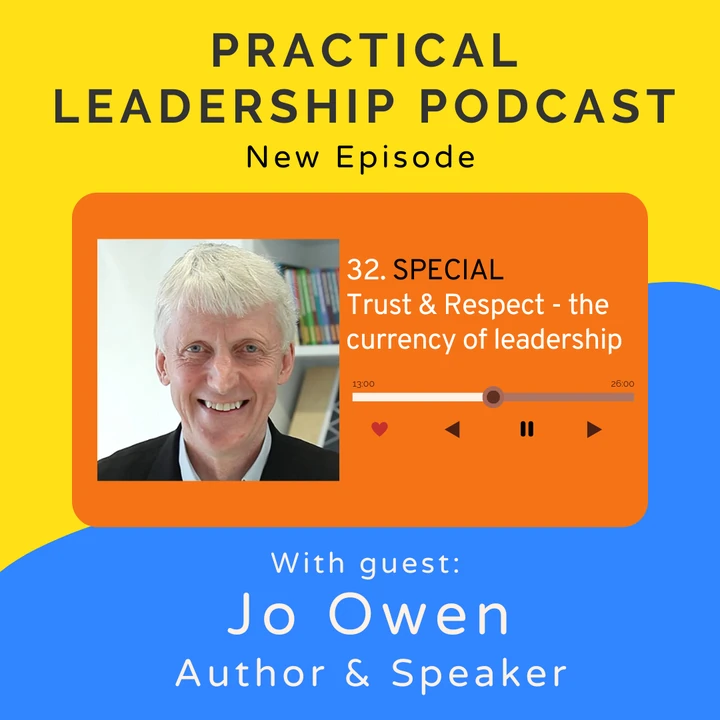
Special: Trust & Respect – The currency of leadership
with Jo Owen
Show notes
Join me in this remarkable 1 hour special episode with Jo Owen on a wide ranging conversation covering:
- The mindset of highly effective leaders: Elon Musk, ruthlessness and obsession – is it a bug or a feature?
- The Hybrid work revolution – Autonomy, Accountability, Ambiguity Seeking and following inspiration
- Having the ‘success’ conversation
Jo Owen has worked with over 100 of the best, and a couple of the worst, organisations on our planet.
He is a founder of eight NGOs which have a collective turnover of £100 million annually.
He led businesses in Japan, North America and Europe; he created a business bank; he was a partner at Accenture and is one of the founders of Teach First which is now the largest graduate recruiter in the UK.
His career highlights include:
- putting the blue speckle in Daz
- becoming the best nappy salesman in Birmingham
- getting sued for $12 billion (when a billion was worth something)
He also worked with tribes over fifteen years across the world to discover how they survive and succeed, and what businesses can learn from them.
Jo is the only person to winner the Chartered Management Institute gold award four times for his books.
He has written twenty books on leadership and management which run to over 100 global editions.
His titles include How to Lead, Global Teams, Tribal Business School and the Mindset of Success.
His latest book is out now “Smart Leadership”.
Find Jo here: https://amzn.to/3YjYafR
—————-
I will help you to improve the performance of your new managers: https://leadershipthatsells.com/
Transcript
Automated transcript. Speaker labels and spellings may contain errors.
Paul
[upbeat music] Hello, and welcome to the Practical Leadership Podcast, where I interview great leaders and try to extract their wisdom and experience for you to learn from and hopefully avoid making their mistakes. Check out practical-leadership.academy because you want to help your new managers succeed with hybrid or remote working. [upbeat music] Joe Owen, thank you very much indeed for joining me.
Jo Owen
Always a great pleasure to be with you.
Paul
So you've worked with, what, over 100 of the best, and you say sometimes a couple of the worst organizations on the planet. You have founded eight NGOs. Okay, one wasn't enough then. All right. Eight NGOs, uh, with a collective turnover of over 100 million pounds. One of these is ... One, one of the ones that's very dear to my heart is around the education effort. 600,000 teachers and over two million students in India. Uh, and that's, that's quite, quite impressive. You've been building and leading businesses in Japan, North America, Europe. Built a ... You built a bank. You're an Accenture partner. You were the man who put the blue speckle in Daz. Now, that is something. I hope you have that on a T-shirt. The best nappy-
Jo Owen
My career's been downhill ever since. I mean, that's it. [laughs]
Paul
[laughs] The best nappy salesman, diaper salesman in Birmingham. And-
Jo Owen
You're getting to the highlights
Paul
... uh, the, the highlights, career highlights here. And you were sued for 12 billion, with a B, pounds when a billion was worth something.
Jo Owen
You got it.
Paul
Oh my goodness. And I've got one of your books here, and I was just saying there, it's, it's a, it's a pain, I'm afraid. I'm annoyed having read, uh, Smart Work: The Ultimate Handbook for Remote and Hybrid Teams, 'cause now I want to read the other 19.
Jo Owen
I'll let you. That's fine. That's good.
Paul
[laughs] Tell me, g- give me some, uh, flavor of your journey. I mean, 22 years-
Jo Owen
So, look
Paul
... quite some time.
Jo Owen
I mean, s- some people have career, a noun, but for me, career has been a verb, where I career from triumph to disaster and back again with tedious regularity, and it is immense fun actually. Uh, although, a huge amount of effort and work. Um, and you have to learn the fine art of the hustle the whole time-
Paul
Mm-hmm
Jo Owen
... and you have to keep on learning and improving the whole time because otherwise you will be redundant. N- not as in someone firing you, but just the phone will never ring. And if you just, you know, enjoy that, enjoy that process of learning, enjoy that process of discovery, you won't have a career, you will career through life, and it will be absolutely brilliant. Except, of course, for the times when it's totally catastrophic. [laughs] But I mean, that simply makes the good times even better.
Paul
My goodness. How do you keep the energy up? I mean, there's you, obviously now you must be what, 32, 33 years old? Something like that, right? Um-
Jo Owen
Yeah, I'm probably having my, my third 21st birthday or something like that-
Paul
That's the one
Jo Owen
... third time around. [laughs]
Paul
This, this whole ... the, the, the hustle, right? So I've been out on my own for now for nearly three years, and loving every damn minute of it, frankly. I love the freedom. I also love the diversity. But the, the, the, the hustle. It's not hustle culture, you know, this bro nonsense, but just keeping on keeping on and being consistent. How'd you get your energy? Where do you get that from? What, what energizes you?
Jo Owen
So look, uh, actually it's one, one of the lessons of leadership, to be honest. If you have a clear goal about, "Yeah, this is what I really want to do, this is what I really want to achieve," if it's something that excites you, you will do whatever it takes to get there. I mean, if your ambition is to reduce the usage of paperclips in the office, that, that's fine. You know, that, that's good, and that's all right, but you're probably not gonna get terribly excited about it and probably nobody else is gonna get excited about it. But if you're kind of like anyone else, you go through life and suddenly ideas hit you. You're not looking for them. They just come and hit you. So let me give you an example. Um, after getting bought out of the bank by accident, I was kicking my heels in San Francisco listening to a radio station.
And it interrupted the good music, Doors, Dire Straits, that dates me, with a little piece about a brilliant project which got great graduates to teach in the inner city. I knew nothing about education, but I went, "That's a great idea." So I rang the radio station, said, "Give me the name of the project." Teach For America. So I rang, uh, Wendy Kopp, the chief executive of Teach For America. I've got a fruity British accent, so I got straight through to her. British accent does help sometimes. Um, and I said, "Look, Wendy, you've got to bring this over to the UK." She said, "No, I'm a bit busy." Talked to McKinsey 'cause they interviewed me about what to do about education in London. So I rang McKinsey and said, "Look, I know you're doing this project. I've got the answer." We sat down and, uh, coming out of that first cup of tea, we started Teach First, which is now the largest graduate recruiter in the UK, and I knew nothing about education, which was probably my advantage 'cause I wasn't stuck by the
orthodoxy of education. Okay? So those opportunities are everywhere, and I had no right to set that up. To, to set that up required a, a great team, a brilliant team, a brilliant partner in Bre- Brett Wood-Tawse. Okay? So that's lesson number one about leadership. You know, don't do it yourself. Don't be a hero. You know, build your alliance, build your team, get your partners. Um, yeah, you, you don't need to be the smartest people in ... person in the room.
Paul
Mm.
Jo Owen
A leader does not need to be the smartest person in the room. The leader needs to be-
Paul
It's a problem when they-
Jo Owen
... getting the smartest people into the room.
Paul
Yeah.
Jo Owen
Okay? That's your job. And, and once you have this idea that we're gonna... Yeah, we, we had this crazy idea. We're gonna transform education by getting the very best graduates to teach in the very toughest schools. Okay? Impossible. Absolutely impossible. But we said we're gonna do it because we know they can do it in America if they... If, you know, if those Americans can do it, we can certainly do it, all right?
Paul
Totally.
Jo Owen
Um, so it happened, and that's where the hustle came from. That was, that was hustle massively to make that happen. So once you have an idea that you really believe in, that you're really committed to, really enthusiastic about, you will find yourself quite naturally doing all the things that a leader needs to do. Of course you'll do all the, the hustle because you have to do the hustle. You will find yourself building your team because you have to build the team. You will find yourself having the difficult conversations. You will find yourself, um, not accepting no for an answer, ever. Uh, you will not accept excuses, and you will have those tough and difficult conversations. You will step up when other people step back.
You will be a natural leader. Why? Not because you're trying to be a leader, not because you've got the genetic disposition to be a leader, not because you've been through a leadership training course. You don't need to do those things. All you need to do is have a very clear idea about this is what I want to achieve, and it doesn't have to be, oh, I'm gonna set up Teach First or something like that, which is just crazy and bonkers. It can be something as simple as, look, I'm gonna make this, this team, this team, we're gonna be the best, I don't know, risk management operation in the United Kingdom. Okay? We're just gonna transform the way people think about risk. Brilliant. Okay? Go for it. So whatever it is, have that idea because
leadership is the art of taking people where they would not have got by themselves, right? That sounds boring.
Paul
It's a wonderful quote.
Jo Owen
So before you go to sleep, let's repeat that and we'll look at why that's revolutionary. Leadership is about the, the art of taking people where they would not have got by themselves. So that means leadership has nothing to do with your title. You can have a grand title such as president, prime minister, chief executive, but if you're not taking your team, your firm, your country where it would not have got by itselfs, by itself, you're not leading. You're simply managing a legacy, right? If on the other hand, you have a radical idea for how you are gonna change your team, you can be towards the bottom of the organization. You're leading. You are leading. So leadership is for everyone, and it is about what you do. It is not about your title.
Paul
Wonderful. There's an idea of abundance there as well, I think.
Jo Owen
Oh, oh, look, there are so many opportunities out there.
Paul
Oh, yeah.
Jo Owen
So look, I mean, I-
Paul
Slitting through the universe
Jo Owen
... I think I've hardly never had an idea for an NGO or a business. The ideas are just coming at you the whole time. Let me give you one simple story and example. So a good friend of mine was reading The Times and saw a letter in The Times, very old-fashioned and read it, and it was from the Saudi ambassador saying, you know, "Please stop giving us such a hard time about democracy and human rights because you, you Brits, you've had 1,000 years to work it. We've had about 20 years. So just be a little bit patient. Yeah, we're on a journey. We will get there, but, you know, hold your horses." Now, you read that and you go, "So what?" You know? Who cares? So my good friend wrote to the Saudi ambassador and said, "Well, that's really interesting.
You know, maybe we should do something about it." Next thing he knows, he's being invited to the embassy, so, uh, to have tea and to talk about what might be possible. Coming out of that, about a year later, he found himself at a, uh, uh, at a reception at the British Museum where he was starting the wonderfully named University of the Desert. Isn't that great? So it... The opportunities are there the whole time. They're sort of being chucked in our faces.
Paul
Yeah.
Jo Owen
And actually in the pub or over dinner, whatever it is, we all have these ideas about how we're gonna change the world, right? We all do. And of course, those idea- ideas die on first contact with reality, which is called the hangover the next morning. Okay? And we just forget about it. Don't forget about it. Why don't you be that stupid person like me who goes, "Well, actually this is a good idea, this thing I heard on the radio. Let's see if we can chase it down." Let's just make a phone call. Make a phone call, see what happens. And then when people don't say no, you'll say, "Oh, all right. I'll make another phone call." Then another one, then another, and suddenly you find yourself this thing snowballing, and like, you just go for it. So the opportunity's all there.
You don't need to be a genius. You don't ne- need to have an original idea. They're all there already. I'm sorry, I'm ranting, but I love it.
Paul
It's a bloody good rant, I tell you. If that's your ranting, I should read your books. Oh, no, wait. I do. There you go. [laughs] Well, you've, you've got these ideas, as you said, that, that they're in abundance. They're sleeting through the u- the universe, bouncing off our tinfoil craniums, and if we were for but one fleeting moment to ga- to grasp them and run with them, you know, that's how anybody does anything. Shin, you look at-
Jo Owen
So look, I mean, just find a problem. So, you know, one, one of my books is called Global Teams. Guess what that's about. Okay? So yeah, why did I write that? Because when I was given a one-way ticket to Japan- I had to figure out how to run a team, a global team. I had no idea. So I thought, "Fine, I'll read the book." And then I found that there are lots of professors writing very grand books about globalization, global strategy, the global firm, but none would write about the plumbing.
Paul
Mm.
Jo Owen
Of how do you manage a global team, because that's a bit practical and messy.
Paul
Yeah.
Jo Owen
And it just frustrated me, and I kept on looking for the book, and it never came out. So I thought, "Well, if no one else is gonna write it, I'll write it because there's a real need." And so, you know, it's, it's actually quite easy to write. You, you know, talk to lots of people and draw on your own experience, and there, there are little bits of research out there, and it all comes together. So again, it comes back to this thing of the ideas are always there. If something frustrates you and annoys you, that's an opportunity. So that's where the bank came from. I was so annoyed that banks were ripping off small and medium-sized enterprises with rubbish service and very high fees. Isn't that a great opportunity? Isn't that a brilliant opportunity? So all you have to do is offer slightly better service and slightly lower fees and a little bit of innovation, and off you go.
So every problem genuinely is an opportunity if you look at it the right way.
Paul
Mm-hmm. So abundance and then mindset.
Jo Owen
Mi- mindset is really important. Okay. So for 20 years I've been a complete anorak about leadership. I've looked at leadership through endless different lenses, you know, globally across different industries, small to large, different sectors. I've even, uh, over 20 years, spent 20 years, uh, hanging out with traditional societies around the world to see how they're led. You know, tribes from Mali to Mongolia, Papua New Guinea and beyond. Um, special forces, mountaineers. I've even been on board a nuclear deterrent-
Paul
Mm
Jo Owen
... to see how that's run, et cetera, et cetera. Um, so I try to take a very broad view. Now, and for the first 15 years it was like, well, I was trying to identify the skills for leader, because we can all learn the skills of leadership. That's the good news.
Paul
Yeah.
Jo Owen
Good news. We can all... Or like learning a piano, we may not get to play, you know, Rachmaninoff's Fourth at Carnegie Hall, but a little bit of practice makes us better than most people, right? Oh, and also, no leader gets ticks in all the boxes. That's the other-
Paul
Mm
Jo Owen
... incredibly reassuring thing. You do not need to be perfect. You just need a few signa- signature strengths that you play on, and then you compensate for your very modest weaknesses-
Paul
[laughs]
Jo Owen
... by building a team around you. Okay?
Paul
Mm-hmm.
Jo Owen
So if you hate accounting, love accountants.
Paul
Okay.
Jo Owen
Right? Because they'll do it for you. So skills are good, and they're important, but then I saw that quite often the very best leaders had dramatic flaws in terms of skills and in terms of humanity as well. So you go, well, there's actually something else going on, and that something else is very clearly mindset. They act differently because they think differently. Now, mindset sounds a bit fancy, um, because it sounds like we've got-
Paul
It's woolly. It's very woolly, very... Yeah.
Jo Owen
Yeah. So actually... And, and it sounds like you've got to have your brain rewired or something. It's all... You've, you've got to go Frank- all Frankenstein or something to succeed. Like, let's not go there. So m- mindset is actually shorthand for habits of mind, okay? We all have habits of mind, which by definition have been very helpful to us because that's how, how we've got to where we are. They're good habits of mind. Hold onto them. But just occasionally, our habits of mind hold us back. And what you... So, so what I observe is the very best leaders consistently display the same habits of mind. So, you know, this, this was several years research went into this. The best leaders, uh, exhibit the same habits of mind, and I identified seven plus one, seven positive ones and one from the dark side. Now, when I do this talk...
So people kind of listen to the seven positive mindsets, but they're not really interested. What they want to hear is what's the mindset from the dark side?
Paul
What's the dark side of-
Jo Owen
What's the mindset? Come on. What, what's the secret? What's the truth? And I once failed to get to the dark side, and there was a riot. [laughs] We, we, we weren't letting... It's like...
Paul
[laughs]
Jo Owen
So, um, so I'll cut, I'll cut through the seven positive ones, and I'll give you the, the dark side one. The dark side is ruthlessness.
Paul
Mm.
Jo Owen
Okay? Now, every leader I've talked to says, "No, no, I'm not ruthless." And then I get them to tell a few stories, and it's like, "Yes, you say you're not ruthless, but you are." Okay? I ask them, "Do you have a hard edge?" They say, "Oh, yes, all leaders need a hard edge." Hard edge, ruthless, okay? The stories are terrifying. Um, now that isn't about being some sort of crazed psychopath. It's not about being ruthless about everything all the time and being nasty to people. What it is about, it goes back to having this very clear idea, very clear mission. We are going to... We are going to climb that hill. No, we're not going to go paddling in the stream there. We're not going to go for a picnic over there.
We're going to climb that hill. Yes, and I know it's steep, and I know it's rocky, and I know it's icy. We're going to climb it, okay? No excuses. Um, and once you a- adopt that mindset, you then make... discover your, your, your hard edge. You will have the difficult conversations with people when you need to have them. You will make the difficult decisions. You will discover that popularity Is the high road to weakness and to failure because when you seek popularity, you will always compromise. You will always find a reason. Oh, yes, well, maybe that hill's a bit big, or maybe it's getting a bit dark, or maybe it's a bit... getting a bit cold, or maybe you can do it a bit later. There'll always be a, a reason why you shouldn't achieve your idea, and you will compromise.
So the, the currency of leadership is not popularity, it's trust and respect. Okay? If you can build your, your team and your alliances of trust, and respect, and support, then you will go far. That, that, that currency, trust and respect, massively amplifies your formal authority, which comes from your budget and your span of control. Your... In, in today's world of flat organizations, outsourced organizations, your span and control and your, your budget is simply your entry ticket to the leadership race. It is not enough, uh, for you to achieve what you need to, to achieve. You need to amplify your, your budget and span of control massively through influence, through influencing the broader organization and people beyond your organization.
You will only do that through building your alliances of trust and respect. So that's the flip side, ruthlessness. It isn't about being nasty to everyone all the time, because then you won't build your alliances of trust and respect. So it's a bit... Yeah, it's-
Paul
Mm
Jo Owen
... there's a bit of a balance there. But when push comes to shove, you will not compromise on your mission. And what you discover in all organizations is a couple of things. First of all, the survival of the organization takes precedent over the su- survival of the individual.
Paul
Yeah.
Jo Owen
You never forget that. And ultimately, survival of the mission, achieving the mission takes priority over the individual as well. So there are some kind of tough lessons in there that the best leaders do actually take to heart, but they will be ruthless in a sort of humane way if they can.
Paul
It's the decision-making capability, isn't it? So it's the decision-making based on vision, based on mission-
Jo Owen
Yeah
Paul
... and then doing what you say you're going to do.
Jo Owen
Yeah, so you picked up-
Paul
Actually saying what you... saying what you're going to do, doing it, and then having done it.
Jo Owen
So you picked up two critical points. Fi- first of all, decision-making. A lot of people find that very difficult.
Paul
Mm-hmm.
Jo Owen
But if you've got a very clear vision, then actually decisions become very easy. You just go, "Yeah, does this help me achieve the mission or not?" And if it's kind of unimportant, you just delegate it to somebody else. Okay? Kind of simple. Um, so, so clarity of purpose, clarity of vision, you know, what is the problem I'm trying to solve? Being really clear about that helps. Um, and, and then, yeah, bu- build that trust. Sorry, the second point, which I've now forgotten, but build the trust. You know-
Paul
Well, yeah. And how do you build trust? You build trust by saying what you're gonna do.
Jo Owen
Okay. So let, let... Okay, so let's fo- focus on how do you build trust.
Paul
Mm.
Jo Owen
So trust is a function of, of, uh, three or four things. Let's go through. Goal alignment is a lot easier to trust people who are, uh, fighting for the same goal as fi- opposed to fighting the same goal. And in an organization, that's difficult to achieve, because actually organizations are set up for conflict. Pause there. Organizations are set up for conflict, right? Different groups have different priorities. So that's where a lot of creativity is needed to square agendas and all of that kind of good stuff, right? One clue is to make sure that whatever you do is really well aligned with the agenda of the chief executive, because if you're doing that, you're probably on the right path. Okay? Number one. Number two, not... After goals alignment, social alignment.
We all find it a lot easier to trust people who are like ourselves. Okay? That's bad for diversity, incidentally. Um, but it's why a lot of firms talk about one firm firm. You can be any race, color, or creed as long as you all think the same way. Well, that's an interesting ver- view of diversity, isn't it? Okay? Um, but that seeking social alignment is important. Yeah, common experiences. We've been to the same conference.
Paul
Values. Yeah.
Jo Owen
Do this holidays, kids, whatever it is. Yeah. Similar music. I mean, you like Pink Floyd. Great. I happen to like Pink Floyd. Brilliant. Yeah. Maybe it's an acquired taste and it dates you, but whatever, right?
Paul
Mm.
Jo Owen
You find that little bit of social alignment. Second. Then third is credibility. Now, yeah, professionals will say, "Well, of course I do what I say." And probably they not only try to do what they say, they probably try to over-deliver on what they say. So actually the doing is never the problem with professionals. The problem with professionals is the saying, because when someone asks you to do something, you may well reply by saying something like, "Well, I'll look into it. I'll do my best. I'll see what's possible." Okay? You will then perhaps go out of your way to see what's possible and to look into it and all those good things, and then come back two weeks later and say, "Well, I, I looked into it, did my best, saw what's possible.
I'm sorry it's not on." Bang, all trust gone in an instant.
Paul
Mm.
Jo Owen
And at that point, you can have the whole I said, he... you said, he meant, they didn't, da, da, da discussion, and that just makes it worse. The problem was in the saying. You, you were saying things which like... which gave you let out clauses. I'll look into it, right? I'll do my best. I'll see what's possible. You weren't saying you'd do it. But of course, what was being heard is
Paul
He'll deliver on Tuesday
Jo Owen
Right. Exactly.
Paul
Okay.
Jo Owen
So what that says is, if you want to maintain credibility, have a difficult conversation about expectations at the start rather than an im- an impossible conversation about outcomes at the end. Be really... That the point to be tough is at the start-
Paul
Expectation. Mm-hmm
Jo Owen
... of that conversation. Expectations. Okay? So three elements of risk, goal alignment, social alignment, and credibility, which is saying what you can do. Focus on the saying what you can do, be really clear on that.
Paul
So you've got this, um, a- you built a framework that, uh, I, I've seen you using, RAMP. RAMP framework, relationships, autonomy-
Jo Owen
Let's, let-
Paul
... motivation, and process.
Jo Owen
Let's talk about that.
Paul
Yeah.
Jo Owen
So that, that came out of, here's a challenge, um, which was one of the NGOs, last one. Yeah. Uh, 600 million kids in school but not learning, UN challenge. Uh, everyone said, "The teacher's the problem." We said, "No, they're not the problem. There is no solution without the teacher, so the teachers are the solution." Okay? Get over it.
Paul
Mm-hmm.
Jo Owen
But the problem is they're disengaged, disenfranchised, demotivated, disempowered, so of course, they're not delivering. Okay? So how, how do you address tens of millions of demotivated teachers? Motivation at a system level, okay? We've been banging on about, uh, this for 11 years, and we now think it's... w- we found out how to make it work, and that's the RAMP model. The good news is that this is not about getting managers to be motivational and inspirational, because that does not work. Uh, my research shows-
Paul
Cheerleaders. I mean, my goodness, cheerleaders. We don't need any more cheerleaders.
Jo Owen
No. And it doesn't work. So in my research, I looked at this, 65% of bosses think they're good at motivation. Well, that's sort of okay. I then asked their followers-
Paul
[laughs]
Jo Owen
... how good are you, the boss, at motivation? Answer, 32%. Okay? So massive motivation gap, and frankly, yeah, it, it's just one more burden for managers-
Paul
Mm-hmm
Jo Owen
... to be motivational. Because I cannot tell you to be positive, motivated, or happy. I can't. Right? Being positive, motivated, or happy comes from within. So all the managers can do is cre- to create the conditions-
Paul
Mm-hmm
Jo Owen
... in which people will rediscover their intrinsic motivation, and that's the RAMP model. So if you want to get a motivated workforce at a system level or at a team level, put in these four conditions, right? One, R, supportive relationships which are supportive and positive, not command and control. Supportive and positive, both vertically and horizontally. So horizontally, not competitive and all beating each other up.
Paul
Yeah.
Jo Owen
Lots of things you can do to be... to do that, and that's not about trying to be popular. It's about being supportive, right? Making sure people get the right assignments, pushing them, et cetera, et cetera. Autonomy is the second one. R-A for autonomy, because professionals hate to be micromanaged.
Paul
Hmm.
Jo Owen
Right? Which is wonderful. So the way to manage professionals is to manage them less. Let them overachieve. Manage them less, lead them more. Okay? So, um, set the direction, set them up success, and make sure they've got the right time, resources, budget, et cetera, and then let go. Delegate properly. Trust them. Okay?
Paul
And that requires-
Jo Owen
And they will repay your trust by over-delivery.
Paul
That requires the R for relationship to be very strong so you can trust for autonomy.
Jo Owen
Thank you. Exactly. M, mastery. It's very hard to be motivated if you lack the skills for today's role, and you're not building skills for tomorrow's role. So create a culture of learning and help each of your team members learn and grow in role. Support them, mentor them, supportive relationships. Okay? Support them, mentor them, coach them. Don't give them the answers. Coach them to discover the answers instead, okay, for instance. And again, lots of things you can do on autonomy, lots of things you can do on mastery. Too long to do. The final one is often the most difficult, purpose. Yeah. People will go through hell and high water if they have a mission that they really believe in. You see that in the armed forces. You see it in religious groups. You see it in mountaineers. You see it, uh, uh, in all sorts of areas. Okay? Much harder if you're doing reconciliations in the finance function. You know, what's your sense of purpose?
So purpose really comes from three levels. One is the organization, you know, armed forces, religious groups, NGOs, some... and sometimes that's enough. Sometimes that's simply, uh, an excuse for very bad management. "Oh, you've got the purpose, so we don't need to manage you well." So that, that's a bit of a disaster. So, you know, that's one. Organization is one level. Uh, the, the bottom level is individual purpose.
Paul
Mm-hmm.
Jo Owen
That's the whole job crafting thing, where you discover purpose in what you do. Okay? There's a whole literature on that we can come back to. The most interesting level is in the middle, is from the leader. The leader of a team can often create a real sense of purpose in, in that team by creating a sense of mission for that team. You know, we are g- we are going to be the best reconciliations team this country has ever seen. We're going to change the way reconciliations is done forever. I don't, I don't... Whatever it is. Okay?
Paul
Yeah.
Jo Owen
But creating that sense of purpose and excitement within the team can be incredibly exciting. So purpose comes from three levels, organization, leader, and the individual Uh, and you kind of got to work, work all three levels if you really want to do it. So if you have a, have an organization or you have a team where there are supportive relationships, positive relationships, where the team has high autonomy and agency, where they've got the skills and they're building new skills, and they've got a real sense of purpose, the chances are it's gonna be a very motivated team. As long as you don't demotivate them [laughs] a little bit. And not only are they gonna be very motivated, they're gonna be performing well, and you're gonna find a lot of the mental health issues, which are now at epidemic levels nationally, are gonna melt away.
Most of them. Okay? Um, because w- when you're motivated, then a, a, a lot of that other stuff just disappears.
Paul
And you find ... You're, you're saying 11 years in, we think we've found this is a solution now for the, uh, hundreds of millions of demotivated teachers around the world.
Jo Owen
Yeah. So, so okay. So we're, we're currently doing this with about ... Uh, my ... We're up to the millions. Uh, tw- 20 million, uh, kids and about one or two million teachers. I'm sorry. I should have the numbers and endless officials, hundreds of thousands of officials, 'cause you've got to do it at system level. You can't just do just the teachers or just the kids or just the officials. Everyone in that system needs to be, uh, equally aligned because if you have just supportive relationships between two people and the rest of the organization is totally, uh, toxic-
Paul
Toxic. Yeah
Jo Owen
... you've got a problem. Okay? So i- i- it has to be at all levels. So it's taken us about 11 years to figure out how to do it at the system level, and we're now beginning to grow. We're only at 20 million kids. We're now beginning, beginning to grow at 20 million, and, uh, yeah, we, we want to get to six- 600 million as fast as possible, and of course, we're gonna learn more and more as we go. But the exciting thing is this is system level in motivation. It takes the burden off the individual manager to be motivational. They have to ... And it gives them a suite of very specific tools and techniques that they can just apply to create the conditions in which people rediscover their intrinsic motivation.
So it basically blows o- blows apart the whole motivation industry, which is all about being how do I motivate you? And that is fundamentally the wrong question, and it doesn't matter how good the answer is. The best answer to the wrong question is still wrong. And we're simply a- asking ... Instead of asking, "How do I motivate you?" Wrong question. We ask, "How, how can I get you to de- rediscover your intrinsic motivation?" That's a completely different question-
Paul
And a lot of it given
Jo Owen
... because you, you professionals are motivated. You simply have to help them rediscover it.
Paul
A lot of, a lot of this, I think, is just getting out of people's way.
Jo Owen
Yeah. Oh, oh, a huge ... Well, that's whole autonomy, Gig.
Paul
Yeah.
Jo Owen
Yeah.
Paul
Totally.
Jo Owen
Stop micromanaging, and that's why the hybrid work revolution is brilliant. The hybrid work revolution, everyone thinks it's about what's gonna happen to offices and the local coffee shop. Well, that's kind of marginally interesting.
Paul
Hmm.
Jo Owen
The real interest is that the hybrid work revolution is a revolution in leadership-
Paul
Totally
Jo Owen
... which is happening.
Paul
You have to be-
Jo Owen
What we've dis-
Paul
... a really good leader to actually manage in a hybrid environment.
Jo Owen
Yeah.
Paul
'Cause you can be lazy in the office.
Jo Owen
Well-
Paul
Totally
Jo Owen
... what we've discovered in the office is two things about, uh, uh, leadership in the office. One, the office is very forgiving of mediocre management.
Paul
Very.
Jo Owen
Okay? Because if you make a mistake in the office-
Paul
You think
Jo Owen
... you know about it in real time, and you can-
Paul
Hmm
Jo Owen
... manage it in real time, and it's fine. It's all very ad hoc. You make a mistake, you miscommunicate on a hybrid team-
Paul
Hmm
Jo Owen
... and-
Paul
It festers
Jo Owen
... it festers. It all blows up-
Paul
Oh
Jo Owen
... and it's a nightmare. Okay?
Paul
'Cause I'm sitting in my own head replaying the conversation that I did or didn't have-
Jo Owen
Yeah
Paul
... but I can't remember, but maybe I did. But that's the one, "Oh, my goodness, he hates me," or whatever, and somebody somewhere basically garbled the message.
Jo Owen
Exactly. And, and yeah, the small problem becomes a massive crisis-
Paul
Yeah
Jo Owen
... and is, i- so-
Paul
Unbelievable
Jo Owen
... so all leaders are now having to up their skills level.
Paul
Hmm.
Jo Owen
All, all the basic disciplines of goal setting, communication, delegation, you've simply got to be more purposeful and more deliberate about everything you do, and you've got to better at it, and that's wonderful news if hybrid work is forcing people to raise their skills levels. The second, uh, bit of the rev- hybrid, uh, work revolution, hybrid leadership revolution is that we've discovered that the office was a paradise for control freaks.
Paul
[laughs] Yes.
Jo Owen
Because they could-
Paul
Oh, yeah
Jo Owen
... walk across the office and interfere... I mean, sorry, help.
Paul
Help. Help.
Jo Owen
At will help.
Paul
Yeah.
Jo Owen
Not interfere. Right? In the hybrid world, you can't-
Paul
Hmm
Jo Owen
... interfere at will, and you don't even know what your team is doing. Y- you don't know if your team is actually practicing the banjo at home. You have to hope that they're doing the right thing and making the right decisions while, while you're not watching them. That is a nightmare for control freaks-
Paul
Yeah
Jo Owen
... because they're having to learn trust, to trust their team and to delegate properly to their team. Isn't that a wonderful-
Paul
Hmm
Jo Owen
... wonderful-
Paul
But, Joe-
Jo Owen
... revolution to have?
Paul
... I don't, I don't know if they're wearing their pajamas or not. I can't tell. I don't-
Jo Owen
Exactly.
Paul
[laughs]
Jo Owen
Exactly.
Paul
Ah. Well, it's the thing. It's, it's double standard.
Jo Owen
So if, if, if in a year's time, millions of people are, are playing the banjo really well, we'll know the hybrid-
Paul
They'll know
Jo Owen
... work revolution has gone [laughs] because-
Paul
[laughs] It's gone tits up. That's right. There's, there's, there's a two-sided bit there. It's autonomy and accountability, and you've ... Because we're all now suddenly highly autonomous-
Jo Owen
Yeah
Paul
... we have to be highly accountable.
Jo Owen
Exactly.
Paul
As a leader, I have to set and hold you strictly accountable, and as an individual contributor, I have to actually admit that I need to be held accountable, and I need to be accountable for my autonomy.
Jo Owen
Let, let, let, let's plumb that o- one out because that is, um, a really interesting side of, of, uh, the hybrid work revolution, end of the ramp model autonomy.
Paul
Hmm.
Jo Owen
So auto- increased autonomy goes with increased accountability. You cannot avoid it. Professionals Like the autonomy bit
Paul
Mm-hmm
Jo Owen
... they kind of get a bit antsy about the accountability bit because it's like, hang on, you're gonna start judging, uh, judging me? I don't really like that, you know? But-
Paul
It's outcome. You know, you gotta deliver some-
Jo Owen
Yeah, if, if, if you're auto- you've got auto- autonomy now, you're accountable for the outcomes. So how do you square off autonomy and accountability as a leader? There's a third A, ambiguity. A.
Paul
Oh, yeah. Mm.
Jo Owen
So professionals want autonomy, don't like accountability, but they even more dislike ambiguity. Because if my goals are ambiguous, suddenly I'm gonna be anxious about them, I'm gonna have to do lots of extra work to cover all the different options. I'm g- I'm gonna be going crazy. So as a leader, what you do is you have a conversation with them where you say, "Look, let's drive out all this ambiguity." This is what I call the success conversation, which actually both the team leader and the team member should want. It's like, how do we s- the key question is how do we set this up for success? How do we set this up for success? And you go through all the questions about, you know, budget, resources, timing, reporting, the what ifs, you know, what support do I need?
What are the obstacles gonna be? Where can it go wrong? What, how does this sit with my other priorities? But it's all about how do we ensure that this succeeds before we even start. And that isn't one conversation. That is not one conversation. What... Again, what we found in the office that it is a goal-setting conversation, what we find is that that happens in an ad hoc way, as a s- whole series of conversations. Okay? It's a kind of process of discovery 'cause you suddenly go, "Well, hang on, you said you wanted this, but does that really tie in with that priority over there? And how does that..." K-
Paul
Highly iterative, highly iterative.
Jo Owen
It is highly iterative.
Paul
Mm.
Jo Owen
So in the hybrid world, you have to, in a sense, recreate that journey of discovery. The mistake bosses make is they think that they can simply download the goal all in one conversation. You can't. You've got to keep on coming back to it and revisiting it. But the goal is how do I set this up for success? And actually, once both you and the team member have identified how to set it up for success, there are two possible outcomes actually. One is that as the boss you'll go, "Hang on, I'm now looking at what it's gonna take to make this succeed, and maybe I need to think about changing what we achieve and what we're, we're going for." Okay? That's one possible outcome. But if you both agree, yeah, that is the right goal, we now know how, how it's gonna work, and we've got it set up for success, you've got that accountability 100% ne- nailed 'cause now it's crystal clear.
Paul
Yeah.
Jo Owen
And actually both sides will be very comfortable with it.
Paul
Mm.
Jo Owen
You won't have to talk about, oh, well, you're now accountable. It's n- no, both sides go, "Right, I know, I know what we need to do. I know how, how it's gonna work. We're set up for success, let's just go for it."
Paul
Expectations set and met.
Jo Owen
Yeah, so have the success conversation.
Paul
Success conversation.
Jo Owen
And remember, accountabil-
Paul
Yeah
Jo Owen
... so it's autonomy, accountability, ambiguity.
Paul
Very nice. Very nice.
Jo Owen
Trilogy.
Paul
Just before we wrap up then, you wrote a lovely article a few days ago now, um, about Mr. Musk at Twitter, Tesla, SpaceX, et cetera. And I was wondering, 'cause there was some f- fabulous comments there, and I'll link to it in the, in the notes of this, of this episode. Is Musk, Mr. Musk, President Musk perhaps by now by the time you're listening to this, who knows? Um, is Musk [laughs] , is it a feature-
Jo Owen
President of Mars maybe by the time he gets there
Paul
... there we go. He's off to Mars. I don't know. Do you think... You know what? How could you resist if you owned the rocket ship that was going to Mars, how could you resist not ki- taking a seat on it? My goodness. He might have to lose some weight, but why not? Is, is it a feature or a bug, highly effective leadership? Is there a f- is it a feature or a bug being a bit of an ass, being hard work, being like that? You look at some of the greatest leaders out there, everything from the, the Welches to the Churchills to Trump to all these guys, and some of them are highly, highly effective, but you wouldn't want them dating your daughter. Feature or bug?
Jo Owen
Look, I, I, I, I think it's a, a, actually a feature, whi- which is difficult because when we talk about good leadership, people get very confused. They confuse two different things. They f- confuse good as in effective and good as in a wonderful human being.
Paul
Morally good.
Jo Owen
Moral good, kind good-
Paul
Mm
Jo Owen
... all that kind of good stuff. But what you find is that the very best leaders are, uh, w- well, some of them are just ambitious for themselves, but quite a lot of them are ambitious for a very clear mission, idea, whatever it is, and it goes back to the ruthlessness thing. They get totally obsessed about it, brutally obsessed, and they will not let anything stand in their way because they realize the mission comes... A- actually, it often comes before even their own personal lives. I mean, Mus- uh, uh, uh, you know, Musk's personal life is, you know, by repute-
Paul
Disaster
Jo Owen
... a little bit of a disaster.
Paul
Yeah.
Jo Owen
So, um, so he, he's even putting his own personal life, uh, behind the mission that he, he chooses, and I think all the best leaders that I've come up- come across, they, they can be charming and nice people, but they're not people I'd like to disappoint ever.
Paul
Yeah.
Jo Owen
Ever.
Paul
Wow.
Jo Owen
Yeah, they're sort of uncomfortable people to be with. So, look, I'd, I'd like, you know, great leaders to be not just effective but to be nice and wonderful and warm and cuddly people as well. Um, and I think in the foothills of leadership You, you will find people who can square the circle, right? You, you can be both effective and, and nice. But once it comes to the really big humongous missions-
Paul
Big beasts
Jo Owen
... the big beasts, then you find that, yes, there, there is a dark side. And, and just give you one story. I mean, a lot of people lionize Winston Churchill. Okay? Um, well, actually, he's interesting. He, he was a depressive and a drunk and had all, all sorts of other problems.
Paul
The dark dog-
Jo Owen
Um-
Paul
... or the black dog, yeah
Jo Owen
... oh, the, yeah, black dog days, dark dog days. Um, when, when the first batch of penicillin reached Egypt, the generals didn't know what to do about it. It was the miracle drug, but they didn't have much of it, and they had a choice. They could either, uh, use a small amount of penicillin on all the soldiers who'd been fooling around in the pleasure palaces of Cairo and Alexandria and get them back to the front, right? That, that's one, one option. Or option two is they could use a lot more penicillin on each of the sort of wounded war heroes, but knowing that it wouldn't always work and some of them would die anyway, and some of them would've survived anyway, so much more of a lottery in a sense.
So they cabled back to Churchill, you know, "What should we do?" And the advice came back instantly, "Use it for best military advantage." In other words-
Paul
Mm
Jo Owen
... give it to the soldiers who'd been fooling around, not to the wounded, wounded war heroes.
Paul
Yeah.
Jo Owen
Which is a kind of brutal, brutal decision-
Paul
Mm
Jo Owen
... and a lot of wounded people died as a result who sh- could probably have been saved. But he was very clear, "Actually, we have to win the war." That's the most im- yeah, everything else is secondary. We have to win the war. So it's kind of... Yeah, th- those are the sometimes the really gnarly... Now, and we- people can debate, was it the right decision? Was it the wrong decision? I le- leave that to people to debate. All I'm saying is that when you... A- all leaders will face some very, very difficult decisions from time to time, and you have to face up to them.
Paul
Mm.
Jo Owen
And, and the best leaders often will be the ones who, who will make the difficult and uncomfortable and controversial decision, because that is how the mission will be achieved.
Paul
You look back at many of these decisions, I mean, that one in particular, for example, we can talk about that until the end of time. Is it... Do, do the ends justify the means, or do they not, and what's the circumstance, and all that sort of stuff. But we look at it, and we make judgments about it from the outside with the benefits of hindsight, with the, "Oh, well, yeah, he was a terrible person. She did this. He did that. I would've done differently." And, and, and a lot of the time, you don't know. If you were in there in the moment, I would hope you would... I would have the moral courage to make what was the big difficult decisions, 'cause they're just men and women like us. You know, they put their trousers on the same way.
Jo Owen
E- exactly, and I think w- we've touched on it. It's one of the great mistakes we all make, uh, as managers and as human beings. When we look at, uh, pe- leaders, sometimes our own bosses, um, we're very quick to judge them. You know, that boss is a good bos- boss because she's nice to me. That boss is a terrible boss because he's nasty to me. Okay?
Paul
Mm.
Jo Owen
So we judge them. Or that, that boss is terrible because he's just, you know, nasty person or whatever, right? Stop judging. Just stop judging, 'cause you're not gonna learn anything.
Paul
Mm.
Jo Owen
I, I've worked with some horrible bosses who I've, I've really loathed. But then you have to ask, "Well, how come he or she is the boss, and I'm not?" Right? Maybe they are doing something which works. Learn from it. So step one, stop judging. Start understanding. Understand what is their success formula. You may not want to copy it, because it may be a toxic one, but there will be some things where you can learn positively, even from the, the worst bosses. So start understanding. Start learning, and that's the road to progress. If you simply go in for judgment straightaway-
Paul
You're done
Jo Owen
... that's very nice. Yeah, over the c- water cooler you can all commiserate with yourself or whatever. That's great-
Paul
Mm
Jo Owen
... but you're not actually progressing.
Paul
Mm. It's, it's-
Jo Owen
So understand first, judge later
Paul
... it's like organizational cancel culture, you know? Oh, I, I, I can't, I can't possibly even ask questions about that because it's not even the thing I... It, it's not right. So I, I'm judging about it before I have the beginning of understanding.
Jo Owen
Exactly. So fir- first understand, and actually, you know, w- when you understand, th- then you... Yeah. Again, it is just interesting that Churchill case. What, what would you really do? Um, what would you do? I mean, it's a-
Paul
Well, number one thing you would really do is hope you wouldn't, didn't have to be in the position to, to make the decision.
Jo Owen
Yeah.
Paul
Yeah.
Jo Owen
Be- because you're deciding on people's lives and deaths.
Paul
Right.
Jo Owen
Right there.
Paul
You are.
Jo Owen
Right there.
Paul
Mm-hmm.
Jo Owen
Right.
Paul
My goodness. Uh, it's been a, a, a fairly wide-ranging conversation, John.
Jo Owen
Yeah.
Paul
Yeah. Could I ask, what is the author reading right now?
Jo Owen
Well, look, uh, that's an interesting question. Let me tell you what I'm not reading.
Paul
Go on.
Jo Owen
I'm not reading leadership books for two reasons. First, I want to avoid plagiarism, 'cause if I read them, I can't plagiarize them. Second, I don't want to cau- get caught in conventional thinking. I think, you know, I, I owe it to my readers to, to try and be original and, and practical. Okay? So, um, but everything I read is about trying to improve my understanding of leadership. It's just I look at it in a slightly different lens. So I seek inspiration elsewhere. So the two th- two things I'm reading at the moment, one is I'm going back to, uh, my textbook on neuroscience. I did a course on neuroscience at Harvard, 'cause I think that's really important when we're getting into l- lots of mindset and, and, uh- Resilience things that, that there is a science there that you need to understand.
So that's just, to me, really, really fascinating. The other one I'm reading, again, from a leadership perspective, is The Tale of Two Cities, and just, you know, what can you learn from that? So, um, yeah, y- it- it's, uh, it's all about reading with purpose, not just for pleasure. And if ... I- I'm a complete leadership anorak, so everything I see and do, I see and do through the lens of leadership. So when I go to these tribes, yeah, I'm not there to help them and be nice to them. I'm not s- going to take pictures. I'm going to see how they led, how are they organized, how do they survive and succeed? When I go onto the nuclear submarine, I'm, I'm, I'm not interested in the nuclear warheads.
I'm like, "How is this thing bloody well led," et cetera. And that, and it's great.
Paul
Well-
Jo Owen
It's absolutely, it's a wonderful ... Uh, it's, that's my little window on reality.
Paul
Oh.
Jo Owen
We all have different windows on reality. That's mine, and I love it.
Paul
So Dickens, the, the, the messages of Dickens. I mean, he- he's my, I think, one of my favorite authors.
Jo Owen
Right.
Paul
Dickens and Terry Pratchett, and they're very, very similar. Um, and I'd be, I would be very interested to see in your next work if there are echoes of, uh, the trials and tribulations of ... And I'm trying to remember the two characters 'cause I was looking for the book right now 'cause I was-
Jo Owen
No. Well, what, what, what tends to happen is that I ... It, it often takes me about six months to a year to figure out what the lessons are.
Paul
Mm.
Jo Owen
When I'm reading it, it just doesn't make any sense. Or, or when I'm going to a tribe, it doesn't make sense. And then six to eight months later, I'll suddenly go, "Oh, hang on. That's what it was a ... Oh, yeah, that's what it's about. Oh, okay. Okay." Um, I think Tale of Two Cities is a lot about change and resilience and purpose, actually. That, that's what's really coming out of it for me at the moment. Um-
Paul
Big on purpose. Big on purpose. Yeah.
Jo Owen
Big on purpose. Yeah.
Paul
I think if you ever want-
Jo Owen
Especially at the end. [laughs]
Paul
Uh, uh, oh, didn't, no spoilers.
Jo Owen
Yeah, exactly. Just-
Paul
I think if we ever want to do anything on duty, we should go after, uh, Sullivan, Gilbert and Sullivan. That'd be a good one to do. The leadership level-
Jo Owen
Gilbert and Sullivan
Paul
... Gilbert and Sullivan. Yeah, yeah.
Jo Owen
Gilbert and Sullivan is, is w- wonderful for many things. I mean, talk ... You know, an antidote to stuffy s- uh, stuffy, uh, uh, Victorians.
Paul
Yeah.
Jo Owen
He absolutely had it in for the h- the establishment and, and the aristocracy. So, so he was the sort of Banksy of, of the Victorian era, the, 'cause Banksy, you know, sticks a finger at, at all the, uh, art establishment, and the art establishment loves it. And Gilbert and Sullivan was sticking a finger to the Victorian establishment, and they loved it. It's, it's-
Paul
Lovely
Jo Owen
... a kind of weird, [laughs] weird dynamic.
Paul
Marvelous. Uh, Joel-
Jo Owen
There we are
Paul
... thank you very much indeed for joining me. Thank you.
Jo Owen
Paul, it's been a huge pleasure. Um, thank you very much.
Paul
[rock music] That's a wrap. Thank you for joining me today. Your homework is to leave your five-star review, and please, any comments you have. You've really helped me to improve every day, and it also helps people to discover me online. You should check out practical-leadership.academy because you want to help your new managers succeed with hybrid or remote working. [rock music]