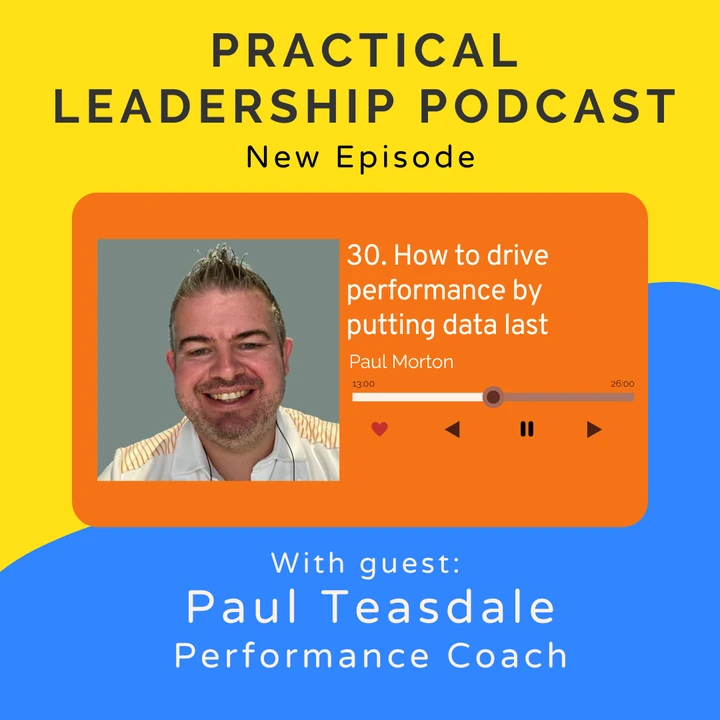
How to drive performance by putting data last
with Paul Teasdale
Show notes
Infobesity.
From the sausage works to Formula One, Paul Teasdale has had an international and madly varied career.
Now landing on his own delivering against his RAPID performance framework – we talk about three great topics:
- Be humble, be honest, be kind – Paul’s mantra.
- How to ideate and generate practical ideas – Could do – no ideas are silly – Should do – what do we prioritise – Will do – the commitment to deliver and lastly
- Paul’s great RAPID framework for performance.
- Results – what and how you want to do things
- Actions – what can you do
- People – understanding who you have and where their strengths lie
- Insights – the decisions you can make based on the…
- Data – the raw source. Ensuring you don’t fall into Infobesity!
Find Paul here:
https://www.linkedin.com/in/pauljamesteasdale/
—————
When you’re ready – help your new managers lead in a hybrid environment: https://leadershipthatsells.com/
Transcript
Automated transcript. Speaker labels and spellings may contain errors.
Paul
[upbeat music] Hello, and welcome to the Practical Leadership Podcast, where I interview great leaders and try to extract their wisdom and experience for you to learn from and hopefully avoid making their mistakes. Check out practical-leadership.academy because you want to help your new managers succeed with hybrid or remote working. [upbeat music] Paul Teasdale, thank you very much for joining me.
Paul Teasdale
Thanks for having me, Paul. Appreciate it.
Paul
Would you be so kind? Would you introduce yourself?
Paul Teasdale
[laughs] Uh, yeah. Well, I'm Paul Teasdale, and I help people perform. That's, uh, that's my reason for being and my, my purpose in life. Um, I've had a, a varied career, everything from sausage making to, uh, container shipping, international dairy export, banking, and six years with Formula 1 team McLaren. And, uh, and from there, I've gone independent, and I now work for myself, helping others to perform. That's my-
Paul
I've gotta ask, which was the most informative? Was it the sausage making or was it McLaren?
Paul Teasdale
[laughs]
Paul
Do you know? There's something about sausages. Well, you, you n- you never want to find out h- how sausages are made or laws are made, right?
Paul Teasdale
I, I, to this day, have no problems whatsoever eating sausages. Um, I would h- have to eat... Well, I would eat them on a daily basis as part of our quality control processes. I have full trust in the whole process and, and the people alongside it who, who make them as well. So depending on which brand, et cetera, but yeah. So it never put me off.
Paul
Fabulous. No, no, I'm a steak man myself.
Paul Teasdale
[laughs]
Paul
But, you know, I like a good sausage now and then. That's it.
Paul Teasdale
Yeah.
Paul
I go... Having, having two small kids, they just... My God-
Paul Teasdale
Right
Paul
... the number of sausages these kids go through.
Paul Teasdale
[laughs] Precisely.
Paul
"Can I put it on a stick?"
Paul Teasdale
Yeah.
Paul
"Okay."
Paul Teasdale
[laughs]
Paul
Dipping it in all sorts of stuff.
Paul Teasdale
[laughs]
Paul
O- what point in this, uh, m- varied and multitudinous career of yours did you first become a people manager?
Paul Teasdale
Uh, from a people manager perspective, it was actually in the sausage making days. So, um-
Paul
Excellent
Paul Teasdale
... that was my second role that I took. I, I had a, a role in a, an aerospace company that was repairing and overhauling airplane engine parts, uh, as my first e- ever job. But I moved into, uh, Kerry Foods, who make the Walls and Richmond sausages, uh, as part of their graduate scheme, and joined them making sausages in their plant in, in Manchester, and started off with a small team in what they call the meat prep team. And I grew from there, uh, making a lot of the specialty sausages and things like that. And by the end of it, I had a team of about 60-odd people working for me across three shifts. And yeah, a lot of learnings in that space from a people management perspective.
Paul
So these were people actually making the sausages, putting, putting the ingredients together, sticking them in the skins?
Paul Teasdale
Yeah. So everything from the meat prep teams who would, uh, actually get the meat out the freezers, or the fresh meat, depending on what it was, and mixing that and putting the recipes together, all the way through to the teams who are on the line. And there was a lot of manual, uh, putting of the sausages into the, uh, the actual, um, uh, packages and things like that at the time as well. So yeah. Big teams, lots of, uh, hard, quick work, manual labor. Um, but some fantastic people and some fantastic learnings with it, so.
Paul
That's excellent. Where... Did you inherit that team, or was it one you had to hire in and build up?
Paul Teasdale
Uh, I inherited it. Um, you know, I, I was on the, um, the graduate scheme there.
Paul
Mm.
Paul Teasdale
And it was very much a case of, look, we'll, we'll... I had a, a sort of mentor and support from, um, some more experienced managers. But my, my role started off as a shift manager, so I had another shift manager who was a lot more experienced who I, I got to learn from there, um, all the way through to managing multiple shifts and things like that, so yeah.
Paul
One of the more interesting... I'm not about to say the sausages are not interesting.
Paul Teasdale
[laughs]
Paul
Not the slightest. I'm a... No. Don't, don't go there.
Paul Teasdale
Yeah.
Paul
But one of the more, um, perhaps, uh, chat-worthy, uh, elements to your career there was the time you spent with McLaren.
Paul Teasdale
Yes.
Paul
And that's all about performance. I mean, the, the Formula 1 is all about performance, and that's your gig as well, you know, helping people perform and all that.
Paul Teasdale
Yeah.
Paul
How would you... What advice would you give to a, a new people leader with respect to that role, with respect to your knowledge and experience you've gained?
Paul Teasdale
Yeah. Uh, experience very much plays a part in this, as in I've learned the hard way here. Um, be humble, be honest, uh, and be kind. Sort of three key things that, um, maybe reflecting back, I, uh, I had some opportunities to improve in those areas. Um, but the other practical tip I would give, and I give a, a lot of this to, um, to new managers in particular is look for frameworks and models and things, the, the reasons behind approaches working. Um, because those are the things that you can fall back on in situations that you weren't quite expecting, or you're going into a, a, a new situation. If you've got a model or a way of working that helps you, um, it really is a, a crutch to help you through those uncertain times.
Paul
Do you have one or two in particular that you would fall on?
Paul Teasdale
[laughs] Uh, yeah. So, um, couple of key things. Um, I, I was working with a client the other day, uh, on some ideation, and how do we generate a lot of ideas but then, then get down to, um, uh, you know, what we're actually committing to do going forward. And I'm, I'm a very simple man, so it's, you know, what we could do, what we think we should do, and what we will do. So it's, uh, going through, we're now in the process of all the things we could do, so it's no idea is a silly idea, lots of idea generation. The things we should do are where we start to prioritize those areas and actually g- um, whittle them down into, into some key areas. And the commitment area of what we will do. What is it of those should? 'Cause there's lots of things we should do, but actually, what is it we will do and are, are committing to doing?
So that's, uh, one of the simple pieces that, that, uh, that's seen me well over the years. And the other one, I guess, is the, the piece that I'm working on, um, a lot at the moment is my own [laughs] model that I'm trying to help people with, which is called Rapid Performance, and that's taken a lot of the lessons from that world of Formula 1 in terms of the data-driven world that we live in these days. How do you get performance and data-led, data-supported performance where data is actually the very last thing on your list? And that's what the Rapid Performance framework's all about. So it's about results, actions, people, insights, and then finally, data. Um, 'cause what we're finding is people are not only data rich at the moment, they are, [laughs] uh, came across a great term of infobesity. People are infobeese. They're so mu-
Paul
That's so brilliant. [laughs]
Paul Teasdale
[laughs] There's so, there's so much coming at them at, you know, that tidal wave trying to drink from the fire hose, those sorts of things, where there's too much out there to actually make sense and to actually drive that into performance. So by taking this rapid approach, I help people to keep performance front of mind with those results, think about the actions that they can take that have an impact on those results, the people who are involved in making the decisions and enacting those actions, and what insights do those people need in order to make the best decisions. And it's only when you get down to that insights level and say, "Right. What's the minimal, smallest data set we can possibly have that will drive those insights for us?" And that way you are focusing on the right data and
also the smallest possible data so it's a lot more manageable, a lot more digestible.
Paul
Okay. I like this. We're gonna dig into this.
Paul Teasdale
[laughs]
Paul
Let's go back to this and do this again. All right. Now, number one, I love the ideation, generating practical ideas, could do, should do, would, will do.
Paul Teasdale
Yep.
Paul
The prioritization bit is always the trickiest bit there, isn't it though?
Paul Teasdale
Yep.
Paul
That's working out what to do first.
Paul Teasdale
Mm.
Paul
Do you know what? That's one for another call, a- another-
Paul Teasdale
Okay
Paul
... conversation. Let's look at Rapid. I like this.
Paul Teasdale
Yeah.
Paul
Results, actions, people, insights, and then eventually data.
Paul Teasdale
Yeah.
Paul
'Cause as you said, infobees, infobeese. My goodness.
Paul Teasdale
[laughs]
Paul
So much information out there, so many reports.
Paul Teasdale
Yeah.
Paul
And my background's in revenue as well, and we get-
Paul Teasdale
Right
Paul
... drowning in our information.
Paul Teasdale
Yeah.
Paul
Where do you start?
Paul Teasdale
Mm.
Paul
What's the thing? So let's look at this. Take, take us through this then. Results.
Paul Teasdale
Yep. So results is all about really defining and really being clear on what you're trying to achieve, but also how you want to achieve that. So it might be, you know, use the F1 type examples. It's championship points are what you're after. That's the high-level result that you're driving towards. But you also need to consider how you're going to achieve that as well. And what I mean by that is what are some of the regulatory frameworks that you have to work within, but also what are some of the strategic priorities that you have as an organization? So McLaren had a very strong, uh, sustainability focus, so it's like how can we achieve those results in a way that is also in line with our strategic objectives, which is, you know, being sustainable, um, and, uh, doing everything in as, in as sustainable manner as possible.
And so you can actually start to break this down with a sort of results hierarchy. Um, things like, uh, str- uh, strategy mapping, for instance, is another sort of mechanism to help people to align the high-level results they're dri- uh, they're driving towards with the next level of results that i- impact on a sort of team or department level. And typically what I would help clients do is, like, whatever you want to do in, whatever it means to you at that time is high performance. You know, you're, you're after that high performance. It might be a successful project. It might be profit. It might be, um, a sustainability focus that you're after. And that can generally be broken down into effectiveness, so am I getting the result that I want, and efficiency in terms of am I doing that and then with the best use of the resources at hand.
Paul
Okay. So you want... You know where you're going-
Paul Teasdale
Yeah
Paul
... and you know what you want to achieve, how you wanna get there. Actions then.
Paul Teasdale
So actions are starting to think about the levers at your disposal.
Paul
Mm.
Paul Teasdale
What are those things that you can do? So, um, you know, typically, you know, F1 [laughs] examples as well, you know, you're talking about everything from the design of the car. That's at your... That's a lever that you've got to push and pull. You can, uh, all the way... And that's a longer term sort of decision. You can have strategy decisions in terms of what, how you want to set up your chassis for the year, uh, how you want to, um, set up your powertrain, those sorts of things that are, once you've made those decisions, it's difficult to change them a lot during the racing season. You can then have more design, shorter to medium term sort of actions at your disposal where you can design new parts, test them out, and see what's what. And then you've got operational actions, which are the things that tend to be more reactive.
So when the plan doesn't go [laughs] quite as you wanted it to, um, what do I do now? Do I pit when the safety car comes out? When I go to pit, what tires do I put on? So I'll have had a plan in the first place, but actually I've got to react to the moment, to the race you're in.
Paul
The momentary tactics.
Paul Teasdale
Exactly.
Paul
Right.
Paul Teasdale
So it's, uh... Um, and so the, you know, you might... Everything from if you start to apply that to organizations, that can be everything from your governance, your policies. These are actions that you have at your disposal, that you can decide to make changes in those areas, all the way through to where do you prioritize your resource. You know, do, do we take, uh, if you've got a smaller team, for instance, do you take resource from one part of the team in order to prioritize somewhere else and support and, and prop up another part of the team? Um, but these are things that you can do. The, the meetings that you run, the way in which you have interactions with people, your clients, et cetera, these are actions that have an effect on the result that you're trying
to drive.
Paul
Okay. So then from results to actions, and then, uh, from actions to people.
Paul Teasdale
Yep. So this is truly understanding people. You know, people, uh, make decisions in organizations. If they don't, it's automated. Um, but most organizations, most teams, people are the ones who are making decisions at the end of the day. And people are the ones who are enacting those decisions, and people are not, uh, completely rational, and they're not completely predictable [laughs] in all sorts of ways. Um, so you've got to understand everything about how people make decisions, how teams work together, how they are managed, motivated, um, remunerated, all sorts of things that help drive the behaviors that actually lead to what could be the best actions or the best, uh, decisions in play. Um, so th- this is about truly understanding the people, who's involved, how do I get the right people involved, how do I get the right people in the right places, what capabilities do I need, how
do I set up my team to be high-performing, how do they communicate with each other, all sorts of those areas.
Paul
That's the Stephen Covey, get the right people on the bus.
Paul Teasdale
Precisely, yeah.
Paul
Awesome. Okay. So results, actions, people. Insights.
Paul Teasdale
Insights. Um, so I, uh, am a man of simple definitions quite a lot of the time. So data for me is what. It's the what of, um, of what's happening, so it's the facts and figures, the raw things that, that are describing the situation. Information is where you bring a bit more richness to that data by giving it context. Um, um, so reports, for instance, classic bit of information. You're providing context of the-
Paul
Yeah
Paul Teasdale
... of the data and maybe bringing it together and presenting it in a slightly different way. Whereas insights actually help people make decisions, so they support a decision in some way or other. Um, and where the world of Formula 1 and the, the modeling and analytics that they do is really, uh, sort of cutting edge in this space is the predictive analytics part of insights. Can you predict what the outcome would be if you made a certain decision? So for instance, you might say, "Right, if I pit it now, am I likely to come out in heavy traffic or in clean air? And, you know, am I gonna come out ahead of a competitor?" Or, or something like that. So you can constantly run those models in that world and actually say, "Right, the insight is pit now, and you'll come out into, um,
into a, a bit of fresh air. But actually, you might need to pit again because of the way that the tires are wearing compared to how we thought they might be." And so those models are spitting out those insights. In the world of business, it can be, um, you know, much less advanced than that, but it can be things like if I've got... I worked with a client that had a global, um, resourcing, um, issue in terms of getting in, um, recruitment and selection was their challenge really, is getting people in. But also, where do I put my global resource to help where I've got those gaps? So can you provide them with insights or the organization with insights around not only where in terms of the volume of those, um, uh, roles are, but what are they in terms of the criticality of those roles, and where do we see the,
uh, the severity of getting it wrong? So you can start to bring different bits of information and maybe present it back in a way such as a map, a visual aid that actually says, "Actually, the decision you're after is really about this. That, you know, you need to put all of your effort initially into one region rather than another because of X, Y, and Z."
Paul
I've always been cautious about, uh, and again, 'cause, 'cause the revenue function. So many reports out there.
Paul Teasdale
Mm.
Paul
You've gotta ask, "Why do I have this?"
Paul Teasdale
Yeah.
Paul
Do I have this just because I need to have it or because you think you should have a report?
Paul Teasdale
Mm.
Paul
Am I going to use this to make a decision? Is it going to inform a decision or not? If it's not, and it's just for pretty-
Paul Teasdale
Mm
Paul
... why bother?
Paul Teasdale
Yes.
Paul
At all.
Paul Teasdale
Precisely.
Paul
Yeah. Okay. So that's insights. I love data, being raw data and from, um, numbers, statistics. Info, the contextualization of the data. And then insights, they're helping you make a decision.
Paul Teasdale
Yeah.
Paul
I like that.
Paul Teasdale
Yeah.
Paul
That's really good. And then, so lastly, then you move on to the, the data piece.
Paul Teasdale
Yep. So this is where it's like what, what is the data that's actually required to drive the insights that your people need? Um, and this is where you can, uh, do things like strip out a load of reports or at least put them to one side or not put them in front of your managers. So data is pretty much free these days, you know? And a lot of software that's out there reporting is, you know, at the drop of a hat you can, you can create a different report. And I've worked with a lot of clients where they get a new system in play, or they're working with something like Tableau or, you know, the, something that's very flexible, and, uh, the IT guys say, "Well, fantastic. This is fantastic bit of software. It can generate any report you want." And managers and leaders are going, "Well, I don't know what I want. You know? I can... If I can cut things in every possible way, I can't see the wood for the trees.
I don't know where to go." So you're starting with the data and, and, and put, going that way. And if you start with the insight to say, "I want to know this," then your IT, uh, data team can actually support that and add value in that process by saying, "Right, if that's the insight you need, we need to generate that by pulling these bits of data together and presenting it back to you in this format, this frequency," whatever that might be. But that should be, at least for the leader, the smallest possible data set because otherwise you are exposing them to far too much, and it actually has a detrimental effect on the decisions you make.
Paul
I mean, it's also then, then you, you start getting into the realms of modeling.
Paul Teasdale
Mm.
Paul
And as soon as you start thinking about modeling stuff, well, it's just all wrong.
Paul Teasdale
[laughs] Yeah. Yeah.
Paul
All-
Paul Teasdale
Yeah
Paul
... all models are wrong. Some models are useful-
Paul Teasdale
Yes
Paul
... but all models are wrong.
Paul Teasdale
Exactly.
Paul
Mm.
Paul Teasdale
And quite often, I, I've worked with a few clients about, um, you can have data that is 100% accurate and absolutely useless-
Paul
Yeah
Paul Teasdale
... if your people don't trust it.
Paul
Oh, yeah.
Paul Teasdale
You, you, it's more useful if it's 80% accurate and your people trust it because they will actually use it, and they will use it in a way that is of value.
Paul
That's fascinating. Rapid performance.
Paul Teasdale
Yeah.
Paul
Um, uh, when your how-to there is what? Is h- how to build data-driven performance. But you don't want... I mean, I never liked data-driven. I prefer data informed.
Paul Teasdale
Yeah. Yeah. It is de- definitely data informed. Data, uh, data led again is- is probably a bit, you know, it- it-
Paul
Mm
Paul Teasdale
... it's about putting data first, whereas this is about data being a servant to the results that you're trying to drive.
Paul
Yeah. I mean, it's- it's the problem of, um, first things first. You know, first things first, and you get lost everywhere.
Paul Teasdale
Yeah.
Paul
You have to know where you're going before you get in the car.
Paul Teasdale
Yeah. Yeah, exactly.
Paul
Was there a particular mistake in your, uh, varied career-
Paul Teasdale
[laughs]
Paul
... that you learned a lot from, learned a lot from?
Paul Teasdale
Um, probably one of the earliest ones, and it goes back to that point about being honest and being humble and things like that.
Paul
Mm.
Paul Teasdale
Um, I walked into the meat prep team at the sausage factory, and I was still wet behind the ears from university days, and my manufacturing methodology, my textbook work said, "Right. I can make these guys more productive by changing their break system." So I'm just gonna watch them, not say a word, didn't in- involve them, didn't, uh, tell them what I was doing. I just stood there with a clipboard and watched them and saw how they did their breaks. And then I got them in a room later on and said, "Right. Great news. We can get performance up. It's just you've got to change your break to here, and you've got to change your break to there. Um, and w- you, you guys go break together." And, ooh, that did not go down well.
[laughs]
Paul
[laughs] As you imagined.
Paul Teasdale
Um, yeah. So it's about, you know... And in the c- the conversation and at the a- at the end of that conversation, I, I at least felt I was humble enough to go, "Sorry, guys. I've, yeah... I- I was trying to do a good thing. I've done this all, all wrong. Let's, let's start again. Let's work, work together."
Paul
Oh, bless. [laughs]
Paul Teasdale
And, and they, and, and then took some insights from those guys in terms of what is it that, you know, where do you see the, the opportunities? Where do you see the, uh, the issues that need resolving? And sure enough, all the answers were there, and just needed to be aired and supported. And, uh, and for me, taking what little leadership role [laughs] I could at the time, actually influencing some, some changes that helped get them the right tools in place, get the right, um, processes in place with other departments to, uh, to help them perform at their best.
Paul
Yeah. I think that's one of the... One of the good questions is where are the most promising unexploited opportunities for growth?
Paul Teasdale
Mm.
Paul
You know? And the people who do the job, they always know.
Paul Teasdale
Always.
Paul
"Well, we're doing it like this, but that doesn't make any sense because..."
Paul Teasdale
Mm.
Paul
"Well, okay."
Paul Teasdale
Yeah. And they, they can't... Uh, a lot of, most of the time, they can articulate it perfectly. A lot of the time, they don't in terms of they don't nec- not necessarily talking about a solution or that we need to do this to resolve it. But your job as a leader is to listen to the struggles that people are having and the challenges that they have. Just even those things like, you know, when I get a plan delivered from a previous department or tells me what I'm doing for the day, it's in a format that I can't read properly or doesn't match up with what I need to do in the next steps in my process.
Paul
Mm.
Paul Teasdale
Um, and so if you can listen to what are those challenges, where are people putting extra effort, particularly in things like translating data and information and insights. You know, if they have to put mental effort into translating that into something else, that's a prime opportunity for you as a leader to go, "Right. I'm gonna make sure you get that data or that information, those insights in a manner that supports your performance."
Paul
Yeah. Excellent. Excellent. What are you working on at present?
Paul Teasdale
Uh-
Paul
Developing the Rapid Performance Framework, it sounds like.
Paul Teasdale
Yeah. So the Rapid Performance Framework, um, I've got that as an online course, so that's, uh, that, that's out and available.
Paul
Link will be in the podcast.
Paul Teasdale
[laughs] Yeah. Fantastic. And, um, uh, I also do, um, workshops and talks and things on that particular topic-
Paul
Mm
Paul Teasdale
... um, in, uh, for clients. Everything from sort of half-hour inspirations learnings from F1 type talks through to, um, multiple modules, breaking down that rapid performance and helping people work through it, and going through, uh, some coaching and development with people on that. As well as various other lessons, uh, from the world of F1, which, you know, about how, you know, how do you become a, a better leader in, in the world of F1? How do you use, uh, data to drive culture? All sorts of, of different lessons that I've taken from working in that high-performance environment that I think can be really applicable to, uh, to modern-day business.
Paul
Is there something in particular you would like to thank the young Paul for having done?
Paul Teasdale
Um, taking up some new opportunities. I think tho- those, there were a few left field opportunities that came my way. Um, a prime example, um, I was... After the sausage making days, I, I was in consultancy for a number of years, um, and decided that we were gonna make a move, myself and the wife. Um, and moving out of London as well because we'd, uh, we'd been there for a while. And we, we said, you know, "Manchester, Oxford, where do we go to?" You know, there's different places we can go around the country. And we, um, we went to New Zealand and went to Auckland and took a chance on, you know, some opportunities that sort of came our way, and w- we didn't have a clue what we were doing. Said, "Right. Let's give it a go. We'll give it two years maximum, then we'll come back." And it was five years later with a, a little Kiwi boy in tow that we, uh, we came back, and I joined McLaren. So yeah, take those opportunities.
Uh, take those big leaps, um, and say yes more. Yeah. And that's a lot of the things I thank my younger self for, are saying yes to some of the opportunities that came my way.
Paul
Excellent. And then lastly, your coordinates. How can people find you, Paul?
Paul Teasdale
Um, so LinkedIn. So I'm, I'm, I'm doing more on LinkedIn these days than [laughs] than I ever have. Um, I've got my website, which is paulteesdale.co.uk, where you'll find both the in- info on the Rapid, uh, Framework, as well as links to my podcast as well. So I do a podcast on helping people perform. Um, and so yeah. Al- you'll listen to some of my insights, but my conversations with others on that theme as well. So yeah. But don't be afraid to reach out.
Paul
Paul Teesdale, thank you very much indeed for joining me.
Paul Teasdale
Thanks very much for having me, Paul. [upbeat music]
Paul
That's a wrap. Thank you for joining me today. Your homework is to leave your five-star review, and please, any comments you have. You really help me to improve every day, and it also helps people to discover me online. You should check out practical-leadership.academy because you want to help your new managers succeed with hybrid or remote working. [upbeat music]