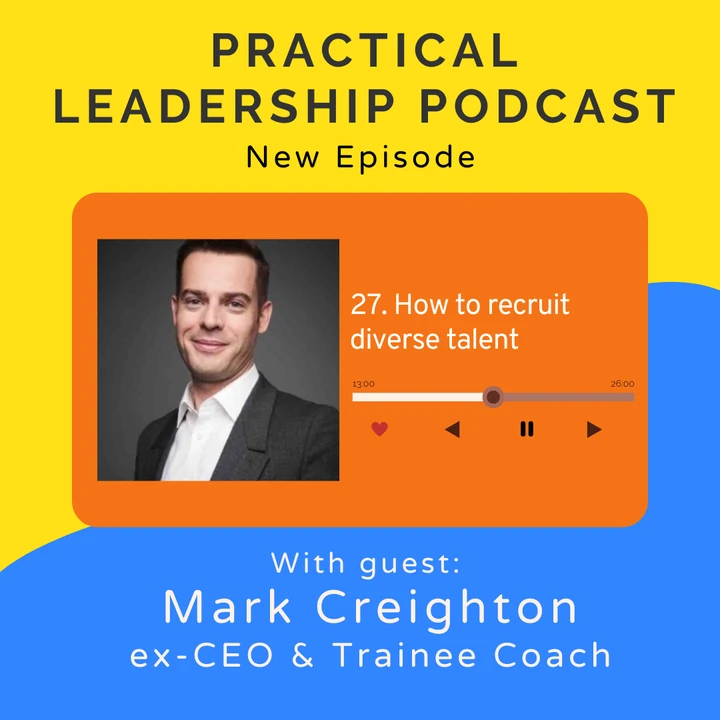
How to recruit diverse talent
with Mark Creighton
Show notes
A 20-year ad-man, veteran of media agencies, Mark Creighton went looking for innate purpose and found adult learning and apprenticeships He was wise enough in his very first job in his first year to hire diversely.
Looking for a team member to help him build ads in the shiny new “Internets”, he purposefully hired someone different to him.
Hiring badly can cause you 3x the pain of not hiring.
Hiring well will repay you 10x the effort of doing it.
He doesn’t pay much attention to CVs, preferring to really listen to candidates and understand what’s behind their passions.
Join me for another cracking chat!
Find Mark here: https://www.linkedin.com/in/markcreighton1/
—-
New managers, and managers of new managers – click here for help today: https://leadershipthatsells.com/
Transcript
Automated transcript. Speaker labels and spellings may contain errors.
Paul
[upbeat music] Hello, and welcome to the Practical Leadership Podcast where I interview great leaders and try to extract their wisdom and their experience for you to learn from and hopefully avoid making their mistakes. If you want to upgrade your leadership skills in 25 minutes, check out practical-leadership.academy. [upbeat music] Mark Crichton, thank you very much indeed for joining me.
Mark Creighton
Lovely to be here. Thank you for inviting me.
Paul
Well, you're an ad man. Well, you were an ad man. You know, leading media agencies for 20-odd years, and then finding that you perhaps wanted some more purpose, not that there's not purpose in advertising and media.
Mark Creighton
[laughs]
Paul
But, um, looking for something for, of more purpose, you fell into something that's very much on, uh, uh, in my field, which is learning, adult learning. Um, what was the purpose you found out of that?
Mark Creighton
I mean, I think the, the one thing I can say about the, the media industry is it's very much a, a people-based business, and I, I love that aspect of working with people. But what I began to realize as I started to manage and lead people is that the purpose of what you do is really important to motivating them, uh, both for you as an individual, knowing that you're doing something that might be bringing kind of a, a better experience to either individuals or, or kind of the world. And therefore, having done 20 years in media, I wanted to go and do something which had a bit more of an innate purpose. And I think I looked at the adult learning space, and I felt, wow, you know, here's this opportunity around people's development but also the development of the organizations
they work for, and that was something I felt really excited by and wanted the opportunity to go in and experience that and work with, you know, in a space that I didn't know, I wasn't a practitioner in. Um, but maybe being able to help those practitioners to reach, uh, more people with kind of their expertise.
Paul
Hmm. In those 20 years then, plus the learning side, if you cast your mind back, at what point did you first become a manager of people?
Mark Creighton
So I was quite lucky. I, I was managing people sort of in the first year of my first job in a very little media agency at the top of Soho in London. Um, and I was also in a really new field. I was in what they then called as new media, which was advertising on the internet. And it was 1999, and the internet had just moved from being like an academic medium to suddenly people were putting advertising in it. And there was content on there all consumers wanted to read, so right in its infancy. And I was the new media expert at the agency 'cause I'd been on the internet once and nobody else had. Um, and I was asked to hire somebody to come in, in effect, build this new department. Um, and the bit I remember vividly was the recruitment process because I was really, uh, taken by needing the right personality.
So I wanted somebody who was curious, who was really initiative-driven, but I remember thinking, "I don't want someone that's like me. I want somebody who's gonna come in and be challenging." We're in this new space, and if they just listen to everything that I say, we're gonna miss loads of opportunities. I need somebody who's gonna be really constructive in the way they say to me, "But what if we did this? If this is possible, how would we do that?" And I really felt that personality type was gonna be the most important thing to us succeeding in this new space that we were trying to develop in. Um, and that I didn't know everything, and if I didn't know everything, the people that I worked with had to be people that were gonna bring something different. So of all the things, that really stands out. And what's really interesting is, um, that first person that I employed is now, you know, one of my best friends, and he subsequently has worked for me in other organizations.
And we've always shared this curiosity even though the kind of new media space kind of matured and evolved and, you know, we're reading lots of stories about Meta, uh, and Twitter at the moment, but we always were curious about what was possible. Um, so my first management experience, I guess th- the advice I give is just recruiting the right people and recruiting people that are different to you is one of the most powerful things you can do.
Paul
You must have been, what, 22, 3?
Mark Creighton
Yeah, 23.
Paul
Having that sort of insight into not wanting to hire somebody like you is, is quite a thing. I mean, uh, there, there are still people I talk to today who have, uh, coincidentally, intentionally, or otherwise, basically hired a room full of people that if not look and sound but certainly think like them. And I recognized fairly early on that you wanted to have a big, diverse group of people, but then what I realized it was a nice big, diverse group of men, women, black, and white. But at their heart, they were all middle-aged Scotsman, you know? [laughs] That, that was, that's no bloody good. That's not what you're after. You want diversity of thought, not diversity of demographic. The demographic is almost coincidental.
You know?
Mark Creighton
Yeah.
Paul
But that's, that's quite advanced thinking. W- w- well done. You would... So obviously you'd had your MBA under your belt at that point then, no?
Mark Creighton
Well, [laughs] if only. Um, I think what I was struck by was I'd been given this opportunity, this new opportunity, which in part was me putting my hand up, but in part was there was a moment in time where this new thing, the internet, had emerged, and it was, it, it was a really blank canvas. You know, to the point where I had a little A5 book in which I would write down the clients that I had at the agency, and every time a new website arrived that was in their category or sector, I would write it down in my book as a potential advertising opportunity. And I would ring or email those people and say, "Would you even think about taking advertising? 'Cause you don't have advertising on your website at the moment. Could, would you do that for me?" So we were creating the opportunity as much as kind of filling the space.
So for that reason, the possibility, the opportunity just very naturally made me think we're gonna need lots of different people to do this 'cause this is all starting out. It can't be one type of person. There is no rules as such to follow. There's no role model I can kind of say, "That's what a manager in new media or the internet looks like." It's all very embryonic. It's all beginning. So for me, I think it was just very much that. It was, okay, how, how would you make sense of this quickly, and how would you take advantage of the opportunity? You know what? That's lots of different people with lots of different skills, and that gives you the best chance to succeed. And also, I had lots of latitude to kind of fail because in being in something new, you can try stuff, and the consequences weren't as great, you know? Everything was very flexible. Everything was very fluid.
So again, I didn't feel... You know, maybe now, 20 years on, I see consequence more, and therefore you see mistakes, and therefore you're not as open, you're not as open sometimes when you've kind of been jaded by it. But at that point, I just was so open to the opportunity.
Paul
So what advice would you have wanted to have been given? Now, you did something pretty major there, which is recruit. You recruited well, and I would say you, you wanna get rid of 80% of your problems, you recruit the right people. But what would you have wanted, w- what advice would you give to a new manager?
Mark Creighton
For me, I, I think I always come back to recruitment.
Paul
Mm.
Mark Creighton
I, I do think that you spending the time getting the right person, uh, will pay back to you, you know, tenfold. And I think for a lot of managers, that's really difficult because when you're under pressure at work and, for example, there's an empty seat in your team, and that's causing you to maybe have to work longer or asking other people to work longer in the day, or you're missing a skill set, you almost wanna fill it too quickly. You almost wanna cut corners and say, "I just wanna get somebody in here who can kind of help share this workload." And the challenge with that is if you get the wrong person, that will actually cause more of a problem. It won't actually become a solution. Uh, whether that's a fit with the team, whether that's, um, complementing other skills that you might have, whether or not that person has the capacity to do what you need them to do.
So I know that very early I realized a bad hire actually create, creates three times, four times the amount of work, and it hasn't solved the problem you originally had, so therefore taking time in recruitment, feeling comfortable that you're making the right decision, not compromising both on the type of individual as much as kind of the skills that they may have, that's really important. And that, as your team grows, becomes, um, even more important that, that they're a fit, that you look at it and you know how they fit with the sort of the dynamics of the rest of the team, that you know your team has certain strengths, and this person might be able to kind of improve in areas where you could be better. So I think really taking time in that first stage when you bring people in, um, will pay back, and I also think it's part of as you then move from managing to leading, it's very important, the culture as well.
You bring the wrong people into an organization that already has begun to establish a strong, positive culture, and they will disrupt it, and they will damage it. So again, you know, with those larger teams, those departments, you're also thinking for that cultural fit. How are they going to fit with something that you feel has given you positive momentum, is actually a part of your identity? Um, and you, you really need to hone in on that because, again, bringing in the wrong person can either slow you down, or they can damage something that maybe you've invested a lot of time in, in developing and building.
Paul
So to recruit the right person then, now, you mentioned a few characteristics there, character, uh, personality. I mean, I, I, I like to look for some very similar things as well when I'm hiring anyone, really. So it's curiosity, courage, and coachability, the three Cs, you know? But what, how would you go about doing that? What is your go-to rules of thumb for recruiting the right people?
Mark Creighton
So I, I tend to be a bit more about what's happening in the room. Um, you know, I, I don't wanna say to you I don't pay attention to CVs, but I've be- uh, through my career, I've given them less and less attention. I, I've looked for kind of more about what they say about a person, their qualities. You know, are there indications of showing initiative? What goes on outside of their work life? Not to kind of... To, to be able to ask them a question and understand why they're passionate about that, you know? What, what is it that makes you passionate about the things you do outside of work as much as the things that you do within it? Um, but I also don't think that people's background and qualifications tell you whether they're the right characters to be in your organization.
And I think for managers today who are thinking more about diversity in all of its forms, I think CVs can be a mistake. I think if they weight too much on people's education, you actually don't see some of the other fundamentals that they bring that you can then nurture and coach within them to make them a good employee. So I, I tend to think about what's happening in the room and how am I gonna ask open questions that allows this person to demonstrate who they are, um, to feel comfortable in sharing who they are, to not look to give me what they think is the right answer to the question but what is the answer they wanna give, what is the authentic answer that they, they have. So make them feel comfortable in the room. Make sure that they can give the best of themselves. Ask open questions that really don't bias against education background, what they may have done before.
Um, and ask them to expand. You know, y- make sure that they're not just giving you a short answer. "Okay, tell me a little bit more about what you mean about that. That sounds interesting." Be positive, encouraging. You want to understand that person in that half an hour, 45 minutes, however long that you've got for the interview. So it is your responsibility to create a space that encourages them to be themselves and to articulate who they are. Because if they do, you've got a better opportunity to decide whether or not they're a good fit with the role that you've got. Um, so, you know, I think sometimes we think all of the responsibility is on the person that we're interviewing, but actually it starts from us. We, we begin that process, and we can make that a good process, or we can make it a really bad one as well.
Paul
It's, is the essence of good management and good leadership. It's all about them, but it's our job to make it all about them.
Mark Creighton
Yeah. And I see... I think it's, it's also about thinking about different ways that you could do it as well. One, one of the notice- things I've noticed is, for example, you're hiring a, a, a new entrant into your business straight out of school, rather than you take them from, say, further education or from university. Is an interview gonna be the best way to understand them? Is sitting in a room across a desk from somebody the best way that they're gonna show who they are? Or could you set a series of kind of interesting tasks, understand more about them in a team dynamic, maybe bring a series of people in that you're interviewing, and ask them to work together and observe kind of how they solve
a problem? What is the way that you understand them that allows you to see what their talent is, what their potential is? And also understand that you might bias against some of those n- that new entrant talent if you follow that very kind of one-dimensional route of interviewing them one-to-one. So I think being creative in the way that you understand people, being creative in the way that you enable them to express their strengths, is one way that you can move away from saying, "Well, someone with a university education would be really good at this." But actually, someone straight out of secondary school who could be just as valuable to me needs a different form, a different space in which they can express what they're good at.
Paul
My father-in-law has a great saying about what you get from universities, and he managed to put all five of his children through top universities with no debt in the US, so that's a-
Mark Creighton
Yeah
Paul
... he, he had that on his CV at one point. Managed to put all, all five of my kids through, so good for him. But he said that the one guaranteed thing you get from any university or college education, older.
Mark Creighton
Yeah.
Paul
That's it. I mean-
Mark Creighton
Yeah
Paul
... apart from a professional education, where typically actually you are made confident by an unnecessary qualification, but competent through a series of apprenticeships, you really, you get older. You get somebody who's slightly more mature than otherwise.
Mark Creighton
Yeah.
Paul
Has had the opportunity to reflect.
Mark Creighton
I, I mean, one of the things that struck me working in an adult learning business, and I work with apprenticeships as well-
Paul
Mm
Mark Creighton
... was, um, talking to parents when their children graduated from an apprenticeship, was they had discouraged them from going on an apprenticeship at the outset. They wanted them to go to university. They had then seen the power of that individual going into work, still learning and developing alongside work, and then being promoted two or three times during their apprenticeship, and they could now see that their child had this amazing almost head start in their career because they started in work earlier. But their perception was that would put them at a disadvantage, not an advantage.
Paul
Mm.
Mark Creighton
And it made me reflect on colleagues that I've worked with, with throughout my career that never revealed that they didn't go to university 'cause they felt there was a stigma. Like, it put them at a disadvantage, and it would come out, like, when they were in their 40s and 50s, "Oh, by the way, I never went to university." As if they had to hide it in order that they would be allowed to progress. And I just thought this was insane. Like, you've already demonstrated in 20 years of your career your absolute value to this organization that had nothing to do with your education. It was about all those other characteristics, all of that diligence, all of that commitment, all of that imagination, innovation that you have brought throughout that.
Why should where you went to school or, or what university, why do you think that that should hold you back? And I'm really pleased that the world is progressing to a point where we can see that now, but it was certainly something that it... I found it really puzzling through kind of, you know, through my 30s and 40s when people would suddenly feel like it was something they ha- hide away, when actually it, it could genuinely be a superpower.
Paul
I'm quite grateful that it's actually turning out to be, uh, apprenticeships in general are turning out to be such a powerful route forward. I've got two young children, and reflecting on my own university time, I'm thinking, "Well, that was interesting, and I really enjoyed it, but was it at all useful or valuable in any way, shape, or form?" I actually, I mean, I learned some, I learned languages, and I've really, really used those languages a lot. But I can learn them 'cause I'm good at doing that, and I could do that again, thank you very much. I didn't need to spend four or five years in Edinburgh doing, doing, doing a degree. I mean, Scandinavian cinema and the history of children's literature in Canada was not exactly-
Mark Creighton
[laughs]
Paul
... that useful. Okay. What, what mistake or event did you learn a particular amount from?
Mark Creighton
Well, I know, I know this meant, this will be mentioned on some of your previous podcasts. Uh, COVID as an event, I think as a learning experience, as a development experience, was just amazing. Like, I, I took so much out of what has been a really difficult period around kind of what leadership is, but also what people want from leadership when they're in kind of difficult circumstances. And the, the standout was really for me around communication. Like, I, I'd, as a leader, someone who's leading sort of departments and organizations, I knew communication was important. I knew that it was important to get face to face with people and explain what we were trying to do as an organization and how they could be involved in that. But the thing that started to strike me in a, [clears throat] in a world that was very face-to-face in an office was no one was asking me any questions.
Like, I would do these, uh, all company meetings. It didn't matter what mechanism, a post box where you put in the question, ask a question from the floor, ask a question via chat. Nothing. I got no questions. And then COVID hit, and we increased the frequency of communication 'cause there was so much to talk to people about to make sure that they understood what was going on in a really uncertain time, both practical, emotional, as well as kind of what the business was doing strategically. And all of a sudden, there was this anonyma- uh, anonymity in asking a question, the ability to put it without your name on it. And suddenly I was getting floods of questions, like, and really tough questions, things that were saying, "I don't think you're making the right decision on that.
I think the better way to do it would be this or that." And immediately that kind of had almost what I'd been wishing for for, like, years of leadership, people saying, "This is what I think. This is the contribution I want to make to the company, and great, that's your decision, but I feel like I need to scrutinize it more. I need to ask more about it." And for me, that was like great, I now have a proper conversation about this in a period of uncertainty, and I now want to engage with that in as honest a way as I can with as much humility as I can and, and this is an opportunity to really connect as a leader. And for two years of COVID, I felt that, one, I, I, I was able to listen and absorb more from the people that, that were working for the company, that I was able to answer questions with humility that maybe hadn't been there before, acknowledging what I didn't know as much as what I did know.
Um, and also just to connect better. Like, in a strange way as a leader, I felt I could let people in a bit more. So the simple thing of, like, being at home on a camera and letting people into your home, you know, talking about your family more, what's happening for them in COVID. Talking about the irreverent stuff like what box set you're watching and what other box sets are you watching, and then everyone sharing back what it was that they were doing. And just feeling as a leader just more connected through there being a dialogue. Yet the ridiculous thing being that that was all being prompted in a completely remote environment where I couldn't see them, they could see me, and most of the conversation was in the chat bar on the right-hand side of the screen.
So it, it really has embedded in me this kind of the importance of communication as a manager and a leader-
Paul
Mm
Mark Creighton
... both in its frequency, but also in how do you connect with people? And, and you don't connect with people by just broadcasting your strategy or your objectives or your outcomes at them. You engage with people by being open to challenge, by hearing what people are saying, and incorporating that into kind of what the business does. But also just being a human being and, and acknowledging kind of your failings, acknowledging your weaknesses, but also letting people in to know who you are. Um, and I felt that I came out of that period, like, understanding more about the importance of that, but also wanting to make sure that it was in, in every aspect of my leadership going forward.
Paul
That's quite a powerful takeaway from an otherwise challenging few years.
Mark Creighton
Yeah. But I mean, and it, I think interestingly, challenge for me has always reconnected me to, like, you have human beings working for you, and they actually are very generous when things aren't going well. So whether or not your business isn't performing well, whether or not you've lost a client, um, or you've got, like, a, a backdrop, a difficult backdrop like we have now and kind of the economic and, and sort of geopolitical situation, actually your, the people that work for you and with you are very supportive and very patient in those circumstances. But they also have lots of great ideas about how you might help address those challenges and problems, but you've gotta have the humility to hear them and not just think that you're there to solve it all on your own. And I think if you can do that in the difficult periods rather than when you're absolutely flying and growth is great and you're winning more new business than you can kind of possibly service,
actually in the tough times, that's where leaning into the people that work for you can be, you know, really powerful.
Paul
We're an amazing species, aren't we? [laughs]
Mark Creighton
Yeah.
Paul
Very nice. What would you like to thank young Mark for doing?
Mark Creighton
So I, I, I had to think about this question quite a lot, um, and what I realized was I wanna thank him for putting his hand up. Because even though I probably was bullied horribly at school for being the kid that put his hand up in the classroom or the kid on the sports field who said, "I'll, I'll do the demo" that nobody else wanted to do, I think that meant that I got lots more opportunities. I think I got a lot more opportunities to try things for the first time and then want to keep doing them. But I also realized that opportunities emerge when you take the initiative, when you give something a go. And when, in my business life, a lot of my progression in my career has come because I put my hand up and said, "I've been thinking about that thing that we don't do, and I think if we did it, we'd be better." And I've worked for some great leaders who've said, "Great, go on and do it." You know, during kind of working for one
independent digital media agency, I went to them, and this will sound strange to people who are, uh, a bit younger, but, um, there was this website that had emerged called Google. Very small, based on the West Coast of America, um, a search engine. No one had really heard of search engine. And I was working for a media agency, and I said to the two founders, "There's this thing called a search engine, and I don't think it's gonna be the same as the other advertising that people do elsewhere on the internet." I think it's gonna be a specialist skill. I think it probably is gonna involve kind of data and response, and I think it's gonna be quite important to retail and commerce. And that was it. I said, "But I think we're gonna have to do it differently." And the two founders of the company said, "Okay, what do you need?" I said, "I think I need a couple of people.
Um, I might need a bit of expertise from different parts of, of kind of the agency. Um, and I need to be able to, like, brand it and take it to market." And they said, "No problem. Go do it." And we were able to spin out a separate division that would then go on and deliver search marketing, which as you know, is a huge part of kind of people's advertising strategies today. But at that point, it was about, like, putting my hand up and saying, "I'm seeing something. I think if we do something differently, something good will happen." And I trace that all the way back to doing that when I was a kid and, and knowing that good things happened as a consequence of that. So, and I love it when people that work for me today put their hands up and go, "I've got this idea," right? And, you know, we talked about this earlier. Okay, Mark, shut up and listen to what they've gotta say, and if you can empower them, probably something good is gonna happen.
And I think that really is, is something that my younger self gave me and then gave me the opportunity to do different things in my career.
Paul
It's kind of the difference between fortune and luck, isn't it? You know, the, the harder I work, the luckier I get. The more opportunities you seize, carpe diem, the further you get along.
Mark Creighton
But, you know, uh, and there is a bit of, you gotta have some resilience to do that as well because the people around you that don't put their hand up kind of also want you to put your hand down, and you've gotta, you've gotta be able to get through that. And that, at the time, isn't very nice, but it pays back 'cause that resilience that you're building will come into play. It will be ... It will help you to get through more difficult situations, but also it will help you with your decision-making because you'll have a belief in yourself that whatever the, the soothsayers around you or maybe people are asking you to be more conservative in your thinking, you'll have a belief in yourself that you can take forward. So I, I don't think it comes easily, and particularly in the formative, you know, stages of your, both your life but also in your career.
But I genuinely think the outcomes for you are, are stronger as a consequence of doing it.
Paul
Excellent. What are you working on at the moment?
Mark Creighton
Well, lots of coaching practice. So I'm, I'm currently qualifying, uh, to be an executive coach, uh, as, as kind of at Henley Business School. So I'm, I've got some really lovely coachees who very kindly have said that I can go and practice on them or with them. Um, and I think that's really connecting me to a lot of things, you know, depend- I'm not sure what I wanna do with my coaching at the moment. I don't know whether or not I just wanna take it as a skill back into another leadership role or whether or not it's something that I want to be my full-time job. But it's really connecting me with, you know, active listening and being present for other people. I notice more people's, what people's bodies are saying as much as what is coming out of their mouths, and forces me to and asks me to explore a little bit about how people feel about what they're saying as much as the words.
And I think that was something that I sort of lost connection with, you know, through some parts of my working life. So the whole coaching experience has really connected me with that. But obviously, I, I hear sort of these themes around leadership that are coming out at the moment as well and kind of how challenging leadership is. So, um, you know, I think for leaders today, they are facing into lots of dynamics that the leaders of the past haven't seen. Um, you know, we're going, you know, the whole kind of COP27, um, kind of conference that we see at the moment, it's gonna ask questions of leaders in business that historically leaders haven't been asked before. So, you know, the power of coaching to support leaders in things, new ground, new territory that hasn't been seen, um, I find that kind of very exciting, but also it's really important so that those leaders can realize that probably the answers aren't in the past.
They're gonna be people that have to create them for the future.
Paul
Mark, lastly as we wrap up, what are your coordinates? How can people find you?
Mark Creighton
Oh, mostly on LinkedIn. So, uh, I'm, uh, uh, linkedin.com/in/markcrichton1. Um, and that's kind of where I kind of post most, uh, and also if you wanna get in contact with me about anything from leadership or coaching, uh, I'm available on.
Paul
Then Mark Crichton, thank you very much indeed for joining me.
Mark Creighton
Thank you, Paul. Really enjoyed it.
Paul
That's a wrap. Thank you for joining me today. Your homework, subscribe and share this with a friend or colleague. Please leave your five-star review and any comments you have because that really helps me to improve every day, and it helps people to discover me online. If you want to upgrade your leadership skills in 25 minutes, you should check out practical-leadership.academy. [outro music]