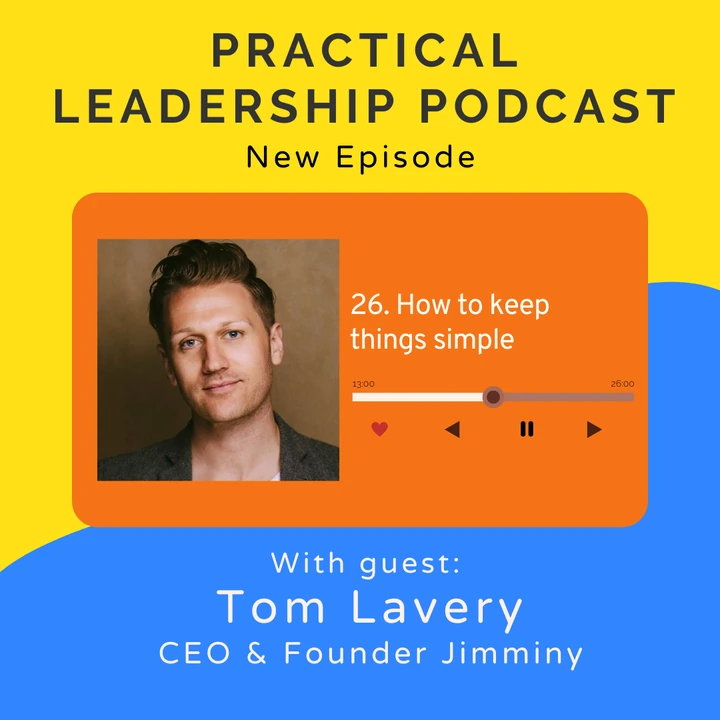
How to keep things simple
with Tom Lavery
Show notes
“Measure twice, cut once” said Tom Lavery’s old design & tech teacher, Dr Knapp.
He’s CEO over at Jiminny (Tom, not Dr. Knapp…).
Talking about first aid for new managers – we spoke about How to Simplify things.
Keeping things simple makes them go faster and be easier to test.
Tom started as a leader on the footie pitch.
Eventually building high performing sales organisations and now running his own company.
“Measure twice, cut once” stuck with him – even in the fast-paced high-growth world, there’s still time to measure twice.
Find Tom here: https://www.linkedin.com/in/tomlavery7/
https://twitter.com/TomLavery7
———
For your New Managers who need training & coaching, digital & live visit: https://leadershipthatsells.com/
Transcript
Automated transcript. Speaker labels and spellings may contain errors.
Paul
[upbeat music] Hello and welcome to The Practical Leadership Podcast where I interview great leaders and try to extract their wisdom and their experience for you to learn from and hopefully avoid making their mistakes. If you want to upgrade your leadership skills in 25 minutes, check out practical-leadership.academy. [upbeat music] Tom Lavery, thank you very much for joining me.
Tom Lavery
Hey, Paul. Great to be here. How are you today?
Paul
I'm cracking. All the better to have you on board. All the better. Now-
Tom Lavery
Awesome
Paul
... I wanna go back in time for just a tiny bit here. Now, you founded Gemini about six years ago. We'll get to that.
Tom Lavery
Okay.
Paul
Okay? But you started off in health clubs. So 20, whatever it was, years old out of university, there you were running health clubs and being a manager there. And I ... It didn't sound like you got very much in the way of help learning how to do what you needed to do there. It's mostly an experiential thing. Moved from there to being a sales leader on some benefits and reward platform for a while, and ... Now, you did a grand job there. Built a, a team. Started selling yourself. Built, built a team. Went on the whole private equity journey for a few years. Expanded that into Australia. Expanded it into the US. You moved to New York City, I think.
Tom Lavery
Yeah. Mm-hmm.
Paul
Uh, and then ended up with, like, over 100 people in sales.
Tom Lavery
Mm-hmm. Yeah.
Paul
Something like that.
Tom Lavery
Yeah. Mm-hmm.
Paul
Then that was then where lightning struck and you had the fabulous idea for Gemini, being that you were trying to be this global sales leader and couldn't really see, as we all struggled, you always struggle to actually have this view of what's going on.
Tom Lavery
Yeah.
Paul
You came up with Gemini.
Tom Lavery
Mm-hmm.
Paul
So going back in time, what point did you first become a people manager?
Tom Lavery
Oh. That's a great question to start. I think, um, I think it didn't start with management with me. It started with leadership.
Paul
Oh, go on then.
Tom Lavery
Yeah.
Paul
Tell more.
Tom Lavery
Uh, I started with playing sport. So I think if I look back at, like, playing football, like, 13, 14, 15, playing men's football, county league, you know, it's about being a leader on the pitch or one of those leaders on the pitch. Um, communicating, talking to people, making people feel good, getting people back up, you know? Um, so m- people management for me is a work in progress and a learned behavior. Um, uh, and I'm always ... Like with anything, you're constantly trying to improve, but I think it started with leadership. So I knew how to lead because of sport. I didn't know how to manage. That's a whole different ballgame. [laughs] So ...
Paul
Do you know, it's, it's an interesting thing, that.
Tom Lavery
Mm.
Paul
I've, I've been saying that sometimes you, you need t- you need to learn how to manage before you can become a leader.
Tom Lavery
Mm.
Paul
But that's almost intentionally when you're trying to become this leader, 'cause so many people say, "Oh, I need to be an inspirational-
Tom Lavery
Yeah
Paul
... Steve Jobs type." Ah, son, that's not gonna happen. It's just not.
Tom Lavery
[laughs]
Paul
Right? I- if that's you, that's great.
Tom Lavery
Mm.
Paul
But most of us, that's not the case. Most of us are, you know, just trying to get stuff done, but you're doing it the other way around.
Tom Lavery
Mm.
Paul
You came across it from y- you're out there on the pitch in the peeing rain-
Tom Lavery
Mm
Paul
... trying to get people to actually lift their feet off the ground out the mud and, and score goals.
Tom Lavery
Yeah. Well, you d- you know, it's kind of like the old analogy really of being a player coach, where you're in it with them, you're doing it with them. So I think that's how I started off in people management, like, I would be very much in the weeds with them, leading by example, 'cause that's all I knew. I didn't know any other way. I didn't have a d- a BA Honors degree in this, or I didn't go to uni. I just wa- ... So you know, I didn't have a, a textbook way of people management. I just do what I ... [laughs] Did what I knew, which was to lead, you know? But everything else kind of evolves over time, and you learn from experience, you know?
Paul
I was having that chat with my, my daughter actually. She's just going in-
Tom Lavery
Oh
Paul
... she's just applied for ... Uh, she's 11, right?
Tom Lavery
Oh.
Paul
So it's a job application, okay? Big job application.
Tom Lavery
Okay. Yeah.
Paul
She's just applied to her, her school to be the sports, uh, captain. She loves her football.
Tom Lavery
Yeah.
Paul
So she wants to be a sports captain. She was trying to write down all this stuff about, you know, what I can do as a leader and that, and she came up herself by saying, you know, "I'm gonna help people who are good at things get really good, and I'm gonna help the people who are not so good actually just like it." I'm thinking, "Whoa, my God, she's 11."
Tom Lavery
[laughs]
Paul
It's not a bad start, is it?
Tom Lavery
That's ama- that is, that is amazing for an 11-year-old.
Paul
It was.
Tom Lavery
Yeah.
Paul
It was. She's a smart cookie. Um, I, I take all the credit of course.
Tom Lavery
No, of course. Yeah. [laughs]
Paul
Right? But, so at, at what point then did you realize that this whole leadership gig, um, needed more to it than just character? Because you come across as a quite a charismatic chap.
Tom Lavery
Mm-hmm. Uh, like, I g- you know, I guess it gets to the point where you need to get stuff done. So, you know, that, that, that kind of leadership will only take you so far, you know, 'cause then you've got the process around it, how, how you make people feel, you know, all the different types of, uh, situations that come up. Um, but yeah, I d- I just felt after a period of time that you, you had to do, you had to do much more around, um, listening, understanding. And then you've got the whole situation where every, every person in your team is different. They respond differently. They behave differently. They need different things. So, and then of course you've gotta deal with different situations, so people who are performing, aren't performing.
The prob- the pr- the difference is, uh, a football match is finite, right? It has a start [laughs] and it has a finish. Um, business is generally infinite, so it's constantly going and moving. So even though there is lots of- ... things that are the same in sport and business, and you can make lots of good analogies to it, they are very different in that way. Um, so you're not defined by, "Oh, it's finished," and, you know, "We did this today," and, you know, it's a constant moving feast, so you do have to approach it in a different way.
Paul
Infinite games are finite games, isn't it? Game-
Tom Lavery
Mm-hmm
Paul
... game theory.
Tom Lavery
Yeah. Yeah, exactly. I don't, I don't claim credit for that. It's a Simon Sinek book.
Paul
It is. Uh, it's a good one.
Tom Lavery
Yeah, yeah. Cool. [laughs]
Paul
So, I mean, there's the, the, uh, what do they call it? The golden rule.
Tom Lavery
Mm-hmm.
Paul
Treat people as, uh, you want to be treated. It's not quite right. I think it's a misinterpretation. It was, it's, "Do unto others as you would have done unto you," which really means treat them as they want to get treated, not as you want to get treated.
Tom Lavery
Mm-hmm.
Paul
Just kind of turn it the other way around.
Tom Lavery
Well, it's interesting you say that, 'cause one of our company values is to be kind, right? They all have, they all have adjectives in front of them, but, you know, it's use of language is so important all the time. You know, it treads a very thin line between saying one thing, it's all how you say it and when you say it, you know, not necessarily the, the, you know, what you're saying. Um, but making sure that you say... You could say... A really simple example is, "I've got to have a difficult conversation with that person next week." Or you could say, "I've got to have a really important conversation with that person next week." Same thing.
Paul
Mm-hmm.
Tom Lavery
Just very different, and that's coaching, right? That's coaching yourself. Um, different mindset, mentality. 'Cause if I have a really important conversation with that person, they're gonna und- understand how they need to get better or how they need to improve, or we need to make a change, you know? So it's all about that, and e- even though it might be challenging, it's important, but it's all about how you do it. You can do it in a be kind way even though it might not, might not be something you're looking forward to for X, Y, Z reason, you know?
Paul
I love changing things up. I like, I love-
Tom Lavery
Mm-hmm
Paul
... the framing that that sort of subtlety puts around. I mean, it's very persuasive language.
Tom Lavery
Mm-hmm. I'm not gonna take credit for that either. That's my wife, Shelley. [laughs] Very, who's a very big, uh... She coaches me a lot and very, uh, good coach generally. So, like, if I was having, you know, the important conversation's not, uh, a difficult conversation, so that's something, you know, uh, it's all about use of language.
Paul
I do like that a lot.
Tom Lavery
Mm-hmm.
Paul
Mm-hmm. What, then, if you were having to give advice on somebody who was taking on a management role, leadership role for the first time, what would be your first aid for them?
Tom Lavery
So I thought about this in terms of, you know... There, there's two sides to it because they have to... D- do you know what, actually? There's process, and then there's listening to people, and it's always a balance, right, of going, "Right, this is the way we wanna do things, and this is what I'm hearing you, and this is how we need to change and adapt." You know? So you've got those two sides of it. Probably the biggest thing or the biggest value I add still now is simplifying things. The biggest mistake I see in management, business, leadership, product, sales, you know, anything, we, he, as humans, we are fantastic at overcomplicating things, ugh, to the Nth degree.
Paul
Yeah.
Tom Lavery
You know?
Paul
Gold plating stuff like crazy.
Tom Lavery
Yeah. Yeah. Uh, it's just, you know, it's in- inherent in, in most people. So it's not, it's not... It's just the way people are generally, but, you know, if I was saying my one bit of advice, it's just simplify everything.
Paul
Oh.
Tom Lavery
And it'll get, and it'll get you a lot further. Well, you could write out, "Well, these are the steps I think there are in the, in the sales process or, you know, the product delivery," but, you know, you're probably thinking, "Well, could I cut out, you know, 60% of them? Do I actually need to do that 60% of it today, or do I just need to do this and see how it works?" Because the bigger the project, the bigger the task, the more steps, the longer it'll take you to find out if it works or not, you know, just generally. [laughs] So you keep stuff simple and iterate, then it tends to, tends to help.
Paul
That, I mean, that's not a necessarily intuitive point-
Tom Lavery
Mm-hmm
Paul
... in the fact that, yes, you want to simplify, but why do you want to simplify? Okay, take, it takes less time. Yeah, that's great. It takes less time, but what does that then mean? And I love second and third order effects.
Tom Lavery
Mm-hmm.
Paul
Again, you're trying to teach your kids that, you know, you have a reason for something, but then you've got the reason for the reason for the reason-
Tom Lavery
Mm-hmm
Paul
... or the subsequent consequence of the consequence of the consequence.
Tom Lavery
Mm-hmm.
Paul
And you said it. Number one, you get it done faster, but number two is you get to test it, and that from your point of view as a leader of a, a very fast-growing startup is you, you test things. You experiment all the time, and the fewer steps, the more iteratively experimental you can be with those fewer steps-
Tom Lavery
[laughs]
Paul
... and the f- less complex that is.
Tom Lavery
But p- people have a perception, "Oh, I'm gonna do this, and it would just work."
Paul
Ah, that's fine.
Tom Lavery
Right?
Paul
I like that. [laughs]
Tom Lavery
No, but, like, it's just natural. Again, it's like, "Oh, well, we spent this long doing it, so it must be right." Well, maybe not. Maybe you got to throw it all away and start again.
Paul
[laughs]
Tom Lavery
Not always, but-
Paul
Mm-hmm
Tom Lavery
... you know, sometimes you just got to, you know, do that in certain situations. But again, uh, you know, that comes with time and experience and understanding, you know? 'Cause if you... This is an old... [laughs] One of my, uh, not many things stick in my head from school teachers, but this, uh, design and technology teacher I had called Dr. Knapp. Anyway, doesn't, name's irrelevant. Uh, it was basically like measure twice, cut once, and even though you're working at speed- And you're growing in a startup or a scale-up, you know, you can always measure twice, cut once. 'Cause if you, if you, if you implement it and it's wrong, the clawback and the, you know, everything is, uh ... So measure twice, cut once, even if you're going fast. [laughs]
Paul
I like that as well. That's really good. Dr. Nap, there you go.
Tom Lavery
Yeah.
Paul
I had a-
Tom Lavery
Yeah
Paul
... a chemistry teacher. I, I really ... I, I'm sure he's dead now. He's, he m-
Tom Lavery
Mm
Paul
... he was very old when he was a chemistry teacher. M- all your teachers are old, weren't they? All my teachers were old. You know, like-
Tom Lavery
That's, that's right
Paul
... you could've been in your 25s, you know.
Tom Lavery
Mm.
Paul
But my teacher was a, a chap called, uh, Richard Dick, and of course, he was the head of chemistry, and on his door, for God's sake, on his door, he had A ... I'm s- it was Anthony. No, wasn't it? Let me say that again. It was, it was Anthony Dick, Head of Chemistry.
Tom Lavery
Mm.
Paul
And of course, on his door, he had A. Dick, Head of Chemistry. Somebody should have told him, you know?
Tom Lavery
Yeah. That's, uh ... Yeah, especially with schoolkids. You're asking for it.
Paul
Oh, miserable.
Tom Lavery
Mm.
Paul
We must have made his life miserable. I'm sure I did.
Tom Lavery
Mm.
Paul
Um, you're a sales leader at heart. That was your core before you got into doing this, and this is the, the, the, the be-all and end-all of Gemini, is to make sales leaders' lives better. And, but it's a hell of a piece of kit, by the way.
Tom Lavery
Mm.
Paul
I've recommended it to all the folk that I work with, so.
Tom Lavery
Oh, thank you.
Paul
I won- I won't ask you for any commission.
Tom Lavery
Oh, of course.
Paul
But certainly, big, big-ass plug here. Go, go see Gemini. Go. It's brilliant, brilliant piece of kit.
Tom Lavery
Mm-hmm.
Paul
Um, especially when you can search for things. I love that-
Tom Lavery
Mm
Paul
... inside a, inside a call recording tab.
Tom Lavery
Yeah.
Paul
Absolute genius idea. Building a sales team, a high-performing sales team.
Tom Lavery
Mm-hmm.
Paul
Because you can measure it, I think sales is ... Sales teams are the most measured, the most, the most put upon of most org- uh, parts of an organization.
Tom Lavery
Mm.
Paul
What did you learn most from doing that repeatedly in different places in your career? What's the biggest takeaway you did from having ... From building that?
Tom Lavery
So the biggest takeaway from-
Paul
Building those teams-
Tom Lavery
Yeah
Paul
... repeatedly.
Tom Lavery
Um, so ...
Paul
Do you have to do it again?
Tom Lavery
I think the, the ... Yeah, yeah. You s- well, it's ... Do you know what? A lot of it, I sometimes joke that I'm a parrot. Like, I'm constantly repeating myself. So there's ... People have this illusion. I'll write it down in a document. Could be Playbook, Confluence, Google Doc, whatever, you know. Whatever your tool of your choice is. But that's only half the jou- journey, you know. It's about communication, uh, talking it through. People learn by doing. Uh, they learn by, you know, osmosis in the moment, you know. So just generally, it doesn't matter what they are. So yeah, you know, you've got to hire well. You've got to train well. You've got to coach well. You've got to reinforce all these things again and again. Keep simplifying the process. Keep iterating the process. So, you know, th- those things are just like ...
You know, the knowledge and effort that you need to put into someone to make them great is a lot. It doesn't ... You don't just, you know, hire people, you know, put them through a process, and they pop out being great. You gotta invest time and energy in making people great. Um, and a lot of people are scared of doing that, don't know how to do that, think they don't have to do that, you know. But that, that's it. You've gotta invest time and energy in making, making people great personally. [clears throat]
Paul
So, I mean, you said it there again, simplification. How to simplify.
Tom Lavery
Mm.
Paul
How to keep things ... How to break it all down, make it as easy as possible for everybody to understand, to test, to-
Tom Lavery
Mm
Paul
... to ... Okay. Was there, uh, a mistake or an event that you learned most from on this journey?
Tom Lavery
Well, as many mistakes as there was things that I did right. M- me and my old ... Before I started my own company, my old co- co-founder, uh, sorry, my old founder, he's a, you know, used to joke, "We just get as much wrong as we do right. It's just the stuff we do right was different," you know. So it got us that far 'cause we think, uh, think differently, ultimately. Um, you know, so yeah. I, I think if I'm looking at a particular mistake, in the early days, people have, whether it's consciously or subconsciously, and this is me being very open, I think you ... It's very hard when you're young, in your early 20s, hiring people, not to have recruitment bias and not to hire too much in your own image, you know.
So then, you know, every- it ... But again, people didn't talk about it like they do now. So, you know, it's very front of mind to be diverse and have a diverse team. But as you, as you build teams multiple times and again, you might say, "Well, someone's a culture fit. They fit into the culture. They fit into the values. They've even got a skill fit," yeah? But actually, do you see them sitting with those people and collaborating, working together? No, if I put that person in, it's gonna disrupt the, the culture of the team. So people don't often go that far. So I think that, you know, that's something I learn, you know, is ... And still learning how to hire well, recruit well. Hardest thing is getting a team of people to fit together that don't know each other.
Um, and lots of things you can do. Uh, but yeah, that, you know, that's a big part of it. If you learn fast how to recruit well and train well, it'll get you far.
Paul
Is it 85% of your, your management challenges go away if you've got ... If you can hire well?
Tom Lavery
Yeah.
Paul
At least.
Tom Lavery
Yeah.
Paul
At least.
Tom Lavery
Is it ... [laughs] Yeah. Easier said than done.
Paul
Oh, absolutely. And it's the best thing. When you see it actually working, when a good team is humming-
Tom Lavery
Yeah
Paul
... it is such a rewarding thing. To be honest, it's, it's the best thing that I've done in my career, is build my last management team.
Tom Lavery
Yeah.
Paul
Like, hell yeah.
Tom Lavery
But also as well-
Paul
Yeah
Tom Lavery
... it's almost like that still has a period of time. What goes up must come down.
Paul
It does.
Tom Lavery
Someone has a, someone has a peak. They need a new challenge. You know, I often look back at periods of time and go, "Oh, for that 18 months, we had that team, and that was great." But-
Paul
Somebody leaves
Tom Lavery
... you know, can't ... Yeah, it can't last five years or-
Paul
Yeah
Tom Lavery
... you know, uh- Just different things happen in life.
Paul
Mm-hmm. It's just when, you know, when the wind fills your sails and you're, you're sailing along at full speed-
Tom Lavery
Mm-hmm
Paul
... then all of a sudden, something pops. Storm arises.
Tom Lavery
Yeah.
Paul
You know?
Tom Lavery
Yeah. Yeah, there's always something around the corner. [laughs]
Paul
Always something around the corner.
Tom Lavery
You get, you get used to it after a while. [laughs]
Paul
What are you working on at present, Tom?
Tom Lavery
Um, what, you mean within the company?
Paul
Yeah. What's big for you just, just now?
Tom Lavery
Um, ah, well, we took a 16.5 million, like, round of funding back in August. So, you know-
Paul
You haven't spent it yet
Tom Lavery
... it's always been... Yeah. Well, it's interesting now. Everyone's telling, uh, their investments to choose the Gimme model, which is basically to be capital efficient, and to, you know, still grow at a high rate but deploy the cash carefully and be, generally be capital efficient, which we've always been. So, um, you know, we, we always needed to catch the business up to be a certain size, um, you know, in terms of having the right team in the right spaces. So for us really, it's, you know, we've got hundreds of customers, how do we get to thousands of customers? How, you know, deliver on the mission, you know. And I think the whole conversation intelligence space is just scratching the surface in terms of what you mine from video and voice conversations and email, and how you use that data, um, to self-drive the CRM and to basically make, uh, teams better.
So yeah, I'm really excited about what we're building next year. I'm excited about the new people that are joining the team. I'm excited in properly what it looks like in the economic downturn globally, that people will look to get the best out of their team. So how can we help them do that? So yeah, I think when you pin all those things together, you know, really making that product better, making our team better, and helping customers' teams get better.
Paul
That's a... I, it can be a good place to be in right now.
Tom Lavery
Mm-hmm.
Paul
I think it could be good for, for some people.
Tom Lavery
Yeah. I think it's difficult. Like, we... I mean, we're really open. Like, we see lots of customers where they've renewed and they love the product, but maybe their team's 20%, 30% smaller than it was. That's a, you know, there's a lot of that I see in the market for sure. Mm-hmm.
Paul
It's a challenge if you're selling seats. Yeah.
Tom Lavery
Mm-hmm.
Paul
Mm-hmm. What are you reading or listening to right now?
Tom Lavery
Oh. Do you know what? There's so much co- I was talking to my wife about this the other day. There's so much content out there now. I feel like almost the podcasts that I've subscribed to have become overload. Like, I don't even think I can listen to everything I want to listen to. There's so much content out there.
Paul
Double speed.
Tom Lavery
Yeah.
Paul
[laughs]
Tom Lavery
Well, you know, listening to your team sales calls, then you wanna listen to your favorite football team's podcast, then you wanna actually dive into something business-related. So, um, what do I... I think regularly, uh, I pick and choose which ones, but I listen to Diary of a CEO-
Paul
Right
Tom Lavery
... which is very popular. Um, but he, you know, when someone becomes that popular, some people are gonna like them, some people aren't. But I do like his interviews with CIO- CEOs, just, you know, people who've been there and done it before, and listening to their own experiences-
Paul
Mm-hmm
Tom Lavery
... I think is very helpful. He's not always got that icy, that persona in every interview, but when they do have... Like I think I listened to one the other day with the Whoop, you know, the wearable band.
Paul
Mm-hmm.
Tom Lavery
Um, the CEO of that company, which is really interesting. So yeah, I tend to, to, to listen to other CEOs or founders. That tends to, you know, inspire me, give me ideas, make me think about things. You know?
Paul
That's why, one of the reasons you listen to people like that is the same reason you have friends. It's to rem- remind you that you and your journey is normal.
Tom Lavery
Yeah. Of course. Mm-hmm. Exactly. [laughs]
Paul
Is there something you might like to thank young Tom for doing?
Tom Lavery
Oh. I did, uh... So I didn't think this at the ti- Like, if I went back in time, what am I now? 10, 12 years ago, you know, selling. The best salespeople I have worked with or work with, it's all, it's almost like a professional athlete. It's mindset.
Paul
Mm-hmm.
Tom Lavery
You know? And culturally, you, you know, you don't do these things, right, in a business because you're, um, you're working to support team and stuff like that. But you come in, doesn't matter what happened at the weekend, what went on at home, you can park it at the door and you just go, "I'm in work mode." There's only cer- There's a very few amount of people that can absolutely block everything out and just say, "I am focused. This is what I am doing now for the next eight hours, and it, I don't think about anything else." Yeah? And that, that's the whole thing. And then, you know, in sales, we all know BDR, SDR, how many nos you get, you know, loads. [laughs] You know, just the resilience and the mindset to pick yourself up. And then there's the whole thing, mindset mentality of being, are you externally motivated? Are you internally motivated? Can you internally motivate yourself?
'Cause, you know, a lot of the guys out there that play for England, there's probably more talented people out there when they were younger, but they've got the mindset and the mentality to go, "Right, I'm gonna do this." So again, like, you know, I think one of the things I'm thankful for is I definitely wasn't, at 24, the best enterprise salesperson out there, without a doubt, but I could close deals with Vodafone and McDonald's and Aviva or whatever, um, because of my mindset and because of my mentality and because I believed what I was selling them was the best solution for them. So I'd put a massive, uh, part of the success down to that, but not even realizing it almost at the time it was happening. Um, you know? Yeah.
Paul
How would you describe that mindset? I mean, we, we say, "Oh, it's all about mindset." Yeah, but which one?
Tom Lavery
[laughs]
Paul
Is it the crappy one that says, "Oh, my mindset is to sit at home on m- in bed and eat cake"? It's not a good mindset. What was your, what was your positive one that helped you? A few words
Tom Lavery
Well, I think it's just the, the, the blocking that everyone has, like, people call them different things, voices in their head. So you don't-
Paul
Self-talk.
Tom Lavery
Yeah
Paul
Your positive self-talk.
Tom Lavery
Self... Yeah, you just don't listen to those things. Just not there. You just ignore them. You push them to control your mind.
Paul
Mm.
Tom Lavery
You know, uh, people know way more about it than me, but, you know, it's controlling your mind to go, "Well, I'm gonna focus on these things. These are the most important things." Having a, a, a goal or a, um, target that just, you know, whatever you do, nothing's gonna stop you from getting there, you know? That's just the way, uh, you need to be, you know?
Paul
Okay. Okay. Seems to have worked.
Tom Lavery
[laughs] I'll let you know. I'll let you know the outcome in a few years.
Paul
Mm-hmm. And then lastly, as we wrap up, Tom-
Tom Lavery
Mm-hmm
Paul
... what are your coordinates? How can people find you?
Tom Lavery
Oh, easy. Um, uh, LinkedIn, you just find me Tom Lavery. Jiminy, J-I-M-I-N-N-Y. If you wanna talk directly to the team, you can go to the website, book in a chat. Um, but yeah, if you, you can find me, I do tweet, and, uh, but I look on Twitter, so TomLavery7, or, yeah, just hit me up on LinkedIn.
Paul
Lovely. Tom Lavery, thank you very much indeed for joining me.
Tom Lavery
Absolute pleasure, Paul. See you soon.
Paul
That's a wrap. Thank you for joining me today. Your homework, subscribe and share this with a friend or colleague. Please leave your five-star review and any comments you have, because that really helps me to improve every day, and it helps people to discover me online. If you want to upgrade your leadership skills in 25 minutes, you should check out practical-leadership.academy. [outro music]