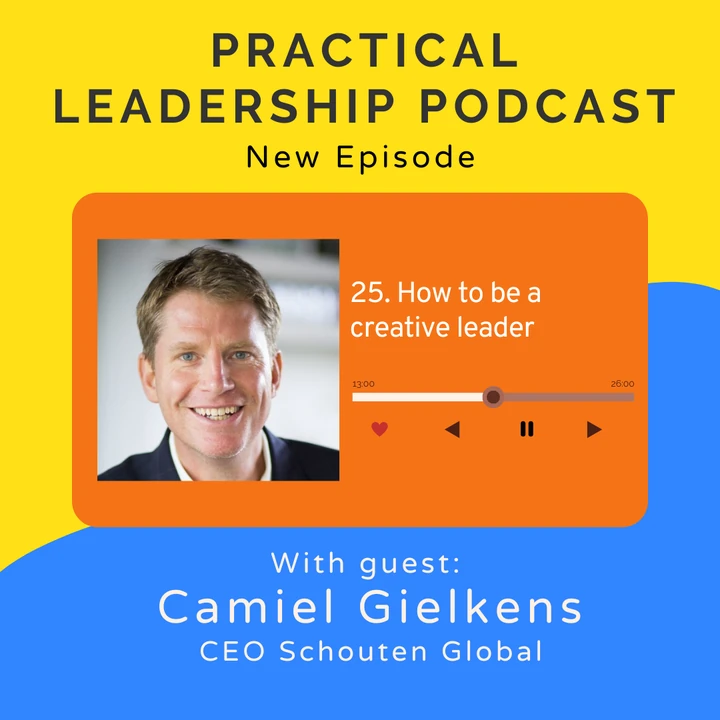
How to be a creative leader
with Camiel Gielkens
Show notes
Becoming global CEO of a face-to-face training company on the leading edge of a global shutdown is a problem on a planetary scale.
Thankfully, Camiel Gielkens, CEO of Schouten Global, one of the world’s biggest and best learning companies, already had a plan to move digital.
He was ready to reinvent. His new learning brand – Relevance – speaks to just that: how do we stay relevant?
By constant learning and reinvention.
Join me as we dig into how to combine and balance Strategy and People.
How to use Power and Influence to get things done.
When to lead and when to sit back.
I’d hire Camiel because he’s possibly the best communicator I’ve met because he knows to focus on his Intent, not his goals.
He speaks about the need for new managers to:
– be fit – mentally and physically
– build and maintain knowledge
– develop the skills to do the job
– create change
Find Camiel here: https://www.linkedin.com/in/camiel-gielkens-a651a6/
—
Leadership is hard. See what people have to say about my focused, practical 25 minute session group coaching here: https://leadershipthatsells.com/
Transcript
Automated transcript. Speaker labels and spellings may contain errors.
Paul
[upbeat music] Hello, and welcome to the Practical Leadership Podcast, where I interview great leaders and try to extract their wisdom and their experience for you to learn from, and hopefully avoid making their mistakes. If you want to upgrade your leadership skills in 25 minutes, check out practical-leadership.academy. [upbeat music] Camille Hilkens, thank you so much for joining me today.
Camiel Gielkens
Thank you for having me, Paul.
Paul
So I want to share with my enormous audience-
Camiel Gielkens
[laughs]
Paul
... you are one of the most admirably best communicators I know. Uh, I mean somebody who can connect strategy and people really, really tightly together, and I think that's what I first noticed when we start- we worked together just, uh, briefly just a- about quite a few years ago.
Camiel Gielkens
Yeah.
Paul
Um, somebody who's smart, gets stuff done, but connects all the dots as well. You're chief executive officer of, uh, Schouten-Nederson. You've had a really interesting early career though. You were a strategy consultant, you did some biz dev roles, then flew off to China to chase your wife.
Camiel Gielkens
Yeah.
Paul
Now, was she your wife at that point or afterwards?
Camiel Gielkens
Um, it's ... No, we are already together for more than 20 years, so when she moved to China-
Paul
Yeah, no, jeez
Camiel Gielkens
... I just followed her like a good husband needs to do, right?
Paul
That's what you do. That's what you do. And so you made that leap. You made it, went into a new industry at that point, I think.
Camiel Gielkens
Yep. True.
Paul
And learned an awful lot from China, brought that back, but in the last four years specifically at Relevance, this global learning company here, which is just such a strong name. What, what, what have you taken from your career so far that has really made that step into the CEO role easy?
Camiel Gielkens
Yeah. I think, you know, Paul, when you look at the world, there are so many uncertainties. You know, we've got a war going on, we've got digitalization, customer expectations that are increasing by the minute, and I think it's so easy to get lost in it, so the key message I take for myself, but also to the people I work with, is always start with an intention. If you look at the situation, what do you really wanna create?
Paul
So start with the end in mind?
Camiel Gielkens
Yeah. But really, it is not only the end goal, but also what do you really wanna create? A purpose for me, for example, is to touch as many people as possible around the globe, and to help them to be relevant, but touching as many people as possible is really what drives me. That's my purpose, my intention. An end goal can be a number, can be a topic, can be anything, but that intention, that's really important. And sometimes, you know, I heard a story about how painters start their work. You know, they really start with a blank canvas, and the first thing they look at are what's the emotion I wanna bring? And what's my intention? And I think if you are aware of your intention, and then you have got endless possibilities.
Paul
So the goals are just subsets of intention.
Camiel Gielkens
Exactly.
Paul
Mm. And then you have to bring, uh, your energy, you have to bring your experience in aligning people, aligning strategy-
Camiel Gielkens
Yeah
Paul
... under the umbrella of intent.
Camiel Gielkens
Yep.
Paul
Okay. When you see people coming through your organization or when you've experienced, um, people developing themselves within your teams-
Camiel Gielkens
Mm-hmm
Paul
... how do you advise them? W- what is it you say to them to-
Camiel Gielkens
Yeah
Paul
... foster that intent?
Camiel Gielkens
I'm really proud, you know, I'm working together with around 400 people and really focusing on leadership, change, power skills, and I see a lot of people, people growing. Uh, what I'm always looking at, you know, what's, what's their core strength, and are they able to utilize it to the max? And when people focus on core strength, I see they're a lot better than avoiding things, of learning the things they are not good at. So I, I love people who, who focus. Also love people who, who know their values and what's their intent. And actually, you know, you talked about goals, when they have a goal in mind. You know, I love when people say, "I wanna be the CEO." Love it. And they have a clear, clear ambition there, and that, that really drives them. So those are usually three things I'm, I'm looking at, and the advice I give, uh, apart from intention, usually certainly when I look at first time managers, I always say focus
on the what. Uh, what do you really wanna create? And that's more from a strategic perspective. And also really look at the how, but it goes hand in hand. I don't really believe in people managers, you know, because you cannot only manage people. You can only manage both direction, strategy, and people, and when you're able to, to combine it, I think then you can really, really step forward. You know, people who only focus on people, I think they go for harmony, too nice. People who only focus on strategy, like I did in the past actually, I was so good at losing people around me. And you call me a good comm- comm- communicator. I'm the worst one, because I love content, I love strategy, I love direction, but if I'm the only one who believes in a ...
You know, I try to be the smartest people in the class all the time, and if you do that, you know, you take space from other people. They wait, they become reactive. But certainly when you wanna scale up, then you want to put other people in the driving seat, and it ... You can only achieve that by combining the what and the hows. That's really my advice to, to first time managers.
Paul
It's ... The, the strengths one always resonates with me.
Camiel Gielkens
Mm-hmm.
Paul
There's a lovely phrase, I think it's from the Gallup, uh, you know, this massive Gallup survey they do every year.
Camiel Gielkens
Yeah, for sure.
Paul
And it was something like, I'm gonna get this wrong, I'm sure.
Camiel Gielkens
[laughs]
Paul
Don't focus on putting in what was left out.
Camiel Gielkens
Mm.
Paul
Focus instead on bringing out what was left in, because that's harder.
Camiel Gielkens
Exactly.
Paul
Yeah. And when you focus on, on trying to, trying to develop a weakness, then, oh, it's, it's, it's not as, it's not as pleasant. It's not as effective. It certainly won't move the needle.
Camiel Gielkens
No.
Paul
Moving somebody from a three in a 10 point scale to a four, well, it might stop them being debilitating, but it won't move the needle in your organization.
Camiel Gielkens
Mm.
Paul
But moving somebody from a position of greatness to a position of excellence And that's the impact there
Camiel Gielkens
That's where the magic happens. Yeah. I love what you said about moving the needle, uh, because that's the end, but as CEOs, and you as a business leader, what we try to achieve and really move the needle, go from a six to a nine, and that works a lot better when you focus on strength and all the things that are, that are working well, and without pushing the rest away, of course.
Paul
And you build up the, the, the talent stack. I mean, people have these, this... Like, if you think of like a stack of pancakes, you know?
Camiel Gielkens
Yeah
Paul
Like big stack of pancakes there, and each of those pancakes is one of your talent, one of your core talents, one of your core skills.
Camiel Gielkens
Right
Paul
And if you are in the top 25%, it's not great, but top 25% in each of these things, that unique combination really makes you a highly valuable individual.
Camiel Gielkens
Yeah.
Paul
And that, I think, goes to your relevance point of view, doesn't it? How do you stay relevant?
Camiel Gielkens
Yeah, exactly.
Paul
Yeah. So what, what are those skills then? 'Cause you see these, the, the things coming out of the WEF and it's always gonna be, "Oh, it's critical thinking. It's, uh-
Camiel Gielkens
Critical thinking
Paul
... all that sort of stuff. And they, I'm sure they just copy and paste it, frankly.
Camiel Gielkens
Yeah.
Paul
But what do you think then are the, the core talents that you see in a, in, in, in a leadership company, in organizations you talk to?
Camiel Gielkens
Uh, actually for me, the key thing is that you look at four things. The first one, actually you talk a lot about it, is fitness.
Paul
Mm.
Camiel Gielkens
'Cause there's so much change going on, so if we are not fit as leaders, we don't have the energy, how can you give energy to the people around you? So I know you do a lot of meditation, and I think that's, that's a great way to work on your, on your fitness, both physically, as mentally. Then, of course, you need to have the knowledge, understand your industry, understand the key trends. So I think having that outside view is, is critical. Uh, and to have that outside view, that's a lot to do with skills, of course. And then I think curiosity is, of course, one. Looking at the whole, like being able to, to see the whole is another one. Uh, good communication, but you know all the, all the lists. You know, people skills are getting more and more important, but combining the knowledge with skills, I think that's, that's where a lot of the, the, the, the magic happens.
So if you are fit, you have the knowledge, you have the skills, so then the next step is really to be able to create change, to have that creator modus, to be, in a way, to be the artist, um, uh, a- and make change happen, drive change, and create things that are not, not there yet. So those four things for me are, are crucial, and it's in the combination. Uh, and I love what you just said about your own strength, and don't try to copy somebody, don't try to fit in the mold like how a leader should be, and be your own leader.
Paul
Mm-hmm.
Camiel Gielkens
And that's, you know, I think that's also the, the key message of, uh, of, of building inclusive organizations. And we don't have one mold, and every leader should be like that. And we really look at you, we focus on you, we see your values, your strength, your ambitions, and we help you to be the best leader, leader possible that really has the right fit with what the organization needs in, uh, in a specific moment in time. And I don't believe in the mold. Of course, skills give a direction in, in what we all need to learn. Um, it looks what fits, and I think even if you look at skills, for me, one of the... So I'm, I'm thinking aloud here when we are talking, it's just the skill to learn, of course.
Uh, because what you learn today is less relevant tomorrow. So to keep on learning, to keep being curious, uh, to keep innovating, I think that that's what we need in time. Yep.
Paul
I think the only way you can genuinely stay relevant is to constantly reinvent yourself.
Camiel Gielkens
Exactly. Yep. And that's what we need to do.
Paul
When you took on, uh, the CEO of, uh, Schouten, and then I remember we were talking about this, and you were saying, "Gotta go digital," 'cause you guys were all face to face.
Camiel Gielkens
Yep, true.
Paul
You gotta go digital, gotta go digital. Then guess what? Well, the, a year, maybe a year and a half into your role, bang.
Camiel Gielkens
Yeah.
Paul
Everything kinda had to go digital really, really quickly.
Camiel Gielkens
COVID helped us a lot, but you're right. We had the vision, we had the building blocks-
Paul
Yeah
Camiel Gielkens
... um, and we make it happen. Yep.
Paul
So you had to reinvent yourselves as a, as an organization.
Camiel Gielkens
For sure.
Paul
But I think as an individual, we have, we... And you gotta look at somebody like Madonna, right? I still like Madonna, you know. Vogue, vogue.
Camiel Gielkens
>
Paul
> Oh, totally. We should do this as a duet. Um, but you've gotta-
Camiel Gielkens
Sure
Paul
... she reinvents herself so many times over her career.
Camiel Gielkens
Right.
Paul
And it's not by accident. You know? Maybe the first time was, but it's, it's because to, to stay relevant, you have to be, um, ahead of the game.
Camiel Gielkens
Yep.
Paul
And if you think, I mean, it's a thing for L&D as well. I used to talk about this to L&D people, and the L&D types, learning and development people, they would be saying, "Okay, what does the business need, uh, to, to, to, to deliver what they're delivering?" Says, "No, no, no, no, no, no, no. What does the business need to be ahead of where the, the market is?"
Camiel Gielkens
Going back, yeah.
Paul
"What skills are the ones for t- " So you kinda, it's a guessing game. That's why I asked you-
Camiel Gielkens
Yeah
Paul
... what are the skills of tomorrow, that sort of thing. It's really, it's quite hard to stay ahead of things.
Camiel Gielkens
Yeah.
Paul
So it's constant reinvention.
Camiel Gielkens
And that's also what I try to, to tell first time managers, 'cause I know you work a lot with first time managers, is embrace the uncertainty there, because you don't know. So let go of the control, let go of all the things you want to know or you need to know, but embrace uncertainty and, and look what, what, what is possible, and what are different scenarios, what's the impact on, on the organization, on your team? And given those uncertainties, then what are the smart moves you can make today to prepare yourself and be ahead of the game, and to innovate yourself? Um, but it has a lot to do with, with certainly for young people, I think letting go of control, um, and just accept the world is uncertain, and that you need to, still need to move and to act.
Paul
I think there, there's a, there's an agility, there's a mindset-
Camiel Gielkens
Mm
Paul
... of, there's like a flexible mindset, something like that-
Camiel Gielkens
Yeah
Paul
... that comes in there. What's the thing? VUCA, right? So it's volatility, uncertainty, chaos-
Camiel Gielkens
Ambiguous
Paul
... ambiguity, yeah
Camiel Gielkens
... complexity, ambiguity.
Paul
Yeah, yeah. That's it. Complexity, complexity. And you, you flip that, and then you have, with, with, to, to beat volatility, you need to go for vision.
Camiel Gielkens
Mm-hmm
Paul
... clarity of vision is what you were saying. What is the, not the goal, but what's the purpose? What's the intent here?
Camiel Gielkens
Yeah.
Paul
Yeah.
Camiel Gielkens
Exactly, and embrace it.
Paul
And the, uh, the, uh, the uncertainty has to be met with, I think, understanding.
Camiel Gielkens
Yeah.
Paul
And you understand that this is the nature of being.
Camiel Gielkens
That's right.
Paul
It's not something to fight against, it's something to flow with.
Camiel Gielkens
Yeah. And certainly as a young, as a young manager, you need to make decisions when you only have half, half of the information that, that is, uh, uh, that, that, that's available, and still you need to make a decision.
Paul
So there's a, there's a confident curiosity, I think.
Camiel Gielkens
Yeah.
Paul
Curious is the potential, but confidence the ... Confident that, you know, we're gonna go for this based on the deliberate intent that we only know-
Camiel Gielkens
Sure
Paul
... 60% of reality here.
Camiel Gielkens
Yeah.
Paul
You've, you've spoken elsewhere about power and influence, and not limiting yourself, and not being small, and being, having the courage to, to, to make yourself, you know, be the pufferfish. You know that fish that sort of goes whoop-
Camiel Gielkens
Yeah. Yeah
Paul
... and blows itself up to make itself look bigger. Can you talk some more about the, the, the, the, your concept of power and influence?
Camiel Gielkens
Well, if, if I look at my own career, it's really important to know when to take space, when to take the lead, and, uh, uh, be, be that strong leader in a way, but also when, when to follow. And I've seen a lot of smart people, uh, maybe a little bit introvert, have the right ideas, but they make themselves small, they are not heard, and then they com- they complain, "Hey, I don't get the credit," or, "I don't get the promotion." But in a way it's, it's, uh, look, that's the result of your own behavior. So as always, also say, hey, create, of, celebrate your successes, uh, ensure you also get the credits. 'Cause, you know, I love servant leadership, but I also seen [laughs] a lot of servant leaders who didn't get anywhere. Why?
Because they were so humble, and that's exactly what I mean by know when to lead, be bold, take the credits, and know when to follow, give the credits, build confidence, but you need both. And sometimes I think when I look at current leadership theories, you know, we, we emphasize servant leadership too much.
Paul
Totally.
Camiel Gielkens
Because of course you need to, to help other people. You need to be there. You need to listen. Now that's, that's one part of the business, but you also need to ensure there's clarity, there is direction, there is, there's boldness, that our decisions are made, like w- what I did when I joined Gaus four years ago. Said, "Everything we do is blended. We go digital." No questions allowed, [laughs] no nothing. That's the direction. That's what we do. And as a leader, you know, that's, that's, that, uh, you need both. And again, I saw too many really beautiful people, talented, young, who were only asking the questions and, and, and, and be humble, and then you don't get anywhere. So that's what I meant with combining power
and influence, have both, that the both sides.
Paul
That's, uh, I like that a lot. I think I like that a lot.
Camiel Gielkens
Yeah.
Paul
I have struggled on some occasions with people coming with the ... 'Cause I, I do, like you I'm sure with your teams as well, I, I do a lot of mentoring and coaching.
Camiel Gielkens
Yeah.
Paul
And, uh, I'm working just now with, um, my Practical Leadership Academy. It's basically-
Camiel Gielkens
Oh
Paul
... um, first-time managers.
Camiel Gielkens
Yeah.
Paul
The essence of what the first-time manager needs. And people coming and saying, "Well, humility. I've got to be humble. I've got to ... " I said, "Well, actually, no, you're struggling a little bit with the whole imposter thing here."
Camiel Gielkens
Mm.
Paul
"You've just got to step up. You know? You've just got to step up and in some cases be dictatorial."
Camiel Gielkens
Yeah.
Paul
This is my vision, and why am I having this vision? Because I'm the boss.
Camiel Gielkens
Yeah.
Paul
Today it's my choice. It's my turn to lead. I'm going to make this decision.
Camiel Gielkens
Yeah.
Paul
You know? And there's a, talking to Chap about, um, how you deal with conflict. You know, you can deal with conflict with your peers differently than you do with your, the, the reports, differently than you do with your boss.
Camiel Gielkens
Mm.
Paul
But in some cases you have to consider, is this conflict warranted? Because I am simply telling you what to do.
Camiel Gielkens
Yeah.
Paul
Not necessarily how to do it, but this is my vision, and execute it please.
Camiel Gielkens
Right.
Paul
Please, if you don't mind. [laughs]
Camiel Gielkens
Yeah. No, I, I, I recognize your struggle. I had the same struggle with, with conflicts for example, because in the beginning I thought, well, conflict, what's going on, and how to avoid it. But in a way I love, I love the conflict because usually it means I'm on the right track. 'Cause if everybody agrees, it's too easy, it's too simple, then a lot of competitors will do the same. But if there is a conflict, if people disagree, then it's actually a great thing because you know, hey, we are, we have something here. We are on the right, and going in the right direction, or we, we are not completely right yet, and so let's see how we can go to the, to the 80%.
Paul
And I think creativity comes out of conflict.
Camiel Gielkens
For sure. Yeah.
Paul
Collaboration comes out of conflict.
Camiel Gielkens
Yeah. Yeah. Yeah. Okay.
Paul
As long as it's not toxic. You're not talking people yelling at each other and throwing bricks.
Camiel Gielkens
Right.
Paul
But there's the, the managed conflict I think is such an important thing.
Camiel Gielkens
Yeah.
Paul
You've got, you can either use it-
Camiel Gielkens
Yeah
Paul
... or you've got to, you know, uh, g- get rid of it. Yeah.
Camiel Gielkens
And change your perspective on conflicts, right? If you see from that perspective, that it is actually a source of creativity, a source of new th- newness, a s- maybe a sign that something new wants to create here, and then it's, uh, a beautiful thing. But it took me years to, uh, to understand that perspective and really, really embrace it with my heart.
Paul
I mean, 'cause y- you spoke, you used the word harmony-
Camiel Gielkens
Right
Paul
... earlier on. And it is very easy, people ... I think most people, most people who end up as managers are good people, and they like people.
Camiel Gielkens
Yeah.
Paul
People who like people make good managers. People who are typically, you know, are, are good in a role don't always make a good manager of that.
Camiel Gielkens
Yeah.
Paul
But you like people, so you like harmony. You like people to get along-
Camiel Gielkens
Yeah
Paul
... and get together.
Camiel Gielkens
Yeah.
Paul
But the harmony side of it-
Camiel Gielkens
But that's why the, the word people manager doesn't resonate with me at all. Yeah. It's exactly there. The, the, the harmony has a direct impact on your, your skill to innovate-
Paul
Mm
Camiel Gielkens
... to challenge the status quo. Yeah.
Paul
Knowing when to lead. I mean, you, you've got the, the, amongst the servant leaders, I think as you said, we do hear, I do see a lot of voices that are just lost.
Camiel Gielkens
Mm-hmm.
Paul
And that, that's, that's such a shame because there's such value there that's going to waste
Camiel Gielkens
And what do you mean with lost? And what's, uh-
Paul
When you have somebody who's sitting back too humble-
Camiel Gielkens
Yeah
Paul
... who's not, who's not stepping up and not making the decision that at this point in time they need to lead.
Camiel Gielkens
Mm.
Paul
Hmm. Was the-
Camiel Gielkens
So what do you do? What, what, what do you do when you see somebody's lost, when somebody's too, too humble, aware? What, what do you do?
Paul
I think there's a, it's a, situationally it depends. I think if you've got somebody in a, in a, in a room or something, you call on the, you, you call specifically on the quiet ones.
Camiel Gielkens
Mm.
Paul
Um, but I think from a, the, the, the meta perspective, if you have the opportunity to coach them, you can coach them through what might well be something like imposter syndrome.
Camiel Gielkens
Yeah.
Paul
They don't feel worthy. They don't feel that they should be the one making the, making the decisions. They don't feel they should be, that their voice is valued.
Camiel Gielkens
Yeah.
Paul
So you have to under- let them understand that everybody's voice is valued. And if they... We need everybody's voice, and if they hold back, we lose out.
Camiel Gielkens
Yeah.
Paul
Collectively we lose out. So you either, you call on the quiet people, which can be awkward if they're... That's not what they're comfortable for-
Camiel Gielkens
Yeah. Yeah. Fair
Paul
... but I'm afraid that it's what needs to be done. You know, "Camille, I haven't heard from you here. What do you think?"
Camiel Gielkens
Yeah.
Paul
"Oh, well, you know..." "No, I really need to know what you think."
Camiel Gielkens
Mm-hmm.
Paul
I used to reinforce this actually, where I used to have, um, a monthly business meeting, and the first two or three, uh, slides in the presentation were always the same.
Camiel Gielkens
Mm.
Paul
One of them was, "Your job is to speak up."
Camiel Gielkens
Mm.
Paul
"Your job is not to sit there looking nice in a suit. Your job is to speak up and tell us what you think-
Camiel Gielkens
Love that
Paul
... and what you see, what, what, what you see."
Camiel Gielkens
So you really, you really design your lines there.
Paul
[laughs] Exactly.
Camiel Gielkens
Yeah.
Paul
And if you see it and you repeat it often enough, and a lot of this, a lot of, as you'll know, um, change is all about repetition, right?
Camiel Gielkens
Yeah, for sure.
Paul
You see the same, the same damn thing until you're sick about it.
Camiel Gielkens
Yeah. Yeah.
Paul
You might feel sick, but they don't feel sick, so you repeat the message.
Camiel Gielkens
Maybe a, a, a short story if you still have time. You know, like 15 years ago, I, uh, I did a boxing class.
Paul
Excellent.
Camiel Gielkens
And, uh, so I was boxing, but I was the kind of guy who, uh, boxing, so I step back, I wait. Now sometimes I punch really hard. So start, but there was no dialogue, there was no conversation. It was just wait, punch really hard, wait, punch really hard. And it also made me reflect on my communication style because in a way I did the same. You know, I was waiting, and then I made a really smart answer. But because there was no link, there was no connection, it just often it didn't land. People were just, "What? What's going on? I know there's some value there, but what to do?" And I really learned, you know, if you box, if you constantly box and there's like a dialogue going on, and then if you punch hard, the, it'll land. There is like a platform to make it work.
I think in communication for me was the same thing. When I ask questions, I give comments, and then when I really want to say something, then it's, you know, there's, it's a lot more easy for myself to, but also for the people in the team and the audience to, to, to, to understand, to get close to it, to embrace it. So I think that that boxing class has taught me a lot.
Paul
When you are in or in s- settings where it's, uh, at all creative, how do you sit back? 'Cause there's a, there's a syndrome or a problem, I call it, uh, Hippo, the highest-paid person's opinion, right?
Camiel Gielkens
Mm.
Paul
And the minute you, Mr. Boss, open your mouth, guess what? That's the thing we need to be doing.
Camiel Gielkens
Yeah.
Paul
How, how do you encourage that dialogue without coming across and saying, "That's the thing we need to be doing"?
Camiel Gielkens
For me, the key thing is because I also have the same feeling myself. Hey, I'm the highest person or the highest paid person in the room, so I should say I should do something. So I really let go of that. I don't focus on myself, but I know my intention. I, I always, 'cause certainly when I begin, I have so many meetings, so now I ensure I always have time before a meeting to really think about it, think what's my intention. And in a way I really focus on the people around me. I focus on the energy, and then I decide what to do. Should I push? Should I set direction? Or should, is this a time to listen, to, to, to give compliments, to build confidence, and to really make a choice between the power side and the more the influencing, asking questions side.
Paul
Mm-hmm.
Camiel Gielkens
And sometimes I also really say, "Hey, uh, is it okay if you, if I'm the coach right now? For now I, I really wanna... This is, I'm, I'm the, I'm the boss, I'm the leader. This is what I wanna do. This is the direction I want." So make clear from which perspective I'm talking, but it's really important for me to, to sense the energy, know my own intention, and then, uh, then act, but let go of my own doubts, feelings, worries, ego. 'Cause I know for myself, if I focus on that side of me, I can also block myself, you know, uh, because I'm the kind of person, everything that I do needs to be perfect. Everything should be good. So if I go in that modus, you know, then I make myself small. So I really stay out of, uh, of, of that part.
Paul
Yeah. There's, there's a, a time and a place for the ego.
Camiel Gielkens
Exactly.
Paul
And your ego's a great tool-
Camiel Gielkens
Yeah
Paul
... if you can control it. But if you can't and you end up making decisions from the position of ego, I think-
Camiel Gielkens
Exactly
Paul
... mostly those decisions are bad.
Camiel Gielkens
Yeah. For sure.
Paul
Mm.
Camiel Gielkens
And that self-awareness also for young leaders is important that, that you, you know from just, "Hey, now I'm getting... Now my ego is talking," or, "Now I'm making myself too humble" and, "Now I'm too forceful." Well, well others need to move. So constantly think, "Hey, what's going on? How are people reacting? Is this what I really want? If not, I need to do something different." And if it's okay, then continue it and make it bigger. But have that self-awareness.
Paul
Yeah.
Camiel Gielkens
One of the keys.
Paul
'Cause you get, you get a promotion as a young leader, and all of a sudden you're important.
Camiel Gielkens
Yeah, exactly.
Paul
Gosh, I'm the boss. Yes.
Camiel Gielkens
And usually you, you are the boss of people you work with, and which is also not that easy. Uh, they, they are friends. You go, maybe you go to the pub on Friday evening. And so it's a lot of interesting dynamics there.
Paul
Okay. Camiel, if you could go back and thank young Camiel for doing something-
Camiel Gielkens
Hmm
Paul
... what would you like to thank young Camiel for doing?
Camiel Gielkens
That's an interesting question, Paul. Um, I think when I say also that when I was young, I have that, that shy side in me and, uh, the observant. But from the beginning, I have been always m- like made bold moves, go outside my comfort zone and be curious, go out there and really try to achieve the best that can be, like playing tennis on a high level and really training for it, can be to, uh, really my parents' school is good. No, I wanna go to that school because I know that's, that's better. Or, uh, go abroad for studying when I was 19, 20, and make, make those bold moves has helped me a lot to, to constantly challenge myself, go outside comfort zone, and accelerate my own, my own growing path. So I think the... Also, when I talked to my parents once I, I showed my mother a picture when I was really young and what, how was my behavior, and she was always curious, asking questions, but also in a way, make bold moves.
Look for the, the, the boundaries, push the boundaries, and I think that's, that's what helped me a lot in my, uh, my life actually. Not in my career, but in my life.
Paul
So curious and bold.
Camiel Gielkens
Yeah.
Paul
I like that.
Camiel Gielkens
And, and, and challenge. Yeah.
Paul
Yeah. So there's three th- three Cs there, challenging, courageous, and curious.
Camiel Gielkens
Yeah.
Paul
Do you know what? I, I know it's three Cs because these are the things I look for when I hire people.
Camiel Gielkens
Ah, [laughs] that's interesting.
Paul
If somebody says, "Oh, what sort of person are you looking for?" I'm looking for somebody who's courageous, who's, who's-
Camiel Gielkens
Three Cs
Paul
... curious and is gonna challenge the, the-
Camiel Gielkens
Huh. I didn't realize, but that's, uh-
Paul
There you go. You're hired. Well done
Camiel Gielkens
... that's a good team. [laughs] Thank you.
Paul
[laughs] Camiel, lastly then w- as we wrap up, how can people find you?
Camiel Gielkens
On LinkedIn, Camiel Hielkens, and that's the, the easiest way, uh, to do. Yeah, just go to LinkedIn, search for my name. We are connected, Paul, for already many years. But, uh, LinkedIn, send me a direct message if you wanna get into contact, and I would love to discuss, yeah, discuss things further.
Paul
Camiel Hielkens, thank you very much indeed for joining me.
Camiel Gielkens
No, thank you for this wonderful conversation, Paul, and, uh, lot of things to reflect on. Thank you.
Paul
That's a wrap. Thank you for joining me today. Your homework, subscribe and share this with a friend or colleague. Please leave your five-star review and any comments you have because that really helps me to improve every day, and it helps people to discover me online. If you want to upgrade your leadership skills in 25 minutes, you should check out practical-leadership.academy. [upbeat music]