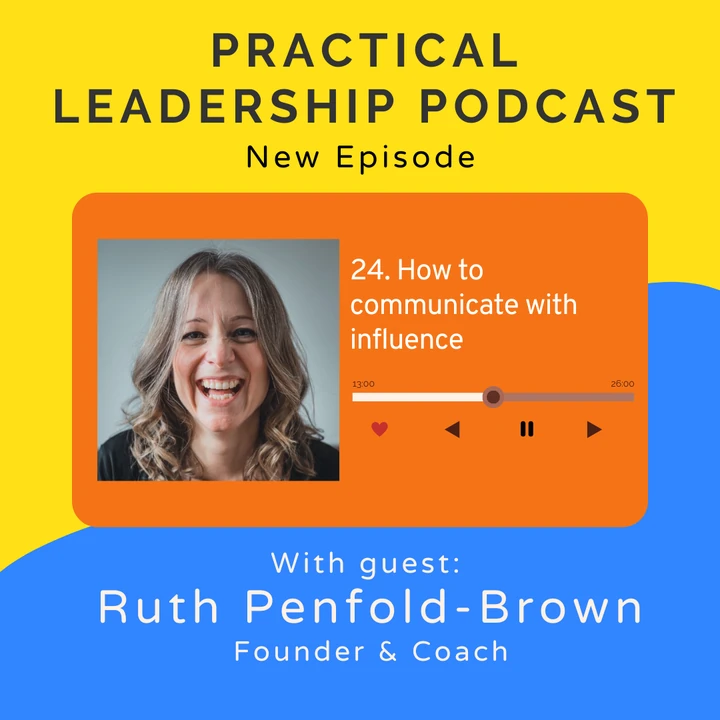
How to communicate with influence
with Ruth Penfold-Brown
Show notes
Ruth would like to thank her 30-year-old self for having the courage to reboot and restart her life anew.
She’s been a people person for a long time – 13 years in recruitment, leading the talent team at Shazam, Chief People Officer at the BP new energy accelerator Launchpad and now independent.
Thankfully, she explains why Pancakes and Peacocks are a thing for her.
(Round edible things – the pancakes, not the peacocks.)
New managers don’t have to know everything (or anything), and her three steps to being able to communicate better are starting at the end point, consider the Situation, the Implication and the Action you want to drive.
We touch on impostors and mentors and great conversations that have changed both our lives for the better.
Ruth is a force to be reconned with.
She asks: Why don’t we all accept and take that which we should be entitled to?
Find Ruth here:
https://www.linkedin.com/in/ruthpenfold
https://twitter.com/ruthpenfold
———-
Transcript
Automated transcript. Speaker labels and spellings may contain errors.
Paul
[upbeat music] Hello, and welcome to the Practical Leadership Podcast where I interview great leaders and try to extract their wisdom and their experience for you to learn from, and hopefully avoid making their mistakes. If you want to upgrade your leadership skills in 25 minutes, check out practical-leadership.academy. [upbeat music] Ruth Penfold-Brown, thank you so much for joining me.
Ruth Penfold-Brown
Ah, thank you for having me, Paul. I'm delighted to be here.
Paul
So you are a finder of people, a recruiter of, what, 13 years in boutique agencies, then director of talent acquisition for Shazam.
Ruth Penfold-Brown
Yeah.
Paul
And I love this. You are, in some way, responsible for connecting a billion people together. That's not bad.
Ruth Penfold-Brown
Yeah.
Paul
Yeah.
Ruth Penfold-Brown
Well, for Shazam [laughs] yeah, by ... Ab- absolutely. [laughs]
Paul
Well, you had this lovely line there that you were hiring the humans that made the magic happen.
Ruth Penfold-Brown
Yeah.
Paul
I love that line.
Ruth Penfold-Brown
Yeah. Absolutely.
Paul
Hiring the humans that made the magic happen.
Ruth Penfold-Brown
Absolutely.
Paul
So then VP of people at a machine learning company, Onfido, and then CP- oh, chief people officer, so at the BP Launchpad. That was a fun gig. That sounded nice. Then a yoga teacher, podcast host-
Ruth Penfold-Brown
Yeah. [laughs]
Paul
... and Pancakes and Peacocks. I have to know where you came up with the name for your own gig.
Ruth Penfold-Brown
[laughs]
Paul
Pancakes and Peacocks.
Ruth Penfold-Brown
Well, I mean, Pancakes and Peacocks, there is a ... I mean, there is a story behind it, um, because, well, first of all, I love round, edible, flat things, right? So we're talking-
Paul
Mm-hmm
Ruth Penfold-Brown
... pancakes-
Paul
Yep
Ruth Penfold-Brown
... um, tacos, pizzas, anything we ... A, a wrapper, anything that you can, like, e- round, edible, round, flat things. So there was an obvious-
Paul
Chapattis.
Ruth Penfold-Brown
Absolutely. Ex-
Paul
By George
Ruth Penfold-Brown
... as long as they can be gluten-free.
Paul
Yep.
Ruth Penfold-Brown
And I've yet to find a chapatti that can be gluten-free, but I maybe haven't looked hard enough, but [laughs] ... So, um, there was an obvious synergy with the pancake, and pancake, for me, actually, the Pancakes and Peacocks title started out as a podcast about s- I'd realized to ... I'd managed to create a life for myself that felt truly joyful, and I decided I wanted to share that with others and, like, provide a little bit of the inspo that I'd been feeling. So at the time it was, like, pancakes, love them, joyful, beautiful. Peacock, it's really, I think, what we all could be, right? The peacock is unapologetic. It is proud. It lets its feathers shine out to the world, uh, but also has a few dark other feathers that it keeps hidden, right?
And I just thought that was beautiful for kind of the, the power that we could step into. And so when I sort of by accident rather than by design ended up creating my own business, um, it was just natural to pull that title through, and actually, there's quite ... You can really use, take the pancake analogy quite a long way because the culture of an organization is a bit like a pancake, right? [laughs] Um, you know, like, you can easily get the batter wrong. [laughs] The first pancake is usually terrible. [laughs] So I kind of now have, have, I guess, created a segue into culture for organizations from a title that already existed.
Paul
Marvelous. There's a li- I'll, I'll, I'll add one. You, you've probably heard of this, a thing called the talent stack. So you take ... And you're in the US now, right?
Ruth Penfold-Brown
Yeah, absolutely.
Paul
Des- des- despite our British accents.
Ruth Penfold-Brown
Yeah.
Paul
Um, and you've got the American-style pancakes. You know, think of the American pancake stacks. You've got a stack of these pancakes with this maple syrup and stuff on that, on top of that, and each of these are the individual skills and talents that you develop over time. And that together makes up your unique talent stack.
Ruth Penfold-Brown
Ooh, love it.
Paul
There you are. So that's what-
Ruth Penfold-Brown
Love it
Paul
... it's the, the individuality that is you but based on these skills that you can then sort of develop. So is it-
Ruth Penfold-Brown
Thanks, thanks for that ad. I will make sure to thank you whenever I use it. [laughs]
Paul
Please, please do. I think I stole it from somebody as well. Sc- uh, Scott Adams, the Dilbert guy. I stole it from him.
Ruth Penfold-Brown
Yeah. [laughs]
Paul
So i- in that illustrious career then, at what point did you first become a people manager?
Ruth Penfold-Brown
Oh, well, see now, that was ... It was during the recruiter years, that first 13. And it was actually interesting because I started to lead others somewhere in my mid-20s in that role, and I was given the title of director at that time. But here's the interesting bit. I actually wouldn't even use the title publicly because I didn't think I deserved it. And, um, it's so interesting when, when I look back as someone in their 40s at the version of me in their 20s, um, the fact that I'd ac- other people were giving me that role, yet I was so impostery that I didn't even claim it even though I was running a business from an operational standpoint. I was leading a team of others. I was bringing in the li- the lion's share of the revenue within that organization and managing many of the client relationships. Um, and so it's kind of amazing when you look back and you think, "Wow, I ...
Like, there is a textbook example of somebody not claiming even the role that they've been given, let alone powerfully, uh, energizing their own career," right? Um, but I mean, if I talk about how I led others then, I mean, it was kind of, I guess, clumsy and s- apologetic and like, "Ooh." And as a people pleaser, I w- Didn't wanna ruffle any feathers, so I took on other people's work rather than actually empowering them and enabling them and having the conversations that I now know how to have. So I would say that my first kind of little dalliance with people management was probably clumsy at best, but I gave it a good go, Paul. [laughs]
Paul
Do you know, I think there's a thing about most people's own experience of their first manager, and most people's experience of their first manager tends to be somebody in their first manager role.
Ruth Penfold-Brown
Mm-hmm.
Paul
So that is then what shapes us and is ... You have to go through this whole period of unlearning all the crap that we saw.
Ruth Penfold-Brown
Absolutely. Yeah.
Paul
Because who do you put in charge of the most junior people, which is you coming out of college or university or school? The most junior manager who knows jack shit about managing people.
Ruth Penfold-Brown
Yeah.
Paul
Who then blunders their way through it, leaves this trail of destruction behind them. Not, not intentionally. I mean, my God, I need to apologize to them all. So sorry to all the people I've screwed over and made a disaster of in learning how to actually manage people. So but then you go through, you, you, you do ... You said it's the archetypical mistake, isn't it? "I'll just do the job," rather than do the managing of the job, right?
Ruth Penfold-Brown
Yeah. Yeah.
Paul
Role model sense.
Ruth Penfold-Brown
And, and without that role model of leadership, you just stumble your way through.
Paul
Yeah.
Ruth Penfold-Brown
And it wasn't until my early 30s that a role model emerged, and actually he was my leader for about six to eight weeks, Paul. But in that time, he changed my life because he saw stuff in me that others hadn't seen before, rather they certainly haven't told me that they saw, and his belief in me was so powerful that it actually made me grow bigger and then start, um, really investing in learning, really investing in my own development and my own leadership development, and starting to build the tools and skills that would actually then set the foundation for the rest of my leadership career. Um, but it was just when that magical human came along as the role model that I was able to go, "Wow." And I could ... You know, six, within six to eight weeks, he, he literally changed m- the trajectory of my life at that time.
Paul
Never underestimate the power of a single conversation to change your life.
Ruth Penfold-Brown
That's it.
Paul
Totally. Totally. I, I had a, um, a marvelous guy called Jacques Levy, French chap.
Ruth Penfold-Brown
Mm.
Paul
Um, and I'm almost, I, I'm almost embarrassed to, to talk to the guy 'cause he's kind of like an, you know, an idol. And I had him as a short period of time as my manager and exactly the same. He was the one that said, "Managing people is a thing, it's a practice, it's a skill you can go and learn and get better at and do these things." Uh, yeah, yeah. I know what you're talking about.
Ruth Penfold-Brown
Yeah.
Paul
It's just-
Ruth Penfold-Brown
It's so amazing
Paul
... it's one of those moments. Yeah.
Ruth Penfold-Brown
Yeah, yeah, yeah. And a really important reminder of just how much we can give to others by just seeing the light in them that they're not seeing in themselves yet.
Paul
Yeah, yeah.
Ruth Penfold-Brown
Right? By saying it out loud, you know? It's, it's so, so powerful.
Paul
I believe you can do this.
Ruth Penfold-Brown
Yeah.
Paul
Really? Really? Really, really?
Ruth Penfold-Brown
You and me. [laughs]
Paul
Yeah. Yeah, what?
Ruth Penfold-Brown
There you go.
Paul
I mean-
Ruth Penfold-Brown
And looking behind you, you know? [laughs]
Paul
You do. You're talking to the other guy, the other, the other-
Ruth Penfold-Brown
Oh, that one
Paul
... Scottish bloke called Paul.
Ruth Penfold-Brown
Yeah. [laughs]
Paul
Like, what? Ah, the, the, the, the ... Where does this come from, this, this lack of belief or faith in us? I don't ... I mean, you're, you're sitting there in the US right now, and I, and I said before I'm married to an American. I don't know if the Americans feel this. Maybe they're better at faking it, or is it a British thing, or I don't know.
Ruth Penfold-Brown
No. I think, I honestly think culturally there is a different mindset here, which is one of you can, um, and anything is possible. Now, um, you know, I, I, I, I know that that isn't everybody's lived experience here, but I would say-
Paul
Mm
Ruth Penfold-Brown
... if I compare British culture and American culture, I was hugely inspired when I started to work with more American colleagues, or should I say coworkers, at Shazam because of this mindset difference of, like, you can. Like, you can do it. Um, if not, and, like, why not you, frankly? Whereas there's something about British culture that teaches us a subservience and, and an over- an overly powerful sense of gratitude for what we have. Although I will say, Paul, I think that's shifting from Millennial onwards, um, and happily is dragging some of us slightly older people with it. [laughs] You know, like, the, the sense of actually I, I, I should get to do something that I feel, I feel, uh, inspired by.
I do deserve to be paid more. I do ... You know, do you know what I mean? But I think, I think that certainly there is a whole generation and beyond of folks that really did just come into the workforce grateful for whatever they were given.
Paul
Thank you for the crumbs. Thank you for my-
Ruth Penfold-Brown
[laughs]
Paul
Yeah. I mean, is there ... Or the corollary of that perhaps, is that entitlement, no?
Ruth Penfold-Brown
Well-
Paul
You know, you see people being ... Do, do ... Sometimes you look, you hear, or you look at people and you think, "That's a bit entitled." But then hang on. Whoa, whoa, stop. Maybe you should be entitled to-
Ruth Penfold-Brown
Right
Paul
... these things.
Ruth Penfold-Brown
Yeah. Yeah, but it's amazing the reaction that that brings up in us, and it's through our societal coding and conditioning that comes from our families and the humans that we're around that makes us have this sort of feeling of disgust in ... When we see the things in others that we're not living into ourselves, right?
Paul
Mm.
Ruth Penfold-Brown
So when we see someone claiming their space for the first time, we're like- Whoa, what's g- oh, that's gross. Look at that person. Who do they think they are? Now, if we get lucky, we manage to stick around long enough to be inspired by that person and realize that the way that they're seeing themselves, we could actually see ourselves like that, too. Now, don't get me wrong, folks, there is a dark side to entitlement, and-
Paul
Mm
Ruth Penfold-Brown
... one that we have to be careful to, to walk the line of. But I would love to get to live long enough to see a world where we're all claiming the space that we inhabit in the world much, much quicker, and, and really being able to say, "I deserve this, and I deserve to have a great life, and I'm gonna be the person who can drive it forward and build it." But at the same time, society is going to enable it, too.
Paul
What would you then, on the basis of that phenomenal six to eight weeks of epiphanical relationship you had, what would you, in turn, do for someone else, for a, a new first-time manager?
Ruth Penfold-Brown
Ah, I think, I think the best advice, although I know if you're a first-time manager or if you were me in my 20s, you won't believe me, um, but you, you don't have to know all of the things. You have to just... The only thing you've gotta do is trust that you've been given your role for a reason, and even though you might not believe it yet, there are folks that are around you that do, and you just gotta trust them over yourself, honestly. Um, and, and as you're coming into that leadership role, I get that you're gonna feel like you need to prove yourself, but I would also encourage you to try to breathe that out as quickly as you can, because that over, like, the over-indexing on that need to prove yourself is a slippery slope that will dri- take you towards burnout really, really quickly.
So as soon as you can give yourself a break, take a, breathe out, realize that you've been chosen for a reason, and trust other people's view of you if you're not able to quite trust your own yet.
Paul
I think that's the one, that's a great way of dealing with the imposter, uh-
Ruth Penfold-Brown
Definitely
Paul
... sense, sense. And it's, what was it, it was originally called, uh, an imposter phenomenon, not imposter syndrome, because the syndrome makes people think it's some sort of psychological disorder, and it's really not.
Ruth Penfold-Brown
No.
Paul
You know? It's just a reality perception. But it's-
Ruth Penfold-Brown
Yeah
Paul
... the, the fact that do you think the person that gave you this job is an ass, an incompetent ass? Yes, no? Well, well, no. Good. So be quiet. You're fine.
Ruth Penfold-Brown
Yeah.
Paul
Get on with it.
Ruth Penfold-Brown
Trust them. Trust them.
Paul
Yeah.
Ruth Penfold-Brown
And also, a little hack for our listeners if you need one, is every time somebody gives you some good feedback, or, you know, what, i- ideally good, um, but any comment, don't care what it is, write it down and keep it all in the same place. I call this your case file of excellence, and any time you're doubting yourself, you can literally just read through that amazing feedback and remind yourself who you are, because I can almost guarantee that you're just sitting there having forgotten what you already know.
Paul
Yep. There's, um, i- in the US, they call it a resume, which is-
Ruth Penfold-Brown
Yeah
Paul
... a, just a s- a summing up of your life. Uh, in the UK, we tend to use CV, which is curricu- curriculum vitae, or the path or the river of your life. And I think you can take that, which is normally, like, two pages with all your jobs and stuff, and if you expand that with your case file of excellence.
Ruth Penfold-Brown
Yeah, I love that, and I love the river of your life, by the way. That is beautiful. Um, yeah.
Paul
Ah, the Romans had a thing.
Ruth Penfold-Brown
Yeah, although in America it won't be a river of your life, 'cause they recommend one page. [laughs]
Paul
A small-
Ruth Penfold-Brown
I'm like, "I think you can write more. Let's change that." [laughs]
Paul
Yeah, keep it going. Keep it going. So you don't need to know everything. You need to trust your boss. You don't need to prove yourself. Is, is there, is there a way, is there a magical how-to that comes from that or that surrounds that?
Ruth Penfold-Brown
Yeah, I mean, I think, I think the byproduct of learning to believe in yourself is, will show up in things like learning to communicate with influence. So there is magic in learning how to share just the right m- amount of information. So, um, and that means starting with the point, really. Um, get there first. What is the situation? Learn not to ramble. Talk about the implication of that situation, and then state the action that you're requesting. Now, I know that will sound a little bit like what for some people, or like, it might sound demanding. It might sound commanding. But I promise, to other people you will just sound straightforward. So situation, implication, action. And even if, again, this is one of those fake it till you make it things. Even if you don't quite believe that you're there yet, communicating in that way will help others to believe in you, and that is,
it's a symbiotic relationship. The more they believe in you, the more you're gonna believe in you, promise.
Paul
Communicating better. That's, that is... I love these super simple, almost al- we, we think, we, we overanalyze everything.
Ruth Penfold-Brown
Yeah.
Paul
And we get down to the s- the real basics of management, managing yourself, managing others. That's the stuff that really makes a difference. I love that, communicating better. Situation, implication, and action. Nice. Was there a particular event or a mistake, obviously somebody else's, not yours, that you learned from most?
Ruth Penfold-Brown
The, I would say as a leader, the thing that I learned from the most was, um, when I used to avoid difficult conversations. [laughs] When I first entered into leadership, it was, it, as I said earlier, kind of in direct conflict with being a people pleaser. And I had a team, as I said, where I was taking up the slack rather than addressing any underperformance. And over time, these things kept coming back up. So everything that you don't say is like a, it's like a, it's like death by 1,000 tiny cuts, right? Because what's gonna happen is you don't say it, and then it's gonna show up again, and then it's gonna show up again, and then it's gonna show again [laughs] before you finally, well, expire perhaps. I don't know.
But, but I realized that actually by avoiding those difficult conversations, the only person that I was serving there was myself, and the fact that my brain was trying to keep me safe and trying to keep me liked. Um, and that was it. And, and over time I learned that clarity really is kindness, and that it's possible to give feedback in a way where both parties go away still respecting and admiring each other. Um, fun fact, my sister-in-law here in the US actually jokes that I am the person that she knows [laughs] that can now, that can complain in a restaurant and go away from that conversation with the restaurant owner thanking me and essentially falling in love and inv- with me and inviting me back, right?
[laughs] Um, as a side note, though, Paul, I will say that I do live in a part of America where they love the British accent, so I suspect that that helps quite a lot. But it is an art. You literally can give people, um, some fairly constructive feedback, and do it in a way where you both go away still conserving and preserving a fantastic relationship.
Paul
Beautiful. Very diplomatically done.
Ruth Penfold-Brown
[laughs]
Paul
Yeah. Apparently there's one thing the Brits are very good at, is diplomacy, and I think some, some of my American friends say that we just never get to the bloody point.
Ruth Penfold-Brown
Yeah. Yeah.
Paul
Get, get on with it.
Ruth Penfold-Brown
Maybe.
Paul
Yeah.
Ruth Penfold-Brown
But if we use situation, implication, action-
Paul
Yes
Ruth Penfold-Brown
... we get to the point much faster, probably.
Paul
And you start with the end in mind.
Ruth Penfold-Brown
Yes. [laughs]
Paul
Yeah. Start with the end in mind. Isn't, so it's, um-
Ruth Penfold-Brown
Oh, great
Paul
... habit number one or something like that of the seven habits. I love it.
Ruth Penfold-Brown
Yeah.
Paul
Great. All right. What are you working on at present? Tell us a bit more about Pancakes and Peacocks. What's, what's going on with you right now?
Ruth Penfold-Brown
Well, so that is my coaching and consulting business, but I'm actually really excited about a new project that I'm working on, Paul. That is a new leadership accelerator called Bloom that's targeted towards women, actually, women in the workplace or anybody that identifies as a woman who... I mean, really, I, I wanna give you the tools and the hacks that I've learnt painfully over the years. I want you to get there faster. That's it. So I'm building an accelerator to s- to support people to get to leadership roles in a confident, authentic way much faster than I did.
Paul
Marvelous. Is there anything in particular that you are reading or listening to that you'd like to share?
Ruth Penfold-Brown
Uh, I, my husband and I actually have a book club, which, uh, I think is a great hack, by the way, for relationships-
Paul
Book club
Ruth Penfold-Brown
... of like, uh, you know, like actually lis- listening or reading the same book so that you can then talk about it together and figure out your learnings. Right now, that's a Brene Brown book, which you've guessed it-
Paul
Mm-hmm
Ruth Penfold-Brown
... is my choice, not his. Um, but no, I mean, we, we listen to a blend, honestly, of, uh, they're normally development books either in the business or human development sphere. The last one that we listened to before this was a, was Will Smith's book, but actually that's kind of a little bit around development, too.
Paul
What would you like to go back in time and thank the young Ruth for doing?
Ruth Penfold-Brown
Now that is a really easy one for me, because, um, I would like to thank the 30-year-old Ruth for leaning into the hard change that was required to completely reboot my life and start it over again. Um, I realized when I got to the age of 30, Paul, that the life I'd chosen wasn't the right one. I'd chosen the wrong partner. I'd bought the wrong house. I was living in the wrong place. I was in a career that wasn't really serving me, in a role that wasn't really serving me. Um, and I set myself free, and I started over again, and I rebuilt myself from the inside out. And I shaped myself, and I continue to shape myself, uh, to this day, and kind of iterate on whatever it is I need to learn at any moment.
But it was that 30-year-old me who tore it all up and started over again, and to her, I am eternally thankful.
Paul
That's a hat tip and a half, isn't it?
Ruth Penfold-Brown
[laughs]
Paul
30 years in. I mean, fair enough, you hear people saying, "Well, you know, I, you know, wanted to go back and tell my 18-year-old self well done for doing a thing," but 30, that takes some chutzpah.
Ruth Penfold-Brown
[laughs]
Paul
Some, some yes, some courage.
Ruth Penfold-Brown
Yeah.
Paul
Well done.
Ruth Penfold-Brown
Thank you.
Paul
How can people find you? What are your coordinates?
Ruth Penfold-Brown
Well, probably the best place is LinkedIn. I'm fairly active on LinkedIn, so I'm on there as probably the only Ruth Penfold-Brown, but let me know if you find any other doppelgangers out there, and I will, I will say hello. I'll make it my, my mission to say hello to them. You can also go find me on Twitter, @ruthpenfold. You can also find me on Instagram, @ruthpenfold. Um, I, I love to connect with people across all of those platforms. Um, and, and of course you can always email me, too. You can go to ruthpenfold.com and drop me a note.
Paul
Marvelous. Ruth Penfold-Brown, thank you very much indeed for joining me.
Ruth Penfold-Brown
Thank you, Paul. This has been a thoroughly delightful conversation, so thank you so much. [upbeat music]
Paul
That's a wrap. Thank you for joining me today. Your homework, subscribe and share this with a friend or colleague. Please leave your five-star review and any comments you have, because that really helps me to improve every day, and it helps people to discover me online. If you want to upgrade your leadership skills in 25 minutes, you should check out practical-leadership.academy. [upbeat music]