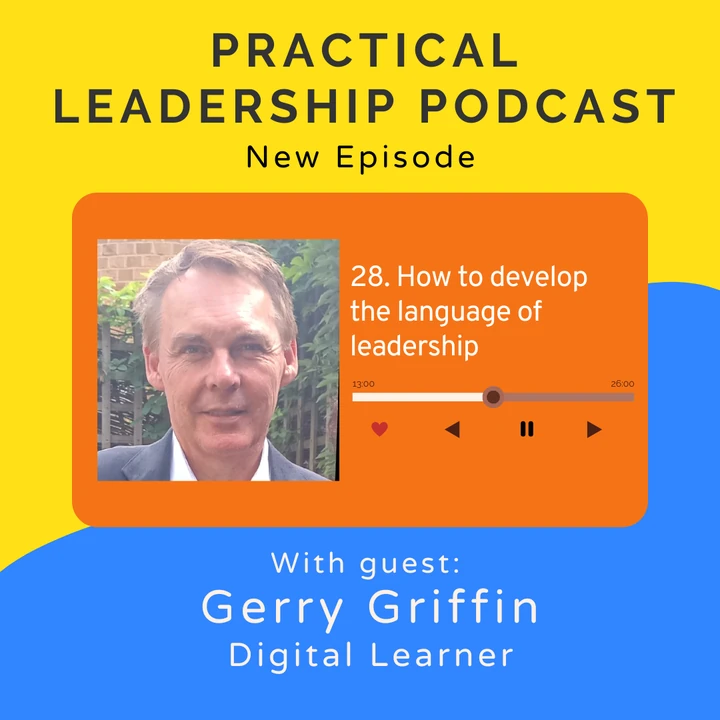
How to develop the language of leadership
with Gerry Griffin
Show notes
Gerry Griffin is an author, composer, teacher, entrepreneur and now luthier (maker of guitars).
He’s also a storyteller and expert in communications and strategy.
In his illustrious career he has refined his approach to the use of language and leadership and takes us through his way to use language to power your ‘self-created’, contextual self.
Authentic – comes from Autos Hentes – Greek “Self doing, creating”
Gerry advises
- Find out where you are
- What’s your true context?
- How best should you communicate with the people around you
You can find Gerry here:
https://www.linkedin.com/in/gerry-griffin-4301532/
Transcript
Automated transcript. Speaker labels and spellings may contain errors.
Paul
[upbeat music] Hello, and welcome to the Practical Leadership podcast, where I interview great leaders and try to extract their wisdom and their experience for you to learn from, and hopefully avoid making their mistakes. If you want to upgrade your leadership skills in twenty-five minutes, check out practical-leadership.academy. [upbeat music] Gerry Griffin, thank you very much indeed for joining me.
Gerry Griffin
Pleasure.
Paul
You, sir, are a published author. I did try to buy a couple of your books, but they're an absolute sod to get ahold of on Amazon. They're out of print, you know.
Gerry Griffin
Well, what's, what's rarer than a fir- uh, a Gerry Griffin first edition is a Gerry Griffin second edition.
Paul
I like that. I like that. Okay. Accomplished composer, musician, guitarist, entrepreneur with successful exits under your belt, communication specialist, and now luthier. That's a fabulous word, isn't it?
Gerry Griffin
Indeed. Well, I, uh, I'm just trying to learn how to make guitars at the moment. Uh, and if I don't lose a finger, then I'll be able to play one as well when it's finished.
Paul
When in this illustrious career of yours did you ever have the privilege and opportunity to start managing people?
Gerry Griffin
Probably in the '90s. Uh, worked in consulting. Uh, then I also managed team. Actually, I had quite a difficult management job at London Business School, where I had a team of, uh, mostly dysfunctional people, uh, and I might include myself in that as well. But I was warned in advance that it was a slightly barmy set. I got on very well with them. We had good fun, but it really stretched me as well. Um, but, uh, probably, probably in the late '90s where I, I got involved in that, uh, uh, managing people. I was relatively... One of the challenges I had there was actually managing people who were a lot older than me as well, uh, which is a bit of a weird one to have to do in practice, because we sometimes associate
leadership with experience. And as a result, if you're more experienced, you tend to have a leadership position and manage people, uh, who are more junior in age to you. Uh, um, so I had a sort of, mostly having to manage people who were 10 to 15 years older than me, so that was a bit, bit, uh, bit of an odd one. But it was interesting and, and you learn. And, uh, ult- ultimately, uh, working at London Business School had a very strong positive influence on me, 'cause it got me more into the training side of things. It got me more into the writing, as you mentioned earlier. And also, uh, just thinking about strategy and thinking about, um, what good leadership in today's world, you know, some 20
years later, uh, means in practice. 'Cause things have changed a little bit, particularly with the digital age, the shift towards, um, visualizing things a lot more on, on mobile phones. So there are certain, certain things have changed, but some of this, the things remain the same in the sense that if you're going to be a leader or take on a leadership role, uh, people expect certain things of you, for example, uh, straightforwardness wherever possible, uh, a level of integrity, uh, a level of capability as well. They actually can do what you say you do or what they do. Um, I'm a believer that, uh... Well, a strength that I always admired was that ultimately the leader could roll up their sleeves and just go and do most of the jobs themselves. And if you get into a position where you are technically unable to understand what's going on, um, to me, that's...
You're, you're, you, you struggle, or you may struggle a little bit more if you don't understand the, um, the, the technical detail and the granularity that goes on. Um, at least that's my, my, my take on it. I do quite... And I'm not a coder, um, but I, I know enough around technology to, to, to avoid scope creep, to understand, uh, where technology can be of value, where it can be opaque so that you need to try and get through a project to make sure that it delivers what it's supposed to do. That doesn't mean that you need to know coding.
Paul
So, I mean, especially with the older thing there, I mean, in the hierarchy si- the hierarchy, deep, strong environment of a business school, having somebody younger coming in, managing somebody older. I mean, we normally throw people coming into, uh, jobs for the first time at least experienced managers. But in your case, it was kind of the other way around.
Gerry Griffin
Mm.
Paul
So you were coming in with less experience, less age, fewer gray hairs at that point anyway, um, at these older types. What-
Gerry Griffin
Yeah, it's true
Paul
... what did you do to be that ham?
Gerry Griffin
I mean, there is some, there is some schools of thought that think that, um, leadership has not a lot to do with experience, actually. And when you see so much, so many failures of leadership going on, uh, are people who are, um, who are, uh, uh, uh, advanced in, in, uh, workplace experience, there may be a correlation between it, but n- maybe not a causation between experience and good leadership. A- and, and the way to manage through is to be just clear as to what you're trying to achieve. Just focus on what the business or organizational goals are. Uh, you know, basically what activity can help make us or save money, uh, if you're in the commercial space, and use those coordinates to try and align the specific departmental activities
against that, and then appoint people to roles in terms of how they can play a role in delivering against those. And if you do that, then a, a bit like a stick of Brighton rock, really, the organizational agenda, the tenets, the beliefs, the goals all work their way through each activity. And if, if it's not clear, the relationship between what you do and what the organization is trying to do, then it's the role of the leader to try and, uh, remove that obfuscation or to readjust the role in order to make sure that it's clearer. Years and years ago, uh, the head of Budweiser, um, at the time, August Busch III, this is when the, when the family ran the business, uh, he had a... I remember he had an annual review and, uh, had a letter written on the inside to shareholders, the standard sort of rhetoric of, of CEOs, you know, you know, white shirt, red tie, kind of very focused glare out at the, at the shareholders.
But he said, "In everything we do at Anheuser-Busch, and we're the first, um, you know- brewers in the world to have al- aluminum recycling, uh, biggest brewer in the world, um, and so on, a whole series of, of, of, um, achievements. He said, "We must never forget," and he wrote it at the bottom of the letter, "to sell more beer." Um-
Paul
[laughs]
Gerry Griffin
And, and I like that because it's the rigor of an organization that, you know, you need to be able to, at the time I presume, if Augie walked past you, to point out a relationship between what activity you were in and how you sell more beer. And if you struggle to answer that question, you know, that, uh [laughs] you might have been in danger, uh, of your, of your job, particularly with his reputation. Um, and, and I think it's a good thing, is that how, how can we sell more beer in doing this? And, and, and to me, that's part of the l- leadership. And then whether your, your style, whether you're, you know, very expressive or not, I think that's less material to it and more that you're there to try and help and guide people towards achieving their activities.
And, and language, which, well, I think we've already talked is an absolutely core part of that, but language is also part behavior as well. You say a lot by the way that you behave. You know, if you turn up early for work or you, uh, do various things, that itself sends out loads of messages, uh, and that either align with the rhetoric you deploy or are misaligned with it and therefore, uh, take away some of the credibility and the consistency of, of what you're trying to get across.
Paul
So aligning people with what the f- the overall mission or the, the, the goal of the organization is. There's the lovely, um, I'm sure it's apocryphal, but there's a story of Kennedy going to visit NASA in the early days, and he goes to the f- the, some guy sweeping the shop floor.
Gerry Griffin
Mm-hmm.
Paul
And he says, uh, "What is it you're doing here?" And the guy's got a brush in his hand, right? So the guy's got a brush in his hand, sweeping the floor. President comes up and says, "What are you doing here?" And the guy says, "Helping put a man on the moon, Mr. President."
Gerry Griffin
That's him. Yeah. Yeah.
Paul
That'll do. So I mean, how do you then align that? What, what's the, what's the, what's the purpose of language in the communication piece here on making sure everybody's aligned and going the same way and doing the same thing?
Gerry Griffin
Well, I mean, it's, it's absolutely core, particularly as, uh, to slightly drift from my point that I mentioned earlier about the technical expertise or capability of managers and leaders, uh, because increasingly when you've got services and technology, you know, you may have managers or you may be leading projects that actually under the hood you're not that sure how it gets done. It just gets done. That's fair enough. But, but the, the, the way that you set out, uh, the game plan, uh, if it's a small organization or the vision and mission if it's a bigger one, depending on how it gets parceled up, uh, is, is, is absolutely core. So language is, and the way you express yourself, uh, does a couple of things. First of all, it builds trust between, uh, yourself, uh, and the team, um, which without that trust, I don't think you've got much currency to, to, to trade with in first place.
It shows that you care as well, and I think one of the things that I think has changed a lot in the last 10 to 15 years, probably with the advent of, of more and more digital, is that what we ask of our leaders is that they care about what they do. So language is important to try and carry, if you like, the value across through storytelling, through expressions, sometimes through appropriate, you know, references to, to your personal world because, you know, we are people rather than just corporate automatons. Uh, building trust, and ultimately then be really clear to try and inspire people with a level of energy and, and passion towards what you're trying to achieve. So I think to sum up, I think language is, is the, the way we trade these days as leaders because it's mostly desk-based and office-based, um, discussions that we have.
Um, and, uh, the language and the way that it aligns with behavior and how it communicates stories, vision, passion, is a key to organizations being successful. It doesn't mean all the way that you have to communicate happy, positive messages. You can be tough. You can be rigorous. Uh, you can be robust in how you get across what needs to happen. But what people are looking for is that you actually care about various things and, and you maintain the levels of trust that sit underneath that.
Paul
We're talking this in the context of modern times and all that, um, you know, the interwebs and various devices. And do you know what? There's, to some aspect I would posit that it's not necessarily a modern desire on our part. It's like s- it's like putting people into the boxes. Oh, you're gen this, that, or the other. You're millennial, whatever. It's the description, it's the definition, it's the activity, the action, and the behaviors of the individuals that are, who you put into these boxes that, that matter more. And you go back to, you go back to things like, uh, Dale Carnegie, right? 1936, he was writing about show people you care, be effusive in your praise, be consistent. Drucker from 1967, he's all about consistency.
He's all about time management, of course, but he's all about the, the, the, the messaging and the, the clarity and the humanity of this. So it's not, I don't think it's something particularly new. I think it's perhaps just something that has become more front of mind as we look for the realities that will help us to drive our businesses, whereas previously we were looking at this, the long tail shiny stuff, or what's the latest and greatest crazy thing? And then you go back to the core and you really, there's this reflective moment that we take, or people have taken perhaps-
Gerry Griffin
Yes
Paul
... to decide that actually it is the core. It's not human resources. It's resources that are human. That's our side of it. When, when you think about the, the idea of language and channels here, how would you go about doing this? So I'm, I'm brand new. What's my first aid sticking plaster from Gerry on using my language in the most appropriate way?
Gerry Griffin
Well, I mean, you, you could, there's loads of good tools out there. I mean, you know, when I started learning and, and, uh, trying to manage people, you know, there were f- fewer and fewer, there were fewer tools around. But, you know, you need to figure out what kind of organization you're in. So if it's a smaller one, let's say up to 150 people, um, you've got a certain tribe-like mentality In which, you know, face-to-face network kind of communication works a lot. If you're in a much larger distributed workforce, uh, with matrix management, then the channels and the way that you communicate, uh, clearly are gonna be a little bit different. So I think you need to figure out what kind of organization you're in and, and, uh, Rob Goffee has got a great book out called The Character of Corporation, which again organizes people into different cultures. You've got networked, communal, fragmented, and mercenary organizations.
Mercenary doesn't mean bad, it just means it is more focused on business goals than collegiality. So, you know, you fill out a questionnaire and just find out, okay, this is where we are, this is the kind of organization I'm in. And there are certain ways of couching what you say that are more appropriate to that language. You'll discover that yourself anyway pretty quickly. However, if you can do a little bit of advance warning to yourself, then, you know, you'll, you'll get there faster. So, you know, you would, you know, you would use words like family, we're one big family, in a networked organization, but you won't use that in a mercenary organization. So there's certain ways of, of, uh, of expressing yourself that are gonna be more register appropriate based on the organization. So, you know, there's some simple tools there, um, that you can use to try and figure out the way that you set it out.
Um, and, you know, be, be yourself wherever possible, but you need to be appropriate i- in that regard, particularly for larger organizations, because just being yourself can end up being a bit like Kevin Keegan when he was crying in the, in the, in the, the dressing room at the England, um, uh, game h- at halftime. I think they were, or Newcastle, I think, were falling apart. You can be yourself, but if you're, if you're yourself in an unreal environment, it comes across as kind of amateurish. But, but what is also great, and which is, uh, you mentioned earlier about reflection, um, the, the, the power of good active listening, uh, rather than inactive listening, which is what most do, including
myself, by the way, of just, you know, shutting up for a little while and then waiting to jump back in again. Um, if you listen more credibly, you are ultimately more persuasive as well. So if you want to make a good impression in an organization, find out what sort of hinterland you're entering into, uh, figure out some of the ways that you're going to tell your story that's appropriate for that register, uh, actively listen in order to course adjust, but ultimately be, uh, aware that that also makes you a more persuasive individual as well. Um, and those things are, you know, to me, common sense. They're not always common practice, but they are good ways of beginning to set out what you do.
Paul
Who would you like to thank young Gerry for doing?
Gerry Griffin
I don't really know. Um, that's a, that's a good question. Um, I think just g- I think the enthusiasm that I used to bring to the table. I was out for lunch with a colleague that I used to work with back years ago, and he said, "You were always a bit of a live wire." Uh, and I wouldn't have described myself as that, but a, a certain enthusiasm I, I brought to the table, and that's something that I'd, I'd like to try and, as I get older, try and maintain a level of energy and enthusiasm for that. But, you know, I think as you get older, you need to marshal your energy more, a bit like managing your diet [laughs] and all the rest of it, and your fitness level.
Paul
[laughs]
Gerry Griffin
Things that you took for granted at a young self, you just don't take so for granted anymore. Uh, and there are some compensations. But, uh, yeah, so I think, I think, uh, just bringing a, a certain, uh, sort of energy and, and enthusiasm to a project, uh, can count for a lot. Um, as long as, you know, it's channeled properly and it doesn't, um, it doesn't skate across things too much.
Paul
Are you reading or listening to anything that's interesting you wanna share?
Gerry Griffin
Um, well, I'm li- I listen to stuff all the time. I'm actually trying to learn Paul Weller's, uh, You Do Something To Me on the guitar at the moment.
Paul
Oh, wow.
Gerry Griffin
Um, which is just such a good song. Uh, so when I tr- I, I write the odd song, and I do then, um, I try and look at when you see successful songs as to what they're doing, 'cause if you actually look at the or listen to the, um, to the melody line of that, it's nearly... A lot of the time it's just one note he's singing.
Paul
Mm.
Gerry Griffin
But it sounds so melodic. Um, so I, I kind of love to try and unpack the secrets of things. And in part, when you try and learn it on the guitar, you're more exposed to the mechanics of the chords and the beat, the timing, the pauses, to actually look at the mechanism of the song. So I do like deconstructing, uh, songs like that. So I'm just listening to a bit of Paul Weller. I wouldn't be a massive fan of his, uh, but at the same time, um, that's just as you asked. That's what I'm listening to at the moment. There's a book called, um, I'm just looking up the title of it here, um, uh, called Homo Sapiens that I'm reading, A Brief History of Humankind, uh, by, uh, Yuval Noah Harari.
Paul
Harari, yeah.
Gerry Griffin
Um-
Paul
Excellent. Mm
Gerry Griffin
... slightly cynical book, I think, but, um, and he does a brisk trot through, uh, how, [laughs] how we've, uh, how we've progressed as a, as a, as a species. Um, so it's interesting. There's a couple of nice, um, couple of nice quotes. Uh, actually, if I could just pull out one quote. I sent it to a friend, so I'll pull it up. One quote that I thought was actually very interesting. Um, "Scholars tend to ask only those questions that they can reasonably expect to answer." I thought, that's actually a really nice idea. So that it's almost saying that even in research, we are framing or even limiting our curiosity because i- we can't ask questions that are unknowable, if you like, and therefore we stick to our gut.
I think that's sort of what it's trying to say. But I thought that was a quote from the book that kind of stood out for me a little bit.
Paul
I do like that. I mean, I'll ... The, the idea of, uh, learning a piece of music as well, I mean, the be- it's the best way of ... learning anything is to teach it. I think in, particularly when you're, you're trying to, as you do, deconstruct a piece of music, that's the process you go through. When you're trying to teach something, you're deconstructing it and reconstructing it in your head so that you truly understand it in order to be able to teach it. You're taking on a new piece of music, you're doing that, you're deconstructing it to c- its component parts so that you can then reconstruct it in whatever device or machine you put that, your handmade luthiered guitar that you happen to be, uh, wanting to play on at that moment.
Gerry Griffin
Yeah, it's true. I mean, when you strip things down and to look at the components, uh, most of the time you realize, uh, that things are trickier than they appear.
Paul
Mm.
Gerry Griffin
Um, so songs that appear to be quite simple, you'll find... Well, I find from time to time, I think they're, they're actually harder to pull off than you think, um, because of the way usually maybe the timing signature is just not so self-evident. But I realize that's actually quite a tricky song to do. So I quite like discovering that. So part of what I bring to the table now when I'm looking at things is never underestimate the task ahead of you, whether it's putting up a shelf or-
Paul
[laughs]
Gerry Griffin
... learning a song. Just don't underestimate, and therefore you won't get annoyed. And I think probably one of the things I have learned as I've got older is to just not to run in like some kind of Labrador puppy and go, "Yeah, I can do that," and it's really easy going. No, no.
Paul
I think-
Gerry Griffin
I think just stand back. Just re- look at what's needed to deliver that. Uh, doesn't m- a- and in fact, I've grown in confidence in delivering things, in part that's by being more realistic in my expectations as to the requirements to deliver that as well. So maybe that's part of the, the upside of getting older is that an experience does teach you not to o- overestimate or, uh, your capability or underestimate the requirements behind a task. But also you should still maintain a level of stretch and what we'd say, throw your hat over the wall so you have to follow it. Of course, do, still do that. But, but, but to also realize that at a technical level, when you see all around you things that are happening, somebody at a sandwich shop making great sandwiches or making great coffee or somebody, you know, d-
there's technique behind it, that's learned technique. And if they make it look easy, a lot of times 'cause they're very good at doing that. Uh, and I quite enjoy the craft behind, you know, all of the things that are going on. You know, I see over your shoulder Dark, Dark, Dark, uh, Side of the, of the Moon by Pink Floyd. There's a Money song there that starts in 7/8 time, and then shifts to 4/4 time during the solo. They shift during the solo 'cause they didn't think that Dave Gilmour could play the guitar in 7/8 time. It was built in 7/8 time because it started with a trumpet or a saxophone solo, and they discovered the guy was doing this saxophone solo in 7/8 time. But it gives it a really cracking opening beat.
Paul
Mm.
Gerry Griffin
As you w- you'll notice the timing signature shift in the solo, and the song shoots forward when it shifts that timing signature. But playing a song and doing something in 7/8 time is incredibly hard to do. Um, so as I say, it's a great song and it's very interesting, but part of its drive is the craft that sits underneath the construction of that song.
Paul
You're trying to delayer something and finding the layers themselves just come crashing down in your head like a badly built shelf.
Gerry Griffin
Exactly. I've done enough badly, badly shelves-
Paul
[laughs]
Gerry Griffin
... I can tell you. Above all, if I can, if, if I can leave, uh, your listeners with one thing, never underestimate how hard it is to put up a shelf. [laughs]
Paul
[laughs]
Gerry Griffin
Above all. Above all.
Paul
Excellent.
Gerry Griffin
And even if it's up perfectly, it may look out because the goddamn ceiling is wonky.
Paul
[laughs] That's the worst bit. You're in an old house, you put the damn things up, and then you realize, "My shelf is perfect. It's the bloody walls are that are squint."
Gerry Griffin
Correct. 100%.
Paul
Oh, then what do you align it to? Gerry Griffith, thank you very much indeed for joining me.
Gerry Griffin
Pleasure. All right, fella.
Paul
[upbeat music] That's a wrap. Thank you for joining me today. Your homework, subscribe and share this with a friend or colleague. Please leave your five-star review and any comments you have because that really helps me to improve every day, and it helps people to discover me online. If you want to upgrade your leadership skills in 25 minutes, you should check out practical-leadership.academy. [upbeat music]