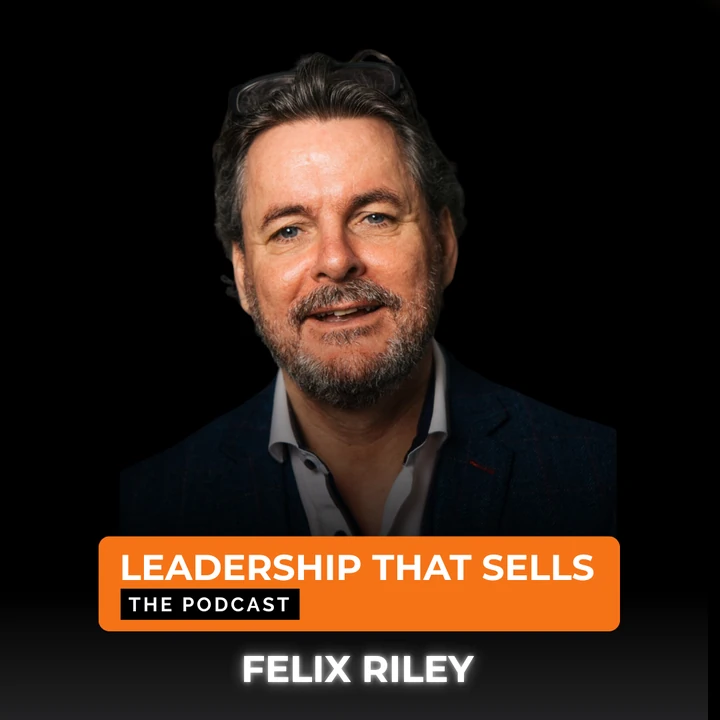
How leaders create momentum in uncertain times
with Felix Riley
Show notes
Most deals don’t die because your product is wrong. They die because the person on the other side is scared of losing.
This conversation with Felix Riley is a reminder that we are not operating in a rational world. We are operating in a psychological one. Risk aversion, learned helplessness, confirmation bias. These aren’t abstract ideas. They’re the hidden forces shaping every commercial decision. If you don’t surface them, you’re negotiating in the dark.
We get into what’s really going on in the buyer’s head, why doing nothing feels safer than change, and why the best operators stop selling products and start uncovering what people actually want. Not what they say. What they really want.
In this episode
If you want to win better deals, do this:
- Surface every fear in the room. If it’s not said, it’s still there and it will kill your deal
- Reframe risk. Buyers fixate on certain loss versus uncertain gain. Your job is to challenge that framing
- Ask “what do you really want?” until you get past the surface answer
- Lean into uncomfortable truths instead of hiding behind polite conversations
- Be willing to walk away. Trust compounds faster than revenue
Episode highlights
[03:08] The three biases quietly wrecking your deals: confirmation bias, learned helplessness, and risk aversion
[08:01] The internal finance conversation that kills momentum before it starts
[10:11] Why “and what else?” is the most powerful question in discovery
[12:10] Kind lies vs painful truths and why one leads to failure
[15:58] The real differentiator isn’t product or price. It’s trust
[17:20] Why doing nothing feels safer even when it’s clearly wrong
[24:58] The shift from “what do you want?” to “what do you really want?”
[31:57] The mistake most operators make: not taking enough risk
Links and resources
https://uk.linkedin.com/in/felix-riley-brilliant-thinking
If you got value from this, follow the show and share it with someone who’s responsible for real commercial outcomes. And if you haven’t already, leave a review. It helps more than you think.
Transcript
Automated transcript. Speaker labels and spellings may contain errors.
Paul
[upbeat music] My guest today is a strategic provocateur, and he helps leaders escape incremental thinking and to aim higher. This man works with founders, exec teams, and helps them to challenge all those assumptions we just, we just sit on and we think- we don't think about. He helps them to rethink the constraints and unlock bold decisions in their professional lives. He's a sought-after speaker on moonshot thinking and also on behavioral biases, which for salespeople is, we, we know drives everything. He's very well known for turning complex psychology into simple practical shifts that change outcomes. An expert in learned helplessness, so he's hopefully gonna help me, and w- dealing with risk aversion. Welcome to Leadership That Sells. This is a podcast about what leadership and sales looks like when conditions are not ideal.
I talk to founders, CEOs, and operators who've had to make those decisions when time was short, pressure was real, and the obvious stuff didn't work. We're not here for frameworks. We're not here for slogans. We're here to try and actually understand what creates momentum and conversely what quietly destroys it. So if you're responsible for results and not just ideas, you are in the very, very right place. [upbeat music] Riley, thank you very much indeed for joining me.
Felix Riley
Oh, a pleasure. Thank ... I'll, I'll take the introduction. Can we end now? I think we've peaked.
Paul
Yeah. Oh, we're done. We're good.
Felix Riley
Yeah.
Paul
We're good. There we go.
Felix Riley
See you later.
Paul
Thank you very much and good night.
Felix Riley
Yeah. [laughs]
Paul
Right, so, um, most of the boards who are gonna be listening to this, um, and of course we need to be talking to one person at a time. So the person I'm thinking I'm talking to is somebody who's relatively grown up and is probably in some way, shape, or form c- responsible for commercial results. Okay? And in order to get a commercial result, you have to persuade somebody to part with money. So, "Dear Mr. or Mrs. X, can I have your cash? I can solve this problem for you." Now, they're not gonna do that for many, many reasons. If only they would just turn around and say, "Paul, of course, because it's you. Have 200 grand and come and solve my random enterprise problem." Okay? Why are they not just gonna hand over their eddies? What are the things holding them back?
What are they looking at and not seeing in me? What are they seeing in me? What am I doing wrong? What are the biases that are infecting this relationship I'm trying to expand and develop here, in your experience?
Felix Riley
I think, um, it's interesting, isn't it? I mean, we know, you know, you know better than me that when you, you know, you're looking to solve a problem Mar- in, on in any sale.
Paul
Yeah.
Felix Riley
You're looking to solve a problem, and when we lose sight of that or when we fail to do that when we could've solved that problem, when we should've been the solution, um, I think it's, it's cognitive biases mainly in us, but also in them as well. You've gotta work on yourself first, sort yourself out, and then you, you really have got the headstart you're looking for. And the ... In my experience of working with businesses, the ... I would say the three most common I see are confirmation bias, uh, learned helplessness, and risk aversion. And if I go through those three, confirmation bias is where we have a view, and what we want is information that backs that view up. Uh, and we actually don't wanna listen to anything that contradicts that.
Um, interestingly, by the way, uh, social media is weaponized confirmation bias.
Paul
Yes. With bells on.
Felix Riley
Uh.
Paul
Yeah.
Felix Riley
Which is very sad. Um, it's very sad. Uh, but it shows you how easy we are to manipulate.
Paul
Yeah.
Felix Riley
It's incredible. It's incredible. Um, fun fact, by the way, if you, if, if anyone's got time on their hands, and I'm a- and I'm afraid in many ways we all have. Um, if you, if you get adverts on your social media, if you don't subscribe, uh, um, social media companies, the, the video before the advert sets up your mindset.
Paul
Mm.
Felix Riley
Sets up ... So if you ... So you might have a violent mob, um, smashing up a street, cut to home security advert. They know what they're doing. They know what they're doing.
Paul
[laughs]
Felix Riley
And that is purely is confirmation bias. It's confirming, I do feel scared. I am scared of this world, you know? So, so we're surrounded by it. Uh, so confirmation bias is, yeah, it's, um, if I, you know, if I happen to be, uh, let me think, a green supporter, you know, then every time I see anything where a, a banker gets a big bonus, you go, "Oh, they, I bloody knew it." See? See? This is why I'm a green supporter. And then when a banker gives a m-m- gives a fantastic donation to a school we go, "Well, yeah, but I bet most of the time he's on his yacht." You know? You, you ... Yeah, you can-
Paul
[laughs]
Felix Riley
You ... I'm being unkind to green supporters, but, you know, for an example. But the ... But you do, and that's, and that ... Well, 'cause you've got confirmation. And I'm afraid the whole political spectrum thinks that way. So I'm not-
Paul
Yes
Felix Riley
... I'm not singling out green. We're all guilty of it. And then, and re- and, and learned helplessness is ... I, I actually think it's almost the, my working assumption of how most companies and organizations operate, which is where you suffer so many setbacks in your life. You hear the word no, you have failed initiatives. You, you go to sell something for the hundredth time, and the last, um, you know, 99 didn't, didn't buy it. And you just lose heart, and you settle for good enough is good enough. Um, and you just kind of grind it out. And you go into companies where you go, "Why is there sort of a hum of despair here?" [laughs] And that's learned helplessness, where-
Paul
Mm-hmm
Felix Riley
... 'cause no one ... You know, who starts a company with a low ambition? You know? Who, you know, who goes into a role with a low ambition, you know? Everyone starts out with massive dreams. But actually re- when you, when the rubber hits the road, when we hit reality, you know, obviously we get some of our stuffing knocked out of us. And, and the real entrepreneurs, the, you know, the really, you know, tiger-ish, uh, salespeople just push through it and go, "Well, that's all right. It's all right. Set your face to the storm. Go, keep going." But a lot of people, quite naturally, they understandably just give up. You know? They, they, they just ... They decide that's reality. So that's learned helplessness. And then the third one I think is a massive challenge. And going back to, you know, your commercial director, why is he gonna buy? This is, I think, the single biggest thing you'll deal with, say, especially people ...
Anyone who's got to do with the money decisions on their side, is risk aversion.
Paul
Mm-hmm.
Felix Riley
And risk aversion is exactly as it sounds, an aversion to risk, but it's much deeper than that Because, and, and, and if you understand this, you can really start to have pr- better conversations with your customers. Um, so risk aversion is based on the, on the fact, 'cause all the research backs this up, is based on the fact that we feel a loss much more than we feel the, the happy... or sorry, the pain of a loss much more than the happiness of the equivalent gain. So if, if, if you, you know, if you or I walk down the street and we lose 1,000 pounds, because we happen to be carrying 1,000 pounds, that's gonna ... And we g- get home and go, "Oh, I've lost the money. Oh, God," you feel terrible. The, that, the acuteness of that pain is way more than being in the park and finding 1,000 pounds.
Paul
Yeah.
Felix Riley
You know, that, that, there's a certain amount of pleasure from that. But they've done all the re- they've done all the tests and-
Paul
Mm-hmm
Felix Riley
... and we really feel pain, the equivalent pain much worse. Now, put someone in the psychological situation where, where they're looking to spend money on the company's behalf, and they, their default is, "I'm scared of losing. I feel the pain of losing." So they're not thinking that consciously, but subconsciously they are. Um, and what happens is, um ... And I, you know, and I talk, talk about this in my talk, The Flea Job, because I, to me, it's core, it's core to what we're dealing with with cognitive biases. People want deterministic outcomes in a probabilistic world.
Paul
Okay, break that down.
Felix Riley
Yeah. Well, because that's how we work our minds. We want to do something and get a definite result.
Paul
Yeah.
Felix Riley
And outside of maths and physics, everything's probabilistic.
Paul
Yeah.
Felix Riley
And but people kind of don't accept that, you know? Um, I mean, my daughter studies astrophysics at university. You know, she's got my brains but none of my humility. And she, uh, and she, if she phoned me up and said, "Dad, I just ran an experiment and we had a non-deterministic outcome," I'd start breathing into a brown paper bag, because I really like maths and physics following the laws of nature. Everything else is probabilistic. But what you do is, so you're sitting there with an FD, and this is what's ... These are the conversations that are happening on their side, and they'll say, "Look, I wanna buy Paul's product. You know, if we spend 200 grand on that, I think we can make a million next year." And the FD sucks air through their teeth and say, "Right, if you spend 200,000 on it, £200,000 on it, you've definitely lost
200,000 pounds, and you might get a million." Yeah, I'm kinda thinking about the definitely lost 200,000 pounds bit. And that's the bit we have to challenge. We have to get people out of that zone where they are stuck on the absolute 'cause that, that's ... We have to make them comfortable with the reality that life is probabilistic, that-
Paul
Mm
Felix Riley
... y- you know, nothing comes with guarantees. But if, you know, you know, I can't stop COVID. I can't stop Trump invading Greenland and whatever [laughs] that will do to the world. I can't do that. But those, you know, force majeure aside, uh, actually if you accept that this is a great product, it solves your problem, um, you know, we've got a great track record, we've got a great relationship, uh, you know, it, it's in, in line with what your goals are. You know, tell me about a solution. Tell me about, you know ... You, you, you know, you've, you've ... But, but you, I think you have to call out people's concerns. That's what I, I ... You know, when I'm negotiating-
Paul
Mm-hmm
Felix Riley
... with people.
Paul
Mm-hmm.
Felix Riley
I, in good faith ... Because my product might be wrong. But you know, in good faith, if, if you ... Ev- where we're not having a full conversation, where the person's hedging and, "Mm, yeah," you know, and sort of ... And not opening up, I, I know I've almost already lost. Until I can get them to, to ... Until I say, "Look, I'm not gonna use the information against you. What's your concerns? What are your problems?"
Paul
Yeah.
Felix Riley
And what they'll do is they'll talk, they'll be, they'll talk in, in cognitive biases, which is, "I'm worried about losing the money. I'm worried it won't work," risk aversion, you know? And you know, "What if it doesn't? What if it doesn't? What ..." All those are risk aversions.
Paul
Hmm.
Felix Riley
So we have to lean into it and say, "Well, think, you know, you know, what ... Let's go through and, and let's look at all the scenarios where this won't work," so that you put it on the table. You say, "We ..." And then you kind of, you're scaring the ghosts away by-
Paul
Yeah
Felix Riley
... getting people to talk about ... 'Cause they'll say, "Well, this might." And you go, "That's incredibly unlikely. Has that ever happened before?" "No." "But you think it might happen on this occasion?" "Well, not really." "Okay, good. So we, can we put that one to bed? Right." You know. And it's ... But they might have a really good concern, and you have to, and you have to deal with that, you know. But I think where, um ... And they're never gonna frame it as risk ave- as cognitive biases, but where their concerns aren't aired, I think there's a problem. And I think there's, "Okay, I've got a ways to go here." But if everything is aired in that conversation, and therefore you've addressed all their fears and all their, you know, and all their upsides, I think you've got a really
good chance. And for me, that's how I try to negotiate, and not just sales, in life.
Paul
Yeah.
Felix Riley
You know, if I ... If you're, you know, if you're sort of, you know, if you're sort of, um, sort ... If you're, you're shadow wrestling with someone, whether it be on a personal life or in a commercial situation, you leave very unsatisfied because you think, "Well, I didn't get to the bottom of that, you know, and I, and I, I haven't got a handle on it." But where everything's aired, then as I said, they're not gonna say, "I've got risk aversion, loss, and learned helplessness," but you'll listen and you'll go, "Oh, I know what that is. Oh, I know what that is. Oh, but that's okay. I mean, we all, we all suffer from that. I get that as well." But, you know.
Paul
Yeah.
Felix Riley
So that's why risk ... Cognitive biases are very powerful to me.
Paul
On, just on, on, on the, the discovery thing then, when that's what it is, it's discovery. It's ... My, my, my favorite question in the whole thing is, and what else? You know? So you've listed something. Okay, that's good, and you just get the big long list and work through it one at a time. But in the, right at the very end when you think you're done, you say, "And what else?"
Felix Riley
Yeah.
Paul
You're still trying to pull and pull and pull. And it's interesting, you think about this both from a relationship, a human relationship or a societal or a cultural dis- position. And you have high-functioning societies and low-functioning societies. You have, um, strong relationships and weak relationships. You have-
Felix Riley
Yeah
Paul
... the, the things that succeed and the things that fail. And if you have the, the kind lies, "Does my bum look big in this?"
Felix Riley
[laughs]
Paul
"Well, no, it's fine." It's huge. It's elephantine.
Felix Riley
[laughs]
Paul
You know? Versus the, the harsh truths.
Felix Riley
Hmm.
Paul
If you have the, the painful truths rather, a, a succession of painful truths will lead you to a peak, a pinnacle, clarity, understanding-
Felix Riley
That's it
Paul
... drive. Whereas kind lies will decline and take you down to a, a, a pit from whence you have to es- es- escape
Felix Riley
Yeah, yeah, yeah
Paul
... by telling the truth and reaching that peak.
Felix Riley
Yeah.
Paul
So whether you either go up or you go down, and if you don't, if you're not clear about something, you're going further and further and further into the pit of, uh, uh, opacity, of misunderstanding, and you're missing the opportunity to get to the, the truth.
Felix Riley
Yeah. Yeah, yeah.
Paul
The truth will out. The truth will out.
Felix Riley
The truth will set us free-
Paul
It is
Felix Riley
... as they say. Yeah, yeah.
Paul
I mean, sunlight the best disinfectant, all that good stuff.
Felix Riley
Yeah. Yeah.
Paul
Mm.
Felix Riley
Well, and the problem is if, if you don't get it all on the table, as you say, to the what else, which is a great question to end on-
Paul
Yeah
Felix Riley
... because... Well, not end on. It, it, I, it, we both know-
Paul
Mm
Felix Riley
... what else can often open up a much bigger conversation. We go, "Oh, I'm glad I asked that," you know?
Paul
Yeah.
Felix Riley
And the... Uh, but that's the salesperson's job is to surface this stuff. I mean-
Paul
Mm
Felix Riley
... you, you know, you know, you've got, you know, push and pull salespeople, and push people obviously have a success rate, and they can drive, drive, drive, but they're not really interested in the what else a lot of the time.
Paul
No.
Felix Riley
They're being like, "Do you wanna sign the document?" "Sign the document." But actually the pull salesman wants that trust of like, "Look, just tell me it all. Come on, just get it all on the table." And I, and if it comes to a point where I say, "I'm the wrong product," I'm gonna tell you because-
Paul
Yeah
Felix Riley
... I don't, you know, I don't want, uh, you know, to, to make money just today. I wanna make money for the next 10 years with you.
Paul
Absolutely.
Felix Riley
So I'm much more interested in that. And of course, uh, and the minute you say that, that you're addressing another fear, you know, another risk aversion-based fear. Fear, fear is ni- you know, 90% of our decisions are fear-based.
Paul
Oh, yeah. You have... There are only two emotions. There's love and there's fear.
Felix Riley
Yeah, yeah. And I've got none of-
Paul
Everything else is a shade
Felix Riley
... I've just got fear. So-
Paul
[laughs]
Felix Riley
So, but the, uh, but yeah-
Paul
Well, I'm full of love, Darren. [laughs]
Felix Riley
[laughs] No, but that's... But, but the thing is w- yeah, but that's a really good, you know, way to think of it, which is that, you know, this person's objections, if you think of them as fear-based, not obviously-
Paul
Mm
Felix Riley
... and we both know we're not talking about terror. We're just talking about don't wanna cross a busy road. That's fear-based.
Paul
Mm.
Felix Riley
Uh, but if you... So fear is very sensible as well. But the... If you can sort of say, "What are they, what are they worried about?" You know, "What are they scared of?" And is it, you know... And you can talk to them, and you know this from what else conversations where y- they might say, "Oh, the FD's, you know, just running riot at the moment, just looking for anyone to crucify. If anyone here makes a bad decision." And you go, "Right, that is holding you back. That's an extra layer of risk aversion," you know? Uh, and I think when you, when you surface it all, and, uh, w- y- you will get to points where you, you, you... Where the conversation goes is nowhere near where it started. And you might, and you might realize, "Oh, look, I'm... This... You, you guys shouldn't be buying this." [laughs] You know?
Paul
[laughs]
Felix Riley
You've got... This is a, a desperate roll of the dice, and I don't want... You know, I'd much rather work with you in a, in a, you know, as a consultancy way and come back and sell you my stuff next year when you're ready. So whatever it is. And I think the people will always, um, respond to that honesty, you know? And they... And you'll never... You know, I've, I've, I've had more business from, uh, people who I've turned away sort of saying, "We shouldn't do this right now, but I'd love to bloody work with you, you know, when you're ready." Uh, I've had more from them than from the push, people I've tried to push through because-
Paul
Yeah
Felix Riley
... you know, and, and when you look back and go, "Why did I do that?" You know? What... I wasn't thinking about them at that point. I was thinking about me, you know? And you get to a point in your life where you go, "I've just... You've gotta walk away. It's okay." There's, there's, there's so much, so many people you can sell to out there. If you've got a product you can only sell to the, the UK government, which I've got a client that he's, he can only sell to the UK government. I mean, that's ballsy. That is tough, but it, he's doing it. But, uh, but it's just, it's one of those rare unique products. Most people can sell to lots of people.
Paul
Mm.
Felix Riley
So you don't... You... So walking away is the creds you'll get, the kudos you'll get.
Paul
Yeah. The, the trust.
Felix Riley
Yeah. Oh, it's everything.
Paul
The trust. And it moves them from the fear end of the scale onto the love-
Felix Riley
Yeah
Paul
... end of the scale.
Felix Riley
Yeah.
Paul
It moves them because you are endeavoring to serve them in the best-
Felix Riley
Yeah
Paul
... possible way and not serve yourself.
Felix Riley
Yeah.
Paul
The minute you start looking at your own navel, you're, you, you, you... Well, you just smear up your own backside, frankly.
Felix Riley
Yeah. Well, and that, and, and, and on the question of trust, you know, there's, being brutal about it, there's only really two things that separate, uh, two products. You know, one, one is price, and one is differentiation. You know?
Paul
Mm.
Felix Riley
How is it different? But if you throw trust in the mix, I like dealing with Paul 'cause I trust him.
Paul
Yeah.
Felix Riley
And if Paul says I should do this, it, you know, okay, our company might have some other issues, but he means it, and he, and I can trust him, you know? And that's, that's worth its weight in gold, you know? There was a... Was it the, um, a story of the, the most successful, uh, car salesman in America was a guy who would, again, walk away from deals, tell people, "Look, we haven't got the right car for you, but there's a lot down the road where they do sell it."
Paul
Mm.
Felix Riley
And the boss said, "What are you doing?" He says, "I'm not trying to sell them this car. I wanna sell them their next car and the one after that and the one after that," you know? And that's... And he's the most successful sales, car salesperson in America because playing that long game. Goldman Sachs, long-term greedy.
Paul
Yeah.
Felix Riley
And you can tell clients don't mind that. I said, yeah, I said my client, "I'm long-term greedy, which is why I'm not gonna do this deal with you 'cause I want, I want, I want you to love every deal, you know, and I want you to look at me and say, 'We always make money together,'" you know?
Paul
Yeah.
Felix Riley
And then, then... And so I don't wanna be involved in the deals where it's skinny 'cause you're gonna, you know, you're gonna... It's gonna ha- it's gonna leave a bad smell, you know?
Paul
You'd be scraping away at something.
Felix Riley
[laughs]
Paul
You'd be scratch and sniff trying to get the little last essence out of this.
Felix Riley
Yeah. Exactly, yeah.
Paul
That's it. I mean, the thing, when you're... W- we touched upon it, one of the, the earlier bits there was the confirmation thing and the learned helplessness where people just drift through, but you've also got doing nothing, and this... I just... Doing nothing is safer, you know? I don't wanna spend-
Felix Riley
Yeah
Paul
... the money because I'm, I'm, I, I'm averse to the risk.
Felix Riley
Yeah, yeah.
Paul
And frankly, in my situation, why do you think, why do you think that doing nothing feels like this safe option for people? Even when all the logic says you have to do the change, you have to, have to make these changes. Yeah.
Felix Riley
I think because going back into my, my idiom, if you like, my, my rule that people want deterministic outcomes in a probabilistic world. They get to say, "Well, I definitely didn't do that, and I didn't do that, and I didn't do..." And they give you all the reasons for not doing stuff. And I've been in too many meetings, and I mean countless meetings, where typically the FD-ish figure sounds the cleverest because they're giving you all these reasons why we've saved money by not doing that and saved money by not doing that. And there comes a point where I say, "Listen, we're entrepreneurs. We're businesspeople- We've got to take risks. Business is by its very nature risky, otherwise you're gonna get a job with the government, you know? Very important by the way, not knocking the government in any way, but you know, you do.
I mean, there's, you know, a lot of people get jobs with civil service-
Paul
Mm-hmm
Felix Riley
... because they like the surety, they like the security. Um, and you sort, you sort ... You know, why are you in business if you won't take a risk? And the, you know, and the, and, and there's no question there's ... I mean, all the data shows that companies who take the most risks are the most successful. So Google, IBM, Apple, Amazon, um, they ... Do you know they fail the most?
Paul
Mm.
Felix Riley
That's an absolute fact. They fail the most. They are constantly, uh, releasing new initiatives, new products that fail left, right, and center, but they know that's the price of progress. And when you've got companies that say, "Everything must succeed," you go, "Oh, good luck. Just show me the other company that's done that, the really successful company where they've never failed." You know, nothing goes up in a straight line. And when you get this, um, this mentality, this sort of status quo mentality where people fear change or they get used to, they just believe in if we just keep doing, doing the same thing, even though the world's changing around you-
Paul
Mm-hmm
Felix Riley
... you know, uh, that, that, that will ha- somehow be a winning solution, um, it's very dangerous when people get ... You know, those people get a grip on the company. You know, it's ... But again, a lot of it's reframing, you know? It's, you know, if you, if someone says, "Let's just keep doing what we've always, always done," you could say, "Okay. Yeah. Well, you could do that. That's fine." But you could ... But you can reframe it and say, "That's fine. You're doing that because you're working on the basis that if everything's the same and I do the same, I'll get the same outcome." And the, you know, the person will say, "Yeah, absolutely." You go, "Right, okay. Do you realize nothing's the same?
Do you realize the economy has revolved and evolved, so you're literally not where you were. So you're, so you're g- ... Let me take you back to when you started it, you know. What was the economy like? What were you doing? H- why is it successful?" And when they'd start airing that, they'll realize, "Oh, I'm talking about a different world, a different time." You go, "You are."
Paul
And you are not the same.
Felix Riley
Yeah. Well, that's it.
Paul
Right.
Felix Riley
There's no man steps-
Paul
You've gone ... You, you ... It's five years later
Felix Riley
... no man steps into the same river, you know?
Paul
Yes. Man never steps in the same river twice. And it's-
Felix Riley
Yeah
Paul
... d- different man, different river.
Felix Riley
Yeah. That's it. That's it.
Paul
Different man, different river. And that's the thing, that's the thing that I think is, it's one of those, um, fairly subtle but blindingly obvious things you pick up as you get older, is that I'm not the same man.
Felix Riley
Yeah.
Paul
I'm slightly achier and slightly older, but by golly gumboots, do I know a lot more stuff.
Felix Riley
Yeah.
Paul
Things not to do, right?
Felix Riley
Yeah.
Paul
What questions to ask.
Felix Riley
Well, but I think as we get older-
Paul
Yeah
Felix Riley
... another kind of ... I don't even think it's a risk aversion. I think we look at a battle ... When you're young, you just think ... I mean, I, I look back at the hours I used to work when I was f-
Paul
[laughs]
Felix Riley
... when I did my first companies. Oh, God. How would I do that now, you know? I was sleeping under the desk in my first company-
Paul
Yeah
Felix Riley
... you know? And-
Paul
'Cause it was so exciting. So exciting
Felix Riley
... well, it is, it's so exciting, and you've got this boundless energy, and-
Paul
Yeah
Felix Riley
... your people around you are up for the battle. And then you get older and you go ... And I, I know this time and time again, you know, from friends and colleagues and clients where they just haven't got the stomach. They're like, "Oh."
Paul
Yeah.
Felix Riley
And you go, "Well, get someone else then. It's okay."
Paul
Yeah.
Felix Riley
You know, step back. But, and, and what happens is, again ... 'Cause when people say ... When people have objections, it's incredibly rare, happens occasionally, it's incredibly rare they tell you the truth about the objection when it's a-
Paul
Oh, no. Never
Felix Riley
... when it, when it reflects a flaw.
Paul
No.
Felix Riley
When it reflects a flaw.
Paul
Mm.
Felix Riley
So when someone's thinking, "I can't be bothered," they'll go, "Oh, you know, the, it's-"
Paul
It's not the right time. [laughs]
Felix Riley
Yeah. The s- yeah. That's it.
Paul
[laughs]
Felix Riley
It's the wrong time, the wrong part of the s- the financial year. Cl- uh, the staff are overwhelmed at the moment. And what ... And you said, "What's the truth?" They go, "I can't be bothered. I just can't be bothered." Yeah. Oh, okay. But it's a good idea. Yeah, it is. But you can't be bothered, you know? And what happens is ... I mean, I, I ... You know, I ... When I, uh, used to run my companies, I used to say my problems were 90% personnel and 10% personnel.
Paul
[laughs]
Felix Riley
Because, you know, it, you know, it, the psychology, the, especially the g- group psychology-
Paul
Mm
Felix Riley
... overwhelms the best intentions.
Paul
Mm.
Felix Riley
Overwhelms the machine. And that's why when you have an inspiring boss that makes everyone wanna just get out there and ruddy do it, that's great because actually suddenly everyone points in the same direction. They know their purpose. They know their goal. They get on with it, you know. They trust each other. Boom, you've got a company at that point. But the amount of times a key decision-maker, and you know this, you're dealing with a gatekeeper, you were going, "You're not qualified to b- you know, keep this gate. This ... You're, you're a shocking person." And you think, "I can't go above you." But you are ... You know, you're in love with that other company because of a relationship, not because of their product. And you go, "Well, I'm stuffed now." You know what I mean? God, how many times have we all met that in our lives, you know?
Paul
Yeah.
Felix Riley
And you ... But, but that-
Paul
Can you give me a quote? Because I need to compare it to my cousin's company that-
Felix Riley
Yes
Paul
... we're going to use.
Felix Riley
That's it. Yeah. Yeah. I mean, when they-
Paul
But would you mind spending three months filling this out?
Felix Riley
Yeah.
Paul
Yeah.
Felix Riley
And you've got ... Well, but again, this is how irrational the markets are. There are tens of thousands of companies that are lopsided in their outputs and outcomes because they're maintaining relationships with people because of favoritism or just, you know-
Paul
Mm
Felix Riley
... or laziness or, you know, or just as you say, you know, "He's my, he's my cousin," or whatever. And you go, "Well, that's fine, but that's not gonna get you to, that's not gonna get you to the up, the sunny uplands because you're holding yourself back." And, and again, those are cognitive biases. Those are ... It might be people pleasing. It might be-
Paul
Yeah
Felix Riley
... you know, confirmation bias that, you know, this fella's always been right, and if he's saying it I agree with it. And you go, "Well, that's not, that's not really how it works, you know? You, no one's right all the time." So, you know, the ... So, and, uh, yeah, I think the ... But I, I'm always wanting to know who am I dealing with the other, other side of the table. And the big question in my mind actually at the back of every conversation, every conversation, is what do you want? What do you want? What do you really want? You know, what do ... You know, there's a funny thing when ... So I've written novels and screenplays, as you do, and, um, and there's a really interesting thing with characters which everyone, even if you're not a writer, you kind of get it and you go, "Oh, I've always thought that,
but I've never really articulated it," where a really great film ... What ... You know, Fast and Furious, it's got the depth of a puddle. Fine. V- and it's, but it's fun. Whatever. But you get a really great movie like When Harry Met Sally, you know? Um, and take ... And you go, and you go, right, "What does Harry want?" And, and, and it's, uh, and it's like, oh, just, to, you know, he wants, uh, he wants to sleep with every female friend. He wants the gin. He just ... It doesn't think it can be done, you know? Uh, or, or he wants Sally. He wants Sally, you know? Um, and you go, "All right, fine. So he wants Sally. Fine." And everyone would agree on that. Yeah, all right. He wants Sally. He spends most of the film chasing her. You know, you go, "What does he really want?" And you go, "Oh, he wants to believe in love." He actually wants to believe.
He's cynical. He says, "Oh, love, pho-" He really wants to believe in love. And at the end, that amazing emotional scene at the, the, uh, New Year's Eve party, he believes in love. He finally believes in love. And, and, and, and, you know, and it's a beautiful scene. But the reason it speaks to us is we, we get that, but we don't l- we don't live our lives that way. So when you're dealing with a, a business person, you say, "Well, what do you want?" And the- and they're, and they're like, "Well, I, we want, you know, uh, a new CRM system, uh, that will r- you know, just revolutionize things, uh, and really, you know, just take so much of the pain out the comms and the emailing, blah, blah, blah." Fine.
Okay, right. Uh, but what you really wanna say is, "What do you really want? What do you really want?" And they'll say, " [sighs] I've missed my targets for three years in a row. I just wanna hit my targets."
Paul
So-
Felix Riley
That's what they really want. That's what re- And if you can get to that, gosh, you're having a conversation. My Lord, you're having a conversation. And then, and then you can say, "Well, okay, what can I do to help you?" You know? Or, "No, I, I'm the wrong person, but I really wanna work with you, you know? But I'm gonna put you in touch with someone who can fix that." And when you can speak to what someone really wants, my God, you've got a relationship.
Paul
Mm.
Felix Riley
Then you're ... You know? And that's the trust there where ... You, you can't exploit it. You know, gotta be in good faith and all these things. But where someone... And it doesn't have to be a personal thing. Doesn't ... It might actually be a, a confessional thing about the company. I've had this recently where I'm giving a talk and they were saying, "Yeah, yeah, we want the talk to be this, this," and I felt something was wrong. And I said, "So what's, what's going on with the company?" "Oh, you, you know, we've missed these numbers, but, you know, it's gonna be ... We think it's gonna be okay next quarter." And I said, "What's really going on?" They said, "They're screaming at us from head office in America. Screaming at us, you know." And I said, "Right. So we want the talk to somehow deal with that, how to navigate that, you know, and have to come out the other..." And it wasn't until I got to that part of the conversation-
Paul
Mm
Felix Riley
... that I could give ... And, and I thought, " 'Cause I'm gonna give you a talk you don't want. And you're saying you want this," and I could see it. You know, you know that thing in sales where they're saying, "I want this, I want this." You think, "That's not what you want, and I can't for the... I'm not... Somehow we're not getting there." So I, I try to get to the what do you really want.
Paul
Mm-hmm.
Felix Riley
What do you really want, you know? And then you can deal with someone, you know?
Paul
Yeah.
Felix Riley
Sometimes, sometimes they say, "I just wanna be out this job." And you go, "Okay, well, if you want to be out this job, well-"
Paul
I can help you. [laughs]
Felix Riley
"... let's painlessly get you out the job, you know. It's fine, you know." But I really wanna know what they w- You know, then you got a relationship, you know?
Paul
Mm.
Felix Riley
Uh, and it ... And even if it ... And there's layers. You know, one might be a sort of personal thing. I just wanna, you know, buy my, buy my wife a new car, and w- that means a bonus. Oh, fine. But... Or it might be, um, I just want to... This company is... it just isn't taking off, and for three years we've just been going sideways. I want, I want to get, I wanna get lift off again, you know. And you go, "Oh, well, okay. Well, that's a, that's a bigger conversation." So this, this, this is your tool to getting that... You know, 'cause anything you're doing is a tool to their bigger goal, you know?
Paul
Mm.
Felix Riley
So if you, if you know their bigger goal, well, then you, then you're having a conversation, aren't you?
Paul
That's it. And I think when you're doing it on an individual level, I mean, I, I come into organizations, and one of the things is after investment, that's the first place, the first... The, the, the people start to drift. They've had a chunk of investment come through, and all of a sudden it's like, oh, we can do 27 different things. Optionality comes on the table, confusion, all that sort of stuff. And you've got lots of people, and mostly people, investors are buying, uh, the team. They're buying the individuals working together and all that jazz. And while the focus is on the strategy and what we're trying to sell and to whom and things, one of the things you need to do is retain the team. And one of the conversations you have with the team, the top team, the top high performers, is what do you actually want?
Felix Riley
Mm.
Paul
What do you really want, and what do you want for your next job? Okay? Can the what do you want for your next job is ... It's not just how can I help you improve, learn, do stuff today, but when you grow up, what do you want to do next? And if you can make sure that whenever you're talking to them every couple of weeks, you're talking about both what we're doing now and what you're gonna get, how you're gonna get that next thing, that real thing that you really, really want, whether it's go off and go on the Mars program or, you know, l- learn Spanish guitar.
Felix Riley
Mm.
Paul
You can talk to both just the, the same way you're saying there. When you really understand what somebody really wants.
Felix Riley
Mm.
Paul
Mm. And so it's, it's the same-
Felix Riley
That's interesting as well, isn't it? 'Cause when you talk to someone, uh, what do you want next, you smoke out their timeframe.
Paul
Yeah.
Felix Riley
Because, you know, the, the, the, the disaster... I mean, it's funny, I was, I was sp- talking to an incubator, uh, lady the other day, and I said, "What, what, um, what, what, what's the biggest challenge? Uh, what, what makes them fall apart most?" She goes, "Oh, just the relationships, you know, the people. Com- pe- personnel, personnel, you know?"
Paul
Mm.
Felix Riley
And it's the... And again, you've got... 'Cause what happens is they, some people can go seven years. You know, when people... I mean, I... The amount of times you've had this as well, when people come to you and say, "I wanna start this company. I'm gonna sell it in 24, 36 months tops." And you go-
Paul
No, you're not
Felix Riley
... [laughs] "Are you? Have you read Odysseus?" You know, have you... [laughs] You know. Oh, I love the, I love the metaphor of Odysseus 'cause he went off on a short boat journey-
Paul
Yeah
Felix Riley
... and it ended up taking seven years.
Paul
Yeah.
Felix Riley
You know, and that is running a company. You sit there and you go, you know, it's, uh, I'm, I'm gonna do this and do this, and we'll exit in three years. And you go, if you can't assume it's gonna be seven years, don't do it. I always say that to people. Like, you've gotta assume seven years because that's... You know, seven to 10 years is, is the norm.
Paul
Mm.
Felix Riley
And by the way, statistically, it's very, very tough. So if you're working with the wrong timeframe, I already know you won't make it, you know. And, uh, again, but that's going back to what do you really want.
Paul
Yeah.
Felix Riley
And so, like you say, you know, what do you, you know, what do, what do you want here? But what do you want in the future? 'Cause now I know, now I ... Now, uh, if I knit those two things together, I get you. I get you now, you know.
Paul
Yeah. And the, the, the timeframe thing, the journey thing is if you are mismatched with the journey ahead of you, you, you don't have the mental packing. You do- you haven't packed your bag the right way. You, you don't have the, the goods for the journey. If you-
Felix Riley
I know. And the thing is, I, it's, you know... And, and I feel for people because the novelty of the beginning-
Paul
Mm
Felix Riley
... where everything is new and everything is, uh, the first time you're doing it, which is incredibly exciting but rather daunting, is so different to two or three years in when you are-
Paul
Mm
Felix Riley
... just trying to refine stuff or try, or one more push, or trying to raise more money, you know, because you, [laughs] you missed your, you missed your targets, you know. It's, uh... And they are very different people who can do that.
Paul
Yeah.
Felix Riley
Very, very different people, you know. It's, it's... And I think, I think, uh- It, I think a lot of people ... Well, we, you know this, you know. So many people start with the wrong team members where, yeah, 'cause you're mates or whatever-
Paul
Mm
Felix Riley
... you think that's gonna be enough. And you go, "Are you really gonna be there in the tough times?" Uh, and again, honest conversation. We've, we've drifted off the thing, but the ... But I, I think when people are starting out, I think the, the most valuable thing is bottoming each other out.
Paul
Mm.
Felix Riley
Are we, you know, what's our, our, what's our real ... If, if someone said we should get some psychometric testing or something, I'd think that's a great idea. Come in, check to see what sort of people you're gonna be when the, when the rain comes down, you know.
Paul
It's crucial.
Felix Riley
Uh, because it's, uh, it's, it's, uh, very, very different to that day one, isn't it? I mean, you know. That, that said, on the, on the upside, I think one of the exciting things about, uh, entrepreneurs is the- often the ... Well, these are where the new ideas come from, isn't it? So they have, you know, they have got this fresh take on, on the world, you know. So, uh, but it's ... Have they got the endurance? It's, it's, it's just that it's a marathon, not a sprint thing, isn't it?
Paul
Totally is. Totally is. Do you have a final word for us? Bring your wisdom to a peak.
Felix Riley
Uh, zizivia. It's the last word in the English dictionary. And [laughs] whenever I used to row with my PA and one of us just wanted to shut the other one up, we'd say, "Zizivia," 'cause it's the last word. Get out.
Paul
[laughs]
Felix Riley
Uh, I think, um, I think, um ... Let me think. Take risks. If you're young, you know ... I think pe- I think people ... It's funny, I was at a, I, I gave a talk about failure and, y- you know, using it as rocket fuel the other day, and it's sort of on my mind that someone sort of says, you know, "What advice would you give us? What, what did you mess up? What risks," you know ... Well, sorry, "What failures have you got?"
Paul
[laughs]
Felix Riley
And I said, I said I should've took more risks.
Paul
Mm.
Felix Riley
Definitely should've took more risks, because the consequences of most risks aren't that great.
Paul
Mm-hmm.
Felix Riley
And, and, and, you know, and, and luck favors the brave. It does favor the brave, you know. When I've been conservative, and Lord knows I've done it enough in my life, I've always looked at myself. I was just in disbelief, like, "Why'd you do that? Why didn't you just go for it?" You know? And I just-
Paul
We drift. We drift by default, right?
Felix Riley
Yeah.
Paul
You know? It's, it's, it's the opposite of the learned ... It is, it is the definition of learned helplessness. It's like, "Well, you know, it's all right. I'm getting paid. I can just mumble along." And you mumble along, and then you die.
Felix Riley
Yeah, yeah. Yeah, yeah, yeah.
Paul
Right?
Felix Riley
Yeah.
Paul
Because the journey is the destination. Like the entrepreneur, the journey is the destination. It's not, "I'm gonna build this and sell it." Mate, if you do that, you're one in a million, or one in whatever the statistic is.
Felix Riley
Yeah, yeah. No, it's-
Paul
Yeah
Felix Riley
... shocking how small. Fucking small.
Paul
Uh, but you've got to build for the journey. You've got to build yourself, your psyche, your team, your product, your organization for the journey, assuming that it might take you the rest of your life.
Felix Riley
Yeah. Yes. That's ... That ... And I, and I think you've said a really good thing there. I think the, um ... Uh, when someone comes to you with a business idea, I think it's worth saying to them, "Would you do this for the rest of your life?"
Paul
Yeah.
Felix Riley
Is it, you know, is it that good, and is, are you that committed to it? And if they go, "About three years," you go, "Well, I'm scared now. I'm scared." You know?
Paul
Mm.
Felix Riley
And it is ... And I think ... And even though you don't really wanna be with it for the rest of your life, if you haven't got that strength ... 'Cause it's so big to start a company, and it's, it's easy, but it's also ... You know, these, these people don't luck out, you know? And, you know, so they don't, they can't, they can't force their way through the laws of nature, you know. The people who win, there's a lot of luck. I mean, everyone, you know, you have to accept that. And you go, "Fine. Dust myself off. Get up. Do it again. I've learned. I'm old. I'm, I know more, more this time than last time," and all that sort of stuff. And good investors will know that. They'll go, "That's all right." You know, I, I saw the ...
Trump invaded Greenland, everything went to hell, you know, and that's, that changed everything. But the ... But I think the, uh ... Yeah, I think, uh, I think luck favors the brave, and I think I've kicked myself when I've ... Uh, you know, I don't advocate recklessness.
Paul
Mm.
Felix Riley
I advocate restlessness. Just be restless.
Paul
There's your billboard.
Felix Riley
There you go.
Paul
Be restless.
Felix Riley
Yeah. Oh, yeah. Well, I think g- restless and curious. Same thing, really. Just be curious.
Paul
Restless and curious. That's it.
Felix Riley
Yeah.
Paul
Do you know what? Let's take that. I'm gonna take that as a final word, Felix Wiley. Thank you very much indeed for joining me.
Felix Riley
Such a pleasure. Such a pleasure. [upbeat music]