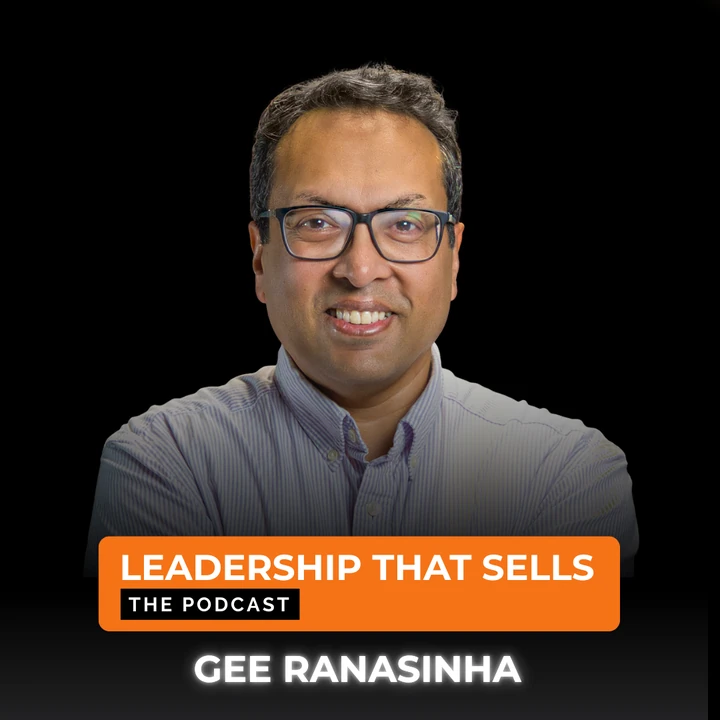
What leaders get wrong about marketing
with Gee Ranasinha
Show notes
Most marketing isn’t broken because people aren’t trying hard enough. It’s broken because nobody actually understands what marketing is supposed to do.
This conversation with Gee Ranasinha is a proper teardown of the nonsense. Too many businesses confuse marketing with activity. Brochures, websites, campaigns, “leads”. None of that matters if it doesn’t create pipeline. And most of it doesn’t, because the fundamentals are wrong from the start.
We get into why marketing is so often misdefined at board level, why sales and marketing talk past each other, and why trust, not tactics, is what actually moves deals forward. If you’ve ever sat in a meeting wondering why all this effort isn’t turning into revenue, this will hit home.
In this episode
If you want marketing that actually works, do this:
- Start with the right prompt. If your positioning and message are wrong, everything downstream fails
- Hold marketing accountable for pipeline, not activity or MQLs
- Get your marketers talking to customers. Constantly. No exceptions
- Use real customer language, not internal jargon, to shape your messaging
- Treat price as perception, not just a number on a spreadsheet
Episode highlights
[02:55] Why you cannot be both head of sales and marketing and do either well
[05:40] The real problem: businesses don’t understand what marketing actually is
[11:49] Pipeline vs leads and why most marketing metrics are useless
[13:54] “How we do it is nobody’s business” – but results are
[23:05] Why marketers who don’t speak to customers are flying blind
[33:47] The uncomfortable truth: people don’t pick up the phone anymore
[36:27] What you are actually selling in every deal: trust
[40:48] Price isn’t a number. It’s a feeling
[42:41] The line every operator should remember: what you tolerate becomes your standard
Links and resources
https://kexino.com/gee-ranasinha/
https://www.linkedin.com/in/ranasinha/?originalSubdomain=fr
If this episode sharpened your thinking, follow the show and share it with someone responsible for revenue, not just activity. And if you haven’t already, leave a review. It makes a bigger difference than you think.
Transcript
Automated transcript. Speaker labels and spellings may contain errors.
Paul
[upbeat music] My guest today is a behavioral science expert and an anti-hype marketing strategist. He helps businesses win trust, stand out in saturated markets, that's a good one, and drives sales with smarter science-backed messaging that actually works. Welcome to Leadership The Sales. This is a podcast about the real conditions under which leadership and sales actually work, and when they quietly break down. I talk to founders, to chief execs, to sales leaders and operators who've had to make the decisions when the effort was high, the pressure was real, but the playbooks just didn't bloody work. We're not here to talk about slogans. Well, I don't need any more frameworks in my life. We're looking for patterns to try and surface patterns, things that create momentum, look at what gets in the way, and what experienced people eventually learn to stop doing.
If you are responsible for results and not just ideas, you are absolutely in the right place. [upbeat music] I want to say, Jeevan Ashina, thank you very much for joining me.
Gee Ranasinha
Thank you very much for inviting me. I, uh, I, I'm delighted to be invited, Paul. Thank you.
Paul
Tell me, you've got, like, a core philosophy of anti-hype marketing. When you look at that in terms of what your average sales bod tries to do in front of a customer, how do, how does anti-hype, uh, help you build trust? How does being against that build trust?
Gee Ranasinha
I, I actually don't ... I think the average sales bod, you know, whatever that is-
Paul
Yeah
Gee Ranasinha
... I, I don't honestly think that they're the problem. Now, you know, if, if we go back traditionally, there's always this sort of, you know, friendly rivalry. Well, I like to think of it friendly rivalry [laughs] between sales and marketing, you know?
Paul
Mm.
Gee Ranasinha
Marketing just say, "Well, we're given these leads," and the sales guys, you know, all they need, all they need to do is turn up on the prospect and just get them to sign on the dotted line, and then they make-
Paul
It's easy, right?
Gee Ranasinha
... you know, gazillions of, gazillions of commission, and they go home, and, uh, and that's it. E- easy day, you know? It's four-hour day for these guys, right? And then at the same time, on the other side of the net, the sales guys say, "Marketing haven't got a clue," right? "They've never been at the coalface. They don't know what it's like. They're sending us these things that are lead- which are they think are leads, but, you know, they're, they're, you know, they're, they're colder than a polar bear's left nut. I mean, they're just ridiculous." Um, you know, a mar- marketing qualified lead is nowhere near a sales qualified lead.
Paul
Mm-hmm.
Gee Ranasinha
Um, they don't know they're born. They're absolutely useless, right? And then obviously, as a result, you get these people who think they can be director of sales and marketing.
Paul
Mm-hmm.
Gee Ranasinha
Right?
Paul
Okay.
Gee Ranasinha
Which I think is a total misnomer. You cannot be one and be the other. You can be one, or you can be the other, but it is physically impossible for you to be both, to do both well-
Paul
Mm
Gee Ranasinha
... because of the outlook, um, of from a sales perspective against a marketing perspective. And it's easy to describe because sales is after a pipeline, 30, 60, 90, and marketing is looking further down to make sure that the value proposition, that the product, that the pricing, that the distribution, that all of that good stuff is still relevant for the sales team after 30, 60, 90.
Paul
Yeah.
Gee Ranasinha
Right? So it's a longer term view.
Paul
Yeah.
Gee Ranasinha
Right? The issue that, um, we have within business is that the people who are defining the roles of marketing, i.e. the C-suite, generally speaking the CEO, maybe the COO, maybe the HR person, haven't got a frigging clue what marketing is, and so are defining the role in terms of promotions or communications. Oh, marketing? Oh, yeah. That's, um, that's brochures and websites and stress balls and, uh-
Paul
Branded pens
Gee Ranasinha
... events and branded pens. That's what closes the deal, right? Not v- value articulation, messaging segmentation. No, no, none of that. It's about s- stress balls, tote bags, right?
Paul
And websites. Yeah.
Gee Ranasinha
It's all of that tactical shit. No, it's not shit, because it's important-
Paul
No
Gee Ranasinha
... and it's a valuable part-
Paul
It's important
Gee Ranasinha
... within the sphere of marketing. But unless you get the s- the, the upstream stuff right, I ... It, it, you know, it's like, it's like prompt ... It's like when you do a bad prompt on AI, right? We've all been there.
Paul
Mm.
Gee Ranasinha
Right? We're using what we think is the best AI of this-
Paul
This week
Gee Ranasinha
... half day, right?
Paul
[laughs]
Gee Ranasinha
Okay? And we put in a prompt, and it comes up with absolute total crap, okay? And then we're sort of trying to recover from it, and we're swearing at it, and we're doing all of this stuff. You know, garbage in, garbage out. If you, if you start-
Paul
Mm
Gee Ranasinha
... off in the, on the wrong foot, you're gonna get shite coming out the other end, right? It's a guarantee.
Paul
Like everything in life.
Gee Ranasinha
Like everything in life. So the problem that we're having with many, not all, there are some outliers, of course, but with, I'd say, 80, 90% of, uh, small to medium sized businesses, even larger businesses as well, is that m- the people who are doing ... Well, people with marketing in their job title haven't got a frigging clue what marketing is.
Paul
Yeah.
Gee Ranasinha
And the people who are hiring these people with marketing in their job title haven't got a frigging clue what marketing is. The blind leading the blind. So it's not exactly a revolutionary result When the whole thing collapses like a house of cards-
Paul
Yeah
Gee Ranasinha
... because none of us are doing the basics of what marketing is before we get to any of that tactical stuff.
Paul
Yeah.
Gee Ranasinha
Right?
Paul
The tactical stuff I can outsource for £2.50.
Gee Ranasinha
Tactical stuff-
Paul
Right?
Gee Ranasinha
... is easy.
Paul
I'll have a website-
Gee Ranasinha
Right? Tactical stuff-
Paul
... built this afternoon.
Gee Ranasinha
You know, you d-
Paul
Claude Coins will build me a website.
Gee Ranasinha
You get, you get your prompt right-
Paul
Done
Gee Ranasinha
... and your, and, and your, a- and your execution works, right? But it's the prompt which is the secret sauce.
Paul
That's the one.
Gee Ranasinha
That's the 11 herbs and spices, right?
Paul
[laughs]
Gee Ranasinha
That's where it all starts from. Right? And we're not doing that.
Paul
No.
Gee Ranasinha
So it's not a surprise when the whole thing slaps us round the face. And the thing is, like, if you're, if you're employing ... Supposing you're employing a finance person, right?
Paul
Yeah.
Gee Ranasinha
You're probably gonna ask them that they're a member of some, you know, finance organization.
Paul
Institute or numbers.
Gee Ranasinha
Uh, chartered institute of finance something.
Paul
Yep.
Gee Ranasinha
You've got a bunch of exams, degrees, this, that and the other. And, [coughs] excuse me, how you do your work, what tools you use to do your work, how you ... I mean, you know, for me, I, I'm one of those people who uses like, like 3% of what Excel can do, and to be honest, I don't really need to use Excel anyway.
Paul
Right.
Gee Ranasinha
But it comes with Office, so I figured, "Well, I might as well boot it up. I mean, I've got it," right? But, you know, you see somebody who knows how to use finance software and Excel, because they're not mutually exclusive, I mean, they're wizards.
Paul
Mm.
Gee Ranasinha
They're a- ab- absolute, you know, gifted people. But we don't ask them how they do it, do we? Right? We let them get on with it.
Paul
Yeah.
Gee Ranasinha
And we judge them on their results, we judge them on what their output is. But for some reason, anybody and their spouse can have an input on, on the process of marketing. Right?
Paul
It's because we all see adverts. We think it's advertising.
Gee Ranasinha
B- so we th-
Paul
It's huge
Gee Ranasinha
... yeah, we, we, we think, and we think that our opinion is as relevant as somebody who is experienced and/or educated in the field that we are commenting on, right? Now, I don't turn round to a finance guy and say, "You know what? See that finance report you kicked out? I thought it was a pile of shit." Right? I don't say that, because what is he gonna t- he's gonna turn round and say, "Well, I don't really care what you think, bud." Right? "Stick in your own lane." Right? "You haven't got a frigging clue what you're talking about." And I'll say, "You know what? You're absolutely right. I haven't got a Scooby-Doo about what I'm talking about. I'm gonna get out of your, your lane. M- much apologies. Carry on as you were." But in marketing, all bets are off.
Paul
Mm.
Gee Ranasinha
Anybody can have an opi- you know, I, I don't wanna use a elbows and assholes analogy because that's been done to death, but anybody can have an opinion. And what happens is so many organizations is that the marketing manager, the VP marketing, the whatever, whatever, turns out to be your next door neighbor's friend's, uh, best friend's daughter's dog, right? And they're all of a s- because they've got a, a MacBook Pro and a, and a, and a c- and a subscription to Canva-
Paul
And a funny beard
Gee Ranasinha
... that makes them a marketer.
Paul
Mm-hmm.
Gee Ranasinha
You know? And, yeah, and var- various pierced appendages, right? They c- they can be whoever they want, and they drink flat whites and s- you know, sit in Starbucks in the corner all day.
Paul
Drink kombucha. They drink their kombucha.
Gee Ranasinha
They mu- they must be a marketer.
Paul
It's all the way.
Gee Ranasinha
Ah, yes. Of course.
Paul
You're like, "I would date." [laughs]
Gee Ranasinha
Yeah. Absolutely. Um, and, and that, and that s- summarizes the issue. It, I think it comes f- I mean, the, the root can c- can go further back because of the way marketing works, because it doesn't fit within the, the rational, logical, mathematical processes that are governed by ... that govern every other area of the business.
Paul
Mm.
Gee Ranasinha
Let me explain, okay? So finance ... I mean, most, most CEOs, for example, have come from a, a finance, an engineering, a economics type background. Certainly a CFO would've done operations. It's very, it's very orthodox, it's very pragmatic, it's very logical, it's very Newtonian in its thought processes. Okay? Two plus two is always four. Okay? Um, and if you're looking at a s- like, looking at systems thinking-
Paul
Mm-hmm
Gee Ranasinha
... and, uh, seeing how the component parts work together as a whole, and by optimizing one area of the system can have a, a, an overly powerful effect on the result of the entire output of the system, all great. Okay? Uh, except in marketing doesn't work like that because we're not dealing with logic, rationality, Newtonian physics.
Paul
Except that we are.
Gee Ranasinha
We're dealing with-
Paul
Except that we are. Right?
Gee Ranasinha
Tell me.
Paul
'Cause in ma- in, in marketing, typically I think two plus two equals pineapple.
Gee Ranasinha
Mm-hmm.
Paul
Right?
Gee Ranasinha
Yes.
Paul
But the reality is when you scrape away the branded pencils and the squish balls and the, "I'm the new CFO, I'm the new marketing manager, the first thing we need to do is rebrand our website," when you get back to the basics and you actually think about what a marketeer has to deliver to the business, they have to deliver pipeline. Not leads, not anything else, pipeline. It's a cash number, and if they don't deliver pipeline, like you said, you wouldn't ask the mar- you wouldn't ask the finance person how to do, how they're doing what they're doing or question it. A good marketeer, if you say, "You need to deliver me That it, you know, 10X, 10 of these pipeline things so I can have three of them at the end of it, 'cause it's a three-to-one or a four-to-one ratio or whatever the hell I'm doing.
Gee Ranasinha
Whatever it is.
Paul
Right?
Gee Ranasinha
Right.
Paul
I need to do a million, I need four million in pipe. Pipe. Okay? Pipeline. Now, pipeline is not the same as a forecast. A pipeline is-
Gee Ranasinha
No
Paul
... out of quarter, a forecast is in quarter. So you have two conversations. One is the pipeline and where are we and how is things going and do we need some more squishy balls to talk about, or whatever it is. But that's a way, way down the, the, the journey. Which the, the, the pipe that they're providing is at the end of that funnel, which you then pull towards the quarter, push it in the quarter, and that becomes your forecast. I want a million dollars. $4 million of pipe so I can close a million dollars of business. Go do. And if they come back and say, "Here's an MQL," you roll it up tightly, lubricate it, and bend them over. Shove it up their jacksie 'cause it's bugger all use.
Gee Ranasinha
So-
Paul
So that is the rationality of it. I just think we're not asking them, we're not making the right prompt, to use your wording.
Gee Ranasinha
No, I think, n- I, I, I think we're, we're backseat drivers because we're, we're, we're telling them, we're, we're tell- we're ... They are telling us, let's say.
Paul
Yeah.
Gee Ranasinha
We're telling them, right? They're, they're, they're telling us what they want, but they're also telling us how they want us to do it.
Paul
Yeah.
Gee Ranasinha
Without having any knowledge, education, or experience about, um, how buyers make buying decisions and the internal and external contextual influences which have a positive or negative effect on those buying decisions, and allow us to frame that messaging, the communication, in a way that predisposes a leaning towards a more favorable result from a decision over the le- over the medium or longer term. How we do that is nobody's business but ours.
Paul
Mm.
Gee Ranasinha
When we don't deliver it, kick us out.
Paul
Yeah.
Gee Ranasinha
Right?
Paul
Yeah.
Gee Ranasinha
Th- just like in sales, there are the in your face, shiny suited, pencil mustached salespeople, men, m- men included, right? [laughs] Um, or-
Paul
[laughs]
Gee Ranasinha
Or there are the-
Paul
In this modern world.
Gee Ranasinha
Right. Or there are the laid back, consultative-
Paul
Mm-hmm
Gee Ranasinha
... selling without selling type salespeople, okay? Both of them deliver results. How they deliver it are in different, different ways, different points of view. Um, and certain prospects are more amenable and receptive to one or the other. But as long as they deliver the numbers-
Paul
Yeah
Gee Ranasinha
... how they do it is up to them. No?
Paul
Ish. Ish.
Gee Ranasinha
Tell me.
Paul
I'm with you on this-
Gee Ranasinha
Tell me. You don't agree. Tell me.
Paul
I agree on the concept, but not when it comes to trying to amplify this. Because we talked earlier on about you're looking, like your CFO, your CEO, is looking to pull a lever.
Gee Ranasinha
Yeah.
Paul
And if I pull this lever hard or something over there moves. So I can put a pound into this engine here, and five pounds comes out the other side. And if I keep putting two pounds in, I get 10. Three pounds in, 15. If you've got a school, a cohort, a ... I don't know what the collective noun for a group of salespeople is, you know, a debauch of salespeople.
Gee Ranasinha
I, I, I, I, I can, yeah, I can think of many-
Paul
I can think of some
Gee Ranasinha
... possible attributive nouns, but let's move on.
Paul
A chaos of salespeople. Um-
Gee Ranasinha
Yeah
Paul
... what it should, when, when it should be a regimen of salespeople, if you've got one relationship guy, one data girl, one, um, uh, luck guy, one ... These different styles. The individual style I think is fine, but what's the uniformity that I can scale?
Gee Ranasinha
Output. Results.
Paul
Yeah. And how do I do that-
Gee Ranasinha
Target
Paul
... if you've got 25 different people all working in different ways?
Gee Ranasinha
No, but the, but the, the target is consistent.
Paul
Yes.
Gee Ranasinha
Now, n- you know, it may be relative-
Paul
Yeah
Gee Ranasinha
... but it's consistent.
Paul
Mm-hmm.
Gee Ranasinha
Right? S- somebody who's, by your or our, your or my, um, yardstick, isn't a, um, a Glengarry Glen Ross type salesperson-
Paul
Yeah
Gee Ranasinha
... going for the jugular, okay? Um, and is compensated accordingly, would be targeted at a different level to somebody who is more laid back and more consultative and more, maybe more of a team player bringing in, um, pre-sales and technical and-
Paul
Mm
Gee Ranasinha
... God knows whoever else to actually, you know, what, what, depending on whatever it was selling. Okay? Whereas ... And then also I think it depends on the products and obviously the sales process, right? If you're talking about s- a sales process of, you know, six, nine, 12 plus months-
Paul
Mm-hmm
Gee Ranasinha
... then the in- the, the incentive package is going to be structured differently of course. But if, but if you're targeted on a result-
Paul
Yeah
Gee Ranasinha
... how you achieve that result ... If I, if, if, if I get into an Uber and I wanna go from here to there, okay, Uber is telling me it's gonna cost me 15 pounds, euro, dollars, yen, whatever.
Paul
Mm.
Gee Ranasinha
All right? The route that the Uber driver takes, don't really care, do I?
Paul
No.
Gee Ranasinha
As long as I'm not stuck in traffic. I mean, if he's, if his GPS, because he's, he's not doing anything, is he or she. They're just, they're just looking at whatever Google Maps is telling them to do, right? But if, if they find a back street that c- shaves off, you know, five minutes of my journey, you know, maybe he gets five stars and a bigger tip, but the actual cost of the journey remains the same.
Paul
Yeah.
Gee Ranasinha
And as far as he is concerned, his incentive i- his incentivification is the same. So how he gets there is irrelevant It can be better-
Paul
Mm-hmm
Gee Ranasinha
... but there, but, but there is a fixed minimum, and surely that should be the same for sales. I know we're talk- we're going off the subject slightly.
Paul
No, no, we are, but it's a good point. It's a good one. Um, and-
Gee Ranasinha
Tell me. T- t-
Paul
Yes, I'm with-
Gee Ranasinha
W- you, 'cause you, you s- you, you s- you're reluctantly with me because you, you, you ... It doesn't seem to fit comfortably with you.
Paul
I think it's simply because I've tried ... I've seen teams of hundreds of salespeople with 20 different ways and 20 different approaches, and yes, you incentivize them all on 7% of new business. It's great. Okay?
Gee Ranasinha
Mm-hmm.
Paul
Uh, but the two pressures that any operator of any business is under is capital and time.
Gee Ranasinha
Right.
Paul
Okay? And you can take as long as you like to do it, as long as you take less than six months, 'cause that's what we've got.
Gee Ranasinha
Yeah, but this is, this is part, this is part of your target. This is ta- part of your incentive-
Paul
Yeah
Gee Ranasinha
... part of your 30, 60, 90, right? When you-
Paul
It's rare-
Gee Ranasinha
When, when you're, when you're, when you're looking at the s-
Paul
In-
Gee Ranasinha
... your forecasts, right?
Paul
Yeah. And you know, the f- the, the forecast is the result of the effort put in. The, the, the ... It is rare to see an incentive plan that really has a coherent time-bound element to it. Absolutely.
Gee Ranasinha
Why do you think that is?
Paul
'Cause it's too bloody hard to manage, you know? The hard ... I mean, I've tried. I've tried. I've put in, "If you close this..." Because you're looking at revenue recognition as well, right? If you close it-
Gee Ranasinha
Yes
Paul
... at the beginning of the year you get more, 'cause we're doing-
Gee Ranasinha
Right, right
Paul
... bookings. Okay? So-
Gee Ranasinha
Yes. Yeah
Paul
... sales people are paid on bookings
Gee Ranasinha
People making accruals and all sorts of things.
Paul
Yeah. I'm paid on ... The sales guy's paid on bookings, but the business recognizes revenue as a one little slice of a sausage over 12 months.
Gee Ranasinha
Right.
Paul
So if you pay earlier on or later on, it just doesn't bloody work. It doesn't. I've tried this couple of years in a row. I've tried different... I had, I had the privilege of being able to mess around with this stuff for quite a bit. Um, and you can pay people a percentage on bookings. They have to be able to work it out in their head. That's the thing. The only differentiator I think of any- a good sales plan and a bad one is that the sales bod can say, "If I sell 100 grand, I'm gonna get six." That's it. 'Cause I can divide that by a number. I ... End of that. If they have to go, "Oh, well, if it's the beginning, end of multiple season of-"
Gee Ranasinha
No, there's no... They, they need to know basis
Paul
... portion of the moon's distance-
Gee Ranasinha
Yeah
Paul
... from Mars and choose-
Gee Ranasinha
Right. They don't ... Yeah. There's a need-to-know basis-
Paul
Yeah
Gee Ranasinha
... um, element to be put into that. But that's surely part of our job as, uh, sales leaders, sales managers, SVPs, whatever, CROs-
Paul
Mm
Gee Ranasinha
... whatever that may be, to present the package, the, the incentive-
Paul
Mm
Gee Ranasinha
... in a way that's easily digestible, right? Just as you, just as you, just like, just as marketing 101 is you adapt your language to the audience that you're being provided to, right?
Paul
Yeah.
Gee Ranasinha
It's doing the same thing internally, right? So all, all of the mathematics that's going on in your head stops there, and a, and a facade is presented into front of the sales team to say, "Do this, and you get first class tickets to Disney World." Right?
Paul
Do your score. I like it. That's it.
Gee Ranasinha
Do you see what I mean?
Paul
Aye.
Gee Ranasinha
So there's, there's, there's just, there's just needs to be this, this pause between mind and mouth, [laughs] if you like.
Paul
Good luck.
Gee Ranasinha
Um, so that, so that we ad- we adapt our ... It's just like what marketing does. Well, marketing should do. We, we, we, we actually internally I don't think we do a very good job of selling marketing within the organization. Um, but that's, that's a different topic. But it's adapting, adapting the verbiage to the audience. And so if you're focused around a bunch of sales professionals who are incentivized in a certain way, it's presenting that incentive in a certain way as easily and as, um, uh, digestible as possible.
Paul
Yeah.
Gee Ranasinha
And, and like I said, it's, it's, it's a, it's a relative number rather than an absolute number because of the differences in sales techniques-
Paul
Yeah, periods and whatever it is
Gee Ranasinha
... and, and closure rates and all the rest of it.
Paul
Mm.
Gee Ranasinha
Right.
Paul
That was a good-
Gee Ranasinha
I als- I also think, I mean, it's interesting, an interesting conversation on sales. I don't often have a conversation about sales-
Paul
Mm
Gee Ranasinha
... uh, like this. So I-
Paul
No
Gee Ranasinha
... it's, it's, it's great for me from a purely selfish s- p- position because-
Paul
That's why-
Gee Ranasinha
... I, I am firmly of the belief that I don't think you can be an exceptional marketer unless you've been in sales at some level.
Paul
Mm.
Gee Ranasinha
Um, even retail, it doesn't really matter. But unless you've been at the coalface, unless you've been in front of a prospect and created the conditions to influence a positive decision, I don't think you can do that remote control, um, in a marketing role.
Paul
Created the con- conditions to influence a positive decision. That's, that, that-
Gee Ranasinha
[laughs]
Paul
... that's behavioral science. That is-
Gee Ranasinha
Well, p-
Paul
Which you don't-
Gee Ranasinha
I should be in marketing, shouldn't I? [laughs]
Paul
You should, which is ... Well, [laughs] what a good idea. Which I think, I mean, I, I'm, I'm working as, um, a chief exec of a little VR training company just now. It's great fun.
Gee Ranasinha
Mm-hmm.
Paul
And we brought on our, our marketing team. First thing I did is I went out to grab by the throat a phenomenal marketeer that I knew, and him and his team are now, uh, firmly ensconced.
Gee Ranasinha
Great.
Paul
And we got them talking to customers on day whatever it was. You gotta speak to customers. Gotta talk to our customers, 'cause if they don't understand the heck's going on in their minds, how can you talk to them? You know? If you can't, you can't-
Gee Ranasinha
Marketing's job is to bring the voice of the cov- customer into the organization-
Paul
Mm
Gee Ranasinha
... ideally into the boardroom, right? You can only do that if you can ... The, the, the problem with, um, any organization is they are looking at the customer, at the client And marketing's job is to be behind the eyeballs of the customer-
Paul
Mm
Gee Ranasinha
... looking out towards the business. Um, and until you can do that-
Paul
Mm-hmm
Gee Ranasinha
... until you can talk to customers, until you can stand in your own queues, until you can actually see what is obvious to buyers but is less obvious to you, you know, through, through lack of attention or process or just accepting the status quo. It's, you know, it's like y- you, you move to a new house, right? And the first things, you know, some people, there's, there's, there's two schools of people. Some people go in and they get a bigger mortgage or get a loan and whatever else, and they do, they redo every room in the house from scratch right when they move in, okay? The other school are people who say, "Well, we'll get round to these things as and when finances allow, okay? When we get a bit of money, we'll start tackling the bathroom, or we'll tackle the kitchen, or we'll tackle the main bedroom." And what happens is you go to those people's houses, very nice houses, very cool comfortable homes,
but there's probably still cardboard boxes in a room.
Paul
Mm-hmm.
Gee Ranasinha
Right? There's still probably, you know, open pipes in a certain place, and they can't see it anymore because they've got comfortable with it.
Paul
Mm.
Gee Ranasinha
Right? S- two schools of thought. D- not saying one way is better than the other because obviously, you know, option one puts you into a bigger hole than option two does, right? But the, I think the-
Paul
Fair enough. There's a tension, though.
Gee Ranasinha
It's-
Paul
There's a tension
Gee Ranasinha
... the-
Paul
I love tensions.
Gee Ranasinha
Absolutely.
Paul
You know?
Gee Ranasinha
Absolutely, yes.
Paul
The tension between-
Gee Ranasinha
Totally
Paul
... yeah, the tension between having it all done, okay? And I've, I've seen that 'cause we were in the latter half. We moved into here 12, 13 years ago-
Gee Ranasinha
Mm-hmm
Paul
... ish, uh, and, you know, bought the place and went, "Holy fuck, what a dump." [laughs]
Gee Ranasinha
[laughs]
Paul
Ripped up the carpet. We basically went in, ripped up all the carpets, shag pile, 1974 style, hadn't been touched since.
Gee Ranasinha
Oh, lovely. Terry and June. [laughs]
Paul
And underneath was the most beautiful parquet. However-
Gee Ranasinha
Wow
Paul
... that was a win.
Gee Ranasinha
Yeah.
Paul
And painted every damn wall white.
Gee Ranasinha
You lucked out there.
Paul
Painted every single wall white, and that was enough. And then gradually we realized there were bare pipes, so we had to do a bathroom, and my kid was born, and then we d- and then, and then, and then, and then. So the tension is, I think, between ripping out the website and changing the messaging and the branding and the logos and everything like that as the new VP of marketing and/or sales, whatever. We're not selling enough, or the board has said that pipelines were shit, or whatever. You go in, you wave a big hammer, bash the walls down. Or you go in and you say, "Well, what's just enough?" And the thing, the mes- the difference I have too, I look at this as, as I've seen neighbors and friends move in somewhere, rip out the kitchen, put in a new one, and then go, "Oh, if only this was over here." We moved in-
Gee Ranasinha
If only we waited
Paul
... we, we moved in. Kitchen took, like, four years 'cause we're skint, brassick.
Gee Ranasinha
Yeah, yeah.
Paul
Couldn't rub two p- coins together. I'll tell you a joke. Do you know how copper wire was invented? Copper wire.
Gee Ranasinha
Copper wire. Go ahead. No.
Paul
Two Scotsmen fighting over a penny, stretching it out.
Gee Ranasinha
[laughs]
Paul
Um-
Gee Ranasinha
Love it.
Paul
There you go. So we moved in, and we lived with a kitchen, which was kinda scrappy but okay, for years until we could afford to put a new one in. And then we knew exactly where that had to go.
Gee Ranasinha
Be- yeah, because you'd had the time to think about it.
Paul
Right.
Gee Ranasinha
But the thing is, when you move into a house, there's two levels of, of work, right?
Paul
Mm.
Gee Ranasinha
There's stuff that you can put up with, and there's triage.
Paul
There's water flowing through the ceiling. [laughs]
Gee Ranasinha
Right. And, and you know, when, when we, when we moved to our home, the, the, the kitchen, I mean, seriously, I, I was ex- I was expecting-
Paul
[laughs]
Gee Ranasinha
... yellow tape around it, you know?
Paul
[laughs]
Gee Ranasinha
It was, it was that bad.
Paul
Must have seen-
Gee Ranasinha
The whole, the whole thing had to be just thrown away and burnt instantly.
Paul
44. [laughs]
Gee Ranasinha
Right? Yeah. That, that was-
Paul
Mm
Gee Ranasinha
... it was the only option. There was not... But, and I, I'm fully with you because there are times when you can, you know, you have an idea for a room, and it's your first idea, and 99 times out of 100 your first idea is never the idea you run with, is it?
Paul
Yeah.
Gee Ranasinha
Right? And you have to live in that room and understand that room, you know, feel the dimensions of that room. You know, even when you lay out furniture and stuff within that room, it's gonna influence the type of decor and color and lighting and goodness knows-
Paul
Mm
Gee Ranasinha
... whatever else, and that takes time. Now, sometimes it may take years, absolutely. But if it's not to u- you know, to use your example, there's not, you know, water leaking or there's black mold in the corner or, you know, rats or whatever, you know, stuff going on like that, it's not a catastrophe, is it?
Paul
No. No.
Gee Ranasinha
Um, uh, so I can't remember how we got onto ta- talking about homes and, uh, ripping, ripping up carpets and finding-
Paul
Well, let, let's go backwards-
Gee Ranasinha
... wonderful carpets for them
Paul
... 'cause that's, that's, that's always a fascinating challenge to try and work out-
Gee Ranasinha
[laughs]
Paul
... how the hell you got there, isn't it?
Gee Ranasinha
Rewind the thread.
Paul
So we're talking about, we, we, essentially we're talking about the marketeer who moves in and rips everything out, and we were talking before that-
Gee Ranasinha
Yeah, well, they, they, they're, they're just pissing in the corner, aren't they? They're just marking their territory so that when they're out the door-
Paul
Sure
Gee Ranasinha
... in 18 months' time-
Paul
Wh- which is a thing
Gee Ranasinha
... they can still say ... Yeah.
Paul
Look what I did.
Gee Ranasinha
Which is, they can say, "There's my, there's my, there, there's my logo, there's my website."
Paul
Mm.
Gee Ranasinha
And it, you know, it's, it's, it's just a dog marking their territory, nothing more than that, you know?
Paul
But it's a deliberate thing.
Gee Ranasinha
It's a logo. Changing logos is just-
Paul
Oh, please
Gee Ranasinha
... you know, is just a pet hate of mine, you know?
Paul
Aviva. Aviva. What a fucking stupid name. Aviva. It sounds like, it sounds like mineral water.
Gee Ranasinha
[laughs]
Paul
Aviva. It's a big insurance company, right?
Gee Ranasinha
Yes.
Paul
They had, they had Norwich Union.
Gee Ranasinha
Yes
Paul
... beautiful, prestigious British name
Gee Ranasinha
And, and a wonderful-
Paul
Some marketeer came along and clattered all over it
Gee Ranasinha
... series of campaign, campaigns-
Paul
Yeah
Gee Ranasinha
... that they ran for, I don't know, decades. Um
Paul
Decades. Same damn thing.
Gee Ranasinha
But didn't, didn't they get acquired or something by some-
Paul
By either
Gee Ranasinha
Right. By, by-
Paul
I, I can't remember what it was. Some Sun Alliance, and then they put them all together-
Gee Ranasinha
Was it
Paul
... or something. It was something like that, yeah.
Gee Ranasinha
Right. Yeah.
Paul
And then some twatty marketeer came in, "We have a new brand. It's-"
Gee Ranasinha
Yes
Paul
"... you know, Shatola." You know, whatever the [laughs]
Gee Ranasinha
Right. Yes. You don't have a new brand-
Paul
I-
Gee Ranasinha
... you have a new name
Paul
That's it. Anyway.
Gee Ranasinha
Yeah.
Paul
So the, you, the, the challenge was, and the way we got this was people working in the sale, in the selling role, the marketeer has never sold, will come in-
Gee Ranasinha
Yes
Paul
... rip out the website. The marketeer has never talked to a buyer, will come in and try and change the world without understanding what the world is, without understanding what curtains do, you know, and why there were, why, why are there heavy curtains-
Gee Ranasinha
That's how, that's how we got on there. That's how we got there, about talking to customers
Paul
... there are heavy ... Yeah. There are heavy curtains in the front room here. They look terrible. Let's rip them out, and then you realize the sun melts the telly every time it li- shi- shines or something like that, you know?
Gee Ranasinha
Yes. Yes, absolutely.
Paul
You don't know your own legacy. You don't know why
Gee Ranasinha
Un- unless if you've got marketing in your job title, unless you're speaking with customers on a regular basis constantly, you don't know what you don't know.
Paul
Yeah.
Gee Ranasinha
You don't know what's bothering them today, what's bothering them tomorrow, what, what they w- the problems that they are looking for someone like you to solve. And that doesn't mean that you just listen to what they say, because customer centricity is another-
Paul
Mm
Gee Ranasinha
... total pile of horseshit as far as I'm concerned. 'Cause customers, m- most customers, if not all customers, will tell you what they think you want to hear, right? But it, but it is a valuable channel as part of a series of channels that you need to take input to-
Paul
Validates you
Gee Ranasinha
... create the insights to where you're moving your company six months, three years, decade down the line, you know, from a strategic point of view. You need to have that input. But p- I, but and I als- I also think, this is making me sound like an old fogey, and I'll, you know, I'll throw that out straight away, but I think it is somewhat of a generational issue, is that people have an issue with speaking to people. Speaking as in-
Paul
Mm
Gee Ranasinha
... you know, the exercising of their vocal cords-
Paul
Yes
Gee Ranasinha
... in some shape or form. And I, I've, I've been on so many, uh, uh, sales meetings where we've discussed the state of play with a, a bunch of leads, and the response has been, "Well, they ha- they have a proposal." "Okay, great. When, how, how long have, have they had, had it?" "Oh, it's been about a week." "Uh, have you followed up?" "Yes, I sent them a mail." [laughs] "Oh, really? You sent them a mail? Okay. When was that?" "Three days ago." "Okay. Um, did you phone them?" And then they'll look at you like you've just dropped from Jupiter.
Paul
Yeah.
Gee Ranasinha
And it's like, "Ph- ph- phone?"
Paul
Pick up the freaking phone.
Gee Ranasinha
"Phone? What, what, do you mean, do you mean text?"
Paul
No.
Gee Ranasinha
"Do you mean WhatsApp?"
Paul
No.
Gee Ranasinha
"No. No. Not at all."
Paul
I mean, good old-fashioned Skype. Oh, good grief, whatever.
Gee Ranasinha
Oh, no.
Paul
Voice.
Gee Ranasinha
RIP Skype. Yeah, but-
Paul
Yeah
Gee Ranasinha
... you know, that, just speaking with people seems to be a, uh, a trait that seem, has fallen out of fa- I mean, it'll come back round, you know, like vinyl did, [laughs] right?
Paul
Of course.
Gee Ranasinha
But p- pe- people have this issue that they think they can do everything by remote control.
Paul
Yeah.
Gee Ranasinha
And then they wonder why it can't be when you're talking about sales, which is-
Paul
Mm
Gee Ranasinha
... you know, uh, primarily a personality driven exercise, or heavily influenced. Obviously, if you've got a crap product, it, you know, it's gonna be a, an uphill battle. Uh, and so excluding that from the conversation and thinking that you can do the whole thing virtually ... I mean, you know, if they had a little bit of, um, forethought, they could assume that, well, what, why does the company need me in the first place then? You know, I could be replaced as an AI agent.
Paul
By a bot.
Gee Ranasinha
Right. But they can't see that.
Paul
Mm-hmm.
Gee Ranasinha
Or they don't want to see that.
Paul
To be outsourced.
Gee Ranasinha
Or, or it, it, and, and, you know, as, as, as, you know, if, if, if you can, if, if you can train somebody to do your job perfectly, you can train AI to do your job perfectly-
Paul
Right
Gee Ranasinha
... in which case they don't need you to do your job anymore. And 'cause AI will obviously scale quasi infinitesimally, right? Infinitely. So, uh, where's the secret sauce? Well, why, why should we as an organization still keep you on board?
Paul
On a massive salary.
Gee Ranasinha
For, you know, c- it has to be from your sparkling personality, right?
Paul
And it is. It's exactly that. It's ex- it's, it's exactly if you, you're hired because of your humanity and your ability to connect to other people and to persuade them to do things that they really do want to do.
Gee Ranasinha
To persuade people.
Paul
That's it.
Gee Ranasinha
Yes. Yes. They want to ... Th- they, they want to be convinced. What, what prospects want more than anything else, they want to f- they want to know that they're not buying a lemon. They're not making a wrong decision.
Paul
Trust.
Gee Ranasinha
Right? And what, that's what all of us are selling.
Paul
Mm.
Gee Ranasinha
Everybody. The first time, the f- the, the first interaction that any buyer has with an organization is nothing to do with the product, the brand-
Paul
Mm
Gee Ranasinha
... the mood board, the color sc- in it, no Right? We're all selling the same thing, we're selling trust.
Paul
Mm-hmm.
Gee Ranasinha
And if those signals aren't there consciously as well as unconsciously, behaviorally, that feeling, right, those neurons firing off in the amygdala at the back of our brains telling us whether it's a fight or flight response, we're not gonna buy from that person.
Paul
Mm-hmm.
Gee Ranasinha
Uh, and therefore that organization.
Paul
Totally. There is one marvelous thing, going back to your point there about the marketeers talking to people. There's a marvelous angle that we have now that we didn't have before, which is call recordings.
Gee Ranasinha
Yes.
Paul
We've got thousands of hours of call recordings with hundreds of customers, and that is a mine of information. You feed that into the clever tools, the AI tools, and you ask, "Give me the language they're using. Give me the sentence."
Gee Ranasinha
Absolutely.
Paul
"Give me the thing." And that-
Gee Ranasinha
Totally agree
Paul
... is just, "Excuse me, there's my new marketing campaign. I'm done. I'm just done."
Gee Ranasinha
And it's-
Paul
Turn this into three posts, but base it on this data, don't make it up out of your arse, and you're done.
Gee Ranasinha
And it, it writes your website, it writes your newsletters.
Paul
It really is.
Gee Ranasinha
It writes your SEO.
Paul
Yeah.
Gee Ranasinha
It writes everything.
Paul
Yeah.
Gee Ranasinha
Now, it may not be technically... And the thing, this is when you need to keep the engineers away.
Paul
Mm-hmm.
Gee Ranasinha
Keep the geeks away, because it may not be technically correct.
Paul
Mm-hmm.
Gee Ranasinha
"Oh, no, no, no, no. Our product doesn't work like that. It works like this."
Paul
Make it work like that.
Gee Ranasinha
STFU. STFU. It doesn't matter.
Paul
Mm-hmm.
Gee Ranasinha
Perception is reality. The buyer considers our product working in this way, and as long as we're not lying, that's how we describe it because that's how they're looking for it, that's how they're searching, that's how they want to buy.
Paul
Mm-hmm.
Gee Ranasinha
And it's very easy... S- s- and this is especially within obviously technical driven companies when the, you know, when the founder CEO was actually the, you know, the lead developer back in the day and is thinking very much in terms of, you know, lines of code and, uh, and this sort of thing. Very pragmatic, very matter of fact type way.
Paul
Mm-hmm.
Gee Ranasinha
That's not what we're selling. We're, you know, we're, we're not selling source code, right? We're s- we're selling application. We're selling a res-
Paul
Outcome
Gee Ranasinha
... we're not sell- we're selling an outcome. We're selling a result.
Paul
Impact. Value and impact.
Gee Ranasinha
And, and the articulation of that value-
Paul
Yes
Gee Ranasinha
... as most appropriate for the particular profile of audience or audiences that we have chosen to attract.
Paul
Mm-hmm.
Gee Ranasinha
Easy when you say it like that, isn't it? [laughs]
Paul
Job done. We can all go home. We can all go home.
Gee Ranasinha
Exactly. Early bath.
Paul
That's us. Tell you what, from a behavioral point of view, what is something... 'Cause it's always nice to come out with one little takeaway. You know, I, I, I'd, I've given up on frameworks and stuff like that, and I'm sure everybody's got dozens of them.
Gee Ranasinha
Yeah.
Paul
Cialdini's seven favorite ways of doing something, whatever. What is the one thing an operator could do just now that will help their teams just be a bit more human and less, less pitch machine-like?
Gee Ranasinha
Um, one thing, I f- I, I, I think it's understanding... Let's, let's talk about pricing.
Paul
Mm-hmm.
Gee Ranasinha
Okay? There's, there's a number of ways of coming to the formula of pricing, the most basic being cost plus X percent, right? We work out what it costs to make our widget, and we stick a percentage on the top allowing for discounts, dealer margins, whatever that may be. But that may have absolutely nothing to do with the perceived value of what we're selling to the customer. Absolutely nothing. Okay? If you, if you, if you buy a Ferrari for 200 grand, right, if you take the whole thing apart and add up the cost of the pieces [laughs] all right, not buying them from Ferrari obviously, the cost is a hell of a lot less-
Paul
Mm
Gee Ranasinha
... than the price of the fully constructed automobile. The difference is the narrative, is the story, is the util- it is the brand. Okay? Price isn't just a number. To an economist, to a finance person, right, um, one person buying one thing three times is the same thing as three people buying one thing once, and it's not.
Paul
Mm.
Gee Ranasinha
Price isn't a number, it's a feeling.
Paul
Mm-hmm.
Gee Ranasinha
How we present a discount, for example, can dramatically perce- change its perceived value. Okay? We can say 50% extra free or we can say 33% off. Now, depending on what we're selling, that creates a totally different attitude in the mind of the buyer. So it's not about what we're selling, it's about what people are buying.
Paul
Mm-hmm.
Gee Ranasinha
Um-
Paul
And why
Gee Ranasinha
... you know, I mean, that, that, that's, that, that's one example. I mean, we can, we can go on about-
Paul
Yeah
Gee Ranasinha
... I mean, you know, your, one of your pet subjects is the, is cognitive biases, right?
Paul
Mm-hmm.
Gee Ranasinha
So, like the IKEA effect, you know. We don't value what's easy, we value what we earn.
Paul
We build. Mm-hmm.
Gee Ranasinha
Okay?
Paul
Mm-hmm.
Gee Ranasinha
So, you know, build- building something, thinking that we've made it-
Paul
Yeah
Gee Ranasinha
... we create more value to it. You know?
Paul
Mutual action plans all the way, baby.
Gee Ranasinha
Right.
Paul
All the way.
Gee Ranasinha
Sunk cost fallacy. I mean-
Paul
Mm-hmm
Gee Ranasinha
... um, yeah, you can go on and on and on. But if, you know, if you're looking at something simple and something easy to sort of accept and take on board, look at your pricing because 10 will get you five is the price that you've set is too darn low.
Paul
Yeah.
Gee Ranasinha
It's too darn low.
Paul
Yeah. Yeah, it is. If I gave you 10,000 billboards and the world's biggest marker pen-
Gee Ranasinha
[laughs]
Paul
... and you put one message on those billboards for the world to see, what would it be?
Gee Ranasinha
What we tolerate becomes our standard.
Paul
Hmm.
Gee Ranasinha
Okay? You know, every business says that they value quality or customer experience or innovation or whatever, okay? But what actually defines our standards isn't what we claim to value, it's what we're willing to let slide.
Paul
Hmm.
Gee Ranasinha
You know?
Paul
Hmm.
Gee Ranasinha
You know, somebody misses a deadline, and there's... We don't... Externally, we don't see any consequences for that, we've set a new standard unconsciously, you know? If we accept work that's good enough even though we know that it's not our best, we're, we're saying that mediocrity is acceptable, you know? Supposing there's somebody in the sales team who's a real obnoxious git, and there always is [laughs] in the sales teams.
Paul
Never met anyone like that.
Gee Ranasinha
The obnoxious git who's non- nonetheless a high performer-
Paul
Mm
Gee Ranasinha
... but oversteps their mark in a particular situation, right? And is allowed to get away with it, we're telling everybody exactly what we're really prioritizing.
Paul
Mm.
Gee Ranasinha
And, and that applies to clients too.
Paul
Mm.
Gee Ranasinha
Right? I mean, for, for our agency, we turn down 70% of the inquiries we get.
Paul
Hmm.
Gee Ranasinha
Right? Because they don't smell right. [laughs]
Paul
Yeah. Yeah.
Gee Ranasinha
It's a wonderful way to term.
Paul
No, that's right.
Gee Ranasinha
Okay? They don't fit with the ideal customer profile. We know where we can help other people and create a greater return, create greater value for their business than the person who's called up, so we, we, we turn them away. Clients that scream for no reason or try to get more for the same, you know, scope creep type of souls, we fire them. So I think, I think it's understanding that what we tolerate today becomes what we're known for tomorrow. If that doesn't sound like a, uh, a very bad business book. [laughs]
Paul
It's, uh, I think it's, it's universal. It's we are what we repeatedly do. It's-
Gee Ranasinha
Yes. Yes
Paul
... yeah, all that sort of stuff. What we tolerate is what we... Yeah, I like that. What we are. Good. I think that point we have to leave, and we have to say thank you very much indeed. And that, Jeevasinya, I hope I got your name perfectly right.
Gee Ranasinha
Absolutely, couldn't be better. [laughs]
Paul
Thank you very much indeed for joining me.
Gee Ranasinha
It's a pleasure. Thank you again for inviting me. [upbeat music]