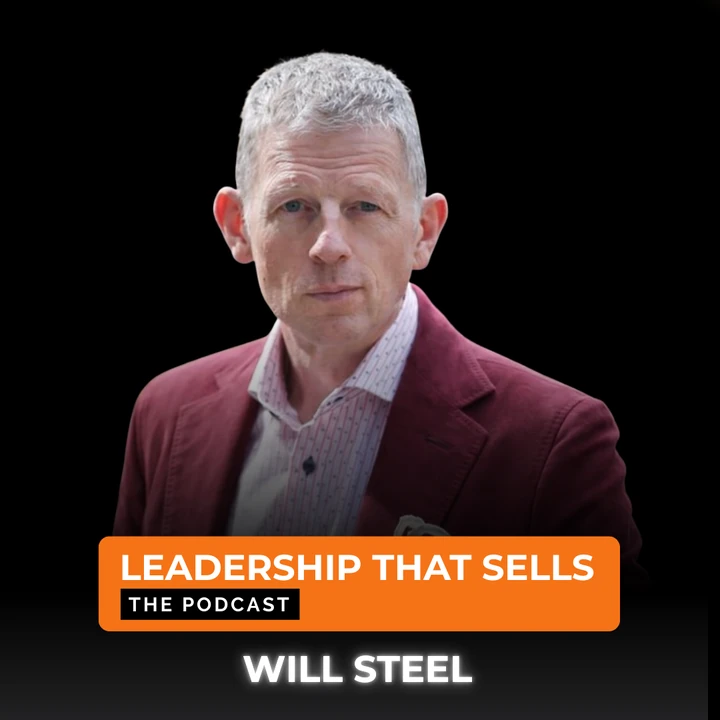
How to align identity and leadership for bigger impact
with Will Steel
Show notes
If you’ve ever felt like leadership requires you to “put the suit on” and pretend you’ve got it all handled, this one will hit you right between the eyes. In this episode of Leadership That Sells, I’m joined by Will Steel, RAF veteran, high-performance coach, and author of Free to Lead. Will’s worked with close to 100,000 people, and he has a gift for getting underneath the surface fast.
We unpack the masks leaders wear, why so many founders burn out before they ever get a breakthrough, and how the real bottleneck is almost never “the business”. It’s you. Your energy, your health, your beliefs, your need for approval, your fear of being seen. Will’s core message is simple and confronting: stop performing leadership and start being you. Not the polished persona. The real you. That’s where sustainable performance and real impact comes from.
How to lead from identity, not ego, without burning out
- Notice the “act” you put on at work, and where it stops working (often at home first).
- Get brutally clear on the vision: once you’re clear, the path becomes clear, then it’s action and accountability.
- Stop telling people what to do; make them accountable for outcomes and let them self-generate the “how”.
- Replace drifting with structure: schedule your life, follow your schedule, and treat exercise and sleep like non-negotiables.
- Strip back limiting beliefs by tracing the story to its origin (often a childhood interpretation posing as “truth”).
- Practise real authenticity: acknowledge when you’ve been inauthentic, apologise, and choose a better way forward.
Timeline summary
[01:00] – Leadership without slogans: surfacing the patterns that actually create momentum
[02:17] – The “strong leader” mask: confidence as performance, and the cost of wearing it
[03:37] – Founders build a monster, then feel trapped inside it
[06:06] – Clarity creates action: vision first, then accountability
[07:20] – It’s never the business problem: start with sleep, exercise, food, and time
[10:39] – Stop telling people what to do: hold them accountable for outcomes instead
[13:27] – Real leadership is causing others to be leaders, not acting like you’ve got it all figured out
[18:51] – Will’s RAF story: “you’re like a ghost” and the moment he chose to be himself
[22:01] – Fitra: your true essence, and why leadership is being your true self in any environment
[23:58] – The only real authenticity: being authentic about being inauthentic
[28:32] – Limiting beliefs: the three-year-old decision that quietly runs your adult life
[33:41] – Reading isn’t enough: the book works when you do the exercises and take action
[38:09] – The final message: just start. Risk going too far, and find out how far you can go
Links & resources
- willsteel.com
- Free to Lead (book + audiobook)
https://www.amazon.co.uk/Free-Lead-Unleash-Hidden-Leadership/dp/1967587051
https://www.audible.co.uk/pd/Free-to-Lead-Audiobook/B0FY7J6T9Q
Transcript
Automated transcript. Speaker labels and spellings may contain errors.
Paul
[upbeat music] My guest today is high performance coach who's an RAF veteran, Royal Air Force here in the United Kingdom, and a global transformation leader who has helped over 90,000 people break through personal and professional limits. And now he's busy working with chief execs, with founders, with top performers around the world. And he- what he does is he leads from identity, not ego, and helps to create impact for these people without them having to burn out. He's also the author of the international bestseller, Free to Lead. Welcome to Leadership That Sells. This is a podcast about the real conditions under which leadership and sales actually work, and where they quietly break down. Now, what I do is I try to talk to founders, to chief execs, sales leaders, operators who've had to make decisions when effort was high, pressure was real, and the usual stuff didn't quite fit. We're not here about trading slogans. There's no frameworks here.
Well, maybe there's a few. We're trying to surface patterns, things that consistently create momentum, talk about what gets in the way, and then what experienced leaders eventually learn to stop doing as much as anything else. If you are responsible for results, not just ideas, you are absolutely in the right place. Will Steele, thank you very much indeed for joining me.
Will Steel
Ah, it's a pleasure, Paul. Great. It's great.
Paul
See-
Will Steel
Learned so much more about your, uh, show from your introduction
Paul
Oh, there you go. Um-
Will Steel
Yeah
Paul
... in your international bestselling book, Free to Lead-
Will Steel
Yes
Paul
... right?
Will Steel
Yes.
Paul
You talk about, I, I mean, in the work you've done as well, you talk about identities as like a facade. Okay? This is a-
Will Steel
Mm-hmm
Paul
... a mask. How do you tell the difference between something that's useful and a mask that is limiting you? So you put on a mask to say, "Okay, this is who I am today. I'm, I'm facing, I'm bravely facing the situation," versus-
Will Steel
Well-
Paul
... something that's holding you back.
Will Steel
Right. Well, that's a very good question. So I can't get inside your head and I can't see from inside your eyeballs what you're seeing. Right?
Paul
It's probably a good thing sometimes, I tell you.
Will Steel
Right. Well, exactly. See, now you're d- now you're pointing at what we can get out of your way. So the doubting, the am I really good enough, can I pull this off. You know, everybody in your company, if you're the founder, looking at you for the ideas, looking at you for the, uh, the confidence, looking at you for ... So it's like, "Well, I've got to put this act on. I cannot not put this act on. I've gotta be strong. I've gotta be assertive. I've gotta be," you know, fill in the blanks, what you've learned over your lifetime that you need to be. But that's not you really.
Paul
Hmm.
Will Steel
Now, it works. It produces... So it's not, it's not sorted out, sort of that conversation that you're scared to have. But who do you go to to get it all sorted out? Well, that's, that's what I do. I sort it all out with people. I, I have founders and, you know, I was speaking to someone last night about it. It's quite ironic that they'll come because they want to sort the business out and get the business going and they're kind of, you know, it's on top of them and like, "I've created this monster and I'm trapped, and I'm just working all the time, and it's not ... You know, I can hardly breathe." It's like they've built this-
Paul
Mm-hmm
Will Steel
... s- in some cases, this business. And it's been successful, but they, they're, you know, they're, they're like, "How long can I sustain this workload?" You know? Um, so they'll work with me or come to me 'cause they can come to me. They can tell me all the stuff they can't tell anybody else that they're dealing with. You know? You can't go to your employees and say, "I'm, I'm really scared about this next move." You know? [laughs] I mean, maybe you can. Or certainly don't wanna burden their family with it, and the family are already saying, "You should just sell the business and get a job for crying out loud. You're too stressed," you know?
Paul
Yes. Yeah.
Will Steel
"And we don't see you. We never see you." You know?
Paul
Mm-hmm.
Will Steel
All those things that, you know, founders who are heroes really, you know, they've created some idea and they've gone for it, and I love that. I love somebody, I love to coach someone who's up to something and they just need the support, the help, the direction, the clarity to actually accomplish it without killing themselves, you know? I think that's ... So, um, yeah. That's a start, right? That's a start with, with who I work with and what people are dealing with and, you know, what do you do? Well, if you've got that, that strategy that you employ or that act that you put on and it, and it's like a suit you put on, you gotta work in that suit, and that's who you get to be at work, but then you come home and that's not you. And, you know, your marriage is not working.
You know? You can be that strong, driven, making stuff happen person, but it doesn't work in your marriage. You know? And, and, and as I was about to say right at the beginning, I have people come and work with me, and you go a month in, two month in, it's like, "What's going on with you?" And it's not about their work. It's not about it. It's their marriage is falling apart.
Paul
Mm-hmm.
Will Steel
Who do they talk to about that, you know? You know, I can't stop doing what I'm doing and the wife is not supporting me, or the husband's not supporting me. You know? I'm not getting the support I need. I'm getting grief. You know? It's like it's pulling people apart. So fortunately, given the work I did in the past, I, I led to 90,000 people all over the world leading transformational programs, really dealing with the human condition. What's going on with you? What's going on with you and giving you access to getting your marriage to work, your life to work, your health to work, your, your business to work. But I work with founders 'cause I love founders 'cause they're heroes, man. They're, they're, they've got this vision. They want it to happen. They know where they wanna go. Sometimes they get lost and we have to get to, and get back to what is the vision here.
What is it you really want to have happen? And get that clear. 'Cause once you're clear, the path to it becomes clear. And now the path co- to it becomes clear, now it's just like, well, what action's it gonna take? This is all about performance. Are you gonna p- to perform, to produce the result, what actions need to happen? And they've come up with their actions, and then I'm holding to account. They've got someone who's holding them to account to actually do what they said they're gonna do, and be organized about doing it. Most people, it's amazing. I work with people and they've like got to-do lists and Post-it notes. That ain't gonna work. If you're gonna be a world-class size company, you've got to get yourself scheduled.
You've got to manage your schedule. You've got to follow your schedule. When it says exercise, that's when you exercise, no matter how much you hate exercise. If you don't do it, you're not gonna be here much longer, you know? [laughs] So-
Paul
I think-
Will Steel
... a long answer to your question
Paul
... yeah. I talk about exactly that.
Will Steel
But I can talk for three and a half days. [laughs]
Paul
I, well, I would hope so. You know, I'm paid by the minute, right?
Will Steel
Yeah. I led programs.
Paul
I... One, when I, uh, I've done a fair bit of coaching in the past, and one of the things we always, I always start with is, is s- because people come and they talk about, "Oh, business this, that, the other," 'cause I do like commercial stuff. You know, "My business is here. My sales team are all crap," whatever it is, and it's never that. In fact, in fa- I, I don't think I've ever actually had that be the actual problem. "I've hired all these salespeople and they're all rubbish." I said, "Okay then." No, they're not. [laughs] No, they're not. And the first thing you start with is, how do you spend your time? How, what exercise are you getting? You know? Do you sleep? "What do you mean, do I sleep?" Do you? "Well, no, not very well." All right then.
[laughs]
Will Steel
Right. Right.
Paul
And it is always the human element. It's the human condition.
Will Steel
Yeah.
Paul
It's you need to eat well, sleep well, exercise well, because you can't do a darn thing for anyone. How can you serve if there's nothing in you with which to serve?
Will Steel
Mm-hmm.
Paul
You know? I don't understand that.
Will Steel
Yeah.
Paul
I don't understand how even today with this surfeit of information that is available to us all, these most basic of things are still not fundamentally understood. I mean, I get that information's not a problem. Okay? Access to information's not a problem. But the problem is exactly what you nailed, it's that accountability and refusing to drift from piece to piece in that if information was not the problem, then we'd all be billionaires with six-pack abs, 'cause it's out there.
Will Steel
Right.
Paul
This is how you become a billionaire and this is where you get your six-pack abs from. Oh, okay then. Tuesday week I'm done.
Will Steel
Yes.
Paul
Next week I'll be, we'll be millionaires. So-
Will Steel
My six-pack thing, my five keys to this, my steps to that, my blueprint to the other
Paul
... another bloody framework. I don't need them
Will Steel
But the problem is the person imply, you know, implementing that framework or trying to take that, you know, it, it-
Paul
They're not you. They're not you.
Will Steel
Mm. Mm.
Paul
That's the thing that, that I think is one of the things that struck me in that I, I'm, I'm 52 this year. Okay? I know I don't look it. Not at all.
Will Steel
No.
Paul
If you're wa- if you're watching in black and white, uh, you can't see the gray hairs. Um, and I reckoned that for a very, very long time I was paid for what I knew and what I could do-
Will Steel
Mm
Paul
... and, and a set of abilities that I've built up and experience. And then I realized I was actually getting paid more for the questions I asked and helping people to f- come to conclusions themselves, which was in reality the leadership that I evolved towards, that idea of service.
Will Steel
Mm.
Paul
And then you're serving someone to help them do stuff. Not necessarily tell them what to do, but understand what to do. 'Cause if you can tell them what to do and they'll go off and they'll do it, fine. You can pay £5 an hour for that.
Will Steel
Yeah.
Paul
But have them understand what to do, then th- that, that's, that's how you get anything to change. They've gotta want to change it.
Will Steel
Yeah.
Paul
You know?
Will Steel
And take it even a step further, so I like what you're saying, and a step further, 'cause I had a, I have a client, still my client, in, uh, Egypt. He's based in Cairo. And he was complaining about all his staff, just like you were saying. They're not doing their job. It's like they're just showing up. They're not producing the result. I tell them what to do. And I said, "There's the problem. You're telling them what to do."
Paul
Oh.
Will Steel
So rather than telling people what to do, get them clear they're accountable for producing an outcome.
Paul
Yeah.
Will Steel
So if the outcome is, you know, they produce... like his marketing department produce all this social media stuff, but if it doesn't produce this many leads, then that isn't working. What they're accountable for is getting this many leads into the business.
Paul
Yeah.
Will Steel
That's what they're accountable for. Now, y- you're not here to tell them how to do that. That's why you've employed them. They're experts in marketing. I'm not an expert in that. You are. So how do you do that? I don't know. This is what you're accountable for. Can you accomplish that? Are you up for accomplishing that? 'Cause that's what I'm gonna hold you to account for, this result. So now they've gotta figure out how to do it. So, and I'm here if you wanna ask me advice, if you wanna, "How could I do this?" Well, could, I can kind of work it out with you, but it's down to you to produce that result. So are you willing to enter into that kind of contract? And if they're not, get somebody else who is. 'Cause you want people who self-generate. You want people who are accountable for the result. You don't wanna have to go and, you know, keep pushing them to do the result.
That's terrible. That's y- you're having to work twice as hard with every single person you employ.
Paul
Yeah.
Will Steel
You know? You know, people call me saying, "I, I, I'm, I'm being an employer rather than running my business."
Paul
Mm.
Will Steel
"I'm too busy being an employer to run my, to, to build my business."
Paul
Yeah.
Will Steel
"I'm dealing with all these people." So anyway, I gave him that and it just turned his whole company around on a dime. It just got everybody clear what they're accountable for, and that's what they are being held to account for.
Paul
Everything has somebody's name on it
Will Steel
All of everything. Yeah
Paul
... everything has somebody's name on it and a number against it, you know?
Will Steel
Right. That's agreed upon, you both agree upon.
Paul
Yeah
Will Steel
"Can you close this?" "Yes, I can." "All right. Good. That's what I'm paying you for."
Paul
Off you go.
Will Steel
That's right.
Paul
Are you on track? No. Okay, what do you need? What do you need to get back on track? This. Well, okay, here you go. Are you on track? Yes, we are. Good. Done. Moving on.
Will Steel
Yeah, yeah. Yeah, yeah, yeah.
Paul
Yeah. Nice. When... You talked about it there, this whole idea of, I don't know, showing up strong, okay? 'Cause I see that a lot.
Will Steel
Mm.
Paul
And, uh, I'm, I've been a victim of it myself as well. You, you go and you do this, you know, stiff upper lip, ramrod straight back and all that when you're former-
Will Steel
Yeah
Paul
... RAF pilot, old boy.
Will Steel
Exactly.
Paul
You know, there must be a thing in there. I guess that's partly where that might have come from. 'Cause you, there's no admittance of failure. There's no admittance of, you know, you can't not be strong. When managers, when people come and they try and show up strong, what are they doing wrong? What should they do instead?
Will Steel
Um, uh, it's about em- uh, you, you, you said it earlier, it's about empowering other people really. What it is to be a really great leader is to have others be leaders around you.
Paul
Mm.
Will Steel
So if you... The ultimate leadership is causing others to be leaders, and allow them to be better than you at what they're doing, like the marketing. Like, you go and be awesome at it. The sales, go and be awesome at it, you know? The whatever it is. Uh, um, I interviewed a guy on my podcast, which is the same te- title as the book, Free to Lead, and, uh, he's actually a very good friend of mine. He was a client for a while, and then became a really good friend, and he runs one of the, um, uh, if not the largest music production company in the UK. And, uh, his interview was great. It was gold. He said, "I just look for people who are real experts in what they do." Um, he says, "And I'm okay being surrounded by all these people all better than me at what they do." And he says, he says, "You've got to be not threatened by that.
You've got to be able to be with that." And that's why it's so success- that's why he's so successful, and I think that's, you know, pointing at what you're talking about. It's not about putting on a act. It's not like pretending you've got it all figured out. But, but it, it's about utilizing. It's you've got a team to grow your business. That's what they want to do.
Paul
Mm-hmm.
Will Steel
They want to increase your sales. They want... 'Cause it's their company. If you work a company for 40 years, you say, "Oh, it's not my company. I just work there." No, no, no. This is my company. I own it. It's mine. I w- this is where I work. This is where I spend 40% of my life.
Paul
Yeah.
Will Steel
Or 50% in some case, or more in some cases, right? This is where I spend my life. This is my expression. This is what I'm doing. This is me. This is what I do. So you've identified with yourself as that, and that where you work is that. All right. Good. Let's have this be really successful. Well, imagine being surrounded by a whole group of people, that's all they want. They want this thing to be amazing. They want it to serve people, to ha- make a difference in people's lives, what they're doing. You know, if you can, if you can articulate what you're doing and connect it with a vision that everyone aligns with, i- i- i- it's plain sailing. All you've then gotta do is just take care of people, make sure they got what they need, and, you know-
Paul
Not run out of money
Will Steel
... go and find more clients. Go and talk to more clients. Go and expand your business. Work on growing the business, not having the business function, you know?
Paul
Yeah. Aye. And not run out of money in the process. That's a-
Will Steel
Yeah, exactly. Yeah.
Paul
This, this the showing up strong thing, I'm going back on this 'cause it's resonate-
Will Steel
Yeah
Paul
... it really resonated on with, with me there. And, 'cause my last job, uh, last grown-up job before I disappeared and, you know, worked for myself-
Will Steel
Yes
Paul
... best thing that ever happened was being made redundant.
Will Steel
Yes.
Paul
And so just before that, there was, I had a, like a, a big all hands, full company all hands, and I was speaking on it. And I did a bit of a hooray job, you know. I was, "Hey, oh, we're gonna fa- yeah," and all that sort of stuff. And half of them come up and said, "Oh, it was brilliant," 'cause I'm a good public speaker.
Will Steel
Yeah.
Paul
And a couple of friendly folk come up and said, "What the hell was that?" Right? 'Cause they'd seen straight through.
Will Steel
Yeah.
Paul
"What the hell was that? Where, what, what, where were you?" And I'd spent the last few months, um, as a spreadsheet jockey, up my own backside, not out seeing customers-
Will Steel
Mm
Paul
... not talking to people, 'cause it was just... It turned into a massive corporate thing. It was acquired by a big corporate.
Will Steel
Mm.
Paul
I was still navigating how you actually work in organizations like that. And I was trying to be something that I absolutely wasn't. So that showing up strong thing-
Will Steel
Yeah
Paul
... hadn't quite... I don't think I burned out, but being made redundant at that point, I had all sorts of skin problems and all sorts of weird shit going on.
Will Steel
Stress. Yeah.
Paul
But three weeks, three weeks after I was made redundant, the stress... 'Cause made, being made redundant, even though I knew it was happening, 'cause I was part of the process, we had all these people in the wrong place, and I was one of them. I was thinking, "Pay me some money and I'll piss off." [laughs] So they said, "Have some money. Piss off. Don't let the back- don't let, don't let the door hit your arse on the way out." And it didn't. So the stress goes up, but then thump, falls. So I think I managed to avoid the actual burnout bit.
Will Steel
Mm.
Paul
But why do, why do more, so many people see or go through that burnout before the breakthrough?
Will Steel
If they have a breakthrough. They don't necessarily-
Paul
If they have one
Will Steel
... have a breakthrough, right? They, they, like, you know, get made redundant, or they-
Paul
Well, you go-
Will Steel
... the company runs out of money. They've got not enough cashflow in the company, you know? Or- Uh, uh, uh, pe- uh, people leave. Key people leave because you're not what I call be- being authentic. So you might be all strong, but you might also be another way. You know, it's whatever that way... You might be all kinda, like, people pleasing and stuff. Uh, you know, that's just as disempowering. It's not... So if you're not being your true self, then it's, it's inauthentic, and it's not bad. It's, it's just we all end up there at some point, right? You know, I was in... I won the... I, I went to the Royal Air Force College Cranwell and had all this a- advice from my university, uh, uh, colleagues that had gone through before me.
"Look, don't, don't..." [laughs] You know, 'cause I was a bit of a, a gobby person, right? You know, a bit full of myself. "Gonna... Just keep your head down, stay quiet. Don't start speaking out and saying the... Just stay quiet, go through it, get through it, and then you can start your flying training." You're only doing your officer training 'cause you have to be an officer to be a pilot, right? So I kept my head down, bit my tongue. Didn't do any, you know... Got through it all. Two weeks before, so after 16 weeks of all this running around and pine poles and shining your boots and, you know, crazy stuff. No sleep for the whole time. I got pulled into the flight commander's office. He goes, "Well, Steel, I cannot recommend you for graduation. You're like a ghost. Officers need to speak up. Officers need to, you know, be there," you know? He didn't have the language I now have, but I c- now I see he was just saying, s- he says I...
He says, "So, you know, you've got two options. You can leave. We'll let you leave, no problem. Leave the Air Force, or you can do the course again. You can start again." I'm like, "What?" [laughs] "I've just done a... 16 weeks. I was about to get out of jail, and now you want me to do it all again?" But I wanted to be a pilot, and to be a pilot you have to pass through officer training, become an officer. So I said, "Yeah. No, no, I'll, I'll, I'll do the recourse. I'll do it again." Got back to my room and it's like, well, shit, that didn't work, you know? Man, I'm trying to be what I thought they thought I'm supposed to be like to get through this goddamn thing. Fine. Screw that. I had stronger language, but, uh, screw that. I'm just gonna be myself. I'll just be myself and let the chips fall where they do, 'cause that didn't work.
Paul
Mm-hmm.
Will Steel
And then 18 weeks af- you know, 18 weeks later I graduated with the leadership trophy.
Paul
There you go.
Will Steel
I was just myself.
Paul
Uh-huh.
Will Steel
You know? Uh, and the flight commander, it was a different flight commander, but one of the things they had us do, which was different to when I first went through, went off to Scotland, and it was really a blizzard. We're in a blizzard going over the Cairngorms, right? So it was a real peak, and I'd got my compass. It was my turn to lead that day, right? And I'd got my compass and a mi- mitten, and I had to keep scraping the ice off to see where we were going. I was following this thing. I had a trail of, like, 14 guys behind me, and there's one really slow. I kept having to bring him up to the front and, like, "Come on, keep going." We had to keep going. I mean, literally was bad c- really bad conditions. Anyway, the flight commander says, he, he said, "Steel, I don't like you, but on that mountain I would have followed you anywhere," [laughs] you know?
So I got the trophy, you know? Uh, because I was being myself. I was just being me, you know? And my book is all about you being you, but big question is by the time you're an adult, you've forgotten who you are. You don't know who you are. You-
Paul
Mm.
Will Steel
Sometimes you're this and sometimes you're that, but who is the real you? So we wanna get you to get... That's why the book's in two parts. The first part is, you know, taking all these facades away so that you get back to your real essence, and in, in, in Arabic it's called fitra. So it's called The Fitra Method, and, and I didn't get this word till I went to the Middle East and started doing leadership programs out there, because it's a word that really works. It doesn't translate directly, but it's like your true essence. Like, what God breathed into Adam.
Paul
Mm-hmm.
Will Steel
Breathed in fitra. But also, you could put a s- a seed in soil, it grows into a perfect tree. That's fitra. It doesn't need anyone's advice. It doesn't need any... It's, it already knows. You put the same seed in a different soil, in a different environment, grows up perfectly and in harmony with whatever environment it's in. That's also fitra. So it's being its true self no matter what. So use that metaphor for leadership. Being your true self no matter what.
Paul
There's the hurdle, and I, that, that st- [laughs] I think there's a thing about authenticity in general, is-
Will Steel
Mm
Paul
[laughs] What happens if you're a bit of an arse, you know? I mean, the, the dismantling piece, the first part of your book, dismantling before creating.
Will Steel
Yes.
Paul
In the, the, the void, the, the spirit hovering over the waters before the creation.
Will Steel
Mm-hmm.
Paul
The dismantle, the... How do you get back to the true self? How do you f- how do you find yourself, oh wise one? What is that?
Will Steel
Yeah. Well, it's discovering who you know. Your answer to being authentic is to... when it's not the true you. So, um, we used to have this phrase at my last company. It's, you know, "The only time..." I don't know if it's... A- anyway, it was, "The only time you're being authentic is when you're being authentic about being inauthentic."
Paul
The only time you're being authentic is when you're being authentic about being au- inau- okay, so when you are actively faking it.
Will Steel
No, no, no. When you're acknowledging that you've been faking it.
Paul
Oh, when you're... Okay.
Will Steel
If I'm acknowledging, "Look, I've been an asshole here."
Paul
Right.
Will Steel
"I've just been selfish. Uh, I've been out to prove I'm better than you, and you know, that's just automatic behavior for me. I, I so apologize. It doesn't work. I'm just gonna be your partner from now on." You see, I had to be authentic in there about the asshole I've been, you know?
Paul
So is it the-
Will Steel
And it takes courage to do that, but when you've done it a few times, you just get used to it, and it's just, it just-
Paul
Mm
Will Steel
... strips away all that having to fake anything.
Paul
Mm-hmm.
Will Steel
And, rather than it making you look weak, it actually takes people, people get... When it's real authenticity, it has a certain ring to it.
Paul
Mm-hmm.
Will Steel
And that's real strength to be able to do that. But, you know, to start with, it's really diff- really difficult to start with when you first do it and go, "Oh my God, God, I am such an ass. Oh, man," you know?
Paul
Mm-hmm. I mean, you-
Will Steel
My first big insight when I did, uh, the program I ended up leading, but when I did it, I, I was coming out of the Air Force. I was an airline pilot, and I sit in this room. I thought, "God, all these people have got problems. I'm in the wrong room." And then I was, like, horrified for a moment. It's like, "What if there's somebody here that knows me? They're gonna think I've got problems. Oh, shit." And I kinda tried to look around the room without bringing attention to myself. You know-
Paul
[laughs]
Will Steel
... see if there's anybody I knew, you know? [laughs] And, and, and then w- w- in the same, that same actual conversation, I got, "God, I'm just so judgmental, and I'm so superior. I think I'm, like, better than everybody else."
Paul
Mm-hmm.
Will Steel
And the pers- people I didn't like the most were those that were superior, they looked down on the nose at you and think they're better than you. And I'm like, "I'm being that. Oh, man." Now, that's news to me, but everyone else knows that. They all know that. They see you. You just didn't know that they see. [laughs] So when you go and tell people, you say, "God, I'm just being so superior and, like, uh, uh, judgmental of everyone." They go, "Yeah, yeah, I know. Yeah." "Oh, I'm so sorry I did that. I s- I apologize. I'm not committed to that," because now I can see it, I can be responsible for it.
Paul
So you start from a place of humility more than, more than anything else.
Will Steel
Totally.
Paul
Humility, courage, desire. I think, uh, the, the, the thing if you... You said it takes, it takes a s- degree of courage and self to, to be that sort of self-aware, because I think if you, you decide I'm going to become self-aware, and then you realize I'm an arse, oh, good God, um, you have to be able-
Will Steel
Well, that's when you know you're onto something.
Paul
That's it.
Will Steel
Those are the best insights-
Paul
That's it
Will Steel
... when you go, "Oh, shit, this is terrible."
Paul
Mm-hmm.
Will Steel
Good, because, because, you know, the real you is not that. It's just who you've ended up being-
Paul
Mm
Will Steel
... in life. You're being that way, but it's not the real you. It's just... And you can be any way.
Paul
Yeah. Yeah.
Will Steel
Except now you can't, you're kinda limited to a certain few ways of being and acting that become what you call you, this persona.
Paul
It's, it's the, it's the thing I talk to my kids about. It's their, it's their behavior and their choices, not who they are.
Will Steel
Yeah.
Paul
So you-
Will Steel
Yeah
Paul
... you never say, you should never say to someone, "You are a pain in the arse."
Will Steel
Yeah.
Paul
"You are, you know, late." It's y- you, your choice, you, the thing that you did, you made a bad choice. You behaved inappropriately. What you said was, you know, unkind.
Will Steel
Yeah.
Paul
And I don't think that's you. I think you're different. I think you're better than that. And there's, you know, it's all that sort of stuff. And it's-
Will Steel
Mm
Paul
... most of my leadership stuff comes from w- dealing with my kids, frankly. There's no better place. So the first part-
Will Steel
They, they test you.
Paul
Now they, they do, they're little sods, I tell you. Then they, they think, oh, you-
Will Steel
They're watching you
Paul
... they, they come back. They come back at you. So, I mean, I'm, I'm s-
Will Steel
It's not what you say, it's what you do. So they, they're watching-
Paul
Mm
Will Steel
... your actions. They're watching your behavior. And, you know, you know, don't do as I say, do as I do, is just the worst.
Paul
Uh-huh. That is, that is. Second part of the book then. So the first part is deconstruction. It's pulling things apart to reveal the inner you that is hopefully the actual you. What happens next?
Will Steel
Yeah. Well, just more accurately what you say, it's distinguishing your limiting beliefs in all these different aspects of being human. See, ultimately, if you get all the way back to the beginning of where you started being that way, something happened. Something happened. It could be a tragic thing or, for everyone else, an innocent thing, you know? And in those moments, you make decisions, but you don't realize it. You see, you have a thought, you go, "Oh, yeah, that's true, my dad doesn't love me," and that then becomes for you the truth. So what's... I call that a limiting belief. It's now a belief, but it's not actually the truth. It's, it's in the logic of a three-year-old or a five-year-old that that's true.
But then it slips into the background, so it's now in the subconscious, if you like, okay, running the show, and you don't even know it's running you. So it's being able to reveal the limiting beliefs that we all have. I don't care if you're really super successful in life, consider that you've become that way to make up for something you believe about yourself that's not that great, or you're not that good, or you're not this, or you're not that, or et cetera. So you can be this to make up for that. So you become this, produce loads of results out of it, but you notice the results never actually fix you. It's never enough. So what do you do? Produce bigger results, more results. Keep going, hoping one day it's gonna work out, and it never does, because it's built on this foundation that's, that's, that's a false foundation, this limiting belief that you have. It's not like you're stupid.
It's not like, um, you know... It, it's not that. It's there's a way you see it, and it's interesting that you see it that way, isn't it? And when you get all the way back to, "Oh, God, that's why I see it that way. That's why I'm so competitive all the time." I'm making up for I decided when my dad said we couldn't afford a third baby, and then mom got pregnant, and we had two boys, so we're looking forward to a girl, and you popped out, and I made all that mean. They didn't want me. They really didn't want me because they wanted a girl. Right, I'm the best. And my life-
Paul
Yeah
Will Steel
... was about proving I'm the best. I didn't know that's what was driving me. It produced loads of results. It just never satisfied me, that it was never enough.
Paul
Mm-hmm. Mm-hmm.
Will Steel
It always looked like-
Paul
Yeah
Will Steel
... it was going to be. You know, become a fast jet pilot in the Royal Air Force, get your wings. If I get my wings on fast jets, then I've made it, right? And you get your wings, put them on, and you look around, everyone else is wearing them. It's like, oh, I don't feel any different. I don't even feel like a real pilot yet. It's like, you know, I don't have the experience yet, so obviously I need the experience. And it never ends.
Paul
Yeah. It's never enough. It's never enough. Yeah.
Will Steel
Yeah, 'cause it's built on a foundation that's-
Paul
Mm
Will Steel
... a false foundation.
Paul
Mm.
Will Steel
A misconception of life or an interpretation that's disempowering.
Paul
Mm-hmm. I mean, I think when I have reflected, and again, um, it's this, uh, you... the, the, not the midlife crisis or anything like that, but it's this momentary change of attitude, change of, of, of, um, frame in trying to work out w- where, where you're going, where your value is, where your value will be. Is it g- I should be being retired by now, you know? My mum retired at 55. She was a teacher. She retired.
Will Steel
Mm. Yeah.
Paul
There's no way in hell I'm gonna do that. I'll be bored shitless, and poor.
Will Steel
Exactly.
Paul
Don't forget the poor.
Will Steel
Exactly.
Paul
Right?
Will Steel
Yeah, yeah, yeah.
Paul
Don't forget your pension. But on that reflective journey, um, 'cause I genuinely believe that, you know, wisdom is knowledge applied, reflected upon, and shared.
Will Steel
Yeah.
Paul
So it's that-
Will Steel
Yeah
Paul
... that, that trium virate, quattro vir- whatever. And the reflection piece there is, I think mine is, um, something like I n- I need approval from people. I need-
Will Steel
Mm
Paul
... well done. Well done. And it's, how often do you get that, right?
Will Steel
Mm.
Paul
I never get that. Very occasionally. Very occasionally. And sometimes you go after it, you go chasing it, or I go chasing it, and then you realize-
Will Steel
Yeah
Paul
... oh, no, no, no. The minute you let your ego make decisions for you, bad news.
Will Steel
Yeah.
Paul
Bad news.
Will Steel
Yeah.
Paul
You know?
Will Steel
Yeah.
Paul
So that's a, kind of a limiting belief is that, or, I don't know-
Will Steel
Well, yeah, if we, if we had the conversation to get back to it, I recommend you read the book, 'cause, you know-
Paul
It's on order
Will Steel
... it, it, it-
Paul
It's on order. I'm just late.
Will Steel
Yeah. I did the audiobook, right? I spent a week doing the audiobook, right? And then I spent about three weeks correcting the editor, 'cause he... when he, when he put, joined things together, sometimes it wasn't quite... Wait, wait, wait, I didn't say that. Wait. [laughs] Had to get in there. 147 edits. But you know, it's all a process. I mean, it took 40 months to write the book, and I wrote it so that... I, I, I really... It, it occurred to me that just reading a book won't do it, you know? I lend courses to people and I'm working with them, and then they go off and take some action, like call their dad and get that thing sorted out, or call their mother, or call their wife and acknowledge this, this and this, right?
Paul
Mm-hmm.
Will Steel
And it resolves everything. But you could read it in a book and you go, "Oh yeah, that's a good idea, yeah," and you don't do anything, so it's not gonna alter you. So, yeah, I've got to have them interact with themselves and read the book, not just read the book. 'Cause you can read it and go, "Yeah, that's good, that's good, that's good," and nothing happens.
Paul
Mm-hmm.
Will Steel
And I've read loads of books that I can hardly remember anything about them, you know? Oh yeah, I remember that thing, you know? So I wanted it to be a book you could pick up and read it again and again and again, and go back to when something's showing up that didn't show up before, but now it's showing up, but it's from your past. So, um, there's exercises in the book. You know, you ask yourself this question and this question, and if you do that authentically, you will reveal something that's at the bottom of, for example, in your case-
Paul
Mm
Will Steel
... what you just said, you know. Um, what was it you just said? You said, uh-
Paul
I need a-
Will Steel
I've no idea
Paul
... I look for approval. I look for approval.
Will Steel
Approval.
Paul
Yeah.
Will Steel
Looking for approval, right?
Paul
Rather than looking in-
Will Steel
So, you know-
Paul
... you're looking out
Will Steel
... you know, how does that feel, and then what does that remind you of growing up, right? And then we'd have a conversation about what actually happened.
Paul
Mm.
Will Steel
No, no, no. No, that's all interpretation. That's the interpretation. It's important, we're gonna get to that, but what actually happened? Oh, my dad said this. Okay, good. And what did you think to yourself when he said that?
Paul
Mm.
Will Steel
He didn't really want me. I'm not wanted. I, I'm gonna be the best. Yeah. That's-
Paul
Yeah
Will Steel
... and then that's your whole story. Your whole life is built on that, you know? A three-year-old decided your life.
Paul
Well, you know, sometimes-
Will Steel
In my case
Paul
... I think there have to be, there have to be worse people than a three-year-old to decide your life. Sometimes they make good choices. [laughs]
Will Steel
Yeah.
Paul
Mad.
Will Steel
Yeah. Awesome.
Paul
I gotta ask one last thing. Um, no, a couple of last things. Number one is where can we find you when we need you?
Will Steel
Yeah. Uh, willsteal.com.
Paul
That's a good point.
Will Steel
Will Steal, all one word.
Paul
Link will be in the description.
Will Steel
S-T-E-A-L. Will, Will Steal. All right, great, .com. Um, and, and I, I'd really just... I just want everyone to read the book, 'cause I know it works. I know what... I've led programs to 90,000 people, well, close to 100,000 now. I've been leading for the last five years in the Middle East, last three years in the Middle East. Um, and I know the book works. I've got evidence for it. You know, m- my own father said, told my eldest brother, he's never told in his life, he told him he loved him. And that's monumental. At 86 years old, to suddenly find the courage to do that, having never done it.
Paul
Mm.
Will Steel
It's altered his life, it's altered my brother's life, it's altered life at home there. You know, so if he can get it, anyone can get it, I promise you. And, uh, and I've got lots of other stories of people having massive breakthroughs just from reading it. So I know it works.
Paul
Mm.
Will Steel
I'm totally 1000% confident. And I don't even care about the money. I want people to read it and action it, and alter their lives in a good way. So, you know- That would be my, um, you know, w- y- you know, reach out to me too, yeah. I, I only work with people that are, uh, entrepreneurs, founders who are really up to s- they've, they've got some game they're really out to accomplish. Like, they're, you know, I have one client that's reforesting forestry around the world that needs reforesting, right? And she's altering the planet that way, and that's awesome. Uh, I got another guy that's, um, getting all c- foreign investors to come into his country. It's Paraguay. 'Cause people in Paraguay can't afford to buy their own properties. He's getting foreign investors to come in, they build all these properties so that their people have got places to go, and the foreign investors get really good return on their money, and they get all the rent and all of that stuff.
And he obviously makes a lot of money building the buildings. But it all works. It's like you said, you know, real sales is everybody wins. You're serving people to get what they really want.
Paul
Sure.
Will Steel
And obviously you're making a sale at the same time. So those are the kind of people I like to work with, you know?
Paul
If there was-
Will Steel
So if you're in that category and you go, "Oh, I think I'd like to work with Will," good. Reach out to me. You can get me at, at the, at the website, willsteel.com.
Paul
If there was one message you wanted to leave, leave the planet with, you could write it on the moon. It'd be seen tonight, full moon.
Will Steel
I think it's just, just start. It's either just start ... Because the other one's one of the best coach you ever got. Okay. I asked Will Earhart who set up this whole enterprise, and they're all doing all this. I said, "How do you do all that? How do you come up with all this stuff?" He said, "I don't know." I said, "What do you mean you don't know? You're the guy that did it." He goes, "I don't know, you just start." And I hated that coaching, but it's the coaching. It's the coaching. You just start. Like you didn't know how to do podcasts before you started, you just started.
Paul
Mm-hmm.
Will Steel
Okay, and now look at you. You're doing great, you know? So it, it, that would be the best coaching I would give to anybody. But I remember looking at a poster. I was on, I was 15, I, I somehow managed to win this competition to go on a outward bound course, and it was all about leadership as well. It was great. Three weeks in Wales. But there was this poster, and there's a picture of this moon. It says, "Only those who risk going too far find out how far they can go." And that just stuck with me. I was just like, "Well, I might as well go for it." I never thought I could be a pilot. I never thought they'd let me in the Air Force. I thought, "What, you're gonna let me in? Me?" [laughs] But that poster was, "Oh, just go for it anyway and see what happens," you know?
And, and then you get. You know?
Paul
Yeah.
Will Steel
So it'd be one of those two, or both.
Paul
So either just start, stop drifting-
Will Steel
Yeah
Paul
... make a decision, get on with it. Just start.
Will Steel
Yeah. Take action. Without action, nothing happens. Just start. If it's the wrong action, you can correct.
Paul
It's an experiment.
Will Steel
Yeah.
Paul
Call it an experiment. Or you never know how far you can, you'll get until you actually try. There we are.
Will Steel
Yeah. Well, it, only those who risk going too far-
Paul
That's it
Will Steel
... find out-
Paul
Risk going too far
Will Steel
... how far they can go. Yeah, risk going too far.
Paul
That's it. Mm. Push it too far. I love it.
Will Steel
Yeah.
Paul
Pedal to the metal. And on that, I have to say, Will Steel, thank you very much indeed for joining me.
Will Steel
Pleasure. Absolute pleasure, Paul. Thank you. [upbeat music]