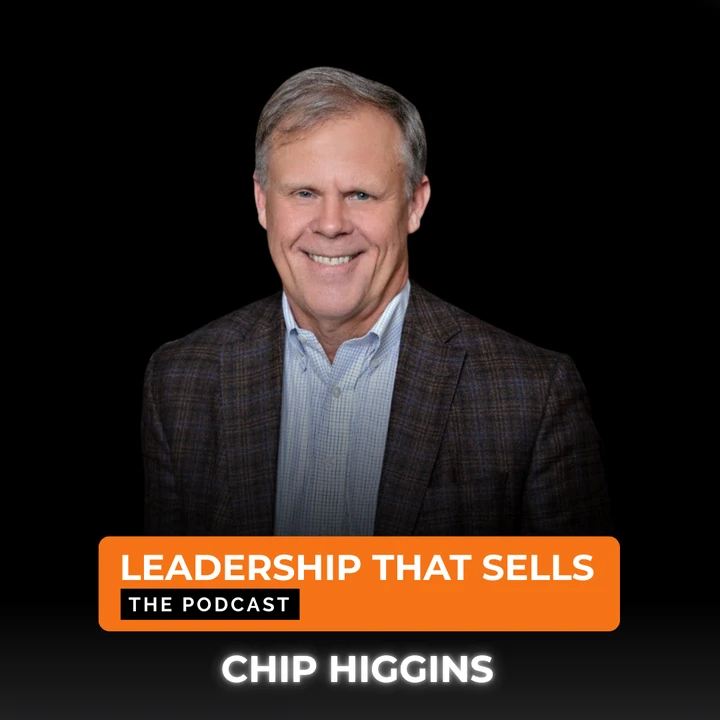
How to Build Sales Momentum That Lasts
with Chip Higgins
Show notes
In this episode of Leadership That Sells, I talk with Chip Higgins — small business strategist, seasoned exec and author of The Bizix Way — about how to lead with energy, focus, and staying power. Chip brings a totally fresh perspective by linking business performance to real physics principles like momentum, force, friction and inertia.
He shares how mass times velocity is more than just an equation from school science. It’s a powerful mental model for sales teams and leaders who want to build real traction and keep it going. We dig into how leaders create energy, how to point it in the right direction, and how to build “mass” inside the business by developing people, sharpening value propositions, and improving the systems that make selling simpler.
Here’s how to create unstoppable sales momentum:
-
Momentum = Mass x Velocity. Mass is the density of your value proposition and team. Velocity is speed with direction.
-
Don’t confuse activity with productivity. Sales energy must be focused on aligned targets that drive real value.
-
Increase mass by building weighty leadership, strong culture, and clear differentiation.
-
Velocity comes from direction. Set the vector: what market, what message, what timeframe.
-
Friction kills energy. Remove unnecessary complexity, systems drag and pointless admin.
-
Reinvest in your people. Developing skills and character builds lasting mass.
-
Bond with your customers. Deep connections create resilience and power, like redwood trees sharing root systems.
Timeline summary:
[02:12] – Sales is the most intense energy field in business
[03:38] – Top salespeople should earn more than the boss
[07:02] – Momentum = mass x velocity, explained for sales teams
[08:34] – It takes exponentially more energy to go faster
[10:13] – Avoid fake productivity: be clear on targets
[14:15] – What makes a small business “massive”
[17:07] – Why your leadership weight matters
[20:07] – Mass is the value in your people, your proposition, and your culture
[24:00] – Bonding builds mass — with team and customers
[27:13] – Crash Bandicoot, tornadoes, and angular momentum
[30:20] – How to grow mass: reinvest in people, develop their weight
[34:05] – Newton’s laws, sales acceleration, and systems friction
[39:48] – Billboard message: “We’re better together”
Links & resources:
-
Chip’s site: https://www.chiphiggins.com/
-
Book: The Bizix Way (on Amazon, Kindle, Audio, Hardback)
-
Physics on Demand AI agent: https://www.bizix.com/physics-on-demand
Enjoyed this episode?
If this gave you a new way to think about energy, leadership and sales momentum, do us a favour: rate, review, follow and share the show. It helps more great leaders like you find Leadership That Sells.
Transcript
Automated transcript. Speaker labels and spellings may contain errors.
Paul
[upbeat music] My guest today is a seasoned executive, small business strategist, but most importantly, the author of The Bizzix Way. He spent 35-odd years helping leaders create, uh, energy, clarity, momentum in their organizations. He's the founder of Bizzix and a Maxwell Certified Leadership Coach, and he shows managers how to turn friction into fuel and build teams with staying power.
Chip Higgins
Mm.
Paul
A warm welcome to Leadership That Sells. This is a podcast that helps you to lead first and then sell more, 'cause that's most sales teams you have them today. The sales teams aren't really teams. They're what we call teams in parallel, and your managers are typically leading them like they're a football team, when in reality what they have is a team of Olympic sprinters or golfers, and this mismatch is a root of all your big problems. You're, you're trying to coach people, but it doesn't land. Your pipeline reviews are like interrogations. Your A players are off going lone wolf in the background. So what we've done is we've built a leadership power up for your managers. It's not another heavy training manual to learn.
It's a just a light, fast reset that gives them a really simple model to lead the team they've actually got. We teach them to set the target with absolute clarity, build a flag with a shared identity, and then hand over the map so that they can coach for autonomy. If you're ready to fix the model and not the people, grab our free Parallel Team Playbook. It's short, sharp, and built for senior leaders just like you, and you can find that at the Practical Leadership Academy. [upbeat music] Anyway, on with the show. Chip Higgins, thank you very much indeed for joining me.
Chip Higgins
Paul, thank you for having me on. I'm so excited to, to visit with you today.
Paul
Well, it's gonna be fun. Uh, Bizzix, you're connecting physics with business, the clues-
Chip Higgins
[laughs]
Paul
... and the, the amalgamated name, right?
Chip Higgins
That's right. That's right. Yeah.
Paul
So you talk, you talk about momentum, about energy, about friction, and you're melding these th- three things together to, for, for business success, okay? Now, I talk about sales teams here, and I know you've got a, a strong background in all, all parts of business. What would you say momentum means inside a sales team?
Chip Higgins
I mean, sa- sales is, um, the most critical part of any, any execution. So I think that, uh, globally there's a big tie in to the corporate momentum that has been expressed by the management team that we're, we're going to establish this kind of presence in this segment at this level, you know, whatever that market share is. But, uh, I especially know this, you know, personally after starting Bizzix and, uh, just, just how hard it is to get going that, um, you know, it's a, it's a daily challenge to keep moving forward toward that. And I think that the momentum idea has to be present with people about, uh, to, to move from, you know, 5% share to 10% share from, you know, 10% bottom line to 20% bottom line.
Uh, it's a, it's a daily battle that requires tremendous energy and flexibility, but, uh, al- always a commitment to the value proposition and what you're trying to change for people. And, um, you know, it's, it's probably the most intense energy field that you're gonna find in a business is the sales team. And, um, they, they've got, they've got to be excited about the value that they're bringing to people and, um, translate it in a way that makes sense and, uh, and close the business and, and, and, and keep people, uh, you know, [laughs] for a long time. So, uh, you know, for me, uh, you know, I've, I've always considered, uh, the professional salesperson to be the most valuable person in the organization. And I think if you look at some of the classic, um, you know, multi-billion dollar franchises now, it's, uh, it's one where people haven't been afraid to pay the top salesperson more than the CEO,
you know? That, that was true for a long time before we get into stock. It's just, uh, that's the kind of value it brings, and it requires, uh, day-to-day, uh, management and, uh, and focus, which is a big part of, you know, what's in the Bizzix way with momentum.
Paul
So, I mean, yeah, absolutely. I mean, I've, I've had many grumpy sales leaders come to me and saying that, "This guy's earning more than I am." I think, "Well, yeah, it's 'cause he's adding more value than you are." "Oh, but, but I'm the big boss." I said, "Mm, no. Well, yes, you are the big boss, but this guy is actually doing, this girl is actually doing-"
Chip Higgins
That's right. Yeah. I, I, I believe that 100%, Paul. I mean, I'm totally aligned with you there. I just, uh, and I, I, I think anybody that's been in business trying to build a brand, um, understands how rare that skill set is of, uh, tremendous integrity, uh, communication skill, commitment, perseverance, uh, a way with people. Uh, I think listening, being able to listen and, uh, then, then translate that into, you know, uh, a value proposition for people. It's a very advanced skill set, and I think sometimes we try to dumb it down and just say, uh, you know, our ratios say, "If you make 40 calls, you're gonna get five sales, and let me tape the phone to your head. It's just gonna go." And that's, uh, especially in today's age, I just don't think that is a re- a realistic view of the world. Uh, it's a very complicated skill set, uh, in sales and, uh, to your point, I think it requires a unique form of, uh, leadership as well.
And, uh, I know, I know, I listened to a couple of your, uh, segments before this.
Paul
Mm-hmm.
Chip Higgins
And, um, uh, there, there was a part, I can't remember exactly where it was, but it was kind of the, the mistake of, you know, the, the high-performing salesperson being put into the leadership role, and they're completely different. You know, it's a, it's a completely different game and, um, you know, lead- leadership in that effort is so important, uh, for it to work. And, uh, there are a lot of tough calls. Uh, you know, I, I think, uh, we always have those calls where we have to accept that the person isn't suited for it or they're not excited about it or whatever it is, you know? And it's probably, uh, to me the, you know, the premier impact part of any company, but it's also the hardest in dealing with, um, underperforming people. Uh, the, the grace that we have with people about being on plan and, uh, making the, the corporate goals, but also, you know, the willingness to be, uh, tough and, uh, demanding about,
uh, being high achievers. You know, it's very- There's a lot of psychology in it, you know. It's very different than, than closing a particular deal.
Paul
If you ... Now, physics, again, you get this amalgam business physics thing. If you think about your, your high school physics, right? So we talk about-
Chip Higgins
And by the way, Paul, that's the level I'm at, is high school physics. [laughs]
Paul
I'm glad. That, that, that makes, that makes one of you.
Chip Higgins
I reached out, I reached out for help in writing my book, but, uh, you know, it's just a very simple equation to remember. [laughs] So anyway, go, go back to high school physics.
Paul
So from, okay, let's say like-
Chip Higgins
Yeah
Paul
... junior high school physics. So the, the basic thing that I think we talk about and people talk about in business in general, especially in sales, is speed, is velocity, okay? Which are two different things, right?
Chip Higgins
Mm-hmm.
Paul
So, but you've got, um-
Chip Higgins
Oh, they are. They're very different things. Um-
Paul
But velocity is speed with direction, whereas speed is just going fast, okay?
Chip Higgins
Correct.
Paul
So you might be going fast, but you're pedaling hard, but don't know where you're going.
Chip Higgins
Yeah.
Paul
Velocity is directed e- effort.
Chip Higgins
Yeah. Uh-
Paul
And you talk about momentum
Chip Higgins
... if I, if I could speak to that 'cause, uh-
Paul
Yeah
Chip Higgins
... you know, I think for ... May- maybe there are people listening that-
Paul
There's a chapter in the book on that, I'm sure.
Chip Higgins
[laughs] There is. So, uh, I, I wanna say that, um, just deconstructing the book very quickly, uh, the fortunate thing about momentum and business momentum, uh, p- is, you know, uh, just one example of it is that the equation's very simple. It's mass times velocity. Uh, so, uh, you know, it's not a multi, you know, eight variable equation. It's something that is, uh, very easy to understand and something that we observe every single day. I mean, we see momentum physically, uh, e- every day of our lives. So when you think about that equation, just very quickly, um, the, the velocity part, um, it, it is a direction, but it's also, um, you know, it, it's a vector. So a vector requires a direction, a distance, and a speed or a timeframe.
So, uh, that, that is fundamental to achieving momentum in anything is that you clearly define that. Um, underlying that, uh, is this idea of, uh, speed. You know, the, the, the, the, uh, kind of, uh, timeframe that's gonna take you to get somewhere. And ultimately, that has a, everything to do with energy. Uh, you know, it's, uh, you know, the ener- the energy part, uh, sometimes when I speak I have a picture of a, a Challenger launch.
Paul
Mm.
Chip Higgins
And it's a picture where half of the picture's the rocket and half of it is the expended energy of getting it into the air, and it's a great visual. But I think before we even start talking about, you know, the velocity, we have to get into where the energy is coming from, uh, how sustainable it is, um, you know, where, where you derive that from, and, and especially as a sales leader, how you distribute the energy you have, uh, to other people. And that's a very, very unique skill set in being able to inspire people. But, um, there's a very interesting thing in that equation that I, I, I, I like to bring to light, and, uh, this, this was kinda toward the end of the, of that interview I had with my physicist
friend as I was writing the book, is that, um, just to bring home this energy point, is that, uh, speed and energy have a direct relationship, but it's a squared relationship. So for something to go twice as fast, you need four times the energy. If you want it to go three times as fast, you need nine times the energy.
Paul
Mm-hmm.
Chip Higgins
And don't ever ask me to go to the board and do the calculus to show you why that is, but I, I, I know that it's [laughs] true because of my-
Paul
It is
Chip Higgins
... my physicist friend. So I think, uh, in all of this, uh, you know, especially in sales, you know, we've got to, we've got to focus on the energy level first, but make sure that we have that clearly defined for people about what market, what target type client that we're going after, how quickly we're gonna gain share in that, and that we don't waste a lot of energy pursuing things that look like sales that don't even fit our business model. You know, it's not even aligned to our value proposition. It ... And to me, you know, banking is not known as a, you know, a high sales environment. It's a difficult sales environment 'cause there's very low differentiation in it. You know, it's, uh, money is money. Uh, but what I, what I would find in banking that would frustrate me to no end is, uh, activity, uh, versus productivity, and how many people enjoyed the lifestyle of a salesperson.
They enjoyed the relationships, and they would talk to anybody, uh, thinking that it was a valid, uh, sales call, and it wasn't really in the target. And, uh, what you come back with is, uh, marginal opportunities for the bank. And I'm sure this is true in any industry. You know, it's like, "Well, that's not really our target client." Like, how much are they gonna buy from us over five years, and is it gonna move strategically? Does it line up with our strategic framework that it's gonna move the needle on our share in this market to a point that we become a valuable company? So, um, that vector, um, you know, the, the distance, direction, and speed, when I talk to small business owners, um, that direction part is awfully hard for them to understand. Uh, I think that most of them are in a world of more.
Uh, they want more. They want more top line. Think they think if they can figure out the top line, they'll sort through, uh, the bottom line, through all the expenses and things. But inherently, uh, you, you build a product to suit a market that's gonna produce a margin, and if you end up in markets where that value proposition is not valued and you're cutting price to make the sale or make your goal, uh, it can have disastrous, uh, impact on the bottom line because you're not getting the margin that you want. Um, so it's a, you know, it's a, um ... You know, I, I, I'm a, I'm a big believer in, you know, there's a difference between simple and simplistic. And, um, you know-
Paul
Mm
Chip Higgins
... momentum is a very simple equation, but it's by no means simplistic. You know, I think there's, there's, there's, there's a lot tied into it. And, um, so, uh, I'm, I feel like I'm rambling on a little bit, Paul. I'll kind of stop.
Paul
No, no.
Chip Higgins
I know, I know we have limited time, but, um, I, I, I thought I'd get a few ideas out there that we could, uh, you know, chop up a little bit. Um, and may- maybe part of this is resonating with you as we talk more about it, about your experiences with sales teams and the work that you do with your company.
Paul
Well, I mean, one of the things that's, that, that, that does resonate is when you talk about momentum as mass times velocity, and velocity being the direction that you take people. It's not just going fast.
Chip Higgins
Mm-hmm.
Paul
Velocity is the, is the vector. It's a-
Chip Higgins
Right
Paul
... vector calculus. I don't wanna go back there. Thank you.
Chip Higgins
[laughs]
Paul
But the, the, the, the, the speed with direction. It's displacement from where I am to where I want to get to.
Chip Higgins
Right.
Paul
But mass ... Now, mass-
Chip Higgins
Mm.
Paul
Momentum is mass in motion. So we have the motion, we have the direction, but it's the mass part. I think I'd like to dig into that, because-
Chip Higgins
Oh, yeah. That's my favorite part, honestly. It was the, it was the hardest one for me to unpack. So anyway, go, go ahead and ask your question about mass.
Paul
Well, it's, it's hard to stop a slow-moving bowling ball, okay? High mass, low velocity. Big, heavy thing, mass, massive, not moving very fast. It's also hard to stop a fast-moving bullet. Little bitty thing going 10,000 feet per second.
Chip Higgins
I can't wait for you to get, get into my book, Paul. You're gonna ... You're ... I think you're gonna really enjoy it. But-
Paul
I'm looking forward to this. I would tell you, you, you sent me an email just ... And I only read it, like, this morning. I was thinking-
Chip Higgins
[laughs]
Paul
... "Paul, are you gonna send me a copy? Why didn't I get this?"
Chip Higgins
Yeah.
Paul
'Cause I was traveling around.
Chip Higgins
I already, I already sent, I already sent you a copy, so-
Paul
Oh
Chip Higgins
... it's waiting for you.
Paul
Well, this is wonderful.
Chip Higgins
But yeah, I mean, this is this, this is really-
Paul
This is good, isn't it? This is good. This is good.
Chip Higgins
This was the most challenging part of the book for me-
Paul
Get in there
Chip Higgins
... 'cause also I think it was, um, in the end, uh, the fun part because, um, I start that chapter with a, uh, a Monty Python and the Holy Grail, you know, paradox, the oracle at the top of the mountain where, you know, there's a riddle. There's a riddle to be solved, and the riddle is, "How can a small business be massive? How can a small business be massive?" And, um, in that chapter I describe exactly what you said there. Um, you know, it could be high mass, low speed. It could be, uh, low, low mass, incredibly high speed. And that's what I ... That's my big hope for small business owners, they understand that they can have, uh, something with a, a specific mass, that they're very agile and they move quickly, and they can have an impact in a niche, you know, and, and kind of explode it.
But in that conversation with my friend Marcus, and you'll find out in the book I had a long interview with a friend of mine who's a Caltech physicist to talk about physics, the real physics, you know, from a physicist. Um, what he un- what he unpacked for me is the idea that, you know, ma- mass has, uh, uh, almost nothing to do with size. I mean, it's, it's, uh, it's a density.
Paul
Yeah.
Chip Higgins
Uh, it's a density. And, um, he went f- ... You know, and, and so in the book I talk about if you took a bowling ball and a volleyball, they're basically the same size but they have completely different mass. I mean, it's a different ... You know. And so what we talk about in the book, and Marcus brought this out, is that, um, in the physical world if you looked at the periodic table of elements, you know, and everything has a specific density, 98% of the mass of anything is in its nucleus. So it's, it's all the configuration of protons and neutrons in that nucleus. And so where that took me in my reasoning mind about whether ... You know, I, I, I was challenged in writing the book about whether this would really work.
You know, like, is ... You know, is this just gonna end up being something that we s- we say in business, but it's not really a useful model? I mean, it was a, a little bit risky to go down the path of writing the book. But, um, you know, it, it just took me down this path of what, what's at the center of a business? You know, if you, if you took, if you took a business and said, "What i- what is the nucleus of a business?" Uh, it would start with an owner or an ownership team, and it took me back to a time when I had great aspirations for my life and my career, and pursued options and was told I was not a heavyweight. And it got me thinking about, what's a heavyweight? You know, what, what i- ... You know, what, what makes a person a, a heavyweight? And it's all about experience, uh, character, your value system. Uh, th- there's, there's a lot at the center of a person that makes us weighty, uh, in an environment like business or in our community or whatever it is.
You know, there's, there, there's inner work to be done with any person or organization that make us weighty. And, um, you could say it's even just leadership ability. And, you know, coming from the John Maxwell team, you know, there's a, there's a thing on John Maxwell team about the law of the lid and, you know, kind of the effort you put into leadership versus the leadership capability that you have. Your leadership capability is really the lid, you know? It's like, how about ... You know, it's a geometric progression, you know, when you figure out that leadership ability. So fundamentally, that is at the center of a business, and I'm firmly convinced of that. I mean, I've seen, you know, over 35, 40 years in banking, uh, lots of successes, lots of failures. And, uh, you can size it up. I think any investment banker, the management team is the first thing they're going to assess.
Uh, you know, it's like they, they have an attractive product or a segment they're interested in. Uh, they're gonna vet out that management team, and you find particularly in PE, uh, you know, private equity transactions, is it's one of the first things they do is bring in, uh, weightier people into the middle of the business.
Paul
Mm-hmm.
Chip Higgins
So, um, so there's that. Um, but there's also this, uh, extremely important thing, and I've, uh, I'm, I'm kind of obsessed now, Paul, with failure rates in business and why it is that so many fail in their first five years, and it's really the, the value proposition of what you're bringing. Uh, is your, is your offering truly distinctly different than anybody else's in the market? Are you the, are you the weightiest, most profound, uh, solution to the problem that somebody's going to find in the market? And that takes a lot of work. You know, there, there are a lot of industries that seem kind of vanilla, uh, you know, plumbing, heating and air conditioning, all these things. And people jump into it thinking, "Well, there's plenty of market and I can take it," and they find out they're no different and they're a technician.
You know, they really, they really have no different, difference in their value. ... proposition. Um, it's absolutely extraordinary the growth that you'll experience with that. And, uh, jokingly, I make fun of myself in the book about this, but when digital music was coming out back in the mid-2000s, um, I'd had some experience with Dell computers and, um, I saw that Dell had a, uh, digital, uh, um, device called the DJ, the Dell DJ. [laughs] And I went out and I was so excited. I was like, "Man, Dell's a great brand." I bought three of them. I tripled down. Not doubled down, I tripled down. I had one for me, one for my wife, one for my oldest. And, uh, we got it and, uh, it, it was just one frustration after another. And finally, you know, my wi- my wife is a big Apple, uh, fanatic, and she said, "Chip," you know, "you just ... You made a big mistake.
I mean, I think this iPod is where we need to go." [laughs] And I still have, I still have DJs around the house just to remind myself about doing my homework. But I think that's a classic example of, like, the weightiness of a value proposition that you're differentiated, and that too is at the center of the business. And, uh, what happened with the iPod is just extraordinary. I mean, I bet if I didn't bring the DJ up today nobody would even know that Dell made a play in digital music. I mean, it was just ... You know, it was, uh, an okay kinda solution to get something to the market. So I wanna, uh, take that and kinda flip into sales and just how important that is that, um, you know, sales is also, uh, highly ... Uh, there's a lot of connective tissue with sales. I think that, um, the responsibility of the executive management team is to, uh, provide a solution that people are excited about selling.
You know, going, going back to the energy. And I think when you find that, uh, the product is not that great, you end up in really bad, uh, sales environments of, uh, hot boxing. You know, it's like selling, uh, merchant credit card services. You know? It's like who, who ... You know, be- beyond you get an extra day of float out of somebody, there's no difference. And it's just a ... You know, it's a constant treadmill of get out there, give them the deal, here's our deal. And, uh, you know, it's tremendous turnover in the sales ranks because, um, they're, they're not excited about what they're doing. They're not bringing a solution to somebody. So, um, that to me is the mass. And I know I'm hitting you with a lot, Paul.
I mean, I, I think if, um, I feel pretty confident if you, if you ... We get off of this and you start thinking about companies that are really successful, the, the mass, the, the density of management, of a value proposition, and even, um, you know, cultural things like the value system of a company, uh, it makes sense very quickly that there is a mass component to business. It's, uh, very differentiating in the way that you roll over competitors.
Paul
Okay.
Chip Higgins
But the thi-
Paul
And that-
Chip Higgins
The thing, the thing that I'll, I'll point out-
Paul
Keep going. Keep going
Chip Higgins
... is, like, it has very little to do with size. And, uh, for me, that is, that's the hope for a small business owner is that, uh, big things are not necessarily massive. And, uh, large companies have pockets, uh, that are not massive that a unique solution can blow that up and make a really nice business for somebody that's not, uh, that's not gonna be a billion-dollar business, but it might be a 50 or $100 million business because your intention of bringing a solution to that market is better than anybody else's.
Paul
I like this. It feels right, but I think I have to push and ask you to dig on the concept that the mass of the company ... 'Cause I do work with PE, with um ... I'm working in a VC-backed business right now. And yes, you're absolutely right. They go into businesses, they pull in, they pull in somebody like me to come along and see if we can fix things.
Chip Higgins
[laughs]
Paul
Um, or make it-
Chip Higgins
Yeah, right. [laughs]
Paul
... even more.
Chip Higgins
Yeah, the sales team is the first, right? [laughs]
Paul
Yeah, yeah, yeah. Absolutely. Executive leadership, sales teams, all that sort of stuff. Um, and part of the due diligence is, of course, customer analysis, customer questioning. Do they actually have customers, people buying stuff? And increasingly I'm thinking that that's probably where I would start, because you go back to 1954 ... I love books that have been around for 50 years plus. I mean, one of my favorite books, book I give away apart, you know, apart from the Gospel of Matthew-
Chip Higgins
[laughs]
Paul
... uh, the, the book I give away most is, uh, How to Win Friends and Influence People. It's been around-
Chip Higgins
Oh. Ah, yeah
Paul
... since 1936. 1936-
Chip Higgins
Yeah
Paul
... that came out, okay?
Chip Higgins
Yeah. Okay.
Paul
Peter Drucker's The Practice of Management was out in 1954, and what he said, and it's still in print, was that the purpose of a business is to create a customer. So I would posit, hypothesize, that your nucleus, the mass, the core of any business is its customers. And how well-
Chip Higgins
Yeah. That's it
Paul
... how, how well you can serve them, what you can do for them. Create, create them and satisfy them.
Chip Higgins
Yeah. So let me ... I, I, that, uh ... I, I told you I, I love, I love great questions, [laughs] Paul, so you've, you've, you've opened up another avenue I, I'd like to, uh, explore with you. So I think, um, I, I agree with you. Um, so there's, there's two things. One is, um, in the nucleus to me would be the intention, the intention of the work to serve people in a way that nobody else has served them. You're going to change their lives. Um, and, you know, in the book I talk a lot about Sara Blakely at Spanx. You know, I think that's a great example of, uh, her understanding, like, this, um, image, uh, self-esteem, um, you know, dynamic with women was so powerful all over the world it led her to this huge solution for people.
Now, there's another thing, uh, I said at the beginning in that, uh, discussion about mass, that 98% of the mass of anything is in the nucleus. Uh, there are extraordinary benefits to bonding. And, um- Uh, one of the things I talk about in the book, and, you know, my friend Marcus talked about this, is that bonding, um, bonding with ... First of all, bonding employees, uh, to each other and to your, uh, mission, values, all of it, is extremely important. But bonding with our clients is even, uh, eq- you know, it's, it's just as important.
Paul
Mm.
Chip Higgins
If you take something like, uh, carbon, uh, pencil lead and diamonds are basically the same matter.
Paul
Mm-hmm.
Chip Higgins
They're both carbon. The bonding in, uh, a diamond, uh, is, it just astronomically higher than what you find in pencil lead. So it's, it's, it's not a function necessarily of what's in the, in the core, but the, the way, the way things are bonded in it. And so, um, the value, the value proposition delivered by a sales team that connects people to the, to the mission of the company and the product is, uh, equally important as what's in the middle to me. You know, I was, I was talking to, um, a guy last weekend, and I haven't fact-checked him on this, but I, I trust [laughs] him. He was talking about the Redwood Forest in California, and how, um, Sequoia Redwoods, uh, are probably the tallest tree that we have, and yet the root base of that is only about six
to 10 feet deep.
Paul
Mm-hmm.
Chip Higgins
And the reason they're s- they, they're so strong and they survive, uh, the way that they do is that, uh, it may be six feet deep, but it's, uh, about 80 feet wide, the circumference of their root ball, and it ends up interconnecting with all the other root balls. And so you end up with this tremendous connective power that makes something endure, and that's really what I have always been about. You know, banking is a very relational business. I mean, it's such a personal thing, uh, business dreams and, uh, the people that are in them, their families, their employees. And I always found that, you know, the money was not enough. I mean, distributing money to people is not that difficult. It's really the bond that you have with them around the vision for themselves and their family that makes all the difference. And so I would always test, uh, client experience.
You know, there's, there's a, um ... My book is about linear momentum. It's about moving from A to B. Uh, I have another book in me that, uh, is really about angular momentum, and it's about-
Paul
The ... [laughs]
Chip Higgins
... the loops, the, the, the loops that we need in our business, uh, that, you know, I, I, I joke, you know, uh, my, my kids were very young when all the PlayStation stuff came out, so I'm kind of fixated on this character, Crash Bandicoot, that was a big, [laughs] a big video game. But if you watch Crash Bandicoot, what was interesting is he, he moved forward, but he was always spinning. And so you have to look at, like, what, what are the loops in your business, you know? I mean, how do you, how do you connect and reconnect, uh, constantly with customers that enables you to, uh, stay close to them, but also to improve your value proposition constantly in the way that you're circling around with that, along with things like reinvestment. You know, I mean, there, there are very circular things that happen, hap- have to happen in a business to have momentum. I live in a state that is, uh, part of Tornado Alley, and, um, I was actually in a tornado in 1998.
It hit the, uh, hit the office building that I was working in, and that is probably one of the most powerful, destructive forces you can find. And what you find in a tornado is that it is, uh, at once moving forward, but spinning violently. And, uh, you know, we, when we have angular and linear momentum at the same time, we're pretty hard to stop. I mean, I think that's where the client connection, uh, re- you know, constantly reminding them of the emotional experience they had when they bought from us, uh, it makes a huge difference. And, um, it's also fun. [laughs] I mean, be- being with your customers is, like, the be- the best part of the, best part of the job, so, um-
Paul
Best part of the thing. It totally is.
Chip Higgins
Yeah.
Paul
Totally is. I mean, you talk, you talk service, and I'm all about service. I believe very firmly that we are put here to serve, and if anything goes wrong, the first thing you should try to do is to serve somebody else.
Chip Higgins
Mm-hmm.
Paul
'Cause it'll make you feel better, but ... and you will also put some positive energy into the world, which will bounce back at you.
Chip Higgins
[laughs] Yeah.
Paul
Um, and but one of the best ways we can, we can serve our customers in most organizations is to improve the people that we have next to us who are joining us on the journey of service.
Chip Higgins
Mm-hmm.
Paul
How do we then reinvest, as you said, and I think that process of reinvestment is therefore building the mass of the organization.
Chip Higgins
It's a mass builder. That's ... Absolutely, and we forget that.
Paul
If you increase the mass and you've still got the velocity, your momentum goes up, right? Some- it's a multiplication.
Chip Higgins
And it, you know, it's so intertwined with employee retention. You know, I think when I, when I joined in banking in 1984, I was lucky to get in a management training program, uh, with a good bank here in Nashville, and, um, those programs don't exist anymore.
Paul
Mm.
Chip Higgins
Um, and I think it's the fear of losing an investment in somebody. And, um, I, I, I, you know, I, I, I remember quotes, but I can't remember [laughs] where they came from. But, you know, there, there's that one of, uh, you know, you have to, uh, you have to invest in people and build a place where they wanna stay. And, uh, when we give people experiences, when we teach them anything, when we show them how to be a more, uh, influential person in the culture, uh, to be a significant part of the culture, that is what we're doing. We're, we're building mass, just like I build mass in every way I've trained myself over the years.
Paul
Mm-hmm.
Chip Higgins
You know, things that I've wanted to learn, um, really hard, hard things about things that were not great about my- myself, my personality, that I had to get rid of to become a better person. And I think, um, that idea is very attractive to people on the hiring front in this day and age, is that someone has a sincere interest in making them a stronger, weightier person. Um, it, it's way beyond what the hourly rate is or working from home. It's like a invested interest in me becoming a heavyweight. So, uh, it's all, it's all related. And, um, you know, I'm a firm believer ... I'd, I'd love after you get the book, Paul, just give me a thumbs up or a thumbs down. I mean, I, uh, I've had, I've had really good response to it and, um, I, I really believe that, um, there are hardly any new business ideas.
I think AI now is, uh, kind of a new frontier that people are learning. But, you know, I learned through John Maxwell, most of his books are quotes from other people, [laughs] you know, that he's, he's, he's put together, and he's got a great mind for prese- presenting information. Um, what I love about The Bizzix Way is this simple formula is one that you can pack ideas from a lot of people in. And, uh, you know, whether it's building a culture, um, you know, even employee onboarding, uh, there, there are all kinds of ... You know, there, there are two chapters at the end that are financial chapters, friction and leverage are primarily, uh, financial. Uh, they have other applications as well. But, um, there are thought leaders that you can pack into this simple paradigm that we know governs everything that we look at.
Why not your business? And if you can keep it to P equals MV, uh, you know, that's ... You know, that, that, that's an easy one. That should be an easy one to remember. Energy and mass and velocity. You know, what am I doing about it today?
Paul
Absolutely. I love it. I mean, you think ... I mean, even ... I mean, you talk there, you had friction, you had m- you had inertia, you had all these different things as well. I mean, again, going back to the high school physics here, and I'm sure somebody will shit at me if I'm wrong, but i- is Newton's ... Is it the first, second? First law of motion-
Chip Higgins
[laughs]
Paul
... was inertia, right?
Chip Higgins
Right.
Paul
It's an object at rest stays at rest, and an object in motion stays in motion-
Chip Higgins
Yeah
Paul
... at the same speed, the same, same direction-
Chip Higgins
Right
Paul
... unless acted upon. And that's about momentum, isn't it?
Chip Higgins
Okay.
Paul
So you've got to overcome inertia of inaction with trying to get things done.
Chip Higgins
That's the, uh ... I've got a chapter on inertia in the book. It's, uh, what I, what I call my leadership chapter because, um, companies have to be agile and, um, developing a leadership culture from the top down, uh, enables you to identify things and either act on them in a positive way or to change direction. And I think the, the path of a business is not unlike a rocket, you know, which is off course 98% of the time or so. You know, it's like-
Paul
Mm
Chip Higgins
... they're constantly readjusting. And, um, that section I have on velocity is kind of like, well, I've, I've written my business plan. I know, I know my value proposition, I know this, uh, demographic that I'm after and how much I want to gain in what period of time. And it's like, you know, the general that walks into battle with their battle plan, and all of a sudden all hell breaks loose. It's like the reality that the business environment is, like, dangerous. And, uh, there's so many forces out there of, you know, economic trends, uh, psychographic trends. I mean, you know, employees, uh, capital, I mean, all of it. And it's like the business owner is navigating that. And, uh, you can't have inertia. You can't stay on the same [laughs] track if you want to survive. Like, you've got to be super agile about the way that, uh, you yourself, uh, lead, lead into spaces where you can be successful.
Paul
The other thing you get to think is how do you grow? How do you go faster? How do you get where you wanna go? And then you're looking at ... And it is the second law of motion, right? So it's force equals mass times acceleration.
Chip Higgins
Right.
Paul
So you've got the force of your training, your coaching, the new things-
Chip Higgins
Right
Paul
... that you're doing. The mass of the complexities of your team, the, the, the organization that you have, whether, whether it's a difficult market or you've got a complicated product.
Chip Higgins
Right.
Paul
And then the acceleration is the improvement of the, the sales you make. You know, you want-
Chip Higgins
Right
Paul
... you want a great acceleration in sales, you need to either push harder, coach better, give them better resources, or reduce the mass.
Chip Higgins
Right.
Paul
So make things simpler. Take a, a-
Chip Higgins
Right
Paul
... administration away.
Chip Higgins
Right. Systems. Right. Yeah.
Paul
Systems. It's systems. And you're looking at-
Chip Higgins
Like less ... There's less friction
Paul
... oh, here's where to ... Yeah, yeah.
Chip Higgins
Yeah. You need, you need less energy, you know, if there's less friction in the system. And, um, I, I love all, all the books on, you know, kaizen and, you know-
Paul
Yeah
Chip Higgins
... continuous improvement and. You know, quite frankly, I think that's a big leadership, uh, opportunity too, is ident- identifying improvement areas. I think sometimes ... You know, especially in smaller businesses, I think the, the owners think they have all the answers. They built it. They know how it works. And sometimes they're surprised at, uh, small changes that can have big impact with people about, you know, where, where the, where the friction really lies in the system, so.
Paul
Yeah.
Chip Higgins
Um, yeah, so, um, you know, it's, it's a, it's an interesting read. I mean, I, um ... It, it bothered me for a long time. This ... [laughs] I would just hear so many people talking about momentum, Paul, and, um, it started to just drive me crazy. And, uh, I, I was like, you know, if, if, if this is, if this is a real thing, it's a very powerful business paradigm. And that, that just kind of led me to ... I was like, "I can't do this on my own. I've got to find a real physicist to help me with this." And I, I was very fortunate that my friend Marcus gave me a few hours of his time, and everything really clicked with me. I think if I had been only five or 10 years, uh, in business working, I, I don't, I don't think I would've had enough experience to see it, uh, in, in the things that he was saying. But, uh, you know, thir- 35 years in and, you know, being in industry like banking, consolidating people, uh, not having momentum, getting bought out,
uh-
Paul
Mm
Chip Higgins
... it all, it all made tremendous sense to me. Uh, and, um, it's, it's an easy book to read. I mean, I'll say that. It's 200 pages. It's full of stories, uh, that support these ideas. But, um-
Paul
I'm looking forward to ... I'm looking forward to it
Chip Higgins
... I hope you enjoy it. Yeah.
Paul
I will, I'm sure. There is ... Uh, just on your point of 35 years there, there's something that I, I, I hark on at for people of ours and slightly older, you know, a little bit older than me, uh, generation, which is that you've s- you spend 20-plus years being paid for and rewarded and lauded for the things that you can do, and then you come to a point where you realize, actually, there are people who are significantly better and younger than me, earlier in their careers than me, who can do these things better, so where's my value? What do I bring to the table? Well, I bring what I can do with what I've learned how to do. You bring wisdom.
Chip Higgins
Yeah.
Paul
You bring this idea of wisdom. And I was talking about this with my son, who is now soon to be 12, so the, the philosopher king that he is.
Chip Higgins
[laughs]
Paul
And, um, if you're listening to the podcast, I've used this before, so I apologize. I will use it again 'cause it is so true. It is the things that you have ... The experiences that you've had based on the knowledge that you've learned. So you learn things, you try them out.
Chip Higgins
Right.
Paul
People who learn things, there's not many people who actually learn anything. There are fewer people who then try these things out. There are fewer still who then reflect on the results of the things that they've tried out, and that, I said, knowledge plus experience plus reflection equaled wisdom. And my son said, "No, Dad. No, it does not." 'Cause of course he spends all of his days in classrooms with ... Being taught things in school.
Chip Higgins
Mm-hmm.
Paul
And he says, "That doesn't count." He says, "That's you sitting on top of a mountaintop as the wise man w- expecting people to come to you and listen to you."
Chip Higgins
[laughs]
Paul
"You have to be actively out there serving people and sharing that." So wisdom, in the 12-year-old's mind, is knowledge plus experience of the knowledge plus reflection on the experience that is shared.
Chip Higgins
Yeah. Yeah.
Paul
That's so true.
Chip Higgins
And, uh-
Paul
That's-
Chip Higgins
And that's, uh ... I think that's the hope. And I, I don't know how old you are, but I'm, I'm 62 now, and, uh-
Paul
Don't look a day over 60.
Chip Higgins
[laughs] Um, but there ... You know, there, there is a, uh ... A friend of mine just, uh, had a LinkedIn article today about this, uh, silver, silver entrepreneur boom.
Paul
Mm.
Chip Higgins
And, um, I think with our longevity, uh, you know, w- we're living longer, and we're more useful much later in life. Uh, there are great opportunities for entrepreneurs, um, in their 50s and 60s, and a lot of it is based on experience, but, you know, just seeing things differently and, uh, having a field of vision for seeing opportunities. And, um, that's what I get excited about. I, I think anybody that has an idea within them, uh, needs to work really hard to, to bring it to fruition and, and see, uh, and see what kind of a difference it can make. So, um, just keep ... You know, just keep at it would be my message. [laughs]
Paul
Well, on the, the message, then, if I could give you 10,000 billboards and the biggest Sharpie ever seen by humankind, what would be that one message you would share with everyone on the planet?
Chip Higgins
Um, we're better together. I think that's a very powerful idea of, uh, this connection and this mass that we're talking about. Uh, it re- it really comes down to how, how we, how we connect, interact, and, um, find each other's gifts and, uh, leverage them up for, for good things. So, um, we're better together would be my, my billboard.
Paul
We're better together. Wonderful. And where can we find you, Chip, when we need you?
Chip Higgins
Yeah, definitely. Uh, I'm ... My, my, my business website is, uh, visix.com, and, um, my ... I have a personal website for public speaking and, you know, just that type of thing. It's chiphiggins.com, so those are easy to remember. Um, my book is on Amazon. It's in, uh, Kindle, audio, and hardback, and, um, I think it's $15 right now, so it's not, it's not a big investment. And you'll find in the book that, um, there's a QR code in the book that takes you to a resource center. I've got a lot of, uh, planning resources that, um, they're ... You know, they're things you could find anywhere, but I think the book makes sense of why they're important, and I've got, I've got my own format, so there's SWOT analysis and competitive advantage exercise and things like that.
So those, those are all included with the book. And I do, and I do wanna mention one thing that I have, uh, that's just come out, which, uh, I feel like I'm about maybe 35 instead of 62 is I've, um ... You know, the excitement of technology. I have developed an agent for the book. So I have an AI agent. It's called Visix On Demand, and, uh, it is amazing. And, uh, I've had so much great feedback on it. Uh, it just allows you to interact with the book in your own way for your own situation, uh, the things that you're struggling with, whether it's sales or hiring or whatever it is. And then I've had people engage with that agent for over an hour and, um, get great feedback, great ideas. It's my ... You know, it's my book and a lot of other, uh, great business ideas. And you can find that on the website under Visix On Demand. So I, I would take a look at that.
There's a seven-day free trial up there right now if you just wanna, uh, test it out. I think it's, uh, a lot more personal than ChatGPT because here I am, a real person, Paul. You know me, and, uh, I have, I have a face and a, a voice, and, uh, it's not just your agent that you're wishing a good weekend to and you'll n- never know who they were. [laughs]
Paul
All right. We will make sure that links to all of those resources, including the, uh, Visix On Demand agent-
Chip Higgins
Yeah
Paul
... is in the description and the, the articles that go with this episode. Then all that remains for me to say is, Chip Higgins-
Chip Higgins
Yeah
Paul
... thank you very much indeed for coming on and sharing.
Chip Higgins
Well, thank you, Paul. It's been, it's been a pleasure. Thank you for the great questions, and, uh, um, wish you all the best in what you're doing.
Paul
Thank you.
Chip Higgins
Bye. [outro music]