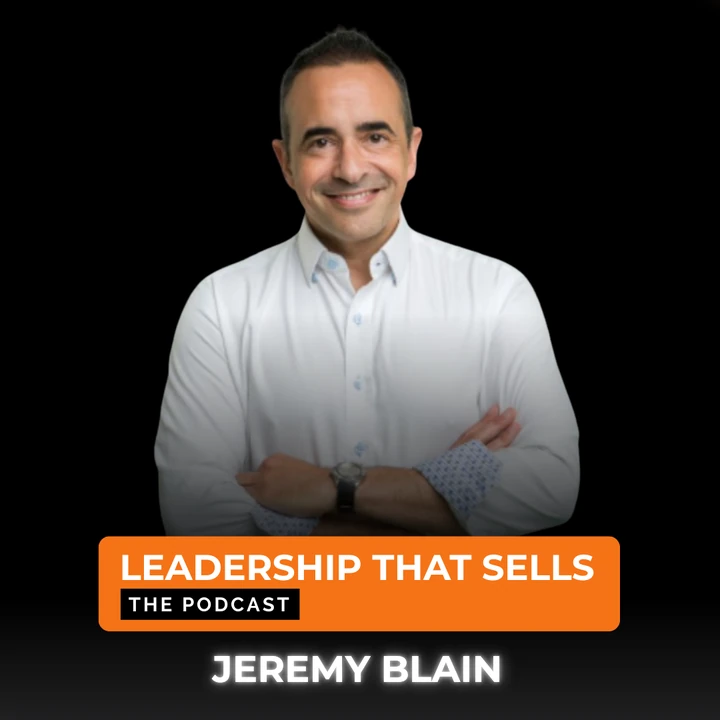
How to lead in the era of open talent & ongoing change
with Jeremy Blain
Show notes
In this episode of Leadership That Sells, I sit down with Jeremy Blain — transformation strategist, leadership expert and four-time best-selling author — to dig into the practical realities of leading in a world that won’t stop shifting. Jeremy has coached leaders in over 50 countries, built award-winning training companies, and previously held senior roles at PepsiCo and P&G. We talk about how leadership has to evolve for the digital age, why the human element is more important than ever, and why managers clinging to outdated models are falling behind fast.
We get into why today’s leaders need a full operating system upgrade, not just a patch or a plugin. Jeremy unpacks what that means in practical terms, and how the best leaders are dropping the need to have all the answers and instead creating the right culture for talent to thrive — including those who just want to do a great job and go home. This isn’t theory. It’s what real leadership looks like now.
Here’s how to upgrade your leadership operating system:
- Accept that yesterday’s leadership models are broken. You’re not here to command and control. You’re here to enable.
- Be a learner again. The best leaders are learning at the same pace as their teams.
- Shift from vertical hierarchy to horizontal collaboration.
- Stop thinking ‘Talent’ with a capital T. Everyone has value. Empower from the ground up.
- Understand the open talent economy. It’s no longer about roles, it’s about skills.
- Redefine the role of HR. HR needs to grow some teeth and lead transformation, not just administer it.
Timeline summary:
[02:24] – Why 20th century leadership needs a digital-age upgrade
[04:04] – Leadership is now a shared journey with your people
[06:06] – Set direction, create climate, and coach for capability
[08:54] – The pace of change in Asia vs. a sluggish UK
[10:08] – Flattening hierarchies and rethinking the org chart
[11:00] – Stop reserving leadership for the “chosen few”
[14:47] – What really stops managers from empowering their teams
[16:05] – The open talent era: 50% of the workforce will be independent
[18:43] – Why HR is not ready and needs a serious reset
[23:04] – Culture is the glue that binds all transformation
[25:05] – The first step? Slow down, look at the data, then decide
[27:48] – “Get comfortable in knowing what to do when you don’t know what to do”
Links & resources:
- Connect with Jeremy on LinkedIn: https://www.linkedin.com/in/jeremyblain/
- Jeremy’s podcast: Rethink Leadership
- Jeremy’s book: The Inner CEO in Action : https://www.amazon.co.uk/Inner-CEO-Unleashing-leaders-levels/dp/1784529338
Enjoyed this episode?
If this conversation gave you some practical ideas or a new perspective, share it with a colleague and give us a rating or review. It helps more people find the show — and helps us keep bringing you the good stuff.
Transcript
Automated transcript. Speaker labels and spellings may contain errors.
Paul
[upbeat music] My guest is a renowned transformation strategist and a leadership expert. He's coached leaders in 50 countries and built award-winning training companies across Asia and Europe. He's formerly a senior leader at PepsiCo and P&G, and he now spends his time helping executives thrive in the digital age. He's also found time to become a four-time bestselling author, don't you know, and won Leadership Book of the Year. But still he finds time to mentor youth and launch social ventures. What a lovely thing. Welcome to Leadership That Sells. This is the podcast that helps you to lead first and sell more, and that's because most sales teams today aren't actually teams. They're what we like to call teams in parallel, and most managers are still leading like it's 1999 or like they're a football team, when in reality what they've got is like a team of Olympic sprinters.
And that mismatch between what the team is and how you're managing them is probably the root of most of your big problems. You're trying to coach and it doesn't land. Your pipeline reviews are like interrogations, and the A players you've got, they're all lone wolves. So I built a leadership power up for your managers. Not another heavy training manual, but it's a light, fast reset that's g- gonna give your folk a simple model to lead the team they've actually got. We'll teach them to set the target with absolute clarity, build the flag with shared identity, and then hand over the map when you're ready to coach for real autonomy. If you're ready to fix the model, not the people, grab our free Parallel Team Playbook. It's short, sharp, and it's built for senior leaders just like you. And you can find it at the Practical Leadership Academy.
Jeremy Blain, thank you very much indeed for joining me from Bangkok this morning.
Jeremy Blain
That's right, yeah. I've been here for two weeks. I'm looking forward to getting home, let me tell you.
Paul
There we are. So a Ryanair flight all the way from Bangkok back to Stansted, right? Standing at the back holding onto the thing, you know?
Jeremy Blain
That's right. I've got lots of 50ps for the toilet.
Paul
That's pretty. [laughs] 50p. It's, it's, it's better 50p for the toilet than 50p for the meter. Uh, you better put another pound in the slot, keep the wings flapping, you know. That's not fair. I actually quite like Ryanair, you know. You, you get exactly what you pay for, which is there. You get there, and you typically get there on time, bless their cotton socks. Um, Jeremy, you said, uh, in some of the work you've done that we need to upgrade the operating systems of our leaders. Upgrade leaders' operating systems. What does that actually look like in practice?
Jeremy Blain
Yeah. The whole point behind that is that yesterday leaders aren't fit for purpose for today. So that 20th century, you, you referred to 1999 and I know exactly what you mean. That the manual of last century for leaders needs an upgrade.
Paul
Yeah.
Jeremy Blain
It needs to be digitalized. It needs to be brought up with the modern fast-paced world. So that's what I mean by that, that change in operating system and the need, the fast need to do so. The problem is, is that many leaders are at different speeds in that journey, and that's where the problem or the opportunity arises.
Paul
There's still, I think, though, there's an argument that says humans don't really change that much. The world that we work in changes, but the way that people respond to stimulus and to friction that you create or incentives that you create has been universal forever, okay? How does that play in your idea of rethinking leadership?
Jeremy Blain
Um, for me-
Paul
Mm
Jeremy Blain
... you bring the greatest hits of leadership forward with you, but you have to be prepared to go on a steep learning journey as a leader at the moment. If you think about the digital world-
Paul
Mm-hmm
Jeremy Blain
... leaders are potentially on the same journey as their people, which is narrowing the hierarchies in our organizations and flattening the structure. Learning at the same rate if the leaders are willing to go on that journey. So from that perspective, it's challenging leaders in ways that perhaps they haven't been challenged in, in a couple of generations really, because there's lots of new things that need to be learned. While those greatest hits that come with you recognize that a human is still at the heart of it, for now.
Paul
Yeah. So it's the relationship, it's the communication, it's the, the, the, the contact with the other that I think is still... That's, that's the valid thing that I- will be eternally valid, in my opinion. I mean, people talk about the whole world of AI and all that jazz, and what's the changes gonna be? And I'll ask you this as well, but you know, what's the changes gonna make to, to, to the world of anything? Well, it's gonna amplify everything. It's like getting drunk. If you're a grumpy person, you're gonna be a big drunk grumpy person. If you're a happy person, you're gonna be a little happy drunk person. It's like an alcohol. It's like a stimulus. It's like an amplifier. And if you're rubbish, you're gonna be really rubbish. And if you're good, you're gonna be really good if you use it right.
Jeremy Blain
Yeah. The, f- for me, though, whatever is happening with AI and technology, what we've got to understand is that leaders need to celebrate or keep celebrating human endeavor-
Paul
Mm
Jeremy Blain
... within the organizations. So while our organizations may change, while some jobs may be lost, which some will, through better efficiencies or productivities through AI, the fact is actually that more will be created, that digital will enable much more human connection. And if we're talking, you know, your audience, uh, uh, get this because the customer should be at the heart of what they're thinking about right now. So if we can release our people to better engage our customers, provide better experiences and start thinking about journeys for our customers with us over a period of time, then we've got a far better chance of actually doing more. But what that takes is, is a couple of things. It takes leaders to understand what direction they need to give to those people, the environment and climate they need to- Um, provide so that they feel empowered to do so, and changing management or line management
to what it should be, away from being super operators or super salespeople, let's say, administrators into coaches who grow people so that we start to lift the bench of our organization in a world that needs it.
Paul
And I think if you've got an audience of... an audience, um, a, a group of people around you, you can readily identify the As, Bs, and the Cs. And the As are great. Hopefully, you're paying attention, they're doing well. The Cs, thank you, good night. You can go off and find something else. But just being realistic. And the Bs are where the effort goes because they're the ones you want to try and lift into being the As, right? You're talking about this, this set of journeys that you're going on and the learning journey that we're trying to... m- I mean, the modern fast-paced world, right? I'm not entirely sure it's that fast-paced, but we find ourselves surrounded in a context where we have to respond to the stimulus around us.
Jeremy Blain
Mm.
Paul
I think equally you can respond not to... You can make a choice not to choose. You can make a choice not to do it. You can make a choice to, to... I think you used the word learn there. You can choose to learn as you go with the people around you, 'cause they're having to respond to this, this, uh, this, this very stressful environment that we find ourselves in sometimes. And how... I mean, if I'm a manager and I'm seeing my, my team surrounded by this, um, increasingly rapidly changing world, and we could go back to the time of, uh, buggy whips becoming no longer the way that you motivate your horse to go forward, or to steam trains or whatever, and there is always this continuous rapid change, this pace of change, and it's getting faster and faster. Or is it? It feels like it's getting faster and faster.
How do you take that idea of leadership from where people think it is, which is just the, the C-suite, just the bosses, how do you bring it back down and you make everybody feel that they're part of that journey? How do you distribute that?
Jeremy Blain
Yeah. You, you, you raise everybody up. And I g- I just want to go back to one point that you made before about speed. Um, speed is relative to where you are. Um, I've been working in Asia for two weeks, and I can tell you that the pace of change and transformation, and the pace of leadership capability improvement is outstripping the traditional West, and I include the UK in that.
Paul
Mm.
Jeremy Blain
And I think the UK, from my experience, has been a little bit stifled from, by Brexit in leadership development terms, in transformation terms, in a lot. And, uh, to, to be honest, I think we're in, in some s- ways playing a little bit of catch-up on the international stage. So if you're in that bubble, you're not aware of that unless you sort of break out of it. So then how can you think about, well, what... You know, my people are my people. What should I do differently if you're not aware of it? So first of all, it is that learning journey that you, that you mentioned. That word learning is key.
Paul
Mm.
Jeremy Blain
We should always be learning as leaders. The problem is, is that many leaders aren't willing to go onto what now is a much steeper learning curve than they've probably been on for years. They've got to remember how to learn in many ways. And I say in some of that, they're doing at that at the same rate as their people. So if that's the case, then the way to look at it is to think, well, look, traditionally we've been structured like this. We've, we've been structured quite vertically. It's been quite hierarchically in that. But if we go back to the customer analogy again, customer journeys are horizontal. So for your customer, each of those silos, which might be vertical, is a barrier that they have to jump through in order to get somewhere in some organizations.
I'm not saying in every organization, of course. So if enlightened leaders start breaking that down, also acknowledge that they're no longer the smartest people in the room and they don't have all the answers, say, "Right, together we can actually do something," you can bring in a bold new age of empowerment in the organization. And that's where I would differentiate that from the system that we use now. The system is often we refer to talent with a capital T.
Paul
Mm.
Jeremy Blain
Capital T meaning the chosen few who are on a fast track to leadership here.
Paul
Yeah.
Jeremy Blain
For me, I'd argue that the talent with a small T is where the gold is.
Paul
Mm.
Jeremy Blain
Is that everybody can contribute. It doesn't have to be, when you say you feel empowered, it doesn't mean to... You don't need to step up. It may be just kind of step more into your role that you know really well, that you've been t- doing for 10 years. You, you wanna stay there. You don't wanna move, but you're the best person to tell us how we might wanna innovate in that role or get things better. So a leader who's able to take a step back and create a psychologically safe environment and culture that actually drives that level of openness, open feedback, innovation at all levels, so we're all looking at the problem together, I think are all for a winner.
Paul
I think you've got, you've, you've got a valid, very valid program there. See, you're trying, we're trying to get the rising tide to lift all boats. We're trying to, we're trying to give everybody the opportunity to lead something, whether it's themselves or the people around them or the organization as a whole. And I think there's a, an immense underestimation of a lot of people's desire just to do their job and go home. Just to take the paycheck. It doesn't mean they're checking out. If anything, they're checking in. They're, they're, they're choosing that this is a job. Okay? This is not a way of life. This is a job. I'm gonna get paid, and I'm quite happy doing that, but see at 5:00 or four minutes past 5:00, I'm gonna go home and that's where my actual life is.
So you're not having a work-life balance. I have life, and life includes work, um, but it's not everything to everyone. There's, there's a... I just hired someone, and, um, it's a always a fun thing to do. You know, the best bit, you call them up and say, "By the way, would you like a job?" And you get the big smile on the end of the phone. And in the process, I spoke about a thing called the tour of duty, which is that I don't think that this is going to be a job for life. And I used to get in terrible trouble when I was in a corporate from the HR people saying, "You can't say that. You can't say that they're gonna leave soon." Well, they are gonna leave soon. They're gonna leave in, like, four years or they're gonna finish this tour of duty in a few years' time. And the reality, I think, is to acknowledge that we're not here in jobs for life anymore.
We might... Be lovely if we can recreate companies where that is a thing, but it's to understand that there's a lot of people who are just doing it for the money, doing it for the check, doing it for the challenge, doing it for the purpose, doing it to ex- to, to exercise their talent. And you made a point there about, um, the leadership in the UK in particular being stifled by Brexit. I think it's a very valid one because you've got so many... For, for so many years, I think both politics, both organizations were basically lying back and letting other people do all the work. And then all of a sudden we Brexited, and all of a sudden it was like, "What do you mean? I have to actually be responsible for my own actions now?" He says, "Yes, you're an adult." You know, you can't blame some regulation in Europe. You can't blame the commission.
You can't lie back. You now have to do your work. You now have to be responsible for that. It's such an opportunity, I think, for everyone to actually recognize that we're capable. But, but w- I can be unlocked. What stops managers from unlocking leadership in their team?
Jeremy Blain
Ego, pride-
Paul
Yeah
Jeremy Blain
... fear of letting go.
Paul
Uh-huh.
Jeremy Blain
Uh, the need to control the narrative, the need to prove myself. Though those things that have been coming along with us, uh, for [laughs] for a while.
Paul
The greatest hits. The greatest hits.
Jeremy Blain
Yeah.
Paul
We called them the greatest hits.
Jeremy Blain
That's, that's right. The greatest hits of non-leadership and management, as well as the greatest [laughs] hits of management and leadership sort of coming forward. There is the... That's the B side, right.
Paul
The B side.
Jeremy Blain
That's it.
Paul
Okay. Let's look-
Jeremy Blain
Great. I'm gonna-
Paul
Let's-
Jeremy Blain
That's brilliant, Paul. Fantastic. I, I've now expanded that analogy to a B side. [laughs]
Paul
[laughs]
Jeremy Blain
Fantastic. Yeah. I, I think it's, it's, it's those things, and we're in a different world now, and our people, particularly young generations coming in, want to add value and they want to be valued in a way that-
Paul
Sure
Jeremy Blain
... me as a Generation X-er was coming into a much more traditional environment where you had to prove yourself. It was about promotion. It was about doing the right things. It was about, you know, and quite formalized.
Paul
Mm.
Jeremy Blain
But within, let's say there's a couple of things happening out there. First of all, the new generation are looking for something slightly different, but the bigger trend that's happening, which many leaders I talk to are completely missing, is the open talent era, and the fact that in two years most large organizations' workforces will be made up of 50% permanent workers and 50% valued independent workers on either long-term contracts or what have you. That changes the game-
Paul
Mm
Jeremy Blain
... because you're then starting to challenge managers, but also HR to say, "Actually, we don't want necessarily role-based filling." You do in some industries obviously, but if we hire for skill and the skill need, the innovation need, um, the growth need that we need, w- we're actually, we're in far better shape. It's much more variable. We play to what you just said, Paul, there about actually, you know, uh, uh, many of the individuals coming into the work these days say, "I don't want the career for life, thank you very much. I'll take two years."
Paul
Yeah.
Jeremy Blain
And, uh, we'll do that. We're not... It's not fit for purpose. So you've got all of this juggling act, and this is, uh, this is passing many, many leaders by, and something they need to get on top of as much as they are on digital.
Paul
If you think the leadership stick and the carrot you've got is, "If you don't do this, you won't get your bonus. If you don't do this, you won't get promoted," and you're telling to somebody who says, "I'm not getting a bonus anyway, I'm a contract, and I don't want a promotion. I'm doing exactly 27 hours a week for you, and I'm working five hours a week over here, and that's me. That's me fully optimized. By the way, bite me, 'cause I'll get another job because my skills," as you said-
Jeremy Blain
Mm
Paul
... "are incredibly valuable." So the-
Jeremy Blain
Yeah
Paul
... how do you then manage that? How do you deal with this?
Jeremy Blain
Well, that, that's, that's all part of the new learnings for leaders and managers that we're not learning. We're not teaching. We're not helping managers and leaders to understand this. And I, I actually, I'm quite critical of traditional HR at the moment.
Paul
Mm.
Jeremy Blain
Um, you know, and I have a background in that too, but-
Paul
Sure
Jeremy Blain
... many HR professionals are just not moving as fast as the trends are taking them from a workforce, workplace structuring our organizations, moving from role to skill-based. So how on earth can they advise the leadership and the boards around what are the trends happening and how we c- sort of build in that capability? The first thing is to educate our leaders and managers.
Paul
Mm.
Jeremy Blain
The second thing is to start to help them understand why this is so important and the benefits that could be brought, and the cost of not shifting with the times as much as the benefits that, that grow from it, but we're not doing that enough.
Paul
So I think what we're, we're trying to talk about here is, is, is, is yet another cultural transformation, is it not? Um, and if we're going to try and get those poor sods in HR to lead a cultural transformation, I think we're on a hiding to nothing, frankly, because having worked with HR for very, very, very many years, um, typically they are wonderful human beings who are disconnected from the reality of what their business does. They have no budget, they have limited authority, limited influence, and yet we're expecting them to be this internal McKinsey type, all-seeing, all-knowing, consultative type person who in reality used to run the L&D department, right? So they used to be a trainer. If you're lucky, they get organizational design. If you're very lucky, they get future of work. If you're incredibly fortunate, they know anything about skills and data. But I think in most organizations we're being told to drive culture, but where do you start with that?
Jeremy Blain
Well, you have to go back a bit and recognize that, that HR have, have been at the heart of, in the last, let's say 10 years, the heart of cost-cutting. They've been focused on recruitment because turnover's increasing. So much more on these a- administrative tasks that you're talking about. And then, "Oh, yes, we've got a... Wow, we've got budget to spend on learning, so let's do this, but actually I'm so, so preoccupied over here." So for me, it's almost like an HR reset. It's like, "Okay, what do we need to do?" And for me, I encourage HR professionals and leaders to grow teeth again, to fight for people in the organization. That is why you're there, to understand these trends, to champion them internally.
Become a leader again rather than just a manager. And I think that is the fundamental gap that I see in HR, is that the leadership chops have been lost or taken away in some ways and, and that's what needs to be reclaimed, because you just don't want to manage and administrate it all the time.
Paul
I've had the pleasure of being on a few boards and your finance guy stands up and he's talking about whatever it is. Everybody sort of asks a few intelligent questions, sits down. Marketeer stands up, "New brand campaign," this, that and the other. "Selling this, selling the following." S- sits down. L&D and HR stand up, and all of a sudden everybody's a bloody expert, right? The guy gets torn to shreds or the girl gets torn to shreds 'cause everybody thinks, "I've hired people, I've managed people, I've trained people, I've been on courses, so therefore I'm an expert." And they don't do themselves any favors by talking about stuff that nobody really cares about. They talk about bums on seats or number of hours trained. They don't talk about transformation.
They don't use the language of business. So I think the, the, the cultural transformation thing has to start with them speaking the right language of... To be useful, 'cause this, one of the last places I would go in an organization for help would be to my HR team. I need to fire someone, make that happen. But that's it.
Jeremy Blain
I, I totally agree with you, and coming back to that piece around culture, um, that that's the be all and end all for many organizations. So how do you engage employees and stakeholders, because it could be something, it could be independent workers as well, and that also changes h- our relationship with contractors and independent workers away from managed services and into this, this is part of my valued employee ecosystem. So how do I build a culture of collaboration with people who aren't permanent, with people who are permanent, et cetera, et cetera.
Paul
Mm-hmm.
Jeremy Blain
So one of the problems, or i- is, is one and the same thing and leading to something else, which is you're absolutely right, is that the HR leaders and other leaders need to start talking the language of transformation. Uh, reinforce that there is just as big a workforce transformation happening as there is digital, and look at all the chatter on that side.
Paul
Mm-hmm.
Jeremy Blain
And the dearth of chatter on that side. If there is on the workforce, that challenges the cultural norms in our organization, organization right now. So how do we evolve the culture at the same rate as our transformation's moving forward? What does the new culture look like and do we need to structure differently? In that culture, are we more empowering or less empowering? Um, are we, are we more favorable as an employer of choice? Um, is our reputation ahead of the game as well? These are all cultural sort of tick boxes really to, to take a look at.
Paul
Mm-hmm.
Jeremy Blain
And therefore, how can we also empower our organization and our people to evolve talent from the ground up as well as what we're trying to do from, from the top down. So that engagement and the relationship with accountability, empowerment, and performance is entirely cultural and could make and break an organization. And, uh, and, and you're right to raise it 'cause I'm increasingly focused in that area as the glue that binds all these transformational phenomena together.
Paul
Yeah. So the strands, we've got the two big ones, I think, is the digital transformation with the new technologies, and it's the human transformation with new ways of working, new ways of people wanting to work, um, and organize their working lives and their working careers. And the confluence of them both, I think, how we respond to that is one. But how you actually then position yourself to try and use the change to your advantage is another big one. Do you see something in particular that would be- If I, if, let's say I'm in an organization listening to this today, and I'm thinking, "See that Jeremy bloke? He's got some clever ideas. I wonder what the first thing is I should do?"
Jeremy Blain
The first thing you should do is slow down, because that's how you'll ultimately speed up. Slow down to understand the organization now and where you need to be. So what's the data that you're using right now to make decisions behind? So everything that we're talking about here, Paul, is about a decision around culture, around how we evolve the organization, about structure around this. But how are we informing that decision? So that slowing down and actually stopping to understand whether we're even looking at the right data, because, for example-
Paul
Probably not. Probably not
Jeremy Blain
... Yeah. Well, i- if I'm a leader that's unaware of this workforce transformation, I'm definitely not looking at that data. So I'm making a decision based on what I know, being informed by the past. That's the 20th century mentality maybe coming, coming out.
Paul
Mm.
Jeremy Blain
And applying it to, um, a different and a new world right now. So that data-backed understanding of where we are now and where we need to be will only then be as valuable as the, as the data sets that you're looking at. But if it's good data, then good data, i- uh, leads to good decisions, better performance, and better culture.
Paul
I think there's, there's the, the simple decision-making model. The first thing you look at as you slow down, exactly as you say, and you decide what sort of decision am I trying to make. That's your first decision. Is it a big one or a wee one? Is it something that I can f- make and undo, or is it something that I can make and not undo easily? You know, it's an acquisition of a business. You can't undo that that easily, you know? And I think people underestimate cultural transformation. When you try... It's like a rebrand, something as simple as, "Oh, we're gonna, we're gonna rebrand." And you look at some of the disasters that are out there. Cracker Barrel in the US, for example. You know, they, they, they threw away a 100-year-old brand because some new brand director come on and said, "Oh, it's old." Oh, okay.
Oops. The President of the United States got involved and said, "Don't you change my favorite restaurant's brand." What? Don't change the tran- Don't, don't try and transform your organization's culture unless you know what you're doing, unless you're confident that this is the right thing to be doing. So base it on good data, good information, I think is a really good starting point. Jeremy, so as we wrap this up, is there one message that you would like to share? If I gave you 1,000 billboards all around the world, Bangkok Airport, Heathrow Airport, everywhere in the world, great big marker pen, what would you write on that for the world to take away?
Jeremy Blain
Well, by the world, I would be focused on leaders and managers.
Paul
Mm.
Jeremy Blain
And, and I would say get comfortable in knowing what to do when you don't know what to do.
Paul
That's excellent advice. [laughs]
Jeremy Blain
You know what I'm saying, right? [laughs]
Paul
That's exactly what... Get comfortable t- in knowing what to do when you don't know what to do. It's w- working with limited information. It's making the right decisions in a volatile, uncertain, chaotic, and ambiguous environment. It's all that sort of stuff. Be comfortable in knowing what to do when you don't know what to do. Outstanding. Is there something you're working on? Where can we find you, just know, when we need you, Jeremy?
Jeremy Blain
Uh, um, well, I, I, I have... Because I have a portfolio career, I'm in-
Paul
Mm. You're everywhere
Jeremy Blain
... lots of different... Yeah, yeah. But, but I'm based in the UK. Um, one of my businesses is based in Singapore, which is why I do quite a lot of work here over in Asia, but I can be find, found in the States as well, um, from that consulting and, um, facilitation and workshopping perspective. That's the digital workforce and leadership transformation. But really the best place to find me is LinkedIn. That will keep you up to date. Follow me. That will keep you up to date with, um, what I'm doing, the latest research that I publish there as well. So, um, I do a lot on LinkedIn. And if you're interested in some of the themes that we've talked about today, of course, you know, you, you've referred to some of the research, the books that I have as well, um, and, uh, and, and my podcast too, which you, which you mentioned earlier.
Um, because as a leader, I said it before, I'm an avid learner, and I really understand how tough it is for leaders out there at the moment, and I'm sure you do as well, Paul. So for me, the duty of care for me is to make sure that I'm on top of my game as a leader.
Paul
Sure.
Jeremy Blain
Because, uh, you know, with, with some of the, the clients I work with, often I'm learning just ahead of them. Uh, but for my own businesses, I really need to be informed of, of what's going on, so...
Paul
Well, here's to staying one page ahead in the book. You can find links to the Rethink Leadership podcast hosted by Jeremy and w- as well as, well, his latest book, The Inner CEO in Action, um, in the description of this episode. All that remains for me to then say is, Jeremy Blaine, thank you very much indeed for joining me.
Jeremy Blain
Thanks for having me, Paul. [upbeat music]