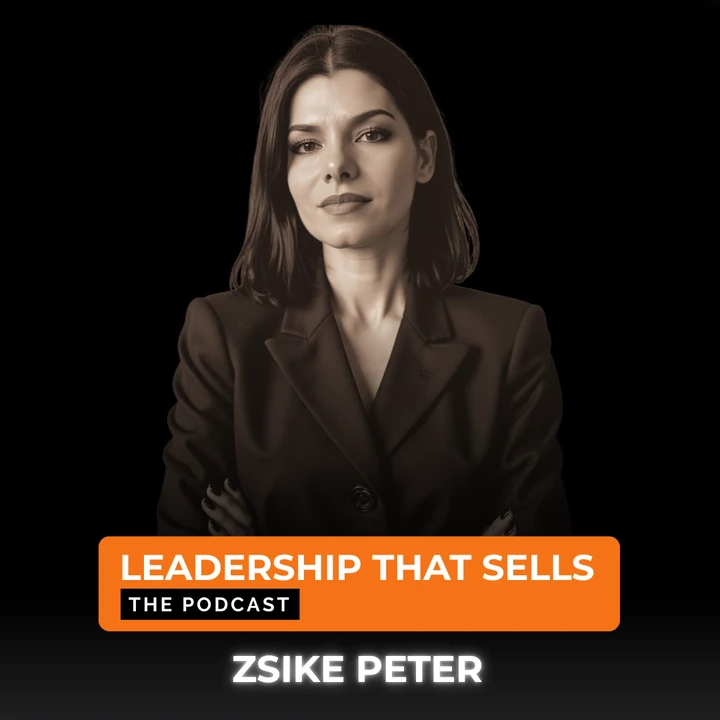
How to stay human and avoid 50 shades of AI beige
with Zsike Peter
Show notes
Some things in sales leadership are easy to say but hard to do. Like being brave enough to push back on customers. Or helping your team give up short-term comfort to build long-term pipeline. In this episode, I’m joined by Zsike Peter, a powerhouse revenue leader at Cognism, to talk about how to lead through those challenges.
Zsike shares how she supports her team to stay consistent under pressure, make the right calls even when it’s tough, and keep leaning into the work that drives pipeline and growth. We talk about building a high-performance culture, the importance of clarity and repetition, and how to create space for both accountability and compassion. If you’ve ever felt the tug between being liked and being effective, this one’s for you.
How to help your team do the hard things that matter
-
Repetition builds belief. Keep saying the same message especially when you’re leading change or growth.
-
Don’t avoid the uncomfortable. Whether it’s a tough customer call or a difficult coaching moment, lean in.
-
Build a culture of care and challenge. Your team should feel supported and stretched.
-
Stay in the trenches. You earn trust by staying close to the work not just shouting from the sidelines.
-
Remember: consistency beats charisma. Day in, day out leadership is what wins.
Timeline summary
[03:02] – Zsike’s take on what separates high-performing teams from the rest
[06:44] – “Saying the hard thing is one of the most important skills”
[09:58] – Coaching SDRs to push back with customers respectfully
[11:36] – Creating a team environment that supports accountability
[13:04] – How Zsike builds trust by staying close to the team
[15:22] – Leadership isn’t a vibe, it’s a series of repeatable, clear behaviours
[18:00] – Balancing empathy and high standards in a performance culture
Links & resources
-
Learn more about Cognism
- Follow Zsike Peter on LinkedIn https://www.linkedin.com/in/zsike-peter/ http://thinkbait.co.uk/
If you got value from this episode, don’t forget to rate, follow and review the podcast. It helps more sales leaders lead first and sell more.
Transcript
Automated transcript. Speaker labels and spellings may contain errors.
Paul
[upbeat music] My guest is a creative strategist, a writer, and she's the founder of Vampire Digital. She's the author of Think Bait. And it's a movement and a writing philosophy fighting back against clickbait and the AI garbage content that pervades the interwebs these days. She began her career as an undercover journalist at, at the tender age of 16, and she has since ghostwritten for royalty, uh, for Harvard researchers, and reality TV stars. She's got more than seven years in SaaS and business to business, um, business, and she now helps founders and industry leaders craft high-trust, attention-grabbing content that's not shite. Although that's my wording, not hers. She's a former Hungarian chess champion. She's an abstract artist and mother of two. She lives in Bristol with her kids and her philosiphil- philosophical cat, Jasper Fang.
Welcome to Leadership That Sells. This is the podcast that helps you to lead first and sell more, and that's because most sales teams today aren't really teams. They're what we call teams in parallel, and that's most managers are still leading like it's 1999, like they're running a football team, and when in reality they've got, like, a team of Olympic sprinters or, best case, golfers on different courses. And because there's a mismatch between the actuality of your team and the way that you're trying to lead them, your coaching's not working. Have you noticed that? And your pipelines reviews are like interrogations. All your A players are like lone wolves. Well, what you need is my Leadership Power-up for your managers, not another heavy training manual.
It's light and a fast reset that gives you and your leaders a simple model to lead the team you've actually got. Teach them to set the target with clarity, build the flag with a shared identity, and hand over the map so you can coach with autonomy in mind. If it's time for you to fix that model, grab our free Parallel Team Playbook. It's short, sharp, and built for senior leaders just like you, and you can find it at the Practical Leadership Academy. Zsika Peter, thank you very, very much indeed for joining me. I'm really looking forward to this conversation.
Zsike Peter
Likewise, Paul. Thank you so much for inviting me on. Really excited about where this is going to go.
Paul
So the, uh, internet's full. We should just turn it off.
Zsike Peter
[laughs]
Paul
My... That's my actual considered opinion. It's full up, we should just turn it off. It had such great promise when we could, y- you know, look up stuff.
Zsike Peter
Mm.
Paul
We could talk to each other. Um, and now it's mostly trash.
Zsike Peter
Mm.
Paul
And it's... Well, I don't know what percentage. You s- you'd given me a percentage when we were just chatting there before. Uh, if I had to guess, I would say it's 80% automatically generated by AI tools, and it's all rubbish.
Zsike Peter
Yeah. Apparently, the... It's even worse now. Apparently, 90% of everything that's online today has been dumped onto the internet [laughs] over the last two years. That's thanks to ChatGPT and the likes, because now it's a content creation frenzy. Everyone's at it-
Paul
Mm-hmm
Zsike Peter
... uh, regardless of their skills, and even those, you know, even some of the, uh, creative writers that I used to admire on LinkedIn, some of them have, um, kind of [laughs] beige-ified their voice in the name of efficiency, and damaged their brand in the process. So it's bad, but it's not all bad news. The cream always rises, as I say, as the saying goes. [laughs]
Paul
That, I think... We can just end the conversation there.
Zsike Peter
[laughs] That's it.
Paul
The cream always rises. There was a chap, uh... I'm vaguely involved in local politics, and there was a chap I follow and he was writing about some study he did of speeches given in the House of Commons in the United Kingdom.
Zsike Peter
Mm.
Paul
Because everything gets recorded in a, in a journal called Hansard, so and it's searchable and all that sort of stuff. So he did some surveys and studies on it, and there was a particular point in time about two years ago when ChatGPT really hit the, you know, got, got, got its mojo going, and all sorts of words started being used, all sorts of phrases that had not previously been used are now turning up in speeches in our House of Commons. This august chamber with the people who purport to, to give... share their, uh, direction and wisdom with us-
Zsike Peter
Mm
Paul
... are having their thoughts manipulated, massaged, and otherwise purified or, you know, beige-ified is a good word.
Zsike Peter
Yeah.
Paul
So everybody is now, with em dashing, everybody is now fostering things. Uh-
Zsike Peter
[laughs]
Paul
... I rise today to speak to you about... Oh, shut up already.
Zsike Peter
[laughs]
Paul
Have an original thought. And if you don't-
Zsike Peter
Yeah
Paul
... then don't. Just, just please, please.
Zsike Peter
It's so lazy.
Paul
It, it's... There's only one... I think if there's one thing you can do today to have an advantage, it's to be real.
Zsike Peter
Yeah.
Paul
This is why we do this. This is why I have these conversations now. It's why I have them on video as well.
Zsike Peter
Mm-hmm.
Paul
It's because you ain't fake, right? You're not. I saw you getting up and walking around. There was a guy in the US who got caught out by some people on a, like, a CV mill, and he worked for, like, a, a cybersecurity firm.
Zsike Peter
Mm.
Paul
And he caught... He got caught out and he admitted it, and he said, "Look, I ended up hiring people who didn't exist." So now what he does is, in his job applications, he has video calls with people.
Zsike Peter
Yeah.
Paul
And he says, "Please raise your left hand. Turn it round, okay? Touch your nose."
Zsike Peter
[laughs]
Paul
"Thank you."
Zsike Peter
Love that.
Paul
Right?
Zsike Peter
[laughs]
Paul
Or just does something-
Zsike Peter
Yeah
Paul
... out of the ordinary.
Zsike Peter
Mm.
Paul
'Cause I'm sure you've done these face auth, face things as well where you've got to look up and down and turn. You, you, you-
Zsike Peter
Yeah
Paul
... have to prove you're real.
Zsike Peter
Confirm your identity. Yeah. It's crazy.
Paul
You've gotta prove you're human. Uh, I'm not a robot. Uh-
Zsike Peter
And quite often you have to prove it to an AI chatbot as well. [laughs]
Paul
And what-
Zsike Peter
It's insane
Paul
... I mean, my goodness me. Yeah. Are, are you a human? This, like, it's the, uh, it's the reverse Turing test.
Zsike Peter
Yeah. It's getting cra- and that kind of AI algorithm and accent, it, you know, it's ... the whole thing is getting so twisted now where people who have been over-relying on AI, and not only in their speak, but also in their everyday communications, like just text- texting their friends or asking ChatGPT how to respond to a text when they're dating, it's insane.
Paul
Yeah.
Zsike Peter
And, um, so yes, it's affecting our everyday communication. Uh, you know, a- and it's crazy think people will be writing their content, their email newsletters or whatever with ChatGPT, pretending that they wrote it themselves, but ChatGPT already stole it from humans [laughs] e- effectively, you know? AI, that, that ... all, all those AI tools, large language models, have been trained on real written data, most of it from, like, Reddit rooms, uh, group forums, which i- is already not ... You know, people don't speak in the, or, or write in the most eloquent ways.
Paul
Sewage.
Zsike Peter
And we n- yeah. And we have a responsibility. If we produce content regularly, we have a responsibility to protect language, because language is the expression of our thinking, of our culture, the way we communicate with each other. And, um, and that's just deteriorating, nosediving. It's such a shame.
Paul
You had a, you had a line I think I read in one of your, one of ... something you wrote is that, is that 1,000 words a year are disappearing.
Zsike Peter
Yes. Yes.
Paul
And these are, these are real words. This is not, this is not nonsense words. It's ... These are ... This is the nuance. This is the difference between the machine and the, the man-
Zsike Peter
Mm
Paul
... and the soul.
Zsike Peter
Yes.
Paul
The language.
Zsike Peter
Words with real depth and meaning. And the problem is, you know, you l- some linguists argue that a lot of those words are being replaced. But it ... They are being replaced by text speech and emojis.
Paul
Yeah.
Zsike Peter
And foster and elevate and all that nonsense.
Paul
Mm-hmm.
Zsike Peter
That's not progress. That's not the language evolving. It's devolving. It's getting flattened, and therefore our, uh, you know, our, um, critical thinking skills are getting flattened because we're not having to digest content anymore like we used to. It's all made for quick, fast skim reading, fast consumption. It's like fast food for the brain.
Paul
There's the, there's, um, some lovely tools. I use Gmail. Um-
Zsike Peter
Mm
Paul
... and there's a lovely tool in that. You can give it a couple of sentences, and it'll write you an email. So you give it a couple of sentences. You say, "Write to Zika thank for attending podcast." And it says, "Dear Zika, thank you so much. It was delightful."
Zsike Peter
[laughs]
Paul
Zika gets my email, hits summarize on the AI, and gives her, "Thanks for turning up."
Zsike Peter
Oh, my gosh.
Paul
So nobody read the email. Okay?
Zsike Peter
Yeah.
Paul
[laughs]
Zsike Peter
That's so sad.
Paul
That's what people are doing. I promise I won't do that. I promise.
Zsike Peter
[laughs] Yeah. I think, I think people can tell, but it's getting to the point where they are becoming desensitized to it because everyone's doing it. So they're like, "All right. Fine. I'll use my AI to do the response as well." So eventually you take the human out of that conversation. You are not building real connections. It's all transactional. It's all superficial. It's such-
Paul
And we struggle, we struggle right now. We've been struggling since before COVID ripped us apart-
Zsike Peter
Mm
Paul
... for no damned point. Before that ripped us apart, um, we're struggling, I think, with a lack of connection.
Zsike Peter
Yeah.
Paul
With a lack of human connection.
Zsike Peter
Yeah, absolutely.
Paul
Now we've have this Orwellian, um, Engsoc, Engspeak double nonsense that ... where we are simplifying the language such we can't think, because you don't have the language. And you h- you said, y- p- people are actually using this sort of type of expression in their day-to-day.
Zsike Peter
Yeah.
Paul
And if you're doing that, uh, you're becoming worse than the machine.
Zsike Peter
Yeah. And the thing is, uh, it's so difficult for the majority of us because the human brain by nature, we are, we are hardwired to take all the shortcuts. It's for, uh, it's p- kind of built in-
Paul
Survival. Oh, yeah
Zsike Peter
... yeah, built into your survival instinct, right? So if there is a shortcut that will make things faster, more efficient with, you know, with sort of okay results, nine times out of 10 people will go for that option, for that route. So for ... Now, the danger is, you know, for you and I who have had ma- many deca- decades before large language models were available, we were able to build up that kind of cognitive resilience where we can tell what's crap and what isn't, and we can still work without those tools. Um, but of course, if we over-rely on it, it's a bit like not going to the gym. You will lose those muscles.
Paul
Yes.
Zsike Peter
But for the younger generations, they ... if they never learn those skills, if university students never learn those skills of how to, uh, almost manually research, um, make those connections, write up an argument, and defend your argument so there's real ownership in your work, real agency, what's going to happen with the future expertise? How are, how are we going to build, raise experts, train, teach experts in the future if the only way the, the younger generation can create anything somewhat meaningful is with the aid of these tools? I, it just ... I can't get my, my head around that.
Paul
And I wouldn't be a, a graduate looking for a job right now, frankly, 'cause the number of graduate jobs has fallen through the r- th- through, through the floor. Because there's so many of the graduate jobs are now being replaced by people using the tools, using these AI tools.
Zsike Peter
Mm.
Paul
So instead of me having somebody summarize 100 reports, and that's your first job, so you learn how to summarize, you learn what the basis of the, the, the business is. You learn, you learn, you learn. And then you get to grow, and then you get to grow, and then you get to grow. All of a sudden, all these entry level jobs are going. So who's, A, who's gonna teach them, and B, who's gonna do them?
Zsike Peter
Yeah.
Paul
And C, what's gonna come next? Right? What do all these people need to go and do? Fill shelves in Sainsbury's?
Zsike Peter
Yeah. Mm-hmm.
Paul
I've got, I've got... What, what, what's the joke from, um, the musical Avenue Q? What should I do with a BA in English? Right? What the heck should you do with that? You can't... You, you... Oh. Anyway.
Zsike Peter
Yeah. But-
Paul
But there's great hope.
Zsike Peter
Yes.
Paul
There's great hope because the cream rises. And there's, the difference, and I talk about this in leadership, I talk about when I'm, when I'm working with teams of people. The difference, I think, between somebody, um, who is not very good and somebody who's good is actually really small. It's really, really small.
Zsike Peter
Which is a shame-
Paul
Yeah
Zsike Peter
... really.
Paul
But it's not a big one. It's not a big one. All it takes is the second of reflection.
Zsike Peter
Mm.
Paul
Instead of you responding to a stimuli, you pause. That's it, and that puts you 95% ahead of the game.
Zsike Peter
Yeah.
Paul
'Cause most people drift through life. They've, they've always drifted through life. They always have, and I think the majority of people will always just drift through life-
Zsike Peter
Yeah
Paul
... bouncing from wall to wall, and being fine, and being happy with that, and that's okay. Um, I think they'll be bouncing a lot more. But the difference, I think, is just that reflection. It's just that will to not rely on the tool.
Zsike Peter
Mm.
Paul
Even for one thing. It's that desire to try and express yourself coherently using the words of your soul painted onto the very corpus of your being.
Zsike Peter
Mm.
Paul
And try to express yourself eleg- elegantly, eloquently, comprehensively.
Zsike Peter
Mm. And it is a muscle you can train.
Paul
Yeah.
Zsike Peter
It's not like some people have it, some people don't have it, you know? English is my third language.
Paul
Mm.
Zsike Peter
When I moved to the UK, my English was very rudimentally, very basic.
Paul
Mm.
Zsike Peter
It's not impossible to master, uh, your own language, let alone a second or third language, to a level where you sound smarter than the average.
Paul
Yeah.
Zsike Peter
It's a matter of reading and then putting that reading into practice by even just journaling, even just writing out your own shopping lists. That registers differently in your brain than typing it into your phone notes app.
Paul
Yeah. I mean, actually using-
Zsike Peter
Mm-hmm
Paul
... a pen and a piece of paper, and taking notes in a, a real live book, I think the difference between... I mean, I, I, I do a lot of meetings. I'm, same, same as you, I'm sure.
Zsike Peter
Mm-hmm.
Paul
I have a lot of meetings, and I can touch type. It's one of the greatest skills I ever picked up at university. My mom was a-
Zsike Peter
Yeah
Paul
... a, a, a legal secretary in her first job, and she taught me, and then I learned. So I can touch type. I can look at something and I can type really damn fast without, you know.
Zsike Peter
Yeah.
Paul
So in meetings, I'm in my tool and I'm going, taking away the notes, and I prefer that to the AI summaries actually, 'cause then I get to pull out what's important.
Zsike Peter
Mm.
Paul
But I don't remember a damn thing I type.
Zsike Peter
Interesting. Yeah.
Paul
Not a thing.
Zsike Peter
Yeah.
Paul
I take a note.
Zsike Peter
Mm.
Paul
I take a note. This is like inscribing it in the sharpened pen on the back of my neck.
Zsike Peter
Yeah.
Paul
That's the difference.
Zsike Peter
It activates different neural pathways when you are writing things out.
Paul
Yeah.
Zsike Peter
So, and al- also, one is because it's slower, because you're having to think about what you're writing down in that moment, so it just registers differently. Yeah. Now, this is, you know, proven by people much smarter than I, so it's, it, it, it works wonderfully.
Paul
I think there's a thing about, um, we don't... I mentioned leadership here, and that's kind of what I try to talk about a lot. Um, because I think it's the difference between success and failure in most organizations and most, most bodies, most groups of people. We talked about parliament before. Leadership, I think, is everything.
Zsike Peter
Yeah.
Paul
And there are so f- everybody wants to be led, but nobody ever wants to lead. It's very easy to lead. All you have to do is say, "We're going over here." "Okay" is the response. That's it. "We're gonna do this." "All right." And I don't know about you, but very few people invite me to anything, okay? Now, that could just be me being an absolute unpleasant person. I'm, I'm sure that's entirely possible. But the minute you reach out and you say, "Let's do this." "All right then, let's go." Okay? Nobody leads, nobody organizes, nobody does. Most people just drift and they wait.
Zsike Peter
Mm, true.
Paul
They wait, and then they die, okay? So being a leader of anything, I think, is the minute you realize that you're not actually leading for yourself, you're leading for other people. You are in service. You're in service. Servant leadership. You're in service of the other, and most people at some point realize that this is, this, it's almost epiphanical. You realize, there's a moment where you realize it's not about you, but it's about other people.
Zsike Peter
Mm.
Paul
Did you have... Is there anything in you, is there a moment where you first realized that that was a thing, when it wasn't about you, it was about the people around you?
Zsike Peter
Mm. I mean, m- my fir- my in, my first sort of thought that comes to mind here is that I know... So that's one of my weaknesses, that I'm not a natural leader. Give me a pen and I will write a two-page essay about it in under half an hour. But give me a team to lead and I panic-
Paul
Mm
Zsike Peter
... generally. I am getting better at it now, but I would say, you know, I think for me, I thought leadership meant, um, being one with the, with the vision of the one steering the ship, but I'm more of a, I run a tight shipwreck rather than a tight ship. [laughs]
Paul
[laughs] Oh, I love it.
Zsike Peter
So, and you know, when I started Vampire Diesel, I was on my own for quite a while, and then the team slowly grew. But then I realized that, like, nothing really moves unless the people around you feel like they have the oxygen to breathe and, and the space to grow.
Paul
Mm.
Zsike Peter
And so, so one of the turning points when we went, uh... So my number two, my operations director is called Luke. I met him on LinkedIn. He was one of my writers to begin with, uh, over three years ago, and he then became the operations director, and he's brilliant in areas. He's brilliant in turning this shipwreck into a ship. He has skills I'll never have. He al- he's also obsessed with burritos. I'm sure he'll be glad that I mentioned this. [laughs] But you know- I had no systems when he came on board, and then, and, and then, so Luke has built all that out for me. But beyond all the systems I, I noticed, and I started noticing all the little ways that he kept the company together. So that's when leadership, I think, clicked for me, when I saw that for me, my role isn't about, like, tightening the reins.
Um, it's more to do with creating conditions where people like Luke can really shine. So I don't need to be in the spotlight from a leadership perspective. I need to cast the light on the rest of the team, because without them, I wouldn't be able to do what I do. My company wouldn't exist.
Paul
So Luke and your burrito obsession. We're grateful for you.
Zsike Peter
Luke and his burrito. Yeah. [laughs]
Paul
We're grateful for you. There's, um... There's, there's the idea y- y- that you're asked to carry a handful of sand across a beach. So you reach down to the beach, and you pick up a handful of sand in one hand, and you pick up a handful of sand in the other hand. In one hand, you squeeze tightly so it doesn't blow away, and thankfully it's not a very windy day, so you carry the two together. And what's happening with this hand is as you squeeze, the tight- tighter you squeeze, the more sand flows out.
Zsike Peter
Mm-hmm.
Paul
But you can cup, you can protect it, and you can cover it, and you can shelter this handful of sand from the wind or from the bu- buffeting waves or whatever, and you're more likely to get across the one that you're protecting and nurturing and taking care of, rather than the one you're squeezing.
Zsike Peter
Mm.
Paul
So the-
Zsike Peter
Yeah, I love that
Paul
... trying to make other people successful, you're trying to lift other people up, there's the concept, there's, um... C.S. Lewis is, uh, the Eng- great English writer and thinker.
Zsike Peter
Yeah.
Paul
And he call, he talks about the four loves, and you have, uh, uh, eros, which is the romantic love for your husband-
Zsike Peter
Mm
Paul
... your wife. You have, uh, storge. You have philia, which is, uh, the love of your brother and your sister, and then you have agape. Agape is the divine adoration of God for you-
Zsike Peter
Yeah
Paul
... and for your success, and this is the thing that you can then turn to other people, and it's this willingness, selfless will for other people's success.
Zsike Peter
Mm.
Paul
And I think if you had-
Zsike Peter
Yeah
Paul
... to define the character of someone who wishes to be a leader, it is to someone that wills the success of others.
Zsike Peter
Mm. Absolutely.
Paul
They will the success of others. And the red line of that is sometimes people set them on fire, set themselves on fire to warm other people up.
Zsike Peter
Yeah.
Paul
Now, that's no good, right? You can't burn your house down because you want somebody else to be warm. That's, that's, that's... The red line's gone too far.
Zsike Peter
Yeah.
Paul
And you see that in many situations in many countries, many, many characters.
Zsike Peter
Yeah.
Paul
But the, the will of other people's success, I think, is, is the big first step for most people.
Zsike Peter
Mm, yeah.
Paul
If I can make you successful, I'll be successful.
Zsike Peter
Absolutely.
Paul
If I can make all of you successful, we'll all be successful.
Zsike Peter
Yeah. And it, I- I think it's nurturing those human relationships alongside the, that, um, the leadership element, um, so that... Because we ultimately, we... [laughs] Quite often we spend more time with our teams than with our families, right?
Paul
Mm.
Zsike Peter
So it's so important to make sure that on the relationship level, your values are aligned-
Paul
Mm
Zsike Peter
... so that you can work together in the best, um, in the most conductive environment, even if you work... You know, we, we've, we're a fully remote team. Some of my... You know, Luke has been with Vampire Digital for over three years. We've never met in person. He lives up in Sheffield, and I've never met him in person. We've been [laughs] trying to organize it, but for one reason or another, no.
Paul
Sheffield's not a scary place. It'd be okay.
Zsike Peter
[laughs]
Paul
You should get on the train, you know? So I, I, I don't know what it was like where you came from, dear, but trains are really good, you know? You can... [laughs] So.
Zsike Peter
Yes.
Paul
[laughs]
Zsike Peter
They will be... They can only be much better than the communist-era Eastern European trains that are still going about in-
Paul
Oh
Zsike Peter
... uh, in Hungary and Romania, so. [laughs]
Paul
I, I've been on a couple of really nice Hungarian trains. We, we got the-
Zsike Peter
Yeah
Paul
... we got the, uh, the sleeper train from, um, where were we? Munich, all the way through Vienna to-
Zsike Peter
Mm
Paul
... to Budapest. That was lovely. Did that.
Zsike Peter
Yeah, they're moving with the times. [laughs]
Paul
[laughs]
Zsike Peter
Slowly. Oh.
Paul
Was there a particular, uh, challenge or a mistake that dealt some particularly hard lesson that shaped that? And you said you noticed the burrito obsession. You noticed how you could make Luke more successful.
Zsike Peter
Yes. I think-
Paul
Or less
Zsike Peter
... mm, I think more so, mm, yeah, as kind of letting go of perfectionism, and I don't know whether that comes from being a chess player, an ex-gymnast, where you had to execute things with precision and strategy and a lot of forethought. But I think at the beginning, I expected everyone to operate at the same obsessive level-
Paul
Mm
Zsike Peter
... as I set for myself, which is not good for my mental health, and definitely not good for the team's mental wellbeing. And, and, you know, people don't follow... It's not like they follow you because you're flawless. You need to, you need to be human, and humans are by nature-
Paul
Messy
Zsike Peter
... come with, they come with faults. So, and I think then ultimately, I think it's motherhood that actually taught me leadership skills that are, in a way that a book never could.
Paul
Mm.
Zsike Peter
Because with your children, you can't, there's, uh, there's no leading with control. [laughs]
Paul
Nope.
Zsike Peter
Right? But you can lead with presence. Uh, and, and being there, and you can be messy and imperfect, but consistent. So that consistent presence, I, you can then apply those survival strategies [laughs] to leadership as well, and you can carry that through into business. So yeah, it's not about, I, I guess polishing every surface until it shines. That's the analogy I can think of on the spot. It's about, um, y- you know, you need to be able to stay present and level-headed when the situation gets messy. When the kids are screaming in the middle of a, a Tesco, you need to hold it together because they can sense you're panicked. [laughs]
Paul
Mm.
Zsike Peter
And I guess that's the same in leadership in a way, because they're looking at you for, you know, saying, "Okay, this is the direction we're going. There's a huge iceberg over there. What are we gonna do about it?"
Paul
They're looking for the rock.
Zsike Peter
Mm.
Paul
They're looking for the security, and even if you don't feel it, you can fake it.
Zsike Peter
Yeah.
Paul
'Cause if you fake it, it's kind of true.
Zsike Peter
Yeah.
Paul
That's the whole thing about, uh, you know, fake it till you make it. Uh, such bad advice. Well, actually it's just human.
Zsike Peter
It works. It does work.
Paul
It's just human.
Zsike Peter
Yeah.
Paul
It's y- you're faking it for yourself more than anybody else. [laughs]
Zsike Peter
Yeah. And actually your, your, your brain does take notice of your thoughts-
Paul
Uh-huh
Zsike Peter
... a lot more than people realize. [laughs] So.
Paul
Y- there's no one who listens to you more than you.
Zsike Peter
Mm.
Paul
Yeah? Certainly not your kids. You know, one word from you, they do what they like.
Zsike Peter
[laughs] Yeah, my kids don't listen at all.
Paul
Sorry, what did you say? Yeah, exactly, exactly. Um-
Zsike Peter
Yeah
Paul
... back to, to leading on from this to, to, to content to writing to, to, um, the technology driving us mad. Um, I'm, I'm wondering if the humanity, the imperfections, the, the, the, the chess-playing gymnast in you connects to the AI being perfect. The AI is going to be letter-perfect. It's gonna be grammatically correct. It's going to be, you know, absolutely solid 6.5 out of 10 every time.
Zsike Peter
[laughs]
Paul
Um, there's something there, and I'm struggling to... I'm just trying, trying to pull a thread out. There's something there about the, the, the, the human being full of typos, being full of spelling mistakes and making mistakes and being rough and ineloquent.
Zsike Peter
Mm.
Paul
And I remember once writing something in high school, and my English teacher with a BA in English said, "You don't have to be up here all the time. You don't have to be writing at nine or 10 out of 10 all the time."
Zsike Peter
Yeah.
Paul
"You need to be giving space. You need the white space, the mental space to... You can be eloquent. You can have a beautiful turn of phrase, and then just expl- explain that the cat sat in the mat." You know?
Zsike Peter
Yeah.
Paul
The cat didn't repose.
Zsike Peter
[laughs]
Paul
The feline did not repose upon the tapestry, you know? You don't have to use that, and I think that's something that the, the, the tools deceive us with and that our humanity when we write comes through in the clumsiness, comes through in the turns of phrase that we choose. I don't know if there's something there or not.
Zsike Peter
Definitely. Def-
Paul
You're the author. You know?
Zsike Peter
I mean, look, AI is flattening and homogenizing language, you know? And, and, and when everyone is sounding the same, whether that's because they use AI, whether that's because they use the five steps to, I don't know, make your first 10K while you sleep and you don't have to lift a finger templates, if they're all sounding the same, perfectly polished but 50 shades of beige, and you're talking about phrases that people use, that's one of my phrases.
Paul
[laughs] 50 shades of beige. Um, I love that.
Zsike Peter
[laughs]
Paul
I'm gonna take my ballpoint pen and write it in my book.
Zsike Peter
[laughs] Write it in your book. In your analog-
Paul
Right, 50 shades of beige
Zsike Peter
... 50 shades of beige, right? So you don't... So then the best way to stand out is to own your faulty human rough around the edges voice, whether that's your, your, uh, I don't know, local dialect, accent, certain words and phrases you use, whether that's your imperfect English because English isn't your first language. Go all in because that's the way to stand out right now, and, um, your r- your readers will appreciate it. Look, I am going fully against the grain. I'm writing really long essay-like posts. I'm citing research. I'm being re- quite poetic with some of the language that I use deliberately. Some of my writing might require a couple of rereads because I want to attract readers who are happy to sit with that complexity, and I'm not saying I write
really elaborately, but I want to attract the kind of audience that appreciates the fact that it takes time to write a well-crafted post. So I've, I have shown them respect by crafting that post from scratch, and they are more likely to spend five, 10 minutes to read that post and another five, 10 minutes to write. Some of the comments I get are incredible. Some of the, the, the-
Paul
I've seen. I've seen, yeah
Zsike Peter
... it's... I lo- you know, I'm, I'm getting some brilliant minds, academics engaging with my content, inviting me to, to speak at universities, to speak at m- major events now that are coming up, and that's all thanks to posts that on paper shouldn't be performing well on LinkedIn. Because the general advice on LinkedIn is write as a, I don't know, fi- sixth grader or whatever the American gurus tell you.
Paul
Yeah.
Zsike Peter
Dump your content down. Write in short bullet points because it's easily consumable. Well, I'm proving the opposite, and we're doing the same with some of our client contents. We're experimenting with some longer form, more, um, uh, complex content that is going viral. So, so it shows now... What it, what this shows to me is that there is an undercurrent. There is a, an AI resistance going on, and it... not just in creators who write- Without AI and write anti-AI content, but also the way people consume content. They are sick of AI generated content, and they block those people, unfollow those people, and they're beginning to engage with more educational, deeper, more nuanced content.
Paul
Being real is the only advantage we have.
Zsike Peter
Mm. Yeah.
Paul
Yeah.
Zsike Peter
And, you know, we, more than ever, we, we are in this attention economy, and so when information becomes, um... What's the word I'm looking for? Democratized. Information is democratized now because you can very quickly find information with AI. You need to obviously check and validate it because ChatGPT likes hallucinating. [laughs] But if you can now come up with content with the help of AI, content that everybody else can come up with, you are no longer going to win the attention economy game. So then your personal expertise, your stance, your voice becomes the real currency here.
Paul
Mm.
Zsike Peter
Your humanness.
Paul
Yeah, your warmth.
Zsike Peter
Yeah.
Paul
There's, um... A lot of churches, I'm, I'm a member of my local church-
Zsike Peter
Mm
Paul
... and a lot of churches deal with the Alcoholics Anonymous and Narcotics Anonymous and things like that.
Zsike Peter
Mm.
Paul
And the 12-step program is, uh, essentially it's a rediscovering of, uh, a higher power and that you are, you should humble yourself.
Zsike Peter
Yeah.
Paul
And one of the things that they teach is that the opposite of intoxication and addiction is not sobriety, it's connection.
Zsike Peter
Mm.
Paul
The opposite of addiction, the opposite of intoxication is connection. And-
Zsike Peter
That makes so much sense. Hmm
Paul
... if we lack connection, we spend ourselves, we spend, we find ourselves intoxicated, not in a good way.
Zsike Peter
Mm.
Paul
We find ourselves addicted to bad things, and bad things happen.
Zsike Peter
Yeah.
Paul
And I think these tools, there is, and sometimes there is the, I think you can possibly, you could say deus ex machina, the god is in the machine. Okay? Um-
Zsike Peter
Mm-hmm
Paul
... we could pull from that great wisdom, but I think, I, I, I still feel that the tools amplify, like alcohol.
Zsike Peter
Yeah.
Paul
If you're a grumpy person and you get drunk, you're gonna be a grumpy drunk.
Zsike Peter
Yeah.
Paul
If you're a cheery person and you get drunk, you're gonna be a super cheery drunk.
Zsike Peter
Yeah.
Paul
They amplify. If you're a crappy salesperson or a mediocre salesperson, you're gonna be mediocre, but on steroids.
Zsike Peter
Yeah, at scale. [laughs]
Paul
Yeah. Yeah, you're gonna-
Zsike Peter
Absolutely
Paul
... you're gonna amplify whatever it is you're doing.
Zsike Peter
Yeah.
Paul
More of it-
Zsike Peter
Yeah
Paul
... by volume, not necessarily by quality.
Zsike Peter
Mm. And you bypass the connection part with these tools.
Paul
Yeah. You just, you don't go anywhere near it. You skip straight over.
Zsike Peter
Mm-hmm. Mm.
Paul
You skip straight over.
Zsike Peter
Yeah.
Paul
What I can see surrounding you, I mean, you're an author. You have your, your new book coming out very, very soon, which is on its way to me. Uh, I just have to make sure I did actually press order. I can't see it right now. You've got a book called Think Bait coming out. You've been working on this for a while. It's a beautiful book. I want you to hold it up to the screen so we can all see it, please, Zica. There we are. Zica Peter, The Definitive Guide to Reclaiming Human Creativity in the Age of AI, Think Bait. Why should we read it? What's in it?
Zsike Peter
So, um, the way that started is when everybody was creating with AI, and initially I went down that rabbit hole because one, it's better to devil you know, right? How can you criticize something when you don't know it inside out? And two, I thought this would decimate my business, you know? We, we, we rely on, um, writing content for our clients. That's our main bread and butter. Uh, so I went down the rabbit, rabbit hole of using it, knowing everything about it, but I've noticed that a lot of the, the output that it was coming up with was a lot more clickbait. And then every time I logged into LinkedIn, it was just one clickbait content after another. And I started writing a post about this one evening and I... It went along the lines of I'm so sick and tired of clickbait content. I want something that makes me stop and think.
And then I want Think Bait. That's kind of... And I'm not the, it turns out I'm not the first person to use the word think bait, but not in this context. Um, so I, I do have it trademarked as well now in the UK.
Paul
Good.
Zsike Peter
Just in case. [laughs] Um, and, and then, you know, the, the book itself kind of grew on the back of a few deeper posts, and I would say, you know, it's, it's part guide, part manifesto, and I created a framework around it that I have been, been instinctively using for years anyway, writing for myself, for our clients. And the THINK framework stands for thoughtfulness, humanity, impact, nuance, and knowledge. And, um-
Paul
Well, go back. No, start, don't, don't gloss over that. Go back and give me a bit of detail around each one. Thoughtfulness.
Zsike Peter
Yeah. So of course, you know, what is that post about? Is this, is it worth your reader's time? Is it thoughtful enough that your reader can spend five, 10 minutes and it's not going to be something that's, you're wasting their time with? Right.
Paul
Okay. Okay.
Zsike Peter
And then humanity is o- adding that human element. So you have your own opinions, your own stances, your own expertise that you can weave into your content and not sound like ChatGPT. Impact. Now, okay, what is that post going to achieve? And this is where I apply the so what rule. So if you read your post, if your reader reads your post and they say, "So what?" You know, [laughs] does that make any difference to their life? Have you just wasted their time? And then, of course, the nuance is the lay- adding layers, adding different perspectives within your post because if otherwise your contents can sound, um, y- really one-sided. Um, so you could even add opposing thoughts and, uh, flesh that out within the same piece of content, for example. And then knowledge, you know, go... That, that is kind of, um, quite straightforward, is that your content should generally be based in, um, based on knowledge that you have built up over
the years and you are expressing that expertise through most of your content because it's all about positioning yourself as an expert, as an industry voice. Whatever stance you want to take, it needs to be grounded in knowledge and not just generic so- s- stuff that anyone could Google or ChatGPT. So that's what the, the framework stands for. And if you can apply at least three out of those five, I would say then you have a good starting point for a piece of content, for a newsletter piece, for a blog post. You don't have to tick all the five boxes, but I would say three out of the five, you want to aim for that. Otherwise, you're just posting for the sake of posting and filler content.
Paul
I do that. Do you know what? I do that. I do, I, I d- I do it for the sake of it sometimes.
Zsike Peter
Yeah. Uh, we, we all-
Paul
Um-
Zsike Peter
... get sucked into that to keep the momentum going.
Paul
Uh-huh. Yeah.
Zsike Peter
But, um, I would say one filler post a week for, with a bit of h- light-hearted fun is good. More than that, you kind of lose that credibility where you're trying to position yourself into a certain category to carve out your o- own category to become known for what you want to become known for.
Paul
Hmm. You're working-
Zsike Peter
But I've ex- you know, I've, I've, um, experimented with that. I've gone... You know, I used to have, I used to have a really strong kind of vampire posts, and all the puns, and all the bad dad jokes, and yes, th- that got me wider reach, and that got me some growth, but it was the wrong kind of growth.
Paul
Yeah. Uh-huh.
Zsike Peter
And since I've gone all in with the, with the kind of thought leadership type of posts, the, um, analytical, the research type of posts where, you know, I explore what AI is doing to our language and to our creative and critical thinking skills, I'm attracting a whole different audience and a whole different clientele.
Paul
The, now the commercial in me is asking you this. You're attracting a whole different audience. Does that audience have money, and do they want what you're selling? Which is always the commercial question. You don't have to answer that.
Zsike Peter
Y- yeah, but the answer is yes. But also, we get, we also get strategic, my, my team and I when I say we, is that we are proactive in building that audience in the first place. We use Sales Navigator to find the right decision-makers that we want to attract, and we know we can help them, and we know they have the budget for our services.
Paul
That's it. That is it. That's excellent. What would you, as an author, uh, well-read, recommend? Book recommendations.
Zsike Peter
Yeah.
Paul
Anything you like. What's good? What you wa- what's on the side of your bed right now?
Zsike Peter
[laughs] So the one I'm reading right now is not a business book, it's not a self-help book or a marketing book. It's a novel called, uh, titled Embers, and it's by a Hungarian wr- writer, Sandor Marai, but I'm reading it in English. It's in, it's English translation. And I, it's kind of like a, a spellbinding exploration or meditation on friendship, on betrayal. I'm, I'm, I'm s- I'm kind of three-quarters, uh, way through it, and, and it, and it explores how time affects friendship and the memory of betrayal. But what really makes it extraordinary for me, it's the language, um, because the suspense is, is, is woven so delicately, um, that you're, you barely notice it until you're caught in it.
So, and I feel like founders, leaders, no matter your industry, you, you kind of need that literary muscle-
Paul
Mm-hmm
Zsike Peter
... to be able to sit with ambiguity, uh, so, so you can read between the lines, uh, and sense what isn't being said, and I feel like Embers, um, shows you exactly that inadvertently.
Paul
Well, the-
Zsike Peter
So, so yeah, sometimes... So what, w- what I do, for every business book I read, I then read a novel or I read poetry to mix it up a bit because, because it gets you thinking differently.
Paul
Mm-hmm. I read a lot of fantasy books. I like, um, uh, modern and ancient, ancient sci-fi, and all sorts of weird and wonderful stuff. It takes your head out of the-
Zsike Peter
Ancient sci-fi. [laughs]
Paul
Ancient sci-fi. Well, you know, um, uh, H.G. Wells, stuff like that.
Zsike Peter
Okay.
Paul
I like the, the, The Time Machine or like-
Zsike Peter
Yeah, all the nerdy stuff. It's good for you
Paul
... Jules Verne, that sort of stuff. Really-
Zsike Peter
Oh, I love it. Yeah
Paul
... it's good fun. Yeah. Yeah, I, I love that especially. I mean, I, my, m- my background, my, my degree is in, um, languages-
Zsike Peter
Mm
Paul
... so I v- I love reading in translation as well. And when you get something that is, as you say, it's so nuanced, it's so delicately put, and you're wondering how exactly did you take this from one language to the other, not just the art of-
Zsike Peter
Yeah
Paul
... the author themselves, but of the translator, who has such mastery of two languages that they're-
Zsike Peter
It's incredible
Paul
... able to take what is... It's just-
Zsike Peter
Yeah, and quite often these translators-
Paul
It's heroic
Zsike Peter
... win, they win awards i- within their own right, you know, because they do such a... I mean, I, I tr- I thought, um, many years ago that I would l- like to become a literary translator-
Paul
Mm
Zsike Peter
... and a pub- and a legal interpreter
Paul
Money's rubbish. [laughs] Money's-
Zsike Peter
Yeah
Paul
... absolute rubbish. [laughs]
Zsike Peter
Well, so yeah. And then, yeah, but I, you know, I... It was, what was interesting, I, I passed all the modules where I had to translate from, um, Hungarian to English-
Paul
Mm
Zsike Peter
... which should, should be-
Paul
It should have been the other way round
Zsike Peter
... the difficult part for-
Paul
Yeah, mm-hmm.
Zsike Peter
Yeah. And it should be the diff- difficult part for me as a non-
Paul
Mm
Zsike Peter
... native English speaker. But then I failed the English to Hungarian part.
Paul
Ah.
Zsike Peter
Because I've been here for so long, and I-
Paul
Yeah
Zsike Peter
... you know, I dream and write and think in English so that, that the local language interference, it, they called it, my dominant language is now English, so.
Paul
So, and so-
Zsike Peter
That's it
Paul
... do you, do you find that when you, um, when you speak to people in Hungarian they look at you in a strange way, and you're thinking, "What are... They, they, they're... You've come with... You're speaking fluent, perfect Hungarian, of course, but there's just this, this flavor of the Anglo flavors coming through." I always love that.
Zsike Peter
Oh, yeah.
Paul
Yeah.
Zsike Peter
Absolutely. The, it's there.
Paul
That's fun.
Zsike Peter
I've just been back to Hungary, and I had to speak to the, um, a guy at the hire car company at the airport, and he, he was giving me some funny looks, but we understood each other. [laughs]
Paul
Right.
Zsike Peter
Uh, I try to nurture that. You know, I have... I do order Hungarian books from Hungary, and I reread some classics like, uh, Madame Bovary I recently re- reread in Hungarian. And-
Paul
It's Hungarian originally? I didn't know that. Okay.
Zsike Peter
No, it's not. It's not.
Paul
No?
Zsike Peter
It's not. It, but I read the, I reread the Hungarian-
Paul
French. Oh.
Zsike Peter
It's French, yes.
Paul
Yeah, yeah. Oh, okay.
Zsike Peter
Flaubert. Um, but I, I... So I try to read some of the more, the chewier classics in Hungarian-
Paul
Yeah
Zsike Peter
... to, just to get my, exercise my brain a bit differently. [laughs]
Paul
There you go. I love it.
Zsike Peter
But it's different. That's passive language, not active language usage, so, you know.
Paul
Oh, yeah. What are you working on? What's next?
Zsike Peter
Um, so I mean, the next big milestone is Think Bait being launched on Amazon and all the, at the major, all the major book stores online. Uh, and that, that's... It's out now on Amazon, which is the paperback version. And then, um, I have a few big s- um, sort of speaking things coming up. I have a, a keynote spot at the Long Haul Leader early November, which is organized... It's a very s- you know, they limit it to 100, um, founders, entrepreneurs. They come from all over the world, and it's organized by Chris Ducker, who is a wonderful entrepreneur himself. He's a well, you know, well-known person, and he is also my, my mentor. But, uh, he... So he's like, "Are you ready to do a speaking spot all by yourself?" And I thought, "I'll get some practice in." So I've, I've been to Berlin. I did, um, a, a panel talk in Leeds, and I've done some smaller workshops now.
And I've got... So I have these, these exciting things coming up now, univ- some university, uh, panel talks amongst some tech experts and professors which I think, "Oh, my God, what am I doing there?" But it seems like they want to... I think what it is, they want to have real world practitioners amongst all the academics to kind of get my, my angle as well.
Paul
Mm-hmm.
Zsike Peter
Uh, so that's, that's a good sign. I feel like that's a good sign if the academia, they want to present, uh, somebody from the marketing, from the content creator's perspective on how we work with AI, what, you know, what the, my red flags are around AI, uh, to present about that in front of their professors and, and students, which is great. So that's coming up in Leeds in November as well.
Paul
Good.
Zsike Peter
And I'm building another business, but that's probably, we might be running out of time [laughs] for that.
Paul
You'll tell us all about that in episode two.
Zsike Peter
Yes. [laughs]
Paul
Yeah. Um, thinkbait.co.uk.
Zsike Peter
Mm-hmm.
Paul
You can find on the website. The links will be, all the relevant links will be in the description of, uh, this episode, as will Embers and the name of the writer, which I'm sure you're gonna send me 'cause otherwise I'm not gonna try and write something out in Hungarian 'cause I, I, I know my limitations.
Zsike Peter
[laughs]
Paul
Um, 50 shades of beige, what a magnificent phrase. If you had one opportunity to share one message with most of humanity, what would it be? A thousand billboards-
Zsike Peter
Yeah
Paul
... one in every airport, as big as you like. What were you gonna tell them?
Zsike Peter
Yeah.
Paul
One message, all of humanity.
Zsike Peter
Is don't forget what makes you human. Don't you lose your humanity in this fast world. That, that would be my message. Use your brain. [laughs]
Paul
Use your brain.
Zsike Peter
Yes.
Paul
Zita Peter, thank you very much indeed for joining me.
Zsike Peter
Thank you so much, Paul. Absolute pleasure. [upbeat music]